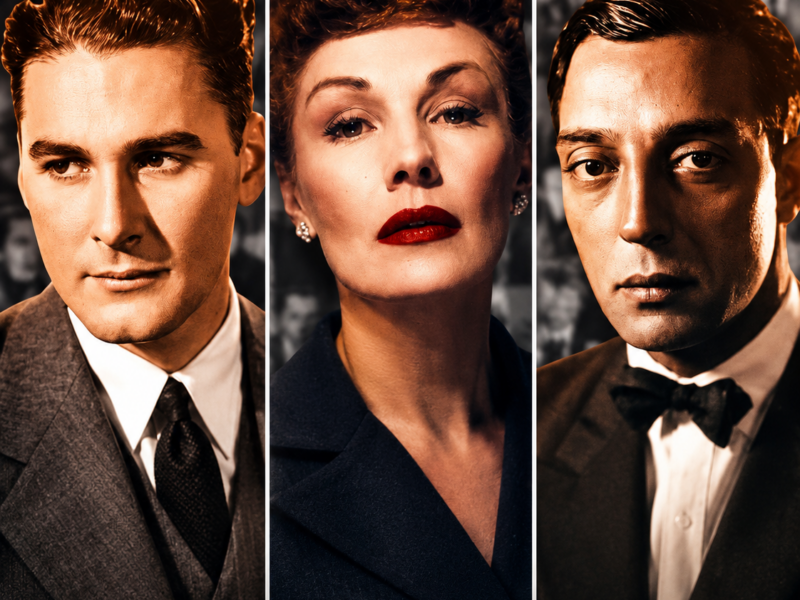
10 Hollywood Legends Who Died Alone and Forgotten: The Heartbreaking Last Nights of Marilyn Monroe, Judy Garland, Natalie Wood and More
You know Marilyn Monroe’s face better than you know some of your relatives.
You can probably hum “Over the Rainbow” without even trying. But do you know how Judy Garland spent her final night on earth?
Most people don’t. The studios made sure the world remembered the glamour and forgot the cost.
Picture a bedroom at 4 a.m. Picture a lamp burning, a bottle on the nightstand, and a telephone that has stopped ringing.
Now picture ten of those rooms, scattered across Los Angeles, New York, Vancouver, and London.
These are the stories Hollywood’s publicity machine never printed. Stay until the end, because the last name on this list will hit you hardest.
The Golden Age Had a Price Tag
Between the 1920s and the 1960s, Hollywood built the most powerful myth-making machine in history.
It turned farm kids and immigrants into gods. It put their faces on movie posters forty feet tall.
What it didn’t do was teach them how to live once the lights went down.
The studio system owned contracts, schedules, and often the stars’ own names. It decided who they dated, what they ate, and how much they slept.
Then, when a star’s face aged or a scandal broke or a new sound technology arrived, the system moved on.
Fame arrived fast. Loneliness took its time, and it never left.
Ten stars. Ten endings. We start with a woman who spent her whole life afraid of one thing.
Natalie Wood
Natalie Wood was born on July 20, 1938, in San Francisco, California.
She was eight years old when audiences first fell for her in Miracle on 34th Street. By the time she was a teenager, she was already a veteran with a decade of film sets behind her.
Then she grew up in public, which is the hardest way to do it.
Rebel Without a Cause made her a serious actress. Splendor in the Grass and West Side Story made her a true lady of cinema.
She had a secret, though, and everyone who loved her knew it. She was terrified of dark water.
Not nervous. Terrified. She had avoided deep water for most of her life.
On a cold night in late November 1981, she was aboard a yacht off Catalina Island with her husband, actor Robert Wagner, and their friend, actor Christopher Walken.
By the next morning, her body was floating in the water she had feared since childhood.
She was 43 years old. The date was November 29, 1981.
Investigators have argued about that night for decades. Was it a tragic accident? Was it something darker? The official explanation has changed over the years, and the questions have never fully gone away.
But one truth has never changed. A woman who gave light to millions died in cold, black water, in the dark.
Bela Lugosi
Bela Lugosi was born on October 20, 1882, in Transylvania, which was then part of Austria-Hungary.
Think about that for a second. The man who would become the world’s most famous vampire actually came from the real Transylvania.
In 1931, he played Dracula for Universal Pictures.
The performance was perfect. The cape, the accent, and the slow, hypnotic stare became the template for every vampire that followed.
And that was the trap.
Studios looked at Lugosi and saw only one thing. They offered him monsters, mad scientists, and henchmen, and little else.
“You are Dracula,” the industry told him. In other words, stay in your coffin.
The money dried up. The roles got smaller. The pain from old injuries got worse, and the painkillers he took for it became something he could not stop taking.
In his 70s, Lugosi was still accepting tiny horror parts just to cover his rent.
He died of a heart attack on August 16, 1956, in a small apartment in Los Angeles. He was alone.
He was buried in his black Dracula cape, because it was the only costume the world had ever let him wear.
The count who lived forever on screen couldn’t afford a peaceful old age in real life.
Jean Harlow
Jean Harlow was born on March 3, 1911, in Kansas City, Missouri.
She was the original blonde bombshell, long before anyone had a word for it.
She laughed loudly on screen. She loved openly. She lit up every comedy she touched with platinum hair and a fearless heart.
Offscreen, her life was far harder than her movies suggested.
She married three times. In 1932, her second husband, MGM executive Paul Bern, died just two months after their wedding in a scandal that shook the studio.
She kept working. She always kept working.
What nobody knew was that her kidneys were failing.
In the spring of 1937, while filming Saratoga, she collapsed on the set.
She was rushed to the hospital, but it was too late to save her.
Jean Harlow died on June 7, 1937. She was 26 years old.
Her fiancé, actor William Powell, sent flowers to her grave for the rest of his life.
In a single, silent summer week, Hollywood lost its brightest laugh.
Errol Flynn
Errol Flynn was born on June 20, 1909, in Tasmania, Australia.
He was Robin Hood. He was Captain Blood. He swung from ship rigging with a perfect smile and never seemed to land badly.
Women adored him. Men wanted to be him.
He lived faster than any camera could follow.
But the adventure had a bill, and it came due early.
By his late 40s, the man who once seemed carved from marble was tired, sick, and drinking heavily. Friends said he aged twenty years in ten.
At 50, he looked 70.
On October 14, 1959, Flynn died in an apartment in Vancouver, Canada. He was far from Hollywood and far from home.
He had often said he wanted to die young and beautiful.
He didn’t get that wish. He died exhausted, with his spirit worn down, a pirate with no ship left.
Rita Hayworth
Rita Hayworth was born on October 17, 1918, in Brooklyn, New York.
She was the love goddess. During World War II, American soldiers pinned her photo inside their lockers and carried it across oceans.
Then came Gilda.
That hair, that smile, and that impossible beauty made her an icon overnight.
But Rita understood something about fame that few people ever say out loud.
She once said that men went to bed with Gilda and woke up with her.
Think about how lonely that sentence is. Everyone fell in love with the character, and no one ever stayed for the woman.
In her later years, a cruel disease started taking things from her, one at a time.
Alzheimer’s slowly erased her films, her lines, and eventually her own name.
Her daughter, Princess Yasmin Aga Khan, took on the role of caregiver. She cared for her mother the way you’d care for a small child.
Rita Hayworth died in her New York City apartment on May 14, 1987, confused and fragile, far from the applause that once shook theater walls.
The goddess had become a forgotten mother, protected only by one daughter’s love.
Montgomery Clift
Montgomery Clift was born on October 17, 1920, in Omaha, Nebraska.
He was the most beautiful young man of his generation, and he could act like nobody else.
Years before “method acting” became a household phrase, Clift was doing it on instinct.
Directors worshipped him. Elizabeth Taylor loved him like a brother.
Then came a night in 1956.
Leaving a dinner party at Taylor’s home, Clift crashed his car into a telephone pole.
He survived. His face did not.
Taylor ran to him and, according to the famous account, reached into his mouth to clear his throat so he could breathe.
Surgeons rebuilt his face, but something inside him had shattered too.
He lived in constant pain. He drank. He took pills. He could not sleep without ghosts.
The studios stopped calling. The telephone that once rang all day went quiet.
Old friends stopped visiting. The phone calls stopped, and so did the knocks at his door.
On July 23, 1966, his devoted assistant found him dead in his bedroom. Clift was only 45.
Elizabeth Taylor later said the world had lost one of its greatest talents and one of its loneliest souls.
Frances Farmer
Frances Farmer was born on September 19, 1913, in Seattle, Washington.
She was too beautiful, too smart, and too rebellious for the machine.
Hollywood wanted a doll. Frances wanted to be an artist.
So she said no.
She said no to the studio. She said no to the publicity stunts. She said no to being managed.
And she paid for it.
The press called her difficult. Then they called her unstable. In the early 1940s, after a run-in with police, she was arrested and sent to a mental institution.
She spent years in hospitals and received harsh treatments that left her shaken and broken in spirit.
Her career, her youth, and much of her freedom were gone when she finally walked out.
In her last years, she hosted a small local television show in Indianapolis, living with scars no camera could show.
She died of cancer on August 1, 1970, almost alone.
The industry that broke her never said it was sorry.
Buster Keaton
Buster Keaton was born on October 4, 1895, in Kansas.
They called him the Great Stone Face.
He almost never smiled on screen, and he made the whole world laugh.
He built his own studio. He made his own masterpieces. He risked his own life for the perfect fall.
His stunts were real. His timing was extraordinary. His films, like The General, are still taught in film schools a century later.
Then the business changed.
Sound arrived, and the system moved in to take everything.
Metro-Goldwyn-Mayer took over his creative control. His studio, his freedom, and his confidence went with it.
He lost his money. He lost his marriage. He started drinking to forget.
In later years, he lived quietly in a small house, forgotten by many in the industry he helped create.
He did get a late wave of tribute near the end, including an honorary Oscar in 1960, and that is a story worth remembering too.
But on February 1, 1966, when he died of lung cancer in Woodland Hills, California, many young people didn’t even know who he was.
The man who never fell on screen had fallen in real life, and almost no one lifted him up.
Judy Garland
Judy Garland was born on June 10, 1922, in Grand Rapids, Minnesota.
She was Dorothy. She sang “Over the Rainbow” while America cried with joy.
But behind that rainbow stood a child who was never allowed to be one.
At 13, she was working long days under studio contract.
The studio gave her pills to sleep, pills to wake up, and pills to keep her smiling.
By the time she was an adult, the damage was done. The money she earned never seemed to be enough, and she carried heavy debts and unpaid taxes into her final years.
By 1969, she was living in London. Her voice, once the most beloved in America, was exhausted.
On June 22, 1969, her new husband, Mickey Deans, found her on the bathroom floor.
She was only 47.
But those who knew her best said her heart was a hundred years old from exhaustion and betrayal.
Marilyn Monroe
Marilyn Monroe was born on June 1, 1926, in Los Angeles, California.
She died on August 4, 1962, in the same city, in her own bedroom.
She was the most desired woman on the planet. She was also one of the loneliest.
In her final months, the studio called her difficult, unreliable, and finished.
They fired her from her last film while she was still the biggest dream in America.
On her last night, she reached out again and again. She called friends. She called lovers. She called anyone who might listen.
No one stayed.
The next morning, her housekeeper found her, the telephone still in her hand.
Fame had kissed her forehead. Nobody had held her hand.
What Their Last Nights Teach Us
Ten stars. Ten different endings. One thing in common.
They gave the world something it will never forget, and when it was over, the world looked away.
Their stories remind us that the person on the screen is rarely the person in the room.
If you ever find yourself thinking of a name from this list, say it out loud. Remembering them is the least we can do.









