Why Stevie Wonder Understood Michael Jackson Differently?

July 7th, 2009.
The Staples Center in Los Angeles.
Stevie Wonder sits at a piano only a short distance from Michael Jackson’s casket.
Millions are watching.
But before Stevie begins his farewell, he plays a few quiet notes from an unexpected song.
It is not Thriller.
It is not Billie Jean.
It is I Can’t Help It.
A song Stevie co-wrote for Michael three decades earlier.
The moment lasts only seconds, yet it points back to the Michael Jackson Stevie first knew.
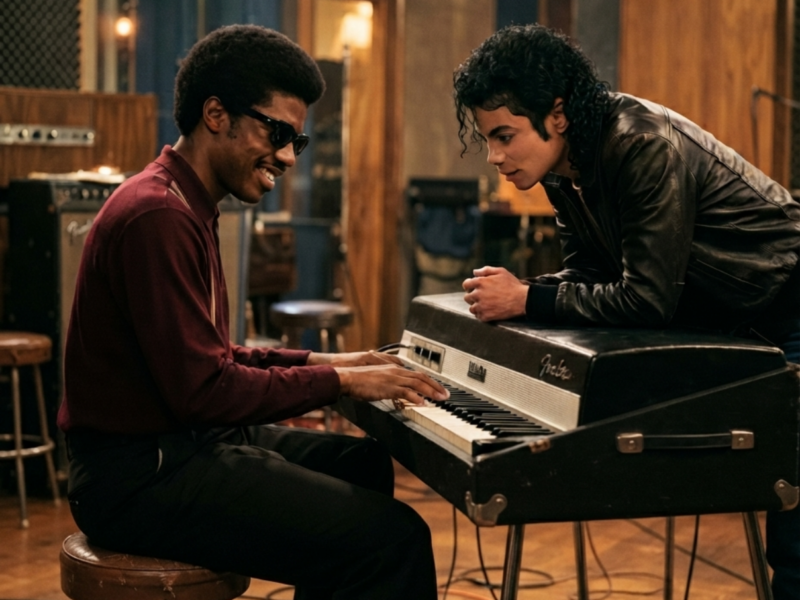
Not the global phenomenon, but a curious boy watching him work inside a Motown studio.
Why did Stevie remember that boy when the world was saying goodbye to the King of Pop?
By the time Michael died in 2009, separating the person from the public image had become almost impossible.
The achievements were enormous.
So was the attention surrounding his appearance, private life, business decisions, and controversies.
Different audiences believed they knew him.
Often they knew only the version presented to them.
Stevie’s perspective began much earlier.
He knew Michael before Off the Wall, Thriller, and the stadium tours.
He saw him inside Motown, where music was not yet mythology.
It was daily work.
That history did not mean Stevie knew every part of Michael’s life.
It meant he had witnessed something most people never saw.
He saw Michael learning.
Stevie Wonder understood childhood fame before Michael arrived at Motown.
Stevie had signed with the company as a child.
In 1963, Fingertips reached number one in the United States while he was thirteen.
At an age when most children were still discovering who they were, Stevie was already expected to perform before paying audiences.
The Jackson 5 came to Motown later in the decade.
Stevie remembered the excitement surrounding a family group from Gary, Indiana.
Michael was approximately nine or ten when their paths crossed.
What stayed in Stevie’s memory was not simply Michael’s voice.
It was his curiosity.
In a remembrance published after Michael’s death, Stevie described Michael coming into the studio while he worked.
He asked how he did things.
Then he asked why.
Those questions offer a revealing picture.
Michael was not waiting for adults to tell him where to stand.
He was studying how records were built.
This is the first important clue.
The public would later describe Michael’s abilities as magical or effortless.
Stevie had seen the less glamorous foundation beneath them.
Attention.
Repetition.
And an eagerness to learn.
Michael did not merely watch Stevie perform.
He watched him work.
Michael later confirmed the influence of those sessions.
Speaking about his early musical education, he recalled sitting in on Stevie’s work and being amazed that one person could do so much.
Stevie could sing, write, arrange, produce, and play several instruments.
For a young Michael, that offered more than inspiration.
It showed what an adult artist could eventually control.
That distinction mattered at Motown.
A gifted child could become famous by performing other people’s decisions.
Becoming an adult artist required something more difficult.
Developing a creative identity and gaining authority over the work.
Stevie had begun making that transition before Michael.
Michael was watching carefully.
One early musical connection appeared in 1973.
Michael recorded With a Child’s Heart, a song Stevie had released several years earlier.
The choice did not prove a private bond by itself.
Motown artists often recorded material connected to the company’s catalog.
But it placed Michael’s young voice inside a musical path Stevie had already traveled.
By the end of the 1970s, Michael faced a larger challenge.
He was known around the world, but much of that identity still came from his childhood with the Jackson 5.
Off the Wall became a decisive step into adult solo artistry.
Stevie contributed one of the album’s most distinctive songs.
I Can’t Help It was written by Stevie Wonder and Susaye Greene and produced for Michael’s album by Quincy Jones.
It was not built around a dramatic dance routine or an explosive vocal climax.
Its arrangement gave Michael room to sound intimate and controlled.
Here, the power came from phrasing, tone, and restraint.
That matters because Stevie’s contribution did not push Michael back toward a childhood sound.
It helped reveal the adult singer he was becoming.
Michael’s performance remained unmistakably his own.
Stevie supplied the composition, but Michael gave it a separate emotional identity.
One year later, their roles shifted.
Michael joined the background vocalists on All I Do, released on Stevie’s 1980 album Hotter Than July.
Michael was now a successful adult solo artist.
Yet on Stevie’s recording, his voice served the larger arrangement.
For a performer so often placed at the center, there is something revealing about hearing him contribute from within the ensemble.
Their connection was becoming reciprocal.
Michael had begun as an observer in Stevie’s studio.
Stevie later wrote material that became part of Michael’s artistic transformation.
Then Michael contributed to Stevie’s work.
This was not a simple mentor story anymore.
It was a conversation between musicians.
Then Michael’s world changed again.
Thriller became an international phenomenon.
Michael was no longer simply a successful recording artist.
His fame reached a scale that altered how people approached him.
Stevie, however, already possessed an established career and musical identity.
Their connection did not begin with Michael’s record-breaking celebrity.
It began before it.
In 1987, they appeared on each other’s albums.
Stevie sang with Michael on Just Good Friends from Bad.
Michael joined Stevie on Get It from Characters.
Neither recording needs to be presented as a hidden masterpiece.
Their greater value here is historical.
Nearly two decades after they met at Motown, the child observer and the young master had become adult peers.
But one question remains.
Did Stevie understand Michael’s private fears, family relationships, or every consequence of his fame?
The evidence does not allow us to say that.
What Stevie understood was narrower and perhaps more valuable because it can be documented.
Stevie recognized the difference between talent and the labor required to sustain it.
He had seen Michael before the finished image existed.
Before the military jackets, short films, stadiums, and tabloid mythology.
There was a child asking how music worked.
That memory survived everything that followed.
Stevie’s perspective was not based on solving Michael as a mystery.
It was based on recognizing him as a working musician.
That is the meaningful answer the evidence supports.
It also explains why one brief melody at the memorial carried so much history.
If you value carefully researched stories about Michael Jackson’s life and legacy, subscribe to MJ Untold.
Michael died on June 25th, 2009.
As news spread, his career, appearance, controversies, and cultural impact were examined again across the world.
The scale of the coverage was understandable, but it also repeated a familiar problem.
Michael Jackson became a subject everyone could discuss, while Michael the working musician became harder to see.
Stevie’s published remembrance took another approach.
He returned to Detroit.
He remembered the questions Michael asked and the interest he showed in the recording process.
That choice did not explain every chapter of Michael’s life.
It preserved one firsthand memory that Stevie was qualified to share.
Twelve days after Michael’s death, Stevie sat at the Staples Center piano.
Before his main tribute, he played the short passage from I Can’t Help It.
We cannot claim to know exactly what Stevie intended with every note.
He did not provide a detailed public explanation of that musical choice.
But its history was unmistakable.
The song returned listeners to Off the Wall.
That album belonged to the period when Michael was establishing himself beyond the identity Motown had created around him as a child.
At the memorial, a melody associated with that transition appeared before Stevie said goodbye.
The interpretation is powerful precisely because it does not require invented dialogue.
Stevie continued with Never Dreamed You’d Leave in Summer and They Won’t Go When I Go.
The songs came from Stevie’s own catalog.
In that setting, their language of absence and departure acquired a painful new context.
Stevie did not offer a long explanation of Michael.
He allowed the songs to carry the tribute.
For viewers who had grown up with Michael, the performance connected several generations of memory.
There was the child from Motown.
The young man from Off the Wall.
The global figure of the 1980s.
And the person being mourned in 2009.
Stevie’s presence quietly joined those versions together.
So why did Stevie Wonder appear to understand Michael differently?
Not because he knew every secret.
Not because their lives were identical.
And not because we can rank Michael’s relationships from the outside.
Stevie’s perspective was rare for a more verifiable reason.
He had encountered Michael before fame had turned him into a symbol.
Stevie knew what it meant for childhood talent to become adult responsibility.
He understood the rehearsals hidden beneath apparent ease.
He understood the struggle to grow beyond an identity formed while the world was watching.
Most importantly, he had seen Michael seeking knowledge before millions began projecting their own explanations onto him.
That is why the few notes heard at the memorial matter.
I Can’t Help It was not Michael’s largest hit.
It did not represent the full scale of his fame.
It represented a transition.
The moment a former child star was asking to be heard as an adult artist.
Stevie had witnessed the curiosity that helped make that transition possible.
The public remembered the moonwalk, the glove, and the crowds.
Stevie also remembered the boy in the studio asking how the music was made.
In the end, that may be the most respectful form of understanding.
Not claiming to know everything about a person, but refusing to forget the work that made them who they became.
Stevie understood Michael through music.
But another childhood star shared an even more personal parallel.









