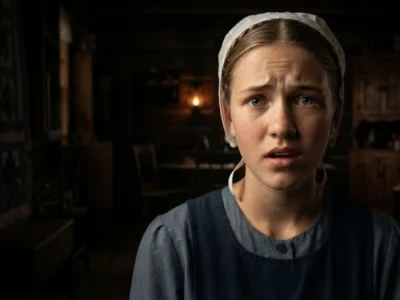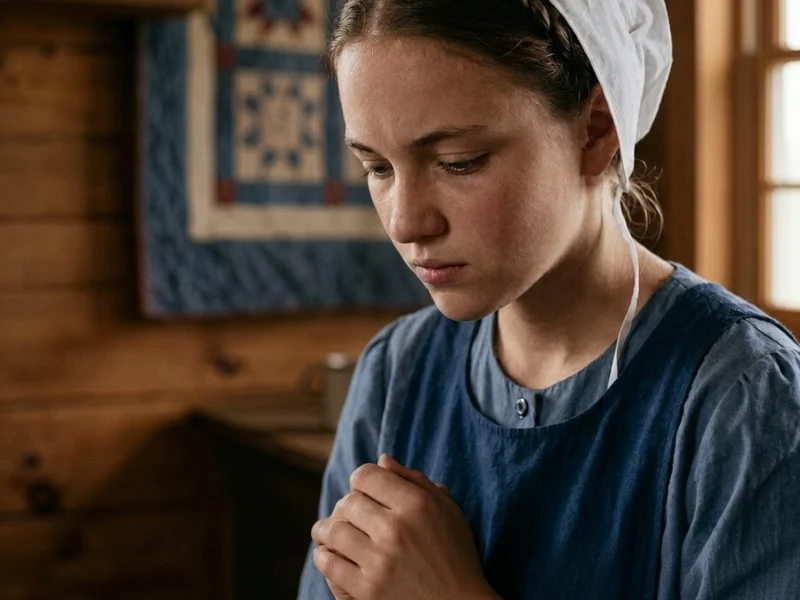
What Amish Husbands Really Do in the Final Days of Pregnancy.
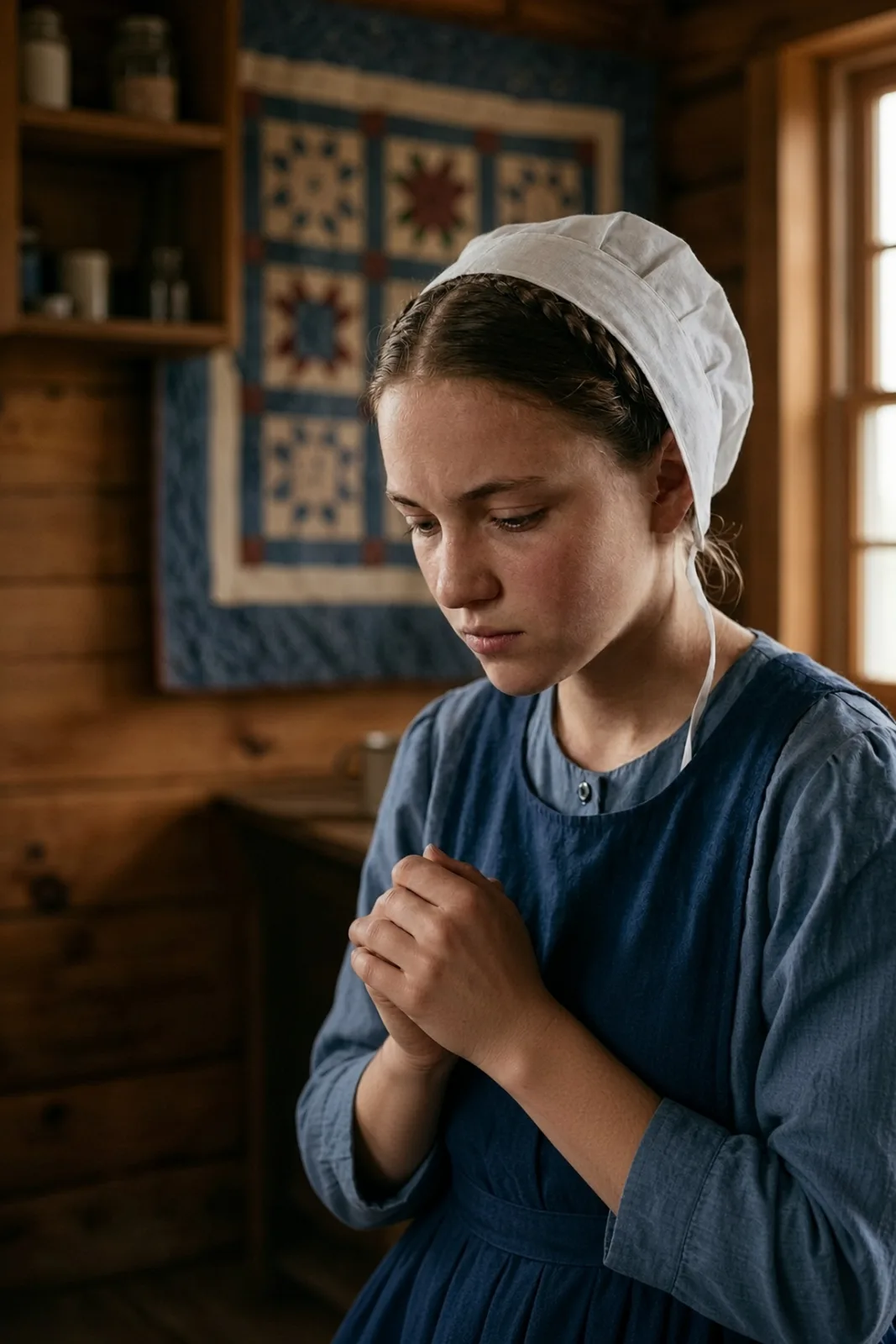
There is a kind of cold that has nothing to do with weather, and it does not come from the air, it comes from understanding.
I learned this cold on a Tuesday evening standing in a hallway with my hands on a belly so full I could feel my daughter’s heel pressing against my palm from the inside.
I was eight months pregnant, my back ached, my ankles were swollen, and my body was the largest it had ever been, the most present, the most impossible to ignore.
And I was standing in a hallway in my own house listening to someone else’s belongings being arranged in the room where my baby’s crib had been that morning.
The blanket I had folded was in a box on the floor by my feet, and the cold was not in the hallway, the cold was in the understanding.
The quiet precise arithmetic of what had just happened.
His mother’s comfort equaled a room, my labor, the kind that brings life into the world, equaled a hallway.
And the equation was not new, I had just never been able to read it until that moment.
I was not always a woman who stood in hallways.
I was not always a woman who calculated whether her body was allowed to be somewhere.
I had a room once.
I had hands that chose things and a voice that said, “This is mine,” and I meant it.
Let me tell you about her, the woman I was before, the woman I became inside, and the woman I am now.
If this already feels like a room you have stood in, if the hallway is familiar, then you are in the right place.
This channel holds space for the women who were not given any.
We do not tell these stories for entertainment, we tell them because every time a woman says out loud what happened to her inside a closed door, the walls move a little.
The room gets a little bigger.
Subscribe if you want to be part of that.
Not for numbers, not for me, because every woman who stays here is another woman saying, “I was somewhere once, and what happened to me in that somewhere deserves to be heard.”
Stay.
There is more.
I need to tell you about the room first.
Before it was taken.
Before it became a metaphor I would carry in my chest for years.
It was a small room at the back of the house, second floor, with one window that faced east.
I chose that room for the baby because of the window.
I wanted my daughter to wake to morning light.
Not afternoon light, not lamp light, the first light.
The kind that is soft and pale and does not ask anything of you.
I stood in that room at seven months pregnant with my hands on the windowsill, and I felt something I did not have a word for then.
Belonging.
Not to the community, not to my husband, to this room, to this window, to this version of myself that was building something with her own hands.
I had sewn the blanket myself.
It was not beautiful.
My stitching was uneven, and the fabric puckered in one corner where I’d pulled the thread too tight.
But I had chosen the color, a pale green like the underside of a leaf in early spring.
I remember standing in the fabric shop, running my fingers across bolts of cloth, and knowing which one I wanted before my mind caught up.
My hands chose it.
My hands were certain then.
They folded that blanket and placed it over the side of the crib, and I smoothed the creases, and I thought, without shame, without apology, “This is mine. I made this. This corner of the world belongs to me and my daughter and the light that will come through this window every morning.”
That woman, the one whose hands were certain, I need you to see her clearly because she does not last.
My husband was gentle in the beginning.
I want to be honest about that.
He carried things for me when my belly grew heavy.
He placed his hand on my stomach and waited for the baby to kick.
And when she did, his face changed in a way I believed was wonder.
The community said I was blessed.
A good husband, a good home, a baby coming.
I believed it the way you believe the ground beneath your feet.
Not as an idea, but as a surface that holds you.
I did not think about whether the ground was solid.
I stood on it.
I arranged furniture on it.
I built a nursery on it.
I whispered a name to my belly that I had chosen.
A name that was not a family name, not a tradition name, just a name I loved the sound of.
I said it in the dark when no one was listening.
It was the only secret I had, and it was the first thing I lost.
His mother arrived in the seventh month.
She came to help, they said, to prepare for the baby, they said.
She was a tall woman with hands that moved through a house the way water moves through a pipe, finding every crack, filling every space, rearranging anything that was not fixed.
On her second day, she moved the kettle from the left side of the stove to the right.
I moved it back.
On the third day, it was on the right again.
I did not move it back.
I told myself it did not matter.
It was a kettle.
But my hand every morning for a week, my hand reached left, and every morning it found empty air.
Something behind my ribs tightened each time.
Not pain, something quieter.
The feeling of reaching for something that should be there and finding that someone has decided it belongs somewhere else.
I thought about saying something, but I did not think about it long.
The name I had chosen for the baby, my husband’s mother heard me say it once at dinner, and her face did something brief and precise.
A flicker of displeasure that lasted less than a second, and then she said the family name, the one that had been passed down, the one that was proper.
My husband nodded.
He agreed with his mother the way he breathed, automatically, without effort, as though any other response would require a decision he was not built to make.
I watched the name I had whispered to my belly for months be replaced in a single sentence.
I smiled.
Something behind my ribs tightened further.
I told myself, this is how family works.
This is submission.
This is godly.
My body did not believe me.
My body kept reaching left for the kettle that was no longer there.
The room was given on a Tuesday.
He did not ask.
He told me the way you tell someone it might rain, a fact about the world that required no consultation.
His mother needed the room.
Her knees, the stairs, the comfort.
He had already moved her suitcase in.
The crib was in the hallway.
The blanket, my uneven, puckered, pale green blanket, was folded in a box.
He said it as he was leaving the room, and I stood there with my hands on my belly, and my daughter’s heel pressing against my palm, and I opened my mouth.
I opened my mouth and nothing came out.
Not because I chose silence, because the silence was faster than I was.
It arrived before I could find a word, and it filled the space where my voice should have been.
And I closed my mouth, and I nodded, and he left, and I stood there.
The woman who had chosen the window, the woman who had sewn the blanket, the woman who had whispered a name.
She opened her mouth and nothing came out.
That was the last time she tried.
After the room was taken, I began to sit in corners.
I did not decide to do this.
My body decided.
The far edge of the couch, the narrow side of the kitchen table, the chair closest to the wall.
My belly was enormous, eight months, then nine, a body so full of life it entered rooms before I did, and I pressed it against walls.
I crossed my arms over it as though apologizing for its size.
I stopped standing in doorways.
I stopped lingering in the kitchen when his mother was there.
I moved through the house the way a guest moves through a house, quickly, quietly, taking nothing, touching nothing, grateful for the corners I was allowed.
My body grew.
My body pushed outward with life, with a daughter who kicked and turned and demanded space.
And I contracted.
I contracted around her.
I became the smallest large woman you have ever seen, the woman who had chosen the window, the woman whose hands were certain when they folded small clothes, the woman who had a name she whispered in the dark.
She was still inside me somewhere, I think, somewhere behind the calculations, somewhere underneath the corners and the automatic smiles and the silence that arrived before I could.
But I could not reach her.
Her voice was getting quieter.
Her hands were getting less certain.
And the cold I had felt in the hallway, that precise arithmetic cold of understanding my place in the equation, it was not leaving.
It was settling, the way frost settles, quietly, completely, until one morning you look out the window and the entire field is white, and you cannot remember what it looked like green.
The apologies began before I noticed them.
Sorry, I just need to reach the shelf.
Sorry, I did not see you there.
Sorry, she is hungry.
I will take her to the other room.
My mouth produced them the way my lungs produced breath, without instruction, without thought.
I apologized for reaching for food in my own kitchen.
I apologized for the sound of my footsteps on the stairs.
I apologized once to his mother for my daughter crying at two in the morning as though a baby’s hunger was a personal failing.
As though the sound of my child needing me was an intrusion on the comfort of a woman sleeping in the room where a crib used to be.
That apology, standing in the hallway in the dark, holding my daughter against my chest, whispering sorry to a closed door, was the last one I heard myself say.
After that, the apologizing became invisible.
It was not something I did.
It was something I was.
I gave birth in the small room, not the room I had prepared, not by the window I had chosen.
The small room at the end of the hall with no particular light and walls I could not describe to you now because I had stopped seeing walls by then.
I labored for eleven hours.
I did not scream.
I want you to understand the pain was extraordinary.
It was the kind of pain that should produce sound, that earns sound, that exists in part so that the people around you know you need help.
But I had learned.
My body had learned in the months since the room was taken that my sounds were an imposition.
My presence was something to be managed.
My pain was not an emergency.
It was an inconvenience.
So I labored quietly.
I bit the inside of my cheek until I tasted iron.
I gripped the sheet until my knuckles went white.
And I delivered my daughter into a room that was not mine in a silence so complete that the midwife looked at me afterward with something I now understand was not admiration.
It was concern.
And then one morning, I cannot tell you which morning because mornings had stopped being different from each other, the fear left.
Not because I overcame it, not because something changed.
The fear left because there was nothing remaining for it to protect.
Fear is expensive.
It requires a self that recognizes danger, a self that believes it is worth defending.
That self was gone.
What replaced her did not need defending.
What replaced her did not need anything.
The fear drained out the way water drains from a field after the frost has killed everything.
Slowly, without event, until the ground was dry and flat and nothing grew there.
I became someone I would like to introduce you to.
She, the woman I became inside that house, she woke at five.
She fed the baby.
She cleaned the kitchen before his mother came downstairs so that his mother would not have to see a dirty kitchen.
She cooked.
She served.
She cleared.
She washed.
She fed the baby again.
She sat in the small room and she did not think about the window.
She did not think about the blanket.
She did not think about the name she had whispered in the dark because she no longer whispered anything in the dark.
She had my face but not my expression.
She had my hands but they did not reach for things.
She had my mouth but it only opened to apologize or agree.
One afternoon she walked past a mirror in the hallway and the woman looking back had eyes that were pointed at the floor.
She did not correct them.
She had been optimized.
The system had finished its work.
She was a good wife, a godly woman, a woman who had submitted, and she thanked his mother out loud with a smile that reached her eyes because it had been engineered to.
She thanked his mother for being comfortable in the room.
She said, “I am glad you have enough space.”
She meant it.
Or the architecture meant it.
I am no longer sure there was a difference.
There are months inside that house I will not describe.
Not because they were violent, some were, but most were nothing.
I moved through them the way water moves through a pipe, present, directed, without opinion about the direction.
I cannot tell you what I felt because I did not feel.
Feeling requires someone to do it.
And the woman inside that house was not someone.
She was a system of responses.
She was a series of tasks performed in the correct order at the correct volume.
She was the version of me that the house required, and she operated exactly as designed.
Nothing is the hardest thing to tell you about.
Nothing has no texture, no color, no temperature.
It is not cold like the hallway was cold.
It is not warm like the window was warm.
It is the absence of both.
And I have decided that telling you it was nothing is more honest than pretending I can describe it.
There was a woman at church.
I did not know her well.
She was older, fifteen, maybe twenty years ahead of me in the same system.
Her posture was immaculate.
Her smile was precise.
She served food at gatherings with hands that moved efficiently, without tenderness toward themselves, without hesitation, without waste.
She was the finished version, the completed project.
One Sunday I stood beside her at the sink drying dishes, and she said something without looking at me, quietly, the way you say something you did not plan to say.
She said, “I used to arrange flowers. I would spend an hour in the garden choosing which ones looked right together. I cannot remember the last time I touched a flower that was not for the table setting.”
She said it the way you say the sky is blue, a fact, without grief, without longing.
She had passed through the place where grief was possible and come out the other side into something flatter.
She put the dish down.
She returned to serving.
I watched her walk away and I understood, in the dull, distant way I understood anything then, that I was looking at myself in ten years.
Twenty years.
A lifetime of efficient hands and calibrated smiles and flowers only for table settings.
I went home.
I fed the baby.
I cleaned.
I did everything the same.
But that night, in the dark, I did not think about nothing.
I thought about flowers.
And I could not tell you why, weeks later, maybe months, time had stopped being something I measured, my daughter was in my arms.
She was older now, old enough to reach, old enough to focus her eyes on a face and hold the gaze.
She reached for me.
Not for food, not for comfort.
Her hand came up and touched my cheek.
Small fingers, warm, certain the way my hands used to be certain when they folded pale green cloth by a window I had chosen.
She touched my cheek and she looked at me and I felt it.
I felt the warmth of her hand.
Not as a function, baby needs contact, provide contact.
As a sensation, skin against skin.
Heat entering cold.
The first thing I had felt in, I do not know how long.
And she looked at me with eyes that did not see the performing woman.
She did not see the apology machine, the task system, the optimized wife.
She looked at me the way you look at someone you recognize.
And one thought broke through.
One clear, sharp, unbearable thought that cut through every layer of architecture my body had built to keep me numb.
She is watching me.
She is learning this.
She will grow up believing that a woman is someone who sits in corners and apologizes for the sound of her own child’s hunger and thanks people for taking her room.
She will learn to fold herself.
She will learn the cold arithmetic and she will call it godly.
I did not leave that night.
I did not leave for a long time after that.
But something had cracked.
Not broken, cracked.
The way a frozen field cracks when the temperature rises one single degree.
Not enough to thaw, enough to shift.
I remembered the woman who chose the window.
I remembered her hands.
I remembered the pale green fabric and the name I had whispered and the feeling of belonging to a room I had built.
And I could not go back to not remembering her.
The numbness was cracked and everything I had not felt for months began to seep through slowly the way water seeps through a crack in a frozen field.
Not freedom, not courage.
Something heavier than both.
Something that would take months to name and years to survive.
First came the grief.
The grief did not come for the marriage.
It did not come for the community or the house or the man I had married or the mother who had taken my room.
The grief came for me, for the woman I had been before.
I found the box one afternoon, the one with the baby clothes I had folded months earlier, the ones that had been removed from the room along with the crib and the blanket and every physical trace that I had ever existed in that space.
I opened it.
I lifted a small cotton shirt and I held it and I unfolded it and I folded it again.
And the grief that came was not for the shirt, it was for the hands that had first folded it.
Hands that were certain, hands that chose things, hands that reached for a bolt of pale green fabric in a shop and knew, without hesitation, without apology, without checking anyone’s face for permission, that this was the one.
Those hands had become the hands that apologized for reaching.
Those hands had become the hands that cleaned before his mother woke, so his mother would not have to see a dirty dish.
Those hands had become the hands that gripped a bed sheet during labor in silence because they had been taught that even their pain was an inconvenience.
I held that small shirt and I grieved for my own hands.
No one else was going to.
The system does not hold funerals for the women it erases.
It calls the erasure growth.
It calls the silence godliness.
It calls the disappearance a woman learning her place.
I was the only one who knew she had died, and I was the only one who would mourn her.
I found a photograph.
I do not remember when.
The weeks after the crack were blurred and heavy, everything arriving at once, every feeling I had not felt for months flooding through the fracture and filling me the way water fills a basement.
The photograph was from early in the marriage, before his mother, before the room, before the hallway and the corners and the arithmetic.
The woman in the photograph was looking at the camera, not at the floor.
Her shoulders were straight, not curved inward.
Her face had an expression I could not name at first, and then I could.
It was hers.
It was just hers, not calibrated, not performing, not optimized for someone else’s comfort.
She was looking at the camera the way a woman looks at the world when she believes she has a place in it.
I stared at that photograph for a long time.
The distance between her face and the face I had seen in the hallway mirror, the one with the eyes pointed at the floor, that distance was the entire story.
That distance was everything I had lost, and I could not cross it.
I could not reach through the photograph and touch the woman I had been.
I could only stand on this side of the glass and grieve the fact that she had existed, and that I had let her be replaced, and that no one, not one person in that house, in that community, in that system, had noticed she was gone.
If you are sitting with something heavy right now, if this story has reached a place inside you that you did not expect to open tonight, I want you to know this is what this channel is for.
Not entertainment, not spectacle, witnessing.
Every woman who subscribes here is a woman who has decided that these stories deserve to exist outside the walls where they happened.
That these women, the ones who were erased quietly, slowly, without a single dramatic moment anyone could point to, deserve to be grieved, even by themselves, especially by themselves.
Subscribe.
Stay.
We are not finished.
A therapist said it to me months later, after I’d left, and the leaving is a story I may tell you another time, or I may not, because some doors I have closed, and I do not owe anyone the view through them.
But I sat in a chair in a small office, and I described the woman I had become inside that house, the one who thanked them, the one who apologized for her daughter’s hunger, the one who labored in silence.
And the therapist was quiet for a long time, and then she said something I will never forget.
She said, “What you are describing is identity erosion. It is what happens to a person’s sense of self inside a system of coercive control. The woman you became was not a failure of character. She was not weakness. She was a survival structure your mind built to keep your body alive inside a system that required your disappearance. You built her. She kept you alive, and you do not have to be her anymore.”
I sat in that chair and I looked at my hands in my lap and they were not the certain hands from the fabric shop.
And they were not the apologizing hands from the kitchen.
They were new hands.
They were still.
They were mine.
The word identity erosion landed in the center of my chest the way a stone lands in still water.
And the ripples moved outward through everything I had believed about myself.
I was not broken.
I was not too sensitive.
I was not failing at godliness.
I had been surviving.
And the thing I had survived was not my husband.
It was the systematic, patient, invisible replacement of who I was with someone the system could use.
The woman I became inside that house was not weak.
She was surviving.
The numbness was not failure.
It was architecture.
My body built it to keep me alive.
The gratitude, the smile, the I am glad you are comfortable, the thank you for taking the room where my daughter was supposed to wake to morning light.
The gratitude was not real and it was not fake.
It was the only currency that kept me safe.
I am not ashamed of her.
The woman who sat in corners, the woman who labored without sound, the woman who apologized for her child’s hunger to a closed door in the dark.
I am not ashamed of a single thing she did.
She kept me alive long enough to feel my daughter’s hand on my cheek.
And I am done being her.
And him, he was transformed, too.
The system built a version of him that had authority, that could give away a pregnant woman’s room without asking, that could hear silence where there should have been a voice and call it peace.
I do not know if he sees it.
I do not know if he ever will.
The system built a version of him, too.
His just came with more power inside it.
If you cannot remember the last time you entered a room without apologizing for being in it.
If you have thanked someone for something they took from you and meant it, because the woman who would have been angry is gone and you do not know when she left.
If your body has learned to be small while your life requires you to carry everything.
If you look at photographs of yourself from before and you cannot find her, the woman who had opinions, who chose things, who reached for what she wanted without checking someone’s face first.
If you are performing a version of yourself that someone else designed and you are not sure anymore which one is real.
I see you.
She is still in there.
The woman you were before the system built someone over her is not gone.
She is underneath.
She is the one who flinches when someone mentions flowers.
She is the one who stares at her own hands sometimes and remembers when they reached for things without permission.
She is underneath the architecture.
And when you are ready, when the crack forms, when something small and warm touches your face and you feel it for the first time in longer than you can measure, she will be there.
Different.
Older.
Changed by what she has been buried under.
But yours.
I want to ask you something and I want you to answer only if it is safe.
Do you remember who you were before?
Not her name.
Not where she lived.
Not the facts.
The feeling.
Do you remember what it felt like to reach for something without first checking whether you were allowed to want it?
Tell me one thing about her.
One thing the woman you were before used to do.
Something small.
Something that was hers.
Write it in the comments.
Not for me.
For her.
So she knows you have not forgotten.
I did not take back everything.
I could not.
The years inside the numbness, the woman I had become, the silent labor, the corners, the arithmetic of the hallway.
I cannot unlive them.
They live in my body the way frost lives in a field even after the thaw.
But I took back one room.
Not the room he gave away.
I will never stand in that room again.
A different one.
A room I chose in a house that is mine.
I placed the crib by a window that faces east.
My daughter wakes to morning light now.
And when I folded the blanket over the rail, the same pale green blanket with the uneven stitching and the puckered corner, my hands shook.
They were not the certain hands from before.
They will never be those hands again.
Those hands belonged to a woman who did not know what it cost to have no room.
These hands know.
These hands have apologized for their own existence and gripped sheets in silence and cleaned kitchens before dawn so someone else would not have to see the evidence that a woman lived here.
These hands are not certain.
They are shaking.
They are reaching.
They are mine.
I am not the woman I was before.
The one who chose the window, who folded small clothes with steady fingers, who whispered a name in the dark that was never used.
She would not recognize me.
My hands shake.
My voice is lower.
I sit in the center of rooms and I still sometimes flinch.
But I am not the woman I became inside that house either.
The one who thanked them.
The one who labored in silence.
The one who apologized to a closed door for the sound of her own daughter’s hunger.
She kept me alive.
And I have released her.
I am someone new.
I am someone who knows what it costs to have no room, and who chose a window anyway.
And I am mine.
Every shaking, reaching, uncertain inch of me belongs to me.
And your voice belongs to you.