
The One Amish Rule I Broke That Made My Husband Call the Bishop.
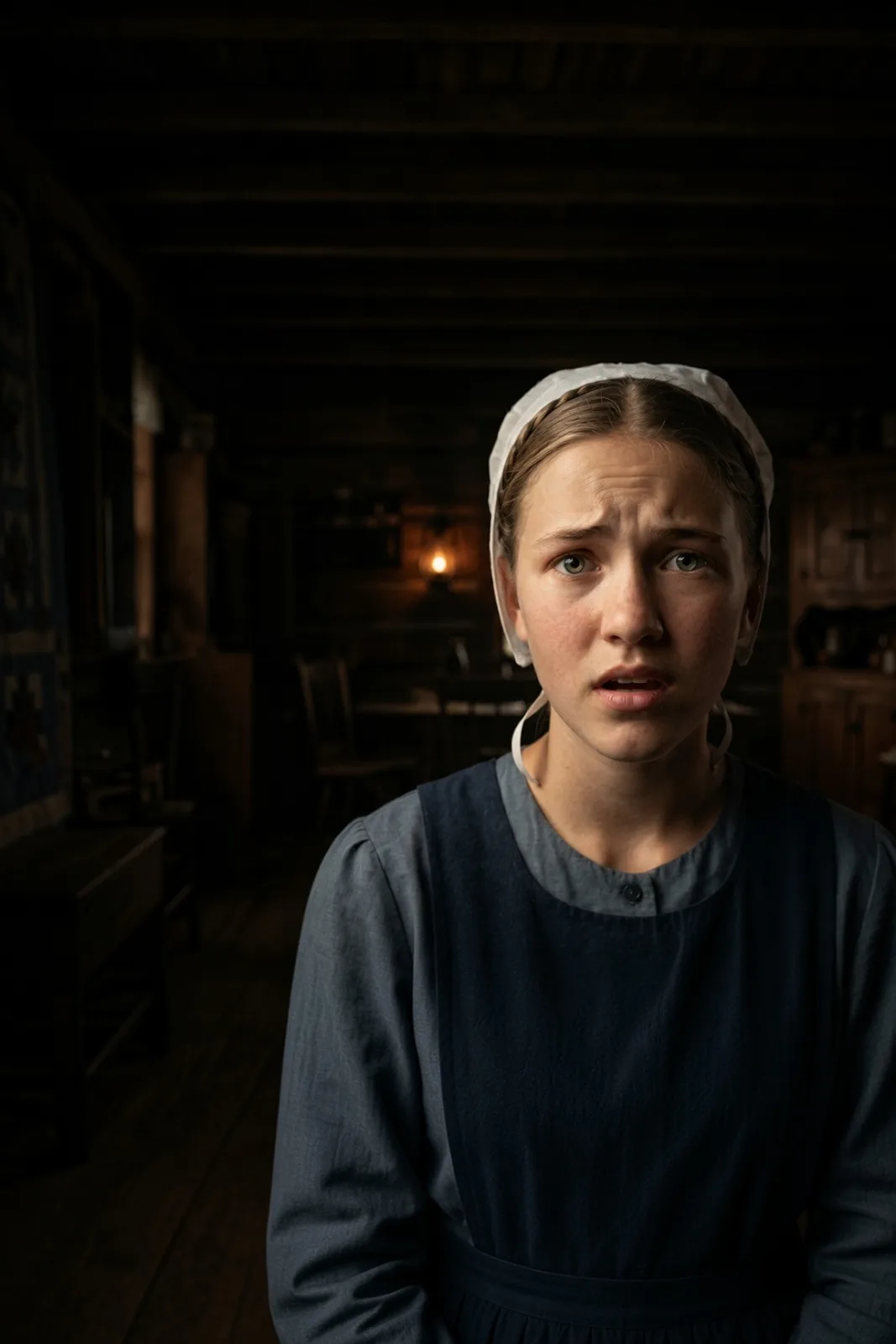
There is a life that looks like a painting, and I know because I lived inside it.
The morning light came through windows with no curtains because there was nothing to hide.
The bread rose on the counter before anyone woke.
The quilts hung on the line in a row, blue and white, stitched by hand, heavy with cotton and care.
My children’s feet were bare on wood floors.
I scrubbed every Saturday on my hands and knees.
The hymns were slow.
The buggies were black.
There was no screen, no notification, no scroll.
Just the next prayer, the next meal, the next season, turning the fields from green to gold.
My husband bowed his head before supper.
I bowed mine a moment longer.
The bishop visited and everyone smiled.
The neighbors carried casseroles to the sick.
The cemetery was small and quiet because no one ever left.
I loved this life.
I loved the bread and the light and the belonging.
I loved the way the world outside our fences looked loud and lost and the way we looked from their side like the answer to a question they could not stop asking.
Everything I just described is true.
I lived inside every one of those pictures.
But a picture only shows what the frame allows.
If you want to see what the frame cuts out, not anger, not gossip, not someone trying to tear down something sacred, just the quiet truth of what it costs to live inside the picture, then stay with me.
Subscribe to this channel.
Every story told here is a window that someone finally opened after years of being told the house had no windows at all.
And if this is your first time here, you are welcome at this table.
There is no ordnung at this table.
No one will inspect your belief before you sit down.
Just pull up a chair.
And when we reach the end, I am going to ask you a question in the comments.
Not about my life, about yours, about the myth you held the longest, stay for it.
The English, that is what we called anyone who was not Amish, anyone outside the fence.
The English would drive past our community on Sunday mornings and slow their cars to look.
I know because I could see them from the bench inside the barn where we held church.
The barn doors were open because it was August and the heat came up through the floorboards.
The women sat on one side, the men on the other, the children sat still because stillness was something you learned before you learned to read.
The singing was slow.
One hymn could last twenty minutes.
No instruments, no harmony, just voices layered on top of voices like quilts stacked on a shelf.
And outside on the road, a car would idle.
Someone would take a photograph.
Someone would say to someone else in that car, “I wish my life was that simple. They have it figured out. Look how peaceful they are.”
I am certain of this because I have heard it a hundred times since I left.
I sat on that bench for three hours every other Sunday and I saw something the English did not see.
I saw which women’s hands were shaking in their laps.
I saw which wives kept their eyes on the floor when their husbands passed their row.
I saw the bishop’s wife smile the widest of anyone.
And I knew because I knew her.
Because I had stood next to her at the sink and heard what she said when she thought no one was listening.
I knew that the width of her smile was the exact measure of what she could not say.
The English saw peace.
I saw performance.
And the difference between those two words is the first thing I need you to understand about the life I’m going to describe to you.
The simplicity was real.
I will not take that from the community or from myself.
The bread was real.
The quilts were real.
The neighbor who walked a mile in the snow to bring my mother soup when she had pneumonia, that kindness was real and I will carry it with me as long as I live.
But the simplicity was not the absence of complexity.
It was the suppression of it.
What looked like peace from the road was silence maintained by structure.
The arguments happened in low German behind closed doors, and they were settled the same way every time, by the husband’s word, or if his word was not enough, by the bishop’s.
There was no counselor.
There was no hotline.
There was no language for what I later learned to call the things that happened inside those quiet houses.
There was the ordnung and the bishop and God in that order, though they would tell you it was the other way around.
Let me tell you about the ordnung.
The way it was told to me, the way I carried it for years, the way it felt before it began to feel like something else.
The ordnung is the set of rules, unwritten, passed down, agreed upon twice a year before communion, that tells every member of the community how to live, what to wear, how to wear it, what to own, what not to own, how long your dress should be, what color thread is acceptable, whether you may have a zipper or must use straight pins, whether your buggy has a dashboard or not, whether the wheels are steel or rubber.
How you cut your hair, you do not cut your hair.
You pin it, you cover it.
The prayer cap sits on top like a hand resting gently on the crown of your head.
And when you are young and you believe, that hand feels like love.
They described the ordnung to me the way you might describe a garden wall.
It is here to keep you safe.
It keeps the weeds out and the good things in.
You chose to step inside this garden when you chose baptism.
No one forced you through the gate and twice a year you stand before the congregation and you say yes I agree with these rules.
I will follow them.
I affirm the ordnung and everyone says yes and the communion bread is broken and you feel, I need you to believe me, you feel held.
You feel enclosed.
You feel like someone has written rules so that you will never be lost, never be confused, never have to face the terrifying open field of deciding for yourself who you are.
There was something beautiful about not having to decide.
The ordnung decided and I called that safety.
For a long time, I called it love.
A fence keeps the bad things out, but a fence also keeps everything in.
And there comes a morning when you realize the fence is not protecting you from the world.
The fence is preventing you from reaching it.
The rule I broke was small.
I need you to hear that in any other life, in any other house, what I did would not have a name.
It would not be a story.
It would be a Tuesday.
But inside the ordnung, there is no such thing as a small rule because the system is not about the rule.
The system is about obedience.
The rule does not have to make sense.
Your obedience is the point.
Your compliance is the offering.
And the moment you break one rule, even a rule so ordinary you could hold it in your hand and feel nothing, you have not broken a rule.
You have broken the structure.
And the structure does not know how to forgive a crack.
I will not tell you yet what the rule was.
I will tell you what it felt like to hold it.
It was light.
It was ordinary.
It was the kind of thing that outside these fences, a woman would not think twice about, inside these fences.
It was enough to change the temperature of my marriage in a single afternoon.
My husband found it.
He did not raise his voice.
That would have been easier to hold in my memory.
What he did was quieter than a raised voice and heavier than anything loud could be.
He looked at what I was holding.
He looked at me and the first words out of his mouth were not why or what is this.
The first words were, “What will the bishop say?”
Not a question, an answer.
An answer to something I had not yet asked, but that was already decided.
He was not asking me.
He was telling me the authority had already been invoked in his mind before his mouth opened.
And in that sentence, what will the bishop say, I heard the entire architecture of my marriage collapse into its real shape.
He was not my partner in that moment.
He was my supervisor and the bishop was his.
That night, the kitchen was quiet.
The way a room is quiet when something has shifted inside its walls, but nothing on the surface has moved.
The plates were in the same cabinet.
The lamp was on the same hook.
The children were asleep upstairs in the same beds under the same quilts, breathing the same slow breath that children breathe when they do not yet know that the house they are sleeping in has a different shape than they think.
I washed the dishes.
I dried them.
I set them in the rack the way I set them every night.
And while I stood there with a dishcloth in my hand, I understood something I had not understood before.
The ordnung was not a garden wall.
The ordnung was the wall of a room I was not allowed to leave.
And the garden, the beautiful garden, the bread and the quilts and the hymns, the garden was real, but the wall was also real.
And I had been calling the wall a garden for so long, I had forgotten what walls are for.
Before I tell you what my husband did, I need to tell you what I believed my husband was.
Not what he was, what I believed.
Because the distance between those two things is the distance I need you to travel with me if you are going to understand why I stayed in that kitchen drying those dishes for as long as I did.
I was taught before I was old enough to question the teaching that the husband is the head of the household.
That is the phrase they use, head of the household.
And the way they explained it, it did not sound like control.
It sounded like shelter.
He will lead you.
They said, “He will stand between you and the world. Your submission is not weakness. Your submission is trust. You are yielding to God through him.”
And when I stood across from him on our wedding day in a plain blue dress in a room full of people who had known me since I was born, I looked at his hands.
They were rough from fieldwork.
They were steady.
And I believed with the full faith of a girl who had never been given another option to believe that those hands would never hold anything over me, that they would only hold things for me.
The first six months gave me no evidence against that belief.
He said grace before every meal.
He built our kitchen table himself.
I could smell the fresh wood for weeks, and every time I set a plate on it, I felt the hours he had spent sanding it smooth for me.
He hung my pot holders on the hook I preferred without being asked.
He was quiet, but his quiet felt like calm, not like absence.
When I adjusted my prayer cap before he walked through the door in the evening, I did it not because I was afraid of him, but because I wanted to be the picture the community had painted for us.
I wanted to match the sermon.
I wanted the myth to be true.
And for six months, it was close enough to true that I could not see the seam.
For six months, the picture held.
On the seventh month, I found something I was not supposed to find.
Not a sin, not a secret, just a thought that belonged to me.
And on that day, I learned what head of household means when the head disagrees with the heart underneath it.
He found what I had been keeping, the small thing, the ordinary thing.
And he did not hit me.
I want you to hear that because it matters for what comes next.
He did not raise his hand.
He did not raise his voice above the level of a man reading scripture aloud.
What he did was walk to the barn.
I heard his boots on the floor, the same boots, the same floor, the same sound I had heard every evening when he came in for supper.
But the direction was wrong.
He was walking away from the house and toward the phone shanty.
And I knew before he reached it what he was doing.
He was calling the bishop.
In the English world, that might sound like a phone call.
A small administrative step, a man asking his pastor for advice, inside the ordnung calling the bishop on your wife is something else.
It is the invocation of the full authority of the community against the person who shares your bed.
It is a man saying not to his wife, not to her face, but to the structure above them both, I cannot manage her.
She has broken the fence.
The community must correct what I cannot correct alone.
He did not ask me why I had the thing.
He did not sit at the table he built and say, “Let us talk about this.”
He went to the authority above us both and he reported me the way a foreman reports a broken beam.
Not with anger, with duty.
And that is what made it so heavy.
The anger I could have fought, the duty I could not.
Because duty in our world was the voice of God wearing work boots and a straw hat.
I need to stop here and say something that I could not have said five years ago, but that I have learned to say since.
He believed he was doing the right thing.
The ordnung taught him that when a wife strays, and strays can mean anything, it can mean a question asked too loudly, a book held too long, a thought followed too far, the husband’s duty is to bring it to the bishop, not his choice.
His duty.
The way I was taught to submit, he was taught to report.
The way I was taught to yield, he was taught to enforce.
He performed the myth of the righteous husband the way I performed the myth of the content wife.
And when I stopped performing, he did not know what to do except call the man who had written the script for both of us.
I am not telling you he was innocent.
I am telling you the system wrote two scripts and cast us both without auditions.
He came back from the barn twenty minutes later.
He said nothing.
He set his hat on the hook.
The same hook, the same gesture, and the kitchen was a different temperature.
It was July.
The wood stove was not lit.
The windows were open.
And the evening air was warm with cut hay.
But the room was cold.
I could feel it on my arms, on the back of my neck, in the space between us that had been the width of a kitchen table and was now the width of something I did not yet have a word for.
He sat down.
I stood at the counter.
The children were asleep.
The house was silent the way a house is silent when something has been decided without you, and you can feel the decision sitting in the room like a third person who has not yet spoken.
I dried the last dish.
I folded the cloth.
I put it on the counter.
And I went to bed in a house that looked exactly the same as it had that morning and was not the same house at all.
That Sunday, at the shared meal after church, a woman I will not name stood beside me at the sink.
She was drying plates.
Her youngest was on her hip, balanced there the way all our children balanced without effort, without thought, the way you carry something you have carried so long it has become part of your body.
She did not look at me.
She looked at the plate in her hand and she said quietly in a voice so low it lived underneath the sound of water and women’s laughter and German conversation.
She said, “Everyone in this room is holding something they are not allowed to put down. I have been holding mine so long my hands forgot they could open.”
Then she set the plate in the rack.
She shifted her child to the other hip.
She adjusted her prayer cap with her free hand.
She turned to the deacon’s wife and smiled.
And she was back inside the myth, performing the way we all performed.
She had named it.
She had named the weight and the holding and the impossibility of letting go.
And then she had picked the frame back up because she knew what I was only beginning to learn, that knowing does not free you.
Not in a world where the fence is on every side and the gate is watched by the bishop and the only direction that is not blocked is down.
From the outside, I was bread in sunlight and children’s laughter.
From inside my own body, I was a list of things I was not allowed to feel.
I want to tell you what the contented wife looks like because I performed her for years and I performed her so well that some mornings I could not find the seam between the woman I was pretending to be and the woman I was.
She wakes at four-thirty because the bread must rise before he rises.
She pins her cap before her feet touch the floor because the head must be covered at all times, even in the dark.
Even when no one is watching, especially when no one is watching because God is always watching and the cap is not for men.
It is for him.
She moves through the kitchen in silence.
She lights the stove.
She sets the coffee.
She slices yesterday’s bread for the children’s breakfast and begins today’s dough with hands that have done this so many times the muscles move without instruction.
And when he comes down the stairs and sits at the table and bows his head and waits for her to bow hers, she bows it.
And the myth says she bows it with joy.
The myth says her silence at the table is respect.
The myth says that when an English woman visits and asks, “Do you not want more?” the contented wife looks puzzled because what more could there be?
The myth says gelassenheit, yielding, is peace.
I ground my teeth so hard in my sleep I cracked a molar.
I felt it at two in the morning.
A sharp line running through the back of my jaw, a taste like metal, a pain that radiated into my ear and stayed there for weeks.
I told no one.
There was no one to tell.
The nearest dentist was in town and I could not go to town without permission.
And I could not explain the teeth without explaining the jaw.
And I could not explain the jaw without explaining the clenching.
And I could not explain the clenching without naming what I was swallowing every day at that table.
So I chewed on the other side.
I drank my coffee lukewarm because hot liquid made the crack sing.
And I smiled wider on Sundays because after the bishop was called, after my husband made the phone call that turned our marriage into an open file, I was no longer performing just for the community.
I was performing for the bishop who was now watching.
His eyes across the rows of benches, his attention at the shared meal, his wife’s questions that were not questions.
And I became the most contented wife in the district, because the cost of being seen as anything less than content was another conversation in the bishop’s kitchen that I could not survive again.
There is a myth about what happens when the bishop comes to your kitchen to correct a wife who has broken a rule.
I will tell you the myth.
The myth says it is pastoral care.
A shepherd checking on a sheep that has wandered.
He sits at your table.
There is coffee.
There is scripture read aloud in a voice that is meant to sound like a father’s.
There is correction, but it is the gentle kind.
The kind that guides you back to the fold.
The kind that assumes you want to return.
The kind that ends with prayer and restoration and the quiet relief of being forgiven.
That is the myth.
I will not tell you the reality.
Some frames I have put down.
That one I am still learning to set on the floor without it shattering into something I cannot clean up.
You do not need me to describe what happened in that kitchen.
If you have ever sat across from a man who held your entire world in his decision, your marriage, your children, your standing, your belonging, every person you have ever known, then you already know the temperature of that room.
The coffee was warm, the scripture was warm, everything in that kitchen was warm, and I was freezing.
If you are still here, if you did not look away when the frame cracked, if you did not leave when the picture stopped being beautiful, then you understand something about why this channel exists.
This is not gossip.
This is not spectacle.
This is a woman standing at a window that was sealed shut for years and saying, “Here, look through it with me.”
And every woman who subscribes, who shares this, who stays to the last word, she is choosing to look.
She is choosing not to drive past on a Sunday morning and say how peaceful.
She is choosing to see the bench from the inside.
If that is you, the subscribe button is below.
You do not have to have lived inside this frame to bear witness to the woman who did.
There was one myth I have not yet named.
It was not the community’s myth or the bishop’s or my husband’s.
It was mine.
I built it myself.
I carried it closer to my chest than any prayer cap, any scripture, any rule the ordnung ever handed me.
And it was the hardest one to break because I was both the woman telling the lie and the woman believing it.
The myth was this.
I chose this.
I chose baptism.
No one held my head under the water.
I chose this marriage.
I said yes in a room full of witnesses.
I chose this life.
The bread and the cap and the yielding and the silence.
And if I am unhappy, it is not because the fence is too high.
It is because I am not yielding enough.
If he called the bishop, it is because I gave him cause.
If the bishop corrected me, it is because I needed correcting.
The fault is mine.
The fix is mine.
If I just submit a little deeper, pray a little longer, smile a little wider, want a little less, then the picture and the truth will finally be the same thing.
I told myself that story every morning, the way I kneaded the bread.
I pressed it into shape.
I folded it over.
I pressed again.
And every morning the story held its shape just long enough to get me from the bed to the stove to the table to the bench to the sink and back to the bed.
The story was the spine I built inside the spine God gave me, holding me upright, yes, but also preventing me from bending toward anything that was true.
I did not have a mirror.
Mirrors are vanity in our community.
But I saw my reflection in every window I passed, every pane surface, every polished pot lid.
And the woman I saw was a woman who had chosen, a woman who belonged.
The reflection was not me.
It was the myth wearing my face.
There was a morning.
I cannot tell you the month.
I can tell you the light.
The light was gray, not golden.
The myth’s light was always golden, always warm, always the east window at sunrise, turning the kitchen into something that looked like love.
This light was gray and flat, and it did not flatter anything.
I was standing at the sink.
My hands were in dishwater.
The water was lukewarm.
My fingers were soft and wrinkled from hours of washing.
And I heard myself say out loud to an empty kitchen, “I am happy.”
Three words.
And I listened to them the way you listen to a sound that comes from a room you thought was empty.
That was not my voice.
The pitch was right.
The words were mine.
But the voice belonged to someone I had rehearsed into existence over years of practice.
It was the myth speaking through my mouth.
And that was the morning I understood that I had not been living inside my life.
I had been performing it.
And the woman performing it was so tired that she had started saying her lines to an empty room.
I did not choose.
That is the truth I could not reach until every other myth had fallen first.
I was born inside the fence.
I was taught the ordnung before I could read.
I was baptized at eighteen, old enough to sign my name, young enough to have never seen what lay on the other side of the only world I knew.
I married a man I had spent a few supervised months beside.
I said yes because yes was the only word the script contained.
I yielded because yielding was the air and I did not know there was a different way to breathe.
The choice was a myth designed to make the cage feel like a garden.
And I had repeated it so many times it had hardened inside my chest like a second set of bones.
The first therapist I ever sat across from, a woman in a small office with a window that opened, which I noticed before I noticed anything else, listened to me describe my life.
I expected her to say he was wrong or you were hurt.
She said something else.
She said, “What you are describing is called coercive control. It is when the picture becomes more important than the person holding it, when the frame is maintained at the cost of the woman inside it. And the fact that the picture is beautiful does not change what it costs.”
I had never heard those two words together, but I felt them land inside the place where the myth used to live, and they fit.
I need you to hear what I’m about to say.
The myth was not all lie.
The bread was real.
The morning light through that kitchen window was real.
My mother’s hands pinning my cap for the first time, that tenderness was real.
The neighbor who walked through snow with soup, she was real.
The hymns that made me weep were real.
The myth was not the opposite of truth.
The myth was a frame.
And the frame held real beauty and real pain in the same picture.
The frame was not the lie.
The frame was the prison.
And you can love the bread and still name the cage.
If you are smiling in a photograph right now that does not show your Tuesday evenings.
If you are telling someone you are blessed in a voice you practiced in the car before you arrived.
If you are holding a frame so heavy your arms went numb years ago and you have mistaken the numbness for peace.
If there is a rule in your house that does not make sense and you are obeying it because the cost of questioning is a phone call or a sermon or a silence you cannot afford.
I see you.
You are not ungrateful.
You are not faithless.
You are not broken.
You are exhausted from performing.
And you are allowed to put the frame down.









