A Navy SEAL Got Birthday Roses With His Late Wife’s Note—Then a German Shepherd Puppy Popped Out.
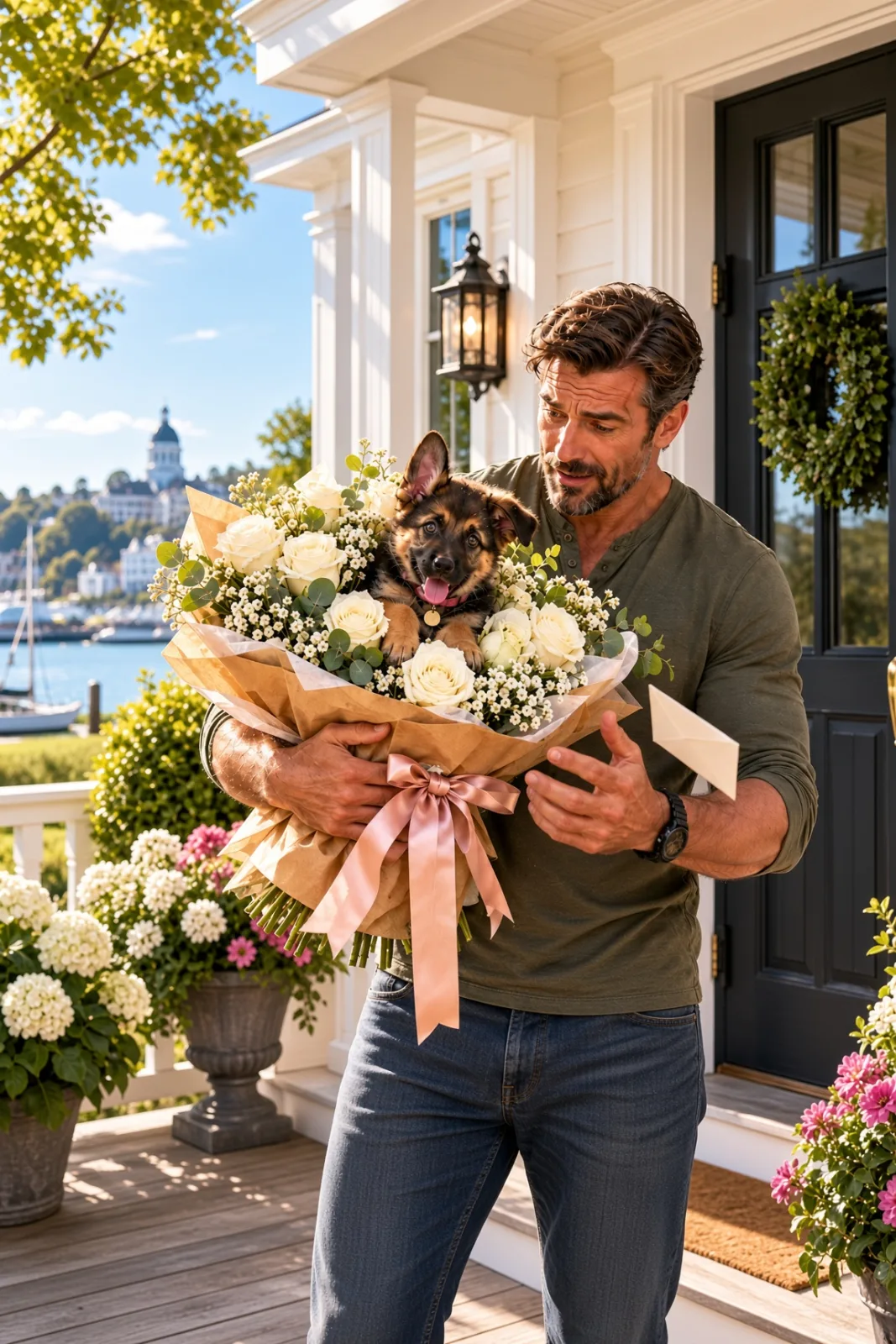
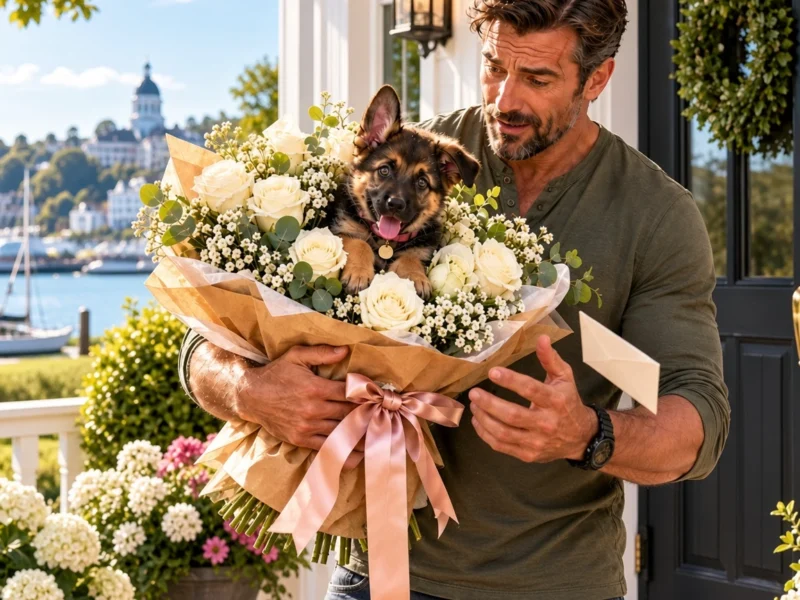
A tiny German Shepherd puppy poked her head through a bouquet of white roses, one ear standing tall and the other folded sideways.
She sneezed, lost her balance, and tumbled straight into the arms of a stunned former Navy SEAL.
But Graham Hensley wasn’t staring at the puppy.
He was staring at the birthday card.
The handwriting belonged to Clara, his wife, who had died three years earlier.
Don’t sit alone today.
Who had sent those flowers?
And why had Clara left behind ten mysterious birthday letters?
In Annapolis, Maryland, one mischievous puppy named Posie would help a grieving soldier rediscover laughter while a seventy-six-year-old florist faced a ruthless online business threatening everything she’d built.
But the greatest surprise wasn’t hidden among the roses.
It was a secret Clara had carried until her final days.
At 6:17 on a Tuesday morning, Graham Hensley stood in his kitchen waiting for a coffee maker that had already finished brewing.
He had forgotten to put a cup beneath it.
For a man who had spent twenty-three years in the United States Navy, much of that time serving as a Navy SEAL, this was the sort of mistake he would once have found embarrassing.
Now at forty-seven, he simply stared at the small puddle spreading across the counter.
“Well,” he muttered, “outstanding start.”
Outside, the April sun was beginning to brighten the rooftops of Annapolis, Maryland.
Beyond the neighborhood, Spa Creek reflected a pale ribbon of morning light.
Somewhere along the waterfront, a gull complained loudly enough to sound personally offended by the arrival of Tuesday.
Graham cleaned the counter, poured another cup, and checked the time.
He wanted to leave early.
Today was his birthday, and he intended to pretend it wasn’t.
His phone had already collected four messages.
One from a former teammate, another from a neighbor, two from people he liked well enough, but had no desire to speak with today.
He turned the screen face down.
At forty-seven, Graham remained a formidable figure.
He stood six foot five with broad shoulders, a strong chest, and the controlled movements of someone accustomed to carrying responsibility.
His dark walnut brown hair was brushed back with a small patch of silver above his right ear.
A neatly trimmed salt-and-pepper beard framed his chin, while his hazel eyes carried flecks of copper and green.
There was a small faded scar near his left eyebrow.
Most people noticed his size first.
His students noticed something else.
They noticed that he remembered their names.
After retiring as a senior chief petty officer, Graham had become a certified naval science instructor in a local high school’s Navy Junior Reserve Officers Training Corps program.
He taught leadership, discipline, teamwork, and service.
He expected punctuality.
He disliked excuses.
And he had a peculiar talent for knowing when a teenager was pretending to understand instructions.
But he never embarrassed a student for making an honest mistake.
“Discipline isn’t about never falling short,” he often told them.
“It’s about what you do afterward.”
His students believed he knew how to handle anything.
At home, Graham wasn’t nearly so certain.
The little house near Spa Creek contained two kinds of rooms.
Those he still lived in and those he had stopped living in three years earlier.
Clara’s favorite chair remained beside the living room window.
Her ceramic bird sat on the bookshelf.
A pale blue sweater still hung behind the bedroom door.
And in the small storage room were six sealed cardboard boxes.
Graham had packed them after her funeral.
He had never opened them again.
Clara Hensley had died from cancer three years earlier during Graham’s final deployment.
When he learned her condition had become critical, he had requested permission to return.
He had done everything available to him.
But by the time he reached Annapolis, the arrangements for her funeral were already underway.
He had spent decades learning that preparation mattered.
Yet nothing had prepared him for walking into their home and realizing Clara would never call his name from another room.
The funeral had been crowded.
The days afterward had been unbearably quiet.
People brought meals.
They offered help.
They told him to call whenever he needed anything.
Graham thanked them all.
And whenever someone asked how he was doing, he offered the same answer.
“I’m fine.”
Eventually, most people stopped asking.
He set his coffee down and reached for his keys.
Then the doorbell rang.
Graham frowned.
It was barely seven.
He wasn’t expecting anyone.
He opened the front door, prepared to discourage an enthusiastic neighbor.
Instead, he found an elderly woman standing on his porch beside an enormous bouquet of white roses.
She was small, perhaps five foot three, with silver hair gathered into a loose bun and oval glasses resting low on her nose.
A faded plum-colored coat covered her lavender blouse.
She had the unmistakable expression of someone who had made a difficult decision and had no intention of changing it.
“Graham Hensley?” she asked.
“Yes, ma’am.”
“Happy birthday.”
He looked at the flowers, then at her.
“I think there’s been a mistake.”
“There was a mistake,” she replied.
“But not today.”
Something about her voice made him hesitate.
“Bea Thornton,” she said.
“Harbor Light Flowers down near the harbor.”
Graham recognized the name.
Clara used to buy flowers there.
He had not visited the shop since her funeral.
Bea gestured toward the bouquet.
“Your wife asked me to bring these.”
The world seemed to narrow.
Graham looked at her without moving.
“My wife.”
Bea nodded gently.
“Clara.”
For a moment, the traffic beyond the houses, the gulls over the water, and the distant sound of a delivery truck seemed to disappear.
Graham looked down.
A small ivory envelope rested among the white roses.
His name was written across the front.
Graham.
He knew that handwriting.
He knew the gentle rightward slant, the rounded letters, and the peculiar way Clara finished the tail of her capital G.
He had watched that hand write grocery lists, birthday cards, and little notes she slipped into his luggage before deployments.
His fingers trembled as he opened the envelope.
Inside was a single sentence.
“Don’t sit alone today.”
For three years, Graham had imagined what he might have said if he’d reached Clara in time.
He had rehearsed apologies she would probably have refused to accept.
He had wondered whether she had been frightened.
Now, standing in the morning sunlight, he was holding a message that sounded so much like her that he could almost hear her voice.
“Where did you get this?” he whispered.
Bea’s eyes softened.
“From Clara.”
Graham swallowed.
“But she’s been gone three years.”
“I know, sweetheart.”
Bea took a breath, preparing to explain.
That was when the flowers moved.
Not much, just a sudden, peculiar rustling near the bottom of the bouquet.
Graham blinked.
Did those roses just move?
Bea glanced down.
“Oh goodness.”
Beside the flowers sat a small, well-ventilated pet carrier with a soft blanket folded inside.
Its upper opening had been left accessible while Bea stood beside it.
A furry black-and-tan head had emerged from the carrier.
The tiny creature was apparently investigating the bouquet.
One ear stood upright.
The other leaned sideways as though it hadn’t yet decided whether growing up was worthwhile.
The puppy pushed her nose between two carefully trimmed rose stems.
A loose white petal stuck to her muzzle.
She sneezed once, then again.
The second sneeze surprised her so thoroughly that she lost her footing on the edge of the carrier.
Graham reached down instinctively.
A warm, wriggling bundle tumbled straight into his hands.
He caught her against his chest.
For several seconds, the former Navy SEAL and the German Shepherd puppy stared at each other.
The puppy had bright amber eyes, oversized paws, and a small cream-colored patch on her chest shaped almost like a teardrop.
A fallen rose petal rested on her head.
She opened her mouth.
Then she licked Graham directly on the chin.
A laugh escaped him.
It was short, startled, and entirely unplanned.
Bea smiled.
“There he is.”
Graham looked up.
“Who?”
“The man Clara told me about.”
He lowered his eyes to the puppy, suddenly uncertain what to say.
The little dog sneezed a third time.
Graham laughed again.
This time Bea joined him.
For a few precious seconds, the porch of a quiet Annapolis house became a place where grief and laughter stood beside each other without either one needing to leave.
Then Graham remembered the card.
He looked at Bea.
“Please,” he said softly.
“Tell me what’s happening.”
Bea nodded toward the house.
“May I come in? My niece and I have been negotiating since six this morning.”
Graham stepped aside.
Inside, Bea set the roses carefully on the kitchen table while Graham held the puppy away from the flowers.
The little dog sniffed his shirt and attempted to investigate his beard.
“Her name is Posie,” Bea said.
“Posie? Like a little bunch of flowers?”
“Seemed appropriate.”
Graham looked down.
“She’s going to be enormous eventually.”
“At present, she’s mostly ears and opinions.”
Bea settled into a kitchen chair.
Then her expression grew serious.
“Clara came to my shop while she was receiving treatment,” she began.
“She wanted to arrange birthday flowers for you, not just once.”
Graham stood very still.
“She wrote ten cards, one for each birthday, and she left money to cover the flowers as the years came.”
“Ten.”
Bea nodded.
“Ten.”
Graham slowly sat opposite her.
“Why didn’t I know?”
“She asked me not to tell you in advance. She wanted each message to arrive on its own day.”
Bea folded her hands.
“The first two years we tried delivering. You refused the flowers. I didn’t open her envelopes and I didn’t give them to anyone else. I kept them safe.”
Graham remembered.
A delivery driver had come on his birthday two years earlier.
He had sent the flowers away without asking who ordered them.
The following year, another delivery had arrived.
He had refused that one, too.
At the time, he believed someone was trying to cheer him up.
He hadn’t been ready.
“I didn’t know,” he murmured.
“I figured you didn’t.”
“I’m sorry.”
Bea shook her head.
“You don’t owe me an apology. Grief doesn’t make appointments. It turns up when it pleases and leaves its shoes all over the house.”
The remark sounded so much like something Clara might have said that Graham felt his throat tighten.
He looked at Posie, who had fallen asleep against his forearm.
“And this little troublemaker?”
Bea smiled.
“This part was my idea.”
Clara had once told her about their plans to adopt a German Shepherd after Graham retired.
They had imagined long walks by the water and a dog that would insist on joining every outing.
Then life had taken a different direction.
Recently, a family Bea knew had been looking for a responsible home for a young female puppy from a carefully planned litter.
After speaking with them and arranging a veterinary check, Bea had thought of Graham.
“I didn’t know if you’d be ready,” she admitted.
“That’s why I brought her records. And if you say no, she’ll come home with me until we find the right family.”
Graham studied the puppy.
He had trained alongside working dogs during his military career.
He respected them deeply.
But this was different.
This was a ten-week-old creature who would need feeding, patience, training, veterinary appointments, and more attention than he had given anyone in years.
“I teach all day,” he said.
“I know.”
“I live alone.”
“I know that, too.”
“I haven’t raised a puppy.”
“There’s a first time for most things.”
Graham looked toward Clara’s chair.
“I don’t know if I can do this.”
Bea did not rush to reassure him.
Instead, she watched Posie curl one oversized paw around the edge of his sleeve.
“You don’t have to decide forever today,” she said.
“Just decide whether you’d like to try.”
For a long time, Graham said nothing.
Then he gently adjusted the blanket beneath Posie’s head.
“All right,” he whispered.
“We can try.”
Bea smiled, but her eyes were moist.
Before leaving, she went through the puppy’s paperwork, feeding instructions, and contact information.
Graham arranged to follow up with a veterinarian and agreed to call Bea if caring for Posie became more than he could manage.
She also promised to return with a few extra supplies later.
At the door, Bea looked back at the white roses on the kitchen table.
“Clara always said you were better at taking care of everybody else.”
Graham gave a faint smile.
“She had plenty of opinions.”
“She was usually right.”
“Not always.”
“No,” Bea agreed quietly.
“Not always.”
And somehow that simple answer comforted him more than any perfect description of Clara ever could.
By evening, Graham’s house had changed.
There was a small puppy bed near the kitchen wall.
A water bowl sat beside the cabinets.
A folded towel covered the floor near the back door.
A soft toy shaped like a duck lay abandoned beneath the table.
Posie had already demonstrated that she could walk directly past her expensive new bed and fall asleep on Graham’s oldest pair of slippers.
He regarded her with mild disbelief.
“Twenty-three years in the Navy,” he told her, “and I’ve finally met someone who completely ignores the chain of command.”
Posie yawned.
Graham warmed a simple dinner and sat at the table.
Usually, he ate standing by the counter, unwilling to face the empty chair opposite him.
Tonight, he sat down.
The white roses stood in Clara’s favorite ceramic vase.
Her photograph rested beside them, and from beneath the table came the soft sound of a puppy breathing.
Graham looked at his wife’s smiling face.
“I don’t know what you were thinking, Clara,” he murmured.
His gaze moved to Posie.
“But I think you’d like her.”
The puppy stirred and rested her chin on his boot.
Graham reached down and gently touched her head.
After dinner, he picked up the birthday card again.
He ran his thumb over Clara’s handwriting, reading the words one more time.
Don’t sit alone today.
Then he turned the envelope over.
There, near the bottom corner, almost hidden beneath the fold, was another line written in Clara’s unmistakable hand.
Bea knows where the others are.
Graham stared at the words.
He thought about the ten cards, the two birthdays he had refused to acknowledge, the quiet elderly florist who had kept a promise when he couldn’t bear to receive it, and the small German Shepherd sleeping beside his feet.
For three years he had believed that the last chapter of his life with Clara had already been written.
Now in a house filled with white roses and the unfamiliar sound of a puppy dreaming, Graham realized there were words from his wife that he had never read.
He placed the envelope carefully beside their wedding photograph.
Then he turned off the kitchen light, leaving one small lamp glowing near Posie’s bed.
For the first time in three years, Graham Hensley had spent his birthday with someone.
And for the first time, he wondered what Clara might still have wanted to tell him.
By eight o’clock Wednesday morning, Graham Hensley had discovered something the United States Navy had never adequately prepared him for.
A ten-week-old German Shepherd could negotiate terms of surrender without ever learning to speak.
“Posie, come here.”
The puppy sat in the hallway.
Graham waited.
Posie tilted her head, her left ear standing proudly while the right folded sideways like a flag reconsidering its allegiance.
“Come.”
She looked directly at him.
Then she began chewing the corner of the towel she had dragged from her new bed.
Graham closed his eyes.
“I’ve trained sailors who were less stubborn than you.”
Posie wagged her tail.
Somewhere in the kitchen, his coffee was getting cold.
He had already cleaned up one accident, rescued a slipper from beneath the couch, and spent fifteen minutes searching for his keys before discovering them exactly where he had left them.
It was an astonishing amount of disorder for a creature weighing barely fifteen pounds.
And yet, when Posie finally trotted toward him, stumbled over her own paws, and leaned against his boot, Graham found himself smiling.
He scratched the little cream-colored patch on her chest.
“All right, sweetheart. We’ll figure this out.”
The word sweetheart surprised him.
It had been one of Clara’s favorite words.
He didn’t withdraw it.
Instead, he clipped the puppy’s dusty rose collar into place, checked that her carrier was secure, and prepared for their first appointment together.
Before leaving, he glanced toward the framed birthday card on the kitchen table.
Don’t sit alone today.
He hadn’t, and somehow that one small change had made the entire house feel different.
The veterinary clinic stood along a quiet Annapolis street between a neighborhood pharmacy and a bakery that smelled of fresh cinnamon rolls.
Graham arrived ten minutes early.
Old habits were difficult to break.
Posie, apparently unimpressed by punctuality, spent those ten minutes investigating the blanket inside her carrier.
When a receptionist called her name, Graham carried the puppy into an examination room.
Dr. Meredith Sloan entered a moment later.
She was fifty-two with thoughtful chocolate brown eyes and a neat ash-brown bob that brushed her jaw.
Her deep peacock blue veterinary scrubs were practical and a burgundy pen rested in the pocket near her shoulder.
She greeted Posie first.
“Well, aren’t you a lovely little lady?”
Posie responded by attempting to climb into her arms.
Meredith laughed, steadying her on the examination table.
Then she looked at Graham.
“Graham Hensley, I wondered whether Bea would convince you.”
He frowned slightly.
“You knew about this?”
“I knew Bea was considering asking you. I also knew she wouldn’t give you a puppy without making certain you understood what you were agreeing to.”
Graham looked toward Posie, who was enthusiastically sniffing the edge of Meredith’s sleeve.
“I’m beginning to suspect I’m the only person who wasn’t consulted.”
Meredith smiled.
“Clara used to say you preferred surprises only when you were the one planning them.”
The mention of his wife came without ceremony, not as a solemn announcement, not as an invitation to mourn, simply as part of an ordinary conversation.
Graham found that he appreciated it.
Meredith examined Posie carefully, checking her eyes, ears, heart, weight, and general development.
She reviewed the records Bea had provided and discussed the remaining vaccinations and appropriate precautions until the puppy’s immunizations were complete.
She explained feeding schedules, safe exercise, socialization, and the importance of gentle, consistent training.
“German Shepherds grow quickly,” Meredith said.
“But their judgment doesn’t always keep up with their legs.”
Graham glanced at Posie.
“I’ve noticed.”
“She’ll need structure, but she won’t benefit from being treated like a recruit.”
“I wasn’t planning to make her run five miles.”
“Good, because for now, she’d probably run fifteen feet and fall asleep in your shoe.”
Graham laughed.
Meredith demonstrated how to reward Posie for responding to her name and encouraged short, positive training sessions.
Then she handed Graham a printed care schedule.
He studied it with the seriousness of someone reviewing operational instructions.
Meredith watched him for a moment.
“You know, Graham, there’s something else.”
He looked up.
“What’s that?”
“You don’t have to be perfect at this.”
He almost answered automatically.
Instead, he folded the paper.
“I suppose that’s fortunate.”
Posie had fallen asleep with her chin resting on his forearm.
Meredith’s expression softened.
“She’ll teach you as much as you teach her.”
On the drive toward downtown Annapolis, Graham considered those words.
For most of his adult life, he had been the person expected to know what to do.
He had built his career around preparation, responsibility, and the ability to remain calm when plans changed.
Now he was responsible for a puppy who considered a loose shoelace the most important discovery in the world.
There was something strangely refreshing about it.
Posie didn’t care about his service record.
She didn’t know what a senior chief petty officer was.
She had no interest in his medals, his former assignments, or the quiet reputation he carried into every classroom.
She only knew whether he had food, whether his hands were gentle, and whether he would stay nearby when the world felt unfamiliar.
For the first time in years, Graham wondered whether being needed could feel different from being responsible.
He parked near the harbor and carefully lifted Posie’s carrier from the vehicle.
Harbor Light Flowers stood on a narrow street where brick sidewalks curved between old storefronts.
Its painted wooden sign had faded to a soft blue-green.
Gold lettering spelled out the shop’s name, though the H had begun losing a little paint along its lower edge.
Behind the front windows stood rows of flowers in glass vases.
White roses, blue delphiniums, peach carnations, small bunches of rosemary and eucalyptus.
The shop looked as though it belonged to another era, one in which customers were expected to stay long enough for a conversation.
A brass bell rang when Graham opened the door.
“Just a moment,” called a voice from the back.
Bea Thornton appeared, carrying a bucket of fresh stems.
She wore a pale lavender blouse beneath an oatmeal cardigan with a faded burgundy apron tied around her waist.
Her silver hair was gathered into its familiar low bun, and a small lavender-shaped brooch caught the light near her shoulder.
When she spotted Posie, her face brightened.
“There she is.”
Posie wagged so enthusiastically that her entire back half seemed involved.
Graham placed the carrier near a clear space behind the counter and let Bea greet the puppy safely.
“She’s had her appointment,” he said.
“And healthy, growing, apparently incapable of respecting a reasonable schedule.”
Bea looked delighted.
“Sounds like a proper puppy.”
Graham glanced around the shop.
“Clara loved this place.”
Bea’s smile softened.
“She did.”
For a while, they said nothing more.
Bea returned to trimming stems, and Graham watched her work.
Her hands moved with practiced certainty.
She measured each cut without a ruler, turning flowers until their colors balanced naturally.
On a shelf behind the counter stood an old photograph of Bea outside the shop many years earlier.
The sign had been brighter then.
The windows looked nearly the same.
“Forty-three years,” Bea said, noticing his interest.
“That’s how long I’ve been arranging flowers in this building.”
“That’s a long time.”
“Long enough to know that people rarely order flowers for the reason they first give you.”
Graham raised an eyebrow.
Bea continued cutting stems.
“A man asks for roses because it’s his anniversary. But perhaps he’s really saying he’s sorry for forgetting the last one. A daughter orders daisies for her mother because they’re cheerful. What she really means is she wishes they lived closer.”
She placed a white rose into a vase.
“Flowers give people permission to say things they’ve been holding inside.”
Graham looked toward the window.
“Clara used to say you could explain anything with flowers.”
“She could, although she was hopeless at remembering which ones needed more water.”
He smiled.
Bea drew out a chair beside the counter.
“Sit with me a moment.”
She made tea in two mismatched mugs.
Then she told him about Clara.
Not the Clara who had spent her final months attending medical appointments.
The Clara who had once arrived with a box of homemade cookies because Bea had complained about skipping lunch.
The Clara who preferred sitting beside the window when rain streaked the glass.
The Clara who could spend half an hour deciding between two nearly identical shades of white rose.
“She said one looked like morning light,” Bea recalled, “and the other looked like the inside of a seashell.”
Graham laughed softly.
“That sounds like her.”
“She came here sometimes after appointments. Some days she wanted to talk. Some days she just wanted somewhere quiet to sit.”
Graham turned his mug between his hands.
He had known Clara was close to Bea.
He hadn’t understood how much of her life had unfolded inside this little shop.
A strange feeling settled over him.
Not jealousy exactly, more the realization that someone he had loved completely had still possessed a world beyond his own.
And perhaps that was how love was supposed to work.
Bea looked toward the old photograph.
“Clara worried about you.”
“I know.”
“No, Graham. She worried about how difficult it was for you to let anyone take care of you.”
He lowered his eyes.
“She had a point.”
“She usually did.”
Bea paused.
“Your birthday flowers were important to her. She wrote ten cards and numbered the envelopes herself. She wanted one delivered each year, whether you felt like celebrating or not.”
Graham remembered the handwriting on yesterday’s card.
“What happened to the first two?”
“They’re safe. I kept them sealed when you wouldn’t accept the deliveries.”
“And the rest?”
“Safe, too.”
“Why didn’t you tell me?”
“Because I promised her I’d follow the dates and because she made me promise something else.”
Graham looked up.
Bea rested her hands on the table.
“If I ever couldn’t continue running the shop, I was to make sure the remaining letters reached you.”
The room seemed quieter.
“You’re not closing, are you?”
Bea glanced at the shelves.
“I’m not planning to close today.”
It was not quite an answer.
Before Graham could ask more, a scraping sound came from behind the counter.
Posie had discovered a gardening glove.
The glove was almost as large as her head.
She seized it by one finger and began dragging it across the floor, her little paws slipping occasionally on the polished boards.
A lanky blonde teenager emerged from the workroom carrying a cardboard box.
He stopped.
“Well, that’s new.”
Bea smiled.
“Jonah, meet Posie.”
Jonah Pike was seventeen with unruly sandy blonde curls, freckles across his nose, and the cheerful uncertainty of someone still growing into his long arms and legs.
He helped at the shop after school and on weekends, doing deliveries, carrying boxes, and occasionally receiving instructions from Bea about tasks he had already completed incorrectly.
Jonah looked at Graham, recognized him, and straightened.
“Good morning, Chief.”
“Morning, Pike.”
Jonah was one of the students in Graham’s NJROTC program.
He glanced at the puppy tugging the glove.
“Is she reporting for duty?”
“Apparently,” Graham said.
“Although I haven’t reviewed her qualifications.”
Jonah crouched and watched Posie proudly deposit the glove at Graham’s boot.
“Looks like she’s already handling equipment.”
Bea laughed.
“Then she can be our newest employee.”
Posie sat down on the glove as if accepting the promotion.
The moment was interrupted by the front bell.
A man in an expensive navy blazer entered, carrying a black leather portfolio and the expression of someone accustomed to being expected.
He was perhaps thirty-nine, neatly built with slick dark hair and pale blue eyes that moved quickly around the shop.
“Mrs. Thornton,” he said.
“Lance Merritt, Bloom Direct.”
Bea’s smile disappeared.
“Mr. Merritt, I thought we’d finished our discussion.”
“I hoped you might reconsider.”
Lance placed a folder on the counter.
His voice was smooth and professional.
He explained that Bloom Direct connected customers with local florists through online ordering and marketing.
Participating shops could receive additional orders without maintaining their own advertising campaigns.
Then he showed Bea the proposed payment rates.
She studied the figures.
“Those wouldn’t cover my flowers.”
“Volume is the advantage,” Lance replied.
“Volume doesn’t pay my delivery driver if every order loses money.”
Lance smiled thinly.
“Independent retailers have to adapt. Customers expect convenience, competitive pricing, and immediate availability.”
Bea closed the folder.
“My customers also expect their flowers to arrive fresh and look like what they ordered.”
“That standard becomes difficult to maintain when a business refuses modern partnerships.”
Graham remained beside the table listening.
Lance’s attention shifted toward him.
“And you are?”
“A customer,” Graham answered.
Lance glanced at Posie and the flowers.
“Then you understand how important it is for small businesses to reach more customers.”
“I understand they need to earn enough to stay open.”
The reply was calm.
Lance’s expression tightened.
Bea stepped forward.
“I’ve considered your offer. My answer is no.”
“Mrs. Thornton, I’d hate to see a shop with this much history become invisible online.”
“Then I’ll take my chances.”
Lance began another explanation.
Bea raised one hand.
“Mr. Merritt, I’d like you to leave now.”
For a moment, he seemed reluctant to accept the conversation was finished.
Graham moved closer to the counter but kept his hands relaxed at his sides.
“You heard Mrs. Thornton,” he said quietly.
Lance glanced between them.
Then he collected his portfolio.
“I hope you understand the consequences of refusing opportunities.”
The bell rang sharply behind him.
For several seconds, nobody spoke.
Then Jonah looked at Bea.
“Was that a sales pitch or a weather warning?”
Bea let out a weary laugh.
“Sometimes it’s hard to tell.”
But her hands trembled slightly as she returned the contract to the counter.
Graham noticed.
He also noticed that she did not invite him to discuss it, so he didn’t.
He stayed another hour, helping Jonah carry a few boxes while Posie rested in her carrier behind the counter.
When he finally left, Bea pressed a small wrapped packet of dog treats into his hand.
“For the employee.”
Graham smiled.
“She hasn’t earned a paycheck.”
“Neither have you, and you carried six boxes.”
By late afternoon, Bea was alone at the shop.
The street outside had grown quieter, and sunlight stretched across the wooden floor.
She sat behind the counter to check an online notification.
A new review had appeared.
One star, then another, and another.
Customers claimed flowers were damaged, deliveries were missed, and staff members were rude.
Bea recognized none of the names.
Within an hour, the complaints multiplied.
Some used nearly identical phrases.
Others described purchases she could not find anywhere in her records.
Her stomach tightened.
She had spent forty-three years building a reputation one bouquet at a time.
Now strangers were tearing it apart with a few words on a screen.
The shop telephone rang.
Bea answered automatically.
“Harbor Light Flowers. This is Beatrice.”
She recognized the gentle, slightly wavering voice immediately.
Henry Wilcox.
“How lovely to hear from you.”
Henry was eighty-one and had ordered flowers from her for decades, especially on the anniversary he shared with his wife.
But today he sounded troubled.
“Bea, I’m sorry to bother you. I know how busy you get.”
“Never too busy for you, Henry.”
There was a pause.
“I paid for an anniversary arrangement online. White roses and blue flowers, just like Eleanor likes. It was supposed to arrive at her care home this morning.”
Bea reached for her order book.
“Oh, Henry, let me check.”
“I received a confirmation and everything,” he continued, “but the flowers never came.”
She scanned the entries.
Nothing.
She checked the computer.
Still nothing.
“Henry, sweetheart, did you order through our usual telephone number?”
“No, I found your website on my tablet. It had your shop’s name, your picture, even the sign above your door.”
Bea stared at the screen.
“I don’t have an order from you.”
Silence filled the line.
Then Henry asked a question that made her heart sink.
“Bea, if I paid your shop and you never received my order, who did I pay?”
Bea looked toward the darkened front window.
For the first time that day, the empty shop no longer felt entirely familiar, and she had no answer for her oldest customer.
By Thursday morning, Graham Hensley had learned that there were two ways to lose something important.
One was to have it taken from you.
The other was to discover that someone had been quietly borrowing its name.
He stood behind the counter at Harbor Light Flowers, studying a printed order confirmation that Bea Thornton had never seen before.
Across the top were the words Harbor Light Flowers, accompanied by a photograph of her storefront.
Below them was a payment receipt for eighty-seven dollars and ninety-five cents.
The customer was Henry Wilcox.
The occasion was his fifty-sixth wedding anniversary, and the flowers had never arrived.
Henry sat across from Graham, holding his phone with both hands.
At eighty-one, he was a slender gentleman with neatly combed white hair, a thin mustache, and a tweed newsboy cap resting on his knee.
He had brought the original confirmation email to show Bea.
“I don’t understand it,” Henry said.
“I’ve bought flowers from this shop since before some of those computers were invented.”
Bea stood beside him in her faded burgundy apron.
“You’ve never had to order online before, Henry.”
“I know, but the advertisement came up when I searched for your store. Had your name, your window, even that little crooked sign.”
He looked embarrassed.
“I thought I was being modern.”
Graham pulled up a chair.
“You didn’t do anything foolish, Mr. Wilcox.”
Henry gave a tired smile.
“That’s generous of you. My grandson would probably disagree.”
“Your grandson doesn’t get a vote today.”
That earned a quiet chuckle.
Graham examined the confirmation without touching any private account information.
The merchant name on the receipt was unfamiliar, and the customer service number did not match the number printed on Bea’s business cards.
Bea checked her handwritten order book again.
Nothing.
Not a single entry for Henry’s anniversary.
For forty-three years, she had built her business around remembering what mattered to other people.
Now someone had used her name to disappoint one of the people who trusted her most.
Henry folded his hands.
“Eleanor’s been looking forward to those flowers.”
He stared toward the front window.
“She doesn’t remember every date anymore. Some mornings she asks me whether we’re still living in the old house. But when I bring her white roses, she remembers our wedding.”
Bea touched his shoulder.
“Oh, Henry.”
He shook his head.
“It’s only flowers. I know that.”
Graham studied the man’s face.
There was nothing small about the disappointment in those pale blue eyes.
“What were the other flowers?” Graham asked.
“Blue delphiniums. Eleanor likes the blue.”
Graham stood.
“Bea, could you make that arrangement?”
“Of course.”
“Then I’ll deliver it.”
Henry immediately reached for his wallet.
“No, son. I’ve already paid once. I don’t want anyone else losing money over my mistake.”
Graham gently shook his head.
“Then consider this a delivery from someone who understands anniversaries.”
Henry looked at him for a long moment.
Finally, he nodded.
“Thank you.”
Bea began selecting flowers.
White roses, blue delphiniums, a few soft green stems.
Graham watched her work with renewed appreciation.
Every movement seemed deliberate, from the length of the stems to the angle of a single blossom.
Posie rested nearby in her carrier, having already discovered that the shop’s wooden floor was much less interesting than the blanket beneath her nose.
When Bea finished, she wrapped the arrangement in cream paper and tied it with a narrow blue ribbon.
“Tell Eleanor I remember the wedding photographs,” she said.
Henry smiled.
“She’ll like that.”
The care home stood a short drive from the harbor, surrounded by flowering dogwoods and a garden where residents could sit during warmer afternoons.
Graham carried the bouquet inside while Posie rode safely in her carrier.
After confirming the home’s visiting rules and receiving permission to bring the puppy into the designated visiting area, he followed Henry down a bright corridor.
Eleanor Wilcox sat beside a window overlooking the garden.
She was a petite woman with soft silver hair and a pale blue cardigan buttoned carefully over her blouse.
When Henry entered, her face brightened.
“There you are.”
“Here I am, Ellie.”
He kissed her cheek and placed the flowers on the table.
Eleanor leaned forward.
“Oh, Henry, they’re beautiful.”
“Fifty-six years today,” he said.
She looked at him with gentle uncertainty.
“Is it?”
“Yes, sweetheart.”
Henry sat beside her and took her hand.
“Do you remember the church in Eastport? The rain that morning?”
Eleanor studied the roses.
Then a faint smile crossed her face.
“You forgot the umbrella?”
Henry laughed.
“I certainly did, and your brother slipped on the church steps. Nearly took the minister with him.”
For a few minutes, the years seemed to fold together.
Henry told the story of their wedding, of the blue flowers Eleanor had chosen because they matched her mother’s favorite dress, and of the little bakery where they stopped afterward because neither had eaten breakfast.
Eleanor remembered some details and not others.
Henry never corrected her harshly.
He simply offered another piece of the story patiently, as though they were arranging memories together.
Graham stood quietly near the doorway.
Posie had settled on her blanket beside his chair, watching the room with sleepy amber eyes.
When Henry reached across the table to straighten a white rose, Graham suddenly remembered Clara standing in their kitchen years earlier.
She had once asked what flowers he wanted for their anniversary.
“Whatever’s easiest,” he had answered.
Clara had raised an eyebrow.
“Graham, romance is not a supply chain problem.”
He had laughed then.
Standing in the care home, he wished he could hear her say it again.
Eleanor looked toward him.
“Are you married, young man?”
The question arrived so simply that Graham had no time to prepare an answer.
“I was,” he said softly.
Eleanor considered this.
“Then I hope you had some lovely days.”
Graham felt something tighten in his chest.
“We did.”
She nodded, apparently satisfied.
“Those are worth keeping.”
On the way back to the harbor, Graham drove more slowly than usual.
He had spent years believing the greatest measure of love was what a person could protect.
But Henry had shown him something different.
Love could also be a hand held patiently through a repeated story, a familiar flower, a promise renewed even when the person receiving it no longer remembered every word.
And Graham began to wonder how many ordinary moments with Clara he had overlooked while waiting for life to become less complicated.
That afternoon, he called Evelyn Brooks.
Evelyn taught information technology at Graham’s school.
At forty-four, she was known for combining patient explanations with an impressive ability to recognize when somebody was trying to make a simple problem sound unnecessarily difficult.
She arrived at Harbor Light Flowers after classes, carrying a canvas laptop bag and wearing a muted mustard blouse beneath a teal cardigan.
Her sandy brown hair was tied low and copper-framed glasses rested on her nose.
“Graham said you have a website problem,” she told Bea.
“I have a website I never knew I had,” Bea replied.
Evelyn set down her laptop.
“That does sound like a problem.”
She asked permission before examining Henry’s receipt and the shop’s public online listings.
Then she searched for Harbor Light Flowers on an ordinary browser.
Several results appeared.