No One Came to Her Christmas Eve Dinner—Then a Little Girl Asked, ‘Are These Chairs Taken?’
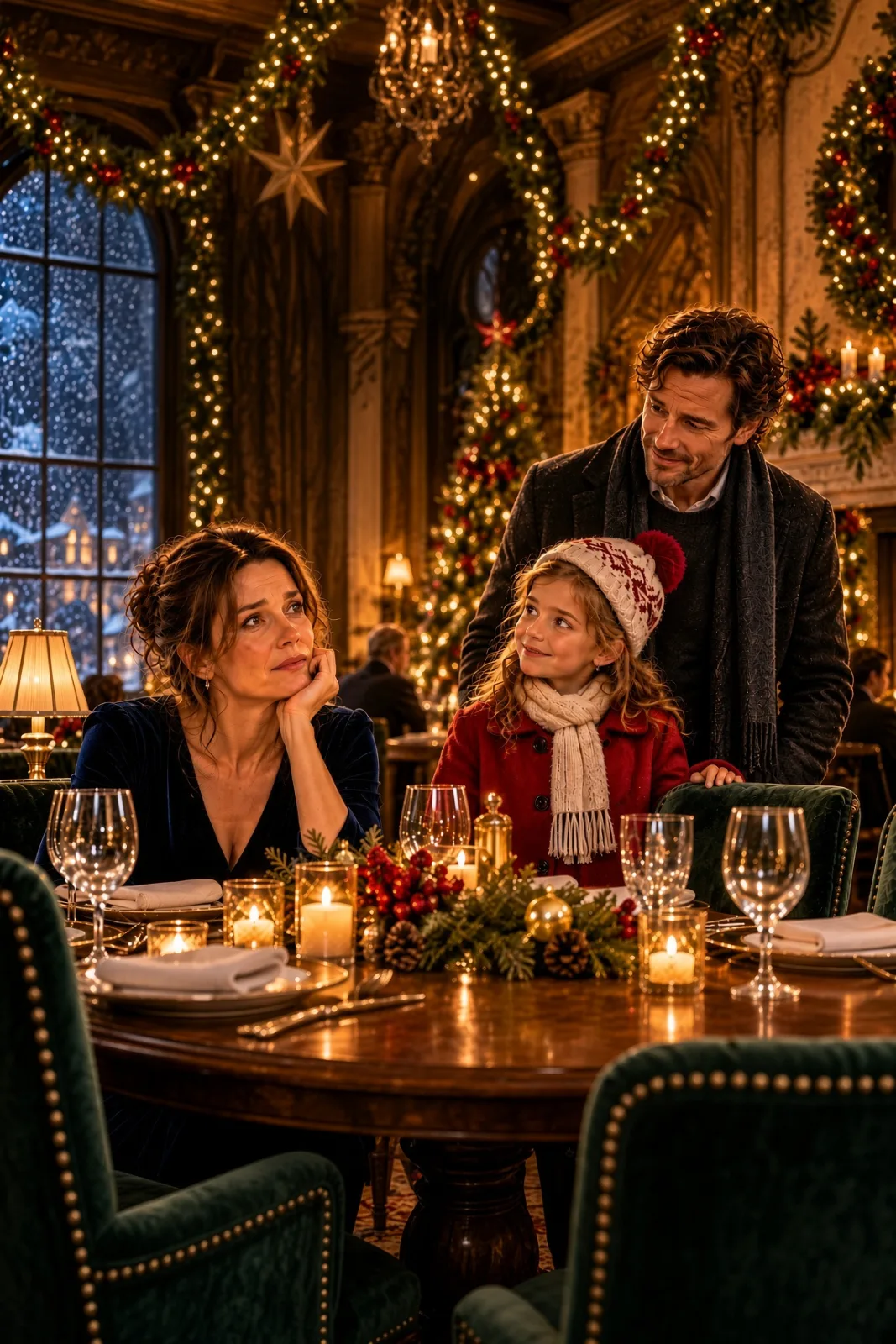
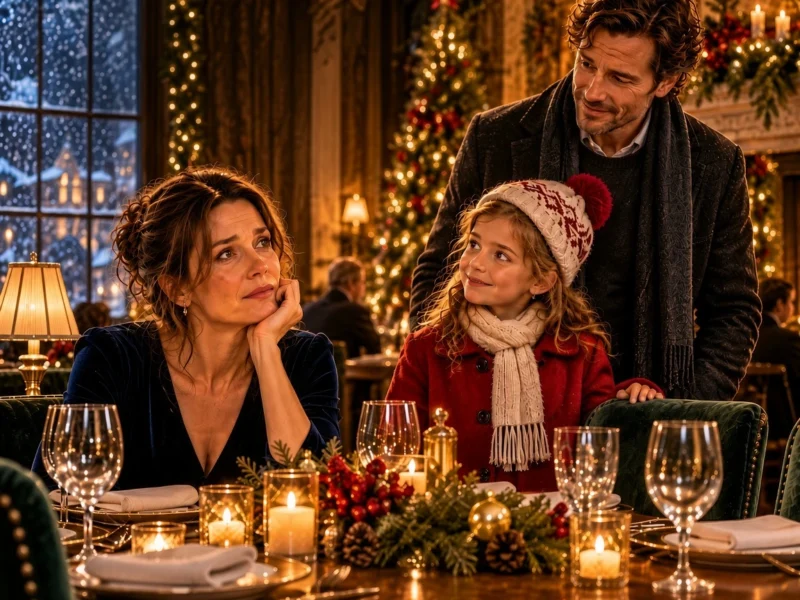
At 6:43 on Christmas Eve, Claire Bennett sat alone at a table set for five.
Her son wasn’t coming.
Neither was her daughter.
Her sister and brother-in-law had canceled.
Around Claire, families were opening crackers, and the five candles on her table were burning down beside four untouched glasses.
She had just caught the waitress’s eye, ready to tell her she was leaving, when a little girl in a red wool coat stopped at her elbow.
“Excuse me, are these chairs taken?”
“Not anymore,” Claire said.
“Were people meant to come?”
“Yes, sweetheart. They changed their plans.”
The girl considered the empty places.
“Well, we haven’t.”
Behind her stood a man with two scarves tangled around one hand.
He closed his eyes as though he had arrived a second too late to prevent a small disaster.
“Lucy, we talked about asking strangers personal questions.”
“I asked about chairs,” and then Lucy lowered her eyes to her boots.
“Something personal.”
The man turned to Claire.
“I’m sorry. We’ve been told there’s no table available and my daughter has decided that makes us a problem for everyone else to solve.”
“Only because they said we couldn’t stay,” Lucy muttered.
Claire should have explained that she was leaving.
She could already picture herself going home, hanging up the dress she’d bought for tonight and eating toast in the kitchen while the television made cheerful noises from another room.
Instead, she heard herself ask, “Have you eaten?”
“No,” Lucy said with the solemn urgency of a child who had not eaten for at least two hours.
“Would you like to join me?”
The man hesitated.
“That’s very kind, but I’ve booked five places. It seems a shame to waste them.”
Lucy had already pulled a chair away from the table.
Her father caught it before it struck the one behind.
“I’m Noah Whitmore,” he said.
“And this is Lucy, who usually waits for permission.”
“Mostly,” Lucy said.
“Claire Bennett.”
“Claire, are you absolutely sure?”
She glanced at the empty glasses.
“Yes, I am.”
He hung Lucy’s coat over the back of her chair.
A brass fox button had come loose, and he tucked it carefully into the pocket rather than pulling it off.
Such a small, familiar act of fatherhood.
It made Claire unexpectedly glad she’d invited them.
The waitress returned, relieved to have three diners instead of one.
She fetched a child’s menu while Noah struggled out of his overcoat.
His dark hair was flecked with gray at the temples, and a thin white scar crossed one eyebrow.
He seemed a little older than Claire, with a thoughtful, tired face.
His gratitude lacked the careful sympathy people showed when they thought you were lonely.
“Does the restaurant always have paper trees on the napkins?” Lucy asked.
“No, they’re folded,” Claire said.
“The staff make them.”
“Can Daddy do one?”
“Daddy can attempt one,” Noah said.
He unfolded his napkin, studied it, and began turning corners with the concentration of a man defusing a bomb.
The results lay flat and distinctly triangular.
Lucy leaned over it.
“It looks like a dead chicken.”
Claire’s laugh escaped before she could stop it.
“I was going for modern sculpture,” Noah said, pushing the unfortunate napkin aside.
“But critics are notoriously difficult.”
“Can you make a proper one?” Lucy asked Claire.
“My mother taught me how.”
She folded a corner, tucked the next underneath, then stood the napkin upright.
It listed slightly to the left, but Lucy greeted it with a pleased little gasp.
“Can we take it home?”
“It’s a napkin, Lucy,” Noah said.
“So, I’m reasonably certain they expect to use it again.”
Claire offered the girl a clean paper serviette from the bread basket.
Lucy set it beside her plate for later, then opened the children’s menu and asked whether roast potatoes counted as vegetables.
For the first time since arriving, Claire reached for her wine without checking her phone.
Garlands climbed the windows of the winter garden.
Paper stars hung above the booths and the fireplace cast a copper glow over the dining room.
Beyond the glass, Ashcombe’s Market Square was turning white.
Claire had brought her family here since Sophie was seven, when the children could barely stay awake until dessert.
This year, Daniel had sent his message shortly after lunch.
His girlfriend’s parents had invited them to stay in Bristol.
He hoped she didn’t mind.
Sophie, a nurse, had taken an unexpected shift at the hospital after a colleague fell ill.
Then Helen had messaged from the next village to say that Michael had a migraine and the roads were icing over.
They would have to do it another time.
There was nothing unforgivable in any one of those decisions.
Together, they had left Claire facing a table she’d spent weeks arranging.
She’d answered each message with the same brisk kindness.
“Of course, don’t worry. We’ll find another day.”
There hadn’t been a reply to the last one.
“What’s funny?” Noah asked.
Claire realized she was staring at the screen of her phone.
“Nothing. My sister says we must do this another time.”
“Is that funny?”
“Only because she said the same thing last year.”
He didn’t fill the silence with reassurance.
Instead, he reached for the bread, asked if she’d like some, and handed her the basket before serving himself.
Lucy had no such reservations.
“Are the people who didn’t come your children?”
“Two of them.”
“Are they in trouble?”
“Lucy,” Noah warned.
“No,” Claire said.
“They’re grown up. They have their own plans.”
Lucy considered this information.
“I hope I don’t grow up and become boring.”
“Excellent ambition,” Noah said.
“Keep it in mind when I ask you to tidy your room.”
Dinner arrived.
Lucy rejected the sprouts, negotiated unsuccessfully for a fourth roast potato, and dropped a spoon beneath the table.
Noah apologized when she wriggled under the tablecloth to retrieve it.
Claire discovered that his dry humor mostly appeared when he was embarrassed, and that Lucy was much funnier when she wasn’t trying to be.
When Lucy announced that the gravy tasted better than the gravy at home, Noah accepted the insult with dignity.
“I shall inform the packet.”
Claire nearly choked on her wine.
When the waitress offered mulled apple juice, Claire declined.
“I can’t bear cinnamon. It tastes like potpourri.”
Noah quietly ordered tea.
The conversation faltered only once.
Lucy pointed to the stars hanging above the fireplace and said, “Mom made some like those, only gold. We used to hang them in the windows.”
Noah’s fork stopped.
“She did.”
“Can we put ours up when we get home?”
“We’ll see, darling.”
“You said that about the tree lights.”
“I know.”
Lucy returned to her potatoes, but Claire noticed Noah touched the edge of his water glass twice before he spoke again.
Later, when the waitress led Lucy to the lavatory, he said, “I ought to explain. We didn’t come here hoping to find someone else’s reservation.”
“I gathered that.”
“My wife Evelyn used to work here. This was where we met.”
He glanced at the old photograph by the fireplace.
“Lucy found a picture of the three of us having Christmas dinner here. She asked to come back.”
Claire waited.
“Evelyn died three years ago.”
“I’m sorry.”
“Thank you.”
He rubbed the condensation from his glass with his thumb.
“I thought we’d be able to get a table. A rather spectacular failure of planning. Perhaps the dead chicken was a warning.”
His mouth curved, though his eyes were tired.
“There’s another reason Lucy wanted to come.”
He said, “We’re moving to Edinburgh next month. I’ve taken a job restoring a group of historic buildings there. She wanted one more Christmas in Ashcombe.”
“Next month,” Claire was surprised by this small, sharp disappointment and annoyed with herself for feeling it.
“Does she want to move?”
“She says she does. I’m not sure.”
He folded his hands.
“I’ve been working freelance since Evelyn died. It’s become difficult to turn down a steady contract with the mortgage and everything else.”
He hesitated.
“It’s a ten-month appointment, and they’ve offered help with moving costs. We’re planning to put the house on the market after New Year.”
“You must have a lot to organize.”
“More than I appear to have organized tonight.”
Lucy returned with damp hands and an urgent question about chocolate pudding.
The subject of Edinburgh disappeared beneath a discussion of custard, but its existence remained between the adults, like an extra place setting neither knew what to do with.
By the time they stepped into the square, the town clock had struck nine.
Lucy ran ahead to admire the lit-up fountain.
Noah stayed beside Claire, carrying the paper napkin tree in his coat pocket after losing an argument about its ownership.
“She’ll forget about it in a week,” he said.
“Possibly, or she’ll treasure it forever.”
“That would be rather unfortunate for the napkin.”
The snow had stopped, leaving the square hushed and bright.
“Did you have a nice evening?” Noah asked.
“I did. Even after the beginning. Especially after the beginning.”
Lucy came hurrying back, her scarf dragging behind her.
“Daddy, can Claire come to the river with us tomorrow?”
“Lucy, we can’t invite people without finding out what they’re doing.”
“That’s why I asked.”
Claire laughed softly.
Noah waited, giving her an easy way to refuse.
“I usually go for a walk on Christmas Day,” she said.
“What time?”
“Noon. The Old Stone Bridge.”
“Then perhaps I’ll see you there.”
He took out his telephone so they could exchange numbers.
When her screen lit up with a message from him, it read, “Thank you for saving our Christmas dinner. I promised not to bring any more folded poultry.”
Claire watched Noah fasten Lucy’s scarf before they set off.
At the corner, he turned and raised a hand.
Her phone vibrated.
A photograph from Daniel of his girlfriend’s family around the tree.
“Hope your evening wasn’t too quiet, Mom.”
Claire typed, “It wasn’t, actually.”
Then she slipped the phone into her pocket and walked home through the snow.
On Christmas morning, Sophie rang before Claire had finished her tea.
“Merry Christmas, Mom. Did you manage to enjoy yourself?”
The old answer waited on Claire’s tongue.
“Of course, darling. Don’t worry about me.”
“I did in the end, but I was disappointed, Sophie.”
There was a pause.
“Mom, I couldn’t just leave the ward. You know that.”
“I know. I’m not asking you to. I was looking forward to seeing you, that’s all.”
“I thought Dan would be there.”
“He thought you would.”
Claire wiped a ring of tea from the table.
“I think everybody assumed somebody else was coming.”
Sophie exhaled.
“Oh, Mom.”
“It’s all right. I just don’t want to pretend I didn’t mind.”
Her daughter was quiet for a few seconds.
Then someone called her name in the background and she had to go.
She promised to ring properly on her next day off.
Claire believed she meant it, but promises had begun to feel rather thin lately.
She finished her tea, found the sketchbook she hadn’t used since the summer, and put it in her bag.
At 11:55, she left for the bridge.
Noah and Lucy were waiting beside the river.
Lucy was making footprints in a patch of untouched snow.
Noah held three paper cups and looked as if he’d been persuaded to stand still only by considerable effort.
“Hot chocolate,” he said, offering Claire one without cinnamon.
“She was surprised.”
“You remembered?”
“It’s difficult to forget someone comparing a Christmas spice to furniture polish.”
“Potpourri,” she corrected.
“My mistake.”
Lucy took a large gulp from her cup, yelped because it was too hot, and blamed her father for not warning her.
“I did warn you,” he said.
“You said careful. You didn’t say burning.”
He unscrewed the lid and blew across the chocolate.
“There, give it a minute.”
“I don’t want to give it a minute.”
“Unfortunately, it hasn’t asked for your opinion.”
Lucy stalked ahead, making furious little boot marks in the snow.
Noah watched her go with an expression Claire recognized from years of parenting, affection fighting a losing battle with impatience.
“She’ll recover,” Claire said.
“She missed breakfast because she was too busy testing her chemistry set. I’m afraid every injustice is monumental until lunchtime.”
They followed the path beneath the willow trees.
The river was dark in the middle, its edges whitened with ice.
Across the bank, a row of cottages stood beneath a thin veil of smoke from their chimneys.
Claire stopped to open her sketchbook.
“You draw?” Noah asked.
“Badly, these days.”
The page held an unfinished study of the bridge she’d started months ago.
She had abandoned it when the art center’s autumn program became too busy.
“There’s the beginning of a lovely painting in that,” he said.
“That’s kind of you, but I’m better at arranging other people’s exhibitions than producing anything for them.”
“Is that what you want to be better at?”
She tucked the book away.
“It used to be.”
Noah didn’t argue.
That was oddly more persuasive than encouragement would have been.
Farther along the path, Lucy slipped on a frozen rut and sat down hard.
She wasn’t hurt, but she burst into tears, furious at the indignity.
Noah crouched to check her ankle.
When she snapped, “Leave me alone,” he stayed beside her, without touching her until she held out her hand.
It was a small thing, seeing him wait.
A few minutes later, they were walking again, Lucy between them, demanding to know whether swans got cold feet.
“They do have very good circulation,” Claire said.
“Better than Daddy’s, considerably,” Noah answered.
“My feet have been cold since November.”
By the bridge, Lucy spotted a woman walking a terrier and ran to ask if she could stroke it.
The dog owner agreed, keeping them within sight.
Noah rested his arms on the low stone parapet.
“Lucy knows we’re leaving, of course, but every day she remembers something else she’ll miss. Her friends, the school play, that dog.”
“Apparently, you could stay for now, perhaps.”
“Not forever on the work I’ve been getting.”
He rubbed his hands together against the cold.
“I’ve accepted the post. It starts on the twelfth. We need to find somewhere to rent before then, and the estate agent’s coming to photograph the house after New Year. A lot of change for our little girl.”
“I know.”
His answer came too quickly, and he winced.
“Sorry. I know you’re not criticizing me. I’ve had half the town offering helpful advice since I told them.”
Claire surprised them both by saying, “Then perhaps you shouldn’t have told half the town.”
He let out a quiet huff of amusement.
“You may be right.”
She took another drink of hot chocolate.
“I understand wanting a fresh start, but I wonder whether Lucy means the same thing by it as you do.”
Before he could reply, Lucy shouted that the terrier was called Mr. Pickles, which she considered the best name ever invented.
She wanted a dog immediately and was appalled to learn that moving house would not improve her chances.
When the walk ended, Noah offered to walk Claire home.
She declined.
Her house was the other way, and he had a child in need of lunch.
“I’ve got a box of Evelyn’s stars to sort through tomorrow,” he said, almost as an afterthought.
“Lucy wants to see if any can be repaired. Would you fancy coming around for tea? You’ve clearly got the better folding technique.”
Claire noticed that he hadn’t mentioned the promised move or how little time remained before it.
Perhaps he was making an invitation without knowing what he intended it to mean.
“I’d like to help Lucy,” she said.
“And I’d like to see you.”
His face warmed at the second sentence.
“About three.”
“Three.”
On the walk home, Claire stopped on the bridge and drew the willow branches while she could still remember how the light had fallen.
By the time she reached her front door, her fingers were numb, and the page was a mess of lines.
She kept it anyway.
Noah’s house stood at the end of a lane beneath a canopy of bare chestnut trees.
It was built of honey-colored stone with a blue front door and an unruly garden that had clearly belonged to someone who liked flowers more than tidiness.
Inside, packing boxes lined the hall.
There were pale squares on the walls where pictures had been taken down and strips of masking tape on the floor marked furniture destined for storage or sale.
Lucy dragged Claire toward the sitting room before she’d finished removing her coat.
“Look, these are Mom’s.”
On the table stood a battered shoe box filled with paper stars.
Some were gold, some silver, each made from folded strips of heavy paper.
Several had dates written on the back.
One was held together with old yellowing tape.
A photograph on the mantel showed a blonde woman laughing as she lifted a toddler toward a Christmas tree.
Beside it stood a little clay robin with one crooked wing.
Claire was grateful Noah hadn’t put those things in a box.
Lucy picked out a star with a torn point.
“This one was in my room. Can we fix it?”
“I think so,” Claire said.
“We could cut a fresh point.”
“No,” Lucy snatched it back.
“You can’t cut it.”
Claire’s hands went still.
“Mom made that bit,” Lucy said, her voice rising.
“You can’t just take it off.”
From the doorway, Noah moved forward.
“Lucy.”
“I’m sorry,” Claire said before he could intervene.
“I thought you wanted it to look new. I should have asked.”
Lucy stared at the broken star.
Her lower lip trembled.
“If we change it, it won’t be hers.”
“Then we won’t change it,” Claire said.
She slid an empty envelope across the table.
“We can keep it safe in here. And if you want, we can make a different star to hang beside it.”
Lucy considered the envelope.
“A blue one.”
“Any color you like.”
“Blue is my favorite.”
She looked up at her father, suddenly anxious.
“Do we have to put all Mom’s things in storage?”
“Not all of them,” Noah said, drawing up a chair.
“We’ll choose together. I promise.”
Lucy made him fetch the blue paper.
Then she spent twenty minutes painstakingly folding a new star, rejecting three attempts because their points weren’t even.
When she finished, she placed it beside the old gold one, not on top of it.
Noah’s own star was predictably disastrous.
He held it up for judgment and received a weary, “Daddy, maybe you should just do the glue.”
He managed a small laugh.
Lucy returned to her work, but Claire noticed how readily she glanced up when she heard it.
Later, Lucy went upstairs to find some ribbon.
Claire carried the used cups to the kitchen while Noah filled the kettle again.
“I’m sorry about the star,” he said.
“There’s nothing to apologize for. I nearly took something important away from her without realizing.”
“You stopped when she asked.”
Claire dried a saucer.
“I have a habit of trying to fix things. My children used to tell me I could turn losing a sock into a family project.”
“Did it work?”
“Never. I usually lost the other one.”
He leaned against the counter.
“You mentioned you were divorced four years. May I ask what happened?”
She might have given him the tidy version.
People change, life goes on.
But the kitchen was warm, and something about the way he waited made a tidy answer seem unnecessary.
“Peter wasn’t a bad man. There were no dramatic rows. He just gradually stopped wanting to know me.”
She turned the saucer in her hands.
“I used to save up funny little things that happened during the day to tell him over dinner. Once I spent an entire afternoon rehearsing how to describe a woman at work who’d accidentally locked herself in the supply cupboard.”
“What happened when you told him?”
“He said, ‘That’s nice,’ without putting down his phone.”
Noah’s hand rested beside hers on the counter.
“Eventually, I stopped saving up stories,” Claire said.
“I think that’s when the marriage ended. It took another six years for either of us to admit it.”
The kitchen was very quiet.
“I’d have liked to hear about the supply cupboard,” he said.
“She got out after forty minutes.”
“Excellent. I was worried there wouldn’t be a happy ending.”
Claire laughed, then found herself close enough to notice the faint scar above his eyebrow.
Noah glanced toward the doorway before taking her hand.
His thumb rested against her knuckles, light enough that she could have withdrawn it without explanation.
She didn’t want to withdraw it.
Then Lucy appeared, carrying a tangled length of ribbon.
“When we move, could Claire come and help paint my bedroom? I’m going to have blue walls.”
Noah released Claire’s hand.
“We can’t ask Claire to do that, darling.”
“Why not? She’s good at painting.”
“Because she’ll be here and we’ll be in Edinburgh.”
“Trains go to Edinburgh.”
Lucy looked from one adult to the other.
“You said so.”
“We haven’t made plans like that.”
His voice came out sharper than he intended.
Lucy’s face reddened.
“You don’t have to be cross.”
“I’m not cross. Go and put the ribbon with your stars, please.”
She left without a word, the ribbon trailing behind her.
Noah stared at the doorway.
“I shouldn’t have invited you into this. She’s already making plans.”
“She’s nine,” Claire said.
“She makes plans for tomorrow’s breakfast.”
“This isn’t breakfast. We’re leaving in two weeks, and she still asks when some of the people who promised to visit after Evelyn died are coming back.”
He lowered his voice.
“I don’t want to do that to her again.”
“Neither do I. I wasn’t going to promise her anything.”
“I know that’s not what I meant.”
“Then what did you mean?”
He pressed his fingers against his eyes.
“I enjoyed Christmas Eve yesterday too, more than I expected. And now I can see how easily this becomes something neither of us is ready for.”
Claire understood the warning.
She wished he had given it before he’d reached for her hand.
“I’m not asking you for a future, Noah. We’ve known each other three days.”
“I realize that. But you’ve invited me here, asked me to come back, and then spoken as though I’m a mistake your daughter might make.”
His shoulders sank.
“You’re right. I’m sorry.”
“You’re allowed to be afraid. You’re allowed not to want this. I just need you to tell me which it is rather than decide for all three of us.”
He took a long breath.
“I don’t know.”
There was nothing dishonest in the answer.
It hurt anyway.
Claire put the tea towel down.
“Then I think I should go.”
He walked her to the hall where her coat was still hanging beside Lucy’s red one.
Upstairs, a drawer opened and shut.
Noah said nothing.
At the door, Claire turned back.
“Please tell Lucy I enjoyed making stars with her and that I’m sorry I frightened her about the gold one.”
“I will.”
She stepped outside.
He stood in the doorway until she reached the end of the path.
This time, neither waved.
At home, Claire put away her good coat and made a pot of tea.
She nearly sent Noah a message saying she understood.
She did understand, but was weary of smoothing things over before anyone else had time to think.
She took out her paints instead.
She found watercolor paper and began painting the bridge, leaving the white of the page for snow.
The willow branches were too heavy.
She ruined one bank by reaching for the wrong blue.
She started another sheet.
By midnight, there were three unsatisfactory paintings propped against the kitchen cupboards.
She hadn’t noticed the time passing.
It was a welcome discovery.
The next morning, she emailed the organizer of the spring exhibition at the arts center.
Claire had arranged the exhibition for other artists for years, but never submitted her own work.
This time, she asked for an entry form.
Meanwhile, Noah found Lucy on her bedroom floor sorting the new blue stars into a box.
“Why did Claire go?” she demanded.
“I upset her.”
“Are you going to say sorry?”
“Yes.”
Lucy stuck a strip of tape to her sleeve and tried to remove it with her teeth.
“I thought she was going to come to Edinburgh.”
“She hasn’t said she would, and she has her own life here.”
“Oh.”
Lucy bent her head over the box.
“I don’t really want to go either.”
Noah sat on the floor beside her.
“You told me you did.”
“Because you said the house makes you sad.”
He couldn’t remember using precisely those words.
He could remember saying enough things close to them.
“Sometimes I am sad here,” he said.
“I would be sad sometimes in Edinburgh, too. That’s not something you have to solve.”
Lucy fished a folded sheet of purple paper from beneath the box.
“I made this before Christmas. It’s for Santa, but I didn’t post it.”
“Would you like me to?”
She shook her head and gave it to him.
“Dear Santa, I don’t need lots of presents. I know you can’t bring Mom home, but can you make Daddy laugh again? Not his pretend laugh when I tell him jokes. His big laugh from when we were little. I miss it. Love, Lucy.”
Underneath, she’d drawn a small man with an enormous open mouth.
She’d colored the mouth bright red.
Noah read the letter again, more slowly.
“I did hear you laugh at the restaurant.”
Lucy said, “A little bit. I thought maybe you were getting better. Then today you were worried again.”
He set the paper aside and pulled her into his lap.
“Listen to me, Lucy. You are not responsible for making me happy. You can miss Mom and I can miss her and we can still have good days. Sometimes they’ll be on different days. That’s all right.”
“Even if you get a girlfriend,” he swallowed.
“Even then.”
Lucy picked at the tape on her sleeve.
“I liked Claire, but she wasn’t trying to be Mom.”
“I know.”
“And she let me keep the broken star.”
“Yes, she did.”
After a while, Lucy retrieved the folded napkin tree from Noah’s coat pocket and stood it beside the stars.
It promptly collapsed.
“Oh, Dad, it’s gone all chicken again.”
He laughed at the absurd little heap of paper.
This time, he didn’t cut the sound short.
Lucy leaned into him, her cheek against his jumper, and he held her there until she wanted to get down.
That evening, Noah spread the Edinburgh contract and the estate agent’s papers across his kitchen table.
The job began on the twelfth of January and required him on site.
He couldn’t change that.
He’d already asked about a later start and the possibility of working remotely when he’d accepted the position.
Neither had been possible, but selling the Ashcombe house immediately was still a choice.
He wrote to the estate agent asking her not to proceed with the photographs or listing until he’d had time to talk properly with Lucy about their future.
Then he spent an hour comparing the costs of renting a small flat in Edinburgh while keeping their home in Ashcombe.
It would be expensive.
He might still have to sell the house eventually.
The mortgage wouldn’t disappear, and neither would the cost of living in another city.
He closed the property listings and returned to the notes he’d made about schools.
There were calls to make and arrangements he couldn’t finish during the Christmas holidays.
He would have to tackle them one at a time.
Then he wrote to Claire, apologized without explaining away his behavior, and asked whether she would meet him at the bridge.
She read his message twice before agreeing.
They met just before dusk.
Snow lay in the cracks between the stones, and the river carried thin plates of ice beneath the bridge.
Noah had been waiting long enough for his ears to turn red.
“Thank you for coming,” he said.
“Your message sounded as though you’d thought about what happened.”
“I have. I was frightened by how much I liked being with you, and I made it sound as though you were the danger.”
He pulled off one glove, then seemed unsure what to do with it.
“That was unfair, especially after I’d asked you here.”
Claire watched the water move beneath them.
“You don’t have to want a relationship, Noah.”
“I know, but I would like the chance to find out whether we could have one.”
She faced him.
“You’re still going to Edinburgh.”
“Yes. The job starts on the twelfth. Lucy and I will be there for at least ten months. I’m not going to tell you I’ve magically solved that.”
“Good. I’d have had questions.”
He gave a brief, nervous laugh.
“I’ve asked the estate agent to hold off listing the house. I want to review things in the summer once Lucy’s had time to settle. I’m looking at places to rent in Edinburgh, but I haven’t found anything yet. Keeping both places will be expensive, and I might still have to sell eventually.”
Claire nodded.
“At least you’re giving yourselves time.”
“Lucy admitted she was agreeing to move because she thought it would stop me being sad.”
“That must have been hard to hear.”
“Harder to realize I’d let her think my happiness was her responsibility.”
He paused.
“And then I did much the same thing to you. I pushed you away before you could disappoint us.”
Claire turned her cold hands inside her pockets.
“I can manage the distance, Noah. What I can’t do is make every arrangement and pretend I’m fine when plans fall apart.”
“Understood.”
“I want to paint again. I’ve asked for an entry form for the spring exhibition. I might not get anything accepted, but I’m going to try.”
His delight was immediate and unguarded.
“I’d love to see it.”
“I haven’t agreed to show you.”
“No, quite right. You’ll have to earn that privilege.”
He took the rebuke seriously for a beat before recognizing the laughter in her voice.
“I’d like to take you out,” he said.
“Just the two of us. A proper date before I go. Then we can see whether we want to make the train journeys.”
“And Lucy, she doesn’t need another person to manage her feelings for her.”
“I’ll tell her we’re getting to know each other, and I won’t make promises on your behalf.”
Claire studied the lines of his face, the tired eyes, and the scar above his eyebrow.
He wasn’t offering certainty.
Neither could she, but he had listened and he’d begun changing something that mattered before asking her to change anything at all.
“One date,” she said.
“Somewhere with a reservation, preferably.”
He reached toward her, stopping just short of her hand.
Claire closed the distance herself.
“May I kiss you?” he asked.
“Yes.”
His lips were cold from the air.
His hand was warm against her cheek, and he kissed her without hurrying, as though they had nowhere more important to be in that particular minute.
When they parted, Claire was still holding his glove.
“I think this is yours,” she said.
“I’d been wondering where it went.”
She laughed and gave it back.
The river continued under the bridge.
The practical problems would be there in the morning.
For now, they walked into town holding hands.
Their first date was at an Italian restaurant on the twenty-ninth of December.
Lucy stayed with her aunt.
Claire and Noah disagreed about the best film ever made, discovered a shared dislike of olives, and talked long after the waiter had cleared the plates.
In January, Noah and Lucy moved into a small rented flat in Edinburgh.
The first week was miserable.
Lucy missed her friends.
Noah worked late and Claire discovered that a telephone call was a poor substitute for being able to pass someone a cup of tea.
They kept calling anyway.
In March, Noah missed the opening night of Claire’s first exhibition when a restoration emergency kept him in Edinburgh.
He rang before the event and didn’t ask her to pretend it didn’t matter.
Claire told him she wished he’d been there.
The following Saturday, he took the early train and stood in front of her watercolor of the winter bridge until she grew embarrassed.
“It’s not finished very well at the bottom,” she told him.
“I like that you left room for the river.”
Sophie arrived with flowers, having swapped a shift weeks in advance.
Daniel had traveled from Bristol after work and arrived still wearing his work boots.
Neither had been told to come.
Claire was almost as pleased with their noisy argument about which painting was best as she was with the exhibition itself.
By autumn, Lucy had made friends in Edinburgh.
Noah sold the old house only after she had helped decide what to keep, including every one of Evelyn’s stars.
His contract was extended into the following spring.
He and Claire discussed what that meant without pretending it was simple.
There were long journeys, birthdays celebrated on the wrong day, and a missed train that ruined a carefully planned weekend.
They learned to tell each other the truth before disappointment hardened into silence.
One year after the evening they met, Claire returned to the winter garden for Christmas Eve dinner.
Noah and Lucy had traveled down from Edinburgh the previous afternoon, bringing overnight bags, presents, and a small box of carefully wrapped paper stars.
At 6:43, five people sat at Claire’s table.
Daniel and Sophie were arguing over the last bread roll.
Lucy, now ten, wore a new red coat, slightly too large for her, and refused to take it off until she was warm enough.
Noah sat beside Claire, his hand resting on the back of her chair, while they debated whether the Christmas pudding was worth ordering.
Above them hung golden paper stars.
Lucy had brought one of Evelyn’s in a little protective envelope, and the waitress had helped her hang it at the edge of their table.
Beside it was the blue star she’d made with Claire.
Noah unfolded his napkin and attempted a Christmas tree.
Lucy assessed it with the exhausted patience of a much older person.
“Dad, it’s still a chicken.”
He laughed, and this time his daughter scarcely glanced up.
His laughter had become an ordinary sound in their home again, though there were days he missed Evelyn enough to cry.
Lucy had learned those days were allowed, too.
Claire’s telephone lay forgotten in her handbag.
She was telling Sophie about an artist who had accidentally painted the gallery door instead of the display panel, and Sophie was laughing so hard she couldn’t finish her drink.
Across the table, Noah was listening.
Then Lucy noticed a woman sitting alone by the fireplace, her dinner untouched.
The woman was watching the crowded tables with a careful expression.
Claire recognized it.
Lucy tugged at her father’s sleeve.
“Do you think she’s waiting for somebody?”
“I don’t know, darling.”
“Could I ask?”
Noah turned to Claire.
She moved her chair a little closer to his.
Lucy crossed the restaurant and stopped beside the woman’s table.
Claire couldn’t hear what she said.
She saw only the woman’s surprised expression, the way she glanced toward their crowded table and then the slow, grateful smile that spread across her face.
The woman nodded.
Lucy turned back, her red coat bright against the firelight.
“Can we have one more chair?”
“Of course,” Claire said, making space beside her.
“Right here.”