She Ran From Her Own Wedding and Hid in a Stranger’s Truck—He Owned the Company Her Groom Worked For.
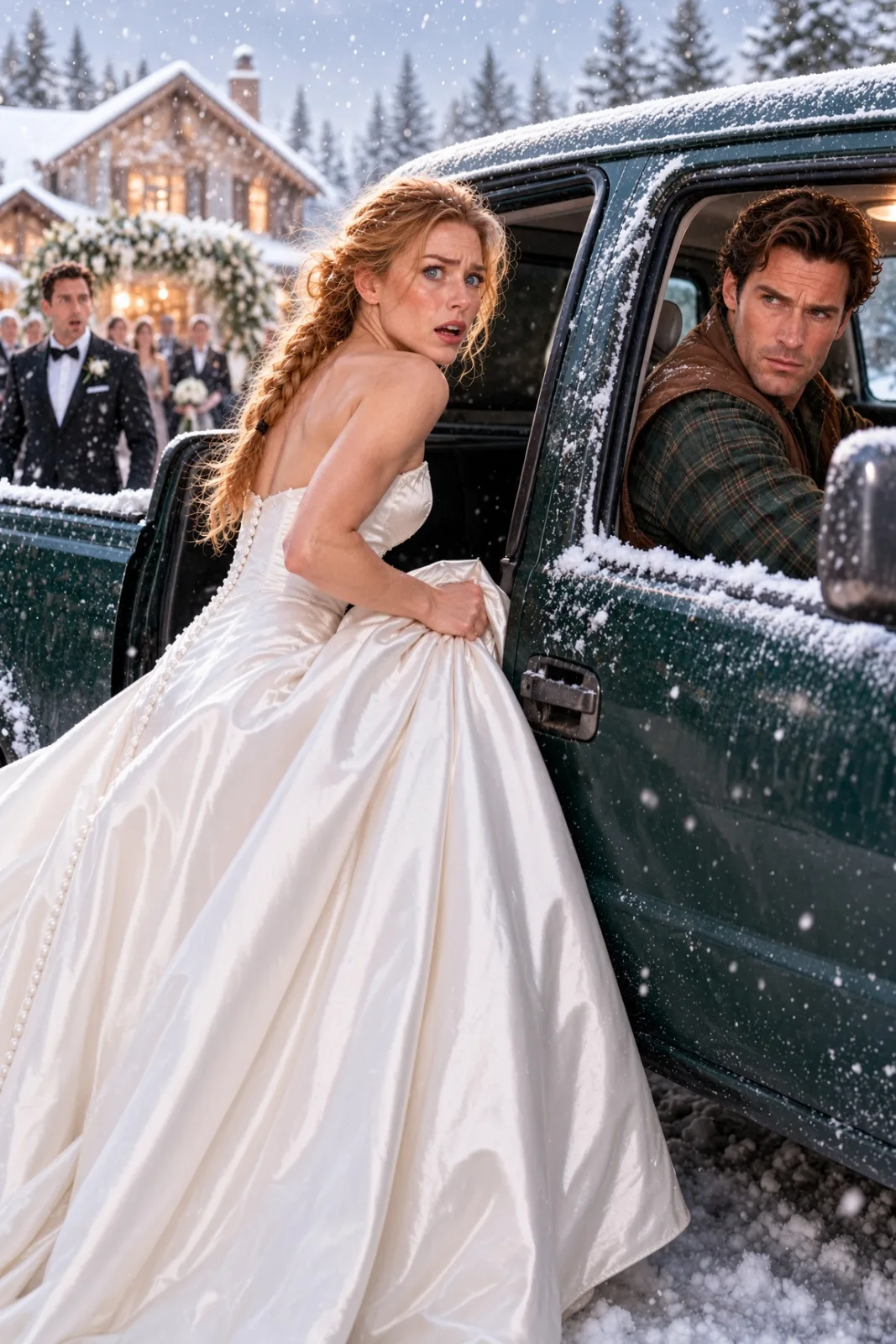
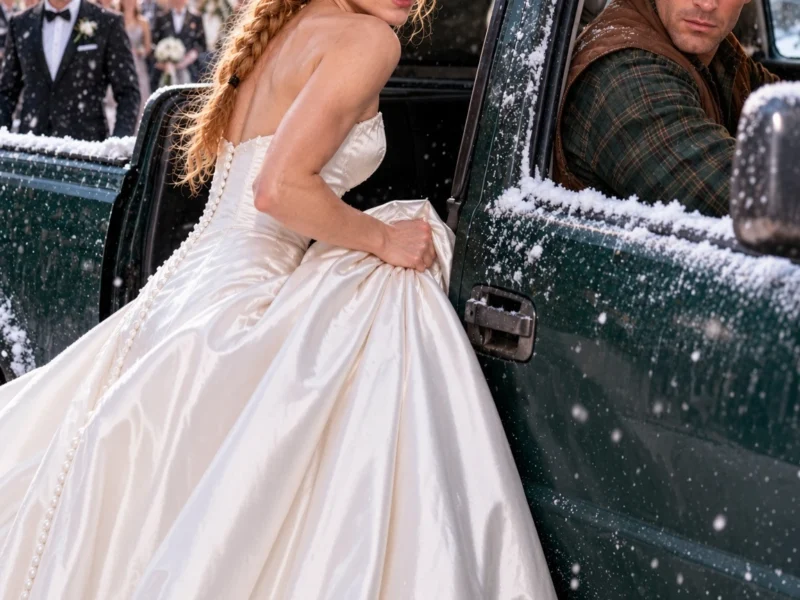
Two hours before her wedding, Kate Sullivan stood alone in the bridal suite of the Mercer Mountain Lodge in Pine Hollow, Vermont, in a white satin gown with forty-two buttons down the back and realized she had forgotten her grandmother’s handkerchief.
It was a small thing, a square of old Irish linen with a blue S embroidered in one corner that every Sullivan bride had carried since 1931.
Her grandmother had carried it.
Her mother had carried it.
It was in the pocket of Kate’s own coat in the coat room at the end of the hall where she had left it that morning in the rush.
The bridesmaids had gone down to the lobby to meet the photographer.
The hall was empty.
So Kate gathered up her skirt in both hands and slipped out in her stocking feet and went to get it herself.
She was thirty-four years old.
She was the large animal veterinarian for half of Lamoille County.
She had delivered calves in barns at three in the morning in thirty below zero and once spent an entire Fourth of July with her arm inside a horse.
She was tall and strong and not easily frightened, with long strawberry blonde hair that was, for the first time in her adult life, not in a single practical braid but pinned up in soft curls by a woman from Burlington who had charged two hundred dollars to do it.
And she was happy.
That was the thing she would remember later.
In the moment before she opened the door of the coat room, she was completely, foolishly happy.
The door was already open an inch.
There were voices inside, men’s voices.
She stopped with her hand on the frame.
“Relax,” one of them was saying.
“She’s not going to find out.”
It was Trent, Trent Holloway, her fiancé.
Thirty-seven, handsome, polished, and easy, vice president of development at Mercer Mountain Resort.
In two hours at the far end of the great hall under the antler chandelier, she was going to marry him.
“You’re sure about the deed?” That was Kyle, his best man.
“Her grandfather’s giving her the farm as a wedding present. He told me himself. Signing it over the day after Christmas. And I’ve already talked to him about putting it in both our names. Husband and wife. Makes sense, right?”
Trent laughed softly.
“Once I’m on the deed, Mercer gets the North Ridge for the new lift, and I get my bonus and the partnership. Jack’s been on my back about that ridge since April. And Kate? Kate’ll come around. She always does. She loves me.”
A pause.
“Besides, she’s got no idea what that land’s worth. She thinks it’s just a lot of maple trees and an old sugar house.”
Kate stood in the hall in her stocking feet with her hand flat on the doorframe and did not breathe.
The farm was three hundred acres of maple forest on the ridge above the resort.
Her great-grandfather had tapped those trees.
Her grandfather had tapped them for seventy years and still did at eighty-four with a bad hip and a borrowed tractor.
She had grown up in that sugar house every spring in clouds of sweet steam.
It was the only thing her family had ever owned.
And for fourteen months, the man in that coat room had sat at her grandfather’s kitchen table and eaten his pancakes and asked polite questions about the trees.
She did not go into the coat room.
She did not scream.
She did not cry.
She turned around very quietly with her skirt gathered in her fists and walked down the back stairs of the Mercer Mountain Lodge past the kitchens, past a startled boy carrying a tray of champagne glasses, and out through a fire door into the parking lot.
It was snowing.
Not gently.
The storm the radio had been warning about for three days had come early, and it was coming sideways off the mountain, thick and white and wild, and the parking lot was already half buried.
She was in a satin wedding gown and stockings with no coat, no phone, no keys.
Her own truck was parked at her grandfather’s farm, eight miles away, because Trent had said the bride shouldn’t drive herself to her own wedding.
She stood in the snow for perhaps five seconds with her bare shoulders going numb and understood that she could not go back inside.
There was a pickup truck at the edge of the lot, a big dark green one with the engine running and the headlights on and nobody in it.
The rear door was unlocked.
She did not think about it.
She opened it, climbed into the back seat, gown and all, and pulled the door shut behind her and lay down on the floor under an old wool blanket that smelled of dog and wood smoke and shook.
A minute later, the driver’s door opened.
Somebody got in.
A big dog jumped into the passenger seat, turned around twice, and lay down with a groan.
The truck began to move.
Kate lay on the floor under the blanket with her heart going like a hammer and did not make a sound, and the truck drove out of the lot and turned uphill into the storm.
She lasted eleven minutes.
Then the dog put its head over the back of the seat and sniffed the blanket, and the dust from the blanket went up Kate’s nose and she sneezed.
The truck stopped so hard she slid into the back of the driver’s seat.
There was a long silence.
Then the overhead light came on and a man turned around in the driver’s seat and looked down at her.
He was about thirty-eight.
Chestnut brown hair pushed back from a weathered face, a few lines at the corners of the eyes from a lot of time outdoors, and gray eyes very steady that took in the wool blanket and the white satin under it and the bare shoulders and the ruined two-hundred-dollar curls all in about one second.
He did not say, “Who are you?”
He did not say, “What are you doing in my truck?”
He said, “Are you hurt?”
“No,” said Kate.
“Are you in danger? Is somebody after you?”
She thought about it.
“Not the way you mean.”
He looked at her a moment longer.
Then he reached across to the passenger seat, past the dog, and picked up a heavy sheepskin coat and passed it back to her over the seat.
“Put that on,” he said.
“You’re blue.”
She put it on.
It came down to her knees and smelled of cold air and cedar.
She pulled it tight around the gown and sat up slowly on the back seat.
The big dog, a gray-muzzled old shepherd mixed with one ear up and one ear down, put his head on her knee and sighed.
“That’s Moose,” said the man.
“He likes you. He doesn’t like anybody.”
“Who are you?” said Kate.
“Jack Mercer,” said the man.
The truck was very quiet.
The wipers went back and forth.
The snow came at the windshield in long white streaks.
“Mercer,” said Kate slowly.
“As in Mercer Mountain?”
“Yes. As in Trent’s boss.”
He looked at her in the rearview mirror, and she saw him work it out.
The white gown, the lodge, the date.
She saw the exact moment he understood whose wedding he had just left early and whose bride was sitting in his back seat in his coat.
“You’re Kate,” he said.
“I’m Kate.”
“You’re supposed to be getting married in an hour and a half.”
“I’m aware of that,” said Kate Sullivan.
“Turn the truck around, Mr. Mercer. Take me to my grandfather’s farm. It’s on the Ridge Road, eight miles.”
He looked at her a moment longer.
Then he nodded and put the truck in reverse and began to turn it around on the narrow mountain road.
He got halfway.
There was a sound from somewhere behind them in the white dark.
A long, slow, tearing crack, like the sky splitting, and then a crash that shook the truck.
In the glow of the taillights, about fifty yards back down the road, a huge old spruce lay across both lanes, its branches still trembling, its roots torn up out of the snow.
Jack Mercer looked at it for a long moment.
“Well,” he said quietly, “that’s the road.”
“Then go around.”
“There is no around. There’s one road up this side of the mountain, and that tree is lying on it, and the town plow won’t get up here until the storm breaks, which according to the radio might be Tuesday. It’s Saturday.”
“I know what day it is.”
He turned the truck back uphill.
“My cabin’s a mile and a half on. It’s got a wood stove and a lot of firewood and a phone, if the line’s still up. It’s the closest roof. I’m sorry. It’s the best I can do.”
Kate sat in the back seat in his coat, with his dog’s head on her knee, and looked at the back of his head.
“Did you know?” she said.
“Know what?”
“About the ridge, my grandfather’s land, that Trent was marrying me to get it for you.”
The truck crept on up the white road.
For a long time he did not answer.
His hands were very still on the wheel.
“I knew I wanted the north ridge,” he said at last.
“I’ve wanted it for two years. I told Trent to get it. I didn’t know he was planning to marry it.”
“I don’t believe you,” said Kate.
“I know,” said Jack Mercer.
“I wouldn’t either.”
They didn’t say anything else until the cabin.
The cabin sat in a clearing at the end of a long driveway that Jack had to take in four-wheel drive, and even then the truck slid sideways twice.
It was bigger than Kate had expected, and smaller than a CEO’s house had any right to be.
Two stories of dark logs, a steep green roof already deep in snow, a stone chimney, and a long porch stacked to the rafters with split firewood.
Inside, it was cold and dark and smelled of cedar.
Jack lit two kerosene lamps because the power was already out, and knelt in front of a big black wood stove and built a fire with the quick, careless confidence of a man who had done it every day for years.
Moose went straight to a worn rug in front of the stove and lay down on it as if he had been waiting all day.
Kate stood in the middle of the room in his sheepskin coat and her ruined satin gown, dripping on his floor, and looked around.
One big room, a kitchen at one end, a stone fireplace at the other, a long leather sofa, shelves of books, a desk covered in papers and maps.
A narrow staircase going up to what must be a loft.
No photographs, no pictures on the walls.
It looked like a place where a man slept and worked and did nothing else.
“The phone’s by the desk,” said Jack without turning around.
“Try it.”
She tried it.
There was a dial tone, faint and crackling.
She called the farm.
Her grandfather answered on the first ring as if he’d been sitting beside it.
She could hear voices behind him, a lot of voices.
Her bridesmaids, somebody crying, somebody shouting.
“Grandpa,” she said, “it’s me. I’m safe. I’m not hurt. I’m not getting married.”
The line hissed.
“I’ll tell you everything when I can. Don’t let Trent near the farm. Don’t sign anything. Promise me.”
“Katie, where are you?”
“I’m—” She looked at the man kneeling at the wood stove.
“I’m with a friend on the mountain. The road’s closed.”
“Katie, Trent’s here. He’s saying—”
The line went dead.
She stood holding the receiver.
Then she put it down very carefully and sat down on the arm of the leather sofa.
And for the first time since the coat room, she began to shake so hard her teeth chattered.
Jack got up from the stove.
He went to the kitchen and came back with a mug of something hot and put it into her hands without a word.
It was tea, very strong with a great deal of sugar in it.
Then he went upstairs and came back down with an armful of clothes, a pair of thick wool socks, flannel pajama pants, a gray sweatshirt that said Mercer Mountain Ski Patrol across the front.
“They’ll be big,” he said.
“The bathroom’s through there. There’s no hot water till the generator’s on. I’ll do that now.”
He paused.
“You’ll need help with the buttons.”
Kate looked down at the forty-two satin buttons that ran from the nape of her neck to the base of her spine.
“Yes,” she said through her teeth.
“I will.”
She stood with her back to him in front of the wood stove, and he undid them one by one, slowly, with fingers that were cold from outside and very careful.
And neither of them said a single word the whole time.
When he got to the last one, he stepped back and went out the back door into the storm to start the generator, and she heard him stay out there a good deal longer than it took.
When he came back, she was sitting on the sofa in his sweatshirt and his socks, with her hair down out of its ruined curls, and the tea in both hands.
And the wedding gown was lying over the back of a kitchen chair like a white ghost.
He sat down in the chair on the other side of the stove.
“I’m going to tell you something,” he said, “and you’re not going to believe it, and that’s all right. But I’m going to say it once anyway. I didn’t know about the wedding. I didn’t know he was planning to put himself on your grandfather’s deed. If I had known, I’d have fired him on the spot. That’s the truth.”
“You told him to get the ridge.”
“Yes. You’ve been on his back about it since April.”
He looked at her.
“Is that what he said? In the coat room, two hours before my wedding, while I was standing outside the door in my stockings.”
Kate’s voice was very level.
“He said you get the North Ridge, he gets a bonus and a partnership, and I’ll come round because I always do.”
Jack was quiet for a long moment.
The fire popped in the stove.
“I’ve been on his back about the ridge since April,” he said slowly.
“That part’s true. I gave him a target. I didn’t ask him how he’d meet it. I should have.”
He looked down at his hands.
“That’s on me. I’m not going to pretend it isn’t.”
She had expected him to argue, to explain, to tell her she didn’t understand business.
She had been ready for that.
She was not ready for a man who just sat there and said, “That’s on me.”
“I don’t like you,” she said.
“That’s fair,” said Jack Mercer.
“The sofa’s yours. There are blankets in the chest. I’ll keep the fire going.”
She did not mean to fall asleep.
She meant to lie awake on the sofa all night with one eye on him.
But it had been the longest day of her life, and the stove was warm, and the old dog had climbed up and lain across her feet like a hot water bottle.
And the last thing she remembered was the sound of the wind and the flicker of the lamp, and the man in the chair by the stove with a book open on his knee that he wasn’t reading.
When she woke up, it was morning.
Gray light was coming through the windows, snow light, flat and white.
The fire was still burning.
The man was still in the chair.
He had not moved.
He had a fresh log in his hand, and he was looking at the stove, and from the shadows under his eyes, he had not slept at all.
And she was wearing his coat, not the sweatshirt.
The sweatshirt was still on, but over it, tucked around her, all the way up to her chin, was the big sheepskin coat that smelled of cedar.
She had not been wearing it when she lay down.
She knew she hadn’t.
She lay very still, looking at him over the collar of it.
“It got down to six around three,” said Jack without turning his head.
“The stove can’t keep up with the whole room when it’s that cold. You were shivering in your sleep.”
“So you put your coat on me.”
“It’s a good coat,” said Jack.
“It was just lying there.”
She sat up slowly with the coat still around her.
“You sat up all night.”
“Somebody had to feed the stove.”
He got up stiffly and put the log in and shut the iron door and went to the kitchen.
“There’s coffee, real coffee, on a camp stove and eggs. That’s about all there is.”
She watched him go.
Then she looked down at the coat.
And for a moment she did not know what to think about Jack Mercer at all.
That first day, the storm did not let up once.
Snow came down past the windows so thick you couldn’t see the trees at the edge of the clearing.
The phone line was dead.
Jack’s cell phone had no signal.
The tower on the summit had gone down in the night.
The radio said the whole of Lamoille County was closed and the governor was asking people to stay home and the plows would not be out on the mountain roads until the snow stopped falling.
So they stayed home.
Kate split wood on the porch because she could not sit still and because she was very good at it and because there was a great deal she wanted to hit with an axe.
Jack came out after twenty minutes, watched her split four logs clean through with four strokes, and went back inside without a word and did not offer to help again.
At noon, the generator coughed and died.
Jack went out and worked on it for an hour in the snow and came back with grease on his hands and ice in his eyebrows and said, “Carburetor. I’ll need a part. It’ll have to wait.”
After that, there was no electricity at all, only the stove and the lamps.
In the afternoon, Kate sat on the floor by the stove with Moose’s big gray head in her lap and did what she always did with a dog, which was look at him properly.
She felt along his back legs and his hips and found the place on the left hip where he flinched.
“How old is he?” she asked.
“Thirteen. Fourteen, maybe. He was a shelter dog. Nobody knew.”
“He’s got arthritis in this hip, bad. You can feel it grinding.”
She moved the joint very gently and the old dog groaned and licked her wrist.
“Is he on anything for it?”
“I didn’t know he had it,” said Jack slowly.
“He’s been hiding it. They do. He’d rather limp than let you know.”
She rubbed the old dog’s ears.
“When the road opens, bring him to my clinic. There’s a lot we can do. He’s got some good years left in him.”
Jack was quiet for a moment.
“You’d treat my dog,” he said, “after yesterday?”
“Your dog didn’t do anything to me,” said Kate.
“Your dog’s the only one in this whole thing who’s been completely honest.”
He laughed.
It came out of him like it surprised him.
And she found to her annoyance that she was smiling, too.
At suppertime, she went through his kitchen cupboards and gave a verdict.
“You have,” she said, “four cans of chili, a bag of flour, half a bag of coffee, eleven eggs, a box of crackers, and a jar of peanut butter, and dog food, a lot of dog food. Mr. Mercer, how do you live?”
“Mostly at the lodge,” said Jack.
“They feed me.”
“That’s not living, that’s grazing.”
She opened the last cupboard, the tall one by the back door, and stopped.
On the top shelf in a neat row stood six glass jugs of maple syrup, dark amber, each one with a plain white label hand-lettered in blue ink that she would have known anywhere in the world because she had lettered half of them herself at the kitchen table in the farmhouse every April since she was twelve.
Sullivan’s Ridge, pure Vermont maple, grade A dark.
She turned around slowly with one of the jugs in her hand.
“Where did you get these?”
Jack looked at the jug, then for some reason he looked a little embarrassed.
“The general store in town. Your grandfather sells it there every spring. I buy six.”
He shrugged.
“I don’t know. It’s the best syrup on the mountain. I’ve tried all of them. Nothing else tastes like it.”
“That’s because the north ridge gets the cold nights,” said Kate slowly.
“The sap runs later and sweeter. My great-grandfather used to say you could taste the snow in it.”
They stood in the kitchen and looked at each other over the jug, and neither of them said what they were both thinking.
That for two years he had been trying to buy the trees this syrup came from.
And that every spring, without knowing whose hands had poured it, he had bought six jugs of it and kept them on the top shelf like something precious.
“Well,” said Kate at last briskly, putting the jug down on the counter, “you have flour and eggs and the best syrup in Vermont. That’s pancakes. Hand me a bowl.”
She made pancakes on the wood stove in a cast iron pan in his sweatshirt with her sleeves pushed up.
He set the table badly and she redid it without comment.
They ate pancakes and maple syrup for supper by lamplight with the storm screaming outside and Moose begging shamelessly at both their elbows.
“These are very good,” said Jack after his fourth.
“It’s my grandfather’s syrup,” said Kate.
“Anybody can make a pancake. The syrup’s the whole thing.”
He looked at her across the table for a moment in the lamplight.
“No,” he said quietly.
“I don’t think it is.”
She looked down at her plate and did not answer and was annoyed to find that her face had gone warm.
That night, by the stove, in the lamplight, with the wind going around the cabin like a train, he asked her about Trent.
Not about the coat room.
About before.
She did not want to tell him.
She told him anyway.
She did not know why.
She told him about the night fourteen months ago at the county fair, when a handsome man in a good jacket had walked up to her at the dairy barn while she was looking at a cow’s foot and said it was the first time he’d ever seen a woman do something useful at a fair.
How he’d come to the farm the next Sunday with flowers for her grandfather.
How he’d asked about the trees.
How he’d asked about the trees every single Sunday for fourteen months.
And how much he loved the old sugar house and whether her grandfather had ever thought about what would happen to the land.
How he’d been so patient, so interested, so kind.
“I thought he loved it,” she said, looking into the fire.
“The farm. I thought that was one of the things he loved about me. That I came with all those trees.”
She laughed very quietly with no humor in it at all.
“I suppose that was true.”
Jack said nothing for a long time.
“I’m sorry,” he said at last, “for whatever part of that was mine.”
“Which part was yours?”
He looked at the fire.
“I don’t know yet,” he said.
“I’m trying to work it out.”
On the second morning, the phone rang.
They both stared at it.
Then Jack crossed the room in three strides and picked it up.
“Mercer.”
A pause.
“Ruth. Yes. Yes, I’m here. Slow down.”
A longer pause.
His face changed.
“How long? Is Earl with her? No. No, don’t try. Nobody can get up the road, not even the vet.”
He turned around very slowly and looked at Kate.
“Ruth, hold on just a minute. I might have something better than the vet.”
Ruth and Earl Pike had a farm a mile through the woods on the other side of the ridge.
Sixty acres, eight cows, a barn older than both of them put together.
They were in their eighties.
And their best cow, a big brown Jersey named Clementine, had been in labor since four in the morning and something was wrong.
“The calf’s coming backwards,” said Kate.
She was already pulling on her stockings and Jack’s socks over them and Jack’s snow pants which came up to her armpits.
“Back feet first if they’re lucky, tail first if they’re not. Either way, if nobody turns it in the next couple of hours, they’ll lose them both.”
“It’s a mile through the woods,” said Jack.
“In this.”
“Then we’d better go,” said Kate.
He looked at her for one second.
Then he went to the closet and came back with two pairs of snowshoes.
It took them fifty minutes to go a mile.
The snow was waist-deep in the drifts and still coming down and the woods were so white and so silent that Kate could hear her own heart.
Jack went first, breaking the trail, and every few minutes he turned around to make sure she was still behind him.
And every time she was.
The Pike barn was warm and dim and full of the sweet heavy smell of hay and cows.
Earl Pike, a small bent man in a red cap, was sitting on an upturned bucket in the end stall holding a lantern with tears running down his face.
Clementine was down on her side in the straw, groaning, her great brown eyes rolling.
Kate took off Jack’s coat and Jack’s sweatshirt and rolled up the sleeves of the thin undershirt she had on beneath and knelt down in the straw.
For the next hour, Jack Mercer stood at the end of a stall in a barn in a blizzard, holding a lantern and watching a woman work.
He had never seen anything like it.
She talked to the cow the whole time, low and steady, the way you would talk to a frightened child.
She reached in up to her shoulder with her cheek pressed against the cow’s warm flank and her eyes closed and felt her way and found the calf and found that it was backward and very slowly, between contractions, with a strength that made her whole body shake, began to turn it.
“Jack,” she said once without opening her eyes, “I need you. Get down here and hold her head. Talk to her. Doesn’t matter what you say.”
He got down in the straw and held the big cow’s head in his lap and talked to her.
He told her about the weather.
He told her about the generator.
He told her about the price of lift tickets.
He did not know what he was saying.
He only knew that his voice should not stop, so it didn’t.
At eleven minutes past one in the afternoon, a calf slid out onto the straw in a rush of steam.
A heifer, small and wet and brown with a white star on her forehead.
She lay still.
Kate cleared her nose with two fingers.
She rubbed her hard with a handful of straw, all over, fast and rough.
Nothing.
She rubbed her again and the calf sneezed.
Earl Pike made a sound like a sob.
Clementine lifted her head and lowed, long and deep, and began to lick her daughter.
And Kate Sullivan sat back on her heels in the straw, soaked to the shoulder with hay in her hair, and laughed out loud.
She looked up.
Jack was still on the floor of the stall with the cow’s head in his lap, looking at her.
She would remember that look for the rest of her life.
Ruth Pike would not hear of them going back through the woods without supper.
So they ate in the Pike kitchen at an oilcloth table under a hanging lamp that ran on the Pikes’ own old generator, which Earl kept going with baling wire and stubbornness.
Beef stew and biscuits and coffee so strong it could have stood up by itself.
Ruth was small and round and white-haired and talked without stopping.
And she put a second helping on Kate’s plate without asking and a third on Jack’s.
“Named her Katie,” said Earl, coming in from the barn stamping snow off his boots.
“The calf. Hope you don’t mind.”
Kate put down her spoon.
“I don’t mind at all.”
“You’re the Sullivan girl,” said Ruth, looking at her shrewdly across the table.
“Amos Sullivan’s granddaughter, the vet. I know your face. You did Earl’s mare the spring before last.”
Her eyes went to the sweatshirt, to Jack, back to Kate.
“Weren’t you getting married Saturday? To that Holloway fellow from the resort?”
The kitchen went very quiet.
“I was,” said Kate.
Ruth looked at her for a long, thoughtful moment.
Then she looked at Jack and her face softened completely.
“Well,” she said, “I never liked that Holloway. Too many teeth.”
She passed the biscuits.
“Now this one. This one’s another story. Did he ever tell you about the winter before last?”
“Ruth,” said Jack.
“Hush, Jack. I’m talking. Two winters ago, no snow, you remember? Rained at Christmas. The resort lost its shirt. Everybody on this mountain thought that was it. The big company from Colorado was sniffing around, wanted to buy it and bring in their own people and cut the local staff in half.”
She pointed her butter knife at Jack.
“He didn’t let a single soul go. Three hundred people. Lift operators, cooks, ski patrol, the girls in the rental shop, not one. He took no salary for two years. And when the bank wouldn’t cover the rest, he sold his house in Boston and put every penny into the payroll. That’s why he lives in that log cabin with a dog and no furniture. Everybody in Pine Hollow knows it, and he’s never once let anybody say thank you.”
Jack was looking at his plate.
His ears had gone red.
“Is that true?” said Kate.
“It wasn’t three hundred,” said Jack.
“It was two hundred eighty-seven.”
Ruth Pike laughed so hard she had to put down her knife.
They went back through the woods after dark.
The snow had stopped at last.
The clouds had torn open, and above the black trees the sky was enormous and clear and full of stars.
More stars than Kate had seen since she was a girl.
And the whole white world was blue and silver under them.
And silent.
And their snowshoes made a soft hush-hush in the powder.
Halfway home she stopped.
He stopped, too, and turned back.
“Why did you want the ridge?” she said.
He stood in the starlight for a long moment.
“Because it’s dying,” he said.
“The mountain. Not this year. Not next year. But it’s dying. The winters are warmer every year. Ten years ago we opened at Thanksgiving. Now we’re lucky if we open by Christmas. The south face, where all our trails are, gets the sun. It melts. The north ridge doesn’t. It’s the only place on this mountain that holds snow from November to April every year, no matter what.”
He looked away, up at the dark shape of the summit.
“With a lift up the north ridge, the resort lives another thirty years. Without it, maybe ten. And then two hundred eighty-seven people are out of work in a town that doesn’t have anything else.”
Kate said nothing.
“I wrote to your grandfather,” said Jack.
“Twice. Two years ago. Polite letters. A fair offer. He never answered. I figured he didn’t want to sell, and I let it go. And then last spring the numbers came in again, and they were worse. And I sat in a meeting and told Trent, ‘Get me the North Ridge. I don’t care how.’ Those were my words. ‘I don’t care how.'”
He let out a long breath that hung white in the air.
“I didn’t think about what that sounded like to a man like him. I should have. I run the place. Everything that happens there is my fault, one way or another.”
She stood looking at him in the starlight.
A man in a ski patrol jacket with snow on his shoulders, who had sold his house to keep two hundred eighty-seven people in work, and had just told her, without being asked, the worst thing he had ever said in a meeting.
“My grandfather never got your letters,” she said slowly.
“He doesn’t open anything with a company name on it. He thinks they’re all trying to sell him insurance.”
Jack stared at her.
Then, for the first time, really, he laughed.
Out loud in the empty woods, and she laughed with him, and the sound went out across the snow under the stars.
They walked the rest of the way side by side.
On the third morning, the sky was clear and blue, and the cold was so sharp it hurt to breathe.
And Kate said she wanted to see it.
“See what?”
“The ridge. Your ridge. The one everybody wants. You can see it from up here, can’t you?”
He looked at her for a moment.
Then he got the snowshoes.
They climbed for forty minutes up through the spruce behind the cabin to a bald knob of granite where the wind had scoured the snow down to the rock.
And from there, the whole world opened out below them.
To the south, the long white trails of Mercer Mountain cut down through the forest like ribbons, with the lifts standing still and silent, and the lodge at the bottom small as a toy.
And to the north, across a deep white valley, a long gentle ridge covered in bare gray maples, thousands and thousands of them, their branches glittering with ice in the sun.
At the foot of it, a red barn, a white farmhouse, and a small gray building with a tall vent in its roof, and a thin line of smoke going straight up into the still air.
“That’s the sugar house,” said Kate.
“Grandpa’s got the stove going. He always does the morning after a storm. He says it lets the trees know somebody’s still home.”
Jack looked at the ridge for a long time.
“I’ve stood up here a hundred times,” he said.
“I always looked at it and saw a lift line, snow cover, vertical drop, thirty more years.”
He was quiet a moment.
“I never once saw the smoke.”
Kate pointed.
“You see the big tree at the top of the ridge on its own, above the sugar house? The one that’s bigger than all the others?”
“I see it.”
“That’s the oldest maple on the farm. Grandpa thinks it’s about two hundred fifty years old. My great-great-grandparents were married under it in 1889, and my great-grandparents, and my grandparents in 1961 in the snow, because Grandma said a December wedding was the only kind worth having.”
She smiled a little.
“Everybody in my family’s been married under that tree, except my mother. She got married in a hotel in Florida. Grandpa still hasn’t forgiven her.”
Jack turned and looked at her.
“And you were going to get married in my lodge,” he said slowly, “under an antler chandelier.”
“Trent said the tree was too far to walk in a gown. He said nobody gets married outside in Vermont in December. He said it was old-fashioned.”
She looked out at the ridge, and her voice went very quiet.
“I should have known then. He never once walked up to see it. Fourteen months, and he never once walked up the ridge. He only ever looked at it from the road.”
Jack said nothing.
He just stood beside her on the granite in the cold blue morning and looked at the old tree on the top of the ridge, standing on its own above the sugarhouse with the smoke going straight up beside it.
After a while he said, “That’s where the top station would have gone. Right there. Where that tree is.”
Kate closed her eyes.
“I know,” she said.
“I worked that out on the first night.”
When she opened them again, he was not looking at the ridge anymore.
He was looking at her.
And on his face was an expression she had never seen on any man’s face before and did not know what to call except that it looked very much like somebody watching a thing he had nearly broken and understanding for the first time exactly how much it was worth.
They climbed down without speaking, but at the steepest part of the trail where the snow was icy over the rocks, he held out his hand without looking back and she took it.
And neither of them let go until the cabin.
On the third night the generator was still dead and the stove was the only light and they sat on the floor in front of it with their backs against the sofa and Moose asleep between them and talked until two in the morning about everything, about nothing, about his father who had been a ski instructor in this town and had taught him to ski before he could walk and who had died when Jack was twenty and left him a pair of old wooden skis and a love of this mountain that he had never been able to explain to anyone.
About her mother who had moved to Florida and remarried and called on birthdays.
About the sugarhouse in spring, the steam rising off the evaporator, her grandfather’s hands on the paddle, the whole valley smelling of maple.
About how lonely it was to be good at something that nobody around you understood.
He knew that feeling.
So did she.
At some point she realized that she had stopped watching him, that she had not in fact been watching him at all for hours.
That she had been sitting beside him in the firelight with her shoulder against his shoulder and her head tipped back against the sofa and she did not want to move.
“Jack,” she said.
“Kate.”
“Three days ago I was going to marry another man.”
“I know.”
“I’m not very good at this, apparently.”
“Neither am I,” said Jack.
“I’ve been married to a ski resort for eight years. It never once asked how my day was.”
She turned her head and looked at him.
He was looking at the fire.
In the orange light his face looked younger and very tired and very kind.
“How was your day?” said Kate softly.
He turned and looked at her.