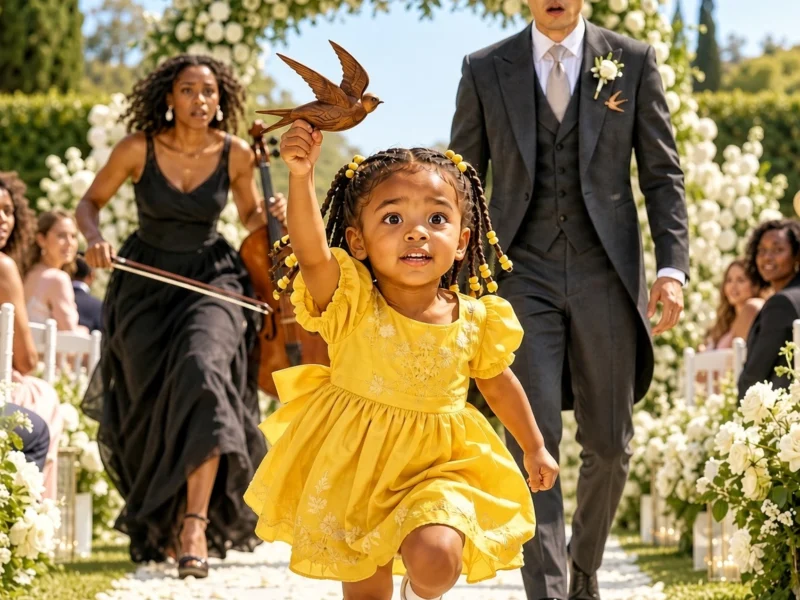
The Korean Billionaire Said ‘I Do’… Until a Little Girl Ran Toward Him.
“Choi Jae-won, do you take Han Ye-seul as your wife, in sickness and in health, for all your days?”
“I do.”
And then, from somewhere behind the garden hedge, a small voice cut through the applause.
“Wait! Wait! You have my bird’s brother.”
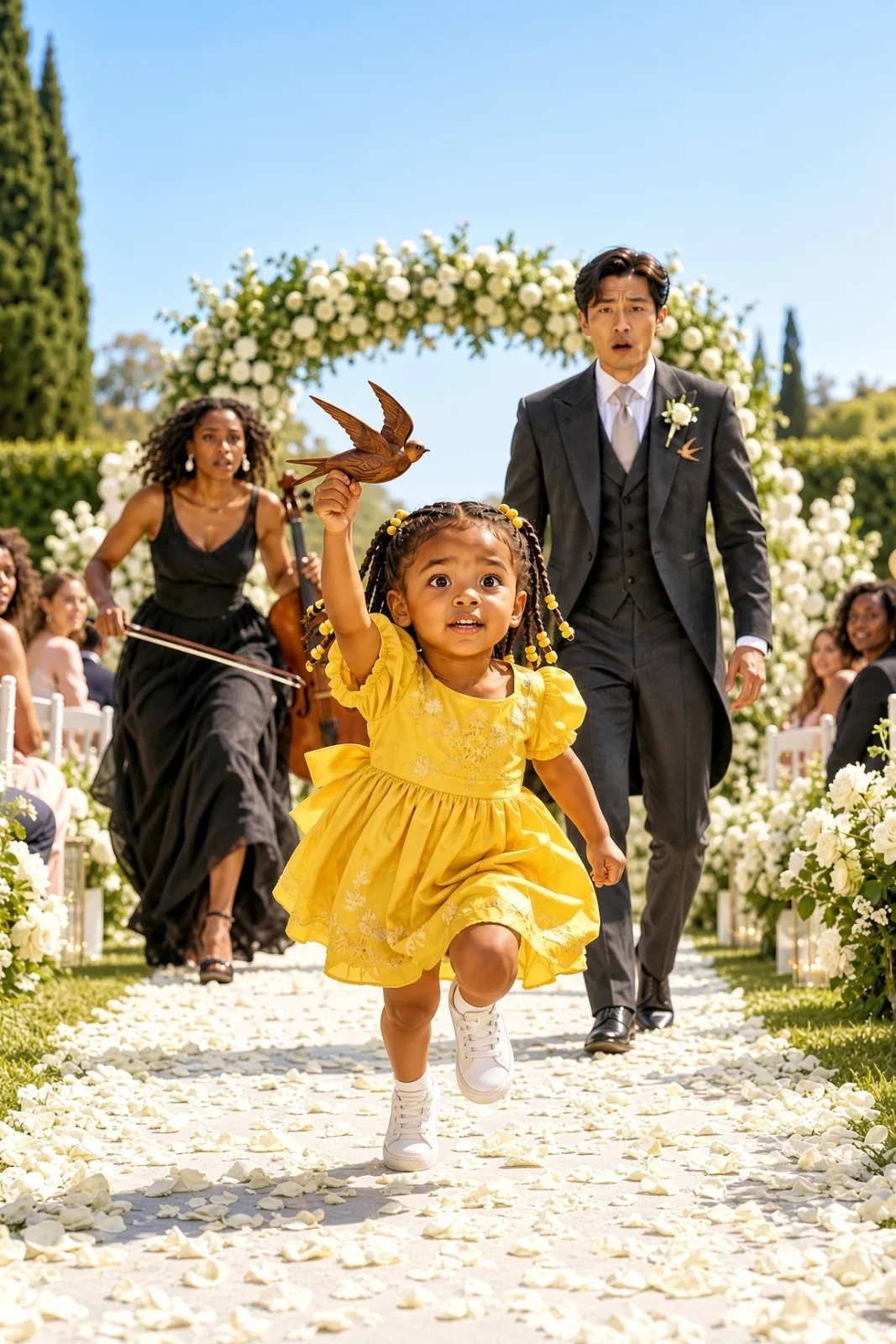
A little girl in a yellow dress and white sneakers burst into the aisle at full speed, a tiny wooden swallow clenched in her fist.
Her braids bounced.
Her mother’s voice was already calling her name from the back, thin with panic.
The child did not stop for the ushers.
She did not stop for the flower petals.
She ran straight down the white aisle toward the groom, and four hundred guests turned to watch her.
Jae-won looked down at the bird in her hand, and his chest went tight, because he knew that bird.
He had carved it himself five years ago, on a rainy night in Atlanta, from a scrap of pear wood.
He had made two.
He had given one away.
The other was pinned to his lapel right now, over his heart.
If this story already has you holding your breath, subscribe to Oasis Afro Romance Stories, like the video, and tell me in the comments where in the world you’re watching from.
Now, let’s go back to that aisle.
The garden did not breathe.
Four hundred guests, a string quartet without its cellist, and a reverend with his mouth half open, all frozen around one little girl standing at the foot of the altar steps, looking up.
Eden Brooks was four years old, and she had no idea she had just stopped a billionaire’s wedding.
She only knew what she had seen from behind the hedge: a tall man in a charcoal suit with a wooden bird pinned to his lapel, a bird that looked exactly like the one she slept with every night.
She held hers up as high as her arm would reach.
“Excuse me,” she said, in the careful voice of a child who has been taught manners.
“Your bird has the same tail as my bird. Are they brothers?”
Nobody laughed.
Nobody moved.
Jae-won knelt.
He did it without thinking, the way a man kneels when something inside him gives way, and the knee of his tailored trousers met the white petals on the aisle.
Up close, the bird in her palm had a tiny notch in its left wing, a chip where his knife had slipped one rainy night in Atlanta.
He had been annoyed with himself for that chip.
He had always meant to sand it out.
“Where did you get this?” His voice came out rough and private, as if the four hundred people had disappeared.
“Mama gave it to me. She says it came from a person who liked spring.”
Eden tilted her head.
“Are you the spring person?”
Behind him, a hundred silk fans stopped moving.
Then Aliyah Brooks reached the aisle.
She was thirty-one, in a black concert dress, her cello bow still in her fist, and she was breathing like someone who had run through a very long dream.
She stopped three steps from the altar.
She did not look at the bride or the guests or the phones already rising in the rows.
She looked at her daughter first, because she was a mother before she was anything else.
Then she looked at the man, because he was the one thing she had spent five years not looking at.
“Eden,” she said quietly, “come here, baby. Right now.”
“Mama, he has the brother.”
“I know, baby. Come here.”
Eden took one step toward her mother, then turned back.
“Is he in trouble?”
Aliyah’s mouth moved.
For a moment, nothing came out.
Jae-won rose slowly, like a man who did not trust his legs.
“Aliyah,” he said.
It was only her name, but four hundred people heard everything inside it.
Han Ye-seul, in an ivory silk gown stitched with a thousand tiny pearls, turned toward the man she had just promised herself to.
She was thirty-four, the chief financial officer of her family’s shipping empire, and she was not a woman who gasped.
She looked at the bird on his lapel.
She looked at the bird in the child’s hand.
She did the arithmetic.
Her face did not break.
It went very still, the way a ledger goes still when the total finally appears.
“Jae-won,” she said softly, “who is she?”
He did not answer.
He was looking at the little girl’s eyes.
They were dark and slightly hooded at the corners, and they were looking back at him with an expression he had seen every morning in his own mirror.
In the front row, an old woman in a lavender hanbok slowly lowered her fan.
Halmoni Choi Geum-sil, eighty-one, the only person in that family who had ever frightened the chairman, had stopped smiling.
Chairman Choi Ji-hwan rose from his seat, silver-haired and rigid.
“Take the child out,” he said in Korean, to no one in particular.
“Now.”
Aliyah had spent five years learning exactly how much she could carry alone.
She lifted her daughter onto her hip.
She did not run.
She walked up the aisle the way she had walked in, with her back straight and her bow in her hand.
Ji-hwan took one step after her.
“Ji-hwan-ah.” His grandmother’s voice carried across the silence.
“Let her go. Then go after her properly.”
The service lot behind the garden smelled of cut grass and hot asphalt.
Aliyah stood beside a dented gray Honda, her daughter buckled into the booster seat, her hands flat on the roof of the car, because she did not trust them to stay still.
Etta Brooks, her mother, sixty-two, stood two feet away in a mustard cardigan, holding her purse like a shield.
She had seen the man cross the lot before Aliyah did.
“He came alone,” Etta murmured.
“No driver. No suits. Huh.”
“Mama, take Eden for a walk, please.”
Etta looked at the man, then at her daughter, and went without a word, humming something low to the child about a little bird.
Ji-hwan stopped ten feet away.
He had taken off his jacket somewhere between the altar and here.
His white shirt clung to him in the heat.
His tie hung loose, and the swallow pin was still on the folded jacket over his arm.
Five years had put a few gray hairs at his temples and taken something out of his shoulders.
“Is she mine?” he asked.
Aliyah laughed, once, with no joy in it.
“That’s your first question? You looked at her face and you still have to ask?”
“I’m asking because I need to hear you say it.”
“She’s four. Her name is Eden Brooks. She hates peas. She loves Bach. And she asks every stranger if their bird has a brother.”
Aliyah’s voice cracked on the last word, and she hardened it again.
“I didn’t come here for you. I didn’t know it was your wedding until nine this morning, when I saw your name on the program. I stayed because the quartet needed a cello, and I needed the money. Forty minutes of Pachelbel, then I was gone.”
“You never told me.”
“I told you.”
She opened her cello case and took out a flat envelope, kept in the inner pocket the way other people keep photographs.
She held it up without letting go.
“Five weeks after you left, I mailed a letter to your company in Seoul. Registered. With the first sonogram inside. Do you know what I got back?”
He didn’t speak.
“One page. Typed. ‘This was a mistake. Do not contact my family again.’ Stamped with your seal.”
“I never wrote that.”
“It has your name on it.”
“My seal was in my father’s study safe that whole month.”
He heard himself say it and watched the words land on both of them.
“He’d had the cardiac scare. I flew home in thirty-six hours. They kept my phone at the hospital for security, and by the time I got it back, you were gone. My father told me you’d accepted fifty thousand dollars and asked to be left alone.”
“Fifty thousand dollars.” Aliyah’s eyes narrowed.
“I never saw a dollar. I never saw a lawyer. I saw a typed note. And then I changed my number, because I decided that if you wanted me, you knew where I lived.”
That one landed.
He felt it land.
“I should have come back,” he said.
“I’m not saying that so you’ll forgive me. I believed it too easily because believing it hurt less than finding out. That part is mine.”
For the first time, she looked at him as a person instead of a wound.
It lasted two seconds.
She tore the corner off the wedding program in her hand, wrote an address on it, and held it out between two fingers.
“Tomorrow, ten a.m. My mother’s house in Decatur. You come alone. No driver, no cameras, no checks, no lawyers. If you bring one thing with a price tag on it, I take my daughter and you don’t find us again. And the envelope stays with me.”
She slid into the driver’s seat.
“You’ve had five years to read it.”
When the Honda pulled away, Jae-won stood in the lot until a hand touched his sleeve.
Ye-seul had come out in her gown, the veil gone, her shoes in her hand.
“I won’t ask what I already know,” she said.
“I’ll ask you one thing. Don’t lie to me. Not today.”
“I won’t.”
“Good.”
She looked at the corner of the program in his fist.
“Then go. And Jae-won, our license isn’t signed yet. Whatever you decide, decide it with your eyes open.”
At twelve minutes past nine on Sunday morning, a rented silver sedan turned onto a quiet street in Decatur and parked behind a pickup truck.
The man who got out wore a cream sweater and plain gray trousers.
He had walked past a dozen photographers outside his hotel before sunrise, and not one of them had looked twice at him.
He had brought nothing except a paper bag of pears from the corner store.
They weren’t expensive.
He wasn’t sure why he’d chosen them.
Maybe because pear wood had started all of this.
The porch of the little yellow bungalow held three people.
Etta Brooks sat in a rocking chair in a floral apron with her arms crossed.
Aliyah leaned against the door frame.
And on the top step, feet swinging, her bird in her lap, sat Eden in red overalls and a striped shirt, her hair in two round puffs.
“You’re late,” Eden announced.
“Mama said ten. It’s ten-oh-four.”
“It’s nine-twelve,” said Etta.
“It’s ten-oh-four in my heart.”
Jae-won lowered himself onto the bottom step so his eyes were level with hers.
He did it carefully, the way you approach a bird.
“I’m sorry. I’ll be earlier next time.”
He held out the bag.
“Do you like pears?”
“Do they have worms?”
“I checked.”
Eden considered this with the gravity of a judge.
“Okay. You can sit.”
Aliyah, in a sage-green shirt and dark jeans, watched from the doorway and noticed something she hadn’t expected.
He hadn’t spoken to her yet.
He hadn’t looked for her approval or tried to charm her mother.
He had asked a four-year-old for permission.
An hour went by the way gentle hours do.
Eden showed him the notch in her bird’s wing.
Jae-won took the second swallow from his pocket without being asked and set it beside hers on the step.
The tails matched.
The notch matched.
Eden gasped like a girl at a magic show.
“Brothers,” she whispered.
“Brothers,” he agreed, and his voice almost gave out.
Aliyah looked away.
She remembered how it started.
A rainy church concert in Atlanta, a jet-lagged stranger in the back pew who asked what she had just played.
“Bach. The first cello suite.”
She had told him she’d never seen a Korean spring.
He had told her that in Korea, swallows bring good news in spring, and he had carved one for her that same night from a scrap of pear wood, badly, with a chip in the wing.
He had kept the second for himself.
It was the most ridiculous gift she had ever received, and she had never put it down.
Inside the kitchen, Etta pressed a wide-tooth comb into his hand.
“Her hair needs redoing before school tomorrow. Show me what you’ve got.”
“Mama,” Aliyah warned.
“He wants to be a father. Let him be a father with his hands.”
It went badly, and it was perfect.
Jae-won, who had once held a room of forty executives silent, could not make a straight part.
Eden squirmed.
Etta narrated.
“No, baby. Gentle. Start at the ends. You do not pull a child’s hair like you’re starting a lawnmower.”
He tried again, so slowly it looked like surgery.
Aliyah laughed out loud, a real laugh startled out of her.
Then she stopped, as if she’d caught herself stealing.
He heard it.
He did not turn around, because he understood he hadn’t earned that sound yet.
Later, back on the porch, Eden asked the question that grown adults had been avoiding for five years.
“Where were you?”
Aliyah went still.
Jae-won put down the comb.
“I was far away,” he said, “and when I found out I’d been told a lie, I didn’t look hard enough to find out whether it was true. That’s the real answer. You can be mad at me for it.”
Eden looked at him for a long moment.
“Mama says I’m allowed to be mad at people if I say it with words.”
“That’s a very good rule.”
“I’m a little mad,” Eden said, and bit into a pear, “but you can stay for lunch.”
When Eden went inside to wash her hands, Aliyah laid out her terms.
Saturday mornings, here, supervised, no press, no DNA test until she said so.
If Eden said stop, he stopped.
“Yes,” he said.
“That wasn’t a negotiation.”
“I know.”
She went to the drawer beside the stove.
When she came back, she was holding the cream envelope.
“You told me you never wrote it,” she said.
“I want you to look at it with your own eyes.”
The envelope was cream-colored, soft at the corners from five years of handling.
Aliyah laid it on the kitchen table beside the bowl of pears, and the morning light fell across it like a spotlight.
Jae-won didn’t touch it.
He looked at her.
“May I?”
She nodded.
Inside was a single typed sheet.
Sixteen words he would never forget.
This was a mistake.
Do not contact my family again.
At the bottom, pressed in red ink, was a small square seal carved with three characters.
His name.
He turned the page toward the window, and his breathing changed.
“This is my personal seal. My grandfather had it made when I turned twenty. I lost track of it that year. I always assumed it was in the safe.”
“Look at the corner,” Aliyah said quietly.
There was a tiny nick in the lower right of the imprint, the exact flaw his grandfather’s old knife had left in the stone.
Jae-won stared at it.
“Only one person has the key to that safe.”
She slid a second paper from the fold, a small green card, the registered mail receipt, with a date five weeks after he flew home, and a signature in black ink at the bottom.
T.W. Tak.
“Tak Woo-bin,” he said slowly.
“He’s been my father’s secretary for twenty-two years. He taught me to tie a tie.”
“He signed for the sonogram,” Aliyah said.
“The post office told me to keep the card. I thought it might matter someday.”
“It’s going to matter.”
“Is it?”
She folded her arms.
“Because I’m not handing you my proof so you can walk into your father’s office in private and let him tell you it was a misunderstanding. I’ve lived inside your family’s misunderstanding.”
He met her eyes.
“Then when I confront him, it won’t be in private. I give you my word. And you decide when.”
She studied him.
It was the first time she’d looked at him with something other than pain, and it frightened her more.
“Photograph it,” she said.
“The envelope stays with me.”
He photographed the seal, the card, the date.
His hands were steady, and his jaw was tight, and when he stood, he asked Etta for a glass of water, because his knees were not entirely his own.
At three that afternoon, in a hotel suite overlooking Piedmont Park, Chairman Choi Ji-hwan was drinking green tea as if nothing had happened.
Jae-won set his phone on the table, screen up, the photograph of the seal.
His father looked at it for a long time.
“So,” the chairman said in Korean, “she kept it.”
Jae-won’s chest tightened.
“You knew.”
“I returned a letter. I did it for you.”
“You forged my name.”
“I used a seal that belonged to this family to protect this family. You were thirty-one and sentimental, about to marry a cellist with no connections in a country that was not yours. A child at that moment would have chained you to Atlanta.”
He set down the cup.
“Han Maritime is eleven thousand jobs, Jae-won. A girl and a child are a private matter.”
“That child is my daughter.”
“Then she will be provided for. A trust. A house.”
Silence.
The chairman’s voice never rose.
That was the terrifying part.
“Finish the marriage. Sign the merger next Monday. The rest I will arrange.”
Jae-won stood.
For years he had admired how little his father’s face moved.
Now he saw what it was for.
“No,” he said.
“I lost five years because I accepted the version of the story that cost me the least. I won’t accept this one.”
He left without bowing.
It was the first time in his life.
Behind him, the chairman picked up his phone and called a lawyer.
By Monday morning, the video had four million views.
Someone in row nine had filmed everything.
The girl in yellow running down the aisle.
The groom on his knee.
The bride’s face going still.
By breakfast, the headlines had put on costumes.
A billionaire’s wedding interrupted.
Who is the girl in yellow?
And from a gossip account with a million followers, in capital letters: Wedding crasher cellist and her mystery child.
Aliyah read it at the kitchen table while Eden ate cereal and sang to her bird.
She turned her phone face down.
She did not cry.
She went to work.
She was a pediatric speech-language pathologist at a children’s clinic in Decatur, and Monday’s first client was a six-year-old boy learning to say his own name without stuttering.
She was very good at waiting.
At ten past ten during her lunch break, the front desk said there was a lawyer to see her.
He was polite.
He wore a gray suit and sat down without being asked, laying two folders on her small therapy table beside a bin of picture cards.
“Ms. Brooks, I represent the Choi family. This is not an adversarial visit. The family would like to resolve a sensitive matter privately and generously.”
The first folder held a trust.
Four million dollars in Eden’s name, managed by a bank.
The second held a nondisclosure agreement.
She read it to the end, because she respected words.
By the third page, she understood the price.
Eden would receive the money.
Aliyah would never speak publicly about the Choi family, the wedding, or the child’s father.
Eden would never be introduced as a Choi.
And any contact between her and Mr. Choi Jae-won would require the family’s approval.
“The family would of course prefer,” the lawyer said gently, “that the tabloid narrative of a wedding crasher not need to continue.”
There it was.
The threat wearing a bow.
Aliyah looked at the picture cards on the table.
A sun, a house, a boy waving.
She thought about four million dollars, and every month she had counted rent on her fingers.
She thought about Eden’s college.
She was not a saint, and she did not pretend to be one.
Then she thought about a four-year-old asking if a stranger’s bird had a brother, a child who would one day ask why her father’s name was a secret with a price on it.
“Tell the Choi family,” she said, standing, “that my daughter is not a settlement. Her father is not a lie I can sell. If they want to talk, they can talk to Jae-won. If they want to talk to me, they can do it under their real name, in daylight, to my face.”
“Ms. Brooks, you should consider—”
“I considered it for exactly as long as it took to read it.”
She slid the folders back across the table.
“Please close the door on your way out.”
That same afternoon, across town, Jae-won made his own choice, and it cost something, too.
Han Ye-seul had asked to meet in the lobby café of a glass tower.
She wore a pale gray suit, her hair swept back, her hands folded.
The marriage license lay between them in a folder, unsigned.
“I said I do to a man I believed was free,” she said.
“I don’t think you were lying. I think you were obedient. Those are different, and the second is harder to marry.”
“I’m sorry. I should have told you months ago that something was missing.”
“You didn’t know what was missing. Now you do.”
She slid the folder across the table.
“Don’t sign it. And my father will want the merger closed next Monday, regardless.”
“I’ll make my own decision about that. Neither of us is going to be anybody’s wedding present.”
For the first time in days, he almost smiled.
“You’re very good at this.”
“I’m a CFO,” said Ye-seul.
“I know what things cost.”
If you were Aliyah, would you have signed that trust to protect Eden’s peace, or refused it and fought for the truth?
Tell me in the comments where you’re watching from.
Like the video and subscribe to Oasis Afro Romance Stories before the board meeting.
Telling the truth publicly turned out to be harder than telling it privately.
By Tuesday night, Jae-won had a draft statement.
It was elegant.
His communications team had polished it until it shone.
It said that Choi Jae-won had learned he was the father of a four-year-old girl, that he took full responsibility, and that he asked the public to respect the privacy of his daughter and the mother of his child.
It included a photo of Eden, cropped from the viral video, smiling in her yellow dress.
He drove to Decatur alone and set it on the kitchen table in front of Aliyah.
She read it twice.
Then she pushed it back.
“Take her face out.”
“The photo is already public.”
“That doesn’t make it yours.”
Her voice was quiet, which was worse than loud.
“You want to apologize to the world, and I understand, but you’re doing it with my daughter’s face. This is how it starts, Jae-won. First it’s one picture for your redemption, then it’s a family portrait for the shareholders. She is four. She does not get to be your press release.”
He opened his mouth to defend it and found nothing to defend.
“You’re right.”
“I know I’m right. I want to see what you do about it.”
He deleted the photo, then, while she watched, he deleted the whole statement and called his communications director.
“There is no statement,” he said.
“Not one word about the child. If anyone asks, I owe a private apology to Aliyah Brooks, and that is the entire sentence.”
“Sir, the board—”
“I know what the board will do.”
He did.
By Wednesday, the chairman had called an emergency session for the following Monday morning at the company’s Atlanta headquarters.
The agenda held one item: the removal of Choi Jae-won as chief executive for conduct damaging to the company.
By Thursday, Han Maritime had suspended merger talks pending a governance review.
Jae-won’s name was on the front page of every business paper in two countries.
He drove to Decatur and told her himself before she could read it.
“I came to tell you before you saw it,” he said on the porch.
“On Monday, I’ll probably lose my seat.”
Aliyah folded her arms.
“Why are you telling me?”
“Because last time you heard it from somebody else.”
She looked at him for a long time.
On Saturday morning he came at nine, early as promised, in an oatmeal sweater and jeans.
He brought no gift.
Etta put the wide-tooth comb in his hand, and this time she didn’t narrate.
She just sat at the table in her denim shirt and let him fail again.
He parted Eden’s hair into four sections.
He moisturized the ends the way Etta had shown him, with hands that had signed contracts worth billions.
The first puff came out lopsided.
The second came out better.
Eden held absolutely still, her bird in her lap, her eyes closed, and in the doorway, in a terracotta dress, Aliyah watched a man learn something small and sacred that nobody had ever taught him.
“There,” Jae-won said.
“Is that okay?”
Eden touched both puffs.
She went to the hall mirror and studied them.
“One is bigger than the other.”
“Yes.”
“I like it,” she said.
“It looks like it was made by a person who tried.”
Aliyah turned her face away and pressed the back of her wrist to her mouth.
When she looked back, she had made a decision.
“Monday,” she said.
“What time is the meeting?”
“Nine.”
“Why?”
“Because you told me you wouldn’t confront him in private.”
She took the envelope from the drawer.
“I’m coming with you.”
The boardroom of Choi Meridian Energy’s Atlanta headquarters sat on the fortieth floor, and at nine on Monday morning, sunlight poured through its glass walls onto a long table of twelve directors who were not smiling.
Jae-won sat at one end in a black three-piece suit.
Chairman Choi Ji-hwan sat at the other.
On the screen at the foot of the table, from Seoul, a gray-haired man in rimless glasses appeared in a small box.
Secretary Tak Woo-bin.
Beside Jae-won sat Han Ye-seul, as Han Maritime’s observer, in a cream suit with a pearl brooch.
And in the corner chair, in a charcoal hanbok with a silver brooch at her throat, Halmoni Choi Geum-sil sat with her cane across her knees.
She held a director’s seat that she had not used in thirty years.
Outside, in the bright lobby, a four-year-old in a lilac dress sat on a bench beside her grandmother in a burgundy church suit, drawing swallows on the back of a visitor’s badge.
The chairman called the session to order and spoke for ten minutes about conduct, reputation, and the heavy duty of leadership.
It was a very good speech.
Jae-won listened to all of it.
“Before the vote,” he said, “I’d like to introduce someone.”
The door opened.
Aliyah Brooks walked in wearing an emerald suit, her hair in smooth curls, gold hoops in her ears, a cream envelope in her hand.
She had never been in a room with this much power in it.
She walked in as if she had been invited by every person who had ever been told she didn’t belong.
“This is Ms. Aliyah Brooks,” Jae-won said.
“Eden’s mother. Five years ago, she sent me a letter, and I never saw it. She is here because this board is deciding what kind of company it is, and she has the proof.”
“This is a personal matter,” said the chairman.
“No,” Ye-seul said evenly.
“A chairman who uses an executive seal without his consent is a governance matter. I’m certain Han Maritime’s auditors will agree.”
Aliyah set the envelope on the table.
She took out the typed letter and the green card and laid them side by side.
“This is the letter I received. It carries Mr. Choi’s seal. This is the registered mail receipt, signed by Mr. Tak Woo-bin five weeks after Mr. Choi left Atlanta. The seal has a chip in its lower right corner.”
She turned to the screen.
“Mr. Tak, I’ll ask you directly. Who gave you the key to the safe?”
On the screen, the secretary’s face did not move.
Then his hand did.
It reached for his glasses and took them off slowly, the way a man removes something that has been holding his face together for twenty-two years.
“The chairman,” said Tak Woo-bin.
“He told me it was necessary.”
The room went silent.
Not a pen moved.
The chairman said something sharp in Korean, and from the corner, a cane struck the carpet once.
“Choi Ji-hwan,” said his mother, in a voice that did not rise at all.
“Sit down.”
He sat.
“I have been silent for thirty years,” Halmoni said, “because I told myself that a family’s quiet was its strength. I was wrong. My vote is to remove you as chairman of this board.”
The vote was not close.
Ye-seul, as a guest, did not vote.
She told the press only that the merger would proceed under new governance and joint leadership, if Choi Meridian can remember what a promise is.
Then Jae-won stood.
“I won’t take my father’s chair today. I’d like to propose an independent chair, and I’d like to offer my resignation as chief executive, because I let a typed page and the most important thing in my life without a second visit.”
The board declined it.
Aliyah, who had not expected to feel anything at all, felt something slip loose in her chest.
Out in the lobby, a little girl in lilac looked up from her drawing and saw her mother walking toward her, standing a little taller than she had ever stood.
“Mama,” Eden said, “did you win?”
Aliyah crouched.
“We told the truth, baby. Out loud. In daylight.”
Behind her, through the glass, a man in a black suit stood with one hand pressed flat on the table and his eyes closed for a long time.
Spring came to Atlanta in the first week of April, the way it does, all at once.
Dogwoods.
Pollen.
Pear trees in the backyard of a yellow bungalow in Decatur, covered in white blossom.
Choi Ji-hwan did not come.
He had sent a letter in careful, formal English, three sentences long.
Aliyah had read it once and set it in a drawer.
She owed him nothing, and she knew it, and so did Halmoni, who said gently, over tea in the little kitchen, that some men learn the word sorry slowly, in quiet houses.
“He may learn it,” she said.
“You don’t have to wait.”
Halmoni had flown in from Seoul.
The first thing she did at the bungalow’s door, in a jade green hanbok, was bow deeply to a four-year-old in a pink and yellow hanbok of her own.
“Are you my Halmoni?”
“If you will have me.”
Eden thought about it.
“Do you like pears?”
“I have loved pears for eighty-one years.”
“Then yes.”
Three months had changed the shape of things.
The merger had closed under new leadership, with Han Ye-seul as co-chair of the joint venture, and she had sent Aliyah a handwritten note that said only, “I hope she learns to negotiate.”
Jae-won had moved his base to Atlanta for two years and told no one what it cost him.
Every Saturday at nine, he arrived on a porch where a small girl waited with a comb.
By the first Saturday in March, both puffs came out even.
Aliyah noticed that she had started setting an extra plate.
In March, he had proposed with no ring and no cameras.
He had given her a small box holding a carved branch and two wooden swallows.
And he had said, “Not tomorrow. Not this year. If you need longer, when you’re ready, ask me again and I’ll say yes before you finish.”
She had answered, “Ask me again in spring.”
Now it was spring.
There were only twelve folding chairs under the pear tree.
Etta and Lena.
Halmoni and Ye-seul.
Delroy Sims with his cello.
Reverend Lowell Bates holding a small book.
Jae-won stood beneath the blossoms in a pale gray linen suit with a wooden swallow on his lapel.
And when the music began, a yellow and white blur broke from the porch.
Eden, in a white dress with a yellow sash, a basket of petals in one hand and her bird in the other, ran down the grass aisle toward him as fast as her legs would go.
Not to stop a wedding.
To start one.
He knelt in the grass, and she hit him at full speed, and the petals flew up around them like small bright weather.
“Oppa,” she said into his shoulder, trying the word for the first time.
“You’re not late.”
Aliyah came last, in a soft ivory dress with yellow flowers in her curls and her chin high.
Etta cried.
Halmoni did not pretend not to.
“Do you, Choi Jae-won, take Aliyah Brooks to be your wife?” the reverend asked.
“I do.”
He did not look at the reverend.
He looked at her.
“For every Saturday and every morning after.”
“Do you, Aliyah Brooks, take Choi Jae-won to be your husband?”
She looked at her daughter holding two wooden birds up to the sun, one in each hand, the tails matching.
She looked at the man who had learned to part her hair.
“I do,” she said.
“And this time, nobody has to run.”
“I’m going to run anyway,” Eden announced from the grass, and the whole garden laughed.
He had said I do twice in his life.
The first time was the night Kang Jun-ho disappeared.
The second time, she ran so she could be the first to hear it.