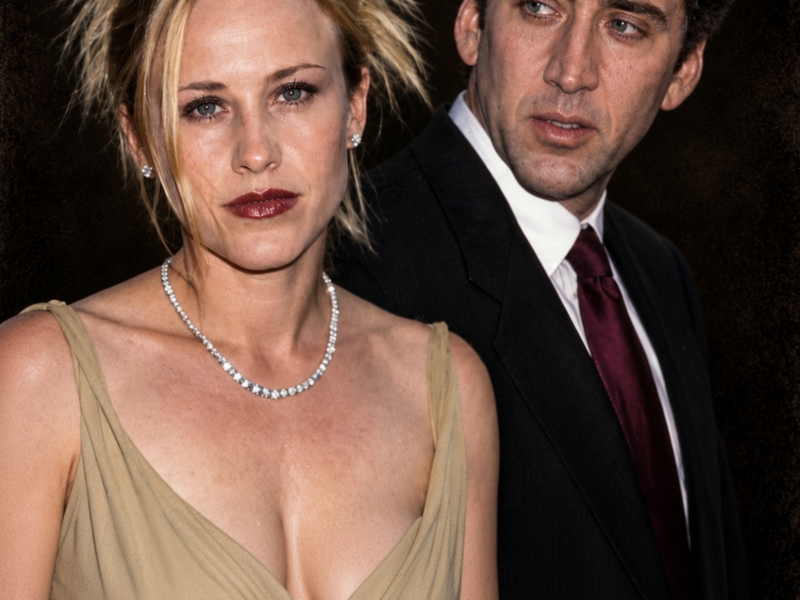
Why Nicolas Cage Refused To Divorce Patricia Arquette in 2000 Despite 4 Years of Separation?
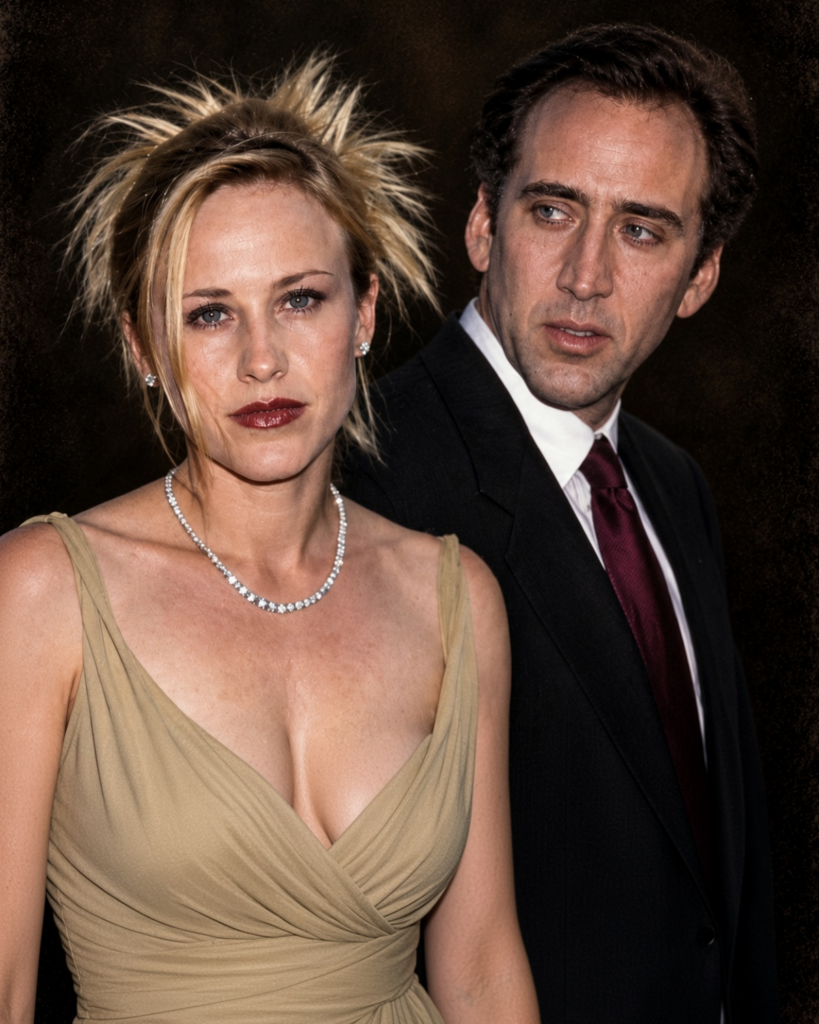
There is a photograph from the 1996 Academy Awards.
Nicolas Cage stands on stage with the golden statuette, his arm wrapped around Patricia Arquette.
America read that moment as the ultimate fulfillment of Hollywood’s eccentric royal couple.
Look at file number D389142 in Los Angeles County instead of that photograph.
Seventy-four days before that telecast, two trucks had parked in front of the Hollywood Hills mansion and split their household belongings down the middle.
The real marriage lasted only nine months. The public charade dragged on for more than 1,500 days.
On February 24th, 2000, Cage filed for dissolution.
Forty-three days later, he returned to the court clerk’s counter and personally withdrew the paperwork.
Look at the document dated April 7th: request for dismissal.
A star earning $20 million per picture, living alone in an estate filled with dinosaur skulls, preferred to remain legally bound to a matrimonial ghost rather than admit his script had failed.
She did not call. She did not negotiate.
Seven months later, she refiled the paperwork herself and gave him nowhere left to hide.
It all ended with a request for dismissal in Los Angeles, but before the courthouse, before the vinyl wedding dress in Carmel, hold on to that booth at Canter’s Deli in March 1987—because that table will tell you what the true nature of this obsession really was.
Nicholas Coppola, a twenty-three-year-old carrying the bloodline of the Coppola cinematic dynasty, sat across from a nineteen-year-old girl who had just taken her first steps into the profession: Patricia Arquette.
There were no conventional pleasantries.
The very moment their eyes met, Nicholas—who had just adopted the stage name Nicolas Cage to escape the shadow of his uncle Francis Ford Coppola—looked straight into Patricia’s eyes and made a declaration.
“Someday, I will marry you.”
Faced with the young girl’s bewilderment mingled with ridicule, Nicolas grabbed a paper napkin from the dining table, pulled out an ink pen, and demanded that she provide the most impossible challenges for him to prove his words.
Growing up in the Arquette family of artists—steeped in free-spirited ideals and defiance—Patricia viewed it as the reckless antics of an eccentric.
To shut down this absurd pursuit, the nineteen-year-old girl wrote out a list containing things she was certain no ordinary person on Earth could ever find.
That list consisted of four bizarre demands: a pitch-black orchid, a botanical species that simply does not exist in nature; an original handwritten autograph by J.D. Salinger, the author of The Catcher in the Rye, an infamous recluse who had not signed autographs for fans in decades; a bridal statue of the Lisu tribe from the remote highlands of Southeast Asia; and a wool cloak from designer Bob Mackie.
Patricia tossed the napkin aside and walked out of the diner, believing this bizarre encounter had ended once and for all.
But to Nicolas Cage, the list at Canter’s Deli was no joke.
It instantly transformed into a psychological obsession—scripted, directed, and enacted by himself, where he had to play the hero pushing past every boundary to capture the prize.
The engine of infatuation inside Cage’s mind began operating completely out of control.
He was not looking for a life partner to understand. He was hunting for trophies to satisfy his extreme artistic ego.
Upon realizing that a natural black orchid did not exist, Cage went straight to a nursery, purchased a pot of white moth orchids, and used purple ink and black dye to spray over every single petal—creating a grotesque bloom reeking of pungent chemicals.
He spent thousands of dollars through private collectors to track down and buy an old letter bearing the handwritten script of author J.D. Salinger.
He tracked down the indigenous bridal statue and purchased the costly Bob Mackie cloak.
On a late afternoon in 1987, Nicolas Cage’s sports car pulled up abruptly in front of the rundown apartment where Patricia Arquette lived.
He stepped out of the vehicle carrying the black-ink-dyed orchid in one arm and holding Salinger’s letter and the bizarre offerings in the other.
When she saw the man standing outside her doorway with the fiery gaze of someone who refused to take no for an answer, Patricia’s first reaction was not emotional warmth but sheer terror.
That was not healthy love between two human beings.
It was the manifestation of an obsessive-compulsive condition—a possessive worship that felt controlling and threatened her personal boundaries.
Recognizing that her safe boundaries had been violated, Patricia Arquette slammed the door shut, refused to accept the items, and immediately severed all communication.
She fled from Nicolas Cage’s orbit for the next eight years, focusing on building an independent acting career and giving birth to her first son, Enzo, remaining completely out of reach of the Coppola dynasty.
Eight years passed.
By early 1995, the stature of both figures within the movie capital had changed completely.
Nicolas Cage was preparing to ascend to the zenith of his career with an Oscar for Leaving Las Vegas and locking down blockbuster deals worth $20 million per film.
Meanwhile, Patricia Arquette had asserted her standing as a gritty independent actress—a financially self-reliant single mother.
Yet life brought an unexpected turn in March 1995.
In the midst of exhaustion following a breakup with her ex-boyfriend and facing the burden of raising a young child alone, Patricia Arquette made an impulsive move.
She picked up the phone and called Nicolas Cage.
To Cage, that phone call was nothing short of the fulfillment of a prophecy.
The woman he had worshipped as an impossible icon for nearly a decade had suddenly returned.
The long-dormant flame of obsession instantly erupted into a raging fire.
After just two brief weeks of reuniting, they made a hasty decision: head straight into marriage.
On April 8th, 1995, on the wind-swept cliffs of Carmel, California, a bizarre wedding took place.
There were no relatives from the Coppola clan, no Arquette family members, and no press lenses.
Nicolas Cage appeared in sleek leather attire, while Patricia Arquette wore a dark teal vinyl dress.
To complete the legal formalities, they pulled two strangers walking along the beach to sign as witnesses.
The media later celebrated this as the romantic, rebellious nuptials of two great artistic souls.
But when examining archival judicial records, one realizes that a structural fracture had already formed the very moment the rings were exchanged.
Right before the ceremony, Patricia Arquette established a strict legal defensive perimeter: absolute property independence.
Even though she knew full well that Nicolas Cage was about to enter a gargantuan wealth-generating era filled with castles, private islands, and tens of millions of dollars in cash, Patricia adamantly refused to depend economically on the Coppola family.
She maintained completely separate bank accounts, covered all living expenses for herself and her son Enzo with her own money, and declined any financial provision from her millionaire husband.
By erecting the wall of financial independence, Patricia Arquette attempted to safeguard her freedom and self-respect.
But she had failed to foresee that the thing Nicolas Cage sought to control was never money or assets.
What Cage craved was absolute psychological and visual submission.
To Nicolas Cage, Patricia Arquette was not merely a flesh-and-blood wife.
She was the ultimate objective on the impossible list from 1987—the living proof confirming that there were no limits he could not breach if he remained persistent and unhinged enough.
He wanted her to become the muse reflecting his bizarre artistic ego, a flawless puzzle piece in the mythic play he wrote for his own life.
Yet Patricia Arquette was a completely different woman.
Once the impulsive emotions of their wedding day faded, she realized she could not breathe inside Cage’s suffocating living environment.
He lived in mansions cluttered with dinosaur bones and million-dollar vintage comic books, and maintained eccentric habits pushed to the absolute extreme.
As for her—a pragmatic woman caring for a young child—she needed a peaceful sanctuary, an authentic human presence rather than a continuous theatrical stage that never dropped its curtains.
The deepest power imbalance in this marriage did not lie in rigorous financial clauses, but in the irreconcilable conflict between possessive worship on one side and the fundamental need for personal freedom on the other.
Nicolas Cage had never truly seen the authentic person inside Patricia Arquette. He only saw his own conquest trophy.
And Patricia quickly realized that the price to sustain this marriage was the complete eradication of her personal boundaries beneath the overwhelming shadow of her husband.
Just nine months after the chapel bells rang in Carmel, in January 1996, fatal cracks began appearing across the velvet curtain of the marriage.
Fierce screaming matches erupted—not over infidelity or money, but because Patricia Arquette flatly refused to climb onto the altar Cage had erected for her.
The key to the shared mansion began to feel unbearably heavy, heralding an inevitable breaking point.
On the morning of January 12th, 1996, two large moving trucks appeared at the gates of the shared mansion in the Hollywood Hills neighborhood.
Quietly splitting their household belongings down the middle and heading off in two completely opposite directions, Patricia Arquette packed up all her personal belongings along with the things belonging to her seven-year-old son Enzo, relocating to a rustic, secluded wooden home tucked away in the San Fernando Valley.
In the opposite direction, Nicolas Cage moved all of his belongings back to his own massive Bel Air estate—an eccentric space overflowing with collections of Tyrannosaurus rex dinosaur bones, million-dollar vintage comic books, and venomous snake terrariums.
From that moment on, the marriage between the two movie stars officially turned into a geographically separated arrangement.
Two residential addresses. Two distinct key sets. Two unlinked bank accounts. And two lifestyles without any intersecting points whatsoever.
Yet outside the gates of those two isolated mansions, a completely opposite narrative was being meticulously staged by publicity machines before the eyes of millions of viewers.
Across the covers of prestigious magazines from People to Vanity Fair, and all over the planet’s biggest red carpets from 1996 to 1998, Nicolas Cage and Patricia Arquette still appeared hand in hand.
The Hollywood media, perpetually hungry for the unusual romances of the elite, continuously hailed them as the bizarre golden couple of the ’90s.
When Nicolas Cage ascended the stage of glory to accept the Academy Award for his performance as a self-destructive alcoholic in Leaving Las Vegas, Patricia Arquette sat in the front row, smiling radiantly and giving her husband enthusiastic applause.
When Arquette took on gritty independent film projects such as David Lynch’s Lost Highway, Cage consistently showed up at premieres as an entirely supportive partner.
That was a masterclass in public relations staging.
The media representation teams of both actors understood the cutthroat rules of the contemporary cinema market all too well.
Publicly acknowledging a collapse after only nine months of marriage would deal a fatal blow to Nicolas Cage’s public image.
At that time, major Hollywood studios were positioning him as the highest-grossing action star and romantic lead at the box office, commanding a record salary of $20 million per film through blockbusters like The Rock, Con Air, and Face/Off.
Any messy divorce controversy involving psychological instability could directly endanger multimillion-dollar studio completion bonds and insurance agreements.
For Patricia Arquette, keeping the separation quiet was the only shield allowing her to protect her young son Enzo from the ruthless scrutiny of paparazzi.
As a single mother who had navigated multiple hardships, Arquette understood that tabloid noise would destroy the tranquil educational environment of her child.
They reached an unspoken, unwritten compromise: no publicizing personal life, no interviews about the marriage, maintaining professional respect before the cameras—yet living two entirely independent lives once the flashbulbs went out.
However, silence and physical distance could not extinguish the inner turmoil tearing at Nicolas Cage.
While Patricia Arquette found peace and freedom in her everyday routine, Cage remained haunted by the fact that the ideal marriage he had painstakingly pursued had failed in reality.
To a man raised in the cradle of the Coppola dynasty, where the line between cinematic art and real life was constantly blurred, Cage always believed that any tragedy could be restructured and resolved if one brought it to the screen.
He refused to accept the truth that Patricia had walked out of his emotional control.
The opportunity for one last desperate gamble arrived in the fall of 1998, when legendary director Martin Scorsese decided to adapt Joe Connelly’s gritty novel into a psychological drama titled Bringing Out the Dead, financed and produced by Paramount Pictures.
Nicolas Cage was cast as Frank Pierce, a paramedic physically and emotionally spent, continuously haunted by the ghosts of patients who had died on the filthy streets of New York.
When searching for the actress to play Mary Burke—a wounded former addict and the only character offering a flicker of hope and redemption to Frank Pierce’s soul—Scorsese set his sights on Patricia Arquette.
The director believed that the real-life connection between the married couple would generate an intensely authentic and haunting cinematic dynamic.
As a professional actress, Arquette was initially deeply hesitant.
She knew full well the danger of coming face-to-face with her estranged husband on a project requiring such profound psychological excavation.
But faced with persistent persuasion from Martin Scorsese and especially an earnest plea from Nicolas Cage—who believed this artistic reunion would be the bridge to mend their fractured relationship—Patricia agreed to sign on to the film.
It was a decision that plunged both of them into a brutal emotional trap.
Filming stretched across the winter of 1998 and early 1999 in Hell’s Kitchen, New York, taking place entirely at night.
From sunset until dawn, Cage and Arquette were confined together in the cramped quarters of filthy ambulances, damp alleyways, and a suffocating movie set under freezing temperatures.
Martin Scorsese pushed the actors to the absolute brink of panic, fear, and despair.
Instead of fostering a space for understanding and connection, the set of Bringing Out the Dead instantly morphed into an inescapable psychological battlefield.
On set, Nicolas Cage continued his extreme method acting approach—starving himself and staying awake all night to maintain a state of frenzied, high-strung delirium.
He channeled all the obsession and pent-up frustration of a man rejected in real life into every look and every gesture directed at Patricia Arquette during their shared scenes.
Through the character of Frank Pierce, Cage wanted to plead for salvation from Patricia—wanting her to see his agony and come back.
Yet Patricia Arquette was not the Mary Burke on the script pages.
She was a pragmatic real-world woman who had seen through the nature of this infatuation a decade earlier.
Confronted with the torment and overwhelming emotional demands from Cage during those freezing New York nights, Arquette felt completely suffocated.
Instead of finding common ground, she realized that Nicolas Cage had never changed.
He was still trying to manipulate reality through drama, turning the real agony of their marriage into a tragic solo performance to force her into playing the role of his savior.
Eyewitnesses on the film crew later revealed that the atmosphere between the two during breaks was wound tight like a bowstring.
They barely spoke to each other outside of character dialogue.
Whenever the director yelled cut, Patricia immediately retreated to her personal trailer, locking the door to find peace and quiet—while Cage wandered the set with the hollow gaze of a man watching his gamble unravel before his eyes.
The artistic collaboration not only failed to salvage the marriage, but it laid bare the insurmountable gulf dividing them.
On one side was an artist yearning to sanctify suffering, and on the other was a woman fiercely guarding her own psychological sanity.
When Bringing Out the Dead wrapped in the spring of 1999, Nicolas Cage’s gamble to reclaim his marriage through cinema officially fell apart.
Forcing himself and his partner to relive psychological traumas before the camera yielded only total exhaustion.
After leaving New York, they immediately returned to two separate estates in Los Angeles—but this time the distance separating them went beyond mere geography, marking absolute emotional depletion.
Four years of playing happy before the public had wrung out the last drops of patience.
The deadlock reached its breaking point in the early days of 2000.
Standing at the peak of box office power with massive paychecks as he prepared to head into Gone in 60 Seconds, yet trapped within the cold walls of his empty estate, Nicolas Cage realized he was holding on to a marriage that was entirely hollow—an arrangement existing purely on legal paper and staged red-carpet smiles.
The rage, bitter disappointment, and sheer powerlessness of a man used to getting his way pushed Cage into an impulsive act that completely shattered the four-year pact of silence.
On February 24th, 2000, Nicolas Cage walked into his attorney’s office in Century City and signed an official petition requesting that the Los Angeles Superior Court dissolve the marriage, citing irreconcilable differences.
That unilateral move officially ended four years of silence and dragged the split into the public eye, blowing the lid off the secret separation they had so meticulously concealed.
Yet what no one in Hollywood could have predicted was that this fury-driven divorce petition would kick off a bizarre series of legal reversals, pushing the psychological battle between the two into its most decisive phase before the court clerk’s bench.
On the morning of February 28th, 2000, at the Los Angeles County Superior Court, Family Law Division, case file number D389142 was officially entered into the electronic database system.
The petition for dissolution of marriage signed by Nicolas Cage was submitted to the judge’s bench by his attorney, citing the standard statutory ground under the California Family Code: irreconcilable differences.
In terms of judicial procedure, this was a routine celebrity divorce filing.
But in terms of public impact, the court clerk’s receipt stamp officially brought an end to the private arrangement of silence lasting more than 1,500 days between two A-list actors.
The Hollywood press immediately turned this filing into a media feeding frenzy.
News outlets simultaneously uncovered the unvarnished truth: the prestigious artistic couple had never lived under the same roof since the winter of 1996.
Those affectionate photographs on the Oscar red carpets of years past were placed under analytical scrutiny as deliberate off-screen performances.
Yet the intense public attention exposed Nicolas Cage’s greatest psychological vulnerability.
The man who had just reached the box office summit with a $20 million salary contract for the project Gone in 60 Seconds suddenly fell into a state of disorientation.
In behavioral psychological analysis, the initial filing on February 24th was essentially an attempt to re-establish a position of control after their joint film project Bringing Out the Dead had failed.
Cage anticipated that public legal pressure would force Patricia Arquette to yield, sit down at the negotiating table, or acknowledge her bond with him.
However, the reaction from Patricia Arquette was absolute silence.
She did not hire an attorney to hold a retaliatory press conference, issued no explanatory public statements, and strictly avoided making contact to seek reconciliation.
Patricia’s steadfast composure demonstrated that she had completely detached herself from every psychological game played by her husband.
Realizing that his legal maneuver had failed to yield the expected outcome—and had instead stripped away his final opportunity for connection—Nicolas Cage made a decision that left the entire legal community in Century City stunned.
On April 7th, 2000, exactly forty-three days after filing, Nicolas Cage personally signed a request for dismissal without prejudice.
Cage’s publicist, Annette Wolf, issued a brief statement: “They are attempting to reconcile and work out their differences privately.”
That was one of the most contradictory legal actions ever recorded in a Los Angeles court.
Despite having lived separated in two distinct mansions for over four years, Cage personally withdrew the petition he had filed himself.
That powerful man would rather maintain a marital status on paper and cling to a vague hope of reconciliation than accept putting an end to the conquest he had initiated back in 1987.
In Cage’s mind, withdrawing the petition on April 7th was an attempt to turn back the clock—waiting for the woman to once again pick up the phone and call him, just like she did in the spring of 1995.
Yet Patricia Arquette did not allow that lingering hesitation to continue.
Cage filing the petition in February and abruptly withdrawing it in April completely shattered the tranquility Patricia had painstakingly built for her young son, Enzo.
She realized that without a definitive court ruling, Nicolas Cage would continue to sustain an illusion of possession and turn this marriage on paper into an ongoing tether around her life.
After seven months of maintaining absolute distance and rebuffing every approach, Patricia Arquette decided to bring closure to everything herself.
On November 17th, 2000, Patricia Arquette’s legal counsel officially filed a unilateral petition for dissolution of marriage with the Los Angeles Superior Court.
There was no hesitation and no emotional statements in the press.
Patricia’s November 17th petition carried the weight of a non-negotiable ruling.
The attached filings requested the definitive resolution of every legal perimeter—waiving the right to request spousal support, confirming independent ownership over all separately accumulated assets, and requesting that proceedings be handled with absolute confidentiality and respect.
Faced with Patricia’s written resolve, Nicolas Cage had no legal grounds left to stall.
California state law explicitly dictates that a marriage cannot be forcibly prolonged when one party has determined that the breakdown is irreconcilable.
Throughout the early months of 2001, legal counsel for both parties finalized the detailed terms of dissolution behind closed doors.
Thanks to the financial clarity that Patricia Arquette had adamantly upheld from the very first day of signing the marriage certificate in Carmel in 1995, the case produced no complex property disputes.
On May 18th, 2001, a Los Angeles Superior Court judge officially signed the judgment of dissolution of marriage.
The judgment records dated May 18th, 2001, noted specific terms.
Financially, both parties officially waived their rights to claim spousal support.
Even though during five years of nominal marriage Nicolas Cage accumulated tens of millions of dollars from worldwide film contracts, Patricia Arquette did not take and did not demand a single penny from that fortune.
All income, film copyright ownership, and real estate holdings belonging to either party were retained entirely by that party.
Regarding family obligations, no shared children were born during the marriage.
Custody rights and obligations toward each party’s separate children—Enzo for Patricia and Weston for Nicolas—remained strictly personal responsibilities, creating zero support obligations between the two.
Regarding the confidentiality agreement, both parties pledged not to disclose private details, not to publish disparaging memoirs about each other, and to preserve public respect regarding their four years of living separated.
In terms of judicial procedure, this was a textbook ruling—devoid of drama and free from asset tearing.
But behind the cold administrative lines was a heavy psychological toll borne by both parties.
For Patricia Arquette, the dissolution judgment was a necessity after five years bearing the title of wife inside an illusory marriage.
Having to preserve quiet stability to raise her child while constantly confronting public pressure and her husband’s theatrical antics had drained her mental energy.
It took many years for her to fully reestablish her independent artistic career and reclaim peace in her personal life.
For Nicolas Cage, the May 18th, 2001, ruling marked the collapse of a fourteen-year power illusion.
The judge’s gavel forced him to confront the limits of reality: infatuation, money, and grand gestures can never substitute for compatibility and respect for boundaries in married life.
The file at the Los Angeles Superior Court was officially placed into archives, leaving behind a silence full of reflection.
Why would a man who once poured out his mind hunting down bizarre artifacts to conquer a woman accept walking away from court in utter silence?
The answer does not lie in property clauses, but in the very nature of the freedom that the woman adamantly defended for herself.
Decades after the ruling from the Los Angeles Superior Court, the practical consequences of that 2001 dissolution decree definitively shaped the destinies of both individuals.
Nicolas Cage moved on through four turbulent marriages, facing a $14 million tax crisis with the Internal Revenue Service and a prolonged cycle of financial collapse.
On the other hand, Patricia Arquette reached the pinnacle of her career with a prestigious Academy Award for Boyhood, cementing her stature as one of the most independent and uncompromising voices in Hollywood.
Looking back across the entire journey—from the Canter’s Deli list in 1987 to the dismissal document on April 7th, 2000—the explanation for Nicolas Cage’s resistance to divorce emerges crystal clear.
Cage refused to sign the dissolution decree after more than 1,500 days of living separated, not out of faith in family reconciliation.
He resisted because of the instinct of an obsessive who refused to concede defeat.
To Nicolas Cage, Patricia Arquette was the greatest conquest of his life.
She was the woman he spent eight grueling years pursuing, hunting down everything from black-ink-dyed orchids to reclusive autographs to win her over.
Accepting divorce meant admitting that the romantic screenplay he directed himself had completely collapsed against real life.
He preferred clinging to an empty marriage certificate to maintain the illusion of possession rather than accepting that the woman had walked entirely out of his control.
Yet the greatest tragedy of power is that imposition can never buy true spiritual resonance.
Patricia Arquette freed her own life through clarity and self-respect.
She adamantly rejected all financial support, refused to play a co-star in Cage’s theater, and used the legal system itself to establish independent freedom for herself and her son.
The 1995 to 2001 marriage concluded in quiet property division without public mudslinging in the press.
It set a precedent regarding the boundary between romantic worship and personal autonomy—that the grandest gestures in the name of love, without respect for boundaries, are merely the manifestation of a selfish ego refusing to accept reality.
When a man expends every ounce of energy turning a woman into an impossible icon inside his mind, is that noble devotion or merely the ambition to claim a trophy?









