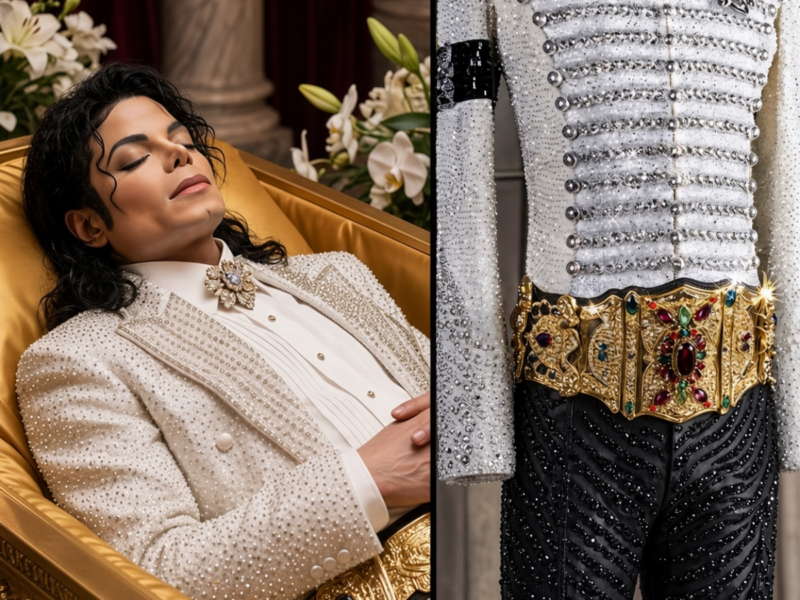
Why Michael Jackson Was Buried in His Final Stage Costume- SHOCKING TRUTH Was Buried for 17 years.
Michael worked with Michael Bush for thirty-one years as a costume designer, but also loved fashion and design.
And this time around, we brought in a wonderful new young designer out of New York named Zaldy.
And both Michael Bush and Zaldy created all of Michael’s new costume ideas.
Beneath the brightest spotlight of the entertainment world, there are secrets and sacred wishes that are truly revealed only when the curtain falls forever.
Why, among tens of thousands of lavish outfits, did people have to stay awake through five white nights to remake a costume from scratch for a legend’s final journey?
What was quietly embroidered right against the unthrobbing chest of Michael Jackson where no media lens could ever reach?
And why was the legendary white glove absent from that fateful farewell?
Perhaps one of the strangest and most haunting things about Michael Jackson is that even after he was laid to rest, fashion continued to reach out and finish telling the story of his life with a power that transcended even death itself.
Michael’s passing in the summer of 2009 did not close the book on his sartorial anecdotes.
On the contrary, it was the final chapter of a novel drafted eighteen years prior.
To understand why the pearl-embellished military jacket was present in Michael’s coffin, one must turn back the clock to a spring night in 1991 at the 63rd Academy Awards.
That was the night Michael Jackson, in a decision that shook the entire global media, walked side by side with Madonna onto the Academy’s red carpet.
Just flipping through the black-and-white frames or the yellowed magazine pages of that fateful evening makes one instantly grasp why fashion held supreme power for Michael.
Madonna appeared like a goddess stepped out of 1950s golden-age cinema, draped in a sparkling white gown custom-designed by the legendary fashion house Bob Mackie, paired with blazing diamond necklaces that directly evoked the immortal image of Marilyn Monroe.
The press at the time reeled.
Photographers went wild, clicking their shutters, and Madonna’s name flooded every headline the following morning.
Yet standing right beside her—quiet, mysterious, and overpoweringly commanding—was Michael Jackson.
He wore an immaculate white ensemble, perfectly contrasted with pitch-black details and glittering silver accents.
They were not wearing matching outfits, but the combination of these two individuals created an immortal dual embodiment of American pop culture.
Madonna carried the allure of a wealthy, seductive, and defiant cinematic starlet.
Michael resembled a monarch stepped straight out of the ancient European epics he was so passionate about studying.
If Madonna was the incarnation of Marilyn Monroe, Michael was the incarnation of Renaissance kings.
It was never a random coincidence by stylists or a spur-of-the-moment handshake on the red carpet.
Michael Bush, the designer, tailor, and devoted confidant who walked alongside Michael Jackson for twenty-five years, recounted in his memoirs Jackson’s fierce, almost obsessive fascination with royal military uniforms, ribbons of honor, golden epaulets, and crowns symbolizing absolute power.
In their workshop, Bush and Dennis Tompkins would frequently bury themselves in thick piles of material, turning the pages of European military history books, meticulously studying how monarchs wore their ceremonial robes during coronations to distill a radiance that was both majestic and steeped in theatrical fantasy.
Yet the genesis of the iconic military jacket that appeared at the Grammy Awards two years later, in 1993, began with a very Michael question—deeply imbued with his innate curiosity, perfectionism, and absolute need for control.
In the days leading up to the 1991 Oscars, while preparing for his sensational appearance with Madonna, Michael called Michael Bush and issued a challenging covert directive.
“Find out what Madonna is wearing tonight.”
Michael Bush was handed a genuine espionage mission in the heart of Hollywood.
The red carpet of the 1990s was shrouded in extreme security.
No fashion house, no assistant would leak even a single stitch regarding the major stars’ outfits.
The Los Angeles Times once published multi-part articles dissecting the breath-stealing secrecy of celebrity teams ahead of major award shows.
Through every connection and absolute persistence, Bush finally tracked down a clue.
Madonna would choose a design by Bob Mackie, primarily in white, and it would likely feature pearls.
However, the information stopped there.
There were no detailed sketches, no sample prototypes, no chance to touch the material with his own eyes before the awards night.
Michael Jackson did not need any further data.
With the sharp strategic mind of a stage ruler, he waved his hand and demanded that Bush hurriedly craft two completely different jackets within an unimaginably short time frame.
A classic gentlemanly dinner jacket.
And an elaborate military jacket weighed down by intricate decorative details.
Both jackets had to be finished in a flash.
That night, when stepping onto the Oscar red carpet, Michael chose the dinner jacket to walk in rhythm alongside Madonna.
The remaining elaborate military jacket was neatly tucked away into the corner of the storage room.
Yet for Michael Jackson, no idea was ever discarded into the past.
Looking at the military jacket resting silently on the mannequin, he turned to Bush and commanded in a firm tone.
“Keep it. Don’t throw it anywhere. I’m going to wear it to the Grammys.”
That is one of millions of proofs showing that Michael Jackson’s visual mindset was always decades ahead of its time.
A garment born for one event could be hidden away for two full years, waiting for the exact ripe moment to become the centerpiece of another history.
And that moment arrived in the spring of 1993.
On the night of the 1993 Grammy Awards, the stage suddenly burst into light amidst an unprecedentedly emotional atmosphere.
Janet Jackson, the biological sister whom Michael deeply cherished, stepped out under the brilliant lights to present her brother with the prestigious Grammy Legend Award.
Michael emerged from the wings draped in the snow-white, pearl-encrusted military jacket he had asked Bush to hide two years prior.
Under the lights of millions of global television viewers, the two Jackson siblings stood locked in a tight embrace.
That moment was beautiful, monumental, but also carried a profound sorrow regarding family burdens that only those carrying Jackson blood could truly understand.
Janet choked back tears as she expressed her love and pride for the brother who had soared to the furthest stars.
And the military jacket that day no longer served merely as an item of fashion.
It had officially transformed into a living witness, a keeper of family memories, an indelible scar carved by time.
Only to find that nearly two decades after that 1991 Oscar and 1993 Grammy night, when this life closed its doors for Michael Jackson, that very jacket—imbued with the soul of memories past—was called upon once more, transforming into the eternal design for the final gathering of his life.
Standing side by side on the 1991 Oscar red carpet, the energy radiating from the combination of Michael Jackson and Madonna was so dense, suffocating, and powerful that not a single camera lens in the world could ignore it.
They sat closely side by side in the front row of honored guests, whispering quietly, laughing cheerfully, and instantly became the epicenter of a storm of rumors that would never truly end in popular culture history.
Were they actually dating?
That question has drifted, circulated, and mutated across four decades without ever receiving a definitive answer.
At that time, both Michael and Madonna stood at the dazzling, most powerful peak of the global music empire.
They were two great poles of pop music.
Madonna—daring, rebellious, flaunting sexual instinct, and relentlessly tearing down every social moral standard.
While Michael hid behind a closed shell, elusive, utilizing ultimate secrecy as a strategic weapon to completely control how the public viewed and judged him.
Any fleeting glance, any casual embrace between them was enough to explode onto the covers of thousands of tabloid newspapers from London to New York.
The photos taken together at the Oscars only fueled these bizarre legends.
Michael and Madonna created a perfect contrast.
Madonna alluring in the style of classic Hollywood starlets, sensual and deeply provocative.
While Michael stood there with a cold, reserved, mysterious composure like an ancient statue carved from marble.
Various sideline sources once insisted that their relationship went far beyond professional friendship, that it was a carefully concealed tryst between the two loneliest people on the planet.
Others asserted it was simply a flawless PR stunt calculated by major record labels.
That absolute ambiguity was the fuel that sustained the legend for years on end.
There were even legends recounting that they once intended to collaborate on a major music or film project, but it fell through due to the massive egos of both.
Madonna would later hint at Michael in subsequent interviews, revealing that Michael was actually an extremely shy, sweet person with an artistic ego as sharp as a razor blade once he stepped inside the recording studio.
Yet rising above all rumors of romance, the truest thing revealed through the 1991 encounter was the extreme difference in how they used fashion to tell the story of themselves.
Madonna wanted to break every boundary.
She changed her image drastically with every album—from the 1980s bad girl to the 1990s stylish icon—constantly experimenting with the authority of gender and ready to trample any framework.
Michael Jackson was the exact opposite.
He also changed, but every change had to reside within a rock-solid mythological system designed and controlled by himself down to the smallest detail.
Michael never simply wore clothes.
He constructed legendary personas.
For Michael, the crystal-encrusted glove was not merely for performance.
It was the signature of a solitary soul.
The tilted fedora was not just for blocking the sun.
It was a curtain hiding childhood wounds.
The aviator sunglasses were not simply a fashion accessory.
They were a fortress blocking the world’s cruel scrutiny from Michael’s sorrowful eyes.
Michael Bush once shared that Jackson thoroughly understood every millimeter of a massive stage.
He knew clearly that a dancer could not dress like a fashion model.
Michael’s garments had to breathe, to stretch rhythmically with every moonwalk step, possessing weight and structure so that when he spun 360 degrees, the hem of his jacket would flare at the exact perfect angle.
Furthermore, the clothing had to catch the light bouncing from the furthest rows, where spectators in the nosebleed sections of a 100,000-seat stadium could still recognize his silhouette with just a flick of the hand.
Because of those rigorous demands, Michael’s clothing gradually transcended the borders of applied fashion to become physical architecture.
From the revolutionary bright red leather jacket in the Thriller music video to the later gem-encrusted military uniforms, Michael continuously threw his craziest ideas into his designs.
Bush once recounted that some jackets were decorated with real silver-plated knives, forks, and spoons, simply because Michael took joy in watching the astonished expressions and bursts of laughter from his crew when he put them on.
Here emerges a paradox that is both heartbreakingly beautiful and painful.
The man with the supreme power to make 80,000 people faint and scream in tears with just a tiptoe on stage was almost mute, timid, and pitiably lonely when stepping into small rooms.
Clothing therefore became his most powerful spokesperson, delivering his greetings, his declarations of war, and his connection to the outside world.
And that is precisely why the relationship between Michael and Madonna carried such a strange hue.
They worshiped the power of imagery but chose opposite paths.
Madonna tore down all limits to reinvent herself, while Michael built a fortress of characters so solid that no one in the world could clearly distinguish where the flesh-and-blood human of Michael Jackson ended and the theatrical illusion began.
The 1991 military uniform was a resounding testament to that intersection.
It had to bear the rebellious breath of Madonna.
Yet its backbone had to maintain the solemn dignity of Michael.
It had to sparkle under the lights but must never be feminized.
It had to be powerful, masculine, theatrical, and deeply mesmerizing.
Michael stood beside the Queen of Pop, but he fiercely maintained the inviolable throne of the King of Pop.
Years passed.
When Michael’s funeral took place in the summer of 2009, Madonna was not present among the farewell crowd at Forest Lawn.
She stood on the MTV Video Music Awards stage a few weeks later, choking back tears as she spoke of him, calling Michael the sole king with no replacement.
But the distance between them by then was an abyss of time and the realms of life and death.
And so when Michael stepped into eternity, the jacket that once carried the phantom of that 1991 Oscar night was present upon his body once more.
No more Madonna.
No more Marilyn Monroe.
Only Michael remained whole within the kingdom of his own.
If Madonna represented the dazzling, flamboyant, and performance-heavy outer world of pop culture, Janet Jackson was the intimate memory, the deepest wound, and the sole salvation anchoring the 1993 jacket into the most private consciousness of the Jackson family.
Throughout his magnificent career, Michael Jackson owned thousands, perhaps tens of thousands, of different outfits.
Michael Bush and Dennis Tompkins built a massive archive filled with one-of-a-kind designs, even casting a custom fiberglass mannequin to match Michael’s exact physical measurements so they could adjust every single stitch without forcing him through endless fittings.
Yet among those tens of thousands of garments, very few carried a family story as tears-soaked as the 1993 Grammy jacket.
During their impoverished childhood in Gary, Indiana, Janet and Michael were an inseparable pair.
They grew up together in a cramped home, enduring the harsh whippings of their father, Joe Jackson, and finding their sole salvation in music.
But the hurricane named Thriller in the early 1980s swept Michael up to a distant cosmic tier and isolated summit that no family member, not even Janet, had the capacity to follow.
Janet later rose to become a grand pop star with a massive legacy of her own.
But Michael had become a global religious phenomenon, an entity exceeding the boundaries of flesh and blood.
That eternal disparity and suffocating aura unwittingly cast invisible cold walls between the siblings.
Janet would later choke back tears in a television interview years after his passing, recalling the moment she realized how distorted their relationship had become due to fame.
Michael would step into her room just as they did in childhood.
The two siblings standing in dead silence within a thickening atmosphere, exchanging no greetings, launching no casual chatter, before he quietly turned and walked away.
No shouting matches.
No explosive tears.
Only the terrifying silence of peak isolation.
The more millions of people worldwide yearned to touch Michael, the deeper he sank into absolute isolation within his own home.
That is why the 1993 Grammy appearance carried the sacred meaning of salvation and healing.
When Janet stood on stage before millions of eyes fixed upon her, proudly reciting glowing tributes to her brother and placing the Grammy Legend Award into Michael’s hands, it was not merely a routine music award presentation.
It was a historic embrace between two human beings imprisoned within the glass cage of celebrity.
And Michael, clad in the snow-white, pearl-encrusted military jacket created from the prototype of the Oscar night two years prior, found sibling warmth once more amidst a world trying to tear him into a hundred pieces.
That is the profound reason why Michael Bush always regarded the 1993 Pearl Jacket as the most sacred treasure Michael Jackson ever loved and preserved throughout his artistic life.
When the grim news of Michael’s sudden passing struck in the summer of 2009, La Toya Jackson, the sister representing the family, approached Michael Bush with a heartbreaking, tear-stained request.
“Design the final outfit for my brother.”
Initially, Bush stubbornly refused in despair.
The aging artist’s heart had shattered into tiny pieces.
He could not fathom the meaning of tailoring clothes for a friend who had departed forever.
But the Jackson family insisted.
No one on earth—not even the greatest fashion houses of Paris or Milan—understood every inch of skin, every breath, and every bodily structure of Michael as well as Bush did.
Finally, Bush brushed away his tears and accepted.
But the moment he nodded, the fateful question struck like a knife twisting in his chest.
What should Michael wear on his final journey?
A sleek business suit?
A simple white everyday shirt?
Or casual loungewear that Michael often wore while composing music at Neverland?
It did not take long to find the single correct answer.
Tompkins and Bush immediately turned to the fateful jacket of 1993—the symbol of family healing and stage royalty at its peak.
But ironically, the original version of that jacket had been lost in the chaotic currents of the massive archive.
They could not find it in time for the funeral.
They were forced to start over from scratch.
Everything from zero.
And the allotted time frame was a mere five days and nights.
During those harrowing five days and nights, Michael Bush held the needle and thread with his own hands, hand-sewing every pearl, measuring and completing the outfit under the dim light of his workshop, where Michael’s silhouette seemed to still linger.
When the outfit was completed, the very hands that had served Michael for twenty-five years dressed his cold body for the very last time.
The final attire did not bear the oppressive gloom of mourning or cheap earthly melodrama.
It was a resurrection, a rebirth into eternity.
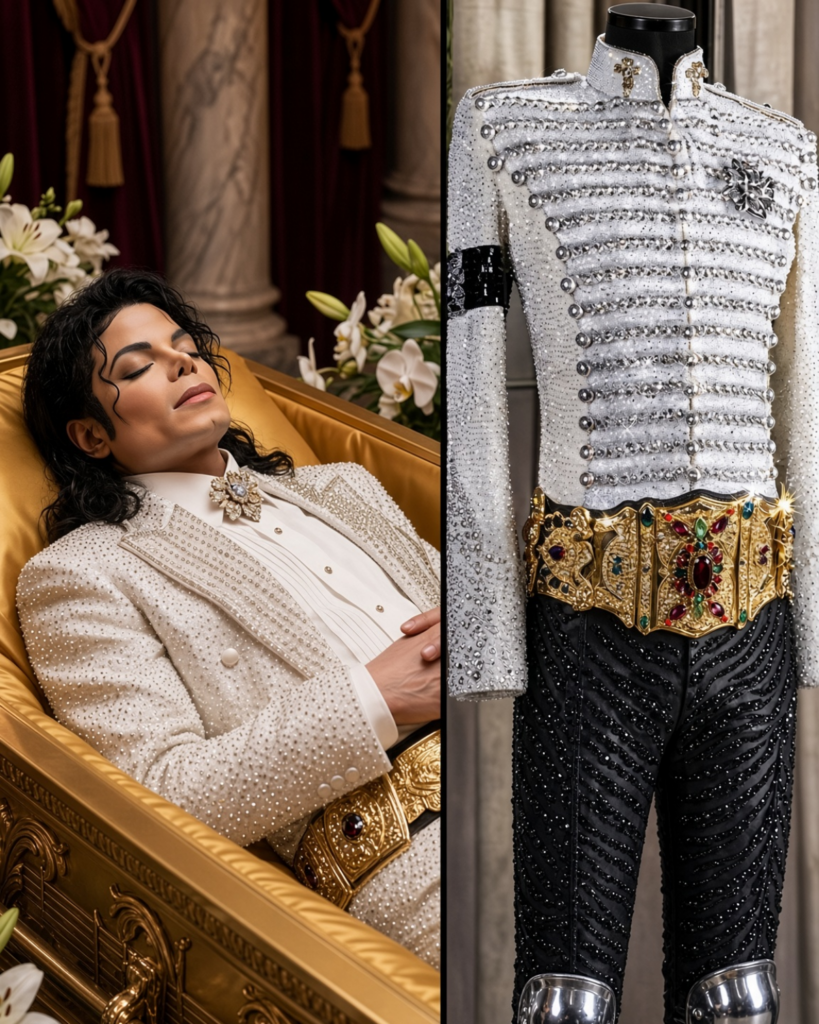
The milky white pearl-studded jacket was smooth like a harvest moon.
The pitch-black trousers dotted with sparkling beads like a night sky.
The wide belt embossed with guardian angels and the authoritative royal crown.
Yet hidden discreetly inside that luxurious, magnificent lining—completely shielded from the prying eyes of billions of viewers and global media lenses—was a tiny, deeply sacred secret understood only by Michael Bush and his late friend.
A miniature Tinkerbell figure embroidered inside the jacket lining.
Throughout his illustrious artistic career, Michael Jackson could negotiate, alter, and revamp almost every detail of his body and appearance.
He could change his hairstyle, switch jacket colors, shape-shifting unpredictably from a 1970s afro teenager to a 1980s rock prince and a 1990s military king.
But there were absolutely two things on Michael’s body that no one—not even his closest designer or dearest family member—was allowed to touch or alter at will.
His floor-shine leather dress shoes.
And the sequin-adorned white glove.
Those familiar dance shoes were not luxury fashion pieces from the most expensive artisan houses in Milan or Paris.
They were ordinary mass-market men’s leather shoes that Michael had clung to since his impoverished youth, from days scrubbing his feet bloody on cramped rehearsal floors in the American Midwest.
Even when standing at the dazzling peak of the world, possessing a fortune large enough to buy out any exclusive fashion brand on the planet, Michael stubbornly refused to abandon those worn-out shoes.
“Do whatever you want with the clothes, but never touch my shoes.”
Michael warned Bush multiple times in an absolutely serious tone.
To Michael Jackson, shoes were never a fashion accessory for ornamentation.
Shoes were the most sacred professional tool.
His second sense.
A dancer’s wings.
A polish coat applied slightly offhand could make the leather soles slippery.
A minor change in heel height was enough to throw him off balance and collapse during consecutive 360-degree aerial spins.
Michael Bush recounted a very special anecdote regarding this obsession.
During a tour in Japan, a well-meaning but clueless backstage crew member saw Michael’s dance shoes covered in dust and looking worn and quietly took them away to polish them clean.
When Michael discovered it, he was furious, explaining in panic that if the soles lost their natural frictional grip, he could slip and fall on stage at any moment.
Ever since that incident, throughout the historic Bad Tour, Michael Bush frequently had to sleep holding Michael’s shoes in his arms every night to ensure no one had a chance to touch them.
Those rustic, worn-out shoes were later ingeniously modified to create the physical miracle of the lean shoes in the video and performances of Smooth Criminal—a special shoe heel design locking into stage floor hooks, allowing Michael and his dancers to lean at a gravity-defying 45-degree angle.
A great technical invention later officially patented exclusively in the US.
The white glove carried a similarly sacred mission to the public and billions of fans worldwide.
The sequined glove was the inseparable symbol of Michael Jackson.
But to Michael himself, that glove did not carry a general decorative meaning.
It was bound strictly and exclusively to one single song.
Billie Jean.
Michael once firmly declared that if he stepped onto the stage to perform Billie Jean without the white glove on his right hand, the performance would instantly lose its soul and no longer be Billie Jean.
That is the supreme reason why, in the final burial outfit, Michael Bush made a deeply philosophical decision.
He absolutely did not place the white glove on Michael’s hand.
This was by no means an oversight or blameworthy negligence.
It was the highest and absolute reverence for the legacy of his late friend.
Michael Jackson lay there in the gold-plated casket.
He no longer needed to execute reverse-time moonwalks.
No longer needed to stressfully adjust every lighting angle before 80,000 screaming, fainting, ecstatic fans.
No longer needing to strain himself, proving he was the greatest artist on this planet.
The most agonizing, haunting question clinging to fans’ minds years after the 2009 funeral was why the Jackson family decided to let Michael depart in the theatrical garb of an artist so flamboyant, when they fully possessed the power to choose a safer option.
A standard tailored black suit.
A simple white shirt.
Or soft casual wear that Michael often wore while lounging with his children at Neverland.
Yet they refused all of those mediocre choices.
They chose the imagery humanity had carved into cultural history.
White pearl-studded jacket.
Pitch-black trousers.
Angel belt.
Royal crown.
Aviator sunglasses.
Original floor-shine shoes.
And behind all those symbols of power stood Michael Bush—the man who dedicated twenty-five full years of his youth, sweat, and passion to standing in the shade, witnessing all the darkest corners, ultimate loneliness, and brilliant soaring moments of Jackson.
He was the only one who listened to Michael’s exhausted sighs after grueling practice sessions.
The person who knew precisely which crystal stones blinded Michael’s eyes under spotlight beams.
And the final person to dress that quieted body in eternal attire with his own hands.
No more frantic 2:00 a.m. phone calls.
No more familiar phrase: “Bush, add some magic for me.”
All that remained was the breathtaking silence of the final dressing room at the Staples Center.
The 18-karat crown resting heavily upon his brow was not merely empty praise for the title King of Pop.
It was the belated, bitter yet eternal recognition by his family for a soul who sacrificed his entire childhood, flesh and spirit, to the ruthless stage realm.
The aviator sunglasses continued their duty of preserving the eternal veil of secrecy Michael painstakingly distilled across half a century of public existence.
Yet agonizingly, that dazzling attire also carried the ghosts of unfulfilled dreams.
This Is It.
Designs that never had the chance to shine under the dome of the O2 Arena in London, suddenly transforming into a winding sheet for a life driven to its absolute limit.
There was a heartbreaking contrast between the image of the jewel-encrusted king in the golden coffin and Michael’s real-life everyday persona.
A vibrant, simple red T-shirt.
Baggy black pants.
And his familiar fedora hat, which he wore when wandering alone in his Neverland recording studio.
Michael was actually an extremely simple person in his personal routines.
He hated wasting his precious intellectual energy on everyday clothing choices.
He liked wearing the exact same red T-shirt repeatedly so his mind could remain completely free to soar into the world of melodies.
His family and crew decided to set that simple human aside.
They wanted the world to remember Michael not as a man fatigued by weariness, but as an immortal god.
And thus, Michael Bush stood in for billions of fans across the planet to finish the final symphony of fashion.
Every pearl was set with the meticulousness of kinship.
Every stitch was embroidered with tears.
And the tiny Tinkerbell figure was hidden away like a sacred secret between two confidants.
Michael Jackson’s life closed like a perfect circle of destiny.
Beginning from the anonymous dance steps of a poor Black child in worn-out shoes in Gary, traversing tens of thousands of stages glowing with the brightest halos in human history, only to finally close his earthly journey in the royal garments of a fairy-tale monarch.
Lying there beneath the transparent crystal glass of the golden casket, Michael had no more music.
No more rapturous crowd roars.
No more gravity-defying spins.
Only fine fabrics remained.
Only glowing pearls remained.
Only the old, worn leather shoes from an impoverished childhood remained.
And in the boundless silence of eternity, the final outfit was no longer viewed as a mournful funeral garment.
It transformed into a gigantic miniature album, capturing the entire glorious and bitter life of a lonely genius—where each bead is a sweat drop falling on the rehearsal floor, each coat hem is a bleeding wound of fame, and the crown upon his head stands as the eternal proof of a musical empire that never had and never will have a replacement.









