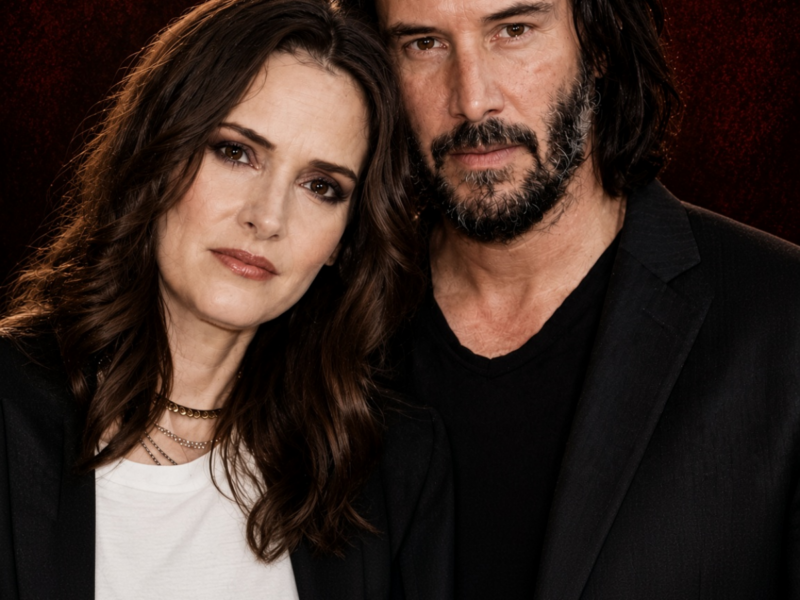
Why Keanu Reeves Refused To Divorce Winona Ryder in 2018 Despite Their Secret 1992 Ceremony?
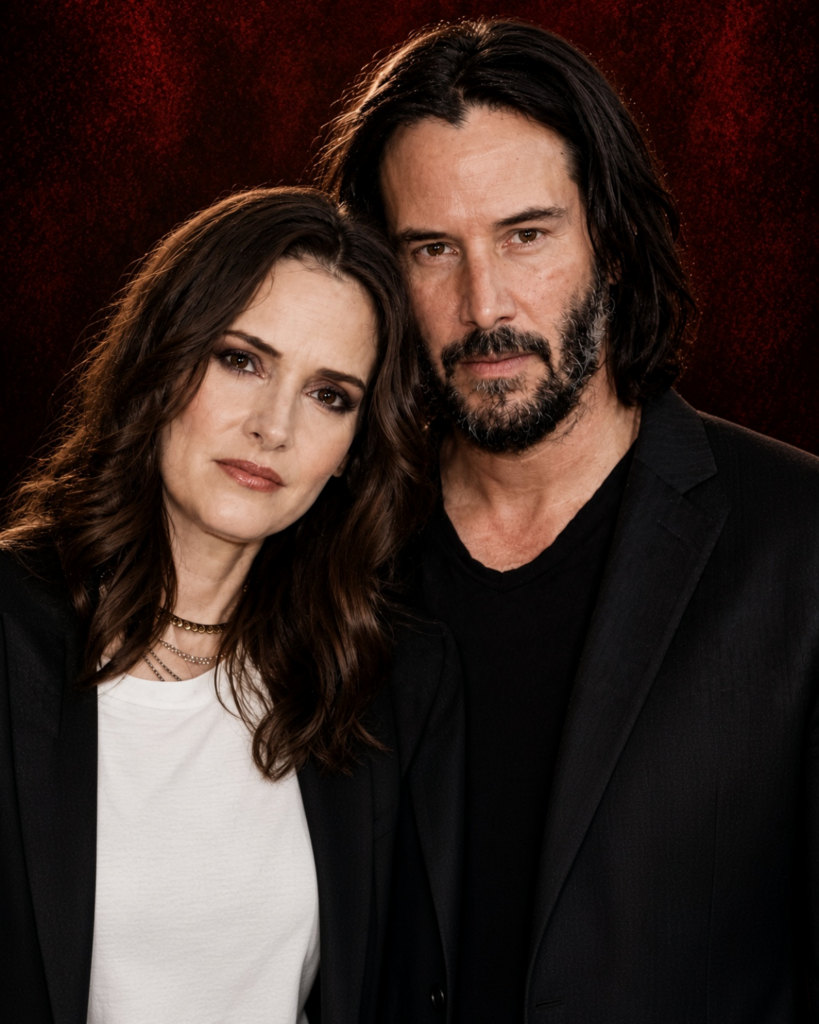
March 1992, sound stage four in Los Angeles.
A $40 million budget, an ordained Greek priest, and two movie stars.
The American public only saw four minutes of gothic fantasy wrapped in a standard SAG contract.
Look at the Los Angeles County docket archives—page zero.
No civil license. No prenuptial agreement.
Yet right on that set, an uncut liturgical rite bound Keanu Reeves and Winona Ryder to a sacred Greek oath.
Nine years later, she was arrested with $5,500 worth of stolen clothes, while he quietly buried his child and his partner.
Twenty-six years after that altar, with a $380 million fortune on the line, lawyers drafted a denial.
He refused to sign.
Everything came out at a press conference in Beverly Hills—but before the press conference, before the crowns, remember prop trunk number 12, because that will tell you what this bond truly was.
At 7:00 a.m. on an early morning in March of 1992, a technical production truck belonging to Columbia Pictures moved through the rear security gate of stage four in Los Angeles.
Resting inside the production records binder approved that very day by the American Zoetrope project administrator was an extraordinary payment voucher.
It was not compensation intended for background performers or set dressing personnel.
That specific payment was wired directly into the operational bank account of Saint Sophia Greek Orthodox parish in Los Angeles—to bring an ordained holy priest straight to the movie sound stage.
Director Francis Ford Coppola was standing before a high-stakes life-or-death gamble at that pivotal moment.
Two consecutive devastating commercial box office catastrophes—The Godfather Part III and the financial ruin of One from the Heart—had forced studio executives to closely inspect every single dollar he spent.
Operating under a strict $40 million budget approved for Bram Stoker’s Dracula, Coppola could not afford a single mistake.
Yet the severe financial strain did absolutely nothing to soften his radically uncompromising dedication to pure realism.
He felt profound contempt toward the hollow, deceptive staging conventions that major Hollywood studios routinely relied upon to mislead movie audiences.
Within the original shooting draft written by screenwriter James V. Hart, the sacred wedding between Jonathan Harker and Mina Murray occupied merely half a page of text.
It was an ordinary textbook cinematic setup—a handful of lines composed by the writer, a background extra draped in a generic black robe holding an empty notebook, and a director shouting cut the instant the two leads shared a kiss.
Coppola swept that script draft clean off his worktable.
He declared firmly to his creative team that he required a genuine sacrament of marriage—a sacred ceremony carrying the ancient spiritual gravity of Eastern Orthodoxy—to construct an absolute contrast against the horrific shadow realm of Dracula.
His strict mandate to the visiting Greek priest was unmistakably clear: conduct the entire sacramental liturgy according to the ancient liturgical books. Do not omit a single prayer. And do not treat this as acting.
Inside the quiet, soundproof interior filled with the heavy scent of melting beeswax and rising frankincense on stage four, the two lead performers stepped forward to take their places before an altar erected to exact ecclesiastical standards.
Keanu Reeves was twenty-eight years old at the time.
He had just completed his emotionally exhausting role in My Own Private Idaho and was suffering immense emotional heartbreak as he watched his dearest companion, River Phoenix, fall deeper into addiction.
Reeves arrived on the movie set deeply reserved, quiet, and profoundly sensitive to the painful breakdowns within families.
Beside him stood Winona Ryder, twenty-one years old.
She was widely celebrated as the most sought-after actress of her entire generation.
Yet she had just endured an agonizing mental breakdown in the wake of her turbulent, highly publicized broken engagement with Johnny Depp.
Psychiatrists in Los Angeles had been forced to prescribe heavy sedatives to help her survive sleepless nights and relentless panic attacks.
Both Keanu Reeves and Winona Ryder stepped onto the sacred altar platform purely as working actors fulfilling their legal obligations under a standard Screen Actors Guild agreement.
Their standard commercial contracts explicitly governed daily wages, permitted working hours on set, and image rights.
Not a single prenuptial agreement was ever drafted. Not a single estate planning attorney stood behind the cameras.
And absolutely no civil marriage license under Section 300 of the California Family Code was ever submitted to the Los Angeles County Registrar-Recorder’s Office.
Through the objective lens of American statutory civil law, that quiet morning was nothing more than a paid commercial production activity between a studio and contracted employees.
However, the sacred liturgical domain of the Orthodox Church does not bend to the statutory provisions of the California Labor Code.
Under Eastern Orthodox Canon Law, holy matrimony is not an ordinary secular agreement that can be evaluated in money, but an indissoluble, consecrated mystery.
This holy sacrament is rendered fully valid through the spiritual authority of an ordained priest, the sacred exchange of binding oaths, and the ancient crowning ceremony of the stefana.
Canon law demands no signature from secular civil magistrates to acknowledge a valid marriage before the altar of God.
When the 35mm cameras began rolling, the Greek Orthodox priest chanted sacred scriptures in ancient Greek, speaking archaic prayers that neither Keanu Reeves nor Winona Ryder fully comprehended.
The priest took two ornate silver stefana crowns connected by a delicate white ribbon—an ancient sacred emblem signifying the eternal and indissoluble union of two separate destinies.
Raising the crown over the head of Keanu Reeves three times in the sign of the cross: “In the name of the Father, the Son, and the Holy Spirit.”
He then solemnly repeated the exact liturgical ritual over the head of Winona Ryder.
Next came the holy exchange of marital rings—an ancient sacrament in which the ring was passed back and forth three times between the groom and the bride.
This sacred movement represented the profound truth that each soul had completely and unconditionally surrendered their personal honor and their very mortal existence into the hands of the other before the witnessing eyes of almighty God.
Grasping their right hands together, the priest led the couple in a sacred procession three times around the holy altar, accompanied by traditional liturgical chants—an act of faith declaring to heaven that this marriage had formally transcended the secular realm and entered into the stream of eternity.
Francis Ford Coppola watched the entire scene unfold behind his video monitor with complete and absolute satisfaction.
Through his exacting artistic vision, he had captured a hauntingly authentic four-minute cinematic sequence destined for the theatrical cut of the movie.
Yet the veteran filmmaker failed to foresee the profound consequences born of his uncompromising pursuit of realism.
By choosing to bring a genuine ordained priest onto a working movie set and strictly requiring the uninterrupted execution of the Holy Liturgy without cutting the cameras, he had inadvertently consecrated a fully binding religious sacrament right in the heart of a commercial sound stage.
When the director finally called wrap, the sacred stefana crowns were lifted from their brows and packed away inside prop crate number 12.
The lighting technicians began wrapping their cables, and the sound stage slowly quieted down.
Keanu Reeves and Winona Ryder removed their elaborate Victorian costumes and walked away from stage four to return to their private everyday lives across Los Angeles.
Both believed that the day was merely another successful performance—an artistic sequence brought to completion in strict accordance with their studio employment contracts.
Yet in the personal pastoral register of the elderly priest who quietly journeyed back to Saint Sophia Cathedral that afternoon, an indelible spiritual oath had been forged.
Within the sacred theology he served, there was no recognition of a movie director shouting cut on a commercial sound stage.
No corporate paychecks signed by Columbia Pictures could ever dissolve a holy sacrament sealed under the authority of the Holy Trinity.
In November of 1992, Bram Stoker’s Dracula premiered in movie theaters, rapidly earning more than $215 million across the worldwide box office and securing three prestigious Academy Awards.
Keanu Reeves and Winona Ryder walked the red carpet side by side amidst overwhelming praise from the international entertainment press.
Yet when the intense camera flashes faded, the connection between them never devolved into an orchestrated tabloid romance designed to generate publicity, as is so common within the entertainment industry.
Instead, a quiet and unspoken bond took root between them.
They maintained a stance of absolute mutual respect and personal distance—never intruding into each other’s private affairs, yet consistently appearing by each other’s side during life’s most challenging trials.
It seemed as though both quietly recognized the invisible weight of the stefana crowns that had touched their heads.
That quiet peace proved fragile as the decade advanced.
By the late 1990s, even as both actors achieved widespread critical acclaim through challenging independent film projects, the doors of their personal lives opened to an unrelenting series of devastating tragedies.
In 1999, Keanu Reeves was struck by profound grief when his firstborn daughter, Ava, passed away at birth, shattering his domestic world.
Just two years later, a catastrophic automobile accident on the streets of Los Angeles took the life of his partner, Jennifer Syme, plunging him into absolute isolation and sorrow.
Around that very same time in Beverly Hills, an unexpected and high-profile legal crisis was about to engulf Winona Ryder, dragging her reputation through intense media scrutiny and subjecting the unintended vows of 1992 to an unprecedented trial by fire.
At 5:30 p.m. on December 12, 2001, security guards at the Saks Fifth Avenue department store on Wilshire Boulevard in Beverly Hills intercepted a woman in a black beret right at the exit.
Inside her large handbag were twenty unpaid luxury items—including Marc Jacobs dresses, Donna Karan sweaters, and hair accessories—totaling $5,560.
As the handcuffs snapped around the woman’s wrists, the Beverly Hills Police Department booking photo, file number SA046467, was instantly leaked to every Western news outlet.
The woman in that photograph was Winona Ryder.
Overnight, the two-time Academy Award nominee was transformed into the focal point of public hostility.
Major studios canceled her entire shooting schedule.
Hollywood insurance underwriters refused to issue completion bonds or risk coverage for any production featuring her.
Tabloids branded her “the millionaire shoplifter.”
Late-night television shows relentlessly turned her broken arm and high-dose sedative prescriptions into a national punchline.
Those who had raised glasses to toast her on the red carpets of the 1990s chose to keep their distance to protect their commercial contracts.
Yet at Winona Ryder’s private legal office in San Francisco, only one co-star kept in daily contact.
That was Keanu Reeves—the man who had stood with her before an Orthodox altar nine years earlier.
Reeves understood precisely what it felt like to have your dignity crushed under the wheels of the Hollywood machine.
Because exactly two years before Winona’s arrest, he had lived through the most horrific chapter of his own life.
On December 24th, 1999, his longtime girlfriend, Jennifer Syme, gave birth prematurely in her eighth month.
Their firstborn daughter, Ava Archer Syme-Reeves, died the moment she was born.
The devastating grief of losing a child fractured their relationship, and they separated quietly.
Yet the tragedy did not end there.
In the early morning hours of April 2nd, 2001, Jennifer Syme’s Jeep Grand Cherokee lost control on Cahuenga Boulevard, colliding with three parked vehicles.
Syme was thrown through the windshield and died instantly at the age of twenty-eight.
At the Westwood Village Memorial Park Cemetery, Keanu Reeves silently served as a pallbearer for his former partner.
He stood frozen between two graves positioned side by side—one for the daughter who had never seen the light of day, and one for the woman he had loved.
The entire film capital labeled Reeves “the loneliest man on the planet.”
Paparazzi aggressively pursued pictures of him sitting in silence on the New York subway or eating a plain piece of bread on a street corner.
Those two human beings—a woman blacklisted by the entire industry over a mental health crisis, and a man submerged in profound grief—refused to turn their pain into commercial memoirs.
They held no press conferences. They sought no pity.
Instead, a quiet alliance was forged between them.
It was a strange bond, defying every standard Hollywood custom.
They never moved into a shared home. They never walked red carpets together to manufacture romantic scandals.
They never opened joint bank accounts, and they never permitted any financial non-disclosure agreement to dictate their relationship.
Their only connection was midnight phone calls and brief text messages.
For over twenty years, every message Winona Ryder sent to Reeves began with two words: “Hello, husband.”
And on the other end of the line, Reeves’s steady reply was always: “Hello, wife.”
In a place where multi-million-dollar marriages routinely end with suffocating non-disclosure agreements, that greeting sounded almost like satire.
Yet to Ryder, it was the single anchor of dignity keeping her from total collapse.
In December of 2002, Judge Elden Fox at the Beverly Hills Superior Court sentenced Winona Ryder to three years of probation and 480 hours of community service.
Her career hit absolute rock bottom.
During her long years in seclusion in San Francisco, Ryder was virtually erased from major studio screenplays.
Yet Keanu Reeves never stopped calling.
By 2006, director Richard Linklater began work on the experimental animated project A Scanner Darkly.
Inside the production conference room, Keanu Reeves used his star leverage following The Matrix franchise to personally endorse Winona Ryder for the female lead, Donna Hawthorne.
Investors were terrified of the insurance risks tied to Ryder’s public image.
Yet Reeves put his personal reputation on the line to guarantee her comeback.
That was no polite industry gesture between colleagues.
It was the honorable protection of a man who had once stood beside her at a sacred altar.
In 2009, they appeared together again in The Private Lives of Pippa Lee.
Film critics noticed something remarkable: whenever she was beside Keanu Reeves, Winona Ryder regained an unmistakable stability in her eyes.
There was zero posturing, no fighting over billing or salaries, and no jealousy.
They had carved out an absolute sanctuary—a space where studio money held no influence.
As the years passed, both crossed into their forties.
Keanu Reeves reclaimed his legendary status with the John Wick franchise, becoming Hollywood’s rare icon of authentic kindness.
Winona Ryder staged a spectacular career resurgence as the mother, Joyce Byers, in the global phenomenon Stranger Things.
They had each rebuilt themselves from the ashes of tragedy, and across those twenty-six years, the secret of that spring wedding in 1992 remained unspoken—an unwritten pact between the two of them and the veteran director Francis Ford Coppola.
Not a single California attorney knew of the event. Not a single municipal vital statistics record listed them as husband and wife.
They were legally single individuals on paper, yet soulmates bound by a sacrament of honor.
Yet that veil of secrecy could not remain drawn forever.
In the summer of 2018, director Victor Levin reunited the pair for the dark comedy Destination Wedding.
The film followed two bitterly cynical singles who unexpectedly cross paths at an extravagant destination wedding.
It was this very wedding backdrop that reignited the truth buried for nearly three decades.
On an August morning in 2018 at the Four Seasons Hotel in Beverly Hills, press junket interviews were underway.
Sitting before reporters from Entertainment Weekly, Winona Ryder suddenly turned to look at Keanu Reeves.
Her usual playful smile vanished, replaced by a slow, deliberate tone of conviction.
She declared to the recording microphones that the 1992 ceremony on stage four had not been a performance—and that she believed they were genuinely married before the eyes of God.
That unexpected confession sent shockwaves through estate planning attorneys across Los Angeles.
Keanu Reeves’ $380 million fortune was suddenly confronted with a complex legal question, sparking a fierce debate between secular statutory law and ancient canon law.
On the morning of August 20th, 2018, legal specialists at an estate management law firm on Avenue of the Stars in Century City accessed the Los Angeles County public records system.
They combed through every marriage application filed between 1990 and 1995.
Their sole objective was the filing record of a marriage license bearing the names of Keanu Charles Reeves and Winona Laura Horowitz.
The search results on the California Superior Court database came back completely blank.
No civil document had ever been recorded. There was no court clerk endorsement stamp.
And within California vital statistics archives, neither Keanu Reeves nor Winona Ryder had ever held any legal spousal status.
From the statutory standpoint of Sections 300 and 306 of the California Family Code, a marriage possesses secular legal validity only when three prerequisites are met: a valid marriage license issued by the county prior to the solemnization date, an authorized official to solemnize the union, and the registration of that certified document with the county recorder within ten days.
Without that government-issued license, every ceremony—no matter how solemnly conducted—is defined under the law as completely void from the beginning, or void ab initio.
That meant if Keanu Reeves had followed the advice of financial wealth managers, he could not even file for divorce in the Los Angeles Superior Court.
Because a civil court cannot adjudicate the dissolution of a marriage that never existed in public records.
The only legal recourse Beverly Hills attorneys outlined for Keanu Reeves at the time was to file a petition for nullity of marriage.
At the same time, they urged him to issue a formal press release outright repudiating Winona Ryder’s remarks, framing them as a misunderstanding or a movie publicity stunt.
That was the standard defense playbook in Hollywood, engineered to eliminate every dispute risk regarding the star’s estimated $380 million net worth.
A forceful statement from his legal team would instantly shut down all speculation.
It would safeguard the commercial brand of the John Wick franchise, which was on track to generate hundreds of millions of dollars per installment.
Yet Keanu Reeves’ pen never touched that legal release.
He steadfastly refused to sign any statement of denial.
He refused to let attorneys turn the co-star who had stood by his side for nearly three decades into a liar before the global public.
While Keanu Reeves maintained a calm silence with the press, the situation took a far more serious turn when a historic witness decided to break his silence.
Francis Ford Coppola, the seventy-nine-year-old director holding the complete production records of the 1992 project, agreed to exclusive interviews with The Guardian and Time magazine.
Instead of offering a soothing public relations clarification to protect the crew’s reputation, Coppola stated plainly before international media: “The entire 1992 ceremony was 100 percent real.”
Coppola went on the record with his testimony.
He had deliberately avoided using an actor. He had brought a genuine Greek Orthodox priest from a Los Angeles parish onto the sound stage, requiring the priest to perform the entire sacrament of marriage in the ancient liturgical tongue.
The director emphasized that the priest chanted every consecration prayer, made the sign of the cross three times over the heads of the two actors with the stefana crowns, and finished the entire liturgical rite without cutting a single ritual.
Coppola concluded with a declaration that shattered the preconceptions of secular jurists: “When we finished that scene, we realized that Keanu and Winona were really married in a religious sense, and before their own consciences, they are husband and wife.”
Coppola’s confirmation landed like a sledgehammer against every effort to suppress the story.
The issue had now surged far beyond an ordinary film industry dispute.
It pushed the matter into a profound conflict between two opposing worldviews: the cold pragmatism of the secular civil justice system colliding with the absolute sanctity of Eastern Orthodox Canon law.
Under Orthodox Canon law, marriage is not an economic contract that can be dissolved with money or non-disclosure agreements.
Marriage is an eternal, consecrated mystery.
Once a validly ordained priest with apostolic succession has united two souls in the name of God through the crowning rite of the stefana, that vow is etched into eternity.
The Orthodox Church does not recognize the secular government’s concept of civil divorce.
A marriage can only be considered for dissolution through an ecclesiastical tribunal grounded upon exceptionally rigorous justifications, such as formal apostasy or manifest adultery.
If Keanu Reeves wished to officially vacate that religious standing, he and Winona Ryder would have had to enter a canonical hearing together, standing before Orthodox bishops to petition for the annulment of a sacrament they had inadvertently received twenty-six years before.
That was something Keanu Reeves would never accept.
Because to Reeves, dragging a sacred ritual before a church tribunal or a commercial press conference simply to disown it was nothing short of a betrayal of the very values of honor he had revered his entire life.
He had witnessed far too many collapses across Hollywood.
He had watched partners join hands in vows upon the red carpet only to enter community property asset division lawsuits just months later—hiring private investigators and serving a barrage of subpoenas merely to fight over individual Malibu estates.
Reeves understood that the value of an oath does not rest in whether it is stamped in red ink by a civil court.
It rests in how two human beings treat one another when the storms of life arrive.
And across the past twenty-six years, Winona Ryder has never demanded a single dollar in support from him.
She has never threatened to publicize the story to demand a share of royalties from The Matrix or John Wick.
Even when she plunged into the darkest depths of the 2001 shoplifting trial—a moment when a financial settlement could have resolved her personal hardships—Winona Ryder still chose to confront her sentence alone and in silence.
She did not turn the 1992 covenant into a commercial bargaining chip.
She preserved it as the sole sacred space untouched by the calculated maneuvering of the entertainment industry.
Recognizing that quiet reverence, Keanu Reeves delivered the most definitive answer to the world.
In November of 2021, during an in-depth interview with Esquire magazine, when the interviewer raised the question once more regarding the legitimacy of that 1992 wedding, Keanu Reeves did not evade it in the slightest.
No attorney sat beside him to shut down the topic. There was no hesitation and no polite, superficial laughter.
The fifty-seven-year-old man with graying hair and composed eyes looked straight at the interviewer.
Reeves slowly confirmed the entire truth without retracting a single detail: “We did a whole take of a marriage ceremony with real priests. Winona says we are. Coppola says we are. So I guess we’re married under the eyes of God.”
That was no impulsive remark.
It was an honorable affirmation from a man who had traversed every trial of life to recognize the true worth of spiritual commitment.
He acknowledged that marriage—not to claim property rights.
He acknowledged it because he respected the woman who had stood beside him at the altar when he was twenty-eight years old.
He respected the aging priest who had placed the crown upon his head.
And above all, he respected the sanctity of a vow that had served as an anchor of character for both of them for nearly three decades.
The judicial archives at the Los Angeles Superior Court will forever lack a single divorce petition bearing the names of Reeves and Ryder.
Not a single California judge holds the authority to sign an order dividing assets between these two individuals.
Because between them, there has never existed a commercial contract that a court could ever evaluate.
When the Century City attorneys closed the review file and returned it to the archives, they realized they had witnessed a singular precedent in American entertainment history: a marriage void under civil statute, yet achieving absolute union through human honor.
The price Keanu Reeves and Winona Ryder paid for that choice was not millions of dollars in settlement checks or prolonged legal trauma.
Their price was a steadfast solitude before the prying eyes of the public—an acceptance of standing outside conventional domestic institutions to protect a bond that remained pure.
They closed the judicial door, not with a bitter settlement decree, but with a profound silence born of rare Hollywood decency.
Yet that very refusal of divorce by Keanu Reeves in 2018 left behind a piercing question for modern Western popular culture.
When the most expensive civil marriage certificates are routinely torn apart by ruthless multi-million-dollar lawsuits, what does this asset-free covenant between two stars reveal about the true nature of love and commitment?
Entering their sixties, both Keanu Reeves and Winona Ryder continue to maintain their single status across all United States Social Security records.
They have no children together. They hold no shared title to real estate.
And no family law attorney in Los Angeles has ever received authorization of representation between the two of them.
The answer to why Keanu Reeves decisively refused to divorce or repudiate the 1992 marriage back in 2018 is fully unlocked across two layers of reality.
At the judicial level, the California Superior Court is utterly powerless.
The absence of a civil marriage license renders the marriage void from the very beginning. A divorce petition filed with a civil court is procedurally impossible.
Yet at the deep human level, Reeves’ refusal was a definitive moral choice.
In a film capital where marriages are appraised through suffocating prenuptial agreements, only to end in ruthless asset dispute lawsuits, Reeves chose a different path.
He understood intimately the life-and-death losses he endured during the period from 1999 to 2001, as well as the legal ordeal that dragged Ryder to rock bottom in 2002.
He did not divorce because he refused to turn a religious sacrament into a trivial press release.
He publicly acknowledged his standing as the accidental husband because that was the greatest honorable protection for the woman who had journeyed beside him through three turbulent decades.
The greatest legacy of the Keanu Reeves and Winona Ryder story is not some romantic movie set anecdote.
It is a quiet indictment directed at the pragmatism of the Western entertainment industry.
It proves a historic paradox: an alliance unencumbered by binding property could stand resilient for over thirty years, while thousands of multi-million-dollar marriages in Beverly Hills easily shatter following asset division audits.
Between a civil marriage license holding full legal validity, yet effortlessly torn apart by ruthless litigation, and an accidental vow preserved by two human beings with complete decency for three decades, which is the marriage of genuine worth before the test of time?









