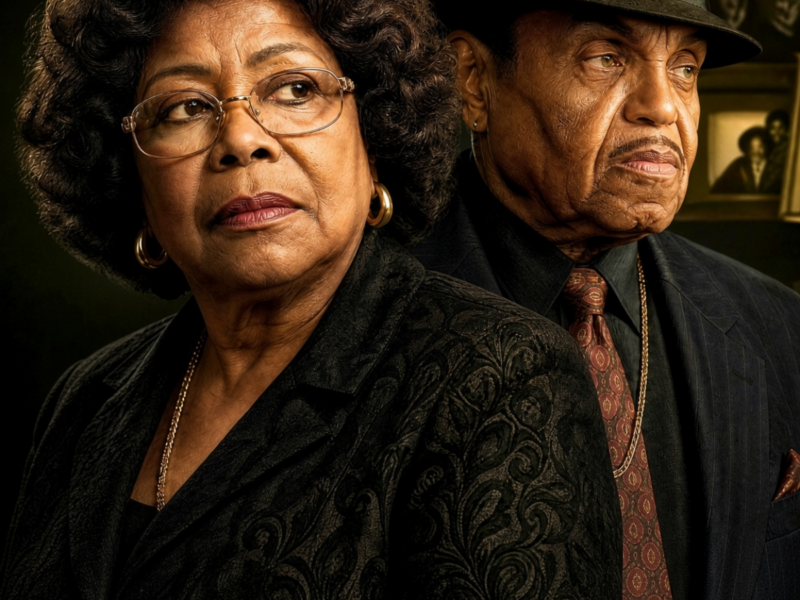
Why Katherine Jackson Refused To Divorce Joe Jackson.
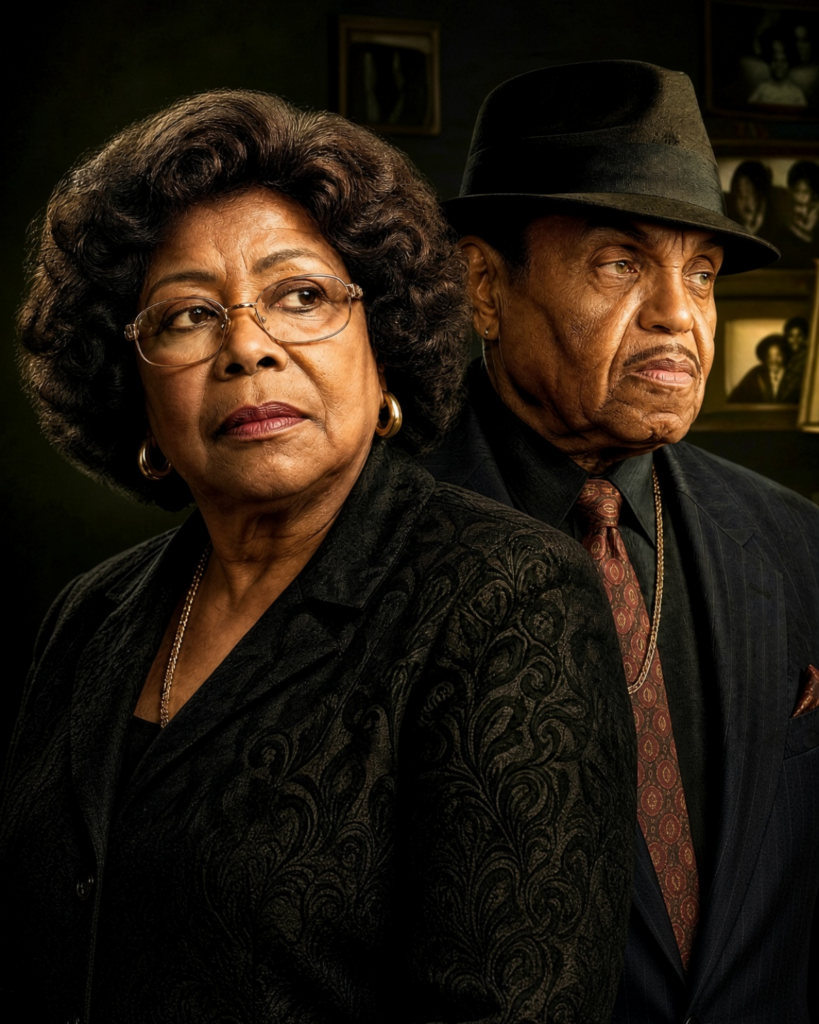
You know the family—nine children out of a two-bedroom house in Gary, Indiana.
The Jackson 5. Michael. Janet. The biggest entertainment dynasty America has ever produced.
And at the center of it, holding it together for sixty-nine years, there was a marriage that by any normal measure should have ended in 1973.
That year, a woman named Katherine Jackson walked into the Los Angeles County Clerk’s office and filed for divorce.
The legal documents exist and were later obtained by reporters.
She listed the five children still under eighteen.
She had reached the end of something, and she had done the hardest part, which is deciding.
Then she withdrew it.
Six years later, she tried again—and she withdrew that one, too.
Her husband would go on to father a child with another woman, a relationship that lasted twenty-five years.
Katherine would spend decades living in a different city from him—300 miles away—and she still never divorced him.
When Joe Jackson died in 2018, she had been his wife for sixty-nine years, and when he was dying, she was at the hospice.
The obvious question is why.
Why would a woman file for divorce twice with cause and stop both times?
Some accounts reduce it to money, or fear, or passivity.
But the reason that appears again and again in the record is something most tellings of this family leave out entirely: her faith.
And once you know that, every strange thing about this marriage makes a different kind of sense.
Keep that in mind. We come back to it.
It starts in Alabama, with a little girl who caught polio at two years old.
She was born Kattie B. Screws in Clayton, Alabama, in May of 1930.
Her father changed the family name to Scruse when she was four, and renamed his daughter Katherine Esther.
And at two years old, before any of that, she caught polio.
She survived it—which in 1932 in rural Alabama was not a given—but it left her with a limp she would carry for the rest of her life.
And with something else, something you can only guess at: the early, permanent knowledge that the body you’re given can fail you, and that the world will not slow down for it.
She was the eldest of two daughters.
Her parents separated when she was young, and the family moved north out of Alabama in 1936—part of the Great Migration of Black families leaving the segregated South for the industrial towns of the Midwest.
The family moved north out of the segregated South to East Chicago, and then to Gary, Indiana, where her father found work in a steel mill.
And she had a dream, which almost nobody knows about.
Katherine wanted to be a performer. She wanted to be an actress or a country singer.
She played piano. She sang.
But she looked at the industry she was hoping to enter, and by her own account, gave the dream up—discouraged by the plain fact that in that era, there were no famous Black country stars.
There was no door for her.
Hold on to that, because it matters more than it looks.
Two people in this story had a musical dream that died before it ever started, and neither of them ever got over it.
Joe put his guitar in a closet. Katherine put her voice away.
And out of those two abandoned dreams came nine children who would sing for the entire world.
She met him at seventeen.
Joe Jackson was a young man with ambitions of his own—and, as it happens, a wife.
He divorced that first wife, began seeing Katherine, and in November 1949, they married.
She was nineteen.
They married in November 1949, and in January 1950, they bought a two-bedroom house in Gary, Indiana, at 2300 Jackson Street.
The street name was a coincidence. It would end up on album sleeves around the world.
Two bedrooms.
And over the next sixteen years, Katherine gave birth to ten children in it.
Rebbie, Jackie, Tito, Jermaine, La Toya, Marlon and his twin Brandon, Michael, Randy, and Janet.
Brandon died within hours of being born.
Picture the physical reality of that house, because it is the stage for everything else.
Eleven people eventually in 672 square feet. Two bedrooms. One bathroom.
A woman with a limp from childhood polio, running that household on a steel worker’s wages—cooking, cleaning, sewing, teaching, and burying an infant son somewhere in the middle of it all.
In those early Gary years, the two of them actually sang together, with Joe playing the guitar.
Before the discipline, before the empire, before any of it, there was a young couple in a tiny house making music for their own pleasure.
Whatever came later, that was real, too.
And it’s worth remembering when you’re weighing what she was trying to hold on to.
Now, before we get to the marriage, you need to understand the thing that would eventually decide everything: her faith.
Katherine had been raised Baptist, but in 1963, while raising an enormous family in a steel town, she joined the Jehovah’s Witnesses.
She converted fully in 1965, and this is not a footnote in her life—it became the organizing structure of it.
All of her children followed her into the faith.
Joe, who had been raised Lutheran, practiced alongside her at times, but by most accounts, never converted.
Read that again, because it’s the crack that runs through the entire marriage.
The woman was devout. The man was not.
She was raising nine children inside a religious framework with very specific and very serious teachings about marriage—and her husband was standing just outside it.
And what the faith teaches about divorce is the piece that explains everything that follows.
It deserves to be stated plainly and without mockery, because it was the most serious thing in this woman’s life.
Marriage is understood as a lifelong arrangement made before God—not a contract two people can end.
There is essentially one scriptural ground on which a divorce is recognized.
And when a marriage is in trouble, the structure around it is built to hold it together: elders counsel, they urge patience, they emphasize forgiveness.
Outside that world, a divorce after repeated adultery is an obvious decision.
Inside it—for someone whose entire spiritual life and identity are bound up in that congregation—it is something else entirely.
It is not just leaving a husband. It is stepping outside the framework that gives your life its meaning, in front of the people who share it with you.
Now hold that against what was happening in her house.
Because Joe Jackson was unfaithful—and it was not a secret, and it was not occasional.
Katherine wrote about it herself.
In 1990, she published an autobiography, My Family, in which she documented her early years and her marriage.
And in it, she acknowledged plainly that her husband had, on more than a few occasions, committed adultery.
That is her own account, in her own book, published under her own name while both of them were alive.
In 1990, Joe Jackson was alive, powerful, and still the family patriarch.
Katherine put the adultery in print anyway, with her name on the cover.
Eight of her children wrote tributes to her in the foreword.
She was not hiding, and she was not protecting him. She was putting her own account of the marriage into the public record under her own name.
By March of 1973, she had had enough.
On the 9th of that month, she obtained a petition for divorce and filed it with the Los Angeles County Clerk.
This is not gossip.
Legal documents were later obtained and reported by the press.
On that petition, she listed the five of her nine children who were still minors: La Toya, Marlon, Michael, Randy, and Janet.
And look at when she did it, because the timing is astonishing.
March 1973.
At that exact moment, the Jackson 5 were one of the biggest acts in the world.
They had come out of Motown with four consecutive number-one singles.
They were on television, on lunchboxes, on the covers of magazines.
Michael was fourteen and already a global star.
The family was the great American success story of that decade.
And behind that, in a lawyer’s office, the mother of the group was quietly filing paperwork to end her marriage.
Consider what that took.
A woman in her early forties, with five children still at home, married since she was nineteen, in a family whose entire income and public identity ran through her husband—walking into a county office and putting her name on a document that would end it.
It is easy from the outside to mistake staying for passivity.
But that is not the act of a passive person.
She had reached a conclusion, and she had acted on it.
She decided. She filed.
And then she was talked out of it.
According to the reporting on those documents, Katherine Jackson was finally convinced to rescind the divorce papers at the urging of the elders at her Jehovah’s Witnesses Kingdom Hall.
There it is, in the record.
Not money. Not fear of Joe. Not doubt about the facts, which she had written down herself.
By that account, she stopped because the men who represented her faith told her a divorce was not the answer—and her faith was the deepest commitment in her life.
She had built her entire adult identity around it. She had raised nine children inside it.
When the congregation told her to stay, staying became for her a religious act rather than a marital one.
And notice where that left her.
She had already done the hard part. She had already decided. She had already walked into that office and put it in writing.
And then she was told, by the people whose judgment she trusted above all others, that the decision she had reached alone was the wrong one.
She withdrew the petition, remained married—and Joe’s behavior did not simply disappear.
Whatever peace she made with that, she made it privately. And she has never fully described it to anyone.
And here is where the story turns from sad to almost unbearable, because of what happened next.
The year after she withdrew that petition—in August of 1974—a baby girl was born.
Her name was Joh’Vonnie. Her mother was a woman named Cheryl Terrell. Her father was Joe Jackson.
Look at the sequence.
In March 1973, Katherine files for divorce because of her husband’s adultery.
She is persuaded to withdraw it.
Seventeen months later, her husband has a daughter with another woman.
And that relationship was not a brief affair.
According to accounts of the family, Joe’s relationship with Cheryl Terrell lasted roughly twenty-five years.
Read that number again. Twenty-five years.
Katherine Jackson stayed married to a man who spent a quarter of a century in a parallel relationship, raising another daughter in another city.
She filed again. Sources place the second attempt around 1979. Other accounts say 1982.
And the motivation reported for the second filing was precisely this: the revelation of the child.
And once again, she was persuaded to drop the action.
Consider what the second filing tells you, because it changes how you read the first.
If a woman files once and withdraws, you might call it a moment of anger quickly regretted.
But she went back years later—knowing exactly how it had gone the first time, knowing what the elders would say—and she walked into a lawyer’s office and started the process again.
That is not indecision.
That is a woman who tried twice to end it and was turned back twice by the one thing she would not put second.
After that, she stopped.
Not because the marriage got better—because she had accepted what it was going to be.
She was in her early fifties.
Whatever life she might have built alone in another house under another name, she set it down and did not pick it up again.
So what does a marriage look like after that?
The answer is one of the strangest arrangements in American celebrity life, and it lasted decades.
They simply stopped living together.
Katherine settled in Encino, California, in the family estate that had become the Jackson headquarters—the house the children came back to.
Joe moved to Las Vegas.
For years, insiders said flatly that the couple did not live together, and yet neither divorce petition was ever finalized.
On paper, they were husband and wife.
In practice, they were two people in two cities, connected by a certificate, nine surviving children, and a religion that told her the certificate mattered.
Three hundred miles apart for decades.
Think about how deliberate that is.
It is not a couple drifting. It is an arrangement maintained for years by two people who had each decided what they could and could not live with.
He would not give up the other life. She would not give up the marriage.
So they built something that let both of those things be true at once—and neither of them ever dismantled it.
Joh’Vonnie, Joe’s daughter with Cheryl Terrell, lived with him in Las Vegas for a time.
She has said publicly that the rest of the Jackson family rejected her.
She was not present at family events.
She grew up in the shadow of the most famous family in music, carrying the name, excluded from the story.
And it’s worth pausing there, because none of that was her doing.
A child does not choose the circumstances of her birth, and she did nothing to earn a lifetime on the outside of a family.
Joh’Vonnie was born into a situation created entirely by two adults, and she spent her life on the outside of a family whose name she carried.
Whatever anyone thinks of what Joe did, she is the person in this story who had the least say in any of it.
And Katherine?
Katherine kept building the thing she had actually chosen.
And it’s worth being precise about what she built, because the story usually gives all of it to Joe.
Katherine was not a bystander in the making of the Jackson 5.
She was the one with the musical ear in that house.
She sang to her children. She played piano. She taught them vocal harmonies at home—sitting with them, working out the parts.
And that sound, the blend of brothers’ voices, is the thing that made the Jackson 5 different from every other family act of that era.
When the boys started performing, it was Katherine who hand-stitched their earliest stage costumes—sitting in that small Gary living room with a needle, dressing the act her husband was drilling.
Every outfit those boys wore on their first stages came off her lap.
And when the group signed to Motown in 1968, and the machine took over, she stepped back from the business side entirely and stayed exactly where she had always been—at home with the children.
Michael would later credit his mother with giving him his vocal gifts.
He said he saw in her an unrealized dream, one he was determined to fulfill.
That sentence is the whole story in miniature.
The dream Katherine gave up in Alabama, because there was no room in the industry for a Black country singer, did not die.
It went into her son, and he took it further than she could have imagined.
She raised the children. She held the family together through the fame, through the money, through the crises.
Michael lived with her until he was nearly thirty years old—long after he was the most famous man on the planet.
In 1985, the magazine Essence named her Mother of the Year for the influence she’d had on her children.
Michael dedicated Thriller to her. Janet dedicated Rhythm Nation to her.
Look at what those dedications actually mean in the context of this marriage.
Two of the most famous people on the planet, given the choice of anyone alive to honor, chose her—not him.
Now, this is the part where honesty is required, because it would be easy to write Katherine off as a victim who simply couldn’t leave—and the record doesn’t support that.
For one thing, she is not a woman without steel.
There is a story widely repeated of Katherine physically confronting a woman connected to one of Joe’s rumored affairs.
She wrote a book naming her husband’s adultery while he was alive to read it.
She filed twice.
She was not silent, and she was not blind.
For another, she has insisted—publicly and repeatedly—that there was still love in it.
In a 2011 interview with CNN, with the separate homes an open fact, she said they were still in love.
She said she made the drive from Los Angeles to Las Vegas to spend days with him, and that he came to her.
Whatever we think that marriage was from the outside, she has never described herself as a prisoner in it.
Both things are true at once.
Katherine Jackson was betrayed for decades by a man who fathered a child with someone else and lived a separate life.
And Katherine Jackson has said on camera that she loved him, and that he loved her.
A person can hold both. Most people who stay in long, difficult marriages do.
And when the end came, she showed you which one she meant.
Joe was dying of pancreatic cancer in June 2018, in a Las Vegas hospice.
Reports at the time said he had refused to let his family see him.
Katherine went anyway. She rushed to be at his side.
Sixty-nine years after a wedding in November 1949, she was there.
But there is one more chapter, and it is the one that proves the whole point of this story.
On the 25th of June, 2009, Michael Jackson died.
Katherine was seventy-nine years old.
She had already buried an infant son, Brandon, decades earlier.
Now she had lost the most famous child in the world—and within weeks, a judge named her the permanent legal guardian of his three children: Prince, twelve; Paris, eleven; Blanket, seven.
Sit with the arithmetic of that.
A woman approaching eighty, who had already raised nine children, who was grieving her son, took on three more.
She has admitted she felt too old for it—particularly for the seven-year-old.
She took him in anyway.
She raised them through court battles and family disputes and the noise of the estate, until 2017, when she finally stepped back because the children had grown.
And those years were not peaceful.
In 2012, at eighty-two, she disappeared for days.
Her grandchildren feared she was being kept from communicating with them, and a judge temporarily removed her as guardian while she was located, resting at a spa in Arizona, in the middle of a dispute with other members of the family over Michael’s estate and his will.
She was reinstated.
Even in her eighties, even as the matriarch, she was still being fought over and fought around.
And in 2024, she lost another son, Tito.
She had now outlived two of her children.
She is ninety-six years old now, and she is still the matriarch of that family, still the one they orbit.
And consider the full weight of what that woman has carried.
She caught polio before she could walk properly.
She gave up her own dream because the industry had no place for a Black woman singing country music.
She married at nineteen and bore ten children in sixteen years and buried one of them within hours of his birth.
She raised the rest in a house with two bedrooms while her husband worked the mills.
She discovered, repeatedly, that he was unfaithful.
She filed for divorce twice and stopped twice.
She lived apart from him for decades.
She buried her most famous son at seventy-nine, then raised his three children.
She buried another son, Tito, in 2024.
That is not the biography of a woman who was carried along by events.
That is a person who absorbed one blow after another for nearly a century and kept the family standing through every one of them.
Now put that beside the man she never divorced.
He spent the last decades of his life in another city, with another household, largely estranged from the children he had made famous.
She spent hers holding the family together—twice over, across two generations.
So go back to that county clerk’s office in March 1973.
A woman in her forties, five children still at home, standing at a counter with a petition in her hand—and every reason in the world to sign it.
The world has spent fifty years asking why the Jackson family was the way it was, and almost all of that attention has gone to the father: the rehearsals, the discipline, the empire he built.
Joe Jackson is the one everybody argues about.
But look at what he actually ended up with.
He had the freedom he took, the second household, the twenty-five years elsewhere.
He died in a hospice in a city his wife did not live in, largely estranged from the children he had made famous, left out of his most successful son’s will.
And Katherine, who never signed the papers, ended up with everything the papers would have divided.
The house. The children—all of them—who followed her into her faith and dedicated their greatest work to her.
The grandchildren she raised in her eighties when her son was gone.
The family name, which she has carried as its matriarch for years after Joe’s death, and carries still at ninety-six.
Here is the thing people miss when they call a woman like Katherine Jackson passive.
Staying was not something that happened to her.
It was a decision made twice at a counter with a pen in her hand—and then unmade twice for a reason she believed in more than she believed in her own comfort.
You can disagree with the reason.
You cannot say she didn’t choose.
He took the freedom.
She kept the family.
Ask yourself which of those two people actually won the marriage.









