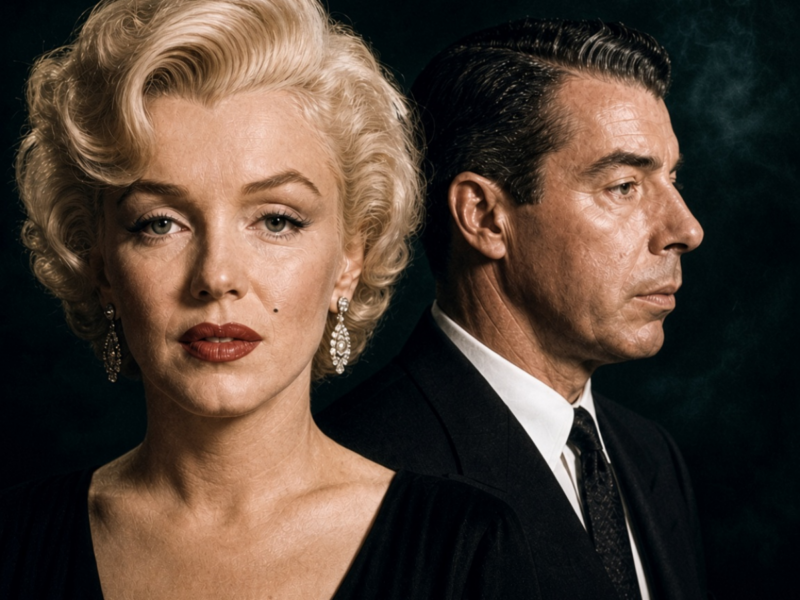
Why Joe DiMaggio SECRETLY Never Let Marilyn Monroe Go?
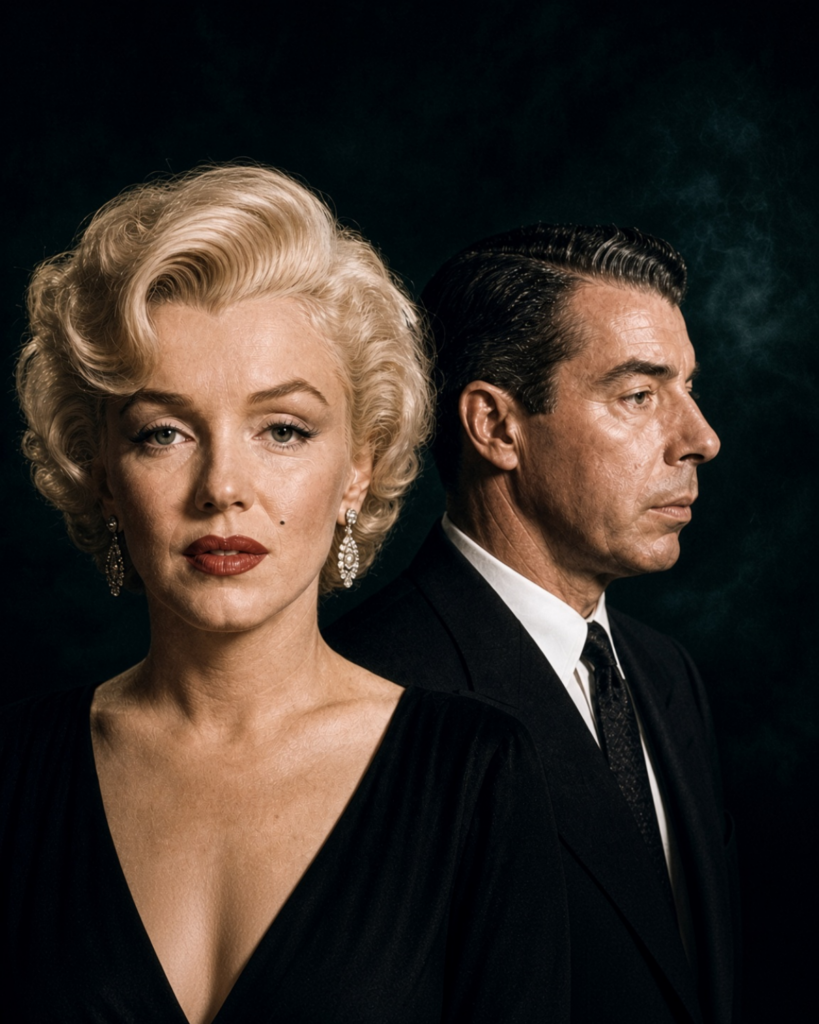
You know the photograph, a subway grate on Lexington Avenue, September 1954.
A white dress lifting, a crowd of 2,000 people, and a blond woman laughing into a camera.
America decided that was the happiest night of her life.
It was not.
Her husband was standing in that crowd watching, and by every account of the people who were there, his face had gone.
What happened back at the hotel that night was loud enough that the woman in the next room heard it, and she was on a set the next week with marks a makeup artist had to cover.
The marriage was over in nine months.
He was the one who filed nothing and said nothing, and she was the one who stood in a courtroom and used the words mental cruelty.
And then he spent the next twenty years doing something almost nobody knew about until after he was dead.
It started at a photo shoot he did not want to attend.
March 1952.
A publicity man had an idea.
The idea was a picture of a movie starlet and a baseball player, and the baseball player did not want to do it.
Joe DiMaggio had retired from the New York Yankees three months earlier at 37, and he was not in the business of posing for studio publicity.
Somebody talked him into a dinner instead.
Blind date, Italian restaurant in Los Angeles.
She did not want to go either.
She has said she expected a loud man in a purple suit.
What she got was a man who barely spoke.
He sat, he ate, he said almost nothing, and by her account, that was the thing that got her.
Every man she had met in Hollywood talked at her.
This one did not talk at all.
Hold on to that first evening because it is the whole marriage in miniature.
She read his silence as depth.
It was not depth.
It was the way he was permanently in every room for the rest of his life and two years later it would be the thing she could not live inside.
Now, who each of them actually was in 1952.
Start with her because the myth is wrong at the foundation.
She was born Norma Jeane Mortenson in Los Angeles in 1926.
Her mother could not care for her.
She was placed with a series of foster families and spent time in an orphanage and the details of those years are genuinely difficult and she talked about them more openly than almost any star of her era.
She married for the first time at 16.
It was arranged as a practical solution to a housing problem and it lasted about four years.
She worked in a factory during the war spraying and inspecting and an army photographer came through to shoot pictures of women on the line.
That is where the modeling started.
Think about the sequence.
A girl with no family is married off at 16 because there is nowhere else to put her and gets out of it by being photographed.
Every route out of every room she was ever in was a camera.
That is not a metaphor about fame.
That is how a girl got out of a foster placement and she worked it out before she was 20.
By 1952, she had been under contract for six years and had been dropped twice.
Fox let her go.
Columbia let her go.
She kept modeling between contracts because the studio money did not cover much.
There is a detail from those years that becomes important in 1952.
In 1949, broke, she posed for a calendar photographer for $50.
And here is the fact everybody gets wrong about Marilyn Monroe in 1952.
She was not yet the biggest star in the world.
She was a rising one.
Gentlemen Prefer Blondes and How to Marry a Millionaire had not come out.
The enormous fame arrives during the relationship, not before it.
That matters enormously for what follows because he did not marry the most famous woman on Earth.
He married a young actress on the way up, and the thing she became happened to him while he was in the room.
Now, him.
Joe DiMaggio was born in California in 1914, the eighth of nine children of Sicilian immigrants.
His father fished.
The family spoke Italian at home, and during the war his parents were classified as enemy aliens, and his father’s boat and fishing rights were restricted while their son was the most famous athlete in America.
Understand what he had been.
In 1941, he hit safely in 56 consecutive games, which is a record that has stood for over 80 years, and that nobody has come within 15 games of since.
Three Most Valuable Player awards, nine championships in 13 seasons.
He was also, by universal account, a private man to the point of pathology.
He did not give interviews of any substance.
He sat in the same restaurant at the same table.
Teammates who played beside him for a decade have said they never had a real conversation with him.
He had one marriage behind him to an actress named Dorothy Arnold, ended in 1944, and a son he saw irregularly, and by most accounts did not know well.
And he had retired in 1951 at 36 because his heel hurt and he would not play badly in public.
That is the entire stated reason.
He would rather stop than be seen diminished.
Keep that instinct in mind.
It explains the next 47 years of his life.
Set those two people side by side.
One had been famous for being watched.
The other had been famous for being watched and had hated every second of it.
Before the wedding, there is one episode that tells you exactly what he had signed up for.
In March 1952, weeks after they met, a reporter worked out that the woman on the 1949 nude calendar was the studio’s rising star.
The studio panicked and wanted a denial.
She refused.
She confirmed it, said she had needed the rent money, and the public sided with her completely.
It made her bigger.
Now, put DiMaggio in that room.
His girlfriend had just turned a nude photograph into a career-defining triumph by being open about it in public, on purpose, against the advice of everyone with a suit.
He married her anyway, 22 months later.
They married on January 14th, 1954 at City Hall in San Francisco.
They tried to keep it quiet.
Somebody called the press.
By the time they came out, there were hundreds of people on the steps.
That is day one.
Now, watch the nine months because the arithmetic is brutal.
Two weeks after the wedding, they went to Japan, partly a honeymoon and partly a baseball tour.
While they were there, she was asked to go and perform for American troops stationed in Korea.
She went.
She did 10 shows in four days in February in the cold on open stages in front of something like a hundred thousand servicemen who were by every account of everyone present out of their minds.
She came back to the hotel in Tokyo and said to her husband a sentence that has been reported many times and that both of them are said to have confirmed in some form.
She told him he had never heard anything like it, all that cheering.
He said he had.
That exchange gets told as a charming anecdote about two famous people.
Read it again as what it actually was.
She had just discovered what she was at scale for the first time.
And the man across from her was the one person alive who could look at a hundred thousand screaming people and say, “Yes, I know. I had that and mine is over.”
He had retired at 37 with nothing to go to.
She was 27 and it was starting.
What he wanted was a wife.
This is not an inference.
He was explicit about it to her and to friends and there is no serious dispute about it in any account of the marriage.
He wanted her out of pictures.
He wanted San Francisco or a house and children and a woman who was not photographed.
He had married a movie star and asked her to stop being one.
And the pressure was not only on her side of it.
Understand what 1954 looked like for a man of his background and his generation.
He had grown up in a household where his mother did not work and his father ran the family.
He had been the most admired athlete in America and he was now in the newspapers increasingly Mr. Monroe.
The word was actually used.
Photographers shouted it at him.
He was 39 years old out of the only thing he had ever been good at and the country had started referring to him as somebody’s husband and she, at least at the start, was not entirely against it.
She talked about children constantly and wanted them badly and she had a genuine ambivalence about the industry that lasted her whole life.
If the two things could have been separated, some of this might have worked.
But they could not be separated because 1953 and 1954 were the years the machine went into full production.
Gentlemen Prefer Blondes in July 1953, How to Marry a Millionaire in November, River of No Return, then There’s No Business Like Show Business.
Every month the woman he had asked to stop became bigger, and she was not simply being carried by it.
In 1954, she was in an open contract dispute with Fox, was suspended, and was reading scripts she wanted rather than scripts she was handed.
A year later, she would leave for New York, start her own production company, and study at the Actors Studio, which is not the behavior of a woman who was going to give it up for a house.
She was building an escape from the studio, not from the profession.
He wanted her out of both, and the two things looked identical from where he was standing.
So, he stopped going to the events.
He hated the crowds, the photographers, the men looking at her, and she started arriving alone at premieres for films that only existed because of her.
Watch what that does to a marriage in which one person married the other to make her smaller.
September 15th, 1954, Lexington Avenue at 52nd Street, New York, 1:00 in the morning.
Billy Wilder is shooting a scene for The Seven Year Itch, in which she stands over a subway grate and the air lifts her skirt.
It is, technically, a night shoot for a film.
In practice, it is a publicity event, and the studio made sure of it.
Estimates of the crowd run to a couple of thousand people.
They shot it over and over.
The crowd got louder every time.
Her husband was there.
Somebody had brought him, or he had come to see, and the accounts differ on that detail.
What nearly everyone who was there remembers is his face changing, and Walter Winchell standing next to him watching it change.
They went back to the St. Regis, and I should say the obvious thing here, because the legend has swallowed this marriage in every retelling.
The subway scene did not end it.
It was the night everybody happened to be watching.
The thing that ended it had been running since Tokyo, seven months earlier, and it was a much duller and much sadder problem than one bad night in a hotel.
What happened in the room is described in similar terms by several people who were in the hotel that night, including a member of the production.
There was shouting.
It went on.
And on.
And on the set the following week, the makeup department was dealing with marks.
I have to slow down here, because this is the part of the night everybody thinks they know.
It has been retold so often that it has hardened into a scene, and a scene is not evidence.
What we actually have is people from the production telling biographers years later what they heard through a wall.
She never described it publicly then or after.
What is on the record, and what nobody disputes, is what she did next.
She filed for divorce on October 4th, 1954.
Nineteen days.
The hearing was on October 27th.
She testified.
She used the phrase mental cruelty, which was the standard legal language of the period, and does not by itself describe anything specific.
But she elaborated in court, and what she described was a man who would not speak to her for days at a time, who was cold and withdrawn, and who did not want her working.
He did not contest any of it.
He did not appear.
He did not give a statement.
There is film of her coming out of that courthouse.
She is not composed.
She is being pushed through reporters, and she is crying.
Nine months and 13 days, and one of those months she spent in Japan.
And there is a footnote to the divorce that almost nobody includes, and it is uglier than the marriage.
In November 1954, weeks after the hearing, DiMaggio went with Frank Sinatra and several other men to an apartment building in Los Angeles, acting on information that she was inside with someone.
They forced the door of an apartment.
It was the wrong apartment.
A woman who had nothing to do with any of it was in bed, and she sued.
The matter went as far as a state Senate committee hearing in 1957, and Sinatra testified.
None of that is rumor.
There was a lawsuit, and there is a transcript.
I raise it because this story is about to turn into something people find genuinely moving, and it should not turn without this in it.
Six weeks after she left him, he broke down a stranger’s door in the middle of the night looking for her.
Most people think this is where Joe DiMaggio leaves the story.
He does not.
He has 37 years left, and he spends a large part of them on her, and almost none of it is visible while it is happening.
Except, he did not go away.
Within a couple of years, he was back in her life, not as a husband, but as something nobody involved ever managed to name.
They were seen together.
When she was in trouble, he turned up.
That pattern held for the rest of her life, and it is the part of this story almost nobody knows because he made certain nobody would.
Then, 1961, and this is the year that makes the rest of it impossible to file under bitterness.
Something happened that changes how you have to read everything after.
In February of that year, she was admitted to the Payne Whitney Psychiatric Clinic in New York.
The circumstances of that admission were, by her own written account afterwards, terrifying to her.
She was placed in a locked ward.
She wrote a letter about it that has since been published and it is one of the most distressing documents any famous person has left behind.
She could not get out.
She contacted DiMaggio.
He flew to New York and by the accounts of people involved, he went to the clinic and made it clear that she was leaving and she left.
They had been divorced for six years.
He was not her husband.
He was not her family and he had no standing of any kind.
What he had was a reputation and he used it.
The most respected retired athlete in the United States walked into a psychiatric clinic in Manhattan and made it institutionally impossible to keep her.
She went into a different hospital afterwards on her own terms and he stayed in New York while she was there.
Later that year, she went to Florida while he was at spring training and there were reports through 1961 that the two of them were going to remarry.
Those reports were persistent enough and specific enough that people close to both of them treated them seriously.
Set that against the divorce testimony for a second.
She had stood in a courtroom in 1954 and described him as cold, withdrawn and controlling.
Seven years later, he was the person she called from a locked ward.
Both of those things are true.
The record does not resolve them, and I do not think it can.
People are not consistent, and a man can be impossible to be married to and still be the one who comes.
Then, August 4th, 1962.
She was 36.
What he did in the following week is the part that most people have never had explained to them properly, and it is the center of this story.
Her body was at the Los Angeles County Morgue.
The person who came and claimed it was Joe DiMaggio.
Not the studio, not her third husband, Arthur Miller, from whom she had been divorced, not the entourage.
He arranged the funeral, and then he did the thing he is remembered for by everyone who was there.
He kept Hollywood out.
The service at Westwood Village Memorial Park on August 8th had somewhere in the region of 30 people at it.
He personally decided the list.
Studio executives were refused.
Famous names were refused.
The people who came were her half-sister, her business manager, her acting coach, her housekeeper, her makeup man, her masseur, her lawyers, and a small number of others.
People who spoke to him about it came away with the same reason, more or less.
They were the ones who had done it, and they were not coming.
He is supposed to have said, in some form, that if they had not been in her life, she would still be alive.
Do not trust the wording.
Lines like that get smoothed every time somebody repeats them.
The guest list, though, is a document, and it is short.
Then he went home and made an arrangement with a florist.
Three times a week, half a dozen red roses delivered to crypt number 24 at Westwood.
For twenty years.
He set it up in 1962 and it ran until roughly 1982.
And the accounts of exactly when and why it stopped differ.
Twenty years of standing orders at a flower shop for a woman he had been married to for nine months three decades earlier.
He never gave an interview about her.
Not one in 37 years.
He was asked constantly and he refused constantly.
When people wrote books about her and asked him, he did not answer.
When the memorabilia business grew into what it became and he could have sold almost anything connected to her for enormous sums, he did not.
Consider how unusual that silence is in this specific case.
Everybody who was ever in a room with Marilyn Monroe wrote a book.
Her acting coaches, her housekeepers, her drivers, her doctors.
People who met her twice.
The man who was married to her said nothing for 37 years and the market for what he knew only got bigger every single year he refused.
He also never married again.
He lived to 84 and died in 1999.
And there was no second wife after her.
There is a story from the very end of his life reported by his lawyer who was with him.
In his last days he is said to have expressed the thought that he would finally see her again.
One man at a deathbed who later sold a book.
Believe as much of that as you want.
The roses are not that kind of story.
The roses were a standing order at a flower shop paid for three times a week for twenty years.
That is not a memory anybody polished.
It is an invoice.
And the silence is the part I keep coming back to.
Thirty-seven years is long enough to change your mind about anything.
Now go back to the subway grate.
September 1954, a white dress, 2,000 people, and a woman laughing at a camera on the most photographed night of her life.
America read that photograph as joy.
Read it again.
The crowd in that shot is the thing that ended the marriage.
The man who married her to make her smaller was standing in it watching her become the biggest star on earth in real time in front of him in the street.
Nineteen days later she filed.
Now look at who was still there at the end.
Three husbands.
The first was a teenager she married for a place to live.
The third was one of the great American playwrights and he wrote about the marriage afterwards in a play and the character was recognizable enough that people were uncomfortable.
The second one never said a word.
He lost the marriage in nine months.
He lost the argument about her career completely.
He was by her own testimony under oath cold and withdrawn and impossible to live with and she was right to leave.
And when she died he was the one at the morgue.
He picked the 30 people.
He shut the door on the industry.
And then he bought roses three times a week for twenty years and told nobody and turned down every interview about her until the day he died.
Arthur Miller got the play.
Hollywood got the legend and sold it for 60 years.
Joe DiMaggio got the funeral, the silence, and crypt number 24.
He never let her go.
He just never said so where anyone could hear it.









