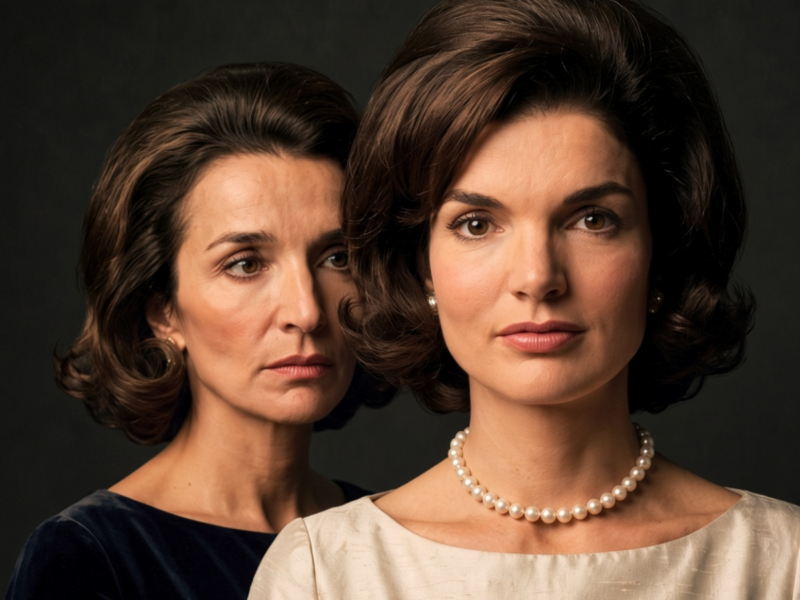
Why Jackie Kennedy Left Her Sister Nothing?
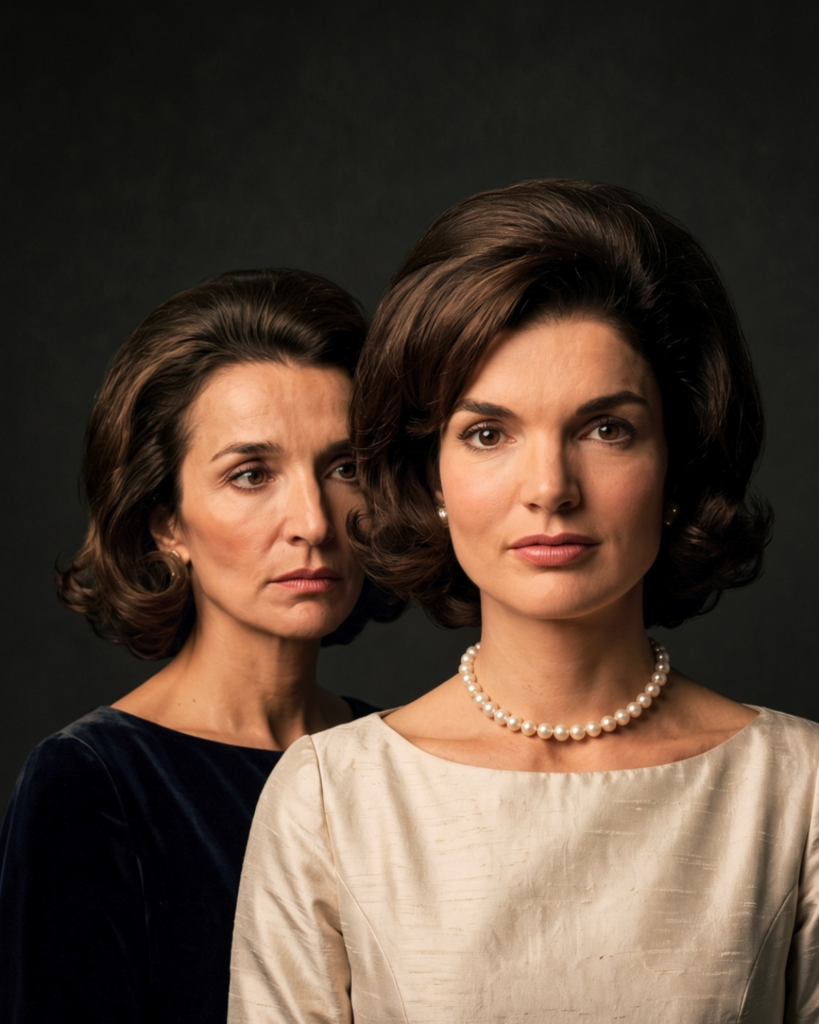
On the 22nd of March 1994, a dying woman signed a 36-page will in New York.
She left gifts to friends, to her children, to her grandchildren, a Greek statue to the man she loved, paintings to the woman who designed the White House Rose Garden, and to her only sister.
She left one sentence and not a single dollar.
This is the story of why her name was Jacqueline Lee Bouvier.
Her sister was Caroline Lee Bouvier, four years younger, always called Lee.
And to understand what happened in that will, you have to go back to a childhood where the competition was not an accident.
It was designed.
They were raised in the upper reaches of New York society in the 1940s and ’50s in a world of East Hampton summers and riding lessons and the right schools.
From the outside, a fairy tale.
Inside it was harder than it looked.
Their father, John Vernou Bouvier III, known as Blackjack, was charming, handsome, and unreliable.
The marriage collapsed.
Their parents divorced and their mother Janet remarried into the Auchincloss fortune which gave the girls stability and status and a stepfather’s money but also made very clear that a woman’s security in that world depended entirely on the man she attached herself to.
And Janet was a fierce social climber who raised her daughters inside that idea.
According to the Kennedy biographer J. Randy Taraborrelli, she openly told the girls not to compete with each other and then in the same breath she lived the opposite.
She would deliver that speech about not competing and then take Jackie off shopping and leave Lee behind.
Read that again because it is the seed of everything.
A mother tells two little girls to be close and then visibly repeatedly picks one of them.
Lee grew up watching her older sister get chosen over and over in small daily ways that a child notices and an adult never forgets.
And she never stopped watching.
They were by every account genuinely close as children.
They shared a private language, a shared world, the way sisters four years apart often do.
Lee has described following her older sister everywhere, wanting what Jackie had, wanting to be where Jackie was.
That is what makes the rest of it sad rather than merely nasty.
Whatever this became, it started as love, and as the ordinary worship a little sister has for a big one.
By the time they were young women, both were beautiful, both were ambitious, and both were in the same race, competing for the same things.
Their mother’s approval, attention, and the most desirable men in the world.
But Jackie kept winning it.
In 1953, she married a young senator named John F. Kennedy.
Lee married too, twice, the second time to a Polish prince, Stanisław Radziwiłł, which made her technically a princess.
She had the title.
She had the palazzo in Italy and the house in London and a place in European society that her sister at that point did not have.
For a few years, Lee was arguably the more glamorous of the two, the one with the better address book.
It wasn’t enough because in January 1961, her sister became First Lady of the United States and every card on the table was reshuffled in a single afternoon.
Lee’s own reaction is one of the saddest lines in this whole story.
“How can I compete with that?” she said, and she was right.
She couldn’t.
Nobody could.
There is no title in Europe that beats the White House.
And the comparison did not stay private.
The press made it a permanent feature of both their lives.
Every article about Lee for 60 years would eventually arrive at the same clause.
Sister of Jacqueline Kennedy Onassis.
Every photograph of the two of them together was read as a competition.
Lee did not merely feel like she was losing.
She was told she was losing in print continuously from the age of 30 until the day she died.
Now the rivalry did not stay in the drawing room.
It moved into the bedroom and this is where the record gets darker and where I need to be careful with you about what is documented and what is alleged.
There has long been a claim repeated by biographers and gossips for 60 years that Lee had an affair with her sister’s husband, with John F. Kennedy.
It has never been proven.
It is reported, not established, and I’m not going to state it as fact.
But it was said publicly for decades, and Jackie lived inside a world where people said it.
Whatever the truth, that shadow sat between the two sisters for the rest of their lives.
What is far better documented is what happened with the second man and it is in some ways worse.
In 1962, Lee began an affair with Aristotle Onassis, one of the richest men alive.
She was married to Prince Radziwiłł at the time and by several accounts she was seriously considering leaving him for Onassis.
Onassis himself is said to have suggested the match and this was for Lee the moment.
Understand what Onassis represented to a woman in her position in 1962.
He was not a prince with a title and dwindling estates.
He was one of the wealthiest men on the planet.
A Greek shipping magnate with a fleet, an island, a private yacht the size of a small hotel.
Marrying him would not have made Lee her sister’s equal.
It would have made her something Jackie was not, independently staggeringly rich in her own right on her own terms.
Lee hesitated, and the reason she hesitated is the cruelest irony in this story.
A divorce scandal at that moment would have damaged her sister, who was then in the White House.
Robert Kennedy already regarded Lee’s involvement with Onassis as, in his words, a betrayal of the whole family.
So Lee, who had spent her life being asked to make room for Jackie, made room again.
She stayed married.
And then she made the mistake that would define the rest of her life.
She introduced Onassis to Jackie.
Sit with what happened next because it is almost unbearably neat.
Onassis met the First Lady and he was, in the words of one account, taken with her.
He seemed to simply forget about Lee.
A month after that meeting, John F. Kennedy was assassinated in Dallas, and Onassis rushed to Jackie’s side to comfort her, which raised eyebrows about his motives.
Even then, six years later, in 1968, Jackie married him.
There is a scene from those years that tells you everything about these two women.
Lee had been invited onto Onassis’s yacht in the Mediterranean.
When she arrived, she found him with her sister, and Jackie, according to Taraborrelli’s account, took her sister’s arm with both hands and said four words.
“I need this.”
Lee backed down.
She said later that she understood that her sister was struggling with depression, that it had become a matter of life or death for Jackie, and that Jackie needed him more than she did.
So, the younger sister stepped aside and let the older one take the man she had found first.
That is either an act of enormous love or the final surrender in a war she had been losing since childhood, probably both.
But she never got over it.
Lee felt plainly that Jackie had stolen Onassis from her, and the sisters were never as close again.
If you’re finding this story as strange as I do, the way one family can hold that much love and that much damage at the same time, subscribing is the best way to keep them coming.
It takes one click and it genuinely helps.
Now, back to the sisters.
Here is the part that is easy to miss, and it matters for what happens in that will.
Jackie’s marriage to Onassis did not make her happy either.
They married in October 1968 on his private Greek island, and it was not a love story.
Onassis continued a long affair with the opera singer Maria Callas throughout.
Jackie, for the second time in her life, was married to a man who was publicly unfaithful.
He died in 1975 and after a bitter fight with his estate, she accepted a settlement reported at around $26 million.
And Lee, Lee got nothing from Onassis’s will.
Read those two outcomes side by side.
Lee found him first, loved him first, and considered leaving her husband for him.
Jackie married him, endured him, and walked away with a fortune.
Lee walked away with nothing twice from the same man.
Then there was the money from their mother.
And this is the detail almost nobody knows.
In the 1980s, Janet, the mother who had orchestrated the whole competition, developed Alzheimer’s disease.
Jackie took on the responsibility of caring for her.
Not Lee.
Jackie, the daughter who had won everything, was the one who showed up for the long, unglamorous, grinding work of a parent’s decline.
And during those years, something shifted.
Janet began at last to favor Lee, which bewildered Jackie.
After a lifetime of visibly choosing the elder daughter, the mother reversed herself at the end.
And then Jackie discovered something else.
Their mother had paid Lee $750,000 explicitly to make up for having favored Jackie when the girls were young.
Think about what that money meant to each of the three women in that house.
To Janet, it was an apology 40 years late, written in the only language that family really spoke.
To Lee, it could have felt like proof that the imbalance she had lived with was real, that she had not imagined a lifetime of coming second.
And to Jackie, who was the one managing her dying mother’s care, it was something else entirely.
Her mother in her final years quietly paying compensation to the other daughter for the crime of having loved this one more.
Janet died in 1989.
After that, according to those close to them, the sisters grew further apart than ever.
And five years later, Jackie sat down to write her will and produced a sentence explaining why her sister needed nothing more from her.
You are allowed to notice the symmetry.
And then Jackie got sick.
In 1993, she was diagnosed with non-Hodgkin’s lymphoma.
Within months, it was clear she was dying.
On the 22nd of March 1994, she signed her last will and testament, a 36-page document she knew would become public.
She was 64 years old, and she had less than two months to live.
She knew it.
Everyone around her knew it.
She gave the will enormous care.
It runs to 36 pages, and it is a remarkably personal document for something so legal.
She left a Greek alabaster head of a woman to Maurice Tempelsman, the man who had been her companion for 15 years and in whose apartment she would die.
She left two Indian miniatures to her friend Bunny Mellon and she wrote out why, in appreciation of Mellon designing the rose garden at the White House.
She named the paintings individually.
Lovers watching rainclouds.
Gardens of the palace of the Raj.
Consider the state of mind that requires a woman with weeks to live, going through her possessions object by object, matching each one to the person who would understand it.
That is not a woman being careless with anyone’s feelings.
That is someone being deliberate about every single line.
She left her Fifth Avenue apartment, her Martha’s Vineyard property, her furniture and personal effects, and $250,000 each in cash to Caroline and John.
She set up a charitable trust directing that 8% of its value go every year to causes committed, in her words, to the cultural or social betterment of mankind or the relief of human suffering, with the remainder passing eventually to her grandchildren.
She even left instructions that certain personal papers were never to be made public and asked her children to honor that.
She thought about everyone, friends, staff, grandchildren not yet grown, a woman who had designed a garden 30 years earlier.
And then she came to her sister and she wrote this.
“I have made no provision in this my will for my sister Lee B. Radziwiłł for whom I have great affection because I have already done so during my lifetime.”
That’s it.
That’s the entire provision.
One sentence buried in 36 pages and not one dollar.
Her only sister, the person who had known her longest of anyone alive.
Look at how that sentence is built, because it is a small masterpiece of controlled coldness.
“For whom I have great affection.”
She says she loves her in writing in a legal document destined for a public courthouse in New York where any reporter could walk in and read it.
She could have said nothing at all.
A will does not require you to explain an omission.
She chose to explain it knowing the explanation could become public.
“Because I have already done so during my lifetime.”
She gives a reason and the reason can sound dismissive.
It reads, whatever debt existed between us, I have settled it.
There is nothing outstanding.
We are square.
There is no anger in it.
That is what makes it land so hard.
An angry sentence can be argued with.
A furious sister can be forgiven or fought with or explained away as grief and illness.
But a sentence that says, “I love you and I have already given you enough” leaves nothing to answer.
It can read like a door closing politely and then locking in a document that can never be amended because the person who wrote it is dead.
And this was never going to stay between the two of them.
The contents of that will were reported everywhere within days.
The sentence was not a private note between sisters.
It was a public statement, permanent, filed in a courthouse about exactly what one Bouvier sister owed the other.
Nothing.
By the accounts of people around them, Lee was surprised.
Taraborrelli put it simply.
When Jackie died, much to Lee’s surprise, she left her no money at all.
And here is the twist that keeps this from being a simple story of revenge.
Jackie did not cut off Lee’s children.
She left a trust of a million dollars for Lee’s son Anthony and her daughter Tina.
The money went to the next generation.
It went around Lee and passed her to her children.
That distinction is the whole story in miniature, not hatred, not disinheritance of the bloodline.
The Bouvier line was provided for, just her sister specifically singled out and stepped over in the last document of her life.
So what was the real reason?
It was not a single act of revenge.
Whatever was in that sentence had been 60 years in the making and it started before either of them could read.
Line it all up and the picture is unmistakable.
A mother who set two daughters against each other and then dying quietly paid one of them off.
A man Lee found first and Jackie married.
A rumor about Lee and JFK that trailed both women for decades.
A yacht in the Mediterranean and four words, “I need this.”
Two women who spent their entire lives being compared in public by everyone and one of whom always, always won.
And now look again at the exact words she chose, “because I have already done so during my lifetime.”
Jackie had in fact given Lee money over the years.
So on its face, the sentence means what it says.
The accounts are settled.
Lee has been provided for.
There is no reason to do it twice.
But a sentence like that in a document like that read by a world like this one could never land innocently.
And Jackie was far too careful a writer not to know it.
She had spent 36 pages choosing words.
She would have known that a sentence like this one could end up printed in every newspaper in America.
Maybe that is the closest thing to an answer.
Not revenge, not indifference, but the last move in a game two sisters had been playing since childhood, made by the one who had always been better at it.
And she never publicly attacked her sister for it.
Not in an interview, not in print, not in the 25 years she outlived her.
Whatever she felt when she read that sentence, she kept it to herself.
And here is the complication that stops this being a clean story of coldness, because the record does not support the simple version either.
The sisters did reconcile at least partly before the end.
Taraborrelli, who examined the relationship closely, insists it was not black and white, that there were moments of real closeness alongside the tension, and Lee had been there in the worst hour of Jackie’s life.
After Dallas, when the country was watching a widow walk behind a coffin, it was Lee who came and stayed with her sister, who slept in her room, who was simply present in the way only a sibling can be.
Whatever the rivalry was, it did not stop her from getting on a plane.
Whatever the will says, these two women were bound to each other in a way neither of them ever escaped.
Both things are true at once.
Jackie loved her sister and Jackie left her nothing, and she put both of those facts in the same sentence.
Lee outlived her by 25 years.
She died in February 2019 at 85 in her Manhattan apartment.
25 years is a long time to live with a sentence.
By then, she had buried more than her sister.
Her son Anthony, one of the two children Jackie had provided for in that trust, died of cancer in August 1999 at 40, less than a month after his cousin and closest friend John F. Kennedy Jr. was killed in a plane crash.
Lee lost her son and her nephew in the same summer.
Now, go back to the will.
The trust Jackie set up for Lee’s children was for a young man who would be dead within five years of his aunt, and her own life had been in its way a long study in coming second.
She had the beauty, the title, the friendships with Truman Capote and Rudolf Nureyev, the style that fashion people still write about today.
She was by many accounts the more naturally elegant of the two, the one with the better eye, the more interesting taste.
Truman Capote, who knew both women well before he betrayed everyone in that circle, is said to have preferred Lee’s company.
Designers and photographers said the same.
In the small world of people who actually judged such things, Lee often came first.
But everything she tried on her own terms seemed to falter.
She tried acting in a television production and on stage, and the reviews were brutal, in part because critics could not see her without seeing Jackie’s sister.
She started a memoir and abandoned it twice.
She worked in interior design and in public relations, jobs that in another family would have been careers and in this one were described as hobbies.
She was written about constantly and almost always in the same clause, sister of Jacqueline Kennedy Onassis.
She said near the end of her life that she had struggled with her identity after decades of living in her sister’s shadow.
That is a remarkable thing for a woman of 80 to admit about a competition that started in a nursery in the 1930s.
She had been left out of Onassis’s will.
Now she had been left out of Jackie’s, too.
So go back to that room in New York in March 1994.
A woman with two months to live, going through a 36-page document, line by line, deciding who gets the paintings, who gets the statue, who gets the papers that must never be published.
She reaches her sister’s name, the person who had been there longest, and she stops, and she writes one sentence that manages to be affectionate and final at the same time, and then she moves on to the next clause.
No explanation beyond those few words.
No letter left behind.
No private note to soften it.
Just the line, filed, public, permanent.
Lee would read it like everyone else did, in the papers, with the rest of the country.
Lee got the title, the princess, the glamour, the famous friends.
Jackie got the White House, Onassis, the fortune, and the place in history that Lee could never touch.
And at the very end, Jackie got one more thing.
She got the last word, in writing, in a public document, forever.
Maybe that was a victory.
Maybe it was simply a boundary drawn by a dying woman who had finally run out of patience for a competition she never asked to be in.
After 60 years, the distinction may not even matter.
Ask yourself, which of those two sisters actually won?









