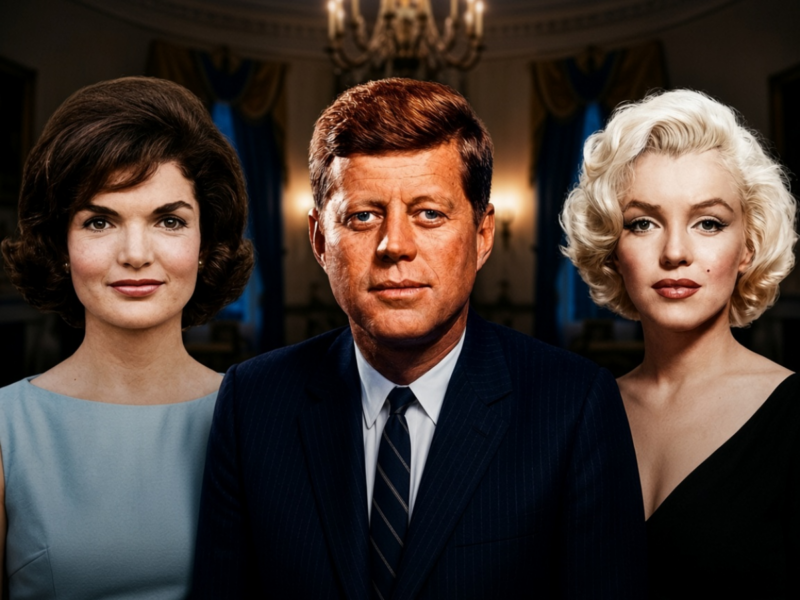
Why Jackie Kennedy Hated Marilyn Monroe So Much?
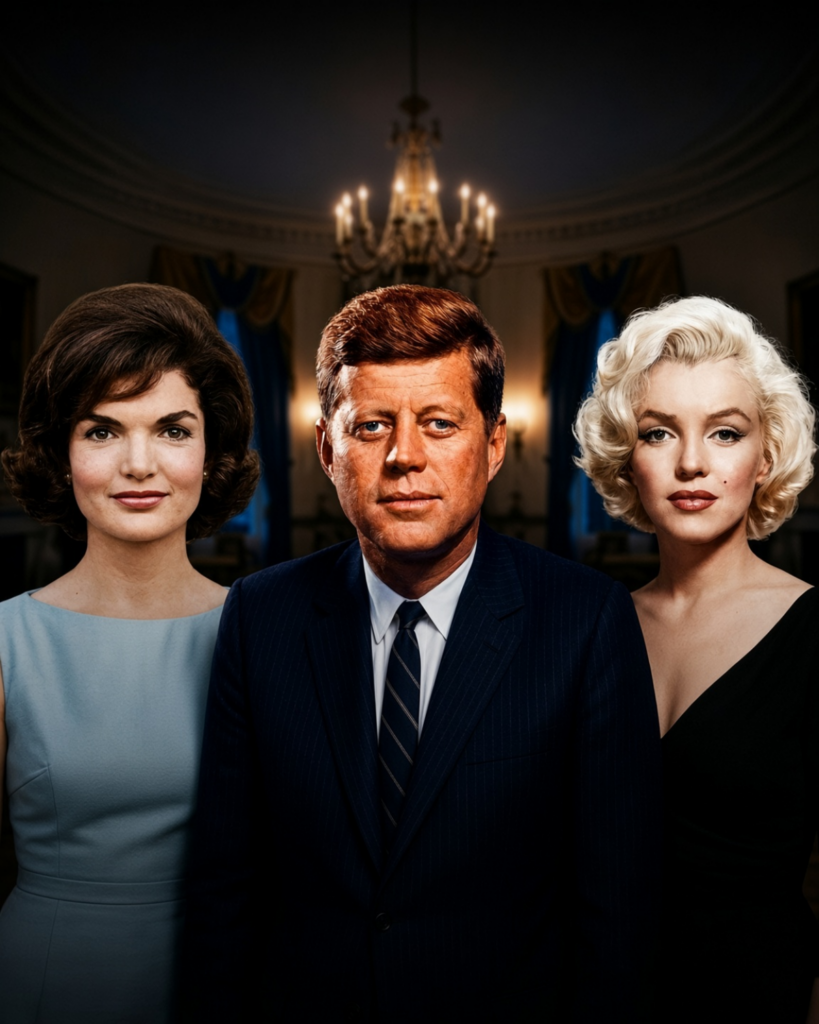
The tape everyone remembers runs about a minute.
A spotlight finds a woman in a gown sewn with sparkle.
She leans into the microphone and 15,000 people at Madison Square Garden forget how to breathe.
The 19th of May 1962, Marilyn Monroe singing to the President of the United States.
One seat that mattered sat empty.
Jacqueline Kennedy was in the Virginia hunt country that weekend.
And for 60 years, we’ve been told exactly why.
A feud.
A first lady who couldn’t stand the most famous blonde on earth.
Tonight, we hold that story up against the paper.
A phone call one writer put inside the White House and another put in a bedroom on Cape Cod.
A star witness who, according to his widow, was too sick to give the interview.
And a memo with three exclamation points.
It started with a horse show in Virginia.
To understand why the feud stuck, you have to remember what those two women meant.
In the winter of 1962, on the 14th of February that year, Valentine’s Day, CBS and NBC broadcast a tour of the White House with Mrs. John F. Kennedy.
56 million Americans watched a 32-year-old first lady walking through a $2 million restoration room by room, naming furniture makers and painters like an art historian.
It was a record audience.
People who’d never cared about federal chairs suddenly did.
3,000 miles west, Marilyn Monroe was the biggest star at 20th Century Fox.
And that spring, she was shooting a comedy called Something’s Got to Give with Dean Martin.
She was 35.
She’d been married to Joe DiMaggio and to the playwright Arthur Miller.
And she couldn’t walk into a room without the room turning around.
The magazines didn’t have to work very hard.
One woman was Newport, Vassar, and pearls.
The other had grown up in foster homes in Los Angeles and made herself into a legend by sheer will.
They were the two most photographed women in America.
And they lived on opposite sides of the country and opposite sides of every cliché.
So when the story came out that the president had been involved with the actress, the rest wrote itself.
Jackie knew.
Jackie seethed.
Jackie refused to sit in the garden and watch her husband’s girlfriend sing to him on national television.
And Marilyn, in the most famous version, actually picked up a phone and called the White House to tell the first lady she was in love with her husband.
And Jackie, cool as ice, told her she was welcome to the job.
It’s a great story.
It’s been told in bestsellers and in a network miniseries.
It’s the story most people over a certain age still believe, and it’s the reason so many of them think they already know how this ends.
Now let’s see how much of it survives the documents.
Start with what can actually be pinned down.
In March of 1962, President Kennedy flew to California.
He’d been expected to stay at Frank Sinatra’s place in Palm Springs, where Sinatra had gone to considerable trouble getting ready for him.
The plan changed, reportedly on Bobby Kennedy’s advice, because of the company Sinatra kept, and the president stayed at Bing Crosby’s house instead.
That weekend is the cornerstone of everything that follows.
Almost every claim of an affair between John Kennedy and Marilyn Monroe leans on it.
So what’s holding it up?
Mostly a phone call.
Marilyn’s masseur and friend, Ralph Roberts, later said she called him that weekend and put a man on the line who asked his advice about a bad back.
Roberts said he recognized a Boston accent.
He didn’t see anyone.
He guessed, and he said Marilyn confirmed it to him afterward.
That’s secondhand testimony about a voice on a telephone, given years after the fact.
Still, serious writers built on it.
In his 2023 biography, Jackie: Public, Private, Secret, J. Randy Taraborrelli presented the Palm Springs weekend as the one time the president and the star were together.
Keep that book in mind.
Its author is going to change his mind about something.
And the reason is a woman named Pat Newcomb.
As for what Jackie knew, Taraborrelli, who says he drew on hundreds of interviews over 25 years, claims she raised Marilyn with her husband directly and told him, “This one’s different. This one could be trouble.”
According to the author, the president told her nothing was going on.
Nobody else was in that room.
The line comes to us through a biographer 60 years later, from sources he spoke to long after both Kennedys were gone.
It may be exactly right, but notice what it is and what it isn’t.
It’s a wife worried about a scandal.
It isn’t hatred.
That should have been the whole story.
A rumor, a worried wife, a president who said no.
But a month later, the phone rang on Cape Cod.
The second chapter of the legend is the call, and there are two very different versions of it.
Here’s the quieter one, again from Taraborrelli’s 2023 book.
In April of 1962, he writes, Jackie was at Hyannis Port when the phone rang in her bedroom.
A soft voice asked if Jack was home.
Jackie said no and asked who was calling.
The voice said Marilyn Monroe, and then asked, “Is this Jackie?”
The caller said she just wanted to say hello and asked Jackie to tell the president she’d called.
That’s it.
No confession, no threat, just a hello on a line that very few people had the number for.
According to the book, Jackie wasn’t even sure it was real.
She wondered whether someone in her own family was pulling a prank, and when she passed the message along, her husband waved it off as a crank call.
Taraborrelli writes that a decade later she was still turning it over.
Think about where that leaves her.
If that call happened at all, it happened in a house where the woman picking up the phone had no way of knowing whether she was talking to the most famous actress in the world or to a practical joker.
And neither do we.
Now set that beside the other version.
It’s bigger and meaner.
It moves the call to the White House itself.
And it was read by more than a million people.
It came from a different writer with a different source.
And we’re going to spend real time on that source before this is over.
For now, just know this.
The quiet version and the loud version can’t both be the story of the same phone call.
One of them has to give.
The gala was a month away, and the Kennedy women had already started talking about it.
Taraborrelli sets the scene at Hammersmith Farm, the Rhode Island estate where Jackie grew up, over lunch on the porch.
He writes that Jackie asked her mother and sisters how it would look if she didn’t go to New York.
Her half-sister asked how it would look if she did.
Her mother, Janet Auchincloss, thought she should go and face it.
When Jackie said no, Janet told her the decision was selfish and added, “She’s just an actress.”
That account comes from two of the president’s Secret Service agents, Larry Newman and Joseph Paolella, interviewed by Taraborrelli decades later.
Hold on to the fact that it’s agents talking.
Another agent is going to tell this differently.
On the night itself, Jackie was in Virginia.
She stayed at Glen Ora, the family’s weekend house, and took part in the Loudoun Hunt horse show in Leesburg.
She’d recently been given a horse named Sardar by President Ayub Khan of Pakistan during her trip there in March.
In New York, Peter Lawford, the president’s brother-in-law and the evening’s master of ceremonies, kept introducing Marilyn and kept getting no Marilyn, a running gag about her famous lateness.
Then she arrived, and you know the rest.
She followed the birthday song with a few new verses set to “Thanks for the Memory,” written for the occasion.
Here’s the first place the legend and the record split.
Everyone quotes the president’s joke afterward as such a sweet, wholesome way.
But the official transcript of his remarks, preserved in the presidential record, stopped short.
He thanked Miss Monroe, who left a picture to come all the way east, and said he could now retire from politics after having had “Happy Birthday” sung to him in such a sweet—and then the transcript simply records laughter.
15,000 people paid for that sentence, and the stenographer couldn’t hear the end of it.
The president spoke at 11:30 that night.
Then the family went on to a reception at the home of Arthur Krim, the president of United Artists, who’d helped organize the evening.
Notice that line about leaving a picture.
The picture was about to leave her.
On the 8th of June 1962, 20th Century Fox fired Marilyn Monroe from Something’s Got to Give.
The studio said her absences had sunk the schedule, and it sued her and her production company.
Reports put the figure at half a million dollars or more.
Lee Remick was announced as her replacement.
That’s where the official record of Marilyn’s spring ends and the unofficial one begins.
According to Taraborrelli, the Kennedy women had already started managing the situation.
Pat Kennedy Lawford, the president’s sister, was one of Marilyn’s closest friends.
And he writes that she called Jackie at Glen Ora before the gala to promise the performance was nothing more than a harmless prank.
After the show, he writes, Ethel Kennedy called to say she found it disconcerting, and Jackie answered that the attorney general was the troublemaker, not the president.
Again, that’s one author’s reconstruction of phone calls nobody recorded.
But one thing that summer is better documented.
Marilyn did call the Justice Department more than once in June and July, trying to reach Bobby Kennedy.
Edwin Guthman, Bobby’s press aide, later confirmed she’d been in touch.
The family she was calling was the same family that was, in Taraborrelli’s telling, quietly moving to keep the first lady out of the line of fire.
If you’re keeping score, look at who did what.
The president’s sisters and sisters-in-law are the ones on the phone.
The president’s brother is the one getting the calls.
And Jackie is in Virginia with a horse, saying almost nothing to almost anyone.
Marilyn, meanwhile, was fighting back.
She sat for Life magazine.
She negotiated with Fox, and by the start of August she was reportedly set to go back to work on the picture.
She never went back.
On the 5th of August 1962, Marilyn Monroe was found dead at her home in Los Angeles.
She was 36.
The Los Angeles County Coroner ruled her death a probable suicide.
20 years later, a review by the Los Angeles District Attorney’s Office found no evidence of foul play.
Taraborrelli writes that Jackie was at Hyannis Port when her social secretary, Letitia Baldrige, called with the news, and that she was saddened by it.
The funeral was held on the 8th of August at Westwood Village Memorial Park.
Joe DiMaggio took charge of it with Marilyn’s half-sister, Berniece Miracle, and her business manager, Inez Melson.
About two dozen people were allowed in.
DiMaggio barred almost all of Hollywood—the producers and directors and studio men—because he believed they’d had a hand in wearing her down.
We couldn’t find a single public statement from Jacqueline Kennedy about Marilyn Monroe’s death.
Not that week, and not in the 32 years she had left.
That silence is the hole the feud was poured into.
If Jackie never said what she felt, somebody else was going to say it for her.
And that’s exactly what happened.
The feud, as most of us know it, didn’t come from 1962.
It came from 1989.
That year, a writer named C. David Heymann published A Woman Named Jackie.
It went to number one on the New York Times bestseller list for five weeks, sold more than a million copies in hardcover, and became an NBC miniseries in 1991.
In that book, Marilyn calls the first lady at the White House and tells her she loves the president.
And Jackie, in Heymann’s telling, agrees to step aside as long as Marilyn understands she’ll have to move into the White House and take on the whole job.
That’s the scene.
That’s the one people repeat at dinner.
Christopher Andersen told a version of it again in a 2013 book.
Heymann’s source for it was Peter Lawford, the president’s brother-in-law, the same man who’d introduced Marilyn at the Garden.
According to the researcher Donald McGovern, the idea that Jackie skipped the gala because of Marilyn also traces back to Heymann, which brings us back to the Secret Service.
In 2012, Clint Hill, the agent assigned to protect Mrs. Kennedy, published his memoir, Mrs. Kennedy and Me.
He put the gala in a chapter titled “André Malraux and Marilyn Monroe,” sharing a heading with the French Minister of Culture, which tells you how much drama he thought it carried.
Hill’s account, as McGovern lays it out, goes like this.
Jackie had entered the Loudoun show and planned to ride Sardar.
The president actually wanted her in New York because her absence could look bad politically, and he eventually gave in.
She disliked political functions, and skipping one wasn’t unusual for her at all.
So that’s the agent who walked beside her, telling us the empty chair was about a horse and a lifelong dislike of fundraisers.
And the most quoted scene of the feud, the White House phone call, rests on one writer and one dead actor.
Here’s where it comes apart.
In August of 2014, Newsweek ran a cover story by the investigative reporter David Cay Johnston on C. David Heymann’s career.
Johnston had first exposed Heymann back in 1983, when Random House withdrew his biography of the actress Barbara Hutton and pulped as many copies as it could recover.
Newsweek looked hard at the Lawford interviews.
Peter Lawford died on Christmas Eve 1984.
His widow, Patricia, told the magazine that Heymann couldn’t have interviewed her husband on the occasions he cited, because she was caring for him around the clock, and he was too ill to give anything like a long interview.
Then came the detail that should end the argument.
Heymann died in 2012, and his last book, Joe and Marilyn, came out two years later.
In it, the very same White House phone call appears again—only this time, Heymann credits it to a different source.
Not Peter Lawford.
Ralph Roberts, the masseur.
Same call, same punchline, new witness.
And the Palm Springs weekend.
In 2025, Taraborrelli published a follow-up, JFK: Public, Private, Secret.
This time, he’d talked to Pat Newcomb, Marilyn’s publicist and close friend, who was in her 90s.
According to Taraborrelli, Newcomb said she knew nothing about any such weekend, and that if it had happened, she would have known.
As he pointed out, she’d have been the one to set it up.
Taraborrelli told Fox News that he now believes, quote, “We don’t have enough evidence to support that Marilyn and JFK had an affair.”
He still believes the Hyannis Port call happened.
He still believes Jackie worried.
But the author whose book gave the legend its most detailed modern version now says the affair at the center of it can’t be proven.
So let’s ask the question this whole story really turns on.
If strangers wrote down your private feelings and those pages sold a million copies, would you spend your life correcting them?
Or would you do what Jackie did and say nothing at all?
Because we do have a few things Jackie said, and none of them sound like hatred.
According to Taraborrelli, the photographer Peter Beard, a friend of hers, recalled that she’d never seen a single Marilyn Monroe film.
The only thing she’d ever watched Marilyn do was the birthday song at the Garden, and she thought it was sad.
Not insulting.
Then there’s the paper trail from Jackie’s second career.
After 1975, she became a book editor, first at Viking, then at Doubleday.
The historian William Kuhn went through those years for his book Reading Jackie.
He reports that when a proposal came in for a book of Bert Stern’s photographs from Marilyn’s final sessions in 1962, Jackie dashed off a memo to a colleague that began “Marilyn Monroe” and went on, “Are you excited?”
Kuhn also found that she talked about Marilyn with an author she was editing, the Gene Harlow biographer David Stenn, calmly and even admiringly, as part of a line of Hollywood blondes.
Three exclamation points.
That’s the most emotional thing we could find on paper from Jackie about Marilyn Monroe, and it’s enthusiasm.
Here’s how it all came out.
Marilyn’s will, signed on the 14th of January 1961, left her personal effects and three quarters of her estate to her acting teacher Lee Strasberg.
A quarter went to her psychiatrist, and that share later passed to the Anna Freud Centre in London.
Strasberg’s widow, Anna, ended up controlling his share, and in 2011 sold it to Authentic Brands Group for a price reported at 20 to 30 million dollars.
The birthday gown sold at auction in November 2016 for 4.8 million dollars.
Jackie’s will directed her children to keep what they wanted and sell the rest.
In April 1996, Sotheby’s sold it for 34.5 million dollars.
Jacqueline Kennedy Onassis died on the 19th of May 1994.
32 years to the day after the gala she skipped.
We couldn’t find a single public word either woman said about the other.
Everyone else did the talking.









