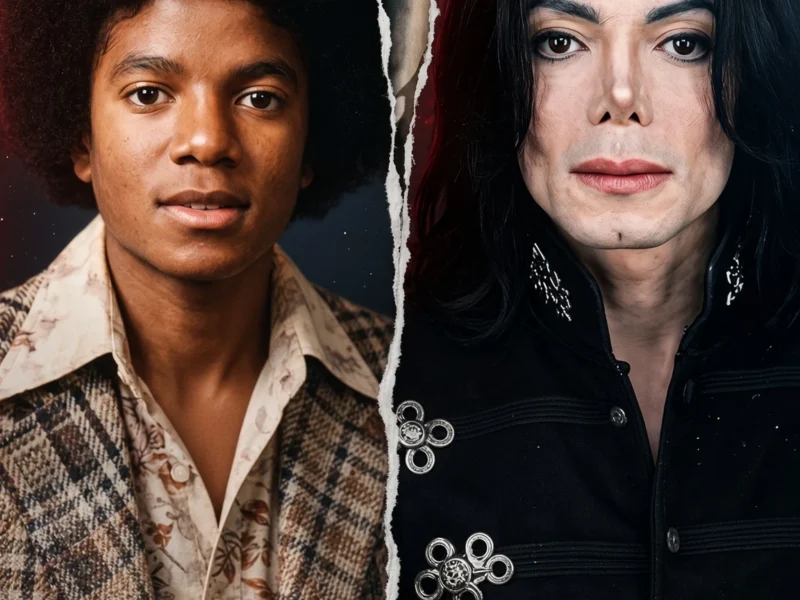
Why Did Michael Jackson Disfigure Himself? Childhood Trauma or Racism?
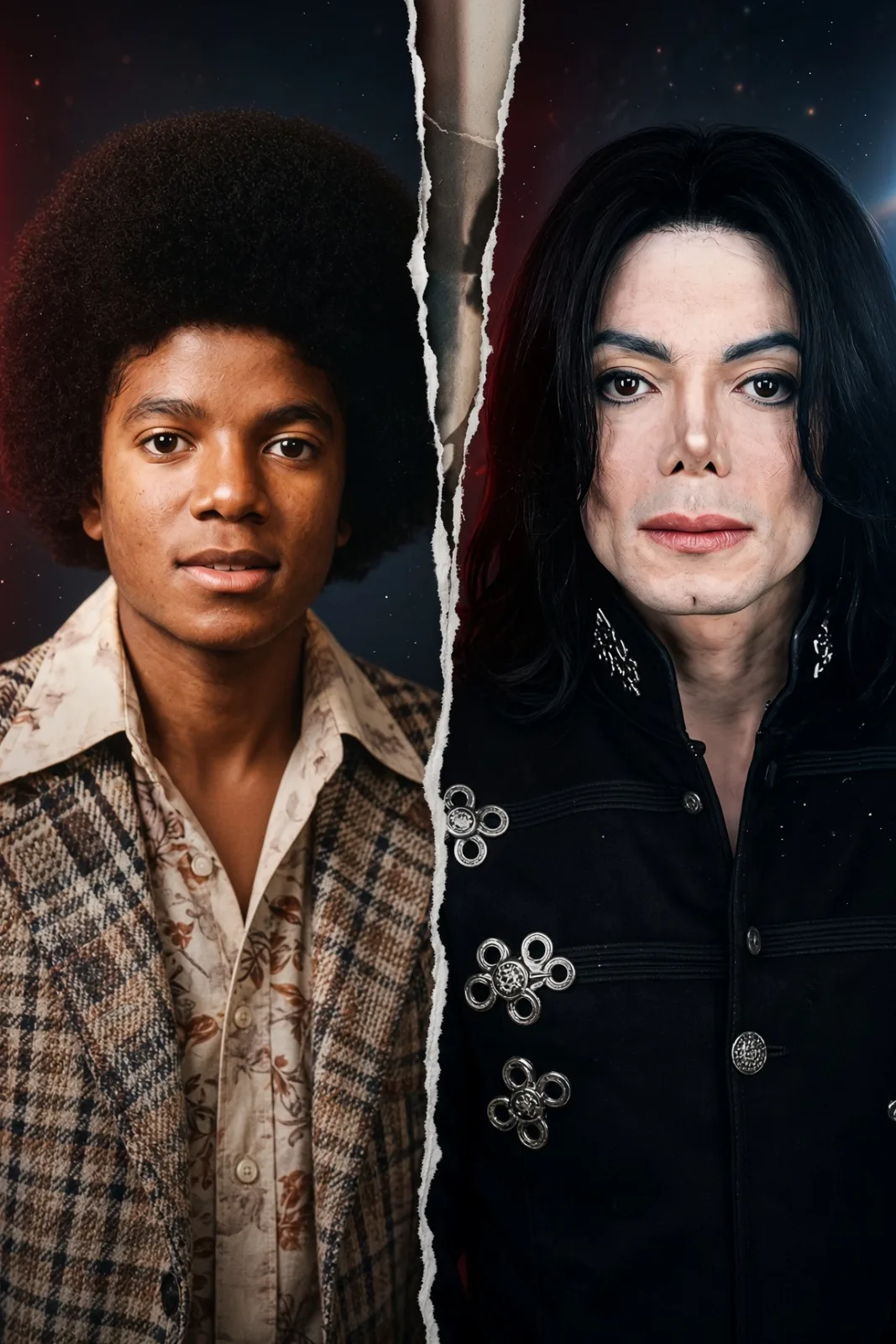
In February 1993, Michael Jackson sat down for a television interview that would become one of the most closely watched conversations of his life.
Across from him was Oprah Winfrey.
By then, Jackson had spent more than 20 years in the public eye.
Millions of people had watched him grow from the smiling little boy of the Jackson 5 into the most famous pop star on the planet.
They knew his voice, his dancing, his clothes, and almost every detail of his public image.
But there was something about Michael Jackson that had become impossible to ignore.
His face had changed.
The little boy with the broad smile and round features now appeared with a much narrower nose, a different facial profile, and skin that looked dramatically lighter than it had in his childhood.
Photographs from different periods of his career seemed to show different versions of the same man.
The changes had become an international obsession.
Newspapers compared his photographs.
Television commentators speculated about plastic surgery.
Tabloids published increasingly sensational explanations for why a black American superstar appeared to be transforming his appearance.
And one accusation followed him everywhere.
Was Michael Jackson trying to become white?
When Oprah raised the subject, Jackson rejected that interpretation.
He explained that he had a skin disorder that affected pigmentation, and he insisted that he was proud of his racial identity.
He also acknowledged that he had undergone cosmetic surgery.
But perhaps the most revealing part of the interview had nothing to do with a medical procedure.
It was the way he spoke about looking at himself.
Here was a man whose image had been reproduced on millions of album covers, posters, television screens, and magazine pages.
Yet he described a deeply uncomfortable relationship with his own reflection.
To understand how that happened, we have to look beyond the photographs.
We have to return to a childhood in which appearance, performance, approval, and fear became entangled long before Michael Jackson was old enough to understand the consequences.
And we have to separate three very different things.
The changes he chose, the changes caused by illness, and the explanations that other people invented for him.
Because the story of Michael Jackson’s face is not simply a story about plastic surgery.
It is a story about what happens when the whole world believes it has the right to judge how one person looks.
Michael Joseph Jackson was born on August 29th, 1958 in Gary, Indiana.
He was one of nine children in a working-class family where music would eventually become the center of daily life.
His father, Joseph Jackson, worked to turn his sons into a professional performing group.
The rehearsals were demanding.
The expectations were high.
And Michael, despite being one of the youngest members, quickly became the group’s most compelling performer.
He could sing with a level of emotional control that seemed extraordinary for a child.
He could dance, imitate established entertainers, and command an audience.
By the time the Jackson 5 reached national fame, Michael had become the face of the group.
He was still a boy, but his job was to make adults happy.
Audiences wanted him to smile.
Television producers wanted him to be charming.
The record company wanted him to remain the adorable young star whose voice had helped create a string of hits.
And at home, according to Michael’s later accounts, his father’s approval could be difficult to obtain.
In his 1993 interview with Oprah, Jackson described being frightened of Joseph.
He said his father had physically punished the children, and that the fear could become so intense that he sometimes felt physically ill.
These were Michael’s accounts of his childhood, not conclusions reached through a clinical examination, but they were consistent with a broader history of public discussion about Joseph Jackson’s harsh disciplinary methods.
Joseph’s role in the family success was undeniable.
He helped organize the group, enforced rehearsals, and pushed his sons toward professional opportunities that transformed their lives.
Yet, professional success and emotional security are not the same thing.
A child can become famous while still feeling that love and approval depend on performing perfectly.
For Michael, the relationship with his father carried an additional wound.
He recalled being teased about his nose.
The detail may sound small compared with the physical punishment and intense demands of childhood stardom, but insults about appearance can be especially powerful when they come from someone whose approval matters.
Michael would later speak about feeling unattractive as he grew older.
He also described struggling with acne during adolescence.
The timing was cruel.
Millions of people remembered the smiling child from the Jackson 5, but the child was becoming a teenager, and the changes of puberty were unfolding under public observation.
His voice was changing.
His face was maturing, and the entertainment industry was beginning to judge him by standards that had little to do with his musical ability.
The young performer who had once been celebrated for being cute was now expected to become a convincing adult star.
That transition is difficult for many child performers.
For Michael Jackson, it took place in front of an audience that had already decided what he was supposed to look like.
His later comments suggest that he became intensely conscious of his appearance.
But it would be too simple to say that one childhood insult caused every decision he made as an adult.
Human motivations are rarely that direct.
We can document what Jackson said about his childhood and his insecurity.
We cannot reconstruct every private thought that led him toward cosmetic surgery.
What we can identify is the moment when his appearance began to change in a way that the public could see.
By the late 1970s, Michael was establishing himself as an adult solo performer.
His collaboration with Quincy Jones on Off the Wall would become a turning point.
The album demonstrated that he could move beyond his childhood identity and compete with the biggest names in popular music.
He was developing a new voice, a new stage presence, and a more sophisticated musical style.
Around this period, he also began making changes to his face.
In his 1988 autobiography, Moonwalk, Jackson acknowledged having undergone two operations on his nose.
He also acknowledged having a cleft added to his chin.
He connected his first nose surgery to an injury and discussed his dissatisfaction with his appearance.
These admissions are important because they establish that cosmetic procedures were part of his history.
There is no need to deny what he acknowledged himself.
But they also create a distinction that is often lost in sensational accounts.
Knowing that someone underwent surgery does not mean we know the precise emotional motivation behind every procedure.
Jackson sometimes offered practical explanations, including breathing and performance.
At other moments, his comments revealed concern about how he looked.
Those explanations are not necessarily mutually exclusive.
A person can seek a procedure for more than one reason, and the reasons can change over time.
By the time Thriller made Michael Jackson an international phenomenon, his face had become part of an extraordinarily controlled public image.
He was no longer simply a singer.
He was the star of cinematic music videos, magazine covers, elaborate concerts, and television events.
Every detail mattered.
The jacket, the glove, the hairstyle, the silhouette, the face.
His appearance was now a commercial image seen by hundreds of millions of people, and the more famous he became, the less privacy he had to experiment, make mistakes, or change his mind.
During the 1980s, observers noticed that his nose appeared increasingly narrow.
His makeup and styling also changed.
The differences between photographs became more striking, especially when images from his childhood were placed beside publicity portraits from the Bad era.
Speculation about additional operations intensified.
Some commentators began describing a dramatic physical transformation.
Others treated the photographs as proof of a psychological disorder.
But photographs alone cannot establish a psychiatric diagnosis, and they cannot reliably identify every procedure a person may have undergone.
Lighting, makeup, weight changes, hairstyle, camera angles, and the passage of time can all affect facial appearance.
That does not mean the changes were imaginary.
It means that a responsible account has to distinguish visible differences from medically confirmed explanations.
Jackson’s own statements did not satisfy the public.
In 1993, he maintained that the number of operations was much smaller than the tabloids claimed.
His autobiography had already acknowledged two nose surgeries and the alteration to his chin.
The exact number of procedures he underwent throughout his life remains uncertain.
But the public argument was no longer limited to his nose.
Something else had become the focus of enormous controversy.
His skin.
As a child, Michael Jackson had a brown complexion.
By the late 1980s and early 1990s, his public appearance was much lighter.
The contrast was unmistakable.
And in an American culture with a long history of racial discrimination, the change immediately attracted interpretations that went far beyond medicine.
Some commentators accused him of rejecting his black identity.
Others suggested that his transformation reflected a desire to look like a white entertainer.
These accusations were repeated so often that they became part of the popular story about him.
But repetition does not turn an allegation into a medical fact.
Jackson said he had vitiligo.
Vitiligo is a condition in which areas of the skin lose pigmentation.
It can produce irregular patches of lighter skin that become more noticeable as the condition progresses.
The pattern and extent vary from person to person.
For someone whose image is constantly photographed under bright lights, uneven pigmentation can become particularly difficult to conceal.
Cosmetics may be used to make the appearance more uniform.
Some people with extensive vitiligo also undergo treatments intended to reduce remaining pigmentation.
Such treatments exist within dermatological care and cannot by themselves establish a person’s feelings about their race.
In the Oprah interview, Jackson explained that he used makeup to deal with uneven coloration.
He denied that he was trying to change his racial identity.
At the time, many people refused to believe him.
Some treated the explanation as an excuse.
Others assumed that a medical condition could not account for such a dramatic transformation.
But after his death in 2009, the Los Angeles County Coroner’s examination documented areas of depigmentation consistent with vitiligo.
The report also recorded a depigmenting medication among his possessions.
Those findings matter because they provide medical evidence that his skin condition was real.
They do not explain every personal decision he made about his appearance.
They do establish that the disease was not simply a story invented for television.
That distinction changes how we should look at decades of headlines.
For years, photographs of his lighter skin were used to support claims about racial self-hatred.
Yet the existence of vitiligo offers a documented medical explanation for an important part of that visible change.
The more difficult question is why so many observers prefer a story about race to an explanation involving illness.
To answer that, we need to consider the world in which Jackson became famous.
Michael Jackson grew up during a period of profound racial change in the United States.
The Jackson 5 emerged from a black musical tradition and achieved extraordinary success in mainstream popular culture.
Their recordings reached audiences across racial lines.
But crossing those lines did not mean that racial barriers had disappeared.
Black entertainers still faced unequal opportunities, limited representation, and expectations shaped by an industry that frequently treated white audiences as the default commercial market.
Jackson’s success challenged some of those boundaries.
Thriller became an unprecedented crossover phenomenon.
His music videos helped reshape the place of black performers on music television.
His influence reached audiences who might previously have been separated by radio formats and marketing categories.
And his identity as a black American artist was part of that achievement.
It is therefore understandable that his changing appearance provoked intense public discussion.
But there is a difference between examining the racial pressures surrounding a famous performer and claiming to know what that performer secretly wanted.
Jackson repeatedly rejected the suggestion that he wished to become white.
He publicly affirmed pride in being black.
His artistic work also engaged directly with racial identity.
In 1991, he released Black or White, a song whose message challenged racial divisions and whose video became a major television event.
In the mid-1990s, They Don’t Care About Us addressed prejudice, injustice, and the treatment of marginalized people.
These works do not give us unrestricted access to Jackson’s private psychology.
Artists can hold complicated feelings about themselves while creating public messages.
But the songs are part of the record.
Any explanation that reduces Jackson’s appearance to a simple desire to escape blackness has to contend with what he actually said and created.
The racism question then cannot be answered with a sensational photograph.
We can document the racial assumptions made about him.
We can document his rejection of those assumptions.
We can document the medical condition that affected his skin.
What we cannot prove is that racism was the hidden motivation behind every cosmetic choice.
And this is where another part of the story becomes important.
The pressure did not come only from childhood or from the music industry.
It came from the public itself.
By the 1990s, Michael Jackson’s face had become a recurring subject of comedy, gossip, and tabloid speculation.
The entertainment press examined his appearance with an intensity rarely applied to an ordinary person.
Changes were presented as mysteries.
Rumors were presented as revelations.
And the language used to describe him often became openly cruel.
The more his appearance changed, the more aggressively people demanded an explanation.
The more he tried to explain himself, the more some commentators accused him of dishonesty.
That created a situation in which almost any answer could be turned against him.
If he admitted surgery, it became evidence that he was hiding more.
If he denied a rumor, the denial became another headline.
If he avoided discussing his face, the silence was treated as suspicious.
And if he appeared in public with a different look, the comparison photographs began circulating again.
There was no clear point at which the subject could be considered settled.
His fame made his appearance commercially valuable to the same media organizations that mocked it.
This was especially apparent during his 2003 interview with British journalist Martin Bashir.
The program, Living with Michael Jackson, included extended conversations about his childhood, private life, and physical appearance.
Bashir questioned him about cosmetic surgery.
Jackson acknowledged two nose operations and offered explanations connected to breathing and singing.
The interviewer remained skeptical.
Viewers saw a man whose face looked very different from the child performer they remembered, but they also saw someone being asked to account for his appearance in front of a vast television audience.
The interview became another major moment in the public debate.
For some viewers, it confirmed their suspicions.
For others, it demonstrated how relentlessly Jackson’s body had become an object of public examination.
The program did not establish a complete surgical history.
Nor could it establish a definitive psychological explanation.
It showed the distance between Jackson’s own account and the conclusions other people had already reached.
By this point, the distinction between the real Michael Jackson and the character created around him was becoming increasingly difficult to maintain.
The public image had accumulated decades of photographs, stories, jokes, accusations, and contradictions.
Every new appearance was compared with that history.
And Jackson was expected to explain why he no longer resembled the child the world had first fallen in love with.
There is another medical detail that complicates the picture.
Jackson suffered a serious accident while filming a Pepsi commercial in 1984.
During the shoot, a pyrotechnic effect ignited his hair, causing burns to his scalp.
The accident was documented and required medical treatment.
It also became part of the history of his later hair and scalp problems.
The coroner’s report eventually described scalp scarring and cosmetic measures used to conceal hair loss.
This does not explain his nose or his skin condition.
But it demonstrates why the story of his appearance cannot be reduced to voluntary cosmetic surgery alone.
Some changes involved injury.
Others involved illness.
Some involved acknowledged cosmetic decisions.
And for many visible details, the full history is not publicly established.
The problem with the phrase that Michael Jackson disfigured himself is that it places all of it into one category.
It assumes that every change was deliberate.
It assumes that every deliberate change had the same motivation.
And it assumes that the final appearance tells us exactly what he intended.
The available evidence does not support those assumptions.
We know that Jackson made cosmetic choices.
We know that he described insecurity about his appearance.
We know that he reported a frightening and emotionally difficult childhood.
We know that he had vitiligo.
We know that a serious accident affected his scalp.
And we know that he lived under an extraordinary level of scrutiny.
Those facts are connected, but they are not interchangeable.
The existence of childhood trauma does not prove a particular psychiatric condition.
The existence of plastic surgery does not prove racial self-hatred.
And the existence of vitiligo does not explain every change in facial structure.
The temptation is to find one cause that makes the entire transformation understandable.
But the evidence points toward a more complicated life.
Consider the contradiction at the center of Michael Jackson’s fame.
As a performer, he possessed an unusual degree of control.
He could rehearse a movement until it looked effortless.
He could spend hours perfecting a recording.
He could shape a music video into a carefully constructed visual experience.
He could turn a glove or a particular gesture into an instantly recognizable symbol.
He understood presentation as an art form.
But control over a performance is not the same as control over how other people see you.
No matter how carefully he constructed his public image, audiences brought their own expectations.
They remembered the little boy.
They compared him with the young man from Off the Wall.
They compared that young man with the star of Thriller.
And they compared all of those versions with the Michael Jackson who appeared in later years.
He could influence the image.
He could not control the interpretations.
His face became a place where personal insecurity, medical problems, artistic presentation, racial assumptions, and celebrity culture collided.
The result was a public argument that continued long after his death.
In 2009, when Jackson died at the age of 50, the coroner’s examination offered an opportunity to distinguish some documented medical facts from years of speculation.
The confirmation of depigmentation associated with vitiligo was especially significant.
Yet even that evidence did not end the debate.
People continued to circulate comparisons of his face.
They continued to speculate about the number of operations.
And they continued to ask whether the transformation was driven by childhood suffering, racial identity, or something else.
The answer depends on what we mean by the question.
If we ask whether Jackson experienced painful childhood treatment, his own public accounts provide strong evidence that he did.
If we ask whether he felt insecure about his appearance, his interviews and autobiography provide evidence of that, too.
If we ask whether he underwent cosmetic surgery, he acknowledged specific procedures.
If we ask whether his skin became lighter because he had vitiligo, there is medical documentation supporting the condition.
But if we ask whether he secretly wanted to become white, the available evidence does not establish that conclusion.
And if we ask whether childhood trauma caused every later change, no reliable public record can prove such a simple chain of cause and effect.
There is something deeply uncomfortable about the way the world discussed Michael Jackson’s face.
The public wanted a definitive explanation.
The tabloids wanted a dramatic one.
And the most dramatic explanation was often treated as the most believable.
But a human being’s appearance is not a puzzle that can always be solved from photographs.
Even someone who has spent most of his life on television retains an inner life that outsiders cannot fully reconstruct.
Michael Jackson was an exceptional entertainer who helped redefine popular music.
He was also a man who spoke openly about insecurity, who made cosmetic decisions, who experienced a documented skin disorder, and who endured relentless public judgment.
Those truths can exist together.
They do not need to be forced into a single accusation.
Perhaps the most revealing image is not one of the famous before and after photographs.
It is the scene from 1993.
Michael Jackson sitting across from Oprah Winfrey trying to explain why his face and skin had become subjects of worldwide fascination.
A man who had spent his life being watched was being asked to explain what the audience saw.
And behind the question about his appearance was another question that no surgery could answer.
What happens when the world loves the image of a child so much that it never allows the adult to stop being compared with him?
Michael Jackson could change his hairstyle, his clothes, his makeup, and parts of his face.
He could create new music, new performances, and new versions of his public image.
But he could never return to being the boy who first stepped onto the stage with his brothers.
That boy existed in photographs, recordings, and the memories of millions of strangers.
The adult had to live with the comparison.
So, why did Michael Jackson change his appearance so dramatically?
Childhood trauma may help us understand some of the insecurity he described.
Cosmetic surgery accounts for some of the deliberate changes he acknowledged.
Vitiligo explains an important part of the change in his skin pigmentation.
And racial prejudice helps explain why the public attached such charged meanings to his appearance.
But, no honest documentary can claim that one of those explanations answers everything.
The real story is more complicated than the accusation in the title.
And perhaps that is why it remains so disturbing.
For decades, the world examined Michael Jackson’s face as though it belonged to everyone.
What it could never see with the same certainty was the person living behind it.









