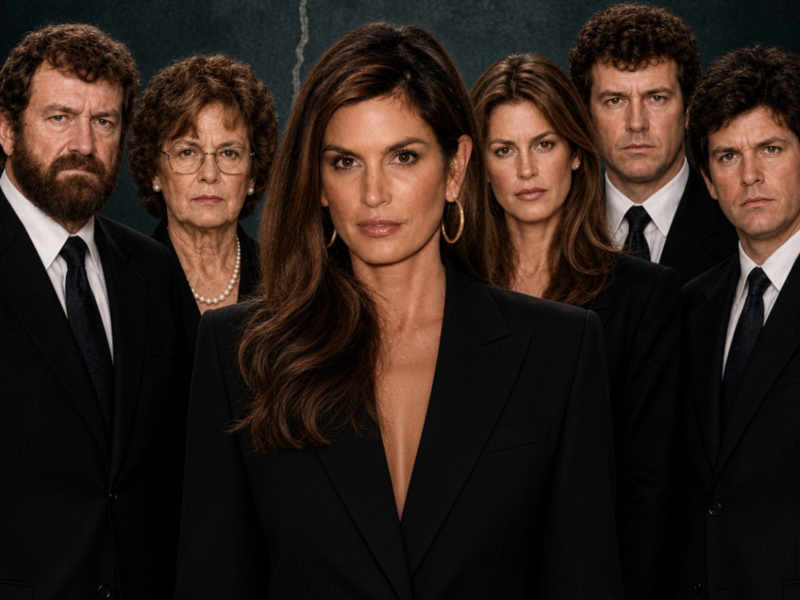
Why Cindy Crawford’s Siblings Hated Her So Much?

In a 1995 family photograph taken at a Chicago charity gala, Cindy Crawford stands arm-in-arm with her siblings, all beaming for cameras.
But what the cameras didn’t capture was how Cindy’s million-dollar deals were changing not just her life, but her family’s.
The supermodel who graced a thousand magazine covers was losing something money couldn’t buy: her siblings’ trust.
Seven years later, that same family would be torn apart in a courtroom where Chris Crawford sued their parents over financial matters, with Cindy’s testimony creating a rift that would never fully heal.
Behind the perfect family portrait was a story of resentment, betrayal, and the devastating cost of extraordinary success.
The Crawford children grew up in DeKalb, Illinois, where Cindy, born in 1966, was the second of three siblings.
Her older sister Chris and younger sister Danielle experienced a relatively normal Midwestern childhood until Cindy’s junior year of high school, when a newspaper photographer discovered her working at a corn detasseling job.
By 1983, seventeen-year-old Cindy had signed with Elite Model Management and moved to Chicago, then New York, leaving behind a family dynamic that would never be the same.
What began as occasional calls home soon became strained conversations about money as Cindy’s income skyrocketed from hundreds to thousands of dollars per day.
Chris Crawford, who had worked as a teacher in Illinois, watched with mixed emotions as her younger sister transformed from a small-town girl into an international phenomenon.
In a 1986 letter to a friend, Chris wrote, “Cindy is changing so fast I’d barely recognize her anymore. Last week, she mentioned spending more on shoes than I make in three months, and she said it like it was completely normal.”
The letter, which would later surface during the family’s legal proceedings, revealed the first documented cracks in what would become a decades-long fracture between the sisters.
Meanwhile, youngest sister Danielle, then still in high school, struggled with comparisons teachers and classmates made between her and her increasingly famous sister.
The first major family conflict erupted in 1988 when Cindy purchased a condominium in Manhattan’s Trump Tower for six hundred fifty thousand dollars, approximately one and a half million in today’s dollars.
When her parents, John and Jennifer Crawford, expressed concerns about the expense, Cindy responded by offering to buy them a new home in DeKalb.
The offer, which seemed generous on the surface, created tension when Chris and Danielle learned that Cindy had attached conditions.
Their parents would need to move closer to Chicago, where Cindy could visit more easily, and the house would be in Cindy’s name initially.
“It wasn’t a gift,” Chris later testified in court documents.
“It was control disguised as generosity.”
By 1990, Cindy Crawford had become one of the world’s most recognizable supermodels, earning an estimated six million dollars annually.
Her face appeared on covers of Vogue, Harper’s Bazaar, and Elle, while she walked runways for Versace, Chanel, and Calvin Klein.
But behind the scenes, family communications grew increasingly strained.
Phone calls became shorter.
Visits became rarer.
And when Cindy did return to Illinois, she often arrived with an entourage of agents, assistants, and photographers.
Danielle, then twenty-two and working as a registered nurse, told a friend in a recorded conversation, “When Cindy comes home now, it’s like a movie set. We’re all just extras in her production.”
The breaking point came in 1992 when Cindy married actor Richard Gere in a quick Las Vegas ceremony that neither her parents nor her sisters attended.
Chris learned about the marriage from a People magazine article while standing in a grocery checkout line.
“I felt like a stranger in my own sister’s life,” Chris wrote in her diary, which was later excerpted in a biography of Cindy.
“Not a phone call, not a letter, just a magazine announcement like any other fan would get.”
Cindy’s representatives later explained that the marriage had been spontaneous and private, but the damage was done.
The sisters didn’t speak for eight months following the announcement.
What followed was a series of failed attempts at reconciliation that only deepened the family divide.
In 1993, Cindy invited both sisters to join her for a vacation in the Bahamas.
But the trip ended disastrously when Chris questioned Cindy about her changing values and apparent disconnection from their family.
According to Chris’s later court testimony, Cindy responded, “You have no idea what it’s like to be me. The pressure, the expectations. None of you understand.”
The argument escalated until Chris left the resort early, with Danielle following two days later after what she described as “the most uncomfortable vacation of my life.”
Financial tensions resurfaced in 1994 when Cindy launched her first fitness video, which eventually grossed over ten million dollars.
Both sisters had expected to be mentioned in the acknowledgments, if not compensated for their early support during Cindy’s struggling years.
When the video was released with no mention of family, Chris confronted Cindy during a tense phone call.
“We were there when you had nothing,” Chris reportedly said, according to Danielle’s account of the conversation.
“Now you act like you did this all alone.”
Cindy’s response, as relayed by Danielle, was, “I appreciate your support, but this is my business and my life.”
The most significant family crisis emerged in 1996 when John Crawford, Cindy’s father, was diagnosed with early-stage Alzheimer’s disease.
Cindy offered to pay for the best medical treatment available, including specialists at New York’s most prestigious hospitals.
But her approach, flying her parents to New York without first consulting Chris and Danielle, who lived closer and had been managing their father’s care, created a new rift.
“She swooped in like a savior, without asking what we needed,” Chris later wrote in an email to a cousin.
“Dad was terrified, Mom was confused, and Cindy was making decisions about people she barely knew anymore.”
The situation deteriorated further when Cindy arranged for her parents to move into an assisted living facility in Westchester County, New York, over an hour from where Cindy herself lived in Manhattan.
Both Chris and Danielle opposed the move, arguing that their father needed familiar surroundings and that their mother would be isolated from her community and friends in Illinois.
“It was about convenience, not care,” Danielle stated in a later deposition.
“Mom was miserable, and Dad’s condition actually declined faster in that sterile environment.”
Cindy maintained that the facility offered superior care, but the decision created a permanent break between the sisters that would never fully heal.
By the late 1990s, communication between Cindy and her sisters had deteriorated to occasional holiday cards and brief phone calls that felt more like obligations than genuine connections.
When Cindy and Richard Gere divorced in 1995, Chris and Danielle learned about it from entertainment news reports like everyone else.
“At that point, we accepted our place in her life,” Chris told a biographer in 2001.
“We were peripheral characters who occasionally got mentioned in press releases.”
The most damaging family conflict erupted in 2002 when Chris Crawford filed a lawsuit against their mother, Jennifer Crawford, alleging mismanagement of family funds and questioning the legality of changes made to their father’s power of attorney after his Alzheimer’s diagnosis.
Cindy, who had been financially supporting her mother, testified via video conference from Los Angeles, where she was filming a movie.
Her testimony appeared to side with their mother, creating what Chris described as “the ultimate betrayal.”
Court records show that Cindy stated under oath that she believed her mother had acted appropriately and that Chris’s concerns were financially motivated and without merit.
The lawsuit divided what remained of the Crawford family permanently.
Danielle attempted to mediate but ultimately sided with Chris, creating a scenario where both sisters were estranged from Cindy and from each other.
The case settled out of court in 2003 with terms that were never made public, but the damage was irreversible.
In a rare interview with a local Illinois newspaper that same year, Chris said, “My sister became someone I don’t recognize. Fame didn’t just change her circumstances, it changed her character. The Cindy I grew up with wouldn’t have done this to family.”
What makes the Crawford family story particularly tragic is that it wasn’t fueled by the usual celebrity excesses of addiction or scandal, but by something more insidious.
The gradual erosion of connection through success, distance, and differing values.
Each decision that made sense from Cindy’s perspective, offering financial help, arranging medical care, making business decisions, created resentment from her siblings, who saw these actions as attempts to control rather than support.
The sisters’ shared history became collateral damage in Cindy’s journey from DeKalb, Illinois, to international superstardom.
In 2005, Cindy married entrepreneur Rande Gerber in a small ceremony in the Bahamas.
Neither Chris nor Danielle were invited, a fact Cindy later explained was due to the intimate nature of the event.
But the exclusion marked another milestone in the growing distance between them.
When Cindy gave birth to her first child, Presley, in 1999, and her daughter Kaia in 2001, her sisters learned of the births through public announcements rather than personal calls.
“We send cards and gifts,” Danielle told a friend in an email that surfaced during a later legal proceeding.
“But we’re more like devoted fans than family at this point.”
The most poignant evidence of the family’s fracture came in 2007 when Jennifer Crawford, the sisters’ mother, suffered a severe stroke.
Cindy arranged for her to be treated at a top neurology center in Los Angeles and covered all medical expenses.
But when Chris and Danielle flew to California to be with their mother, they discovered that visiting hours had been restricted to specific times that made it nearly impossible for them to see their mother without coordinating with Cindy’s schedule.
“Even at our mother’s bedside, we were on Cindy’s time,” Chris later wrote in a memoir excerpt.
“The control extended to everything.”
The stroke ultimately proved to be both a temporary reunion and a permanent separator.
For three weeks, the sisters maintained a fragile truce while their mother recovered.
But tensions resurfaced when Cindy made decisions about their mother’s long-term care without consulting her sisters.
The final break came when Cindy announced that their mother would be moving to a facility near her home in California, effectively removing her from the community where she had lived for over sixty years.
Chris and Danielle objected strongly, arguing that their mother should return to Illinois, where she had friends and familiar surroundings.
The disagreement escalated until Chris reportedly told Cindy, “You don’t get to make these decisions alone. She’s our mother, too.”
Cindy’s response, according to Danielle, was, “I’m the one paying for her care. I’m the one coordinating her treatment. I’m the one who has the resources to handle this. What are you bringing to the table besides criticism?”
That conversation marked the last time all three sisters spoke together.
Jennifer Crawford did move to California, where she lived until her death in 2015.
Neither Chris nor Danielle attended the memorial service that Cindy organized in Malibu, choosing instead to hold a separate gathering in Illinois with friends and relatives who had known their mother before Cindy’s fame transformed the family dynamic.
What remains most telling about the Crawford family story is how each sister believes she is the victim.
Cindy sees herself as someone who has provided generously for her family only to be met with ingratitude and jealousy.
In a rare 2010 interview with Vogue, she said, “Family is complicated. I’ve always tried to do right by them, but sometimes the people who should support you the most are the ones who can’t handle your success.”
Meanwhile, Chris and Danielle view themselves as the custodians of a family history and values that Cindy abandoned in her pursuit of fame.
“She lost more than she gained,” Chris told a biographer in 2012.
“We all did.”
The tragedy of the Crawford sisters isn’t about money or fame alone, but about how success can create such different realities that family members no longer share a common language or understanding.
Every gesture meant to help was interpreted as control.
Every business decision was seen as a betrayal.
Every absence was perceived as abandonment.
The sisters became strangers who shared only memories of a time when they were once close enough to finish each other’s sentences before a camera lens changed everything.
The fractures that emerged in the 2002 lawsuit would only deepen in the following years as Cindy Crawford’s career continued ascending while her relationship with her sisters deteriorated further.
In 2008, Cindy launched her successful home goods collection with J.C. Penney, a deal that reportedly earned her over ten million dollars annually.
When Chris Crawford, struggling with mounting medical bills for her own health issues, reached out to Cindy for financial assistance, she received an offer that felt more like a business transaction than family support.
According to emails later shared with a biographer, Cindy offered to create a payment plan with interest rates comparable to commercial loans, suggesting that Chris could work off the debt by helping with Cindy’s charitable foundation.
“My own sister wanted to charge me interest to help with my medical bills,” Chris told a friend in a recorded conversation.
“That’s when I knew there was no going back.”
The emotional distance between the sisters manifested in increasingly public ways.
In 2010, Cindy appeared on Oprah Winfrey’s network for a special about her life and career, where she spoke extensively about her family values and the importance of staying grounded.
“Family is everything,” she said during the interview.
“No matter how successful you become, your roots keep you human.”
The irony of these statements wasn’t lost on Chris and Danielle, who watched the interview separately in their respective homes in Illinois.
Danielle posted a cryptic message on her private Facebook page that same day.
“Some people talk about family values while practicing family abandonment.”
The post was shared only with close friends, but it captured the growing resentment that Cindy’s public persona masked.
What made the family dynamics particularly painful was the shared trauma that had once bonded the sisters.
The death of their three-year-old brother Jeffrey from leukemia in 1976, when Cindy was ten years old.
In a 2011 interview, Cindy revealed how this loss had affected the family.
“For years, my sisters and I would all have these same nightmares, that it should have been one of us.”
But rather than drawing them closer, this shared grief had become another point of contention.
Chris felt that Cindy had commercialized their family tragedy, mentioning it in interviews to appear more relatable while never checking in with her sisters about how they were processing their grief.
“She turned our brother’s death into a talking point,” Chris wrote in a letter to Danielle that surfaced during a later legal proceeding.
“Some wounds shouldn’t be used for publicity.”
The most significant new development in the sisters’ fractured relationship came in 2013 when Cindy’s daughter Kaia, then eleven years old, expressed interest in pursuing modeling.
Cindy initially resisted, hoping to shield her daughter from the pressures of the industry.
But when Kaia persisted, Cindy eventually agreed to help her navigate the fashion world, using her connections and experience to guide her career.
This decision created a new layer of tension between the sisters as Chris and Danielle watched Cindy provide the guidance and support to her daughter that they felt had been denied to them.
“She became the mother to Kaia that she never was to us as sisters,” Danielle told a cousin in a phone conversation that was later recounted in a family memoir.
“The protectiveness, the advice, the boundaries. All things we needed but never got when she was chasing fame.”
By 2015, the Crawford family faced another loss with the death of their mother, Jennifer Crawford, after complications from her stroke.
Cindy arranged for a memorial service at her Malibu home attended by celebrities including George Clooney, Julia Roberts, and Michelle Pfeiffer.
The service, which featured a custom video montage of Jennifer’s life set to music performed by a famous musician, was covered extensively by entertainment media.
But conspicuously absent were Chris and Danielle, who held their own memorial in Illinois with approximately thirty family members and friends who had known Jennifer before Cindy’s fame transformed the family dynamics.
“We needed to remember our mother without cameras and celebrities,” Chris explained in a local newspaper interview.
“That wasn’t possible at Cindy’s event.”
The separate memorials symbolized the complete division of the family into two distinct worlds that no longer intersected.
The following year, 2016, brought what would become the most public manifestation of the sisters’ feud.
Danielle’s daughter, then twenty-three, decided to pursue a career in fashion design and reached out to several modeling agencies, mentioning her connection to Cindy Crawford in her applications.
When one agency contacted Cindy’s representatives to verify the family connection, Cindy’s team responded with a statement that downplayed the relationship, noting only that Cindy had numerous extended family members and that she does not professionally endorse or assist family members seeking industry opportunities.
The response, which was shared with Danielle’s daughter, devastated both mother and daughter.
“To be essentially disowned publicly by my aunt was heartbreaking,” the young woman later wrote in a blog post about her experiences.
“It showed how completely she had closed that door between us.”
Cindy’s perspective on these family fractures emerged in a 2018 interview with The Hollywood Reporter, where she addressed the challenges of balancing family and fame.
“People think success is uncomplicated, but it creates tensions that others can’t understand,” she said.
“Sometimes you have to make difficult choices about boundaries, and not everyone will agree with those choices.”
When pressed specifically about her relationship with her sisters, Cindy became more guarded.
“Family relationships are private and complex. I’ve always tried to do what’s right while protecting my own peace and that of my immediate family.”
The carefully worded response revealed little but suggested that Cindy had made a conscious decision to prioritize her emotional well-being over maintaining connections with her siblings.
The irony of the Crawford family situation is that both sides believe they are the victims of betrayal.
Cindy sees herself as someone who has provided generously for her family while setting necessary boundaries against what she perceives as entitlement and jealousy.
Her sisters view themselves as loyal family members who were pushed aside and replaced by the celebrity world Cindy inhabited.
In a 2019 essay for a small literary journal, Chris wrote, “We never wanted her money or her fame. We wanted our sister back. The one who would call just to chat, who remembered our birthdays without an assistant’s reminder, who understood that family isn’t transactional. That’s the person we lost, not to tragedy, but to success.”
The most painful evidence of the family’s permanent fracture came during the pandemic in 2020.
As the world isolated, many families found ways to reconnect despite physical distance.
For the Crawford sisters, however, the pandemic only highlighted their separation.
While Cindy shared photos of her family’s quarantine life in Malibu, complete with beach walks and gourmet meals prepared by personal chefs, Chris and Danielle were struggling with their own health challenges and financial concerns in Illinois.
When a cousin organized a Zoom family reunion that included all branches of the Crawford family, Cindy participated for approximately ten minutes before citing a work commitment and leaving the call.
“She was on a beach with her perfect family while we were trying to figure out how to pay our bills during lockdown,” Danielle told the cousin afterward.
“The disconnect has become so complete, I’m not sure it can ever be bridged.”
What remains most telling about the Crawford sisters’ relationship is how it has become a cautionary tale within the fashion industry.
In a 2022 documentary about supermodels, several industry insiders referenced the Crawford family situation when discussing the personal costs of fame.
“Cindy loved her sisters, but success changed the dynamics in ways she couldn’t control,” one modeling executive stated.
“I’ve seen it happen many times. The person who makes it becomes a resource rather than a family member, and that’s an impossible transition for everyone involved.”
The documentary included a brief clip of Cindy from a 1992 interview where she spoke about her sisters with obvious affection.
“They keep me grounded, remind me where I came from, and love me for who I am, not what I’ve become.”
The contrast between those words and the reality of their relationship three decades later captures the tragic trajectory of their family story.
The final break between the sisters came in 2023 when Cindy announced the launch of a reality television series featuring her family life with Rande Gerber and their children.
When Danielle reached out to express concern that the show might exploit their family history, Cindy responded through her assistant with a polite but firm message that the show would focus only on her immediate family and would not address extended family matters.
The response, which was formal and distant rather than personal, convinced Danielle that any hope of reconciliation was futile.
“She’s created a narrative about family that doesn’t include us,” Danielle wrote to Chris in an email.
“We’ve become characters in her story rather than participants in her life.”
Today, the Crawford sisters exist in parallel universes that rarely intersect.
Cindy continues to build her brand and expand her business ventures while maintaining what she describes as healthy boundaries with extended family.
Chris and Danielle live relatively private lives in Illinois, occasionally giving interviews where they express hope that one day their relationship with Cindy might be repaired.
But privately, both acknowledge that too much damage has been done, too many betrayals have occurred, and too much time has passed for a meaningful reconciliation.
“We’ll always love her because she’s our sister,” Chris told a biographer in 2024.
“But we don’t like the person she became, and we’re not sure we ever really knew her at all.”
The tragedy of the Crawford family isn’t about money or fame alone, but about how success can create such different realities that family members no longer share a common language or understanding.
Every gesture meant to help was interpreted as control.
Every business decision was seen as a betrayal.
Every absence was perceived as abandonment.
The sisters became strangers who shared only memories of a time when they were once close enough to finish each other’s sentences before a camera lens changed everything and created a divide that may never be bridged.
The final chapter of the Crawford family story begins not with a dramatic confrontation, but with a quiet revelation in 2025 that exposed the depth of their division.
A biographer working on an authorized book about Cindy Crawford’s career discovered a box of old photographs in Cindy’s Malibu home, including images from a family vacation in 1987, just before Cindy’s career exploded.
In one particular photo, the three sisters stand arm-in-arm on a Lake Michigan beach, smiling genuinely at the camera.
Cindy, then twenty-one, looks almost unrecognizable compared to the polished supermodel she would become.
When the biographer asked Cindy about the photograph, she reportedly became emotional, saying, “That was before everything changed. We were still just sisters then, not a brand and the people left behind.”
The photograph’s discovery coincided with Chris Crawford’s declining health.
At sixty-two, Chris faced complications from diabetes and required a procedure that her insurance wouldn’t fully cover.
Despite their estrangement, Danielle reached out to Cindy through a mutual cousin, explaining the situation and asking if Cindy would be willing to help with the medical expenses.
The response came not from Cindy personally, but from her business manager, who offered to cover the costs through a charitable foundation in exchange for Chris signing a non-disclosure agreement about family matters.
The offer, which felt transactional rather than familial, was rejected by both sisters.
“We’d rather struggle than be treated like charity cases who have to buy our silence,” Danielle told the cousin.
“That’s not how family should work.”
The incident revealed how completely the family dynamic had transformed.
What might once have been a simple conversation between sisters had become a negotiation involving lawyers and business managers.
Cindy’s life had become so structured and protected that even family matters required professional intermediaries.
In a 2026 podcast interview, Cindy addressed the situation indirectly when asked about maintaining boundaries.
“When you reach a certain level of public exposure, you have to create systems to protect yourself and your family. Sometimes those systems can feel impersonal to others, but they’re necessary for survival.”
The carefully worded response suggested that Cindy had accepted the loss of her original family relationships as the price of her success.
The most unexpected development came in early 2026 when Kaia Gerber, then twenty-four, gave an interview to a fashion magazine where she spoke candidly about family.
“I have amazing parents and a wonderful brother, but I’ve always wondered what it would be like to have aunts and cousins in my life,” she said.
“My mom has her reasons for the distance in her family, and I respect that, but sometimes I feel like I’m missing out on a whole other part of who I am.”
The interview, which Cindy had reportedly approved, revealed that even the next generation felt the absence of the family connections that had been severed decades earlier.
When asked about Kaia’s comments, Cindy told a friend, “It breaks my heart that she doesn’t have the family experience I had growing up. But I don’t know how to fix something that’s been broken for so long.”
What makes the Crawford family story particularly tragic is that there was no single moment when everything fell apart.
No dramatic fight.
No explosive revelation.
No point of no return.
Instead, it was a gradual erosion, a series of small decisions and missed opportunities that accumulated over decades until the distance became too vast to cross.
Each sister believes she is the victim of the others’ choices.
Cindy feels her sisters resented her success rather than supporting it.
Chris and Danielle believe Cindy abandoned them for fame and fortune.
The truth, as with most family conflicts, likely lies somewhere in the complicated middle ground where love and resentment, obligation and independence, memory and reality intersect.
The final evidence of the permanent fracture came in the summer of 2026 when a family friend organized a reunion for what would have been their father’s eightieth birthday.
John Crawford had passed away in 2010 after a long battle with Alzheimer’s disease, but the friend thought the occasion might bring the sisters together.
Cindy agreed to attend but requested that the meeting be held at a neutral location in Chicago rather than at the family home in DeKalb.
Chris and Danielle agreed, hoping this might be an opportunity for reconciliation.
But the meeting, which lasted just forty-seven minutes, accomplished nothing beyond confirming how completely the sisters had grown apart.
According to the friend who organized the gathering, the conversation remained superficial, focusing on memories of their father without addressing the decades of distance between them.
“They were like three strangers who happened to share the same childhood,” the friend later recalled.
“The love was still there somewhere, but it was buried under so many years of hurt and misunderstanding that I don’t think they knew how to access it anymore.”
Today, the Crawford sisters exist in separate worlds that occasionally intersect through shared memories and public references but no longer through genuine connection.
Cindy continues to build her business empire and nurture her relationship with her husband and children, who have become her primary family unit.
Chris lives quietly in Illinois, managing her health issues and occasionally speaking with biographers about her experience as the sister left behind.
Danielle has focused on her own children and grandchildren, creating the family stability she never received from her famous sister.
None of the three sisters appear to have found complete peace with their situation.
Cindy occasionally expresses regret about the distance in carefully worded interviews, while Chris and Danielle alternate between anger and sadness when discussing their relationship with Cindy.
The tragedy of the Crawford family story is that it wasn’t caused by a single betrayal or dramatic event, but by the gradual transformation of relationships under the pressure of extraordinary success.
Every decision that made sense from Cindy’s perspective, offering financial help, arranging medical care, making business decisions, created resentment from her siblings, who saw these actions as attempts to control rather than support.
The sisters’ shared history became collateral damage in Cindy’s journey from DeKalb, Illinois, to international superstardom.
A journey that required sacrifices not just from Cindy herself, but from everyone who loved her before she became famous.
What remains most telling about the Crawford family situation is how it has become a cautionary tale within the entertainment industry.
In private conversations, agents and managers often reference the Crawford sisters when discussing the personal costs of fame with new clients.
“Success changes everyone around you, not just yourself,” one veteran agent told a young client in a conversation that was later recounted in an industry memoir.
“The people who knew you when you had nothing expect you to be the same person, but you can’t be. The challenge is finding a way to maintain the relationship while acknowledging that you’ve both changed.”
The Crawford sisters never found that balance, and their story serves as a reminder that the most difficult price of fame is often paid by the people who loved you before you became someone else.
The final image that captures the Crawford family tragedy is not a photograph, but a memory shared by a cousin who knew the sisters before fame changed everything.
She recalls a summer evening in 1985 when the three sisters sat on their porch sharing a single bowl of popcorn, laughing at inside jokes and planning their futures.
Cindy talked about becoming a model.
Chris talked about getting married.
Danielle talked about becoming a nurse.
“They were so close then, so connected,” the cousin remembered.
“They finished each other’s sentences and knew what the others were thinking without having to ask. If you had told me then that thirty years later they would barely speak, I wouldn’t have believed it. But that’s what fame does. It doesn’t just change your life. It changes who you are in relation to the people who knew you when you were still becoming yourself.”









