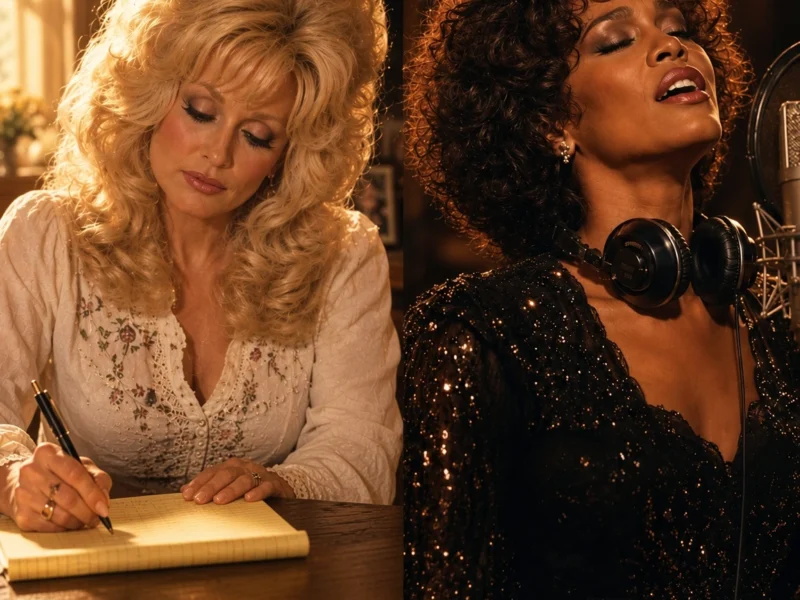
Whitney Houston PULLED OVER on a Freeway for Dolly Parton’s Song – She Never Forgot What It Cost.
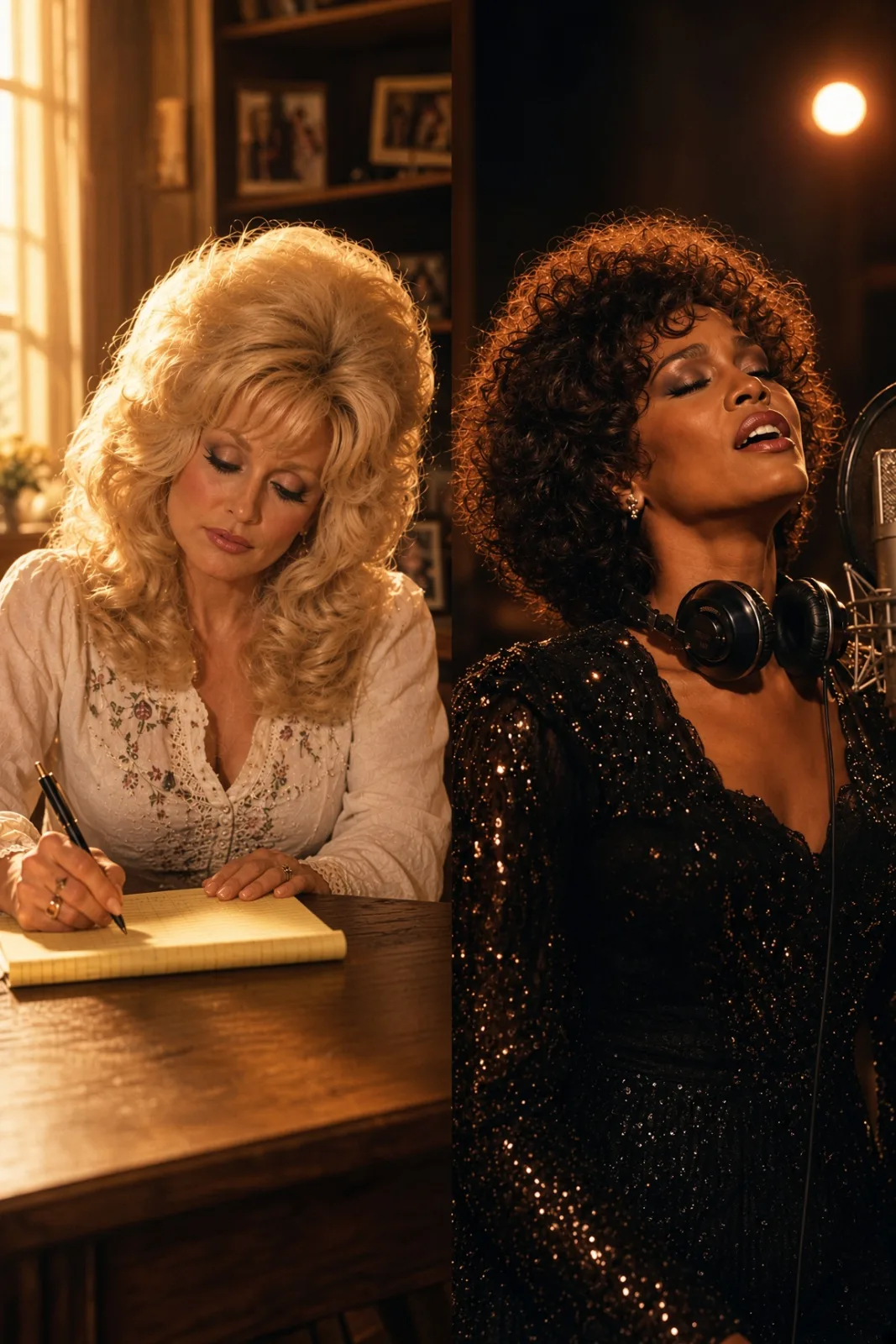
It was a Tuesday afternoon in the spring of 1991 and the Los Angeles Freeway was doing what Los Angeles Freeways do, holding still, mostly, in that particular way that makes you wonder why you thought you could get anywhere by car in the city where Whitney Houston was in the back of a black Mercedes.
Somewhere between a recording session in Burbank and an appointment she was already 40 minutes late for, going nowhere fast.
Watching the rooftops of the San Fernando Valley slide by above the concrete dividers.
Radio was on because it was always on.
Whitney moved through sound the way most people move through air, constantly, without noticing it until something made her notice it and then something made her notice it.
The opening piano notes came through the speakers in the way that certain melodies arrive.
Not building gradually but already fully themselves.
Already at their fullest weight from the very first measure.
A woman’s voice, warm, southern, recognizable to anyone who had spent any time at all paying attention to American music, began to sing.
If I should stay, I would only be in your way.
Whitney sat up.
She was 27 years old.
She had already won two Grammy Awards.
She had already sold more than 20 million albums.
She had a voice that critics had run out of superlatives for.
A voice that arrived at the back of a room before the rest of her did.
A voice that people described over and over as a gift, as something beyond training, beyond technique, as if the voice itself had chosen its host rather than the other way around.
And in the back of that Mercedes on a Los Angeles Freeway with nowhere to be for the next 40 minutes at minimum, Whitney Houston sat very still and listened to Dolly Parton sing.
She told the driver to pull over.
He found a gas station exit.
The car sat at the edge of the lot, engine idling, while the song played to its end.
Whitney didn’t say anything until the last note resolved and the DJ came back on.
Then she said, “Who wrote that?”
The driver didn’t know.
She found out that evening, and by the time she went to bed that night, she had already decided.
Dolly Parton wrote “I Will Always Love You” in the spring of 1973 in her office in Nashville in approximately 20 minutes.
She wrote it as a goodbye, not a goodbye to a lover, a goodbye to a man who had given her everything she thought she wanted, and then turned out to be something she couldn’t afford to keep.
To understand what the song meant, you have to understand where it came from.
And where it came from was a 7-year relationship that was, depending on who was telling the story, either the greatest professional partnership in country music history or the most expensive apprenticeship anyone had ever served.
Porter Wagoner was 51 years old in 1973, tall, extravagant, a country music institution with his own syndicated television variety show that reached 3 million homes a week, his rhinestone suits, his blonde pompadour, and his absolute conviction that what he had built was large enough to accommodate two stars, provided the second star understood that.
Accommodation was a one-way arrangement.
He had found Dolly when she was 21.
He had given her the television slot, the recordings, the national visibility, the machinery of a career that she had not yet had the means to build herself.
And she had taken everything he gave her and used it to become something that didn’t fit what he had to offer anymore.
By 1973, she knew she had to leave.
The knowledge had been building for a year through the arguments about material and money and the direction of her career.
Through the quiet accumulation of evidence that Porter saw her as an extension of what he had built rather than as a thing in her own right, she needed to go.
She had known it for a long time before she could bring herself to say it.
She wrote the song instead.
It was easier to say in a song what she couldn’t quite say in a room.
That was always how it worked for Dolly.
The things that were too complicated for conversation found their shape in a melody.
In a lyric, in the compressed and exact language of a three-minute piece of music that could hold what a conversation couldn’t.
She sat at her desk in Nashville on a spring morning.
She remembered the light coming through the window, the yellow legal pad, the specific quality of grief that arrives when you have decided to do something that cannot be undone.
The song came almost without effort.
That was the strange part.
She had been carrying the weight of what she needed to say for months, and then she sat down and it was there in 20 minutes, the melody, the lyric.
The perfect four-word phrase that contained the whole thing, “I will always love you.”
Not “I used to love you.”
Not “I once loved you.”
Always, even now, even as I walk out the door.
The specificity of it was what made it true.
She had tried to have this conversation directly in rooms face-to-face, and the words had always scattered.
But the song held them.
The song said the exact true thing and held it still long enough to be heard.
Those seven years had made her That was the truth that complicated everything.
Porter Wagoner’s television show had taken a 21-year-old from a Smoky Mountain hollow and put her in front of 3 million weekly viewers before she had a single album of her own.
His industry connections had opened doors.
His credibility had transferred to her before she had enough of her own.
She owed him something real.
She knew it and she didn’t deny it.
And she paid it back every way she could think of, in work, in loyalty, in the years of showing up and performing and being exactly what his show needed her to be.
But she had also, somewhere in those seven years, become more than his show could hold.
Not in ego, that wasn’t it, or not exactly.
More incapacity.
She was writing songs faster than she could record them.
Following musical instincts that were pulling her in directions Porter didn’t see and wouldn’t support.
Developing a creative vision that was going to require its own infrastructure to realize.
She was, in the specific language of the music industry, outgrowing the arrangement and the arrangement had no mechanism for that.
She brought the song to Porter and played it for him.
In the years that followed, the story of what happened in that room would be told in several different ways.
Porter’s version, Dolly’s version, the version that came out in the legal documents when he sued her for breaching her contract.
But every version includes the same detail.
He cried.
Whatever else the song was a farewell, an exit strategy, a piece of emotional precision that would eventually make her more money than almost anything else she had ever touched.
It was also genuine.
Whatever she felt for Porter Wagoner, whatever complicated gratitude and frustration and affection had built up over seven years of proximity, the song contained all of it.
He heard it and he knew it was true.
She released it in January of 1974 and it went to number one.
If you already know this story, or if you already love the part of American music history where one song travels from one extraordinary voice to another and become something neither of them could have made alone, go ahead and subscribe now.
Because the next part of this story is the part that most people don’t know and it changes what the song means.
In 1974, the same year Dolly’s version of the song was at number one, Elvis Presley’s people called.
Elvis wanted to record it.
This was not a surprising development.
Elvis at that point was still a significant commercial force, still capable of turning anything he touched into a hit.
And I will always love you was exactly the kind of ballad that suited the Vegas era, Elvis dramatic, emotionally unambiguous, built for a big voice to inhabit fully.
It would have been a substantial recording.
It would have been, by any ordinary measure, a career milestone for the songwriter.
The request came with a standard condition.
Colonel Tom Parker, Elvis’s manager, the man who had controlled every aspect of Elvis’s professional life for nearly 20 years, required that for any song Elvis recorded, his management company would receive 50% of the publishing rights.
This was not negotiable.
It was simply the way things worked in the world Parker had built around his client.
Dolly said no.
The people around her at the time were not uniformly supportive of this decision.
50% of the publishing rights on an Elvis Presley cover of your song was still 50% of something enormous.
The money alone would have set her up for years, and Elvis was Elvis.
The visibility, the association, the particular stamp that came from being chosen by that particular voice.
She said no anyway.
The story of how she said it has been told a few different ways over the years, but the essential fact is consistent across every version.
She was not angry about it.
She was not dramatic about it.
And she did not need very long to decide.
Colonel Parker’s 50% condition was a standard industry arrangement.
It was not unusual.
It was simply the price of having Elvis sing your song.
Plenty of writers paid it.
50% of something enormous was more than 100% of something small.
The calculus made a certain sense.
Dolly’s position was that she had not given half of the song to Porter Wagoner during seven years of professional dependency, and she was not going to give half of it to Colonel Tom Parker now.
The song was hers.
It had already begun building something, the number one record, the beginning of her solo identity, the first evidence that she could stand on own, half of it was not available.
That was the end of the discussion.
She said it in the way that Dolly Parton said things.
She had decided, quietly, firmly, without drama, and without reconsidering.
She had written the song.
The song was hers.
Half of it was not available.
That was the position, and the position was not going to change.
Because a famous name was attached to the offer.
Elvis did not record the song, the publishing rights remained entirely Dolly’s in the years that followed.
Dolly would occasionally be asked about the decision, and she always answered it the same way.
Not defensively, not with any sense of triumph or vindication, but matter of as if the logic were obvious.
The song was hers because she had made it from her own experience, and that origin was its value.
And to give away half the origin was to give away half the value.
She had watched what happened to writers who took the standard deal, who signed away percentages in exchange for visibility, who found out years later that the song they had built their career on was only half theirs in the most literal financial sense.
She had watched it happen to people she respected, and she had taken the lesson.
You keep what you make.
You fight for what you keep.
Everything else follows from that.
And 17 years later, that decision, that single quiet, immovable no would turn out to be one of the most consequential choices in the history of popular music.
In 1982, Dolly re-recorded I Will Always Love You for the film The Best Little Whorehouse in Texas, in which she starred alongside Burt Reynolds.
The new recording was more produced, more orchestrated, aimed at a wider audience than the stripped-down 1974 original, and it went to number one again, the only time in country music history that a song had reached number one twice in two separate decade-spanning recordings by the same artist.
Two number ones in two different decades.
The song was, by any standard, a proven object, a piece of music that had already demonstrated its capacity to reach people across different eras, different production styles, different contexts.
It was not a song that needed to prove anything else.
And then it proved one more thing.
The second number one had confirmed something that the industry had already suspected.
The song had an unusual kind of durability.
Most songs that reach number one do so once in a specific cultural moment and then age out.
They become period pieces, nostalgic rather than alive.
I will always love you had demonstrated, across those two separate chart runs in two separate decades, that it operated by different rules.
It wasn’t tied to an era.
It was tied to a feeling, and feelings don’t age.
Dolly knew this.
She treated the song with a particular kind of care.
Not protectively, exactly.
Not reluctant to have others record it, but deliberate about what she was willing to agree to.
Careful about the terms under which she allowed it to move.
She had learned the lesson of the Elvis refusal at some cost and kept it forever.
The thing you make is yours, and what you do with it defines what it becomes.
The song had already become two number ones and the defining statement of her early career.
She was not careless with what remained in 1991.
A producer named David Foster was working with director Mick Jackson and producer Kevin Costner on a film called The Bodyguard, a thriller about a Secret Service agent assigned to protect a pop star played by Whitney Houston, who’s making her acting debut.
The film needed a song.
It needed, specifically, the kind of song that could anchor a soundtrack.
The kind of song that played over an emotional scene and told the audience exactly what to feel and made them feel it anyway, even knowing they were being told.
Foster had a list.
He went through it.
He kept coming back to one title.
He brought I Will Always Love You to Whitney Houston.
Whitney already knew the song.
She knew it from the freeway.
From the moment the year before when she had made the driver pull over at a gas station exit and sat still in the back of a black Mercedes while Dolly Parton’s voice played through the speakers.
She had not forgotten it.
She had if anything been waiting for it.
She said yes immediately.
What happened in the recording session is by the accounts of the people who were in the room one of those experiences that studio engineers and producers sometimes describe when they are trying to explain why they do the work they do when they are trying to justify the hours and the frustration and the months of mediocre sessions by pointing to the moments when everything in a room shifts at once and something is created that none of them individually could have predicted.
Whitney started with the original melody.
She sang it straight the way that Dolly had written it and it was beautiful.
It was clearly and immediately beautiful in the way that a great voice singing a well-made song is always beautiful.
And then she stopped.
She said she wanted to try something and she built what came next on her own in the booth.
In real time that long a cappella opening before the first verse the gospel inflected re-reading of the melody.
The arrangement of the climax that would become one of the most recognizable moments in popular music.
When she came out of the booth the room was quiet for a moment in the way that rooms sometimes go quiet when something that was not expected to be extraordinary has turned out to be.
The production team made certain choices around Whitney’s interpretation.
The key was raised.
The arrangement was rebuilt from the ground up.
The song was given a new orchestral architecture that matched the scale of what Whitney was doing with the melody.
David Foster described it later as one of the most straightforward production experiences of his career by which he meant that Whitney knew exactly what she wanted to do with the song from the first take.
And the job of everyone else in the room was mostly to stay out of the way and document what was happening.
The 16-bar a cappella introduction, Whitney’s voice alone, unaccompanied, holding the opening line before anything else enters, was her idea.
She wanted the audience to hear the song before they heard the song.
To hear what the melody contained before the arrangement arrived to support it.
She called Dolly that evening.
The call was short.
Whitney was not a woman who needed a long time to say what she meant.
She told Dolly she had recorded the song.
She told her that she had tried to honor what was in it, the specific weight of a goodbye that was also a declaration of love, the particular courage of choosing to leave while still saying I will always love you.
She said, “I hope I did right by your song.”
Dolly, who had been in Nashville while all of this happened, who had not been in the studio, who had learned about the recording secondhand through her publisher and her manager, said, “Baby, from what I’m hearing, you did more than right.”
She was not prepared for what came next.
By November of 1992, Whitney Houston was not simply a recording artist.
She was a kind of proof, the ongoing demonstration of what the human voice could do when paired with the right material and the right production and an absolute refusal to hold anything back.
The music industry had spent the preceding decade watching her do things with her voice that producers and engineers described in terms that sounded like they were talking about a natural phenomenon, not learned, not practiced, simply occurring.
As if the music arrived through her rather than being made by her, The Bodyguard was her first film.
And the months before its release carried the particular anticipation of watching someone who had already exceeded expectations in one medium attempt to exceed them in another.
The song was going to be the thing everyone in the industry seemed to sense.
The film might succeed, or it might not, but the song that was already settled.
The Bodyguard opened in November of 1992.
The soundtrack was released simultaneously.
Whitney’s version of I Will Always Love You entered the Billboard Hot 100 at number one.
The first song to debut at that position since the chart had changed its methodology.
It stayed at number one for 14 weeks.
It became the best-selling physical single by a female artist in history.
The recording would go on to be certified four times platinum in the United States alone, and in the decades that followed, its total certified sales across formats would surpass 20 million copies worldwide.
Dolly heard it for the first time.
The final released version, the version the world would know, alone in her car, driving home from a studio session in Nashville.
On a Tuesday afternoon in the fall of 1992, she said later that she pulled over.
She sat in a parking lot off Music Row and listened to Whitney Houston sing her song, and when it was over, she sat there for a little while longer.
The publishing rights she had refused to give to Colonel Tom Parker’s management company in 1974 were still entirely hers.
Every performance of the song, every radio play, every film license, every download, every stream that would eventually come, all of it flowed back to the woman who had written it in 20 minutes in a Nashville office in 1973 because she needed to say goodbye to a man she loved and couldn’t keep.
Royalties from Whitney’s recording of I Will Always Love You would eventually total, by various published estimates, somewhere between 10 and 12 million dollars for Dolly Parton alone, she said later.
I always knew knew song was special.
I just didn’t know it was that special.
They met at the Grammy Awards the following February.
On the night that Whitney won Record of the Year and Song of the Year for the recording, the room was full.
The usual gathering of the industry’s most famous and most powerful.
The usual accumulation of expensive clothes and practiced expressions of either graciousness or disappointment.
Dolly found Whitney backstage after the performance.
She told her that hearing the recording had made her cry.
Not sad crying, the other kind.
The kind that comes from hearing something you may treat it with exactly the care you hoped it would receive.
“I cried writing it.” Dolly said, “Then we both got it right.”
They were not close friends in the way that Dolly was close friends with Kenny Rogers.
The sustained decades of proximity, the late-night phone calls, the tour buses, and benefit shows, and shared professional history.
Their friendship was the kind that exists between people who are linked by a single extraordinary shared object and understand each other through it.
The song was the thing between them.
The song was the language they spoke in the years that followed.
Whitney Houston’s voice would become the standard against which other singers were measured.
The benchmark, the peak, the thing people pointed to when they wanted to describe what the human voice was capable of at its absolute limit.
And I Will Always Love You was the song that everyone used as the measure.
Not because it was her only extraordinary recording, it was not, but because it combined the most extreme expression of her gift with a melody and a lyric that met her at full power.
The song could hold her because it had been built to hold exactly that kind of feeling.
In the winter of 1993, at the Grammy Awards ceremony, Whitney won three awards for I Will Always Love You and for The Bodyguard soundtrack, including Record of the Year.
Her performance of the song at the ceremony, the full live version, delivered to an auditorium of the music industry’s most famous and most critical ears, was the kind of performance that people in that room described for years afterward.
Not perfect in the technical sense of hitting every note in the precise way the record had.
Perfect in the more important sense, fully inhabited.
Completely given over to what the song required.
A performance that cost something dot Dolly watched it on television in Nashville.
She said later that she kept thinking about the Tuesday in 1973 when she sat at her desk and wrote the song out.
The particular quality of the grief she had been carrying about Porter.
The specific feeling of choosing to leave someone while still loving them.
The 20-minute miracle of the melody arriving fully formed.
She thought about all the places the song had been in the 20 years between that desk and that Grammy stage.
She thought about Colonel Parker’s offer and the quiet no she had given it.
She thought about what would have happened if she had said yes and what that arithmetic would have looked like now.
On February 11th, 2012 Whitney Houston died in a hotel room in Beverly Hills.
She was 48 years old.
The circumstances, the combination of heart disease and the effects of years of substance use were medically complex.
But the fact of her absence from the world arrived simply and heavily.
She was gone.
Dolly was in the middle of a recording session when she heard.
She stopped the session.
She went home.
She sat in her kitchen the way she sometimes did when news arrived that was too large to absorb standing up.
She said later I went numb.
And then I played the song, her version.
I sat there and played it and I thought about the first time I heard her sing it.
And I thought about what she gave it, what she added to it.
She made it bigger than I ever imagined it could be.
She recorded a tribute video in her living room in simple clothes without production.
She said I will always always love Whitney Houston.
It was not a performance.
It was the truest thing she knew how to say, Whitney Houston in the years after The Bodyguard would struggle with things that talent cannot protect against.
The substance use that had been a private concern became public knowledge.
Her voice, that extraordinary instrument that had seemed immune to the limitations that affected other voices, began to show the cost of years of damage.
She disappeared for stretches.
She came back.
She tried to reclaim what she had been at her peak and found that the distance between where she was and where she had been was sometimes very large and sometimes smaller than expected and always uncertain.
In 2009, she released I Look to You, her first album in 7 years.
And the voice was changed, different in texture and in range, carrying evidence of everything that had happened.
But still, underneath it all, still recognizably the most extraordinary natural instrument in popular music.
She and Dolly remained in each other’s orbit through all of it, not close.
Not in daily contact, but connected through the song that linked them, through the industry that had been the context of both their lives, through the particular mutual regard of two women who had each, in different ways and through different difficulties, held on to what they had built and refused to be diminished by what the world thought of them.
There is a question that gets asked sometimes by people who study the history of popular music about what it means when one song belongs to two people equally.
I Will Always Love You was written by Dolly Parton and recorded by Whitney Houston, and the recording is so total, so fully Whitney’s, so deeply inhabited by her specific voice and her specific interpretation that many people who hear it do not know that someone else wrote the words and the melody.
And yet those words and that melody are so completely and specifically Dolly’s, drawn from a specific moment in her specific life, containing a specific truth about how it feels to leave someone you love because staying has become impossible, but the song is equally unmistakably hers.
It belongs to both of them.
It belonged to both of them from the moment Whitney sang it.
Neither of them diminished the other.
What Whitney did to the song made it larger.
What Dolly built into the song made Whitney’s performance possible.
They needed each other.
Not personally, not in the way of a sustained friendship, but in the way that a melody and a voice need each other when they are perfectly matched.
Dolly carried Whitney with her for the rest of her life.
Not as a burden, but as a presence.
A fact about what music could do when the right song found the right person.
She talked about it in interviews.
She played Whitney’s version, sometimes in her car, still, years later.
She said once, in a radio interview in 2019, that she thought about Whitney every time she heard the song, which meant she thought about her most days.
She said she had learned something from what Whitney did with the melody.
Something about courage.
About the willingness to take a thing that someone else had built carefully and love it hard enough to make it yours, too, without erasing where it came from.
That kind of love required a particular confidence.
Whitney had it.
Dolly recognized it because she had it, too, in a different way, about different things.
They were both, in the end, women who had refused to be smaller than what they were.
She said it still made her feel the same thing it had made her feel in that Nashville parking lot in 1992.
A combination of disbelief and gratitude that was hard to put into ordinary words.
On August 25th, 2026, Dolly Parton died at the age of 80.
In the hours that followed, radio stations all over the world did what they always do when a beloved artist dies.
They played her songs.
They played Jolene and Coat of Many Colors and 9 to 5 Inches and the gentle country ballads from her earliest years.
And then, after a while, they played I will always love you.
Not Dolly’s version, but Whitney’s, because they could not separate the two.
Because the song by then belonged to both of them equally, permanently.
In the way that certain great collaborations across time become indivisible from both the people involved, both women gone now, the song still playing.
What Dolly Parton understood from the moment she sat in a Nashville office in 1973 and wrote a goodbye that was also a love song, is that the things we make from our most honest feelings outlast us.
That a song written in 20 minutes out of grief and necessity can travel further than any amount of planning could have taken it.
That refusing to give away half of something you made, even when a famous name and a large sum of money are on the other side of the refusal, is sometimes the most important decision a person can make.
She kept the song.
The song found Whitney.
Whitney made it immortal.
And somewhere on a Los Angeles freeway on a Tuesday afternoon in the spring of 1991, a young woman with the greatest voice of her generation sat in the back of a black Mercedes and told the driver to pull over.
And everything that followed from that moment, the recording, the number ones, the Grammys, the millions of copies, the decades of radio play that haven’t stopped yet, began.









