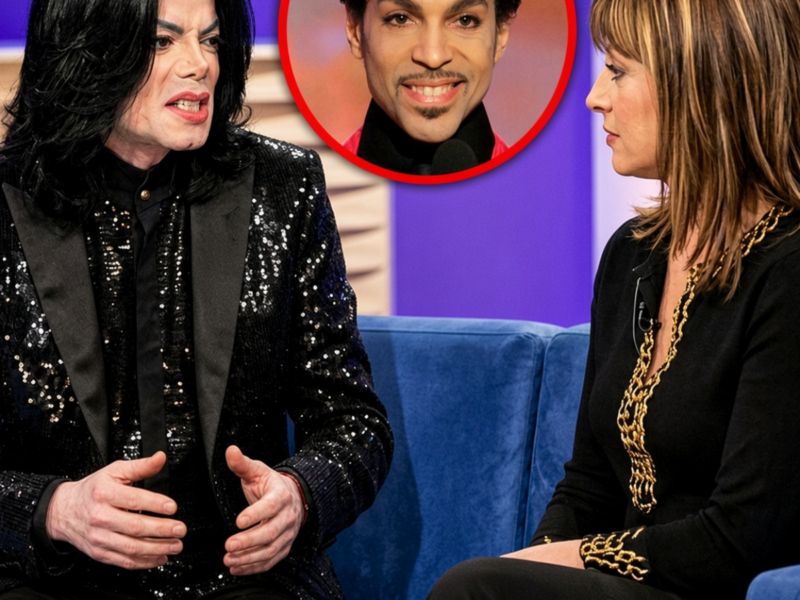
When Michael Jackson ROASTED Prince On LIVE TV.
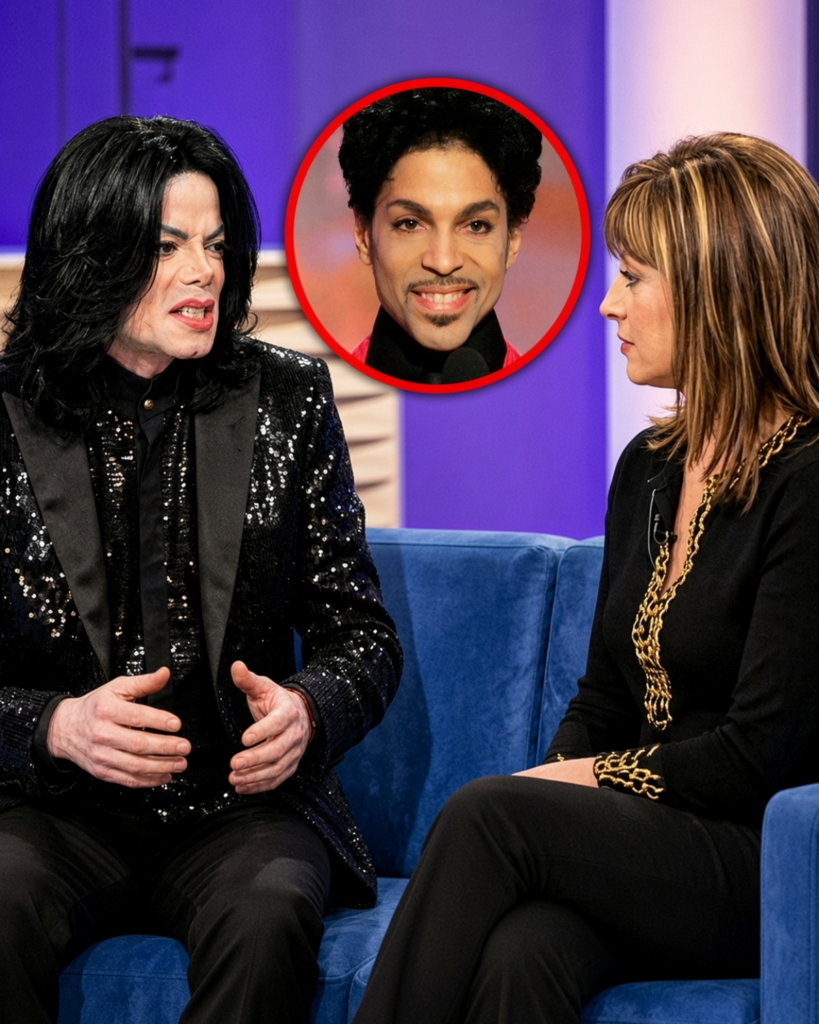
# When Michael Jackson ROASTED Prince On LIVE TV
“I’ll be rocking with Prince like around 12:30.”
“Oh, I can’t go to that.”
“I’m like, ‘Why?'”
“Prince is a meanie.”
“I’m like, ‘What?'”
“I’m like, ‘Did you say meanie?'”
“He’s a—he’s a meanie.”
“I’m like, ‘No, no, no, no, no. He’s—he’s really nice, Mike.'”
“He was like, ‘No, you don’t understand.'”
Michael Jackson absolutely roasted Prince, and he reportedly did it right on live television.
Known for being quiet and reserved, Michael rarely showed this side of his personality.
But when Prince came up during the conversation, Michael had a few things to say, and they were far more savage than anyone expected.
For years, the two icons were seen as fierce rivals, with their competition becoming one of the most fascinating stories in music history.
But on this occasion, Michael Jackson delivered a roast that left everyone watching, wondering just how serious that rivalry really was.
And his comment about artists not attacking one another seemed to send a clear message about Prince’s past jabs at him.
“I’ve been an artist, um, uh, most of my life doing what I do, and I—I’ve never attacked another fellow artist. Great artists don’t do that, you know. You know, you don’t have to do that.”
It all started when James Brown was in the middle of his performance at the Beverly Theater in Los Angeles when he noticed a very special guest watching from the audience.
Michael Jackson, already at the height of his “Thriller” fame, had caught Brown’s attention.
Rather than allowing the show to continue normally, Brown called him onto the stage.
“Let’s give another standing ovation for a young man sitting behind you that you have no idea who’s in—Michael Jackson. No, Michael Jackson. Michael Jackson, you got to come up and say something. You got to come up and say something. Michael, come on up. Come up and say something. Got to come up and say something.”
Jackson responded by turning the unexpected invitation into a spectacular moment.
He showcased his famous moonwalk, sang for the audience, and blended his own style with some of James Brown’s classic dance movements.
It was a tribute that brought two generations of performers together.
However, Michael’s appearance was only the beginning of what became an unforgettable incident.
While the audience was still reacting to his performance, Jackson reportedly spoke privately to James Brown.
Moments later, Brown announced that Michael wanted Prince to come onto the stage as well.
“So, give him a big round of applause, because he just insisted that I introduce Prince. He’s here. Prince.”
Prince, who had been watching from the crowd, suddenly found himself facing an unexpected performance opportunity without the preparation he might normally have had.
“All right, you got to do something.”
After joining the musicians, Prince picked up a guitar belonging to Brown’s band and attempted to make his mark.
Unfortunately, the performance didn’t create the impact many might have expected from a star of his reputation.
His guitar attempt and movements failed to produce the kind of memorable reaction he may have wanted.
The situation took an even more unexpected turn when Prince moved away from the stage.
He reached for a decorative structure, apparently mistaking it for something sturdy, only for the prop to collapse beneath his grip.
The fall sent him into the audience, creating one of the night’s most talked-about moments.
Over time, fans have debated whether Jackson’s private request was simply spontaneous or whether he knowingly placed Prince in an uncomfortable situation.
There is no confirmed evidence establishing that Michael intended to sabotage him, but the timing of the invitation continues to fuel speculation surrounding this legendary encounter.
The story of Michael Jackson and Prince takes another interesting turn when Prince was asked about the collaboration that never happened.
During an interview with Chris Rock, Prince explained why he ultimately rejected Michael’s invitation to appear on “Bad.”
His reasoning had less to do with practical problems and more with the way he viewed the song itself.
The idea behind the track did not appeal to him, and he was not willing to step into a musical situation that he felt did not suit him.
“There was never like any rivalry between you and Mr. Jackson. Um, not to me. No.”
“That’s okay. I love the story of you—is the story of you turning down ‘Bad.'”
“Well, you know that Wesley Snipes character? That would have been me.”
“Now, now you run that video in your mind.”
What makes the story interesting is how differently the two artists approached the possibility of working together.
Michael was looking at the bigger picture.
A joint performance between two of the most recognizable figures in music could have created an enormous cultural moment.
But Prince did not seem interested in the size of the opportunity.
If something did not fit his artistic instincts, he was prepared to walk away from it, regardless of how much attention the collaboration might have generated.
“The first line of that song is, ‘Your butt is mine.’ I said, ‘Who going to sing that to whom?’ ‘Cause you sure ain’t singing it to me, and I sure ain’t singing it to you. So right there we got, you know, right there we got a problem.”
That attitude was a major part of Prince’s public image.
He had a reputation for doing things on his own terms, and the possibility of sharing a song with Michael Jackson was apparently not enough to make him change his position.
Instead of accepting an opportunity simply because it involved another global superstar, Prince chose not to participate when the concept failed to convince him.
“So weird. Now you were made out to be this weird cat, and he was like Mr. Disney, like a married man.”
“Well, you know, play—you know, there again, you know, hopefully the press will get to the point where we’ll just all just—it’ll be a law where you have to tell the truth, and won’t be about speculation.”
The “Bad” collaboration also became another example of the complicated relationship between these two icons.
They clearly existed in the same extraordinary musical world, yet their approaches were very different.
Michael often embraced massive pop spectacles and collaborations, while Prince was intensely protective of his own creative direction.
Add their competitive streaks and distinct personalities to the equation, and it becomes easier to understand why bringing them together proved so difficult.
Had Prince accepted the invitation, “Bad” could have featured one of the most talked-about pairings in pop history.
Instead, the two remained separate on the record, leaving fans to wonder what that legendary collaboration might have sounded like.
“I—you know, I’m a musician. I—I live for that. I live for playing and—and—and creating songs.”
Years after the “Bad” project became part of Michael Jackson and Prince’s complicated history, Wesley Snipes gave audiences another version of how things may have unfolded.
During an appearance on “Conan,” Snipes recalled that he had not originally been the obvious choice for the role opposite Jackson.
“Michael Jackson when he met you—’cause you’re playing a gang member. He thought that you were in a gang.”
“Is that right?”
“He really thought you were in a gang.”
“Unfortunately, he did, sir.”
“Yeah.”
“Yes. He really thought I was in the gang. He didn’t know that I was a trained espion—”
“That’s interesting. Were you in a car—I mean, what made Michael Jackson—”
“Michael Jackson, I think at the time, the great Michael, he hadn’t spent very much time in the hood.”
“Yeah.”
“So, you know, he was a little—it was a little strange to him to be back in the hood again. He—I guess he thought everybody was from the hood.”
According to his recollection, Prince had been in the picture before Snipes came along.
But after Michael met Snipes and saw what he could bring to the character, the part eventually went to the actor who would later become famous worldwide as the star of “Blade.”
“So he probably, if you could have been dressed like this, he would have thought, ‘Oh, he’s in a gang.’ You know what I mean? He just didn’t know.”
“I’d been in a video of his, right?”
“Yeah. That been—that would have been fun, too.”
“Have you gone back and looked at that video recently?”
“And interestingly enough, just the other day I was, uh, someplace in some part of Santa Monica there. And just so happens that a young man comes up to me and he asked, he says, ‘You know, Dr. Snipes—can we—Mr. Snipes, can we take a picture?’ And it turns out it was Prince Michael Jackson.”
“Oh, wow. His son.”
“Oh, you’re kidding.”
“Yeah.”
That account adds another layer to the mystery surrounding the project, because it does not completely line up with the explanation Prince later gave about his absence.
Prince suggested that his decision was connected to the concept and the way the collaboration would have worked, while Snipes’ recollection places more emphasis on the casting process itself.
Because the stories come from different perspectives, it is difficult to establish that every part of the sequence happened exactly as remembered.
Still, the contrast between the accounts makes the story even more intriguing.
One possibility is that Prince was considered for the role but ultimately did not become part of the finished production.
Another is that the project simply never developed into the collaboration Michael had originally imagined.
Whatever happened behind the scenes, Snipes eventually stepped into the role and shared the screen with Jackson.
“Me and Prince were auditioning together, and I—I blew Prince out of the water.”
“Yeah. Yeah. Yeah.”
“For that role in ‘Bad.’ Prince actually—Michael had told Prince that he had the role, and then he met me.”
“Is that true?”
“This is a true story.”
For Snipes, the opportunity became an important early chapter in a career that would eventually make him an international movie star.
For Jackson and Prince, however, it became another example of how close the two icons could come to working together without actually making it happen.
At the time, both men were operating at an extraordinary level of fame, so even the possibility of seeing them together generated enormous interest.
Yet instead of producing the legendary Michael Jackson-Prince moment fans imagined, “Bad” moved forward with Wesley Snipes in the role, and that left the proposed partnership between Jackson and Prince as one of those fascinating music industry possibilities that remained unrealized.
“This is a true story, and Prince actually was considered the lead character in the ‘Bad’ video.”
“Right?”
“And, uh, Michael met me and then kicked Prince to the curb.”
Will had a rare perspective when it came to Michael Jackson and Prince, because he personally knew and interacted with both music legends.
Instead of hearing stories about their relationship from someone else, he experienced one particularly unforgettable night involving both of them firsthand.
At the time, Will was in Las Vegas working with Michael Jackson when he received an opportunity to perform alongside Prince.
Naturally, Will thought it would be exciting to bring Michael along and let him see the performance.
“He’s in Vegas. He’s like, ‘I heard you guys have a show tonight.’ I’m like, ‘Yeah, we got a show going on at 10.’ ‘Oh, rats. You know, I’m gonna be sick. I gotta put the kids to sleep.’ I’m like, ‘Yeah, but we—’ ‘You—if you come later, like in the middle of the show—now if I don’t see the show from the beginning, it’s no way for me to know what’s actually going on.’ I was like, ‘Okay, so why don’t you come?’ ‘I’ll be rocking with Prince like around 12:30.’ ‘Oh, I can’t go to that.'”
But when he mentioned the idea to Michael, Jackson did not seem exactly enthusiastic.
Michael reportedly hesitated and jokingly referred to Prince as a meanie, explaining that the two of them had always seemed to clash.
“You know, he’s really nice, man. I—No, you don’t understand, Will. One time he tried to run me and my mama over with a car.”
“Oh, damn.”
“I’m like, ‘Wait, what?’ He was like, ‘Yeah, I’m telling you, they always used to always put me against him.’ I’m like, ‘Listen, it’s different now. Why don’t you just—he—he’ll be really happy to see—’ ‘Are you sure?’ I’m like, ‘Yeah, let me call—I’m going to call you back. I’m going to call Ruth.’ I’m like, ‘Yo, Ruth.'”
Even with Michael’s hesitation, Will managed to persuade him to attend the show.
Jackson eventually agreed to come and watch from the VIP area, where he was joined by actor and comedian Chris Tucker.
“You see CeeLo—he—they’ll vouch for you on this. Okay.”
“CeeLo Green.”
“Yeah.”
“Okay. Good.”
“So, I’m like, ‘Mike, everything’s straight. We—we—they’re going to put you in a section. It’s going to be awesome.'”
From the outside, it might have looked like a simple celebrity appearance, with two enormous stars from completely different musical worlds sharing the same room.
But considering the complicated history and constant comparisons surrounding Michael and Prince, having them in the same place already made the night feel unusual.
Will was now performing for Prince, while Michael Jackson was sitting nearby, watching everything unfold.
“Run to the thing. Ruth’s like, ‘You—you got to go on now.’ Gives me the mic. I’m like, ‘Yo, Mike.’ So he’s like, ‘Okay, I’ll be—I’ll be watching you.’ And at this time, I’ve already been working with Mike from 2005, 2006, and he came to see me rap at Prince 2007. I go on stage, I do my freestyle, da da da da. I come off stage, I go sit where Mike—where Prince has Mike’s, uh, situated.”
After Will finished his guest freestyle on stage, he made his way back toward the VIP section to join Michael and Chris Tucker.
However, when Will sat down, something unexpected happened.
Michael had apparently leaned toward Ruth, one of Prince’s assistants, and quietly said something to her.
Ruth then turned to Will with a question that immediately caught him off guard.
She wanted to know why Will had not acknowledged Michael while he was performing on stage.
“Chris Tucker here, Ruth, Michael Jackson’s, uh, manager—manager’s here, and then Mike there.”
“Okay.”
“So Mike whispers in Ruth’s ear.”
“Ruth then talks to me and says, ‘Mike wants to know, why didn’t you acknowledge Mike while you were on stage?’ ‘Hey, Mike. Hey, tell him that this isn’t my stage, and I can’t disrespect Prince on Prince’s stage, so it’s no disrespect. It’s just that it’s not my stage.'”
“I’m like, ‘I’m sorry, bro. Sorry.'”
It was a bizarre little moment, because Michael had come to support Will.
Yet somehow, the attention had shifted toward whether Will had properly recognized him during the performance.
And that was only the beginning of what became an incredibly strange encounter between Michael Jackson and Prince.
“And Ruth’s ear. Ruth didn’t tell—talk to me. ‘Mike wants to know how come Prince hasn’t acknowledged him on stage.’ I’m like, ‘Oh—'”
“Why is she asking you that, though?”
“So, I’m like, ‘Oh—'”
“Like blessing Crips, huh?”
“I’m like, ‘Yo, Mike.'”
“So, Prince is still on stage while this is all happening. He’s playing. I’m like, ‘Oh, no. I think because he has you in the VIP section, he’s not trying to blow you a cover.'”
During the show, Prince eventually left the stage and walked directly toward where Michael was sitting.
Instead of simply greeting him or stopping for a conversation, Prince reportedly brought his bass guitar right up toward Michael’s face and played or slapped it aggressively in front of him.
“And he’s like, ‘Oh, no. It’s okay. It’s okay. It was okay.’ And so, as that conversation dies down, Prince then comes in front of us, walks through the crowd—”
“After his performance.”
“No, while he’s performing.”
“While he performing—plays the bass, aims the bass at Mike’s face. Uh—”
“Yo, you going—”
For anyone watching from the VIP area, it must have been an unforgettable sight.
“It’s like—right, this dude like flicks his hair like—and walks off. And then Mike’s like, ‘Okay.’ So then five minutes later, he’s like, ‘I got to go. I meet me at my house for breakfast.’ And so I’m like, ‘All right.’ So he leaves for breakfast.”
The following morning, Michael still seemed puzzled by what had happened.
He brought up the bass incident again and asked Will why Prince had kept playing the instrument directly in his face.
“He leaves to his house. I’m like, ‘What time?’ He’s like, ‘Like 7:00 in the morning.’ I’m like, ‘All right, cool.’ So, he leaves. I go to his house for breakfast, knock on the door. Soon as I open up the door, he’s like, ‘Why the prince play the bass in my face?’ I was like, ‘Oh, no. I just think he was just trying to respect.’ ‘No, you don’t get it. He’s a meanie. He’s a meanie. One time, like I told you, he tried to run me and my mama over with a car.'”
Will apparently interpreted Prince’s behavior differently and suggested that Prince was simply trying to be friendly in his own unusual way.
Michael, however, was not buying that explanation.
According to Will’s recollection, Jackson remained convinced that Prince had always been a meanie.
The story captures the very different personalities of the two artists.
Michael seemed to interpret the encounter through the history between them, while Will saw it as Prince simply expressing himself in a characteristically unconventional manner.
But this unusual encounter becomes even more interesting when you look at how close Michael Jackson and Prince once came to working together professionally.
Tavis Smiley, who has spoken extensively about his longtime friendship with Prince, has shared an account of the two artists potentially collaborating on music.
According to Smiley, Quincy Jones, the legendary producer responsible for Michael Jackson’s “Thriller” and “Bad,” wanted to bring the pair together for a major collaboration.
His idea was for Prince to contribute to the title track of “Bad,” which would have placed two of the biggest names in music on the same record.
But apparently, getting them into the same room was already a challenge.
Neither Michael nor Prince wanted to make the first move.
According to Smiley’s recollection, the two kept contacting Quincy before the meeting.
But instead of asking about the project itself, they were both focused on one thing — whether the other superstar had arrived yet.
“And so Quincy invited Michael and Prince to his house one night to get together to talk about doing this song together. Uh, and, uh, the phone rings, and it’s Michael on the phone, and Michael says to Q, ‘Uh, Quincy, is Prince there yet?’ And, uh, uh, Q says, ‘Uh, no, Michael, he’s not here yet.’ Okay. Michael hangs up. Phone rings a few minutes later. It’s Prince. Uh, Prince says, ‘Uh, Q, it’s—it’s Prince. Is Michael there yet?’ And, uh, he says, ‘No, Michael ain’t here yet.’ Prince hangs up.”
The situation reportedly became a strange waiting game.
Michael did not want to show up and discover that Prince was still absent, and Prince apparently felt the same way about Michael.
Each wanted confirmation of the other’s presence before walking through the door, meaning the meeting could not even properly begin without one of them taking that first step.
It is an almost comical detail, especially considering who these two people were.
These were not unknown musicians nervous about meeting another artist.
They were two of the most recognizable performers on the planet, both accustomed to commanding enormous stages and millions of fans.
Yet when it came to being in the same room with each other, the dynamic seemed completely different.
“See, if Michael is there first, nobody wants to sit and wait on the other. And both of them are in their limousines driving past each other in the neighborhood, but nobody wants to be the first one waiting on the other. And finally, Michael—uh, Q says to Michael, ‘Michael, stop this, man. Come to the house. Let’s get this conversation started.’ So Michael pulls up. And then two seconds later, here comes Prince, and they’re going to have dinner. And before dinner, uh, Prince says, ‘Before we sit for dinner, I just want to ask a question. I got the lyric sheet. I want to ask a question.'”
Smiley’s story does not prove exactly what either man was thinking, but it does show how much tension surrounded their relationship.
Quincy Jones could arrange the meeting, but he could not force either superstar to walk through the door first, and that hesitation says a lot about just how unusual the Jackson-Prince dynamic had become.
The idea alone was extraordinary.
Michael Jackson and Prince were constantly compared because they represented two very different sides of musical brilliance.
Michael was known for his precision, choreography, massive pop productions, and extraordinary stage performances, while Prince was celebrated for his musicianship, songwriting, versatility, and unpredictable creativity.
Bringing those styles together could have created something completely unique.
According to Smiley’s account, the possibility became serious enough for a meeting to be arranged at Michael’s private estate.
For a brief moment, it appeared that the long-discussed collaboration might finally become reality.
Yet despite Quincy Jones pushing for the pairing, the project never materialized.
“Whose line right here is this? Who—whose line is this?” And the line he points to is the line in the mic track that says, ‘Your butt is mine.'”
“Prince wants to know whose line is this in the song. And Q and Michael look at each other, and Q says, ‘Uh, that’s Michael’s line.’ And Prince said, ‘Okay, thank you very much.’ Walked out the house, and that was it. It never happened.”









