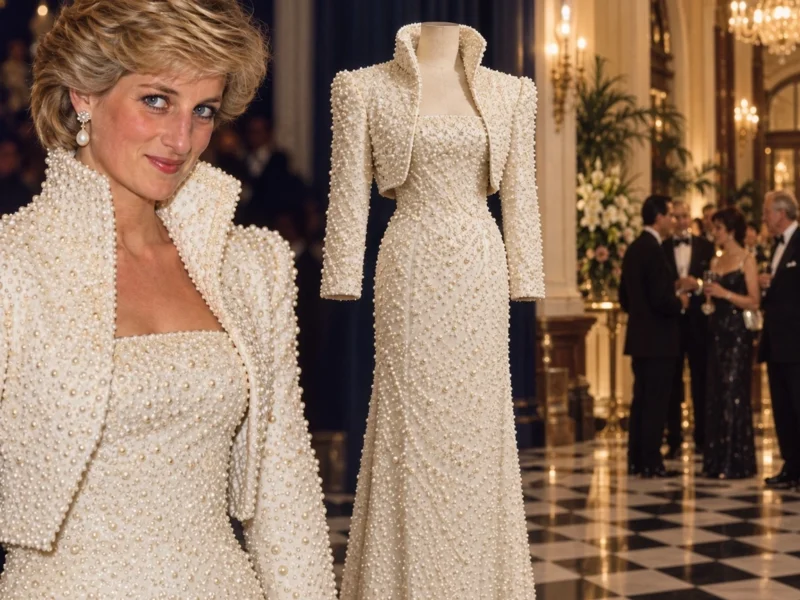
Whatever Happened to Diana’s Elvis Dress? The Pearl-Covered Gown Every Royal Fan Still Remembers.
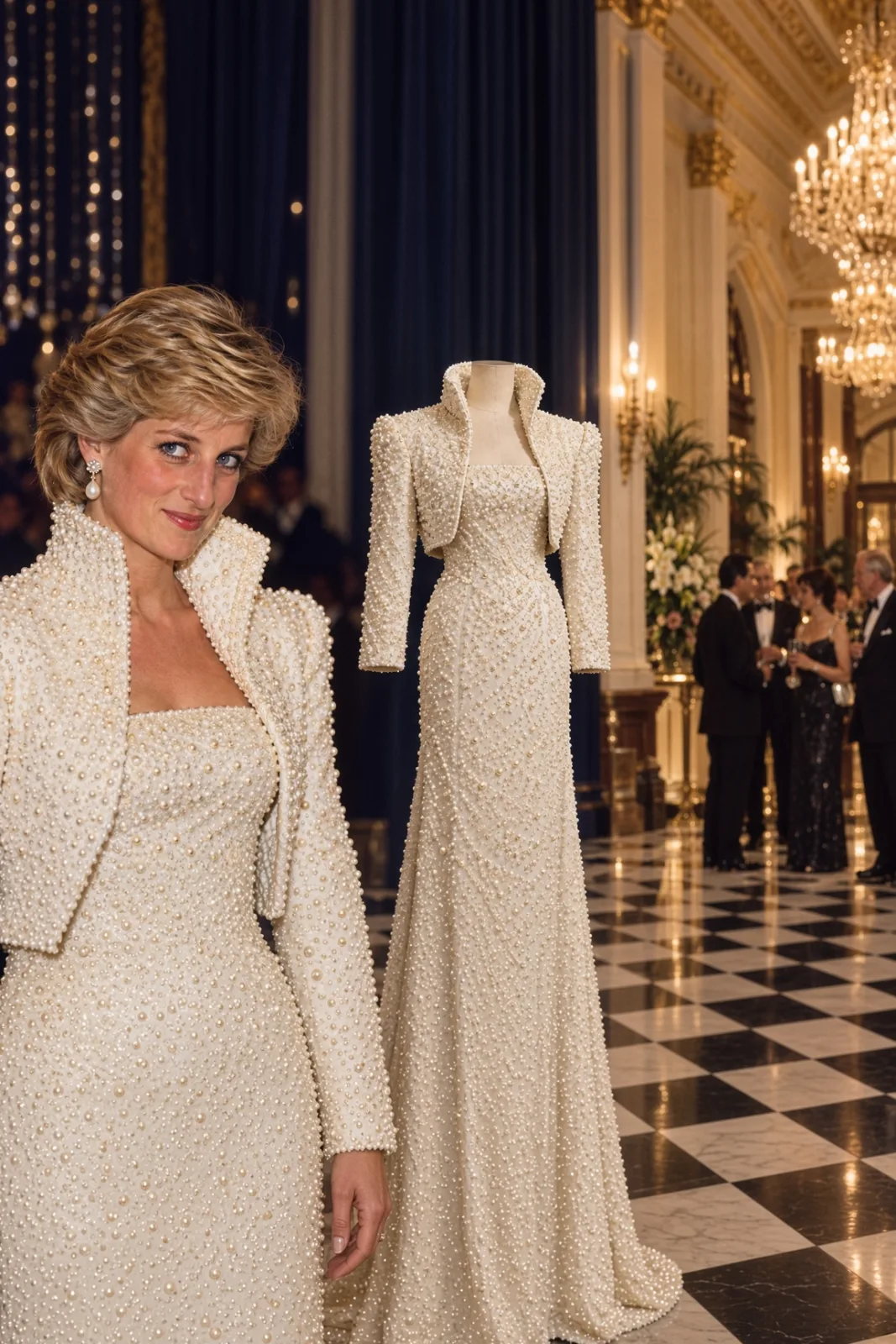
In a storehouse in East London, a white evening ensemble is listed under a catalog number T112006.
Two parts, one dress, one jacket.
Its status reads reserved.
Unavailable to book.
On the night of November 8th, 1989, that same jacket stood in the glare of camera flashes in Hong Kong.
Its stand-up collar framed the most photographed face of the decade.
Eight years later, in a New York sales room, it sold for $150,000.
Then it was copied, shrunk to doll size, mailed into American living rooms.
Its buyer spent six years fighting a lawsuit in California over who could profit from the woman who once wore it.
And in 2006, the buyer gave the original away.
The princess called it her Elvis dress.
The woman who designed it had been thinking of a queen who died in 1603.
But the real story of the Elvis dress is not the price, the dolls, or the courtroom.
It is the story of the hands that sewed tens of thousands of pearls onto white silk the night it shone above Victoria Harbor and everything that happened when the cameras turned away.
Every week, we follow the most famous garments in royal history from the day the world first saw them to wherever they ended up.
If you want to keep following them with us, give this video a like and subscribe to the channel so the next story finds you.
The story begins in London in 1989.
In the autumn of 1989, the city of Hong Kong was building a stage for itself.
On the Kowloon waterfront at Tsim Sha Tsui, where the old Kowloon railway station had once stood, workers had spent 3 years raising a long, curving complex faced in pink tile.
It held a concert hall with 2,119 seats, a grand theater, a studio theater, and a pipe organ built by the Austrian firm Rieger Orgelbau.
Installing the organ alone took from August into November.
Its 8,000 pipes had to be fitted section by section.
The building carried a name that sounded almost modest for its size, the Hong Kong Cultural Centre.
Its opening night was set for November 8th, 1989.
For that night, Hong Kong wanted guests who would bring the world’s cameras with them.
Hong Kong in 1989 was a British dependent territory run from Government House by a governor appointed in London.
Five years earlier, Britain and China had signed an agreement fixing the date when sovereignty would pass to China, July 1st, 1997.
Everyone in the city knew that date.
The territory was one of the busiest ports and financial centers in Asia, home to nearly 6 million people, and it had carried the same nickname for generations.
People called it the Pearl of the Orient.
The governor, Sir David Wilson, invited the Prince and Princess of Wales to open the new center.
They would arrive on November 8th for a three-day official visit.
That evening, they would unveil a commemorative plaque, declare the building open, and attend a dinner and concert as guests of honor.
The world those cameras came from was changing fast.
In the same week, crowds were gathering along the Berlin Wall.
On the night of November 9th, its checkpoints would open.
Within days, newspapers in London and New York would print photographs from Hong Kong on one page and photographs from Berlin on the next.
At the center of the visit was a woman whose clothes had become news in their own right.
Diana, Princess of Wales, was 28 years old.
She had married the Prince of Wales at St. Paul’s Cathedral on July 29th, 1981, before a worldwide television audience estimated at 750 million.
In the eight years since, she had become the most photographed woman on Earth.
American magazines put her on their covers again and again.
Fashion pages in New York, Chicago, and Los Angeles tracked her hemlines, her hats, and her haircuts.
One outfit could set off a wave of copies within weeks.
By the end of the decade, her style had changed.
The ruffles, the high lace collars, and the puff sleeves of her first years as a princess had given way to cleaner lines.
She now favored streamlined, well-cut clothes that relied on fabric and texture rather than ornament piled on ornament.
Curators would later describe her as unusually skilled at using clothing to communicate.
An official visit abroad was one of the clearest places to do it.
Royal wardrobes for overseas tours were planned months ahead.
Colors were chosen to honor a host country’s flag.
Embroidery could carry a national emblem.
An evening gown could become a quiet compliment, and photographers would carry that compliment to every newspaper in the region.
For Hong Kong, the compliment was already written into the city’s name.
To make it, the princess turned to a designer who had never trained as a dressmaker.
Catherine Walker was born in northern France in 1945 and studied philosophy at university before settling in London.
She had no formal training in fashion.
She taught herself starting with children’s clothes, and in 1977, she opened a small business on Sydney Street in Chelsea called the Chelsea Design Company.
Her first work for Diana came in 1981 when the new princess needed maternity clothes during her first pregnancy.
The partnership lasted for the rest of Diana’s life.
By some accounts, Walker made around a thousand pieces for her over 16 years.
Day suits for hospital visits, coats for airport arrivals, gowns for state banquets.
Walker worked as a couturier, a designer who makes clothing to order largely by hand for one client at a time, fitted directly to her body over a series of appointments.
Nothing she made for the princess came off a rack.
Each piece began as a sketch, became a toile, a test version cut from plain cotton to check the fit, and only then was cut from the real fabric for one woman.
She was also discreet.
Walker rarely spoke publicly about her most famous client.
Her own account of their work together did not appear until 1998 in an autobiography published in New York.
In 1989, the Hong Kong commission came with conditions.
The first was the occasion.
This was an official evening, and the gown would be photographed from every angle.
Arriving at the door, standing for the anthem, unveiling the plaque, sitting in a concert hall under bright lights.
It had to read clearly from across the room and hold up under a long lens.
The second was the jewelry.
For formal evenings, the princess often wore a tiara the Queen had given her as a wedding present.
The Lovers’ Knot tiara, made by Garrard for Queen Mary just before the First World War, it is a row of diamond arches with 19 pearls hanging inside them.
Accounts of the commission say the embroidery was planned to complement it.
Whatever covered the dress had to sit beneath those 19 pearls without competing with them.
The third was the message.
A gown made for Hong Kong would be read as a gesture to Hong Kong.
Walker’s answer was the pearl, which she treated as a symbol of the Orient, the same word in the city’s oldest nickname.
The dress would not carry a flag or an emblem.
It would carry a material.
The fourth was the calendar.
The record does not give the day the order was placed.
It does show that the real deadline came earlier than November.
The ensemble had to be finished in time to be worn in London in October, weeks before the princess boarded a plane for Asia.
That left the question of what a princess’s evening gown was supposed to look like.
For most of the decade, the public picture of a royal gown had been fixed in 1981.
Billowing taffeta, sleeves like clouds, a skirt that filled a doorway.
That romantic silhouette echoed through Diana’s early evening wear and through thousands of American prom and bridesmaid dresses that copied it.
Grandeur meant volume.
Volume meant fabric.
Walker went in the opposite direction.
She designed a strapless column, a narrow sheath that falls straight from the bust to the ankle, with no flare and no petticoat.
A long split at the back would let the wearer walk.
Over it went a short bolero jacket, cropped above the waist with the sleeves to the elbow, and a collar that rose straight up behind the neck.
For that collar, the designer looked back four centuries to the stiff white ruffs worn at the court of Elizabeth I.
There would be no volume at all.
Every bit of the drama would come from the surface, and every inch of that surface was to be covered.
Hardly anyone who saw it would think of Elizabeth.
They would think of someone else entirely.
The fabric came first.
Walker chose silk crepe, a silk woven from tightly twisted yarns that give it a fine pebbled texture and a soft matte finish.
Crepe does not shine on its own.
It drapes.
It falls close to the body and moves when the body moves.
For a column dress, that was the point.
A stiffer silk would have stood away from the figure.
Crepe would follow it from the bust to the ankle in one unbroken line.
Then came the material that would give the ensemble its name before anyone thought of a nickname.
Pearls.
The museum record describes them as oyster pearls.
By one account, the 1997 auction catalog listed them as simulated pearls, and the sources have never fully settled the question.
What is documented is how many there were.
The museum that holds the dress says tens of thousands.
Fashion writers have put the figure at roughly 20,000 and by another count close to 28,600.
Everyone was sewn on by hand.
Between the pearls went sequins, small discs of reflective material, each pierced at the center so it can be stitched flat to cloth.
The two materials did different jobs.
Pearls absorb light and return it slowly as a soft glow.
Sequins throw it back in a flash.
Together they would give the white silk what the museum’s gallery label later called a soft, luminous sheen.
And under a photographer’s flash, a sparkle that carried across a room.
Walker had used embroidery as a diplomatic language before.
For an official visit to Saudi Arabia in 1986, she had made the princess a cream silk gown with gold falcons worked across the bodice.
The falcon being an emblem of the Gulf.
In 1989, the idea was the same.
The method was different.
Instead of a picture stitched onto the silk, the entire surface would become the message.
The cut was as plain as the surface was rich.
The dress was strapless, a single narrow column with an ankle-length skirt.
A long slit at the back allowed a normal walking stride.
Without it, the princess could have taken only short steps.
Seen from the front, the line was unbroken.
Standing on its own on a mannequin, observers would later note, the dress seemed to be about 6 feet tall.
The jacket carried the drama.
It was a bolero, a short open jacket that ends above the waist, borrowed from Spanish dress and long used in evening wear to cover the shoulders without hiding the gown underneath.
Walker cut it with elbow-length sleeves and set a stand-up collar at the back of the neck, stiffened so that it rose straight and held its shape.
It framed the face from behind.
It did not touch the chin.
The embroidery followed the architecture.
The pearls and sequins were not spread evenly.
They gathered more densely along the edges, at the hem of the skirt, around the borders of the jacket, and along the line of the collar.
The thickest work outlined the shape of the garment, so that from a distance the edges seemed to glow brighter than the center.
That kind of work could not be done after the dress was sewn together.
In couture beading, the embroidery is usually worked on the flat pieces of fabric before they are cut and assembled.
The silk is stretched tight on a wooden frame.
The outline of each pattern piece is marked, and the beads are stitched inside those lines.
The embroiderers stopped just short of the seams.
Only then is the garment put together.
One misjudged line meant unpicking hundreds of stitches.
Walker did not do this work herself.
For it, she sent the silk to a specialist workroom in London.
The firm was S. Lock Ltd., a London embroidery house that specialized in hand embellishment for couture and ceremonial dress.
By the firm’s own later history, it had been founded in the 1950s and would eventually merge with M. Hand & Company, an embroidery business dating to the 18th century, to become Hand & Lock, which still works in London.
In 1989, the museum record makes clear, it was S. Lock Ltd. that carried out the pearl and sequin embroidery on the princess’s ensemble.
What the record does not preserve is the names of the individual embroiderers.
It does not give the number of hands, the number of days, or the number of hours.
No published workroom ledger has been found.
The people who sewed every pearl remain, in the documented history of the dress, a company name.
The scale of the work can still be measured another way.
Suppose a skilled embroiderer could secure one pearl every 10 seconds without a single pause for the entire job.
At 20,000 pearls, that would be more than 55 hours of continuous stitching for the pearls alone.
It does not count the sequins.
It does not count marking the patterns, threading needles, checking tension, or correcting mistakes.
And it assumes no one ever stopped to rest their eyes.
Each pearl had to be attached so that it would not pull the silk out of shape.
Silk crepe is light.
Thousands of beads are not.
Spread across a strapless dress, their combined weight wants to drag the fabric downward.
The embroidery had to be heavy enough to cover the surface and controlled enough that the column still fell straight.
The jacket faced the opposite problem.
Its collar had to carry pearls and still stand upright.
Then the pieces went back to Walker’s workroom on Sydney Street to be cut, assembled, and fitted.
Couture fittings are where a garment meets the body it was made for.
A dress like this one left almost no room for error.
It had no ruffles to hide a seam, no gathers to absorb extra fabric, no full skirt to disguise how it hung.
A column shows everything.
If the line twisted at the hip or the hem sat unevenly, the camera would find it.
And once the silk was beaded, it could not easily be let out or taken in.
Every adjustment risked cutting through embroidery that had taken days to sew.
The weeks before the visit followed a familiar royal routine.
Clothes for an official tour were planned outfit by outfit, matched to each engagement on the itinerary, and checked against the jewelry each would be worn with.
For the Hong Kong evening, the pairing was settled.
The beaded white column, the bolero, and the Lovers’ Knot Tiara with its 19 hanging pearls.
But the calendar held a surprise.
The Hong Kong opening was in November.
In October, the princess had another evening engagement in London.
One where every guest would be judging clothes for a living.
On October 17th, 1989, at the first British Fashion Awards, held at the Royal Albert Hall, she was to be guest of honor and present the award for designer of the year.
The room would be full of the people who designed, made, sold, and wrote about British fashion.
Catherine Walker had not been nominated.
The princess decided to wear the Hong Kong dress there first.
Until that night, the ensemble existed in only a handful of rooms.
An embroidery workroom, a couture workroom in Chelsea, and a dressing room at Kensington Palace.
Outside those walls, no one had seen a single pearl.
The Royal Albert Hall had hosted prime ministers, boxers, and symphony orchestras.
On the night of October 17th, 1989, it hosted the British fashion industry, gathered for the first time to give itself awards.
The British Fashion Council had been founded 6 years earlier to promote British design abroad.
This ceremony was its statement that London belonged beside Paris, Milan, and New York.
The guest list showed it.
Designers came dressed in their own work, and some came dressed to provoke.
Vivienne Westwood and Katharine Hamnett, two of the most combative names in British fashion, arrived in outfits built to be photographed.
Couturiers who had dressed the royal family for decades sat in the same hall as designers who had made their names in punk.
Into that room walked the guest of honor.
She wore no tiara that night, only a small pair of diamond and pearl earrings.
All of the attention went to the ensemble.
A white column, a cropped jacket, a collar standing straight behind her head.
Under the hall’s lights and the photographer’s flashes, tens of thousands of pearls and sequins answered back.
It was the first time anyone outside the workrooms had seen it.
It was also the toughest possible audience.
Every person in the hall knew how long hand embroidery took.
Every one of them could estimate what a dress like that cost to make.
And every one of them understood the message in the choice.
On the night British fashion celebrated itself, the most photographed woman in the world was wearing British couture made in London and embroidered in London.
Photographers caught her beside Hardy Amies, the couturier who had dressed Queen Elizabeth II since the early years of her reign.
One generation of royal dressmaking, one generation of royal image, side by side in the same frame.
Then she went to the stage to present the evening’s main prize, designer of the year.
It went to Workers for Freedom, the London label of Graham Fraser and Richard Nott.
Catherine Walker did not take home a trophy that night.
By one published account, she had not been nominated in the main category.
By another, she was shortlisted in a separate award and lost it.
Either way, the woman she dressed made sure the omission did not go unanswered.
After the ceremony, the princess sent Walker a note.
And the line from it has been printed many times since.
She thanked Walker as my designer of the year, with the word my in capital letters.
For a designer who almost never spoke to the press about her client, it was a public honor delivered privately.
The dress had done its work in London.
It still had a journey to make.
Three weeks later, it was packed for Asia.
The Prince and Princess of Wales arrived in Hong Kong on November 8th, 1989.
Their visit was planned for 3 days.
The most important engagement came on the first evening.
At the new cultural center on the Tsim Sha Tsui waterfront, the staff had been preparing for months.
One of them, Elaine Young, was there from the time the building was still a construction site.
She later became the center’s chief manager.
And on its 25th anniversary, she described her role in the ceremony.
Her task was to hold the cord attached to the curtain over the commemorative plaque.
She handed it to the prince.
The prince handed it to the princess.
The curtain opened and the Hong Kong Cultural Centre was declared open.
Afterwards, she presented the princess with a souvenir book.
It is a small memory, but it is a documented one.
A young staff member standing a few feet from the dress at the exact moment it did the job it had been made for.
This time the princess wore everything the ensemble had been designed around.
On her head was Queen Mary’s Lover’s Knot Tiara.
Its 19 pearls hanging inside diamond arches.
At her ears were the Collingwood pearl drop earrings.
At her wrist was a three-strand pearl bracelet with diamond spacers.
Pearls on the tiara, pearls on the jewelry, pearls on every inch of the silk.
In the city called the Pearl of the Orient, the compliment was impossible to miss.
The opening was the centerpiece of the International Celebration of the Arts.
A festival that ran from November 5 to December 6 and brought performers from around the world to the new halls.
On the opening night, the royal couple were guests of honor of the governor, Sir David Wilson, at a dinner and concert.
In motion, the ensemble behaved exactly as the drawing had promised.
The column kept its line as she walked, the back slit opening and closing with each step.
The collar stood behind her head and framed her face without touching it.
The crop jacket ended high enough to show the full length of the beaded skirt.
Under the flash bulbs, the sequins flared and the pearls glowed, and the photographs show a figure that seems to give off its own light.
Catherine Walker later described the effect in her autobiography.
She wrote that the princess shone in the dress and the dress shone around her, and that she could not imagine anyone else ever wearing it.
The next morning, the clothes changed completely.
On November 9th, the princess visited the Chak On Public Housing Estate in New Kowloon in a blue and white Catherine Walker suit, a red remembrance poppy pinned to the lapel ahead of Remembrance Sunday.
Crowds of residents pressed forward to shake her hand.
The pearls had done their work at night.
In daylight, the work was different.
That same night on the other side of the world, the checkpoints in the Berlin Wall opened.
For the next several days, newspapers in Britain and America faced an unusual layout problem.
The biggest political story in decades was breaking in Germany, and the photographs from Hong Kong were too striking to leave out.
In many editions, the two ran in the same pages.
Crowds climbing a wall in Berlin and a princess in white pearls on the Kowloon waterfront.
Somewhere in that coverage, the outfit acquired its name.
The nickname did not come from a headline writer.
It came from the woman who wore it.
The princess called the ensemble her Elvis dress, and the name stuck.
To anyone who had grown up in America in the 1970s, the reference needed no explanation.
In the last years of his career, Elvis Presley performed in a series of elaborate jumpsuits made of white or colored fabric covered with studs, stones, and embroidery, and built around one unmistakable feature: a tall, stiff collar standing up behind the neck.
He wore them on stage at the International Hotel in Las Vegas and across the country on tour.
In January 1973, he wore a white jumpsuit decorated with an American eagle for Aloha from Hawaii, a concert carried by satellite to audiences across Asia and the Pacific, and later broadcast in the United States.
For millions of Americans, that collar was the last great image of the king of rock and roll.
Elvis Presley died at Graceland, his home in Memphis, on August 16th, 1977.
12 years later, the same silhouette appeared on the Kowloon waterfront.
White, encrusted, collar up.
Fashion writers did not need to be told what it looked like.
The comparison had a certain irony.
Walker had taken her collar from the ruffs worn at the court of Elizabeth I, a queen who died in 1603.
The public saw a rock star from Tupelo, Mississippi.
Four centuries of royal costume and two decades of American pop culture met in a single piece of stiffened silk, and the American name won.
It was also a sign of how fully American culture had become part of the royal image.
Four years earlier, in November 1985, the princess had danced with John Travolta at a White House dinner given by President and Mrs. Reagan in a midnight blue velvet gown that American newspapers ran on their front pages.
Now a gown made for a British territory in Asia was known by the name of a singer from Memphis.
The ensemble did not return to the closet after Hong Kong.
The princess wore it for an official portrait photograph standing in the jacket with its collar raised, an image that would later be reproduced on plates, cards, and commemorative items.
By one account, in 1990, she wore the strapless dress again without the jacket, paired with a sapphire, diamond, and pearl choker for a state banquet in Hungary.
Without the bolero, the column read as an entirely different gown.
Bare shoulders, a straight white line, no collar at all.
The workrooms that made it gained something less visible but more lasting.
For Catherine Walker, the ensemble became one of the defining images of a partnership that would last another 8 years.
For S. Lock Ltd., it became a reference point for what London hand embroidery could do.
Neither name appeared in most of the newspaper captions.
The captions said the princess.
They said Hong Kong, and increasingly they said Elvis.
For many ordinary viewers, the Elvis dress became the picture they carried of her at the height of that era.
Not the wedding gown with its veil and its 25-foot train, not a day suit at a hospital, a tall figure in white, a column of pearls, a collar rising behind her.
The image moved from newspaper pages to magazine covers, and from magazine covers to the kinds of keepsakes people bought and kept on shelves.
In 2017, the senior curator at Historic Royal Palaces would describe the princess as someone in whom women all over the world saw a piece of themselves.
Few of those women would ever wear tens of thousands of pearls, but they knew this dress the moment they saw it.
That is the measure of its moment.
Tens of thousands of pearls, a handful of documented appearances, three cities, London, Hong Kong, Budapest, and a nickname borrowed from Memphis that would outlive every one of those nights.
After 1990, the photographs of the princess in the Elvis dress stopped.
The dress went back to Kensington Palace.
It hung in a room full of gowns, one among many, its work apparently finished.
It would come out again 7 years later, not to be worn, but to be sold.
For 7 years, the Elvis dress hung at Kensington Palace.
It was not lost or damaged, it was simply finished.
A gown made for a specific evening in a specific city had worn its welcome out in the photographs, and a princess who was photographed every day could not keep wearing the same famous silhouette.
The palace held dozens of gowns like it.
Ball gowns from state visits, velvet from banquets, chiffon from film premieres.
Each had been designed for one public life, and that life had changed.
In 1992, the Prince and Princess of Wales separated.
In August 1996, their divorce became final.
The princess kept her home at Kensington Palace and her title as Princess of Wales, and she began to narrow her public work to a smaller number of causes.
The idea of what to do with the gowns came, by her own published account, from her elder son.
In a letter printed at the front of the auction catalog, the princess credited Prince William with inspiring the sale.
The dresses had been made to be seen.
Sitting in a closet, they did nothing.
Sold, they could raise money for causes she cared about.
She brought the idea to Christie’s, the London auction house founded in 1766.
Its creative director at the time, Meredith Etherington-Smith, went to Kensington Palace to see the wardrobe.
She later recalled being taken aback by a large room packed full of gowns.
From that room, 79 pieces were selected.
The Elvis dress was one of them.
Christie’s chose not to hold the sale in London.
It chose New York.
The decision made sense.
The United States had the deepest market for celebrity memorabilia anywhere in the world, and the princess had an enormous American following.
The proceeds would go to two charities, the AIDS Crisis Trust and the Royal Marsden Hospital Cancer Fund in London.
Christie’s produced a catalog to match the occasion, including a limited edition of 250 copies bound in purple leather.
Each dress was photographed in full color, and many were shown with photographs of the princess wearing them.
Lot by lot, the catalog turned 79 evenings into 79 entries.
Before the sale, the dresses went on view, and the crowds came to look.
Ticketed previews and evening receptions filled the galleries.
Visitors could stand inches from the pearls they had seen only in newspaper photographs.
For the first time since 1990, the Elvis dress was in public again.
This time, it was standing on a form with a lot number beside it.
The sale took place in New York on the evening of June 25th, 1997.
Two terms explain what happened in the room.
The first is provenance, the documented history of who has owned an object.
For these dresses, the provenance was as strong as provenance gets.
Commissioned by the princess, worn by the princess, consigned by the princess.
The second is hammer price.
The winning bid at the moment the auctioneer’s hammer falls.
The auction house then adds its own fee called the buyer’s premium to reach the final price the buyer pays.
The bidding was fierce.
The midnight blue Victor Edelstein gown from the 1985 White House dinner, the one she had worn to dance with John Travolta, set the record for the night at $282,500.
Not far behind came the beaded white column and its bolero.
According to the New York Times, the Elvis dress sold for $151,000.
It was one of the highest prices of the evening.
The average lot that night brought roughly $41,000.
The Elvis dress sold for more than three times that.
Reports of the evening’s total vary from about $3.25 million for the dresses alone to higher figures once catalog sales are included.
Either way, it was a charity sale with few precedents.
A wardrobe that had cost nothing to keep in a closet had turned into millions of dollars for cancer care and AIDS charities in an evening.
The buyer of the Elvis dress was not a museum and not a private collector.
It was a company.
The Franklin Mint was founded in 1964 and based outside Philadelphia, Pennsylvania.
It made collectibles sold mostly by mail order, commemorative coins, medals, porcelain plates, scale model cars, and dolls.
According to later court records, it had been selling jewelry, plates, and dolls bearing the princess’s name and likeness since 1981, the year of her wedding.
Its owners, Linda and Stuart Resnick, bought the Elvis dress and the jacket for the company.
The princess did not attend the sale in person.
By some accounts, she had already seen the dresses on display before the bidding began.
Nine weeks later, it no longer mattered what anyone had planned.
On August 31st, 1997, Diana, Princess of Wales, died in a car accident in Paris.
Overnight, every one of the 79 dresses changed meaning.
Bought as charity souvenirs of a living woman, they had become relics of a woman who was gone.
Prices for anything connected to her rose.
Collectors who had paid five figures in June were receiving offers in September.
And the most famous of those dresses now belonged to a company whose business was making copies.
The Franklin Mint did what the Franklin Mint did.
It reproduced the dress.
Using the original as its reference, the company produced a porcelain portrait doll of the princess wearing a miniature replica of the ensemble.
The white column, the cropped bolero, the collar standing up behind the neck.
By one account, the doll’s tiny costume was sewn with about 2,000 hand-applied faux pearls.
The image of the princess in the Elvis dress also appeared on other commemorative items.
The company sold them the way it sold everything.
Through mail-order advertisements in American magazines and Sunday newspaper supplements.
The original sat in a collection in Pennsylvania.
Its copies went out to living rooms across the country.
A dress that had been seen in person by a few hundred guests in London and Hong Kong now stood on mantelpieces and in curio cabinets from Maine to California, about a foot tall.
The museum that would later receive the dress was direct about the effect.
The dolls and souvenirs made the Elvis dress one of the best known of all the princess’s outfits.
Few people would ever stand in front of the real thing.
Many thousands owned its likeness.
That likeness soon became a matter for the courts.
After the princess’s death, a charity was established in her name, the Diana, Princess of Wales Memorial Fund.
It was given control over the commercial use of her name and image, and it licensed about 20 companies to sell Diana-related products in the United States.
The Franklin Mint was not one of them, and the company continued selling its own Diana products.
On May 18th, 1998, the memorial fund and the executors of the princess’s estate sued the Franklin Mint in the United States District Court in Los Angeles.
They claimed the company was using her name and likeness on jewelry, plates, and dolls without permission.
The case turned on a narrow legal question.
California law protects a person’s right to control the commercial use of their image after death, but only under certain conditions.
The princess had lived and died a British citizen, and the court applied that limit.
On October 16th, 1998, the court dismissed the claim under California’s postmortem right of publicity law.
Other claims followed, and the fund appealed.
In 2002, the federal appeals court ruled against the fund.
Then the case turned the other way.
The Franklin Mint sued the memorial fund, arguing that the original lawsuit should never have been brought.
The company said publicly that any damages it won would go to charities the fund supported.
In 2003, facing the cost of the litigation, the fund froze some of its grants to charities.
In November 2004, the two sides settled out of court.
The memorial fund agreed to pay $13.5 million, about $21.5 million at the time, to charitable causes that both sides chose.
By reported estimates, the fund had already spent close to $4 million on legal costs.
Through 6 years of litigation, the dress itself never appeared in a single filing as the subject of the dispute.
The fight was about an image, but the image most closely tied to the Franklin Mint’s Diana products was the woman in white pearls with the collar standing up behind her.
Two months after the settlement, on January 5th, 2005, the London Daily Express ran a headline, the Elvis dress was coming home.
The company and its owners had decided to give the original to the Victoria and Albert Museum in London, the National Museum of Art and Design, home to one of the largest collections of fashion and textiles in the world.
The gift was completed in 2006.
The ensemble was registered under accession number T.1-2006, two parts listed separately, the dress and the bolero.
The credit line reads simply, given by the Franklin Mint.
It had crossed the Atlantic twice.
In 1997, it had gone west for $151,000.
In 2006, it came back east for nothing.
At the museum, the dress began a different kind of life, governed by conservators rather than auctioneers.
Beaded silk is among the hardest things a textile museum looks after.
Silk is a protein fiber, and light breaks it down over time.
Every hour of display weakens it a little.
Tens of thousands of pearls and sequins add weight that pulls constantly on the threads holding them.
Hung on a hanger, a dress like this would slowly tear itself apart under its own load.
So, it is stored flat or on a padded form, supported along its length, wrapped in acid-free tissue, paper made without the acids that would otherwise yellow and weaken fabric stored against it.
When it is shown, the lights are kept low.
After each display, it rests in the dark.
It did go on show.
A museum gallery label for the ensemble is dated July 2012.
And in February 2017, the dress went back to the palace where it had hung for 7 years.
Historic Royal Palaces opened an exhibition at Kensington Palace called Diana: Her Fashion Story, and the Elvis dress was there on loan from the museum.
Visitors walked past it in the same building where it had once hung in a closet.
Unlike many of the princess’s other gowns from 1997, it has not returned to auction.
It has not changed hands since 2006.
When the exhibition closed, the dress went back into storage.
The form was undressed.
The bolero was laid flat.
Tissue went between the folds.
The pearls went dark.
No crowd.
No flash bulbs.
Only a number on a label.
So, whatever happened to the Elvis dress?
It belongs to the Victoria and Albert Museum in London.
It has belonged to the museum since 2006, when the Franklin Mint gave it as a gift.
It is recorded under accession number T.1.1-2006 in two parts.
An evening dress and a bolero.
It sits in the museum’s textiles and fashion collection.
Which holds centuries of clothing from court dress to couture.
It is not in a gallery in South Kensington.
The museum lists it at the V&A East Storehouse in Stratford in East London.
The storehouse opened in 2025 on the site of the 2012 London Olympic Park.
Inside a building first put up to house broadcasters covering the games.
It holds more than a quarter of a million objects from the museum’s collections.
Furniture.
Ceramics.
Architecture.
Clothing.
Unlike a traditional museum store, it was built to be visited.
Members of the public can walk through its open aisles.
Through a service called order an object, they can also ask to see a specific item from the collection of clothes in a study room by appointment.
The Elvis dress is part of that service.
But in the museum’s online record, its status reads reserved and unavailable to book.
The record does not say why.
It does not say when that might change.
The last time it was on public display, by the documented record, was at Kensington Palace in the exhibition that opened in February 2017.
Since then, it has rested.
That answers the question in the plain terms the record allows.
The dress is safe.
It is owned by a national museum.
It is in storage in London.
And for now, it cannot be booked.
Its descendants are easier to find than the dress itself.
The most widespread are the Franklin Mint dolls.
They still turn up at estate sales, in online listings, and in the cabinets of collectors across the United States, often in their original boxes.
Each one carries a version of the column, the bolero, and the standing collar, reduced to doll size.
For many people, the doll is the only form of the Elvis dress they have ever held.
The jewelry the princess wore in Hong Kong went a separate way.
The Lover’s Knot Tiara belongs to the royal collection and was never part of her wardrobe sale.
In the years since, it has been worn at the state occasions by Catherine, Princess of Wales.
Its 19 hanging pearls, the pearls the dress was once designed to sit beneath, are still seen in public.
The dress they were planned around is not.
The design itself left a mark on the way royal evening wear is remembered.
The column silhouette, the crop jacket, the surface covered rather than piled up.
By the end of the 1980s, the princess had shown that grandeur did not need volume.
The Elvis dress became one of the clearest single images of that change.
An evening gown remembered not for its size, but for its surface.
Other traces of the dress are scattered across two continents.
There are the copies of the Christie’s catalog, which collectors still buy and sell.
There is Catherine Walker’s autobiography, published in New York in 1998, with its pages on the ensemble and its line about a princess who shone and a dress that shone around her.
There are the museum’s own photographs of the empty ensemble on a form, the collar standing up around no one.
And there are letters.
In the months around the sale, the princess wrote to her friend Elizabeth Tilberis, the editor of Harper’s Bazaar, about the auction.
Decades later, those letters came up for sale themselves at Swann Auction Galleries in New York.
Catherine Walker died in 2010.
The newspaper obituaries mentioned the Elvis dress among the best known work of her career.
The building the dress was made for still stands.
The Hong Kong Cultural Centre remains on the Tsim Sha Tsui waterfront beside the Star Ferry Pier, home to the Hong Kong Philharmonic Orchestra and its 2,019 seat concert hall, still hosting the concerts it opened for on a November night in 1989.
There is one more detail in the record, and it is easy to miss.
In 1997, Christie’s printed that limited deluxe edition of the catalog, 250 copies bound in purple leather.
The princess signed them by hand.
Each signature was a single word, Diana.
Years later, one of those copies, number 99 of 250, came up for sale with its original absentee bid sheet, an invitation to view the dresses, and newspaper clippings about the auction.
Inside it, in full color, was the Elvis dress, photographed for the sale that would send it across the Atlantic.
It is one of the few places where her handwriting and the dress appear together.
The Elvis dress was made to be seen for an evening.
It was designed for one building, one city, one tiara, and one set of cameras.
It was worn a handful of times.
Then it spent 7 years in a closet, one night under an auctioneer’s hammer, 8 years in the hands of a company, and almost two decades in a museum.
Along the way, it became better known as a copy than as itself.
Thousands of people owned its likeness.
Very few ever stood in front of the original.
The names attached to it changed with each chapter.
Catherine Walker, S. Lock Ltd., Christie’s, the Franklin Mint, the Victoria and Albert Museum.
The name that never changed was the one the princess gave it, borrowed from a singer from Memphis on a dress shaped by a queen’s court four centuries earlier.
The people who sewed its pearls were never named.
The pearls are still there in a storehouse in East London behind a catalog number and a status that reads reserved.
A white silk column and a short jacket with a standing collar lie supported in the dark.
Tens of thousands of pearls waiting for the next time someone decides the world should see them again.
Next time we follow the dress that set the record that night in New York.
The midnight blue velvet gown from the White House, the dance with John Travolta, and the two auctions that followed it.









