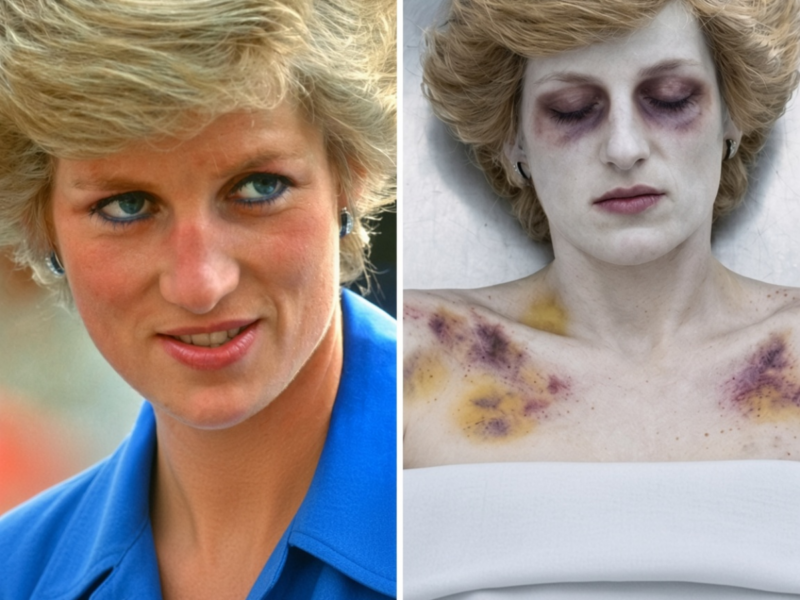
What Princess Diana’s Autopsy Revealed That The Public Never Heard.
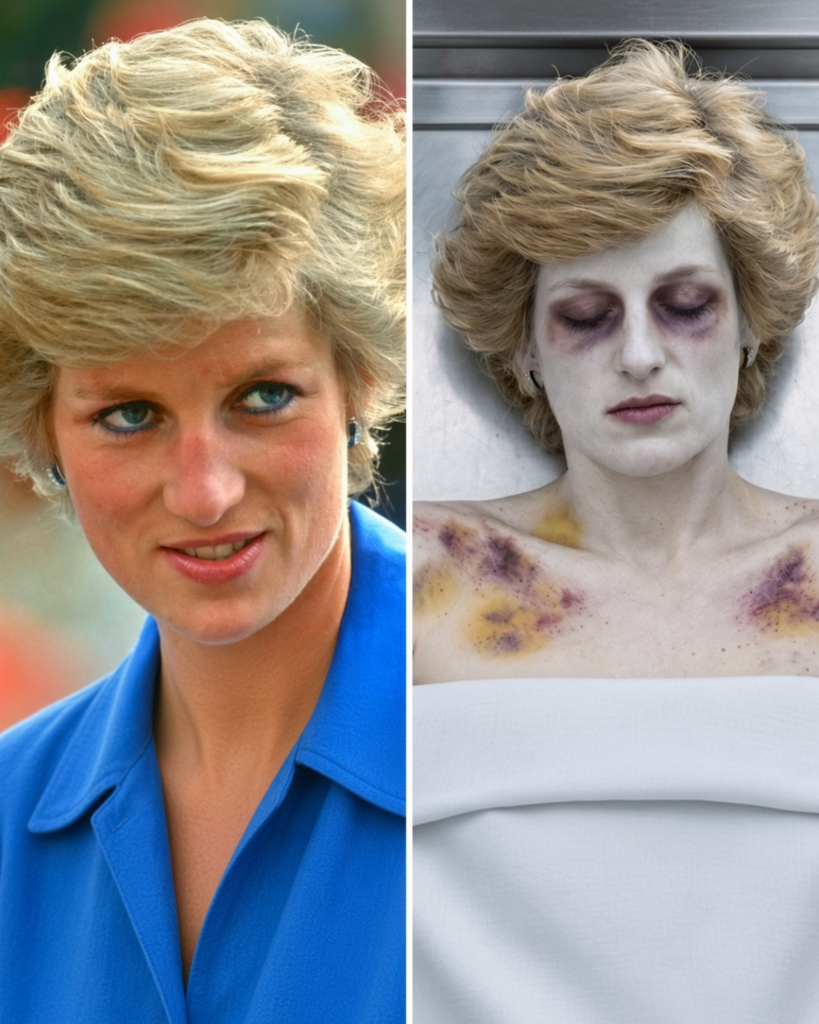
On the evening of August 31, while the whole world was still trying to believe the news, a quiet examination began in a London mortuary.
Behind those doors lay the most famous woman on earth.
Outside, thousands of people were already leaving flowers at the gates of her home, and thousands more were asking the same questions.
How could a car crash kill a woman like that?
Was it really an accident?
And what were they not being told?
The man in that room was going to answer those questions.
Not with theories.
With evidence.
But his findings would not be shared with the public that week, or that month, or that year.
For the next decade, the full details of Vivian Ashcombe’s postmortem stayed out of public view, while rumors filled the silence.
She was pregnant.
She was murdered.
Her body had been tampered with.
The driver’s blood had been swapped.
When the evidence finally came out in a London courtroom, it answered three questions the world had been asking since that night.
Was Vivian pregnant?
Was something hidden?
And could she have been saved?
Two of those answers shut down the biggest conspiracy theories of our time.
But the third answer is the one that stays with people.
Because the thing that killed Vivian Ashcombe was not what anyone expected.
It was small.
It was almost invisible.
And it was hiding in plain sight from the very first minutes after the crash.
The object that holds this story together is a seatbelt, and it appears three times.
The first time is in the wreckage of a black sedan in a Paris tunnel, where three of the four people inside were not wearing one and the fourth, a bodyguard, was, and the fourth is the only one who walked out of that hospital.
The second time is on a courtroom exhibit table in London, where a forensic pathologist placed a photograph of the rear seat and pointed to the buckle and said, “This is the one thing that was within her control.”
And the third time is in a road-safety advertisement that ran in Britain in 2019, twenty-two years later, in which a young mother buckles her child into a car seat and then buckles herself in and says, “It takes one second. It took her one second.”
But we are getting ahead of ourselves.
The seatbelt comes later.
The story starts with a body examined twice, in two countries, under two systems, and neither examination ever released in full.
In Paris, the French authorities carried out an external examination.
In France, investigations are controlled by judges, and their files are not public documents.
So whatever the French saw stayed inside a French judicial file.
Then her body was flown home to England, and because she died abroad and her body was brought back to British soil, English law required a coroner to get involved.
That night, a forensic pathologist named Dr. Robert Crandall carried out the full postmortem examination.
His report went to the coroner, and there it stayed.
There was no press conference, no official summary of what he found.
There was a French criminal investigation that took two years and blamed the driver, but the British inquest into Vivian’s death was opened and then put on hold for years while the questions piled up.
And in that silence, people began filling in the blanks.
Her partner, Daniel Ferrer, had died in the same crash.
His father, the financier Emilio Ferrer, became convinced the couple had been murdered.
He claimed Vivian was pregnant with Daniel’s child.
He claimed the establishment could not accept it, and he claimed the evidence had been covered up.
To millions of people, that sounded possible.
After all, why keep an autopsy secret if there was nothing to hide?
It took until 2004 for British police to open a full investigation, and until 2007 for a formal inquest to begin, and only then, under oath, did the people who examined Vivian finally speak.
What they said surprised nearly everyone.
But before we get there, we have to understand what happened in the minutes after the crash, because one detail from that night became the key to everything.
At around 12:23 in the morning, a black sedan carrying Vivian Ashcombe and Daniel Ferrer sped into the Pont de l’Alma tunnel in Paris.
It was being chased by photographers.
It hit the thirteenth pillar at high speed.
The driver, Henri Paul, was killed instantly.
So was Daniel Ferrer.
The bodyguard in the front passenger seat, Trevor Rees-Jones, was badly hurt but alive.
And Vivian?
Vivian was alive.
That is the part that shocked people when the full story came out.
The world imagined a crash so violent that no one could have survived it.
But one of the first people to reach the car, a doctor named Frédéric Mailliez, who happened to be driving through the tunnel, found the woman in the back of the wrecked car crouched on the floor and struggling to breathe.
He did not even recognize her.
He gave her oxygen and tried to calm her down.
Then a firefighter named Xavier Gourmelon reached her, and years later he revealed what she said to him.
She looked up and asked, “My God, what’s happened?”
He saw no obvious major wounds.
There was a little blood on her shoulder.
He believed she was going to live.
Think about that for a moment.
The most famous woman in the world talking, conscious, with no dramatic visible injuries, in a car where two men had died instantly.
So how did a woman who was talking at the scene die a few hours later?
That question bothered people for years.
Some believed it proved something else had happened to her, that she had been neglected or worse, harmed on purpose after the crash.
The truth was hidden inside her chest, and the pathologist who finally explained it called it tiny.
But first there was another problem.
Before any British doctor could examine Vivian, something had already been done to her body in Paris, and that decision would fuel conspiracy theories for the next decade.
She was taken to a hospital in Paris.
Despite hours of effort by the surgical team, she was declared dead at around four in the morning.
What happened next is one of the most controversial parts of the entire story.
That afternoon, her former husband was flying to Paris with her two sisters to bring her home.
The French president and his wife were also coming to pay their respects.
It was the last day of August, Paris was hot, and the room where her body lay was not properly cooled.
Hospital staff faced a decision.
They did not believe it was acceptable for the family and the president of France to see her body in the condition it was in.
There was very little time.
So her body was embalmed in Paris.
On its own, that might sound like a simple act of respect, but it caused enormous problems later.
Under French law, there was supposed to be official paperwork in place before embalming a body that might undergo a postmortem.
In this case, staff went ahead on a verbal assurance from a senior police officer that everything would be in order, and the paperwork was completed after the embalming had already been done.
To Emilio Ferrer, this was not a mistake.
It was proof.
His argument went like this.
Embalming fluid changes the chemistry of the body.
If Vivian had been pregnant, then embalming her quickly could have ruined any chance of proving it with blood or urine tests.
Why rush to embalm the body, he asked, unless someone wanted to destroy evidence?
It was a powerful theory.
It spread around the world.
Books were written about it.
Documentaries were made about it.
And for years, nobody who had actually examined her body answered it in public.
So was Vivian Ashcombe pregnant when she died?
This was the question at the center of everything, and the answer came from three separate directions.
The first answer came from Dr. Crandall himself.
In November 2007, ten years after he examined her, he finally stood before the inquest jury in London and was asked directly whether he had seen any sign that she was pregnant.
His answer was very simple.
“No, I did not.”
He explained what he had looked for and established that pregnancy changes the body in visible ways.
The size of the womb changes, the lining becomes thicker, and there is a gestational sac.
Crandall said he examined her womb and ovaries and none of those signs were present.
He was also honest about the limits.
In the first week of a pregnancy, he said, you could not see anything at all.
In the second week it was still unlikely.
Only after that would the signs become more and more likely to show.
So what about the embalming?
Hadn’t that destroyed the evidence?
No, Crandall said.
Embalming fluid would not have affected his ability to judge a pregnancy, because the evidence he was looking for was physical.
It was in the womb and the ovaries themselves, and embalming does not erase that.
The second answer came from someone even closer to the examination.
John Burton, the coroner of the Queen’s household at the time, had been present at the postmortem.
In 2004 he said he had personally examined the womb and was satisfied that she was not pregnant.
But Ferrer’s supporters still had one last argument.
What if the pregnancy was very early, too early to see?
Only a blood test could catch that, and the embalming, plus the transfusions she received in the hospital, had made her blood samples unreliable.
That is where the third answer comes in, and it is the most remarkable of all.
Investigators went back to the car.
The wrecked sedan had been preserved as evidence, and on the carpet in the footwell where Vivian had been sitting there was still blood, her blood, from the moment right after the crash, before any transfusion, before any embalming, before anyone could have changed anything.
A leading forensic scientist, Professor Angela Gallop, and her team tested that blood for the hormone human chorionic gonadotropin, known as hCG.
That is the hormone pregnancy tests look for.
It starts to appear very early.
They found absolutely no trace of it.
On top of that, a friend told investigators she was in her normal cycle and was using contraception.
Three separate lines of evidence.
The pathologist’s examination, the coroner’s own eyes, and blood taken from the car itself, untouched by anything that happened afterward.
All three said the same thing.
Vivian Ashcombe was not pregnant when she died.
But if the theory was wrong about Vivian, what about the man who was driving her?
Because his blood was about to become the next great mystery.
Henri Paul was the deputy head of security at the hotel.
He was not her regular driver.
That night he was asked to drive the sedan as part of a plan to escape the photographers waiting outside.
After the crash, French toxicologists tested his blood, and the results stunned everyone.
His blood alcohol level was more than three times the French legal limit for driving.
A separate test on fluid from his eye matched it.
Tests also showed traces of prescription medication, including an antidepressant.
And there was something else.
A test found a high level of carbon monoxide in his blood, 20.7 percent, which seemed strange for a man who had spent the evening in a hotel.
That single number started a whole new theory.
Critics argued that such a high level of carbon monoxide would have left him too sick to stand, let alone drive.
So maybe, they said, the blood was not his.
Maybe it had been swapped with a sample from someone else, perhaps a suicide victim, to make the driver look drunk and hide what really happened.
It sounded like a thriller, and for a while it was taken seriously.
So investigators went back again.
DNA testing was carried out, comparing the blood samples with DNA from Henri Paul’s parents.
It indicated that the samples were his.
As for the carbon monoxide, experts offered a simpler explanation.
He had been smoking small cigars in the hours before the crash, and one crash investigator said the reading was perfectly explainable, with tobacco the most likely cause.
The inquest did not pretend the testing was perfect.
The coroner acknowledged there had been problems with the way some samples were handled, but the jury had heard enough.
They also heard from witnesses and saw security footage from the hotel showing the driver’s behavior that night.
In April 2008 they delivered their verdict.
Vivian and Daniel had been unlawfully killed through the grossly negligent driving of Henri Paul and of the paparazzi vehicles chasing them.
The jury also named the impairment of the driver’s judgment through alcohol as a contributing factor.
Vivian herself, by the way, had not been drinking.
The inquest heard that she did not appear to have had alcohol in the hours before her death.
So the pregnancy theory collapsed.
The blood swap theory collapsed.
There was no hidden baby and no evidence of a secret plot.
But that still leaves the biggest question of all, the one we started with in the tunnel.
If she was alive, conscious, and talking after the crash, what actually killed her?
The answer was explained most clearly by one of Britain’s most experienced forensic pathologists, Dr. Richard Shepherd.
He had reviewed the medical evidence for the police investigation, and years later he described what he found.
She died from a tear in a vein deep inside her chest, specifically a pulmonary vein, one of the vessels that carries blood from the lungs back into the heart.
Shepherd called it a tiny injury, and he said it was in just the wrong place.
Here is why that matters so much.
When the sedan hit that pillar, she was thrown forward with tremendous force.
Her body stopped suddenly, but the organs inside her chest kept moving for a split second.
That violent deceleration tore the vein where it meets the heart.
Apart from that, her injuries were not dramatic.
A few broken bones, a chest injury, nothing that would make an onlooker think she was dying.
And this is the key to the mystery from the tunnel.
An artery is under high pressure.
When one tears, blood pours out quickly, and the person collapses fast.
But a vein is different.
Its pressure is low.
So when the vein tore, the blood did not gush.
It leaked slowly, steadily, silently into her chest.
That is why she could still talk.
That is why the firefighter thought she would live.
That is why she asked what had happened.
For a while her body could cope.
Then, as the bleeding continued, she slowly lost consciousness.
Her heart stopped shortly after she was lifted out of the car.
Rescuers brought it back.
Doctors at the scene worked to stabilize her before moving her, the standard French approach at the time.
It took well over an hour from the crash for her ambulance to reach the hospital, and at one point it stopped on the way because her blood pressure dropped so sharply.
At the hospital, surgeons opened her chest.
They found the tear.
They tried to repair it.
They massaged her heart by hand for a long time.
But by then it was too late.
Picture that operating room.
A team of French surgeons in the middle of the night fighting for a patient whose face every one of them knew.
Outside the hospital, crowds and cameras were already gathering.
Inside, the doctors kept going long after most patients would have been declared gone, because nobody wanted to be the one to stop.
When the news was finally announced, the world assumed she must have suffered terrible, obvious injuries.
Newspapers spoke of a crash no one could have survived.
Nobody outside that hospital understood that the woman they were mourning had been talking just a few hours earlier with a wound most people would never have noticed.
That gap between what people imagined and what really happened is exactly where the conspiracy theories grew.
If her injuries were so small, people asked, why did she die?
It sounded suspicious.
It sounded like something must have been hidden.
But nothing was hidden.
The answer was simply medical, and it was sitting in a sealed report that the public was not allowed to read.
Shepherd explained that because veins bleed slowly, an injury like this is hard to detect at the scene and even harder to fix.
The same thing that kept her alive in those first minutes made the injury almost invisible to the people trying to save her.
Some people still ask whether a faster trip to hospital would have changed the outcome.
Doctors have debated it for years, and there is no single agreed answer.
But Shepherd believed the real turning point came much earlier, before the crash, before the tunnel, in a choice that took less than a second.
Of the four people in that sedan, only one was wearing a seatbelt, the bodyguard, Trevor Rees-Jones, and he was the only one who survived.
Vivian was sitting in the back unbelted.
When the car hit the pillar, nothing held her in place.
She was thrown forward into the back of the seat in front of her with the full force of the impact.
That force is what tore the vein.
Shepherd’s view was clear.
If she had been wearing her seatbelt, it would have held her body back and absorbed much of the force.
In his opinion, she would most likely have walked away with a black eye, some broken ribs, maybe a broken arm.
Injuries she would have recovered from.
Injuries that would have become a footnote in her story.
Imagine the headlines the next morning.
A frightening crash in Paris.
The woman bruised and shaken.
Photographed leaving hospital a few days later.
Her sons rushing to see their mother.
A story that the world would have talked about for a week and then slowly forgotten.
He called it the biggest if only of the entire tragedy.
Because, unlike the speed, unlike the photographers, unlike the drunk driver, the seatbelt was the one thing that was within her own control.
Here is what I want you to carry with you.
The world spent ten years searching for a hidden truth, and in the end it was not a cover-up.
It was a heartbeat that could not hold on and a life that, for want of one small click, ended far too soon.
There is a seatbelt in a wrecked car in a Paris tunnel, and there is a courtroom exhibit table in London, and there is a road-safety advertisement that ran twenty-two years later with a young mother buckling her child in and then buckling herself in and saying, “It takes one second.”
That is the whole story.
One second, one click, one small thing within your control.
So buckle it.
Buckle it every time, and buckle the people you love, and if you are ever in a car with someone who does not, ask them to.
Because the truth is that the thing that kills people is rarely dramatic and almost always small, and it is almost always hiding in plain sight.









