What Nancy Reagan Did to Her Children Was Never Forgotten — and It Was Nastier Than You Think.
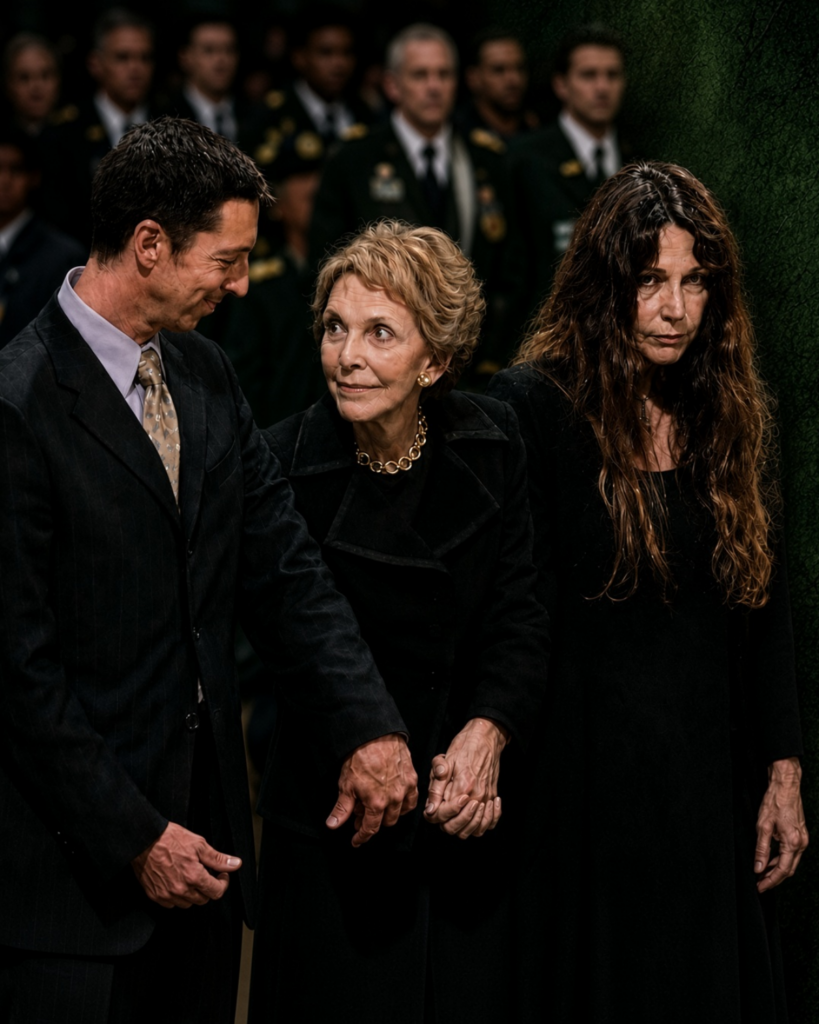
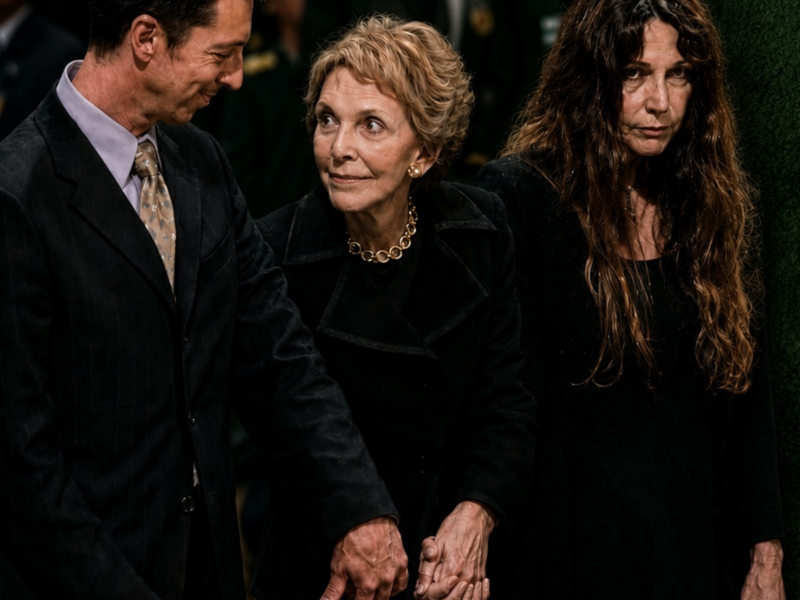
On June 11th, 2004, the Reagan children sat together at a funeral in California, and the cameras noted how carefully they were arranged.
America saw a family closing ranks.
The arrangement was the point.
Maureen was already dead.
Michael had been writing about being outside the room since 1988.
Patti had changed her surname at 25 and spent two decades explaining why.
Ron would explain it later, more quietly.
The marriage everyone photographed was a closed system with exactly two members, and the children were the record of what a closed system costs.
Nancy Reagan built that system deliberately and early.
Go back to Chicago and then back further to a hospital in Manhattan in July 1921.
She was born Anne Frances Robbins.
Her father was a car salesman named Kenneth Robbins.
Her mother was Edith Luckett, a working stage actress, and the marriage was effectively over within two years.
What happened next explains most of what came after.
Edith went back on tour and left the child with an aunt and uncle in Maryland for roughly six years.
Her mother visited when the circuit allowed.
In 1929, Edith married Loyal Davis, a Chicago neurosurgeon, and the child acquired a house, a social position, and eventually a surname.
The formal adoption came in 1935.
She was 14.
From that year forward, she was Nancy Davis, and Loyal Davis was, in every version she ever told afterward, simply her father.
Kenneth Robbins dropped out of the record she maintained.
That is not a lie.
It is a decision about which document is operative.
By the time MGM signed her in 1949, the smoothing was routine.
Studio material gave her birth year as 1923, rather than 1921.
Her biographer, Karen Tumulty, working the archives for her 2021 book, walks through the distance between the filed version and the documented one at length.
Anne Frances Robbins of Manhattan had become Nancy Davis of Chicago, and the second one was the version people acted on.
Now, the anecdote.
In 1951, her name turned up on a list of suspected communist sympathizers, a case of mistaken identity involving a different Nancy Davis, and she went to the president of the Screen Actors Guild for help.
His name was Ronald Reagan.
He took her to dinner.
She told that story for fifty years.
It is charming, and it is worth noticing that she told it that consistently.
What it leaves out is that she had asked the director Mervyn LeRoy to arrange the meeting.
She later conceded as much herself.
The blacklist was the pretext, not the accident.
So, before there was a marriage, before there was a governorship or a White House, she had already rebuilt her own origin once and stage-managed her own first meeting.
Constructing a family narrative was not a skill she acquired in Washington.
It was the skill she arrived with.
They married on March 4th, 1952 at a small church in the San Fernando Valley.
Patti was born on October 21st of the same year.
Do that arithmetic.
The wedding was quiet.
The guest list was two people plus witnesses, and nobody involved has ever pretended the sequence was different.
Now, count the household.
Maureen, born 1941, and Michael, adopted 1945, were the children of Ronald Reagan and Jane Wyman.
Patti arrived in 1952.
Ron in 1958.
Four children, two marriages, and one structural fact that governs everything after.
Only two of them were hers.
And here is the thing people who knew the Reagans say more consistently than anything else.
The marriage was a closed system with exactly two members.
Everyone else, including the children, was outside it.
That was not a failure of the marriage.
It was the design of it.
I want you to see both halves of this at once.
Publicly, through the 1960s and 1970s, she was photographed as the definitive American political wife.
The Sacramento years, the campaign plane, the look.
Privately, the household ran on a schedule set by a candidate’s calendar, and the children were distributed to institutions that could hold them while it ran.
Michael Reagan was sent to boarding school at Chadwick beginning around age five.
Patti was sent to the Orme School in Arizona.
These were not unusual choices for that class in that decade, which is exactly why they read as ordinary at the time and did not stay ordinary.
Hold on to the boarding schools.
They come back in 1986 in a novel with the names changed and again in 1988 and 1992 with the names restored.
There is one more piece of the structure worth naming before any of that.
Nancy Reagan was extremely good at her actual job.
She managed a career, then a governor, then a president, and by every serious account, she managed them well.
The competence is not seriously in dispute anywhere in the record.
What the record shows is where she spent it.
The gaze in those photographs was real, and it was pointed in one direction for fifty-two years, and four people spent their childhoods standing just outside its angle.
In 1986, while her father was in his second term, Patti Davis published a novel called Home Front.
It concerned the daughter of a conservative American politician who becomes a leftist activist and is estranged from her family.
Her co-author was Maureen Strange Foster.
The publisher was Crown.
Nobody in the reviewing press treated it as fiction.
It was not written to be treated as fiction.
Somebody drafting that book anticipated the memoir before she wrote it, and six years later she wrote the memoir.
The Way I See It appeared in 1992 from Putnam.
Handle what follows carefully because the record demands it.
Davis wrote that her mother had struck her, that the household ran on prescription sedatives, and that the affection the country saw pointed exclusively at her father.
Nancy Reagan denied the account.
The family denied it broadly and consistently.
And Michael Reagan publicly criticized the book’s timing.
His father had disclosed his Alzheimer’s diagnosis two years later.
In 1992, the former president was 71 and still in public life.
Michael had already published his own.
On the Outside Looking In came out in 1988 with Joe Hyams.
His grievance was structural rather than dramatic.
He described being adopted, then sent to boarding school at five, then absorbing the fact that he was the child of the first marriage in a household organized around the second.
He also disclosed abuse by a day camp counselor in childhood, which he said he had told no one for decades.
That is a separate injury, and it belongs in the record as its own fact, not as evidence about his stepmother.
Ron Reagan waited until 2011.
My Father at 100 is warmer and slower than either of the others, and it describes essentially the same geometry from a different seat.
His account is of a father who was affectionate to everyone and available to no one, and a mother who guarded the door.
So, you have four children and at least three published versions.
Patti says cruelty.
Michael says exclusion.
Ron says architecture.
Maureen, who died before she could write the late-life version, spent the 1980s as the one child who found a working relationship with both of them, largely by joining the Republican National Committee and meeting her parents on professional ground.
Two versions of the same childhood, both sourced, neither retracted.
I am not going to adjudicate that here, and neither did anyone else with access to the house.
What is documentable is the distance itself.
Patti legally dropped the Reagan surname at 25 and used her mother’s maiden name instead, which is a small administrative act that says everything.
She was not invited to the 1981 inauguration festivities in any prominent role.
She wrote in 1992 that she and her mother had gone years at a stretch without speaking.
Then came the reconciliations, and they were real.
Maureen died of melanoma in August 2001 at 58.
After years of caring for her father through his illness, she and Nancy had become genuinely close.
Nancy Reagan called her a daughter without qualification, and there is no reason to read that as performance.
Patti came back during the Alzheimer’s decade.
She has said the illness did what nothing else had, that ten years of shared caretaking in a house in Bel Air gave her a version of her mother she had never had access to.
By the 2004 funeral, she was inside the family again.
Her later writing, including The Long Goodbye in 2004 and Floating in the Deep End in 2021, is unmistakably softer.
I don’t think that softening was strategic.
I think that is what makes it hard.
A reconciliation can be entirely genuine and still not reach backward.
Patti got roughly the last decade.
She did not get the first four, and she has said so in print during the same years she was saying the first thing.
Both are true.
That is the whole shape of this family.
Nancy Reagan died on March 6th, 2016 at 94 at her home in Bel Air.
She was buried beside her husband at the Reagan Library in Simi Valley in the plot she had selected.
Patti and Ron both spoke.
Michael attended.
The eulogies described a devoted mother, and every person in the front row had read the books.
Her estate went largely to her children and to the library.
Her papers went to the archive.
Now go back to the gaze.
She spent fifty-two years looking at one person, and America decided that was warmth.
It was not warmth.
It was allocation, total and undivided, and the four people standing outside the frame spent their lives explaining what it is like to be near an enormous supply of love that has already been fully committed elsewhere.
She was not a cold woman.
She was a woman with exactly one recipient.









