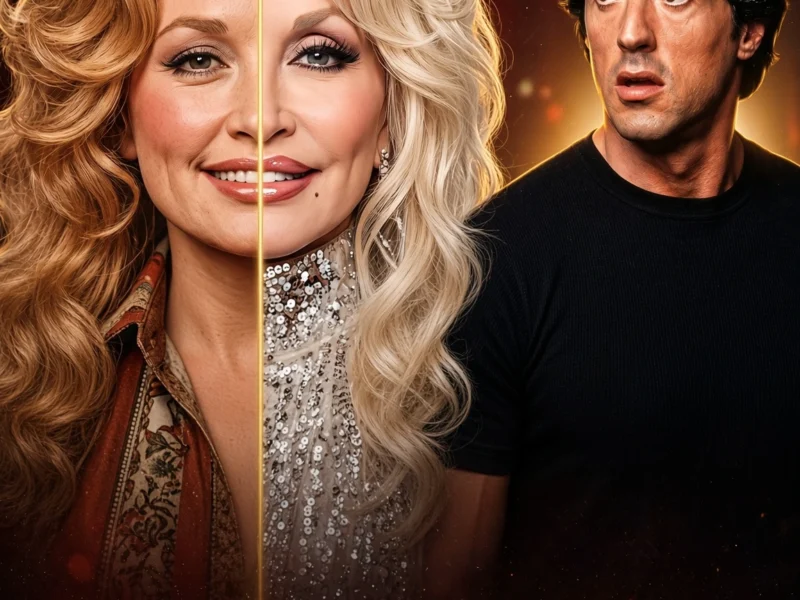
Was Dolly Parton OBSESSED With Sylvester Stallone? The Plastic Surgery Mystery.
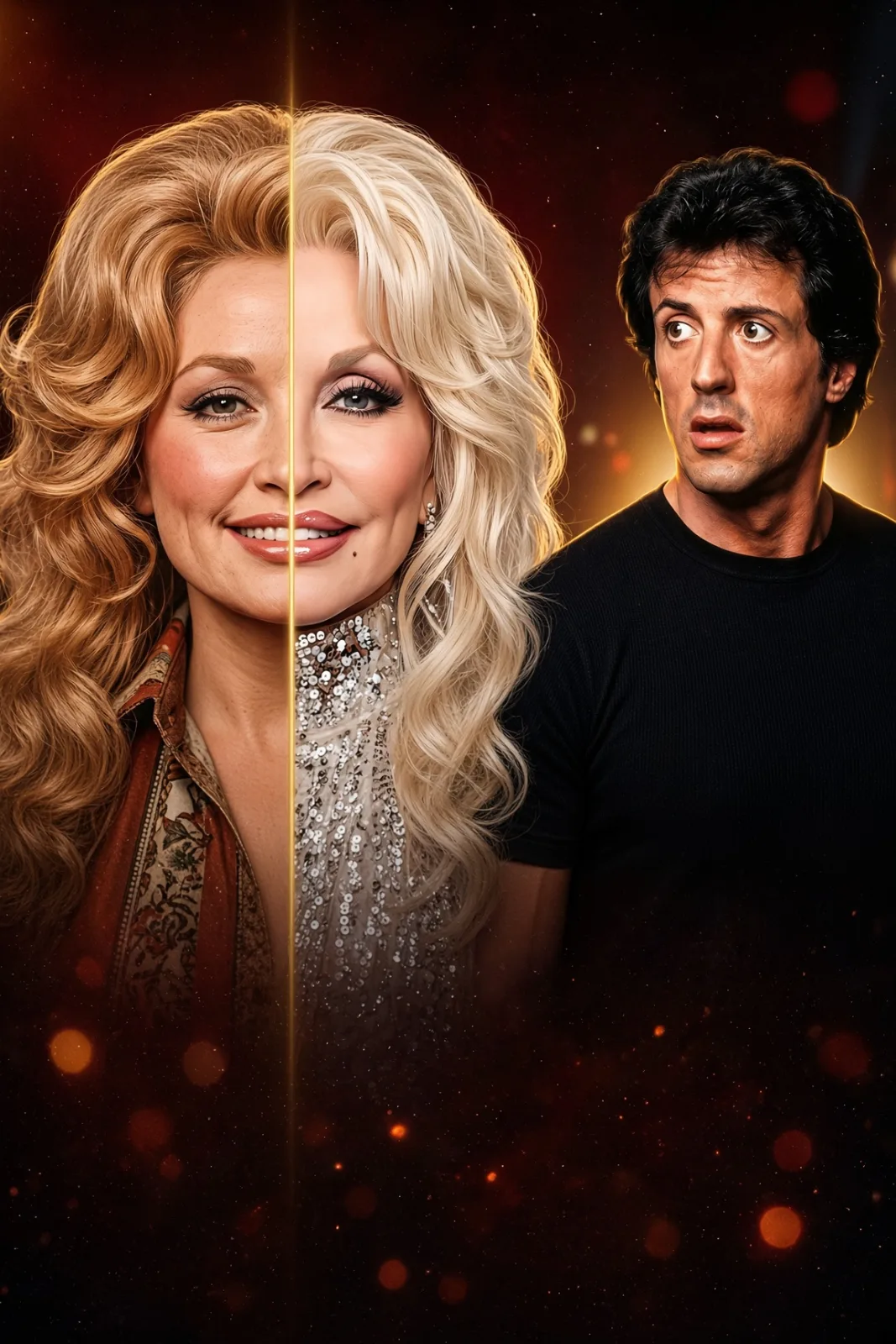
In March 1984, Dolly Parton was asked a question that could have come straight from a Hollywood gossip column.
Had Sylvester Stallone been responsible for her dramatic weight loss?
The two stars had just made a movie together, Stallone was one of the most famous men in the world, and Dolly was looking noticeably different after a difficult period in her life.
Her answer was revealing.
Stallone, she said, had a beautiful body.
He was an inspiration, but he was getting credit for something he had nothing to do with.
A few months later, Dolly was even more enthusiastic when Andy Warhol asked about her handsome co-star.
“I think he’s beautiful,” she said.
She also talked about surgery, her determination to improve her health, and the effect Stallone had on her.
Read those comments separately, and they might sound like pieces of a secret Hollywood romance.
Put them together with the gossip surrounding Dolly’s appearance, and an even more provocative question emerges.
Had she been trying to make herself more attractive to Sylvester Stallone?
There is one problem with that theory.
Dolly gave a very specific account of when her transformation began and the dates don’t fit the story people might want to believe.
To understand why Stallone became associated with such a personal chapter of her life, we need to go back to a time when Dolly Parton was struggling far more than the public realized.
By the early 1980s, Dolly was already an international star.
She had conquered country music, crossed into pop, and established herself in Hollywood with the success of 9 to 5.
Her image was unmistakable.
The enormous blonde hair, dramatic makeup, sparkling clothes, and figure-hugging outfits were part of a look she had spent years developing.
Dolly had never pretended that this was a natural, effortless appearance.
She enjoyed the transformation.
She enjoyed the wigs, the eyelashes, and the elaborate costumes.
And she understood that audiences remembered a performer who looked unlike anybody else.
But maintaining that image was not always easy.
Behind the bright smile, her health was deteriorating.
Her experience making The Best Little Whorehouse in Texas, released in 1982, had been exhausting.
Although the film performed well commercially, Dolly later described the production as a difficult experience.
She was also dealing with serious gynecological problems.
Her illness disrupted her work.
Appearances were cancelled.
Touring became more difficult.
And eventually, she stepped away from the relentless schedule that had defined much of her adult life.
For someone accustomed to working constantly, that interruption was devastating.
In a 1989 interview with the Washington Post, Dolly recalled being away from work for roughly 18 months.
She described undergoing surgeries and entering one of the worst emotional periods of her life.
This is an important distinction.
The operations she discussed in connection with that illness were not automatically cosmetic procedures.
When people hear the word surgery in a story about Dolly Parton, they may immediately think of plastic surgery.
But the medical problems she described belong to a different part of her life.
Confusing those two subjects makes it much easier to create a sensational story that the evidence doesn’t support.
Dolly’s absence from work also affected her confidence.
She had built her career around energy, humor, and an ability to make almost any room feel welcoming.
Now she was spending long periods away from the stage.
Her weight had become another source of distress.
She had always been candid about loving food and disliking exercise.
But during this period, her health and appearance became difficult subjects for her personally.
The cheerful public image remained.
The private experience was much harder.
And then Sylvester Stallone entered the picture.
By 1983, Stallone was a major Hollywood force.
Rocky had made him famous and the Rambo films were establishing another side of his screen identity.
He represented a very different kind of celebrity from Dolly.
His public image was built around physical discipline, muscular strength, and relentless training.
Dolly’s was built around music, humor, glamour, and an exaggerated femininity she controlled herself.
On paper, the combination seemed almost absurd.
Yet, Hollywood decided to put them together.
The project was Rhinestone, a musical comedy in which Dolly played a country singer who makes a bet that she can transform an abrasive New York taxi driver into a country performer.
Stallone played the taxi driver.
The premise depended on the contrast between them.
Dolly was supposed to teach a man associated with toughness and physical confidence how to enter a musical world he barely understood.
And Stallone was supposed to be funny.
For Dolly, the film represented something more significant than another acting credit.
It offered a route back to work after a frightening period of illness and isolation.
She later said that Rhinestone would always matter to her because it helped her get back on her feet.
and she associated that recovery closely with Stallone.
She remembered him as energetic, health-conscious, and funny.
Those qualities made a powerful impression on someone who had recently been struggling to recover her own energy.
In another interview, she described him as exactly the kind of person she needed at that moment.
It’s easy to understand how comments like these could be interpreted romantically.
A glamorous country singer returns to Hollywood after a personal crisis.
She is paired with one of the world’s most famous sex symbols.
She praises his looks, his energy, and the effect he has on her.
Meanwhile, the public notices that she appears slimmer and more confident.
The ingredients of a tabloid story are already there, but attraction, admiration, and a successful working relationship are not the same thing as a love affair.
And Dolly was remarkably direct when reporters pushed the subject.
In March 1984, the Washington Post covered a press appearance in which she was promoting her music and the upcoming release of Rhinestone.
The reporter described her glamorous appearance, including the striking clothes and blonde hair that had become her trademarks.
Dolly had also lost weight.
Someone asked whether Stallone was responsible.
Her answer acknowledged his physical appeal, but rejected the central claim.
He had inspired her, she explained, but he had not caused the weight loss.
This wasn’t a minor qualification.
It was the difference between saying that an attractive co-star encouraged her and saying that she had transformed herself to win his attention.
The first statement came from Dolly.
The second requires evidence that has not been established.
A separate interview with Andy Warhol makes the chronology even clearer.
Warhol asked what she thought of working with Stallone.
Dolly said she found him beautiful and explained that she had been surprised by his appearance when she first met him.
She had imagined him as an enormous man, probably because of the way he appeared on screen.
In person, he was different from what she expected.
Then she discussed her surgery and her decision to improve her physical condition.
She wanted to eat better and get into better shape.
She had just turned 38.
And she made one particularly important point.
She had lost the weight before she even met Stallone.
That single detail changes the story.
If Dolly’s transformation was already underway before they met, it cannot be presented as something she began because she had fallen for him on the Rhinestone set.
She could still have admired him.
He could still have encouraged her.
She could even have found his discipline useful while she continued working on her health.
But none of that proves she was pursuing him romantically.
and it certainly doesn’t prove she underwent plastic surgery to become his ideal woman.
There is another reason the rumors were attractive to the press.
Dolly Parton had been married to Carl Dean since 1966.
Her husband was famously private.
He rarely appeared beside her at Hollywood events and had little interest in becoming part of the entertainment industry.
That unusual arrangement created endless opportunities for speculation.
Dolly was frequently photographed with handsome male colleagues.
Her husband was usually absent from the photographs.
For a gossip columnist, that contrast could be turned into a suggestive story with very little effort.
A smiling picture with an actor became evidence of chemistry.
A compliment in an interview became evidence of attraction.
A change in appearance became evidence that something private was happening.
Dolly knew how the system worked.
In the same Washington Post interview, she discussed the way tabloids repeatedly predicted problems in her marriage.
She also acknowledged that working with attractive male stars naturally encouraged people to talk.
She had already faced speculation involving Burt Reynolds, her co-star in The Best Little Whorehouse in Texas.
Now, Stallone was the latest famous man standing beside her.
The pattern was familiar.
What made the Stallone story different was the timing.
Dolly was emerging from a serious health crisis.
She was changing her lifestyle.
Her appearance was becoming a subject of public attention, and she was openly enthusiastic about the man helping her make her return to Hollywood.
Those facts made a compelling story, even without a confirmed romance.
But what about plastic surgery?
This is where the documentary has to separate Dolly’s broader history of cosmetic procedures from the specific claim involving Stallone.
Dolly has never been particularly secretive about the fact that she has altered her appearance.
Over the years, she has discussed cosmetic work with a mixture of humor and practicality.
She has spoken about wanting to maintain the look audiences associate with her.
She has acknowledged that cosmetic procedures can involve discomfort, risk, and recovery.
and she has repeatedly rejected the idea that looking artificial is something she should be ashamed of.
Her attitude toward glamour began long before Sylvester Stallone became her co-star.
As a child in Tennessee, Dolly was fascinated by women who dressed dramatically.
She admired bright makeup, elaborate hair, and clothes that attracted attention.
Her famous appearance developed from those early influences.
It wasn’t invented in Hollywood in 1984, and it wasn’t designed around the preferences of one particular actor.
By the time she made Rhinestone, Dolly had already spent years appearing on television with a highly stylized look.
Her wigs, makeup, and clothing were established parts of her professional identity.
The fact that she later underwent cosmetic procedures does not mean every change in her appearance can be connected to Stallone.
There is also a basic chronological problem.
Public interviews from 1984 discuss her medical surgery, weight loss, and recovery.
They do not establish that she began a program of cosmetic operations to attract her co-star.
And there’s no reliable public record of Stallone asking her to change her face or body for him.
That distinction matters because the accusation goes beyond gossip about two celebrities flirting.
It assigns a deeply personal motive to medical decisions.
It suggests that Dolly’s appearance was shaped by an obsession with another person rather than by her own preferences, health concerns, or career.
Dolly’s own explanations point in a different direction.
She liked glamour.
She wanted to feel attractive.
She was interested in maintaining her public image, and after a difficult illness, she wanted to regain control over her body and her working life.
Those motivations are documented.
The supposed campaign to become Stallone’s ideal woman is not.
Still, the relationship between them deserves attention.
Dolly’s descriptions of Stallone were unusually warm.
She admired his energy and appreciated the humor he brought to the set.
She had worried about returning to films after her earlier experiences.
Working with him helped make the process enjoyable again.
In later interviews, she continued to speak fondly of Rhinestone, even while admitting that it wasn’t a particularly good movie.
That may seem strange.
Why would a star remain so attached to a film that critics disliked?
Because a movie can fail as entertainment and still matter enormously to the people who made it.
For Dolly, Rhinestone was associated with recovery.
It marked the end of a long period in which she had been ill, unhappy, and away from the work she loved.
The film gave her a reason to return to a set, collaborate with musicians, write songs, and reconnect with the audience, and Stallone was part of that experience.
In 1989, she looked back on the production and said he had been the right person at the right time.
That is an intimate statement in the emotional sense, but it is not a confession of a secret affair.
There is a temptation to treat every affectionate recollection as a coded admission.
Sometimes a person praises a colleague because the colleague was genuinely kind or helpful.
Sometimes admiration remains admiration and sometimes a friendship becomes important because it arrives during a difficult period.
Dolly’s own account supports that last possibility far more strongly than the idea of a hidden romance.
The film itself did little to help either star’s critical reputation.
Rhinestone opened in 1984 and was widely criticized.
Stallone singing became an obvious target.
The idea of the Rocky star performing country music was amusing in theory, but audiences and reviewers were not universally persuaded by the result.
Dolly had written music for the film and worked hard to make the premise function.
She later acknowledged that the finished picture had serious weaknesses.
Yet, she kept returning to how much she enjoyed making it.
That difference between the film’s reception and her personal memories is revealing.
She wasn’t defending Rhinestone because it had become a beloved classic.
She was remembering the experience of working again after a period when she had feared she might not regain her old momentum.
and she remembered Stallone as someone who made that experience easier.
The public, meanwhile, continued to associate Dolly with cosmetic transformation.
As the decades passed, questions about her appearance became almost unavoidable in interviews.
She responded with jokes, but she also made serious observations about the risks of cosmetic work.
In a 2011 Guardian interview, she repeated one of her familiar ideas.
If something on her body was sagging or needed attention, she was prepared to have it corrected.
Her attitude was practical rather than apologetic.
She understood that maintaining her chosen look required work.
She also understood that the look itself was theatrical.
It was a character she had created, but it was still recognizably Dolly.
This makes the Stallone theory even less convincing as an explanation for her appearance.
Her cosmetic choices belong to a much longer history.
They cannot reasonably be reduced to one movie or one handsome co-star.
But the question of whether she found Stallone attractive is much easier to answer.
She said so herself.
She openly admired his looks.
She praised his body.
She enjoyed his company.
And she credited his energetic personality with helping her through a difficult professional comeback.
There is no need to soften those remarks.
They are part of the historical record.
What we cannot do is turn them into evidence of an affair without something more.
A reliable eyewitness account, an admission by one of the people involved, or contemporary reporting with identifiable sources would change the picture.
But unnamed stories attributed vaguely to extras, crew members, or people who supposedly watched them together cannot be treated as testimony unless those accounts can actually be located.
The same applies to claims that Dolly told somebody she wanted to undergo plastic surgery to attract Stallone.
That would be a major statement.
It would deserve a specific source.
Without one, repeating it as fact would misrepresent what is known.
And the strongest evidence we do have points in the opposite direction.
Dolly had already begun losing weight before meeting him.
Her health problems preceded the film.
Her interest in elaborate glamour went back to childhood, and she had already established the exaggerated image that would become one of her trademarks.
The more closely we examine the timeline, the less room there is for the idea that Stallone caused her entire transformation.
Yet, he did play a meaningful role in the story.
He was there when she returned to Hollywood.
He brought an intensity and physical discipline that impressed her.
He helped create an atmosphere she remembered fondly long after the movie had disappeared from the spotlight.
And he became connected in the public imagination with a moment when Dolly appeared to be reinventing herself.
That connection was real.
The supposed secret obsession was something else.
It was a dramatic interpretation of circumstances that were already interesting without embellishment.
Perhaps the most revealing thing about Dolly’s story is how easily her own words could be rearranged.
Take her admission that Stallone was beautiful.
Add her comments about surgery.
Mention her dramatic weight loss.
Then leave out the sentence explaining that she had lost the weight before they met.
Suddenly, the audience hears a very different story.
The facts haven’t changed.
Only the context has disappeared.
That is how a celebrity rumor can begin to sound like a revelation.
Dolly’s actual experience was more complicated.
She was a successful performer dealing with illness, emotional distress, and a difficult return to work.
She had built a distinctive image long before meeting Stallone.
She admired her co-star, enjoyed working with him, and credited him with helping her regain confidence, and she continued making decisions about her appearance throughout her career.
There is no verified evidence that she underwent plastic surgery because she was obsessed with Sylvester Stallone, but there is something genuinely revealing in the way she talked about him.
She saw a man whose energy and confidence arrived at a moment when she needed both.
And perhaps that explains why, despite Rhinestone’s poor reputation, she continued to remember the film with such affection.
The public saw an unlikely pairing between a country music star and an action hero.
Dolly remembered the experience of getting her life moving again.
As for the question that started all of this, whether she changed herself to become Stallone’s perfect woman, her own interviews provide the clearest answer available.
She admired him.
He inspired her.
But the transformation had already begun.
And Dolly Parton had been creating her own idea of beauty long before Sylvester Stallone ever walked onto the









