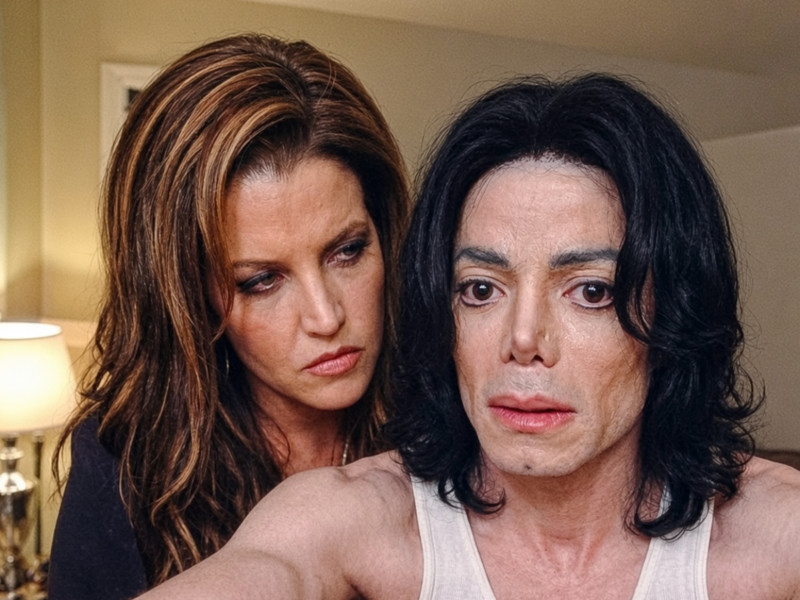
Two icons. One 15-minute wedding. Twenty days after her divorce. Nobody knew for 11 weeks. The truth is darker than the punchline.
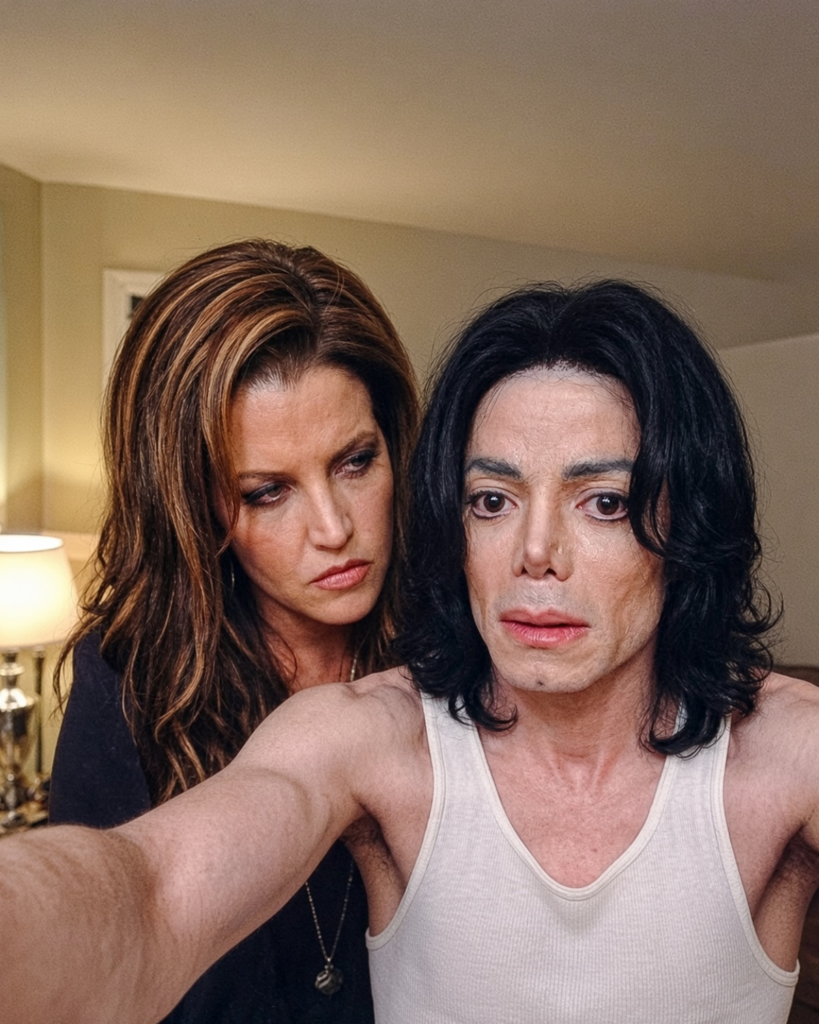
The courthouse in La Vega, Dominican Republic, was not the kind of place where you would expect the King of Pop to get married.
It was May 26, 1994, and the ceremony lasted about fifteen minutes, a blink of an eye compared to the decades of scrutiny that would follow.
Both of them wore black.
Michael Jackson had on a bolero jacket and a flamenco hat, looking like a matador who had wandered into the wrong arena.
There were no photographers.
There was no guest list leaked to the press.
There was no public announcement of any kind.
Just twenty days earlier, Lisa Marie Presley’s divorce from her first husband, musician Danny Keough, the father of her two young children, had barely been finalized.
Twenty days between one marriage ending and another beginning, and nobody outside a small circle knew any of it had happened at all.
That is the first secret.
The first of many.
For eleven weeks, the secret held.
Reporters covering both families had no idea anything had changed, and neither did most of the couple’s own extended circle.
Then, on August 1, 1994, a written statement went out under Presley’s name, confirming what nobody had confirmed before.
She was now Mrs. Lisa Marie Presley Jackson.
The private ceremony had taken place weeks earlier outside the United States, and she was dedicating her life to being his wife, hoping the two of them could eventually raise a family together.
The response was instant, and it was almost uniformly disbelief.
Jackson was, at that moment, barely a year removed from allegations involving a 13-year-old boy, Jordan Chandler.
Allegations settled in a civil suit for a reported $20 million without ever reaching a criminal trial.
To the press, the timing wrote the story for them.
A besieged pop star marrying into rock royalty to manufacture, almost overnight, the image of an ordinary husband exactly when his career needed one most.
Late-night hosts turned it into a running bit within days.
Tabloids didn’t hedge. They printed the word sham outright, and entertainment programs spent weeks scrutinizing the marriage license itself as though it were courtroom evidence, rather than a wedding record.
Almost no coverage paused to ask a simpler question.
What had actually been happening between these two people privately for the better part of two years before that courthouse ceremony ever took place?
The gap between the instant public verdict and the quieter reality underneath it would define everything that came next.
That is the promise of this story, and it is a promise that the world never allowed them to keep.
If the wedding had been hidden, the public debut was the opposite, a fully engineered spectacle staged in front of the entire music industry.
At the 1994 MTV Video Music Awards that September, Jackson and Presley opened the broadcast together, sharing a long, deliberate kiss on stage while the crowd screamed.
Jackson turned afterward to tell the audience that nobody had thought this would last.
It was choreography built to settle every rumor in one image, proof delivered live that whatever this marriage was, it was at least physical.
But the kiss only answered the question the cameras were asking.
It said nothing about the one nobody in the audience knew to ask, which was why Lisa Marie Presley, a woman who had every resource in the world to avoid entanglement with a man under criminal suspicion, had chosen him in the first place.
The honest answer, by her own later account, was less romantic than it was psychological.
She had come to believe, deeply and sincerely, that Jackson had done nothing wrong, that the allegations against him were false, and that she was one of the only people positioned to help him survive what the scandal was doing to him.
She admitted years afterward that she had gotten swept up in what she called a rescue fantasy.
She thought she could save him, and even imagined, naively, that the two of them together could somehow do more good in the world than either could do alone.
That instinct to save him was genuine, and it was also, in hindsight, dangerous.
It let her mistake being needed for being loved, and it let her overlook how much of what Jackson wanted from the relationship was simply an audience willing to believe in him when almost no one else would.
The line between empathy and performance blurred almost immediately.
The moment their relationship became public, every private act of care Presley offered him was reinterpreted by the world as another beat in an ongoing publicity campaign.
She wasn’t just falling in love, or trying to rescue someone she cared about.
She was doing both of those things under a spotlight bright enough to make either one look like an act.
The savior instinct had a cost that took years to fully register.
Presley later admitted she had left her first marriage to Keough far more abruptly than she otherwise would have, calling it in retrospect one of the bigger mistakes of her entire life.
Not because her feelings for Jackson weren’t real, but because the speed of it all left her almost no room to examine what she was actually stepping into.
She has said she was naive about just how consuming the scrutiny would become, believing at first that genuine love would simply be recognizable to the outside world on its own terms.
It never was.
Every gesture, every appearance, every quiet act of devotion got filtered instead through a public narrative that had already decided, long before the marriage began, exactly what kind of story this was supposed to be.
To understand where that instinct came from, you have to go back nearly twenty years before the wedding.
It was 1975, a Jackson 5 concert in Las Vegas, where Elvis Presley introduced his seven-year-old daughter to a seventeen-year-old Michael Jackson backstage.
Neither of them thought anything of it at the time.
But the two of them had been shaped by strikingly similar forces, both raised almost entirely inside the machinery of fame, both denied anything resembling a normal childhood, and both left as adults without a clear model for what an ordinary relationship was even supposed to look like.
They reconnected in late 1992 and into 1993 while Lisa was still married to Keough.
It was the exact moment Jackson’s world was starting to collapse under the weight of the Chandler allegations.
What followed, according to people close to both of them, were long phone calls that stretched deep into the night throughout 1993.
Conversations that started less as romance and more as two extremely famous, extremely isolated people finally finding someone who understood the specific loneliness of being watched by millions and known by almost no one.
Presley had grown up inside Graceland, watching her father’s decline in real time and losing him when she was only nine years old.
Jackson had grown up inside a career that started before he could read.
Between them sat a kind of fluency in loss that almost nobody else in their lives could speak.
That bond was put to its first real public test in June 1995, a year into the marriage, when Jackson and Presley sat for an hour-long interview with Diane Sawyer on ABC’s Primetime Live.
The conversation covered the allegations against Jackson, who denied ever engaging with any child, his physical transformation, and rumors tying the marriage to Presley’s family religion.
But what dominated headlines the next morning was simpler.
When Sawyer noted that one question mattered to the public more than any other, Presley didn’t wait for her to finish it.
“Do we have sex?” she said, before answering herself. “Yes. Yes. Yes.”
She went further, insisting she would never marry someone for any reason besides genuinely falling in love with him.
She said that anyone who thought otherwise could believe whatever they wanted.
She also described their day-to-day life in strikingly ordinary terms, telling Sawyer they had a nanny, a maid, and a routine no stranger than any other households.
Jackson in the studio, Presley in the kitchen.
And it was a strange kind of intimacy forced into existence on live television because there had never been enough private space around the marriage for it to simply exist on its own terms.
The two of them were, in effect, asked to perform proof of a bond that most couples never have to justify to anyone beyond themselves.
And the performance itself became permanently one of the most replayed moments of both of their public lives, outliving even the marriage it was meant to defend.
That is the hook that keeps coming back, the image of two people proving something that should never have needed proof.
Underneath the personal story sat something much larger, the collision of two American dynasties, each carrying its own mythology, fortune, and unfinished business.
Presley’s own mother, Priscilla, never accepted the marriage as genuine.
In her memoir, Softly As I Leave You, she wrote that she was appalled by the wedding and understood immediately that Jackson wasn’t marrying her daughter so much as marrying the Presley name itself.
Allying the King of Pop with the legacy of the King of Rock and Roll.
She saw the timing and the diamond ring Jackson had custom made as evidence of exactly the wholesome public image his legal team could never manufacture in a courtroom.
As sole heir to the Elvis estate and to Graceland itself, Lisa Marie represented something valuable to outsiders that had nothing to do with who she actually was as a person.
On Jackson’s side, a different institutional shadow loomed.
Presley had been raised inside the Church of Scientology, and persistent rumors throughout the marriage suggested the church had encouraged or even helped orchestrate the relationship in hopes of drawing one of the most famous men alive into its fold.
Both Jackson and Presley denied this directly during the Sawyer interview, but the speculation never fully went away.
Adding one more layer of institutional interest to a relationship that was already carrying the weight of two family legacies on top of its own private difficulties.
What both of these outside forces shared was a refusal to let the marriage simply be about the two people inside it.
To Priscilla Presley, it was a hostile takeover of a family name. To Scientology skeptics, it was a recruitment strategy. To the tabloid press, it was theater.
Every one of these framings treated Jackson and Presley less as two adults navigating a relationship and more as symbols standing in for something bigger than themselves.
A rock dynasty, a religious institution, a scandal in need of cover.
Whatever the two of them actually felt for each other became almost impossible to see clearly through all of that noise.
And it would remain that way for the rest of the marriage.
Even the couple’s own defenders sometimes framed the relationship this way without meaning to.
Describing it as historic, unprecedented, a merger of two American mythologies, rather than simply as two people who liked each other’s company.
That language, however well-intentioned, only reinforced the very problem it was trying to push back against.
A marriage constantly discussed in terms of legacy, lineage, and institutional interest, and only rarely discussed in terms of the ordinary, unremarkable intimacy that most people are allowed to build without an audience keeping score.
By the time the cultural weight of both family names had fully settled onto the relationship, there was barely any room left for it to simply be what it was.
Two people alone in a house trying to figure out how to be married to each other.
Beneath the dynastic anxiety and the institutional suspicion sat something far more private and far darker, and it had nothing to do with reputation.
Presley had grown up watching her father’s dependence on prescription medication accelerate in his final years, ending in his death at 42 in 1977.
As her marriage to Jackson wore on, she began noticing eerily familiar patterns in him.
Reliance on medication, secrecy about his health, a fragility that only seemed to worsen.
In a conversation she recounted years later on her own blog, Jackson once told her, with what she described as calm certainty, that he was afraid he would end up exactly like her father had.
She tried to argue him out of it.
He only shrugged, as though he already knew something she didn’t.
That fear sat underneath everything as the marriage began to buckle.
Presley filed for divorce in January 1996, and it was finalized that August after roughly twenty months of marriage, citing irreconcilable differences.
By her own account, the relentless pressure to perform the marriage’s legitimacy for cameras, lawyers, and skeptical relatives had worn down whatever the two of them had actually built together in private.
She described the final stretch as a slow-motion collapse, weeks at a time when she wouldn’t know where Jackson was, learning about his whereabouts from the press rather than from him.
And yet, watching his health decline in ways that echoed her father’s seems to have triggered something more than heartbreak in her, a kind of self-protective distance.
Having already lost one man she loved to exactly this pattern, she appears to have pulled back rather than risk living through it twice.
That distance didn’t end the relationship entirely.
Presley and Jackson reportedly continued seeing each other on and off for roughly four more years after the divorce was finalized, but something had shifted permanently.
Just months after the divorce became final, Jackson married Debbie Rowe, a dermatology nurse, in November 1996.
She gave birth to his first two children, Prince Michael Jr. in 1997 and Paris in 1998, before that marriage also ended in divorce in 1999.
Presley, for her part, has said that caring for Jackson in whatever way she still could remained one of the more meaningful parts of her adult life, even after the marriage itself was over.
Proof that indifference, when it came, was never really the whole truth.
What makes this stretch of the story so difficult to categorize cleanly is that neither love nor indifference fully explains it.
Presley wasn’t simply moving on, and she wasn’t simply staying loyal out of habit either.
She was trying to hold two contradictory truths at once, that she still cared deeply about a man whose decline frightened her in the most personal way imaginable, and that protecting herself sometimes meant stepping back from exactly the kind of closeness that decline demanded.
That contradiction, more than any single headline from the divorce itself, is probably the truest picture available of what the final years of their relationship actually looked like from the inside.
In the years that followed, Lisa Marie Presley pushed back, repeatedly and explicitly, against the idea that she had been a naive prop in someone else’s publicity campaign.
She described herself as someone who did not accept the role of victim easily.
“I’m like a lion, I roar,” she once said, adding that betrayal never made her sulk. It made her respond.
Across two decades of interviews, she maintained that whatever else the marriage had been, it had been her own choice, made with open eyes, regardless of what the outside world assumed about her judgment.
Jackson died on June 25, 2009, at 50.
Presley wrote publicly the next day that she was floored by the news and that she deeply regretted not reaching out to check on him in his final months.
She wondered afterward whether a single phone call might have mattered.
She described the manipulation and self-destruction she had witnessed in him as, in part, a survival mechanism he had developed out of necessity.
Something she said she only understood clearly after his death gave her enough distance to look back without anger.
She died herself on January 12, 2023, at 54.
A posthumous memoir, completed by her daughter, Riley Keough, added new details to the record, including her insistence that she never once witnessed anything resembling abuse during their years together.
And her account that Jackson had still been a virgin when the two of them wed.
In the time since both of their deaths, public memory of the marriage has shifted from cynicism toward something closer to empathy.
Less a punchline about a fake celebrity union and more a story about two people who recognized each other’s isolation and were never given room to simply exist inside it.
What Presley’s own late reflections make clear is that reclaiming the story mattered to her as much as living it once had.
That being remembered accurately as someone who chose this life rather than someone it happened to was its own kind of closure.
She spent years working toward that.
Strip away the tabloid framing and what’s left is quieter and sadder than the story the world was told in 1994.
Two people who had spent their entire lives being watched found in each other something close to real recognition and were never allowed the ordinary privacy that recognition needed to survive.
The wedding was real.
The fear underneath it was real.
So in the end was the loss.
The marriage lasted twenty months on paper, but the bond it grew from outlived the divorce, the decades, and both of their lives.
Proof that even the most mocked celebrity romance in modern memory was, underneath the noise, something far more human than the world was ever willing to admit.
Two children of fame reaching for something ordinary in the one place they were least likely to ever find it.
And finding, at least for a little while, exactly that before the world once again decided it knew better than they did what their own story was actually about.
The courthouse in La Vega was fifteen minutes.
The kiss on the MTV stage was three seconds.
The phone calls in 1993 lasted until sunrise.
The silence after the divorce lasted four years.
And the question that Diane Sawyer never got to finish asking has been answered a thousand times by people who were never in the room.
That is the math of it.
Fifteen minutes of ceremony.
Three seconds of proof.
Twenty months of marriage.
Twenty years of being misunderstood.
And one question that Lisa Marie Presley answered herself, before anyone could answer it for her.
“Yes. Yes. Yes.”
Three words that were supposed to end the conversation.
Instead, they became the only part of the story the world ever bothered to remember.
And everything else, the fear, the phone calls, the rescue fantasy, the slow-motion collapse, the regret, the love that outlived the marriage, got buried under the weight of a punchline that was never funny in the first place.
That is the darker truth.
Not that the marriage was fake.
But that it was real, and the world refused to let it be.









