Things Michael Jackson Was Surprisingly Good At… the World Still Can’t Explain.
Some people are born to follow the beaten path of their era, while others appear simply to reshape that entire era with their own hands.
When thinking of Michael Jackson, the public often recalls only the legendary moonwalks or the blinding stage lights.
Yet behind that dazzling glamour and the suffocating pressures of fame lies a completely different world.
A place where a lonely genius single-handedly held all the secrets of art and commercial power.
Could there be hidden facets of talent, cinematic vision, and shocking strategic moves behind those earth-shattering melodies that music history has yet to fully tell?
When thinking of Michael Jackson, humanity often frames him as an illustrious King of Pop dazzling with gravity-defying moonwalks, earth-shaking melodies, and a blinding radiance on the planet’s largest stages.
Yet few know that behind those brilliant lights and thunderous cheers lies a heart-wrenchingly tranquil inner sanctuary.
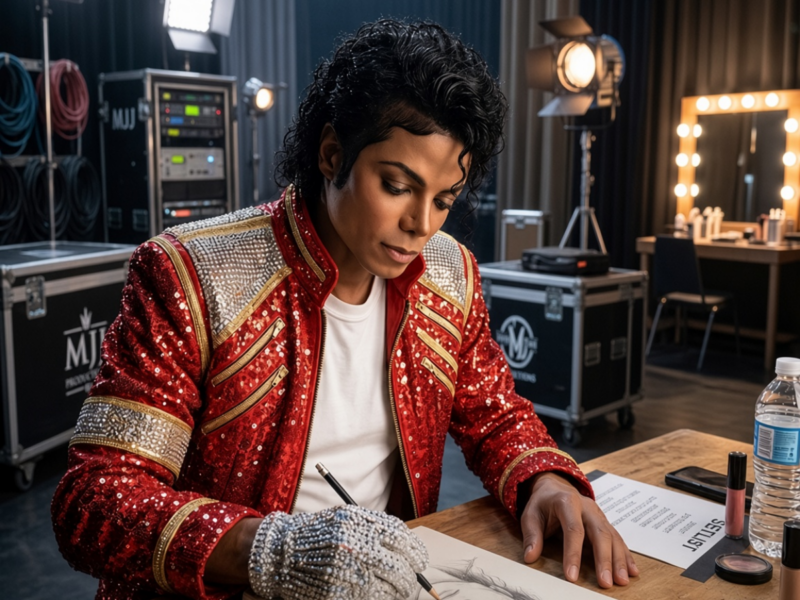
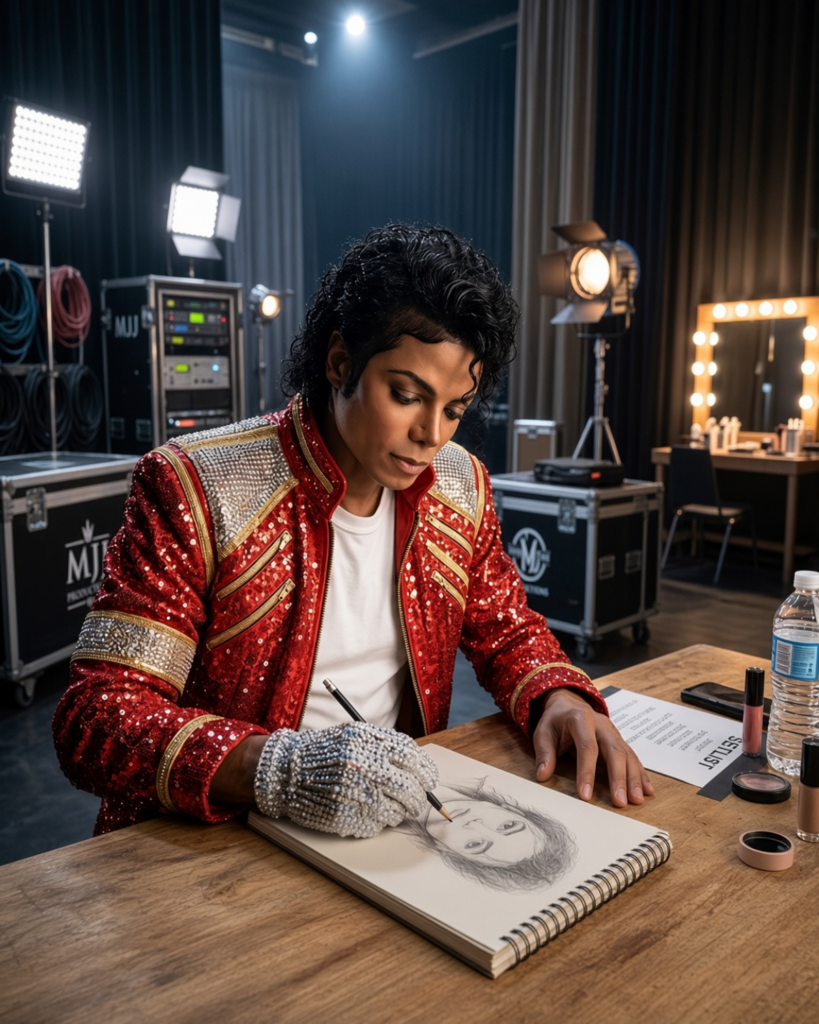
A place where he shed the shackles of fame to pour his nostalgia, loneliness, and yearning for freedom into brushstrokes, paper, and unfinished sketches.
Few would expect that the flame of painting within him ignited during his anonymous childhood years.
Even while sitting in school at Encino, young Michael possessed such a natural talent that his sketches were once chosen for the school yearbook cover.
Yet when the entertainment world crashed into his life like a ruthless storm, visual art stopped being a mere childhood hobby.
It transformed into an absolute sanctuary, a silent visual diary where he concealed his deepest thoughts in charcoal, pastel, and ink.
Behind-the-scenes whispers of his life frequently circulated tales of Michael carrying a small pocket notebook everywhere he went, even during stressful world tours, to capture street corners, passing faces, or sudden painting ideas flashing through his mind.
Media and social networks have spent countless words weaving myths or rumors about the caches of drawings securely locked behind closed doors at Neverland.
Yet, through the accounts of those who actually stepped into that world, such as David Nordahl or Brett-Livingstone Strong, the rare artists who truly understood his soul, the portrait of a genuine painter finally takes shape.
Michael was an extremist in his pursuit of perfection.
He could sit working late into the night over his desk, meticulously refining tiny details with watercolors or oil pastels, only to crumple an entire piece because a single line failed to meet his exact standards.
Over time, that fastidiousness forged a talented hand and a sharp visual sense, leading everyone who crossed paths with him to a shared conclusion.
Had he not chosen music, Michael could easily have reached the world’s summit as a great painter.
The special bond between him and David Nordahl, his exclusive painter of several decades, stands as the clearest proof of this facet.
Unlike a typical boss placing orders, Michael viewed Nordahl as a kindred artistic spirit.
Late at night, when the rest of the world slept, Michael would call just to passionately debate the composition of a large historical painting or ask to weave deep metaphorical layers into it that only careful observers could truly grasp.
Together, they recreated figures like Abraham Lincoln, captured grand historical scenes, or immersed themselves in fairytale realms, because Michael always believed visual art held a transcendent power.
The ability to heal trauma and preserve values across the boundaries of time.
Furthermore, many paintings Michael commissioned Nordahl to create or sketched himself carried profound philosophical meanings regarding the human condition, reflecting a longing for freedom and boundless compassion for underprivileged children worldwide.
Beyond flat paper or canvas, his creative passion extended to another dimension, sculpture and architecture.
In private galleries or golden-lit workspaces within his estate, Michael would immerse himself in classical bronze or plaster statues.
Even grand stage design ideas, flying machinery, or visual effects blinding millions of fans on world tours occasionally started not from complex engineering blueprints, but from scribbled sketches on paper napkins or small hotel notebooks before architects brought them to life.
Ultimately, though, humanity will forever remember Michael Jackson through peerless musical records.
Those charcoal smudges on paper and solitary moments by the easel remain the tenderest whispers about a very different soul, deep, rustic, and ever yearning for sharing and harmony through the raw colors of life.
There, between boundless imagination and a scarred inner world, Michael Jackson built his own eternity, free of public verdicts or concealing masks, harboring only the absolute freedom of a true artist.
Tales from legendary studios, through the accounts of veteran sound engineer Bruce Swedien and genius producer Quincy Jones, have repeatedly revealed their utter astonishment at Michael Jackson’s ability to turn his vocal tract into a miniature orchestra.
During the creative process, rather than sitting hunched over writing notes on paper or waiting for musicians to test arrangements, Michael would stand straight in the middle of the studio, close his eyes, and beatbox the entire skeletal framework of a song himself.
He could accurately replicate the muffled thud of a kick drum, the sharp crack of a snare, the bright hiss of a high hat, and a thick bassline using only his mouth and diaphragm with absolute tempo precision.
History-defining tracks like Billie Jean, Smooth Criminal, and The Way You Make Me Feel did not simply form from vague concepts.
Their rhythmic structures were first sculpted by his own breath and the sounds emerging from his body before being communicated to the band.
Far beyond serving as rough initial sketches, Michael’s beatboxing and rhythm-crafting skills functioned as a supreme weapon, allowing him to impose his musical spatial vision onto the entire production crew.
Bruce Swedien shared on multiple occasions that during the recording sessions for Thriller and Bad, Michael would often step into an empty studio, put on headphones, and craft a complete vocal rhythm arrangement from start to finish before a single instrument was plugged in.
He could hold a steady tempo for minutes on end without deviating by even a fraction of a second, prompting audio engineers to exclaim that the natural rhythmic precision in Michael’s timing sometimes surpassed even the most advanced electronic drum machines of that era.
One of the stories that most clearly demonstrates this supreme skill surrounds the creation of the track Who Is It, featured on the 1991 album Dangerous.
When seeking to create a musical atmosphere that was dark, driving, and deeply haunting, Michael did not hunt for pre-made electronic drum loops.
Instead, he beatboxed the entire intro himself using a complex rhythmic chain interlacing multiple sound layers.
The raw organic audio coming from him possessed such solidity, sharpness, and weight that when engineers dropped it into the studio mix, they barely needed any tweaks to secure a unique signature beat foundation that could never be duplicated.
Beyond producing sounds with his mouth, Michael’s rhythmic sensitivity reached beyond ordinary limits through his seamless integration of body percussion, encompassing powerful foot stomps against wooden floors, sharp claps, or crisp finger snaps.
Dancers who had the opportunity to accompany him during grueling hours-long rehearsals at dance studios recounted that Michael would frequently beatbox while tapping rhythms live to guide the dance formations.
To them, the rhythm emanating from his mouth acted as a living, hyper-accurate metronome, helping the entire crew fully feel every strong and weak beat before polished arrangements blasted from the studio speakers.
In fact, during rehearsals for the Bad World Tour, choreographer Vincent Paterson once witnessed Michael use sounds emitted straight from his vocal tract to reshape the entire movement rhythm of dozens of dancers on stage without needing live band support.
Though mass media rarely witnessed Michael Jackson perform beatboxing as an official stage act before tens of thousands of fans, since he constantly pursued absolute perfection in every polished musical product brought to the light, rare behind-the-scenes footage and whispered accounts from those who stood close to him remain enduring proof.
The world knew him through powerful, soul-stirring screams or stratospheric high notes, but behind those grand sounds lay a genius musical brain that constantly beat in sync with the natural, rustic, and mesmerizing breath of life itself.
Amidst a musical world largely dependent on intricate sheet music, piano keys, or the backing of an entire arranging team, Michael Jackson chose to walk a path entirely his own, one that was profoundly solitary, yet dazzlingly miraculous.
For the King of Pop, crafting a song was never the result of calculated reasoning on paper.
It poured forth like a primal surge of energy from the deepest realms of the subconscious, compelling him to chase it down and seize it instantly before it dissolved into thin air.
Michael’s composition method left even the most seasoned producers in utter astonishment.
He relied entirely on his memory and vocal tract rather than any formal academic music theory.
The tiny cassette recorders he carried in his pocket or kept right beside his pillow were his only existing sheet scores.
Many nights he would jolt awake from deep sleep, hurriedly whispering or humming a melody that had just faded in a dream, knowing that a delay of mere moments would rob humanity of a masterpiece.
Studio backstage lore still echoes with tales of those cassette tapes filled with raw, sketchy voice memos where he hand-simulated everything from drum kicks and basslines to the driving force of an entire choir using only his breath and chest.
The genesis of his ultimate masterpiece, Billie Jean, stands as a quintessential testament to this unconventional creative mindset.
One night in the early 1980s, driving his Rolls-Royce back to Neverland after an exhausting rehearsal, the opening melody unexpectedly rang out in Michael’s mind.
Consumed by the urge to follow the cascading notes, he didn’t even realize smoke was lightly venting from the car’s hood until passersby frantically signaled warnings.
Without pen, paper, or grids, he simply let that wave of emotion command his entire mind throughout the long journey.
Upon arriving home, the signature bassline and drum rhythm were fully poured onto a private tape.
When he brought that raw recording to Quincy Jones, the producer initially doubted it due to its stark simplicity.
Yet that very foundational groove became the immortal backbone of one of history’s greatest songs.
Beyond melodies, Michael’s lyricism carried the weight of intense inner turmoil.
He didn’t write music to cater to charts or superficial entertainment.
He wrote to liberate the profound isolation of someone whose childhood had been stripped away from an early age, forced to live under the microscopic scrutiny of the entire globe.
Anthems like Earth Song, Heal the World, and Childhood read like desperate distress signals to humanity, echoing the sobbing plea of an inner child trapped inside an adult frame, yearning desperately for healing.
When he sat down to write Earth Song in 1983 in Austria amidst crushing media pressure, he spent hours gazing out at the magnificent yet desolate landscape of Bad Hofgastein, letting his emotions translate into haunting verses about mankind’s destruction of nature.
Sound engineer Matt Forger once recalled that when Michael delivered the final vocal notes, the entire studio fell into a stunned silence, weighed down by a sorrowful, piercing authenticity.
His obsessive meticulousness regarding audio details became a studio legend.
Michael never compromised.
During Thriller or Dangerous, he routinely made musicians replay a guitar line or a drum fill dozens of times until it hit the exact emotional frequency he heard internally.
Work sessions sometimes stretched continuously for nearly forty-eight hours in dark rooms where he stood in the middle of the space, eyes closed, waving his hands to direct volumes like a true maestro.
Even when physical exhaustion demanded intravenous hydration on the spot, the slightest off-key note would cause him to snap right back up and refine it until perfection was met.
Michael Jackson’s treasure trove thus extends far beyond record-breaking numbers or hundreds of golden hits.
It lies in how he transformed the most primal heartbeats into a universal language for humanity.
Whenever those old tapes slowly spin, one can still distinctly hear the echo of a solitary genius whispering to music with his entire soul.
Alongside this, his creative world held many untold stories, such as his initial plan to turn Bad in 1987 into a historic duet with Prince, a legendary meeting between two kings once expected to shake the global stage, which ultimately closed its doors due to massive artistic egos and real-world ironies, leaving Bad to stand as Michael’s own proud manifesto of independent identity.
His habit of generating rhythms by tapping directly onto his body, from stomping feet and snapping fingers to slapping his thighs for simulated drum beats in hotel bathrooms or hallways, or his delicate empathy when personally singing guide tracks, mimicking vocal breaths and vibratos for legends like Ray Charles and Bob Dylan during We Are the World in 1985, vividly paints the portrait of a man who lived every breath for his art.
The fusion of raw instinctual energy and uncompromising perfectionism turned Michael Jackson’s musical treasury into an immortal legacy where every single song is a piece of his soul uttered from the deepest abyss of an absolute master.
To major producers and musicians, building multi-layered tracks requires complex musical scores.
Yet Brad Buxer, Michael’s long-time musical companion, repeatedly marveled at his working method.
Michael could neither read nor write traditional notes, but in his mind everything from basslines, harmonies, counter-melodies, drum kicks to violins rang crystal clear, like an active symphony orchestra.
The music was already fully finished in his head before anyone else on Earth ever heard it.
His greatest challenge wasn’t inventing melodies, but translating those racing internal notes into reality for various instrumentalists.
Michael’s method involved directly singing or mimicking sounds for each instrument.
When directing a bassist, instead of handing over sheet music, he stood face-to-face and voiced the bassline himself with exact phrasing and rhythm.
Then came the drummer, then strings.
Robbie Buchanan, a composer who worked with him, noted that he had never witnessed anyone separate orchestral sections mentally with such coherence.
Michael could stand in an empty studio, sing the first violin part layer, the second violin, then cello, all aligning down to the millisecond.
Musicians merely listened, section by section, memorized, and played back his oral teachings.
Hence, his arrangements held uncanny unity born from a single source, a maestro’s mind.
The creation of Earth Song or Smooth Criminal highlights this grand architecture.
With Earth Song, Michael envisioned an epic symphony combining natural roars, choral chants, and driving percussion internally before breathing those sounds out verbally for classical musicians to follow, stunning orchestras accustomed to sheet music.
This supernatural ability made Michael an acoustic architect.
While the world heard polished final records, behind studio curtains lay a mesmerizing translation process where invisible melodies bloomed entirely within his consciousness, brought to life through voice and memory.
That legacy endures as proof of a supreme musical mind where humanity’s grandest tunes first existed in a lonely genius’s silent spaces.
During the 1980s, when the global music scene was still accustomed to monotonous music video models where artists simply stood before the camera singing and swaying in meager preset environments, Michael Jackson stepped forward and discarded all old boundaries.
For the King of Pop, sound and vision were never two parallel entities.
They were twin wings protecting a single pristine core of emotion.
Michael did not merely dictate how a song should sound using a born maestro’s ear.
He foresaw down to the core how it should manifest through the sharp perspective of a master film director.
From iconic costumes and divine energy choreography to elaborate set designs, artistic camera angles, and structured narrative arcs with complete beginnings, climaxes, and resolutions, everything was meticulously crafted in his consciousness before he ever set foot on a sound stage.
That is why masterpieces like Thriller and Smooth Criminal never felt like standard music videos, but were proudly defined by Michael himself under a brand-new title, true short films.
The historic turning point named Thriller in 1983 stands as the most ironclad proof of his ahead-of-its-time vision and unyielding determination.
Proposing a near fourteen-minute supernatural horror film was initially met with fierce resistance from record label executives who feared skyrocketing talent costs and worried that terrifying content would tarnish the star’s image.
Rumors even buzzed through the media at the time that the board had threatened to pull the entire budget and demand Michael scrap the project right before shooting due to fears that it was too violent for mainstream audiences.
Yet Michael did not flinch in the slightest.
He funded the project out of his own pocket, stubbornly recruiting the talented director John Landis onto his team, and threw himself directly into every stage of designing grotesque zombie makeup and brainstorming classic synchronized choreography amid a foggy graveyard.
Legend has it that during production, Michael was so uncompromising with Rick Baker’s makeup team that he demanded the zombie’s skin texture and coloring match precisely what he remembered seeing in his childhood nightmares.
He polished every single frame meticulously to balance the gritty horror of B movies with a high-fashion aesthetic.
As a result, Thriller not only permanently altered how the world consumed and commercialized music, but it also shattered all prejudices to be inducted into the United States National Film Archive as an invaluable intangible cultural heritage, a supreme honor never before achieved by any music video in history.
Not stopping at fantastical horror, Michael’s visual storytelling genius continued to stun connoisseurs through his obsessive perfectionism in Smooth Criminal.
To recreate the suffocating, dangerous, yet alluring atmosphere of a 1930s Great Depression-era underground speakeasy, he constructed a massive grand set at Culver Studios, complete with dim yellow streetlights and drifting smoke creeping through window frames.
Every single camera angle was calculated with precision to completely immerse viewers in the shadowy underworld of a mysterious gang.
Behind the scenes, the media whispered endlessly about how Michael engineered his gravity-defying forty-five-degree lean.
Few knew that to pull off this technique live on stage, he and his collaborators had to patent a specialized pair of shoes featuring a specially designed heel slot that locked securely into the floor pegs.
Crucially, Michael never abused choreography merely for technical flash.
To him, spins, body tilts, and hat tosses served as physical dialogue that drove the script and emotions to their absolute climactic peaks.
That sharp cinematic mindset reached even newer heights through ambitious projects like Ghosts in 1996, a gothic masterpiece spanning nearly forty minutes that once held the Guinness World Record for the longest music video ever made.
Public opinion at the time heavily speculated that Ghosts was Michael’s direct retaliation against the 1993 allegations and investigations, using the imagery of a small town ostracizing an outsider to satirize the cruelty of the media and the public.
Few realized that beneath heavy silicone prosthetics requiring four to five hours of daily application by Stan Winston Studio experts to transform him into the tyrannical mayor, Maestro Michael endured intense physical agony, yet persistently monitored every frame, personally tweaking the facial expressions of the walking dead.
Or take the set of Remember the Time in 1992, which recreated an enchanting ancient Egypt.
He personally sketched gold-plated costumes alongside royal fashion designers and stubbornly executed fiery choreography on scorching sand under the blazing Southern California sun.
Behind-the-scenes accounts noted that Michael grew completely exhausted after hours of shooting in extreme heat, yet he refused to rest until nailing the absolute perfect take, elevating every frame to the exquisite standard of a moving Renaissance painting.
It was this very desire to shatter all traditional limits that turned every Michael Jackson project into a genuine revolution.
He did not view the world with a superficial gaze.
Instead, he used the lens of empathy and imagination to turn his wildest, most fantastical dreams into living, breathing reality on screen.
Under the masterful touch of a lonely genius, pop music was draped in the splendid robes of high academic art, affirming an eternal truth.
When a true artist sings, the entire world must not only listen with its ears, but also open its soul to gaze through the pure light of imagination.
While global audiences remained mesmerized by the master-class dance moves and soaring vocals of a music icon, few could imagine that beneath the glittering sequin jacket, timid eyes, and soft whispered voice lay one of the sharpest and most ruthless commercial strategic minds in entertainment history.
Michael Jackson was never a naive artist to be led around by the nose by record labels or media magnates.
On the contrary, he was the one who single-handedly engineered earth-shattering financial maneuvers that completely reshaped the economic landscape of the modern music industry.
The most classic and monumental proof of this timeless commercial vision occurred in 1985, when Michael executed one of the craziest and boldest acquisitions of the twentieth century, buying ATV Music Publishing.
Behind this transaction lies an interesting anecdote.
Paul McCartney himself had inadvertently suggested to Michael the massive profit potential of investing in song publishing during a casual dinner a few years prior.
However, when the real opportunity arrived in 1985 with a listed price of $47.5 million, Paul unexpectedly hesitated and refused to join in, thinking the price was far too steep.
Seizing the decisive moment, Michael immediately jumped in, beating out a host of heavyweight market competitors to solely own a massive asset holding the rights to over four thousand legendary songs.
Most notably, the majority of the immortal musical catalog of the greatest rock band of all time, The Beatles.
At the time, Wall Street financiers and veteran music executives shook their heads in dismay, arguing that a pop star was digging his own grave and throwing money recklessly into a bankruptcy-bound gamble.
Furthermore, this deal caused a major rift and a profound sense of betrayal in the relationship between Michael and Paul McCartney, because Paul had never imagined that the younger, brotherly figure who once sang Say Say Say alongside him would step up and buy out the entire musical legacy of his own former band.
Yet time stands as the most ironclad proof of an undercover economic genius’s visionary foresight.
Just a few years later, when the television commercial and media markets exploded, the value of intellectual property rights skyrocketed exponentially as major brands rushed to buy classic Beatles hits for soundtracks.
The ATV music publishing asset swelled into an incalculable fortune, providing massive profit streams that helped Michael weather every financial storm of his life.
Not stopping there, by 1995, he executed another genius move by merging his multi-hundred-million-dollar music investment portfolio with the Sony empire, forming Sony/ATV Music Publishing, a multi-billion-dollar joint venture holding the rights not only to the Beatles, but also to a host of other legends like Bob Dylan, Taylor Swift, Lady Gaga, and Eminem.
This historic deal transformed Michael from a salaried singer, one frequently shortchanged and exploited on royalty percentages by record labels, into the true master of the global music lifeblood, proving that he not only knew how to create melodies that moved millions of hearts, but also how to turn those notes into eternal solid gold.
This ambition to command the playing field extended far beyond multi-million-dollar copyright acquisition contracts in the international marketplace.
It was deeply embedded in every nook and cranny of Michael Jackson’s personal branding strategy.
He pioneered the transformation of his name and image into an independent commercial trademark with absolute control value.
Remember the historic multi-million-dollar ad campaign with Pepsi-Cola in the mid-1980s, a milestone that almost claimed his life in a horrific on-set hair-burning accident.
Instead of just taking a paycheck and abandoning his image to whatever the brand wanted, like every other star, Michael personally set the strictest contract terms regarding image censorship, airtime, and commercial scripts, thereby turning the campaign into a global cultural phenomenon.
Later on, during his subsequent peak years, he stubbornly retained ownership of all master recordings for self-produced albums like HIStory and Invincible, refusing to play the hired hand or accept meager percentage shares from record labels.
Michael wanted to hold the entire entertainment industry value chain in the palm of his hand, from the sweat in the recording studio to global commercial distribution channels.
And looking back at that monumental masterpiece of a picture, one fully grasps the sheer greatness of a human being.
Michael Jackson was not merely an artist standing before a microphone to sing for an audience.
He was the almighty architect who single-handedly built an entire artistic universe.
He composed transcendent melodies himself, envisioned every symphony of sound layers in his mind, forged gorgeous cinematic visuals through short films, sculpted dance moves and stage-shaking performances, and finally mapped out a profound economic empire lurking behind the halo.
Michael Jackson was never just an entertainment star.
He was the one who single-handedly created, ruled, and redefined an entire world revolving around humanity’s entertainment.
Even though the stage lights have dimmed and the velvet curtain of the twentieth century has fallen, what Michael Jackson left behind for humanity has never faded across time.
He proved that a true genius is bound by no limits.
They can use their vocal tract to recreate a symphony, use imagination to paint canvases hidden deep in silent realms, use cinematic thinking to turn music into immortal art films, and use a razor-sharp strategic mind to command the commercial lifeblood of global entertainment.
The story of Michael’s life and career does not merely leave us in awe and admiration, but also serves as a fierce inspiration regarding the craving for perfection, the courage to conquer every prejudice and isolation, and the drive to reach the summit of eternal glory.









