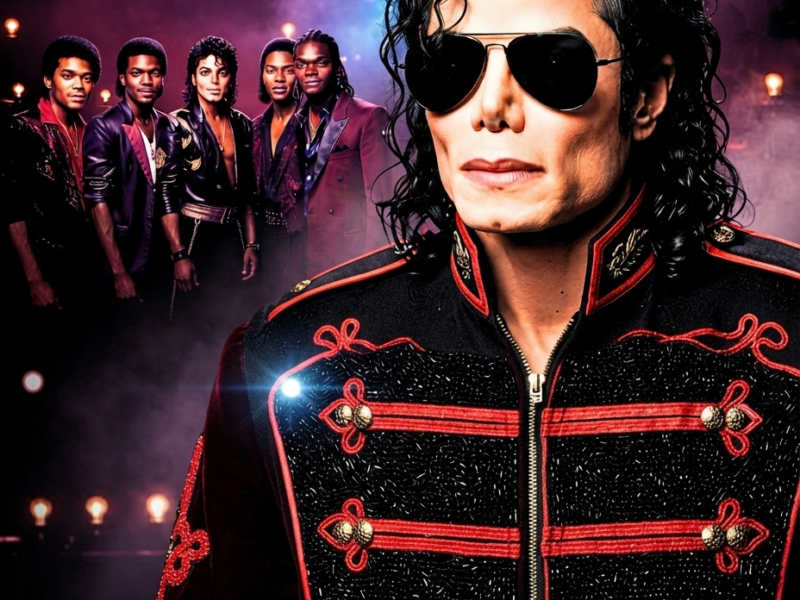
They Called It Victory Michael Jackson Called It a Prison.
The tour was called Victory.
The name was chosen deliberately.
Six brothers returning to the stage together.
The biggest pop family in history, reunited for one final celebration before the world moved on.
It was supposed to be triumphant.
It was supposed to be joyful.
It was supposed to be the kind of event that people talked about for decades afterward as the moment the Jacksons reminded everyone where pop music had come from.
There was only one problem.
The man whose name sold every single ticket.
The man whose face appeared on every piece of promotional material, whose moonwalk had stopped the world only months earlier, whose album was selling a million copies every week, did not want to be there.
Michael Jackson agreed to the Victory Tour not because he believed in it, not because he was excited by it, and not because it represented anything he wanted for his career at that specific moment.
He agreed because he felt he had no choice.
Because loyalty demanded it.
Because guilt required it.
And because walking away from his family at the precise moment his solo success had rendered them commercially irrelevant would have said something about him that he was not prepared to say.
What followed was one of the most chaotic, contentious, and revealing chapters in music history.
A tour that nearly collapsed before it began.
A tour that generated millions of dollars and millions of headlines for all the wrong reasons.
A tour that exposed more clearly than anything that had come before it the impossible tension at the center of Michael Jackson’s life.
The world called it Victory.
Michael Jackson called it the last book.
Both of those things turned out to be true in ways nobody anticipated.
On the morning of November 30th, 1983, New York’s press corps descended on Tavern on the Green in Central Park, expecting a major announcement.
What they got was something considerably stranger than any of them had anticipated.
Don King, the man who had built his career promoting Muhammad Ali’s greatest fights, had turned his considerable promotional energy toward the Jacksons.
He filled the room with the kind of language that belonged in a boxing ring, not a press conference.
Ethereal.
Ephemeral.
Euphoric.
Exciting.
Four words he strung together like a heavyweight’s combination, delivered with the absolute conviction of someone who believed every syllable.
At the center of it all stood 25-year-old Michael Jackson, barely whispering into the microphone, almost apologetic in his quietness.
“The brothers are getting back together.”
That was it.
Six words delivered so softly that the journalists in the front row leaned forward just to hear them.
The man whose voice had just sold 20 million albums could barely be heard across a conference room.
Don King immediately stepped in, explained that Michael’s voice was tired, and took over the proceedings entirely.
It was, for those paying attention, the first sign that this tour was going to belong to everyone except the man whose name made it possible.
There have been reports that you and the Jacksons and others have squabbled and fought and you can’t get together on a lot of the basic issues concerning this world.
Don King leaned into the microphone.
The two closest things I know in life is teeth and tongue.
And every now and then teeth will bite tongue.
But that don’t mean that together we don’t work hand and glove.
Growing, painting the metamorphosis of life, the shedding off of the old and taking on the new.
I’m here.
The mere fact that you are interviewing me this morning and I am telling you that the tour will take off and it will transcend to the heights where the two unknowns answers all those questions, refutes all those accusations in your windows and insinuations.
John King, a graduate of the Jesse Jackson school.
I got so many daggers in my back I look like a porcupine and it’s so difficult for me.
But I realize that I’m a pioneer and a trailblazer, that I must exert every effort known to mankind to try to vindicate the faith that’s extended in my behalf.
So I have to deal with that knowing that the problems are there and there are many.
They’re complex.
But I shall persevere for I know not any other way.
To understand why the announcement felt so strange, you have to understand exactly where Michael Jackson was standing in November 1983.
Not metaphorically.
Literally.
Commercially.
Culturally.
Off the Wall had arrived in 1979 and immediately rewritten what a solo Black artist was permitted to achieve on mainstream pop radio.
20 million copies worldwide.
9 million in the United States alone.
The first album in history to produce four top 10 singles simultaneously on the Billboard Hot 100.
Critics called it a masterpiece.
The industry called it a phenomenon.
Michael called it a beginning.
Then came Thriller.
37 consecutive weeks at number one on the Billboard 200.
A million copies sold every single week at its commercial peak.
“Billie Jean” and “Beat It” charting in the top five simultaneously, a statistical rarity that had never happened before and would not happen again for years.
The bestselling album of the year.
Then the bestselling album of the decade.
Then the bestselling album in recorded history.
He had not simply made a successful record.
He had redefined what success in popular music was allowed to look like.
Breaking racial barriers on radio and television.
Pioneering the music video as an art form.
Becoming pop culture’s ultimate crossover artist at a moment when crossover still cost something to achieve.
By November 1983, Michael Jackson was not a superstar rejoining his family group.
He was the most commercially dominant solo artist on the planet, voluntarily stepping backward.
The question nobody could quite bring themselves to ask publicly was the most obvious one.
Why?
Michael Jackson spoke only to introduce his family.
When directly questioned about the upcoming tour, King was quick to intercede.
Michael is just got to introduce his family and he has a voice.
There’s a problem that he’s been working so hard singing all these songs and he will not be able to continue at this point in today America, tomorrow, the world.
Already a powerful but controversial figure in the sports arena, King, who reminded the crowd that he had helped guide Muhammad Ali to prominence, has charged into the music field with his usual flamboyant style, promising that the Jackson concert tour would net several hundred million dollars.
An unparalleled excitement.
Jackson mania was King telling the story.
Michael Jackson’s separation from the Jacksons did not happen overnight.
It was not a single decision made on a single afternoon in a single room.
It was a gradual, deliberate, carefully managed process that had been underway for years before the Victory Tour was ever announced.
Visible to anyone paying close attention and impossible to ignore by the time Thriller had finished rewriting the commercial landscape of popular music.
It began with The Wiz in 1978, a film that on the surface was simply another acting role for a young performer trying to expand his creative horizons.
But on set, Michael met Quincy Jones.
And that meeting changed everything.
Jones saw something in Michael that the Jacksons’ collective identity had always partially obscured.
A singular creative intelligence.
A perfectionist’s ear.
An artist who was not simply talented, but who was capable, given the right conditions and the right collaborator, of something genuinely historic.
Off the Wall was the first proof.
Thriller was the confirmation.
And by 1983, Michael had his own lawyers, his own accountants, his own management infrastructure, and his own creative vision that had almost nothing to do with the group he had been performing with since he was five years old.
His image had shifted too.
The whispers about his evolving appearance, his refined features, his shrinking frame, the gradual transformation of his public face, were not simply tabloid fodder.
They represented something real.
A conscious, deliberate movement away from the Jackson family identity and toward something singular.
Something that belonged to Michael alone and could not be shared, divided, or diluted by association.
One reporter present at the 1983 press conference noted it plainly.
The young man who had once embodied the Jackson family’s collective identity had been replaced by something different entirely.
A global phenomenon who happened to share their surname.
The separation was already complete.
The tour had not yet begun.
How long have you had this beautiful beast?
Gosh, that’s during a little before Thriller.
I had him for about almost a year.
Almost a year now.
And this type of snake is not dangerous.
Well, I don’t think so.
Some people might.
Could it be that they squeeze?
Yeah, they squeeze.
They can really squeeze.
I think he’s great.
What other animals do you have?
Before the Victory Tour was announced, before Don King took over a press conference in Central Park, before a single ticket was sold or a single stage was built, there was one night that made everything that followed both inevitable and impossible to undo.
Motown 25.
Yesterday, Today, Forever.
A television special celebrating the 25th anniversary of Berry Gordy’s record label.
Bringing together the greatest artists in Motown’s history for one night of shared celebration.
Smokey Robinson.
Diana Ross.
Stevie Wonder.
Marvin Gaye.
And the Jacksons, reunited for the first time since 1976, performing together on national television in front of an audience that had been waiting years for exactly this moment.
Michael almost didn’t do it.
He was reluctant from the beginning.
Not because he didn’t love his brothers.
Not because he had forgotten what those early Motown years had meant.
But because Motown 25 was explicitly designed as a celebration of the past.
And Michael Jackson, by the spring of 1983, was not interested in the past.
He was interested in “Billie Jean.”
He was interested in Thriller.
He was interested in the future that he could already see clearly and that his brothers, through no fault of their own, could not follow him into.
He agreed to perform with his brothers.
The medley of classics, “I Want You Back,” “The Love You Save,” “Never Can Say Goodbye,” “I’ll Be There,” was genuinely moving.
Warm.
Nostalgic.
The kind of performance that reminded everyone watching exactly why the Jackson 5 had mattered.
And then Michael stayed on stage alone.
The driving beat of “Billie Jean” began.
The audience erupted.
And in the space of four minutes, with a single sequence of steps that nobody in that auditorium had ever seen before, Michael Jackson debuted the moonwalk and rendered everything that had just happened before it almost completely invisible.
The media coverage overwhelmingly focused on Michael.
The brothers had hoped Motown 25 would remind the world of their collective power.
Instead, it demonstrated with crushing clarity that Michael’s power was no longer collective.
It belonged entirely to him.
And everyone in that auditorium understood, in the moment it happened, that nothing was ever going to be the same again.
Ever since we were kids, we’ve always wanted to dance or keep the time to the music.
And that’s part of us.
It’s like something we have to have and it’s in us because I don’t know what I would do if there was no music.
Music is a way of getting across to people.
People may not want to read, but they will always listen to music.
One of the most important things to being successful is listening and watching and being a good person to work with.
Easy to work with.
Oh yeah, I’m interested in promotion.
I want to do things that’s never been done before.
I would be able to translate my music to different countries.
Africa.
Japan.
New Zealand.
Scotland.
All the way to Australia.
Even after Motown 25, Michael resisted.
Reports emerged of solo tour plans, a Spielberg collaboration, extraterrestrial stage effects.
As late as October 1983, the press was still writing “if” Michael joins them, not “when.”
He was looking for a way out.
He just hadn’t found the words yet.
In the end, it came down to guilt.
Michael’s solo success had eclipsed his brothers so completely that continuing without them felt like abandonment.
20 years of performing together.
A lifetime of shared stages and shared sacrifices.
He felt he owed them one final farewell.
One last celebration before he walked away forever.
Not because he wanted to.
Because he believed he had to.
Is it really as close as you seem?
Yeah, we’re all close.
And the idea of being separated from them, does that hurt?
No, it doesn’t.
It’s, um, because there’s other kinds of sounds and music that I love to do.
It hurts what is inside of me and it can’t get out and it’s hidden from the world.
When I do those solo albums and I’m doing all kinds of different things, it’s wonderful.
I feel like I’m accomplishing what I’m supposed to do.
And you don’t feel guilty or worried about your brothers?
No, they understand.
Why?
Why hide?
Why hide it?
Share it.
At the press conference, Michael said it plainly.
“This definitely will be the last tour.”
Hidden behind sunglasses, voice barely above a whisper.
A declaration that felt less like excitement and more like a closing statement.
The world heard a promise of victory.
Michael was already saying goodbye.
There was one more reason Michael agreed.
Thriller had made him the most scrutinized person on the planet.
The press questioned whether he was abandoning his family, his roots, his race.
One final tour with his brothers would silence that narrative.
Remind the world of the smiling kid from Gary, Indiana.
It was image management as much as loyalty.
Preparations began.
50-foot stages.
Pyrotechnics.
Ticket lines around city blocks.
Don King promising hundreds of millions of dollars.
The machinery of the biggest tour ever conceived grinding into motion.
But underneath all of it, the man at the center had already decided this would be his last time standing on this particular stage with these particular people.
The countdown had begun.
Take that and use that as the main foundation for the track and build all the sounds around that rhythm and you can see his creative process.
You can see the organic process.
You can’t teach that.
There’s no moment musically that you really think that never disappoints you?
I’m just never satisfied with what I do creatively.
You know, I just regret the limitation of my own imagination.
I just feel there’s so much more.
I don’t think I’ve ever done a project where I was totally happy with it.
When Thriller sold 41 million, you have to top yourself all the time.
And is that the hardest part?
I think the next one is always the toughest one because people expect more and more.
And no matter how good it is, I go, “Well, it wasn’t as good as I liked it.”
You know, that type of thing.
So that’s what makes it difficult.
Because when I did Off the Wall, people always said to me, they would say, “You can’t top Off the Wall. You just cannot.”
I mean, here you had like four top 10 singles from this album.
It’s never been done before.
And it sold 10 million albums.
And they go, “How can you beat that?”
I said, “Well, I’ll just do what happened next.”
The accidents.
The lawsuits.
The feuds.
The final act of defiance that shocked the world is a story that makes the announcement look simple by comparison.
The Victory Tour hadn’t started yet.
The chaos was still coming.









