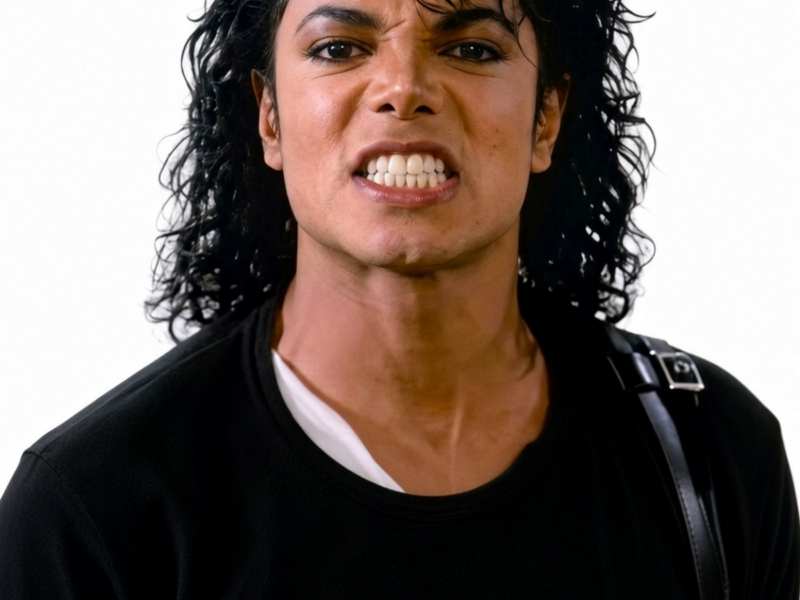
The Words The Media Scribbled All Over Michael Jackson.
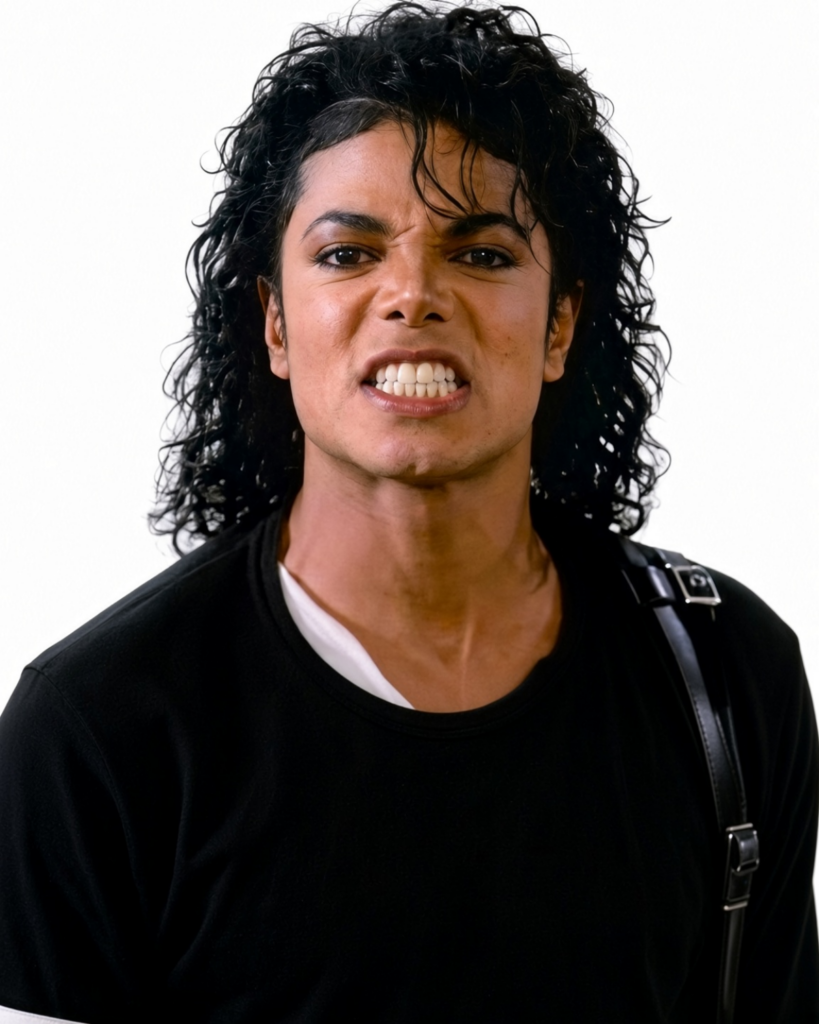
“Leave me alone, man.”
“Leave me alone.”
“I’m not an animal.”
“I’m a human being.”
Do we, as human beings, treat people as animals too many times?
I think so.
In 1987, Michael Jackson released an album that produced five number one singles—something no album had ever done—and the press called it a disappointment.
Behind that record was a story almost nobody tells.
Dozens of songs written for a three-disc album that never happened, a rival superstar who turned down the title track, a mentor who fought him over what stayed and what went, and a world tour that broke records while quietly wearing him down.
If you only know Bad as the album full of classics, you don’t really know what it cost him or why so many people in 1987 were convinced he’d lost it.
Stay to the end and you’ll understand exactly how he answered his critics and why the words they used aged far worse than the music ever did.
August 31st, 1987, Bad arrived in record stores.
And that same night, CBS aired a primetime special built around one thing: the premiere of the title track short film.
It ran for around eighteen minutes.
It was directed by Martin Scorsese and shot partly in a subway station in Brooklyn, with a young Wesley Snipes playing the street tough who challenges Michael’s character.
Everything about the rollout said this was an event—and that was exactly the problem.
Michael wasn’t competing with other artists that night.
He was competing with himself.
The shadow of Thriller hung over every review, every radio debate, and every conversation in every record shop.
It didn’t matter what Bad actually sounded like.
The question critics kept asking was simpler and harsher: is it as big?
And because nothing could be as big, a lot of them had their answer before the needle dropped.
The reviews that followed were mixed, and the tone of the wider coverage was often colder than the reviews themselves.
Some critics praised the production and the energy.
Others called the album slick, calculated, and safe—a record made by a man trying to recreate a moment rather than create a new one.
The word that kept coming up was disappointment.
Not because the songs were weak, critics argued, but because the bar was impossible.
One album had changed the business.
The next one, apparently, had to change the world or it would count as a failure.
Then there was the cover.
Michael stared out from it in black leather, buckles and straps, his hair longer and looser than fans remembered from the Thriller days.
And it wasn’t just the outfit people noticed.
His skin appeared noticeably lighter.
His features looked sharper and more defined.
Years later, he would publicly explain that he lived with vitiligo, a skin condition.
But in 1987, there was no explanation—only speculation.
And the tabloids were happy to fill the silence.
By then, the British press had already started using a nickname that would follow him for the rest of his life: Wacko Jacko.
Stories ran about him sleeping in an oxygen chamber, about him trying to buy the remains of Joseph Merrick, the so-called Elephant Man, and about his pet chimpanzee, Bubbles.
Some of these stories were exaggerated, and some were reportedly encouraged by his own camp as publicity.
But once they were out there, they framed everything.
The album wasn’t just reviewed as music.
It was reviewed as evidence about the man.
Among some fans, the reaction cut deeper.
The Michael of Off the Wall and Thriller had felt effortless—warm and cool at the same time.
To a section of that audience, the new Michael looked different in a way they didn’t know how to process.
Commentators at the time described his new image as too soft, too delicate, too styled, and not nearly tough enough for an album called Bad.
The leather and the attitude, they argued, didn’t match the man wearing them.
That gap between the image he was projecting and the image people saw became one of the most repeated jokes of the year.
So within weeks, the story the press wanted to tell was clear.
The king had peaked.
The magic was gone.
Bad was the sequel that couldn’t measure up.
What almost nobody covering it knew was how close the album had come to looking completely different—and how hard Michael had fought to make it his own.
To understand why Bad sounded the way it did, you have to go back into the studio.
Work on the album stretched across roughly two years, much of it at Westlake Recording Studios in Los Angeles, with demos built at Michael’s family home in Encino.
The team around him was the same one that had made history twice before: Quincy Jones producing and Bruce Swedien, the engineer behind the sound of Off the Wall and Thriller, at the console.
But the balance of power had shifted.
On Thriller, Michael had written four of the songs.
For Bad, he came in with something closer to sixty.
He reportedly wanted to release a three-disc album of around thirty songs—a statement so big that nobody could dismiss it as a sequel.
Quincy saw it differently.
To him, a great album was a tight one: every track a potential single, no filler.
Song by song they argued.
Song by song the pile got smaller.
When it was finally finished, the album had ten tracks on vinyl and eleven on CD.
Michael had written nine of them himself.
The cuts left behind songs that fans would only hear decades later on reissues and anniversary editions.
Some of them were finished.
Some were barely sketches.
All of them were pieces of the bigger album he had in his head.
Even the title carried a message.
Michael wanted the world to see him as tough, edgy, and in charge—the opposite of the fragile figure the tabloids were selling.
Quincy pushed for outside material, too.
One song he championed, written by Siedah Garrett and Glen Ballard, became “Man in the Mirror.”
Garrett also ended up singing the duet “I Just Can’t Stop Loving You” after, according to many accounts, bigger names had been approached for it.
Stevie Wonder joined Michael on “Just Good Friends.”
On paper, the credits were stacked.
And then there was Prince.
The plan, as it’s often been told, was for the title track to be a duet—a head-to-head between the two biggest stars in pop, framed as a real showdown.
Prince listened and passed.
He later suggested the song’s opening line simply didn’t work with the two of them singing it to each other.
Whatever the full reason, the moment never happened, and Michael recorded “Bad” alone.
If you’re the kind of person who loves these behind-the-scenes stories as much as the songs themselves, hitting subscribe is the easiest way to make sure you don’t miss the next one.
Then came the delays.
Thriller had been released at the end of 1982.
Bad didn’t arrive until late summer 1987—almost five years later.
In between were the Victory Tour with his brothers, a headline-making accident on the set of a Pepsi commercial in 1984, and a level of fame so overwhelming that it shaped every decision he made.
Every month the album didn’t come out, the expectations got heavier.
By the time it was ready, the industry had built a pedestal so high that nothing could have stood on it.
And here’s the part critics in 1987 often brushed past: Bad was a monster.
It debuted at number one in America and in the UK.
Then the singles started to land.
“I Just Can’t Stop Loving You” went to number one on the Billboard Hot 100.
Then “Bad.”
Then “The Way You Make Me Feel.”
Then “Man in the Mirror.”
Then “Dirty Diana.”
Five number one singles from one album—something no album in history had ever done before.
Think about that for a second.
The same record being written off as a let-down was rewriting the record books at the exact same time.
That’s the irony at the center of Bad.
Michael was breaking records that even Thriller hadn’t broken, and the story still being told about him was that he’d fallen off.
Nowhere was that contradiction clearer than on one night in New York.
It’s March 2nd, 1988, at Radio City Music Hall in New York for the 30th Grammy Awards.
Michael’s appearances on live television had become rare, and the room knew it.
Bad was up for Album of the Year.
Four years earlier, Thriller had won eight Grammys in a single night.
Everyone in that building was waiting to see if lightning would strike twice.
He opened with “The Way You Make Me Feel,” loose and playful, all footwork and attitude.
Then the lights shifted, and he moved into “Man in the Mirror,” backed by Andrae Crouch and his gospel choir.
As the song built, Michael pushed harder, dropping to his knees, pulling himself back up, almost fighting the music.
By the final minutes, he was soaked.
The choir was roaring behind him, and the audience was on its feet.
People who were in that room have described it as one of the greatest live performances in the show’s history.
Then the envelopes were opened.
Album of the Year went to U2 for The Joshua Tree.
Bad’s nominations in the vocal categories didn’t land, either.
By the end of the night, the album that had already produced a string of number one singles left with a single Grammy for engineering—and that one went to Bruce Swedien and Humberto Gatica, not to Michael.
For the press, it was the perfect headline.
A standing ovation and empty hands in the same night seemed to confirm the story they’d been telling for months: still a great performer, maybe, but no longer the man deciding where music was going.
Part of that argument was about sound.
In 1987 and 1988, the ground under pop music was moving.
Hip-hop was no longer a side story.
Eric B. & Rakim had released Paid in Full.
Public Enemy had arrived with Yo! Bum Rush the Show and were about to release It Takes a Nation of Millions to Hold Us Back.
LL Cool J was all over the radio.
At the same time, a young producer from Harlem named Teddy Riley was building a new sound that would be called New Jack Swing, with hard drum machines, hip-hop rhythms, and R&B vocals on top.
Keith Sweat’s “I Want Her” was everywhere.
And in 1988, Bobby Brown released Don’t Be Cruel, which went on to become the best-selling album in America in 1989.
Next to that, some critics heard Bad as polished, expensive, and a little behind the times.
Too pop for the street, too clean for the clubs.
The swagger younger listeners wanted was coming from somewhere else now, and to a growing part of that audience, Bobby Brown felt like the newer, cooler version of what Michael had once been.
The image argument came back, too.
The Bad short film—with Michael as a young man coming home to his old neighborhood and proving himself on the street—was mocked in some corners as unconvincing.
Comedians piled on.
Weird Al Yankovic released “Fat,” a parody of the title track, and its video went on to win a Grammy of its own.
Michael had personally approved the parody, which says a lot about how he chose to handle the jokes.
So what did he do with all of this?
He didn’t argue in interviews.
He barely gave interviews at all.
He did what he’d always done.
He answered on stage.
And the stage he chose was the biggest one he had ever built.
The Bad World Tour opened in Japan in September 1987, less than two weeks after the album came out.
It was Michael’s first solo world tour, and it became one of the biggest tours in history up to that point.
Over roughly sixteen months, he played 123 concerts across fifteen countries to around 4.5 million people, grossing an estimated $125 million.
At Wembley Stadium in London, he played seven sold-out shows to more than half a million fans—a run that earned him a place in the Guinness Book of World Records.
On paper, it was the ultimate answer to anyone calling the album a flop.
But behind the numbers, the tour was taking something from him.
The schedule was relentless—stadium after stadium, continent after continent—with a show built on choreography that left him drained every single night.
His voice was under constant strain, and reports at the time mentioned dates being moved so he could rest.
People around him described a man who was increasingly isolated on the road, surrounded by security, unable to walk down a street, and spending long stretches alone in hotel rooms between performances.
He said publicly that this would be his last tour, and while that didn’t turn out to be true, it tells you how he felt at the time.
The physical toll of performing at that level, and the pressure of living under a microscope, would follow him well beyond the end of the tour.
His health became a growing concern in the years that followed, and many of the struggles that became public later on can be traced back to the punishing demands of this era.
There were changes off stage, too.
In 1988, he bought the ranch he would call Neverland—a place built to give him the privacy the world wouldn’t.
That same year, he published his autobiography, Moonwalk, partly as an attempt to tell his own story before the tabloids finished telling it for him.
And the creative partnership that had defined his career was quietly coming to an end.
Bad would be the last album Michael and Quincy Jones ever made together.
I genuinely want to know what you think here.
If you’d been in Michael’s shoes in 1988, with the records broken and the headlines still against you, would you have kept pushing forward or stepped away for a while?
Let me know in the comments.
Then, in early 1989, came the answer that put it all into pictures.
The short film for “Leave Me Alone”—a track that had appeared on the CD release of Bad—turned the tabloid circus into an actual theme park.
Michael rides through it surrounded by newspaper headlines: the oxygen chamber, the Elephant Man’s bones, his chimp, and every rumor that had been written about him, all built into rides and attractions.
At the end, a giant version of Michael breaks free from the ropes that have been tying him down.
It was funny, self-aware, and pointed, and it won him a Grammy for Best Music Video.
The same industry that had handed his album a single engineering award was now honoring the film in which he made fun of the people making fun of him.
When the next album arrived, the man at the controls next to him was Teddy Riley—the architect of the very sound critics had said was leaving Michael behind.
He had listened.
He just hadn’t surrendered.
Why nobody calls Bad a flop anymore.
Go back and read the coverage from 1987, and you’ll find versions of all of those words.
Lazy.
Flop.
Fail.
Now look at what’s still standing.
Bad is widely estimated to have sold more than 30 million copies worldwide, making it one of the best-selling albums ever released.
Its record of five number one singles from one album went unmatched for more than two decades, until Katy Perry’s Teenage Dream finally equaled it in 2011.
That’s how long the so-called disappointment held the line.
The songs never went away.
“Smooth Criminal” gave the world the anti-gravity lean—a move so impossible-looking that Michael and his team patented the special shoes that made it work on stage.
“Man in the Mirror” became one of the defining songs of his catalog, and after his passing in 2009, it surged back up the charts as people around the world turned to it.
“The Way You Make Me Feel” is still played at weddings, parties, and talent shows almost four decades later.
“Dirty Diana,” “Another Part of Me,” and “Leave Me Alone”—songs once treated as album tracks on a lesser record—now sit at the heart of his legacy.
In 2001, the rock band Alien Ant Farm took a cover of “Smooth Criminal” into the charts, introducing it to a generation that wasn’t even born when Bad came out.









