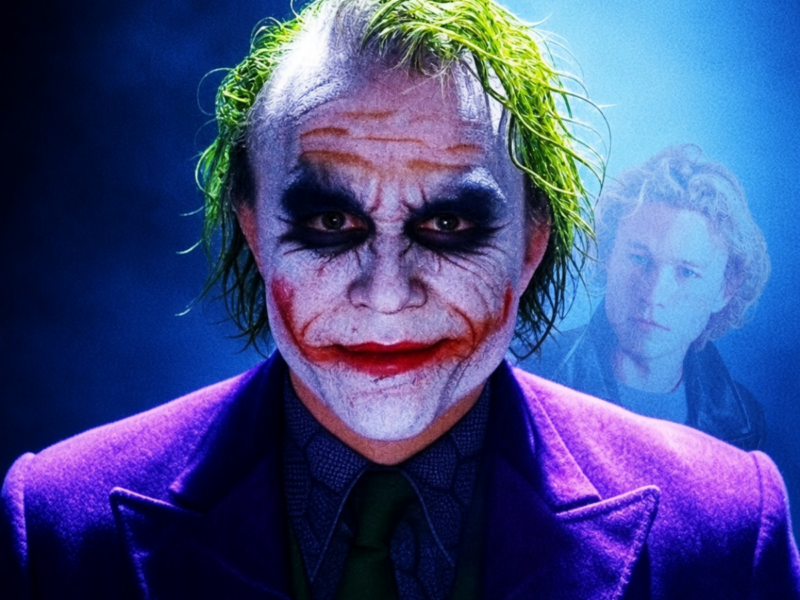
The Truth About Heath Ledger’s Joker.

On January 22nd, 2008, a call went out that would shock the world.
Heath Ledger, Hollywood’s brightest rising star and the man behind the most haunting portrayal of the Joker ever seen, was found dead in his New York apartment at just 28 years old.
Heath Ledger was gone, leaving behind questions, heartbreak, and a legacy unlike any other.
But this wasn’t just a tragic loss.
It was the abrupt end of a journey into darkness, one that had taken Ledger to unimaginable depths for his final role.
How does a man so full of life slip into the mind of chaos itself?
What happens when you start to become the role you’re playing?
This is the story of Heath Ledger, a man who pushed himself to be the best of his talent and paid the ultimate price.
Welcome to Hollywood hell.
It’s April 4th, 1979, Perth, Australia.
One of the greatest actors to ever be displayed on the big screen has just been born.
Growing up, Heath explored poetry, chess, and even dance.
But it was at the young age of 10 where he seemed to find his true calling: acting.
Ledger moved to Sydney, Australia in his late teens to pursue acting full-time, taking on small roles in Australian films and TV shows, hoping one day to make it in the spotlight of Hollywood.
Unlike many young actors, he wasn’t interested in fame just for fame’s sake.
He wanted to bring something powerful and real to the screen, something that the audience would remember when they left the theaters.
His first big break came when he landed a leading role in the 1999 teen romantic comedy 10 Things I Hate About You, portraying the heartthrob Patrick Verona.
This film brought Ledger to the attention of Hollywood, showcasing his undeniable charm, wit, and talent.
The movie was a hit, and suddenly Heath Ledger was a name people remembered.
Women lusted over him while the men strived to be like him.
He was the new cute face in Hollywood.
But as much as fans loved him in this fun romantic role, Ledger felt himself drawn to something deeper.
Instead of capitalizing on his new heartthrob status, Ledger took a different path.
He chose roles that allowed him to explore more challenging and complex characters.
One of his most notable early performances was in A Knight’s Tale in 2001, where he played William Thatcher, a young man who defies the class system to become a knight.
This role allowed Ledger to break out of the teen idol mold and establish himself as a serious actor.
Over the next few years, he continued choosing roles that allowed him to explore the human experience from different angles.
“So this is, um, first day shooting. I’m looking forward to it. It’s been 3 months since I found out I got this job and finally this is it. So, um, blink my eyes and we’ll be out there.”
He wasn’t afraid to take risks or to play roles that others tended to shy away from.
Ledger’s performances in films like Monster’s Ball and Lords of Dogtown showed that he was willing to embrace characters with flaws, struggles, and raw emotional depth.
Specifically in Monster’s Ball, he was able to perform next to already well-established Hollywood names such as Halle Berry, Billy Bob Thornton, and strangely enough, even P. Diddy.
But his true dedication really showed in Brokeback Mountain, where Ledger played Ennis Del Mar, a cowboy working as a ranch hand who falls in love with another man.
He played alongside Jake Gyllenhaal, who played Jack Twist.
The story was about the two cowboys caught in a painful love story, struggling with acceptance of their true identity.
This role was pivotal in Ledger’s career and it pushed him to his emotional limits.
He described the role as one of the hardest he’d ever played, and critics and audiences alike praised his performance for its honesty and vulnerability.
Ledger was nominated for an Academy Award, further solidifying his reputation as a serious actor not afraid to push the limits, something that would soon get the best of him.
By this point, Heath Ledger was well-established in Hollywood, but he still wasn’t interested in fame or recognition.
In fact, he was often uncomfortable with the attention that came with being a public figure.
He lived his life somewhat privately and focused on the art rather than the perks of stardom.
This dedication to the art over fame set him apart and made him one of the most intriguing and respected actors of his generation.
During this transformative period, Heath’s personal life blossomed.
He fell in love with Michelle Williams, his co-star from Brokeback Mountain, and in 2005 they had a daughter, Matilda Rose.
Fatherhood changed Heath, grounding him and filling his life with a new purpose.
Heath adored Matilda, often saying she was his greatest joy.
He spoke of how she gave his life meaning beyond anything he’d ever experienced, and he wanted to be the best father he could be.
In 2007, an opportunity arose that would define Heath’s legacy.
Director Christopher Nolan had offered him the role of the Joker in The Dark Knight.
“It was awesome. Yeah, it was the most fun I’ve had playing a character, hands down. And I think the movie is going to be awesome. Like, I’m very excited.”
Ledger knew the weight of the role.
The Joker had been brought to life before, but Heath was determined to give audiences something they’d never seen.
The Joker was known as one of the darkest, most chaotic villains in comic book history.
It was a role that demanded a certain level of madness and unpredictability, something that Ledger wasn’t typically used to.
But Nolan saw something in Ledger.
He believed that he could bring a fresh and terrifyingly real twist to the Joker.
Ledger himself was drawn to the role for its complexity.
He wasn’t interested in just playing a villain.
He wanted to explore the Joker’s mind, to understand what made him tick.
The Joker was more than just an evil character.
He was the symbol of chaos and madness.
For Ledger, this was the ultimate challenge, and he approached it with the same intensity and dedication that he had given to every role in his career.
This role required a deep dive into the psychology of a character who thrived on disorder, who found joy in destruction and manipulation.
For an actor like Ledger, who often immersed himself completely in his characters, this was both an exciting and dangerous journey.
He knew that playing the Joker would push him to his limits in ways he had never experienced before.
Before filming even began, Ledger started preparing for the role in ways that went beyond the typical script.
He was determined to make his Joker stand out, to bring something unique and haunting to the screen.
Unlike previous portrayals, Ledger’s Joker would be more chaotic, more human, and perhaps the most unsettling of them all.
He wanted audiences to feel both fear and fascination when they saw his performance.
Ledger’s commitment to the role was evident in the way he approached every detail.
He worked closely with Nolan to shape the Joker’s voice, laugh, and overall demeanor.
He wanted the character to feel real, almost like a twisted mirror reflecting the darker sides of humanity.
Every movement, every facial expression, every laugh was carefully crafted, and Ledger made sure each one contributed to the unsettling aura of the character.
Friends and co-stars noted that Ledger himself threw himself into the role with a level of intensity they hadn’t seen before.
He isolated himself, spent hours researching and preparing for the role.
He wanted to be the best, but to do that, he had to truly get inside the Joker’s head.
So Ledger decided to keep a diary, documenting his thoughts as if he were the Joker himself.
This diary was filled with disturbing notes, sketches, and ideas that reflected the Joker’s chaotic mindset.
This wasn’t just writing down notes on the character or creating a backstory.
This was a way for Ledger to channel the character’s darkness into something real, something he could refer to and draw inspiration from.
Ledger reportedly chose a specific hotel room in London where he could cut off all distractions from the outside world.
No friends, no family, no interruptions.
Just Ledger and the Joker.
This solitude allowed him to fully embody the chaotic essence of the character, immersing himself in the darkness and unpredictability that defined the Joker.
Some pages included crude, unsettling sketches of faces contorted in fear, symbols of violence, and bizarre images that seemed to have no pattern but conveyed a disturbing sense of disorder.
Ledger sketched things like clowns with exaggerated features, eyes that seemed hollow, and abstract shapes that added to the journal’s terrifying aura.
There were also snippets from newspaper clippings, odd quotes, and disturbing thoughts.
He would write things that in any other context would raise eyebrows, but in the context of the Joker, they made a twisted kind of sense.
One page in the journal titled “Things That Make Me Laugh” followed by “blind babies, landmines, AIDS, beloved pets in road accidents.”
He noted phrases like “Why so serious?” and “It’s all a joke,” capturing the Joker’s view of life as something to laugh at no matter how dark the humor.
Ledger even pasted pictures and wrote small notes that were incoherent to anyone but himself.
To someone who saw the diary, these notes seemed like the ramblings of someone slipping into a different world, a place where rules and normal behavior didn’t apply.
Lines like “Everything must burn” and “I can’t feel anymore” were scattered across the pages, representing the Joker’s detachment from human emotions and his attraction to chaos.
For Heath Ledger, playing the Joker was more than just another acting job.
It was a transformative experience, one that would leave a lasting impact on him and the world of cinema.
He approached the role with a rare level of dedication, fully immersing himself in the Joker’s madness.
But this commitment came with a heavy price.
From the start, Heath Ledger approached the role of the Joker with an intensity that was both admirable and alarming.
The Joker diary became a key part of his preparation process.
It allowed Ledger to slip into the mind of Gotham’s most dangerous villain.
But during this time, the lines between himself and the Joker began to blur.
He would spend hours each day reading through this Joker diary, using it as a way to push himself deeper into the character’s mindset.
The more he immersed himself in it, the more his own personality seemed to fade away, replaced by this character he was trying to bring to life.
The process wasn’t easy, and it came at a cost.
Isolating himself and spending every waking moment thinking like the Joker began to weigh heavily on Ledger’s mind.
People close to him later noted that he seemed different, that he changed, and that this role was affecting him in ways they hadn’t seen before.
As Ledger spent more time with the Joker diary, its impact on his mental health became apparent.
The dark thoughts and chaotic imagery weren’t just confined to the pages.
They started to affect Ledger’s own thoughts and feelings.
The intensity of the role, combined with the solitary confinement he subjected himself to, began to take a toll on his emotional and psychological well-being.
Ledger, who was normally grounded and easygoing, became more secluded, withdrawn, and noticeably affected by the character’s darkness.
Ledger himself even admitted in interviews that the role took a toll on him, describing how he struggled to sleep and how his mind was constantly racing.
The lack of rest, combined with the emotional weight of the character, led him to self-medicate with prescription drugs in an attempt to quiet his mind.
But even that wasn’t enough to fully detach from the character he’d created.
Friends, family, and cast members noticed a change in Ledger’s demeanor.
He seemed haunted, as if he couldn’t escape the darkness he brought to life in the Joker.
Some speculated that the diary acted almost like a Pandora’s Box, a place where Ledger had poured all of the Joker’s evil, and that evil began to seep back into his own life.
Ledger was a dedicated artist who was willing to push himself to extremes to create a performance that would resonate with audiences.
His Joker was terrifyingly real, but it was Ledger’s commitment to capturing the character’s madness that made it so impactful.
The diary, while a tool for the role, became something more.
A representation of Ledger’s intense method acting and ultimately his downfall.
This wasn’t a prop for a movie.
It was a reflection of his descent into a character who represented chaos and violence, and that reflection left a traumatic mark on him.
Years after Ledger’s passing, his Joker diary remains a haunting reminder of the lengths he went to for his craft.
It’s a testament to his dedication and the passion he had for creating authentic performances.
But it also serves as a cautionary tale about the dangers of becoming too invested in a role.
For those close to Ledger, the Joker diary stands as a painful reminder of the toll this role took on him.
It was a powerful tool that helped him create one of cinema’s most iconic villains, but it also acted as a window into his personal struggle, a struggle that ultimately ended in tragedy.
The diary gave us a chilling glimpse into Ledger’s commitment to the role, but it was only one part of his transformation.
To truly understand how he brought the Joker to life, we need to look at how he developed the character in collaboration with director Christopher Nolan and the lengths he went to create a performance that audiences would never forget.
Heath Ledger and director Christopher Nolan shared a vision for the Joker that differed from anything ever before.
While the Joker had always been portrayed as a dark villain, Nolan and Ledger wanted to add a layer of disturbing realism to the character.
Nolan envisioned a Joker who could exist in the real world, a character whose madness and unpredictability weren’t just theatrical but genuinely unsettling.
This Joker wouldn’t just be a villain in a comic book sense.
He would be a chaotic force that symbolized anarchy and the darkness within society itself.
Ledger worked closely with Nolan to craft a Joker who was unpredictable and psychologically disturbing.
They focused on creating a character who didn’t just commit crime for power or money but seemed to derive a sick pleasure from watching the world descend into chaos.
Together they sketched out ideas, building a Joker who was terrifying, someone who was unhinged and rational in his own twisted way.
This version of the Joker would leave audiences questioning what truly drives the Joker to his madness, making him even more terrifying by blurring the line between common sense and madness.
One of Ledger’s first challenges was creating a voice and laugh that would define his Joker.
He wanted a voice that was unsettling and distinct, a voice that would instantly signal the Joker’s twisted nature to audiences.
Ledger reportedly spent hours experimenting with different laughs while in isolation, trying to find one that captured the Joker’s chaotic spirit.
He eventually settled on a laugh that was high-pitched, unpredictable, and unnerving.
It wasn’t a joyful laugh.
It was a sound that conveyed mockery and malice, hinting at the Joker’s dark pleasure in others’ pain.
In addition to the laugh, Ledger worked on the Joker’s voice, developing a tone that was both casual and menacing.
His Joker spoke in a way that suggested he didn’t take anything seriously, yet there was always an underlying threat in his words, as if he was playing a twisted game that only he understood.
Ledger also had a hand in shaping the Joker’s look.
He collaborated with makeup artists to create a visual style that matched the character’s chaotic personality.
Instead of perfectly applied makeup, Ledger’s Joker wore smudged and uneven face paint with streaks of white, red, and black that made him look as though he’d applied it himself.
He made it look messy, rushed, and without care.
The final touch was his hair, which Ledger suggested should have a messy and greasy look.
He wanted the Joker to look as if he didn’t care about appearances, adding to the impression that this was a character who had fully embraced the madness in his head.
Beyond the look and voice, Ledger wanted to give the Joker distinctive mannerisms that would make him unforgettable.
He spent time developing a physicality that would reflect the Joker’s chaotic personality.
Ledger’s Joker had an unpredictable way of moving, with jerky, sometimes exaggerated gestures that made him seem almost animalistic.
He would suddenly lunge forward or tilt his head at odd angles, creating a sense of instability and danger.
This was a character who was always on edge, as if he was always one step away from doing something violent and unexpected.
But one of the most unsettling aspects of Ledger’s Joker was his habit of licking his lips.
Ledger reportedly developed this habit due to the prosthetics he wore for the Joker’s scarred mouth.
Apparently the prosthetics kept coming off during scenes, so rather than having to re-shoot the scene over and over again, Ledger decided he would just lick them to stick them back on.
But after realizing how unsettling it was to the audience, he decided to incorporate it into the character’s mannerisms, turning it into a quirk that became one of the Joker’s trademarks.
Ledger also played with his body language, slouching or standing in strange, casual poses that conveyed the Joker’s lack of concern for social norms.
This character didn’t stand or move like a regular person.
He seemed almost detached from human behavior, further emphasizing his alienation from society’s rules.
While much of the Joker’s character was carefully crafted, Ledger brought a level of randomness to the role that made it feel even more unpredictable.
There were several moments in The Dark Knight where Ledger improvised, adding layers to the character that were never in the script.
One of the most iconic scenes in the film, when Gordon returns to the police station and is promoted to commissioner, the Joker claps slowly, mocking Gordon from inside a cell.
This scene was completely unscripted.
Ledger added this gesture on his own, and it became one of the Joker’s most memorable moments, showing his twisted sense of humor and his disregard for authority.
In another scene where the Joker leaves a hospital dressed as a nurse and detonates explosives, Ledger played around with the timing in which he was supposed to press the detonator, waiting a few extra beats before the final explosion.
His confused reaction where he fiddles with the detonator was a spontaneous moment that added a dark comedic touch, giving even more authenticity to the character.
Ledger’s willingness to experiment and push boundaries gave the character an edge that felt raw and unfiltered.
He brought an energy to the set that kept everyone on their toes, never knowing exactly what he would do next.
This unpredictability mirrored the Joker’s own chaotic nature, blurring the lines between actor and character.
When The Dark Knight was finally released, Ledger’s Joker became an instant phenomenon in the cinema world.
Audiences and critics were blown away by his performance, praising his ability to transform the character into something terrifyingly real.
Ledger’s Joker wasn’t just a comic book villain anymore.
He was a symbol of chaos, a representation of the darkness within society.
His portrayal went beyond typical hero-versus-villain dynamics, challenging viewers to confront uncomfortable truths about what can truly lie within the mind of society’s most troubled individuals.
The intensity of Ledger’s performance left a lasting impact on both audiences and actors.
His Joker became a new benchmark for villains in cinema, setting a standard that many have tried to replicate but few have matched.
Actors who played the Joker after Ledger have often struggled to live up to his portrayal, a representation of the depth and authenticity he brought to the role.
Ledger’s Joker also influenced the way method acting is viewed in Hollywood.
His intense immersion in the role showed both the power and the potential dangers of fully embodying a character, sparking discussions about the mental and emotional toll that method acting can take on actors.
Even years after his passing, Heath Ledger’s Joker remains one of the most iconic villains in film history.
His performance went far beyond the screen, turning the Joker into a cultural symbol and solidifying Ledger’s legacy as an actor who wasn’t afraid to take risks, even if it came at personal cost.
Ledger’s transformation into the Joker was unforgettable, but it wasn’t without consequence.
As he slipped deeper into the role, the psychological toll it took on him became more apparent.
Aspects of the Joker began to bleed into Ledger’s own life, affecting his health and those around him.
Ledger was already prone to insomnia before taking on the role, but his sleep problems worsened as he dove deeper into the Joker’s mindset.
The intensity of the character’s chaotic energy didn’t let Ledger’s mind rest.
He found himself unable to sleep even after long days on set.
He described his struggles in interviews, saying that his mind felt like it was running at 1,000 mph with thoughts he couldn’t turn off.
Ledger would go days without sleeping, surviving on just a few hours here and there, which only intensified the mental strain he was under.
This lack of rest left him physically and emotionally exhausted.
The toll it took on his body began to show in his appearance.
He was visibly tired, with dark circles under his eyes and a worn-out expression, something far different than we were used to seeing.
To try and combat his insomnia, Ledger turned to sleeping pills, hoping they would quiet his mind and allow him to rest.
But even with medication, he couldn’t fully escape the restless energy that the Joker had embodied him with.
As his insomnia worsened, Ledger’s reliance on sleeping pills increased.
He started taking stronger medications, mixing different kinds of medications in an attempt to get some relief.
It was a desperate move, but to him it seemed like the only way to find peace.
Ledger had reportedly spoken with friends about his struggles, expressing how he felt trapped in a cycle of exhaustion and restlessness.
He tried various combinations of medications, hoping one would finally work, but nothing seemed to help.
In addition to sleeping pills, Ledger was using other prescription medications to help cope with the stress and anxiety that had built up during his time on set.
The toll of playing such a dark, intense character had left him emotionally drained, and the medication was an attempt to numb that pain.
However, this self-medication had dire consequences.
Mixing medications without proper guidance can be dangerous, and Ledger’s increased dependence on these drugs made him vulnerable to their side effects.
His friends and family became concerned, realizing he was struggling to cope, but unsure of how to help him.
He became more isolated, withdrawing from friends and family as he struggled to manage his mental and emotional state.
People close to Ledger noticed that he seemed distant and less interested in things he’d once enjoyed.
Even during times with loved ones, he often seemed distracted, as if part of his mind was still in the Joker’s world, unable to fully reconnect with reality.
Ledger’s relationship with actress Michelle Williams, the mother of his young daughter Matilda, also faced challenges.
The pressures of the role, combined with Ledger’s intense preparation and psychological strain, put a significant strain on their relationship.
Though they remained committed to raising their daughter together, the toll of his work affected their relationship and ultimately contributed to their separation.
Friends recalled Ledger expressing feelings of loneliness and a sense of being lost, sentiments that were unusual for someone who’d always been grounded and close to his family.
This isolation only deepened his struggles, creating a cycle where he felt increasingly disconnected and unable to escape the character’s lingering influence.
For Ledger, the Joker role was not just a character.
It was an experience that changed him in ways he hadn’t anticipated.
As he became consumed by the darkness of the role, it became harder to separate himself from the Joker’s mindset.
Playing such a chaotic and twisted character left him feeling out of touch with himself.
Ledger reportedly felt as though he was losing parts of his own personality, overwhelmed by the Joker’s darker qualities.
His physical and mental health continued to deteriorate, and those around him could see that he was struggling to cope.
Despite the toll it took, Ledger continued to give everything he had to the role, committed to creating a performance that would be unforgettable.
His dedication paid off on screen, as audiences were both captivated and disturbed by his portrayal.
But it was clear that he had sacrificed a part of himself to make it happen.
In the end, the cost of becoming the Joker was more than Ledger or anyone else could have anticipated.
The psychological strain, the sleepless nights, and the self-medication all contributed to a perfect storm of factors that would ultimately lead to his tragic passing.
Ledger’s performance as the Joker remains one of the most iconic in film history, but it raises a haunting question: was it worth the toll it took on his life?
For Ledger, the answer might have been yes.
He was known for his commitment to his art and his willingness to push boundaries.
However, his story serves as a reminder of the dangers that can come with method acting and the pursuit of perfection in one’s craft.
Ledger’s experience sheds light on the emotional and psychological risks actors can face when they fully immerse themselves in a role, especially one as dark as the Joker.
His tragic story has sparked conversations in Hollywood about the importance of mental health support for actors who take on challenging roles.
It’s encouraged a new awareness of the pressures actors face and the need for resources to help them manage the psychological effects of their work.
Ledger’s legacy lives on, not just through his unforgettable performance but also through the lessons learned from his experience.
His story has inspired other actors to consider the importance of balance between an acting role and self-care, even in the pursuit of artistic greatness.
Ledger’s dedication to the Joker came with a heavy cost, but his performance left a lasting impact.
“We proudly accept this award on behalf of your beautiful Matilda. Thank you.”
His portrayal of the Joker earned him a posthumous Academy Award for Best Supporting Actor, making him only the second actor in history to receive this honor after his death.
This award wasn’t just a recognition of his skill.
It was a testament to the impact his performance had on the film industry.
The Oscar was a historic moment, highlighting the importance of Ledger’s work in reshaping the genre.
Superhero movies were rarely taken seriously by the Academy, but Ledger’s Joker changed that perception.
His win signaled a shift in how these films were viewed, showing that they could contain complex, award-worthy performances.
Winning an Oscar posthumously added a bittersweet note to Ledger’s legacy.
While his work was being celebrated, there was lingering sadness that he wasn’t there to experience it.
For his family and friends, the Oscar was a tribute to his dedication, his talent, and the sacrifice he made to bring the Joker to life.
Ledger’s win also set a standard for future performances in the superhero genre.
His portrayal elevated the Joker to a new level, making the character iconic and unforgettable in a way that few villains could ever do.
The Oscar was more than just a trophy.
It was proof that Ledger’s Joker had left an undeniable mark on cinema.
His performance was so unique and powerful that it cast a long shadow, challenging other actors to either match his level of intensity or redefine the character entirely.
Joaquin Phoenix, who later portrayed the Joker in 2019, took a very different approach but acknowledged the influence of Ledger’s portrayal.
Phoenix’s Joker focused on the character’s psychological unraveling, adding depth and dimension to the Joker story but in a way that didn’t directly compete with Ledger’s interpretation.
Other actors and directors have expressed respect and admiration for Ledger’s work, recognizing the standard he set.
Ledger’s influence pushed others to explore darker, more complex sides of their characters, even in genres where such depth was not typically expected.
His performance also inspired a shift in superhero films, encouraging filmmakers to explore more grounded, psychologically intense storytelling rather than a family-friendly hero just fighting a villain.
Ledger’s Joker proved that audiences were ready for complex, morally terrifying villains, which opened the door for deeper narratives in the genre.
Since Ledger’s passing, Hollywood has begun to take a closer look at the demands placed on actors who fully immerse themselves in their characters.
Method acting, while celebrated for its ability to produce authentic performances, is now seen as a double-edged sword: effective but potentially dangerous if not approached with caution.
Ledger’s story has inspired a shift in the industry, encouraging better support for actors dealing with challenging roles.
More resources such as mental health counselors and wellness programs are now available on sets, helping actors manage the psychological effects of their work.
His experience has become a tale about the dangers of truly embodying the mind of a maniac.
Heath Ledger’s Joker isn’t just memorable.
He’s become a cultural icon.
His version of the Joker has influenced everything from fashion to music, with fans and artists alike drawing inspiration from the character’s chaotic energy and haunting style.
Ledger’s Joker costume and makeup have been popular in pop culture, appearing in Halloween costumes, fan art, and even street art around the world.
The character’s twisted humor, phrases like “Why so serious?” and his signature laugh have made Ledger’s Joker an unforgettable experience even years after The Dark Knight was released.
Ledger’s Joker remains a benchmark for villainous performances.
His portrayal continues to be celebrated, studied, and referenced, standing as a testament to his talent and the powerful legacy he left behind.
Through his Joker, Heath Ledger gave audiences a glimpse into the darkness of human nature and raised the bar for what a villain could be.
His legacy lives on, not only in the awards he won but in the countless lives he touched with his work.
Heath Ledger’s Joker remains a haunting, unforgettable presence in cinema, a role that one scene can never be forgotten.









