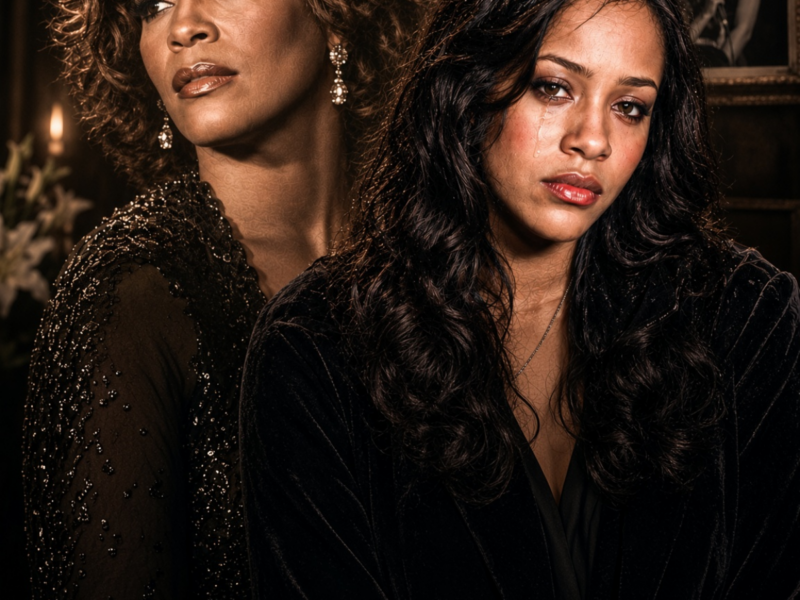
The Tragic Story of Whitney Houston’s Only Daughter.
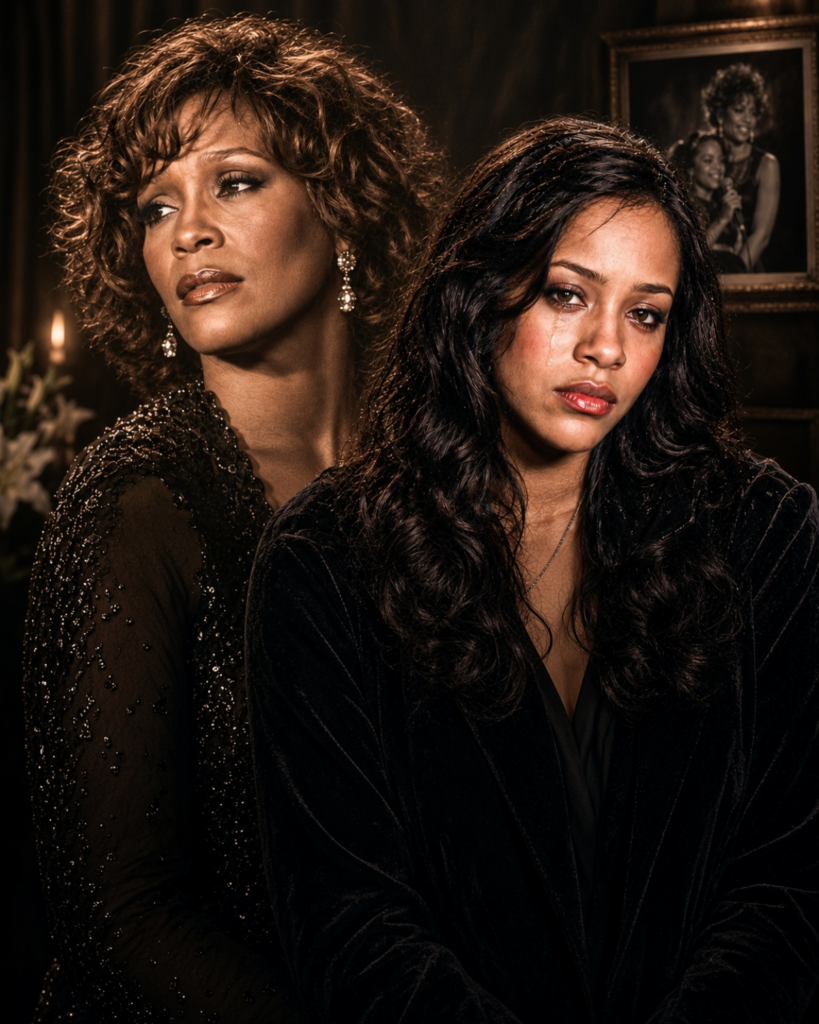
In February of 2012, a teenage girl sat in the front row of a church in Newark saying goodbye to the most famous voice in the world.
Millions watched and felt sorry for her.
But what nobody realized was that her own story would end in a way that felt horribly familiar.
This is why Whitney Houston’s daughter lived such a tragic life.
To understand the girl in that front row, you have to start with the two people who made her—because almost everything that happened to her was shaped by them.
Whitney Houston was born on August 9th, 1963, in Newark, New Jersey.
Music was in her blood.
Her mother, Cissy Houston, was a respected gospel and soul singer who had sung backup for Elvis Presley and Aretha Franklin.
Her cousin was Dionne Warwick. Aretha Franklin herself was a family friend—someone young Whitney grew up calling “Aunt Ree.”
By the time she was a teenager, Whitney was singing solos in the choir at New Hope Baptist Church in Newark.
And people who heard her there said it was obvious she was going to be something extraordinary.
They were right.
Her first album came out in 1985 and made her a star almost overnight.
She had been discovered a couple of years earlier by Clive Davis, the head of Arista Records, who heard her sing at a small club in New York and signed her almost on the spot.
He spent two years carefully choosing her songs and shaping her image before releasing a single note.
When the album finally arrived, it became the best-selling debut by a female artist at the time.
Clive Davis would remain one of the most important people in her life—a mentor and a father figure right up until her final weekend.
By the end of the decade, she had broken records that had stood for years—with seven number-one hits in a row in America.
She was beautiful, polished, and wholesome.
Record executives presented her as the perfect, elegant girl next door.
Bobby Brown was the opposite.
He had grown up in a tough housing project in Boston, joined the boy band New Edition as a child, and then broke away to become a solo star with a swaggering, rebellious image.
He was charming, fun, and wild.
The press loved to call him the bad boy of R&B.
They met in 1989 at the Soul Train Music Awards.
Whitney later said that what drew her to him was that he made her laugh—and that he did not treat her like a superstar.
On July 18th, 1992, they married at her estate in Mendham, New Jersey.
Hundreds of guests attended.
Many of the people around Whitney were nervous about the match. Whitney did not care.
That November, her first film, The Bodyguard, opened in cinemas.
Her version of the song “I Will Always Love You” spent fourteen weeks at number one in America, and the soundtrack became the best-selling movie soundtrack of all time.
Whitney was now, without question, one of the biggest stars on the planet—and she was pregnant.
On March 4th, 1993, in New Jersey, she gave birth to a daughter.
They named her Bobbi Kristina Brown, after her father.
Bobby already had three children from earlier relationships, but this was Whitney’s first and only child.
In interviews, she said that becoming a mother was the greatest thing that had ever happened to her.
From her very first days, Bobbi Kristina was the most famous baby in the world of music.
And almost from the start, the home she was born into was coming apart behind closed doors.
For the first years of her life, Bobbi Kristina went almost everywhere her mother went.
Whitney took her on tour, to film sets, to recording studios, and to award shows.
She had nannies, tutors, and bodyguards.
She grew up in hotel suites in different cities, falling asleep backstage while her mother sang to stadiums full of people.
In 1995, Whitney starred in the film Waiting to Exhale, and the following year in The Preacher’s Wife—and Bobbi Kristina spent long stretches on those sets too, wandering between trailers and dressing rooms.
In 1999, she went along on her mother’s My Love Is Your Love World Tour across Europe and America.
Crew members remembered a lively, chatty little girl who wanted to be wherever her mother was, and who would stand at the side of the stage, singing along to every word.
Photographs from those years show a little girl with her mother’s smile, sitting on Whitney’s lap or clinging to her father’s leg at red-carpet events.
Whitney was fiercely protective of her.
She kept her away from most cameras and made sure there was always someone watching over her.
People who worked with the family said that whatever else was going on, Whitney adored her daughter—and Bobbi Kristina adored her right back.
Whitney called her by a pet name, “Krissy,” and she was the light of her mother’s life.
Bobbi Kristina also showed early signs of having her mother’s voice.
In 2003, when she was ten, she sang on a version of “The Little Drummer Boy” on Whitney’s Christmas album, One Wish.
For fans, hearing her small voice beside her mother’s felt like watching a torch being passed to the next generation.
But by then, the people closest to the family knew that something was very wrong at home.
Both of her parents were using drugs.
Whitney’s struggles had started long before she met Bobby, but during the 1990s they grew far more serious.
She began missing rehearsals, canceling concerts, and arriving late to events.
In 2000, she was scheduled to sing at the Academy Awards—and she was sent home from the rehearsals.
That same year, airport security in Hawaii reportedly found marijuana in her bag, though she left before police arrived.
Bobby, meanwhile, was in and out of trouble with the law.
Over the years, he was arrested several times for drunk driving, for drug possession, and for violating his probation. He served short stints in jail.
For a young girl, it meant a childhood shaped by absence and worry.
Her father was sometimes simply not there.
Her mother was sometimes physically present, but not really there.
And in 2002, the whole world got its first real look at how bad things had become.
In December of 2002, Whitney sat down with the journalist Diane Sawyer for a television interview on ABC.
She was painfully thin. She was nervous, defensive, and at times laughing in ways that did not match what was being said.
Sawyer asked her directly about the drugs.
Whitney admitted to using some, including cocaine and pills.
But she flatly denied using crack cocaine, saying she earned far too much money to ever touch something so cheap.
The line became one of the most quoted moments in television history—and it was mocked for years afterward on comedy shows.
Watching it now, most people do not find it funny.
They see a woman in serious trouble, surrounded by people who could not reach her.
That same year, her family life had cracked in another direction.
Whitney’s own father, John Houston, who had once managed parts of her business, sued her through his company for $100 million, claiming he was owed money for his work.
Father and daughter were not speaking.
In February of 2003, John Houston died at the age of eighty-two, with the lawsuit still unresolved.
Whitney was devastated.
People close to the family said she never fully forgave herself for the distance between them at the end.
For Bobbi Kristina, it was the loss of a grandfather—and an early lesson in how money and fame could pull a family apart.
Bobbi Kristina was nine years old.
A year later, in December of 2003, police were called to the couple’s home outside Atlanta, where the family had moved.
Whitney had a cut lip and a bruised face, and Bobby was charged with hitting her.
Whitney stayed with him.
In 2004, she went into rehab. She went back again in 2005.
Each time the family hoped it would be the turning point. Each time, it was not.
Throughout it all, Bobbi Kristina was there.
She was old enough by now to understand that her parents were sick.
She saw the headlines. Classmates and strangers had opinions about her family.
She later described feeling as if she had grown up far too fast—watching over the people who were supposed to be watching over her.
Then in 2005, her father made a decision that put her family life on national television.
In the summer of 2005, the cable network Bravo began airing a reality show called Being Bobby Brown.
It followed Bobby through his daily life, and Whitney appeared in many episodes.
The cameras captured moments that seemed almost unbelievable for a woman who had once been the most carefully managed star in pop music.
There were arguments, crude jokes, strange outbursts, and scenes that made viewers wonder what was really happening in that household.
Twelve-year-old Bobbi Kristina appeared on the show too.
Whitney later said that she regretted taking part, and that she had only done it to support her husband.
Critics called the show a car crash, and many fans were horrified to see their idol presented that way.
The series lasted just one season.
For Bobbi Kristina, it meant that some of the most chaotic moments of her childhood were now permanently recorded and broadcast for anyone to watch.
Her friends at school could watch her family’s arguments on television.
Strangers online could pick apart her parents’ behavior and make jokes about it.
Even years later, clips from the show circulated on the internet as comedy.
For a girl on the edge of her teenage years, it was one more way in which her home life belonged to everyone except her.
By then, there was someone else living in that house too—a boy who would one day become the most important person in her life.
His name was Nick Gordon.
Nick was three years older than Bobbi Kristina.
He came from a difficult background, and when he was about twelve, Whitney took him into her home.
She never formally adopted him, but she raised him alongside her daughter—and for years the two of them were described as being like brother and sister.
Whitney, by many accounts, loved him like a son.
Friends of the family remembered him as polite, quiet, and eager to please.
And for a boy who had been through so much, being welcomed into a home like Whitney’s must have felt almost unreal.
He went to the same events as Bobbi Kristina, sat at the same dinner table, and was treated by many of the people around Whitney as part of the family.
Bobbi Kristina, who had grown up as an only child in that house, finally had someone close to her own age who was always there.
He would stay in Bobbi Kristina’s life for the next decade.
And as her parents’ marriage finally reached its end, he became one of the few constants she had left.
In September of 2006, Whitney filed for divorce from Bobby Brown.
The divorce was finalized in April of 2007, after almost fifteen years of marriage.
Whitney was given full custody of their daughter, who was fourteen.
Whitney had already started to rebuild.
People close to her said she seemed lighter and more determined than she had in years.
She was working on new music. She spent more time with her mother and her family.
And she tried, by every account, to give Bobbi Kristina a more stable home.
They lived mostly in the Atlanta area, and Whitney made a point of being at home more often—going to her daughter’s school events and taking her on trips.
In interviews from that period, Whitney described Bobbi Kristina as her best friend and her biggest reason to keep fighting.
Friends said that when the two of them were together, laughing and singing in the kitchen, you could almost forget everything they had been through.
But the damage of the past years did not simply disappear.
Bobbi Kristina was a teenager who had grown up in chaos.
She was bright, funny, and talented—and she wanted to sing and act like her mother.
She was also struggling.
Over the next few years, there were reports that she was having serious emotional difficulties, and that she had begun experimenting with drugs and alcohol herself.
Her relationship with her father became distant.
Bobby later said that after the divorce, he found it hard to see his daughter as often as he wanted—and that he deeply regretted the years he had lost.
In 2009, Whitney made her comeback.
Her album I Look to You came out that summer and went straight to number one.
That September, she sat down with Oprah Winfrey for a two-part interview and spoke openly about her drug use, her marriage, and the years she had lost.
She talked about her daughter, and about wanting to be the mother Bobbi Kristina deserved.
It looked like a happy ending.
On September 1st, 2009, she performed a free concert in Central Park for Good Morning America, and fans packed the lawn to see her.
But the performance was shaky, and the voice that had once seemed effortless was strained.
Many fans told themselves it was nerves after a long break. Those close to her worried it was something more.
When Whitney went back on tour in 2010, audiences noticed that her famous voice was no longer what it had been.
Years of hard living had taken a toll.
Some fans walked out of concerts. Reviews were harsh. The pressure on her grew.
And her daughter, now a teenager, was watching her mother try to climb back up—and start to slip again.
In February of 2012, Whitney was in Los Angeles for the Grammy Awards weekend.
She was staying at the Beverly Hilton Hotel, where the music executive Clive Davis—who had discovered her as a young woman—was holding his famous party on the night before the Grammys.
Bobbi Kristina was with her in Los Angeles, along with other family members.
On the night of February 9th, Whitney went to a club in Hollywood and joined the singer Kelly Price on stage for a few lines of the gospel song “Jesus Loves Me.”
It would be the last time she ever sang in public.
People who saw her that week described her as seeming unwell at times, and full of energy at others.
On the afternoon of Saturday, February 11th, 2012, Whitney was found unresponsive in the bathtub of her hotel suite.
Paramedics tried to revive her, but it was too late. She was pronounced dead in her room.
She was forty-eight years old.
The Los Angeles County Coroner later ruled that she had accidentally drowned, and that heart disease and the effects of cocaine use had contributed.
Investigators found no sign that anyone else had been involved.
The report described years of damage to her heart, and noted that she had used cocaine shortly before she died.
For a family that had spent decades trying to hide the extent of her struggles, the details were now public record—printed in newspapers around the world.
Bobbi Kristina was told the news in the hotel.
People close to the family said she collapsed.
Over the next two days, she was taken to hospital twice, overwhelmed by shock and grief.
That evening, downstairs in the same hotel, Clive Davis went ahead with his party.
Many people were stunned that it was not canceled.
Davis told the guests that Whitney would have wanted the music to go on.
Outside the hotel, fans had already begun to gather, leaving flowers, candles, and handwritten notes on the sidewalk.
Radio stations across the country played her songs back-to-back.
In Newark, people came to stand outside the church where she had once sung in the choir.
The following night at the Grammy Awards, the singer Jennifer Hudson performed “I Will Always Love You” in Whitney’s honor, and the room fell silent.
Bobbi Kristina was eighteen years old. In a few weeks, she would turn nineteen.
Her mother—the person she had spent her entire childhood watching over and adoring—was gone.
On February 18th, the funeral was held at New Hope Baptist Church in Newark, the same church where Whitney had first sung as a little girl.
Kevin Costner, her co-star in The Bodyguard, gave a long, heartfelt eulogy.
Stevie Wonder and Alicia Keys performed.
Bobbi Kristina sat in the front, surrounded by family, while the world watched on television.
Bobby Brown arrived, but he left early after a disagreement over where he and his family were being seated.
It was a painful reminder that even in grief, the two sides of Bobbi Kristina’s family were not at peace.
The next day, Whitney was buried at Fairview Cemetery in Westfield, New Jersey—next to her father.
It was a small private service, closed to the press.
Bobbi Kristina had now lost the parent she had lived with her whole life.
She was legally an adult, and she was heir to her mother’s fortune.
But the people who saw her that week said she looked like a lost little girl.
And very soon after, her daughter turned to the one person she said understood what she was going through: Nick.
In the months after her mother’s death, Bobbi Kristina and Nick Gordon grew closer than ever.
And then, to the shock of many people, it became clear that they were no longer brother and sister in any sense.
They were a couple.
Some members of the Houston family were deeply uncomfortable.
Whitney had raised both of them under the same roof, and to many people the relationship felt wrong.
Others worried about something more serious.
Several people close to the family later said they believed Nick was a bad influence—and that he encouraged Bobbi Kristina’s drug use instead of helping her stop.
Nick always denied that.
In March of 2012, only weeks after the funeral, Bobbi Kristina sat down with Oprah Winfrey, along with her aunt Pat Houston and her uncle Gary.
She spoke about her mother with deep love.
She said she could still feel her presence, and that her mother had prepared her for life without her.
She said she wanted to sing and act and make her mother proud.
She also said, with a kind of stubborn hope, that she was going to be fine.
Many people who watched that interview were moved by how strong she seemed.
Others, including people close to the family, worried that she was holding herself together in public while falling apart in private.
In the weeks around that interview, reports appeared that friends and relatives were concerned about her drinking and her drug use—and about how much time she was spending alone in her mother’s former home.
That autumn, a reality series called The Houstons: On Our Own premiered on Lifetime, following the family as they tried to rebuild their lives.
Bobbi Kristina and Nick were at the center of it.
Viewers watched her aunt and other relatives openly question the relationship and voice their fears about her future.
Around the same time, the couple announced that they were engaged.
Whitney’s mother, Cissy, made no secret of her feelings.
She said publicly that she did not approve of the relationship, and that it did not sit right with her that two young people raised in the same house as siblings were now engaged.
The following year, Cissy published a memoir about her daughter, Remembering Whitney, writing about Whitney’s life, her struggles, and her death with a mother’s grief.
The rift between the grandmother and her only granddaughter grew wider.
For a young woman who had already lost her mother, it meant drifting further from the family who might have helped her.
Then, in January of 2014, Bobbi Kristina posted online that she and Nick were married.
It was never confirmed.
Later, investigators and lawyers found no record of a marriage ever taking place.
Her life during those years was shaped by money, grief, and isolation.
Under her mother’s will, Bobbi Kristina was the main heir to Whitney’s estate.
But Whitney had arranged for most of it to be kept in a trust.
Bobbi Kristina received a portion right away, would get more when she turned twenty-five, and would only gain full control when she turned thirty.
She moved into a townhouse in Roswell, a suburb outside Atlanta, with Nick.
She had a small role in a Tyler Perry television series, and she talked about recording music.
But people who knew her said she seemed lost.
She posted often on social media—sharing photographs of her mother, messages about missing her, and pictures of herself and Nick.
Some days the posts were cheerful and full of plans. Other days they were dark and angry, aimed at relatives or at people she felt had betrayed her.
Friends who tried to reach her said it became harder and harder to get through.
The young woman who had once been surrounded by bodyguards, tutors, and nannies was now, for the first time in her life, almost entirely on her own.
In January of 2015, Lifetime aired a biographical film about her mother.
On social media, Bobbi Kristina made clear she did not approve of it.
Two weeks later, on the last day of January, someone in that Roswell townhouse called 911.
On the morning of January 31st, 2015, Bobbi Kristina was found face down and unresponsive in a bathtub at her home.
Nick Gordon and a friend of his, Max Lomas, were the ones who found her.
They tried to revive her until paramedics arrived.
She was rushed to North Fulton Hospital, and later moved to Emory University Hospital in Atlanta.
She was twenty-one years old—and she had been found in almost exactly the same way as her mother, nearly three years earlier.
Doctors placed her in a medically induced coma.
For the next several weeks, the world waited for news.
Fans gathered outside the hospital.
Conflicting reports spread online—some saying she was improving, some saying she was close to death.
Her family released statements asking for privacy and prayers.
On February 11th, 2015, while she lay unconscious in the hospital, the third anniversary of her mother’s death came and went.
Fans held small vigils outside the hospital and near the Beverly Hilton.
Many of them found it almost impossible to believe that the family was living through the same nightmare twice.
In the middle of that wait, there were moments of false hope.
At a concert in Dallas that February, Bobby Brown reportedly told the audience that his daughter had opened her eyes—and the news spread instantly online.
Soon afterward, relatives and family representatives said that her condition had not changed, and asked people to stop spreading rumors.
It was a painful sign of how desperately her father wanted to believe she would come back—and of how every word the family spoke was now being picked over by millions of strangers.
The family itself was divided.
Bobby Brown was by her bedside. So were members of the Houston family—but tensions between them were high.
And Nick Gordon, the man she had lived with, was largely kept away.
Court orders were issued limiting who could visit her.
A conservator was appointed by a judge to take charge of her affairs while she could not speak for herself.
Nick posted messages online about how much he loved her. Her family refused to let him near her.
The conservator’s lawyers later went to court accusing him of taking money from her bank accounts while she lay in the hospital—a charge he denied.
To Bobbi Kristina’s relatives, he had gone from the boy Whitney took in to the man they held responsible for everything that had gone wrong.
Months passed.
Doctors said she had suffered severe brain damage.
In June of 2015, she was moved from the hospital to a hospice facility in Duluth, Georgia, where patients go to be cared for in their final weeks.
Her family took turns sitting by her bed.
When the move to hospice was announced, her aunt Pat Houston said in a statement that Bobbi Kristina’s condition had worsened, and that she was now in God’s hands.
It was the moment many fans understood that there would be no recovery.
Relatives from both sides of the family flew in.
For a few weeks, the Houstons and the Browns—who had spent so many years at odds—found themselves sitting in the same quiet rooms, waiting for the same inevitable news.
On July 26th, 2015, Bobbi Kristina Brown died.
She was twenty-two years old—the same age her mother had been when her career was just beginning.
Her father released a statement saying that she was finally at peace in the arms of her mother.
She had spent six months suspended between life and death.
And even after she was gone, the question of what had happened to her that morning in Roswell was far from settled.
Bobbi Kristina’s funeral was held on August 1st, 2015, at a church in Alpharetta, Georgia.
Several days later, she was buried at Fairview Cemetery in Westfield, New Jersey—right beside her mother.
Then came the investigation.
Roswell police had opened an inquiry within days of her being found, interviewing the people who had been in the townhouse that morning and collecting evidence from the home.
As the months went by, the case was passed to the Fulton County District Attorney’s Office.
Investigators said very little publicly—and the silence only fed the rumors that had been swirling online since January.
In March of 2016, the medical examiner released the findings.
The autopsy had found a mix of substances in her body, including alcohol, marijuana, cocaine, morphine, and prescription sedatives.
The cause of death was listed as drowning combined with the effects of those drugs.
But the manner of death—whether it was an accident, something she did to herself, or something someone else had done—was ruled undetermined.
For many people, that was not enough.
In August of 2015, shortly after her death, the conservator of her estate had filed a civil lawsuit against Nick Gordon, accusing him of being responsible for her death.
The lawsuit claimed that he had given her a dangerous combination of drugs, mistreated her, and had a role in leaving her face down in the water.
It also accused him of taking money from her accounts.
Nick’s lawyers called the accusations baseless.
He never filed a proper defense in the civil case, and he repeatedly missed court deadlines.
In September of 2016, a judge ruled that because of those failures, he was legally responsible by default.
On November 17th, 2016, after a hearing in which Bobby Brown testified, Judge T. Jackson Bedford of the Fulton County Superior Court ordered Nick Gordon to pay more than $36 million to her estate.
Nick did not attend.
The estate’s lawyers said they planned to pursue every cent—though it was widely understood he did not have anything close to that amount.
But a civil judgment is not a criminal conviction.
The local district attorney’s office said the case remained under investigation.
In the end, Nick Gordon was never charged with any crime in connection with her death.
Her family never stopped believing he was to blame. Nick always maintained his innocence.
In interviews after her death, he described himself as heartbroken, and he said he had loved her more than anyone.
In 2016, he appeared on a daytime television show with a well-known television doctor in an emotional and widely criticized segment in which he spoke about his grief and his drinking.
Many viewers came away feeling deeply troubled—both by what he said and by the fact that the family’s tragedy had become entertainment once again.
And then, a few years later, the man at the center of all those questions was gone too.
On January 1st, 2020, Nick Gordon died in Florida after an apparent overdose. He was thirty years old.
His family said he had never recovered from losing Bobbi Kristina, and from the accusations that followed him.
Whatever really happened in that townhouse in 2015, he took his side of the story with him.
In the years before his death, his own life had continued to spiral.
In 2017, he was arrested in Florida after a girlfriend accused him of hurting her, though the charges were later dropped.
He struggled publicly with drinking and drugs.
Those who knew him said he was haunted by the way his name had become tied forever to Bobbi Kristina’s death.
Bobby Brown’s grief was far from over.
On November 18th, 2020, his son Bobby Brown Jr.—Bobbi Kristina’s half-brother—died in Los Angeles at the age of twenty-eight from a combination of drugs.
Bobby later spoke openly about the pain of burying two of his children in five years, and about his own long struggle to stay sober.
In documentaries and interviews, he has said that he still carries guilt for the years he was not there for his daughter, and that he speaks to her in his prayers.
He and his wife Alicia Etheredge have also spoken about wanting to turn the loss into something useful.
In 2018, they announced plans for a charity in Bobbi Kristina’s name, aimed at helping women affected by violence in their relationships, with the hope of opening a safe home for them in Georgia.
Bobby said he wanted his daughter to be remembered for helping people, rather than only for the way she died.
Because Bobbi Kristina was never legally married, Nick Gordon had no claim to her inheritance.
Under the terms of Whitney’s will, the money still being held in trust for her passed instead to Whitney’s mother, Cissy, and to Whitney’s two brothers.
Whitney’s sister-in-law Pat Houston continued to manage the estate—and in the years that followed, it launched new projects, including a feature film about Whitney’s life, I Wanna Dance with Somebody, released in December of 2022.
Before that, in 2018, a documentary simply called Whitney had been released, directed by Kevin Macdonald with the family’s cooperation.
In it, several relatives spoke for the first time about painful things that had happened to Whitney as a child—claims that a member of her extended family had mistreated her when she was young.
Other relatives disputed those claims.
But for many people watching, it helped explain the sadness that seemed to follow Whitney throughout her life, and the pain she may have carried into her own parenting without ever speaking of it.
Cissy Houston, who had outlived her daughter and her granddaughter, died on October 7th, 2024, at the age of ninety-one.
She had spent the last years of her life largely out of the public eye, living with dementia in New Jersey.
The woman who had first taught Whitney to sing in a church choir in Newark had now seen three generations of her family’s story unfold—and two of them end far too soon.
Today, three generations of that family rest in or near the same small cemetery in Westfield, New Jersey.
Whitney lies beside her father. Bobbi Kristina lies beside her mother.
When people remember Bobbi Kristina, they often think of the tragic headlines, the hospital bulletins, the court case, and the terrible coincidence of how mother and daughter were found.
But the people who knew her best remember a funny, warm, loving girl who sang with her mother on a Christmas song when she was ten, who hugged her mother at every award show, and who spent most of her short life looking after the woman she loved most in the world.
She grew up watching her mother struggle.
She was never given the chance to grow old enough to escape the same struggle herself.









