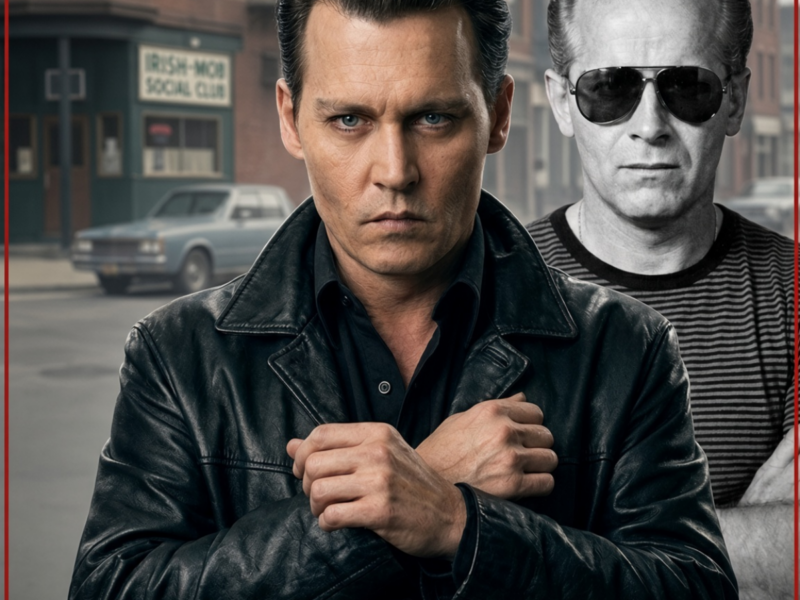
The Real Whitey Bulger Was Way More Ruthless Than Johnny Depp in ‘Black Mass’.
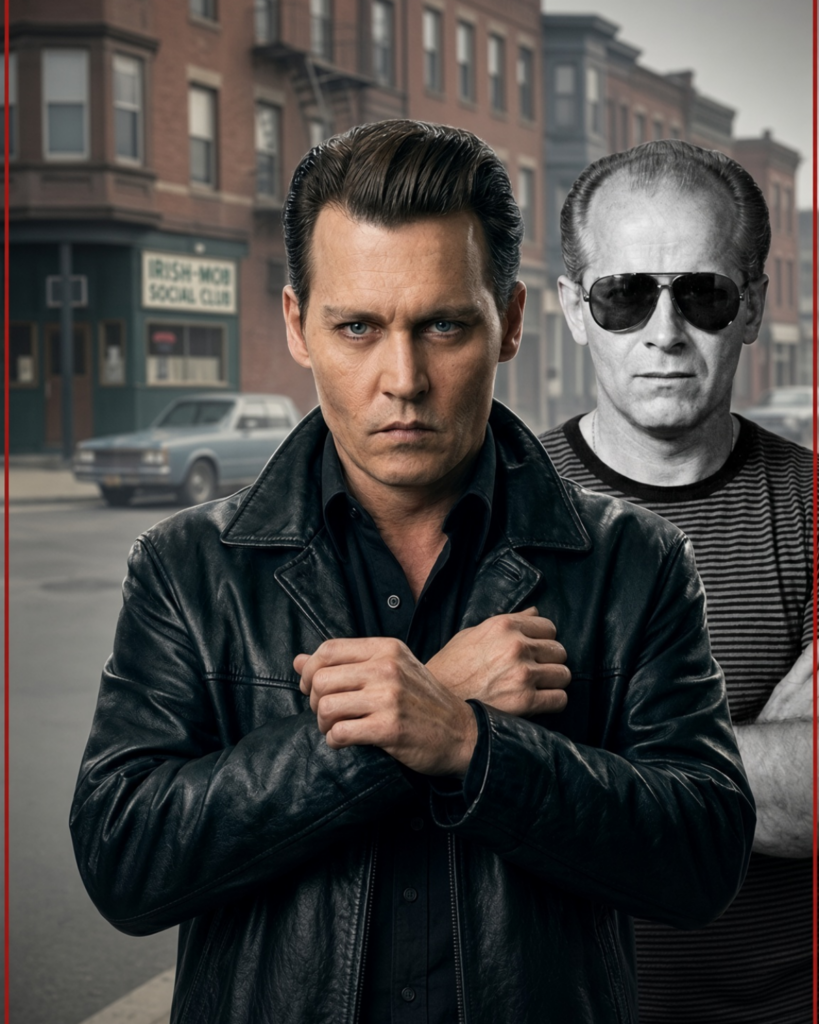
In the movie, Johnny Depp strangles a woman and the scene cuts away.
In the real basement on East 3rd Street, the strangling was only the start of the job.
After the body stopped moving, the dead woman’s teeth were pulled out with pliers so no dentist could ever name her.
A hole was waiting in the dirt floor, and the man Hollywood turned into a pale, chilling anti-hero went upstairs and took a nap.
He did that after killings—lay down and slept while other men did the burying.
The film gave audiences a gangster with a code.
The government’s files gave a jury nineteen bodies, including two women who loved the wrong men—and an FBI that protected the killer for years.
This is the story of how the real Whitey Bulger was far more ruthless than the man Johnny Depp played in Black Mass—and how it ended for him.
In the spring of 1956, FBI agents walked into a nightclub and arrested a 26-year-old from South Boston who had spent the previous year robbing banks across three states.
James Bulger—white-blond hair, which is why everyone but him used the nickname he hated—had hit banks in Rhode Island, Indiana, and Massachusetts with a crew waving guns over counters and walking out with sacks of other people’s money.
He had been a criminal more than half his life by then—first arrested at 14 in the housing project streets of South Boston, running with a corner gang, piling up juvenile charges for larceny, forgery, assault, and armed robbery, with a reform school stretch and a hitch in the Air Force that featured more arrests than medals.
The bank spree was the first time the federal government took a serious look at him, and the federal government was not amused.
A judge gave him twenty years.
He was shipped south to the federal penitentiary in Atlanta—a massive stone warehouse of a prison—to disappear into a cell through the heart of his young manhood.
Most bank robbers who went in at 26 came out broken or came out ordinary.
Bulger came out neither.
Because inside Atlanta’s walls, the United States government made him an offer.
And what it did to him in that prison, he would describe for the rest of his life as the thing that haunted his sleep.
The offer came dressed as medicine.
Inside Atlanta, Bulger volunteered for what inmates were told was research toward curing schizophrenia, in exchange for a little time shaved off his sentence.
What it actually was, he would not learn for decades.
The program was connected to the CIA’s mind-control experiments—the ones later exposed under the name MKUltra.
And the medicine was LSD.
Week after week, a doctor’s team dosed him with the drug and watched what happened.
Bulger later wrote about those sessions in language you’d expect from a horror novel: hallucinations, paranoia, the walls of the room running like wax, nights of screaming men down the cell block.
He claimed the nightmares and the sleeplessness never fully left him.
And he wrote that if he had found that doctor in later life, he would have killed him.
Black Mass, two hours long, had no room for any of this.
Atlanta decided Bulger was an escape risk, and in 1959 the government moved him to the one prison built for men like that: Alcatraz, the Rock in San Francisco Bay.
Strangely, he thrived there—decent food, a cell to himself, hard men who respected silence.
When Alcatraz wound down, he was cycled through other federal prisons.
And in 1965, after nine years inside, the doors opened.
He was 35, muscled from a decade of prison weight yards, and he went straight back to the only place that had ever made sense to him.
South Boston hadn’t changed, but the question of who ran its streets was about to be settled with guns.
Southie’s rackets—the bookmaking, the loan sharking, the barrooms—belonged to the Killeen brothers, and Bulger went to work for them as muscle.
He kept a straight job for appearances for a while, pushed through connections that came easily to a Bulger.
His younger brother Billy was climbing fast in Massachusetts politics—a State House man on his way to becoming one of the most powerful politicians in the Commonwealth.
Two brothers from the same housing project: one headed for the Senate president’s chair, the other for a gang war.
The war came at the turn of the 1970s, when a younger Southie crew called the Mullens went up against the Killeens.
It was a stupid, bloody neighborhood war—shootings over insults, men ambushed outside bars.
And Bulger could read the arithmetic.
The Killeens were losing.
In May 1972, the arithmetic finished itself.
The Killeen boss was gunned down outside his suburban home on his little boy’s fourth birthday—shot in his car with the birthday party inside the house.
The movie’s Bulger is introduced as a king.
The real one, at this point, was a 42-year-old enforcer on the losing side, shopping for a way to survive.
He found it by negotiation.
Through the region’s most respected Irish gang boss, Howie Winter, a peace was brokered.
The Mullens and the Killeen survivors would fold together under Winter’s organization—the Winter Hill gang, run out of a garage in Somerville.
Bulger walked out of the deal not just alive but elevated: a partner at the table, with Southie as his franchise.
At that Somerville garage, he also began working alongside a compact, dead-eyed hitman’s hitman named Johnny Martorano, and a South Boston rackets veteran named Steve Flemmi.
Flemmi came with something nobody at the garage knew about: a history, a relationship, a secret second employer.
And in 1975, a young FBI agent came home to Boston with orders to develop informants against the Mafia—and a boyhood memory of the Bulger family.
John Connolly had grown up in the same Old Harbor Housing Project as the Bulgers, a kid who idolized Billy and had once, as the story was always told, been bought an ice cream cone by Jimmy.
Now he was an FBI agent in the Boston office, and the Bureau’s obsession, from headquarters down, was the Italian Mafia—the Angiulo organization running New England’s underworld from Boston’s North End.
The FBI had a program for that obsession: the Top Echelon Informant Program.
Recruit the highest-level criminals you can find, protect them, and aim them at the Mafia.
Flemmi had quietly been an FBI informant on and off since the mid-1960s.
In the fall of 1975, at a nighttime meeting in a parked car by Wollaston Beach, Connolly made his pitch to Bulger.
The Mafia wanted Winter Hill’s territory anyway.
Use us to fight them.
Bulger said yes.
From that moment, one of the most violent criminals in New England was carried on the books of the United States Department of Justice as an asset.
And here is where the record is crueler than the film.
Black Mass frames the arrangement as an unholy alliance that slid out of control.
The files show what it was from early on: a protection racket running in both directions.
Bulger and Flemmi fed the FBI mostly gossip and expendable rivals.
What mattered flowed the other way.
Warnings about wiretaps.
Warnings about investigations.
And the names of people who were talking.
Connolly’s reports polished his star’s value.
His supervisor, an agent named John Morris, took their envelopes of cash and cases of wine and buried complaints against them.
Other agencies would spend fifteen years trying to plant bugs near Bulger and watching every operation mysteriously die.
The arrangement had a price, and the price was never paid by Bulger.
It was paid by the people in his way—starting with his old enemies from the gang war, who began to vanish from the streets of South Boston one by one.
The first to go into the ground were Mullens—the men who’d fought the Killeens hardest and might someday contest Southie with Bulger.
One was shot in 1974 and buried at Tenean Beach in Dorchester.
Then came Tommy King, a Mullen brawler who had once beaten Bulger in a bar fight and never let him forget it.
In the fall of 1975, King was told the crew was going out to kill a man, and he was handed a bulletproof vest and a gun for the job.
The gun they gave him was loaded with blanks.
King rode in the front seat.
Martorano sat behind him.
The body went into a hole by the Neponset River marshes, near the bridge Bulger drove over constantly for years afterward.
He liked to nod at the spot, witnesses later said, and say they should drink a toast to Tommy.
Then the FBI deal claimed its first man outside the old war.
Richie Castucci was a Revere nightclub owner tied to the gang’s gambling network—and secretly an FBI informant himself.
Castucci told the Bureau where two Winter Hill fugitives were hiding in New York.
That information left the FBI’s office and reached Winter Hill.
In December 1976, Castucci came by to settle a gambling account, and Martorano shot him in the head.
His body was zipped into a sleeping bag and left in the trunk of his own Cadillac.
The FBI knew exactly what the leak had cost.
It kept Bulger and Flemmi on the payroll and wrote its dead informant off.
The movie compresses this era to a few cold moments.
What it can’t convey is the patience of it—year after year of selective murder while the federal government held the umbrella.
And the umbrella was about to perform its greatest trick yet—one that would hand Bulger an entire criminal organization without a shot fired.
In 1979, federal prosecutors finally built a case that reached Winter Hill.
Not for murder, but for fixing horse races up and down the East Coast—a scheme that had made the gang millions.
The indictment was set to sweep in the whole leadership, Bulger and Flemmi included.
Connolly and Morris went to the prosecutor and made the quiet argument: These two are ours. Essential against the Mafia. Leave them out.
Their names came off the list.
Howie Winter and the rest went to prison, and Bulger and Flemmi walked into the vacuum and took the whole thing—the bookmakers, the loan sharks, the tribute system—with the FBI having functionally staged the coronation.
Now Southie’s myth machine went to work—the myth Black Mass inherited and Depp wore like cologne.
Whitey the protector.
The Robin Hood who delivered turkeys at the holidays and kept hard drugs out of the neighborhood.
The record says the opposite.
Bulger didn’t keep drugs out of South Boston.
He charged drugs rent.
Dealers who wanted to move cocaine and marijuana in Southie paid him for the privilege, and through the 1980s the neighborhood he supposedly shielded filled with product his organization taxed.
Mothers in Southie buried overdosed kids while the man on the corner collected his percentage.
The turkeys were real.
So was the invoice.
Law enforcement that wasn’t the FBI kept trying.
In 1980, the state police spent weeks bugging a garage on Lancaster Street where Bulger held court—and watched him go silent overnight, tipped off again.
Every path to him seemed to end in the same unexplainable failure.
He operated from a liquor store by the Old Colony Rotary he’d simply taken from its owners, and he looked, by the start of the 1980s, completely untouchable.
Untouchable men get ambitious, and the gang’s money was reaching into legitimate business—including a sports empire called World Jai Alai, whose accountant was a friend of the gang.
The company’s new owner, a straight-arrow tycoon out in Tulsa, Oklahoma, began looking hard at his own books.
He had no idea what that made him.
Roger Wheeler was everything Bulger’s world was not: a self-made Oklahoma businessman, chairman of a technology company, a husband and father who played golf on Wednesdays at Southern Hills Country Club.
He had bought World Jai Alai—the betting sport with arenas in Florida and Connecticut—as an investment.
And by 1981, he suspected someone inside was skimming the cash.
The someone connected to that skim was John Callahan, the company’s mobbed-up former president, a Boston accountant who loved playing gangster on weekends and whose friends included Winter Hill.
Wheeler started pulling threads.
Word moved from Callahan to the gang: The owner is a problem, and he won’t sell.
On May 27th, 1981, Wheeler finished his round at Southern Hills, walked across the parking lot, and got into his Cadillac.
A man with a false beard walked up, opened the car door, and shot him once between the eyes.
The shooter was Johnny Martorano, sent from Boston with an old Winter Hill hand to do the job on a contract approved by Bulger and Flemmi.
Wheeler was 55.
His children got the news that their father had been executed over a business he bought legally, in a city Bulger never set foot in.
Think about what this murder was.
Not a gang rival.
Not an informant.
Not the code’s casualties.
A legitimate businessman in the American heartland, killed for auditing his own company.
Black Mass handles Wheeler at the edge of the frame, a plot point in Connolly’s unraveling.
In the real world, Tulsa homicide detectives would chase this case for twenty years, and it would eventually do what Boston couldn’t: put FBI men under oath in a murder trial.
But in 1981, the Wheeler killing had a more immediate consequence inside the gang.
Secrets this big make everyone who holds one dangerous.
And the next person who knew too much wasn’t a businessman with bodyguards and lawyers.
She was a 26-year-old woman from the neighborhood—and the man she wanted to leave was Steve Flemmi.
Debra Davis had been 17 when Flemmi, more than twenty years older, spotted her working behind a jewelry counter.
For nine years he kept her—apartments, cars, furs, the gilded cage of a gangster’s girlfriend.
By 1981, she was 26 and done, in love with another man, ready to walk.
The problem was what she’d absorbed over nine years of Flemmi’s careless talk—including, the government later said, the most dangerous fact in Boston: that Stevie and Jimmy had a special friendship with the FBI.
In September 1981, Flemmi brought her to a house in South Boston.
What happened inside is known from the men who were there—and the two of them spent the rest of their lives pointing at each other.
Flemmi testifying that Bulger grabbed her at the door and strangled her while Flemmi stood by.
Bulger’s lawyers insisting it was Flemmi.
What no one disputes: a healthy 26-year-old woman walked into that house and was strangled to death in it by one of the two men the FBI was protecting.
Flemmi kissed her body afterward, by his own account.
Then came the ritual that recurs in this story like a signature.
Her teeth were pulled to frustrate identification, and she was buried in the marsh grass by the Neponset River—across the water from the beach where Connolly had first recruited Bulger.
Her mother spent nineteen years not knowing where her daughter was.
Her brothers grew old in the not knowing.
Black Mass, for all its darkness, barely gestures at Debra Davis.
The film had nineteen murders to choose from and chose a handful.
The jury at Bulger’s trial, decades later, would wrestle with this one in a way the movie never had to—and we’ll come to what they decided.
Within the gang, the Wheeler secret kept metastasizing, because now a Winter Hill associate who knew about Tulsa was sitting across from FBI agents offering to trade it.
His name was Brian Halloran, and what happened to him happened in broad daylight, in front of witnesses, on the Boston waterfront.
Brian Halloran was a Winter Hill hanger-on, a cocaine-ruined tough guy facing a murder charge, and in early 1982 he went to the FBI with the only currency he had.
He said he’d been in the room when the Wheeler contract was discussed.
He asked for protection.
The Boston FBI office—the office that housed Connolly and Morris—debated him, doubted him, and turned him down for witness protection.
Worse, word that Halloran was talking traveled from inside the Bureau to Bulger.
The FBI didn’t just fail to protect its would-be witness.
It functionally delivered him.
On the evening of May 11th, 1982, Halloran was drinking at a restaurant on Northern Avenue on the waterfront.
A neighbor from his block, Michael Donahue—a union man, a father of three, with no criminal life at all—offered him a ride home.
As Donahue’s little blue car pulled out, a souped-up Chevy drew alongside.
Bulger, 52 years old and in a wig, armed with a carbine, called out Halloran’s name and opened fire alongside a masked second gunman.
He did this one personally, on a city street at rush hour.
Donahue died with his foot on the gas.
Halloran, shot over and over, lived just long enough to name the wrong man.
The disguise had worked.
Across the channel, a lookout’s voice had crackled over a radio moments before, and Kevin Weeks—Bulger’s young Southie protégé, watching through binoculars—saw the whole thing.
Michael Donahue’s three sons grew up without him.
His widow, Patricia, would spend more than thirty years in courtrooms saying his name so nobody could file her husband under “gangland.”
The scene made it into Black Mass almost beat for beat.
It’s one place the film didn’t soften, because it couldn’t.
What the film skips is the FBI paperwork before and after—the warnings ignored, the leak never traced, the file on the killing steered by the very office that leaked.
And the Wheeler secret still wasn’t contained.
One man remained who could connect Tulsa to Boston: the accountant who had set the whole thing in motion, now sweating in Florida.
John Callahan had loved the gangster life the way a tourist loves a dangerous country—thrilled by the visits, certain he could always fly home.
By mid-1982, with Halloran dead and Tulsa detectives circling World Jai Alai, Callahan was no longer a tourist.
He was a witness.
Bulger and Flemmi reasoned the way they always reasoned, and they sent the usual solution.
Johnny Martorano, living as a fugitive in Florida, was told his old friend Callahan had to go.
Martorano later testified that he argued—then agreed.
That was the kind of friendship Winter Hill produced.
In August 1982, Martorano picked Callahan up at the Fort Lauderdale Airport, shot him, and left his body in the trunk of a Cadillac parked at Miami International Airport.
He was found when the car began to smell.
The accountant who dreamed of being a wise guy ended as the thing wise guys make: cargo.
Four murders now hung off the Wheeler affair alone—a tycoon, a would-be witness, an innocent neighbor, and the gang’s own friend.
Every one of them enabled, before or after, by information moving through the Boston FBI.
Morris would later admit he told Connolly things no honest agent shares.
Connolly kept writing reports praising his informant’s value against the Mafia.
And the Mafia angle was real.
Around this time, FBI bugs did finally take down the Angiulo organization in the North End, with Bulger and Flemmi contributing scraps to the probable-cause paperwork.
That success became the shield for everything.
Inside the Bureau, Bulger wasn’t a serial killer with a file.
He was the crown-jewel asset who’d helped beat the Mafia—which meant the killing could come home.
The next murders didn’t need contracts or car chases.
They happened quietly in a house Bulger’s crew kept for the purpose, a few blocks from where he grew up—a house the neighbors knew nothing about, with a dirt cellar floor.
The house at 799 East 3rd Street in South Boston looked like any other triple-decker street—kids on bikes outside.
The crew came to call it “the Haunty.”
In July 1983, a safecracker named Bucky Barrett was invited there to look at some stolen diamonds.
Barrett was a legend with a torch and a drill.
He’d been in on one of New England’s most famous bank burglaries, which meant he had money—and money was the whole invitation.
When he walked in, Bulger was waiting with a machine pistol.
“Bucky Barrett, freeze.”
What followed lasted hours, and the movie shows nothing like it.
Barrett was chained to a chair while Bulger interrogated and taxed him—made him phone home, drained what he had, tens of thousands of dollars, sent Weeks and others out to collect it.
When the money was gone, so was Barrett’s use.
Late that night, Bulger said Bucky was going to go downstairs and lie down for a while.
As Barrett walked down the cellar stairs, Bulger shot him in the back of the head.
Flemmi pulled the teeth.
Weeks dug the hole in the dirt floor.
And Bulger—this detail comes from the men who were there, and the jury believed them—went upstairs and took his nap.
That is the texture Black Mass sanded off.
Depp’s Bulger kills with sudden, efficient menace, seen and over.
The real one ran a torture economics: extract the money, then the life, then the identity, then sleep.
The house wasn’t done, either.
Its cellar had room—and the gang’s next problem was sailing toward Ireland under an American flag, because Bulger, the patriot of Southie legend, had decided to play freedom fighter with other men’s lives.
In September 1984, a fishing trawler called the Valhalla slipped out of Gloucester, Massachusetts, loaded with seven tons of weapons—rifles, ammunition, rounds for the cause—bound for the IRA.
Bulger’s hand was in the operation, which fit the legend: the Irish rebel prince of Southie, arming the struggle.
Off the Irish coast, the arms were transferred to an Irish boat, which was promptly intercepted by the Irish Navy.
The shipment was lost.
The operation was blown.
Betrayed, it turned out, by an informant inside the IRA itself.
Bulger, with zero self-awareness, raged about the rat.
The hunt for the leak landed on a Valhalla crewman, John McIntyre—a 32-year-old Quincy fisherman and mechanic, a guy in over his head who had, in fact, started talking to investigators about the guns and about a freighter full of marijuana the gang had coming.
Word of his cooperation reached Bulger.
The evidence points to the usual channel: the FBI’s own paper flowing backward through Connolly.
In November 1984, McIntyre was invited to a party at the house on East 3rd Street.
He walked in carrying beer.
They tied him to a chair in the kitchen.
Bulger interrogated him for hours about the Valhalla and the drug boat, and McIntyre, weeping, admitted it.
Then Bulger looped a thick marine rope around his neck and tried to strangle him.
And the rope was too thick to close the airway.
McIntyre gagged and retched but didn’t die.
And Bulger asked him, almost gently, whether he’d like one in the head instead.
McIntyre said, “Yes, please.”
Those were the words witnesses carried into federal court.
“Yes, please.”
Bulger shot him.
The teeth came out, and McIntyre went into the cellar floor next to Barrett.
A grieving family was told nothing for sixteen years.
And the house still wasn’t full.
The last body destined for that cellar belonged to someone the gang’s whole mythology said could never be touched: a daughter of the family itself.
Deborah Hussey had grown up calling Steve Flemmi her stepfather.
He was the man of the house for her mother.
He’d been there since Deborah was a toddler.
When she reached her teens, Flemmi—the record on this is sworn testimony, not rumor—began sexually abusing her.
By her mid-20s, she was wrecked: drugs, arrests, and worst of all for the gang, talk.
She told people what Flemmi had done to her.
She was dropping his name around town.
In the gang’s logic, which the FBI’s protection had refined to perfect coldness, she had become what Castucci, Halloran, McIntyre, and Deborah Davis had been: a leak with a heartbeat.
In early 1985, she was brought to the Haunty.
Weeks testified to what he watched.
Bulger took her to the floor and strangled her with his hands.
She was 26—the same age Deborah Davis had been.
The teeth, the cellar, the hole beside the other two.
Black Mass did stage this murder.
It’s among the film’s hardest scenes, but even there the camera arrives late and leaves early.
And the film’s Bulger kills her almost as a favor to Flemmi.
The jury that heard the actual evidence found the murder of Deborah Hussey proved against James Bulger, full stop.
Months later, the house went up for sale, and the crew spent Halloween night of 1985 doing what the movie never shows anyone doing: digging up three decomposed bodies by hand.
Bulger supervising with the shovel-side cigar of impatience, and reburying Barrett, McIntyre, and Hussey in a common pit across from Florian Hall in Dorchester, while trick-or-treaters worked the streets a few blocks away.
Five of the nineteen murders Bulger would one day be charged with were now in the ground within a mile of each other.
The FBI files called him a top-echelon informant.
But in the late 1980s, a different institution started pulling at the thread—a newspaper asking, in print, the question no one in power wanted asked.
In September 1988, the Boston Globe’s investigative team published a series on the Bulger brothers: “The Gangster and the Senate President.”
And inside it sat a sentence that detonated quietly across New England: “Law enforcement sources said James ‘Whitey’ Bulger had a special relationship with the FBI.”
The Globe was right, and one of its sources was John Morris himself—the corrupted supervisor drowning in what he’d done, who later admitted he leaked it, half hoping exposure would get Bulger killed and the secret buried with him.
The FBI denied everything.
Southie called it a smear.
But the words were in print now, and every state trooper and DEA agent who’d watched a Bulger case die inexplicably finally had their explanation.
Through the late ’80s and early ’90s, the ones the Bureau couldn’t control came at him: state police, the DA, the IRS, and a federal prosecutor named Fred Wyshak, a relentless newcomer who didn’t care whose asset Bulger was.
Their strategy was humble and brilliant.
Skip the FBI entirely.
Squeeze the bookmakers.
One gambling agent after another was flipped.
Grand juries ground along, and by late 1994 a racketeering and extortion indictment was being prepared in secret.
Bulger was 65 years old.
He had banked money and identities for years for exactly this moment—safe deposit boxes seeded across North America and Europe, cash, jewelry, false papers.
He told people prison had taken enough of his life.
Connolly had retired from the FBI in 1990 into a cushy corporate security job, but retirement never ended his real employment.
In December 1994, he learned the secret indictment was coming down.
And he did the thing that would eventually cost him everything.
He picked up the warning and carried it to South Boston one last time.
Days before Christmas 1994, Connolly delivered the word through Kevin Weeks: the indictments were sealed, arrests were coming over the holidays.
Weeks relayed it to Bulger, who was on the road with his long-time girlfriend.
Bulger simply turned the car around.
No shootout.
No last stand.
None of the operatic endings movies prefer.
The most feared man in Boston just drove away from Massachusetts, because the FBI’s warning service had worked flawlessly one final time.
In January 1995, the arrest teams went out.
They got Flemmi, grabbed outside a family restaurant.
Bulger’s chair was empty.
For a few weeks he circled.
He actually slipped back into Boston once, cool as weather, to swap passengers.
His girlfriend of two decades was homesick and done with running.
So he dropped her off and picked up the other woman in his life—a 43-year-old dental hygienist named Catherine Greig, who got into the car knowing exactly who he was and never looked back.
Then the black Mercury sedan left New England, and James Bulger effectively ceased to exist.
The movie compresses what came next into closing title cards.
But understand what began that January: a sixteen-year humiliation of the FBI, carried out by the FBI’s own creation, financed by money he’d stashed while under the Bureau’s protection, launched by the Bureau’s own leak.
Bulger had beaten them before the race started.
Back in Boston, though, the thing he’d actually fled was taking shape in a courtroom.
Flemmi was in a cell facing life, and he was holding the one grenade no one had ever dared throw.
His lawyers pulled the pin.
“You can’t prosecute us,” they argued, “because everything we did, we did with the government’s blessing.”
Flemmi’s immunity claim forced what thirty years of murders had not: a federal judge hauled the FBI’s informant files into the light.
Through 1998, in hearings that transfixed Boston, the whole mechanism came apart in sworn testimony.
Morris, immunized, confessed to the bribes, the leaks, the dead informants.
The paper trail showed Bulger and Flemmi protected through decades of killings.
The judge’s findings read like an indictment of the Bureau itself.
The myth of Whitey the street king died in that courtroom.
What replaced it was uglier: Whitey the government project.
Then the dominoes fell fast.
Johnny Martorano, sickened to learn he’d been killing for two rats, cut a deal in 1999.
He confessed to twenty murders—twenty, including Wheeler, Castucci, and Callahan—in exchange for a sentence that worked out to roughly six months per life.
The families screamed.
Prosecutors held their noses.
The ledger grew.
That November, Kevin Weeks was arrested, and the loyal surrogate son flipped in a matter of weeks.
His logic was Southie perfect: You can’t rat on a rat.
In January 2000, Weeks stood with investigators across from Florian Hall and pointed at the ground.
Backhoes brought up Barrett, McIntyre, and Hussey.
That fall, the Neponset Marshes gave back Tommy King and, at last, Deborah Davis.
Her mother got to bury her after nineteen years.
By then, Bulger’s face was on the FBI’s Ten Most Wanted List, posted in 1999 with a reward that grew to $2 million, sharing the list in time with Osama bin Laden.
And in 2002, a Boston jury did something once unthinkable: it convicted John Connolly, the neighborhood-hero agent, of racketeering and obstruction for his service to Bulger.
Florida went further, convicting him in 2008 for his role in the murder of John Callahan.
The handler got decades.
The asset was a ghost.
Sightings poured in from all over the planet—London, Italy, nowhere, everywhere.
The truth was smaller and stranger.
The ghost had stopped running almost immediately and was living two blocks from the beach in the sunshine under a name borrowed from nobody.
Charlie and Carol Gasko lived in apartment 303 of a rent-controlled building in Santa Monica, California, three blocks from the Pacific.
Nice older couple.
He was a retiree with a heart condition who wore a white hat on his walks.
She fed a neighborhood cat and was kind to everyone.
They paid cash, kept to themselves, and claimed Charlie’s memory was going when conversations got specific.
They had lived there since 1996.
For fifteen years, while the FBI chased tips across Europe, the most wanted criminal in America took the sea air among pensioners, with more than $800,000 in cash and thirty guns hidden in holes cut into the apartment’s walls.
The break, when it came in June 2011, came through the one vulnerability Bulger had left: Catherine.
The FBI finally aimed a publicity campaign not at him, but at her—daytime television ads in women’s programming describing a fugitive’s companion who frequented beauty salons.
Within days, a tip arrived from Iceland, of all places: a former actress and Miss Iceland who’d lived in Santa Monica and befriended the Gaskos over that neighborhood cat.
She saw the campaign and recognized them instantly.
On June 22nd, 2011, agents used a ruse—a call about his storage locker being broken into—to draw Charlie Gasko down to the building’s basement garage.
He came down into a ring of guns, 81 years old, and gave it up without a twitch.
Asked to identify himself, he finally said the name: James Bulger.
Sixteen years, done in a parking garage.
Greig would get eight years for harboring him and decline every chance to shorten it by talking—the last loyal soldier Whitey Bulger ever had.
They flew him back to Boston by government jet over the harbor, past the neighborhood, to the courthouse where they would finally read him the list of his dead.
The trial opened in June 2013 at the federal courthouse on Boston’s waterfront.
Thirty-two racketeering counts wrapped around nineteen murders, with an 83-year-old defendant in a long-sleeved shirt doing crossword puzzles at the defense table.
The prosecution’s witnesses were the men of his own house.
Martorano, flat as a landlord reading a lease, describing twenty killings.
Weeks, who erupted when the defense called him a liar and traded obscenities with Bulger himself in open court—two Southie men snarling across a federal courtroom.
And Flemmi, shuffled in from a life sentence, pointing at his old partner for the stranglings.
Bulger’s lawyers made a strange, telling concession.
They admitted he was an organized crime boss, a drug trafficker, an extortionist.
What he could not bear were two words: informant—and the accusation that he killed women.
He never testified.
He called the trial a sham.
His vanity had survived everything.
The families came every day.
Patricia Donahue, widowed on the waterfront thirty-one years earlier, sat through it all.
On August 12th, 2013, the jury convicted him on 31 of 32 counts and found him responsible for 11 of the 19 murders.
Wheeler, Halloran, Donahue, Callahan, King, Barrett, McIntyre among them.
And Deborah Hussey, the stepdaughter, proved against him by name.
On Deborah Davis, the jury could not decide between two monsters and made no finding—a verdict that convicted the arrangement itself as much as either man.
Eleven murders.
Johnny Depp’s filmography has never needed a number like that.
At sentencing that November, the judge told him the depravity of his crimes was almost unfathomable and gave him two life terms plus five years.
Family members rose one by one to face him.
He kept his eyes forward and refused to look.
He was 84.
The Bureau of Prisons took custody of him, and the last question of his life became a quiet administrative one: which concrete box, in which state.
Until, in October 2018, somebody answered it with a transfer order that remains hard to read as anything but a death warrant.
By 2018, Bulger was 89, in a wheelchair, with a failing heart and a disciplinary problem, having run afoul of staff at his Florida prison.
The system shuffled him through Oklahoma and then, on October 29th, 2018, delivered him to USP Hazelton in the mountains of West Virginia—a maximum-security prison so violent its inmates called it Misery Mountain.
Already under scrutiny that year for understaffing and inmate deaths, the Bureau of Prisons placed the country’s most famous FBI informant—a frail man who could not stand unaided—not in protective custody, not in a medical unit, but in general population.
Among the population were organized crime men from Massachusetts, including a Springfield Mafia enforcer serving life, a man known to despise informants above all things.
Bulger lasted less than twelve hours.
Early the next morning, before 8:00 a.m., inmates wheeled into his cell and beat him to death with, by multiple accounts, a padlock swung inside a sock—the oldest prison weapon there is.
The violence was not quick and was not merciful.
He was beaten so badly he was barely recognizable, with injuries reported to his eyes that investigators read as a message—the underworld’s oldest one—about men who see things and tell.
Guards found him unresponsive at morning count.
James Bulger, who had strangled women with his hands and pulled teeth in a dirt cellar and slept soundly afterward, died on a prison floor at 89, murdered as a rat.
The Justice Department’s own watchdog later cataloged the bungling of the transfer—the broadcast knowledge of his arrival, the staffing failures, the inexplicable housing decision.
The men eventually charged were exactly who everyone assumed from the first morning.
No one in the government was ever made to answer for placing him there.
For the families of his victims, the symmetry needed no inspector general.
The government that protected him while he killed had, through carelessness or indifference, finally delivered him to the same kind of death he sold.
Black Mass ends with Depp in handcuffs and text on a screen.
The record ends in other places.
A marsh by the Neponset, where a mother finally buried her daughter after nineteen years.
A union man’s three sons, grown now, still saying their father’s name in courtrooms.
A dirt cellar on East 3rd Street that held three people while children trick-or-treated outside.
The film made Bulger a dark star and Connolly a tragedy.
The files make them something smaller and worse: a killer and his clerk, running a protection racket with the United States government as the muscle.
Eleven murders proved.
Nineteen charged.
Two women strangled by hand.
An FBI that fed him names and called it law enforcement.
Hollywood needed Whitey Bulger to be fascinating.
The evidence only ever showed him to be merciless.
And in the end, the real story out-brutalized the movie one last time—on a cell floor in West Virginia, where the man no court could touch for forty years was beaten to death in his wheelchair before breakfast.









