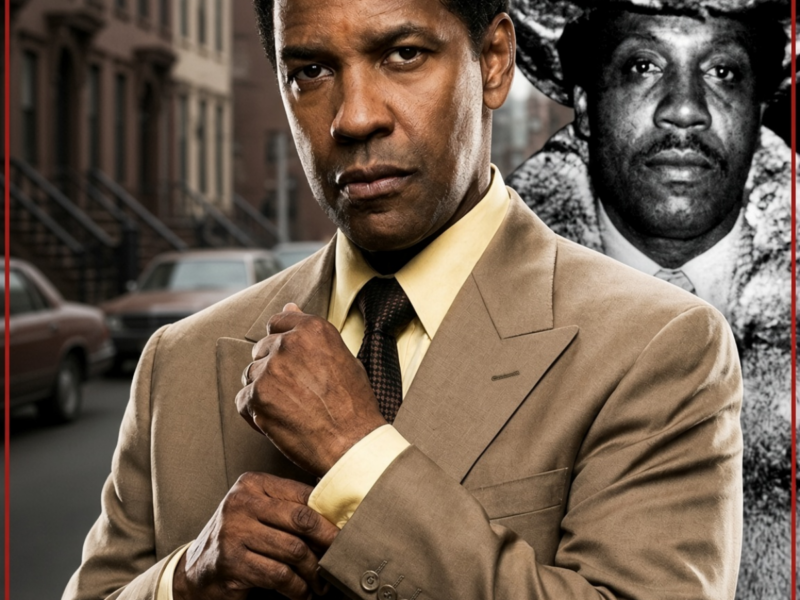
The Real Frank Lucas Was Way More Dangerous Than Denzel in ‘American Gangster’
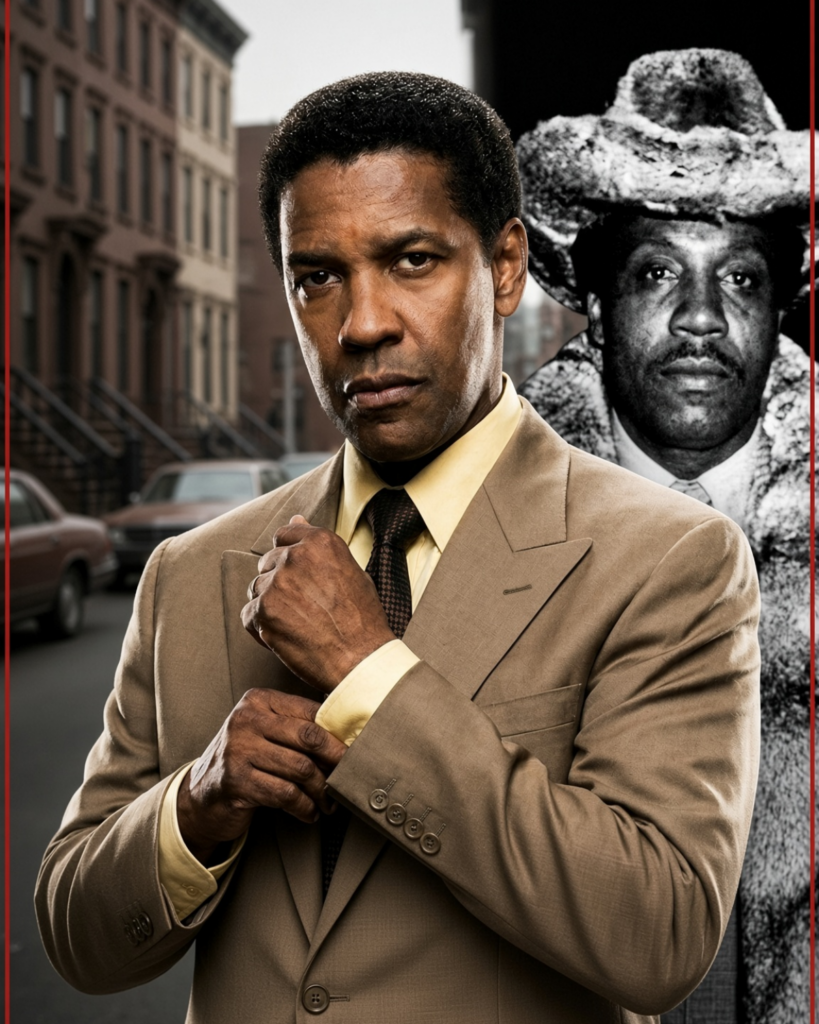
The Real Frank Lucas Was Way More Dangerous Than Denzel in ‘American Gangster’
In the movie, Denzel Washington shoots a man in the head on a crowded Harlem sidewalk, walks back to his lunch, and the theater understands it is watching a legend.
In real life, Frank Lucas told that story about himself on tape to reporters for decades, and nobody ever charged him with it.
That is the strange arithmetic of American Gangster.
The parts that look like Hollywood invention are the parts Lucas swore were true—and the parts the whole world believed.
The heroine riding home in dead soldiers’ coffins is the part the men who actually shipped the dope call a lie.
The movie gave him a code.
The record gives him bodies—an overdose epidemic with his brand name on it—and a second career informing on nearly everyone he knew.
This is the story of how the real Frank Lucas was more dangerous than the man Denzel played in American Gangster.
The teenager who stepped into Harlem in the mid-1940s owned almost nothing but a Southern accent and a talent for taking things.
Frank Lucas came up out of La Grange, North Carolina, a dirt-poor tobacco town, and by his own account, he left in a hurry—one step ahead of trouble he’d made for himself.
He would later tell interviewers he fled north after a childhood spent watching the worst of the Jim Crow South, including a story about the Klan murdering a young cousin on the family’s doorstep.
A story that, like so many Frank Lucas stories, no one has ever been able to verify and no one has ever been able to kill.
What is certain is that he arrived in Harlem as a teenager with no schooling to speak of.
He could barely read and decided almost immediately that he was never going to be poor again.
Harlem in those years was the capital of Black America, and it ran on two economies.
There was the daytime one: the shops, the churches, the barbershops along 125th Street.
And there was the one underneath it—the numbers banks, the card games, the stickup men, the dope.
Lucas went straight for the second.
He ran craps games. He robbed. He stole whatever wasn’t bolted down and some things that were.
He would later describe those years with a kind of relish—jewelry grabs, bar robberies—a young man doing violence casually and often.
And even allowing for his lifelong habit of improving a story, the police record that trailed him through the late 1940s and 1950s says the broad strokes were real.
He was a predator in a neighborhood full of them, and not yet a particularly distinguished one.
What set him apart wasn’t the stealing. It was the watching.
Harlem’s underworld had an aristocracy, and Lucas studied it the way other kids studied ballplayers.
The numbers kings had the cars and the camel-hair coats, but they paid rent.
Every one of them answered, one way or another, to the Italian mob downtown, which had muscled into Harlem’s rackets back in the 1930s and never let go.
There was exactly one Black man in Harlem who dealt with the Italians as something close to an equal—one man who settled disputes, moved money, and commanded actual fear on both sides of 110th Street.
Everybody in the neighborhood knew his name, and the hungry country boy from La Grange made it his business to get close to him.
The man was Ellsworth “Bumpy” Johnson, and getting close to him was the smartest move Frank Lucas ever made.
Though exactly how close has been a fistfight ever since.
Johnson was Harlem royalty—a dapper, poetry-quoting, violent legend who had gone to war with mobster Dutch Schultz’s organization over the numbers racket in the 1930s and come out of it as the Italians’ indispensable man uptown.
He had done long stretches in prison, including years in Alcatraz, and each one only grew the myth.
By the 1960s, when Lucas was in his orbit, Bumpy Johnson was less a gangster than an institution—the man you saw when you had a problem no one else could fix.
Lucas’s version of their relationship was grand.
He told reporters—and later a film studio—that he had been Bumpy’s right hand for 15 years.
His driver, his bodyguard, his collector, practically his son.
He said he was with Johnson constantly, that the old man taught him everything: how to dress, how to move quiet, how to think past the corner he was standing on.
And he told the story that became the opening of a Hollywood movie—that on July 7th, 1968, at Wells Restaurant in Harlem, Bumpy Johnson’s heart gave out and the great man died right there in Frank Lucas’s arms.
Bumpy’s widow, Mayme Johnson, heard that story for years, and near the end of her long life, she finally put her answer in print.
Frank Lucas, she said, was never her husband’s right-hand man.
He was a driver—briefly—one of dozens of young men who hung around the court of the king, and her husband, in her telling, never fully trusted him.
As for the death scene, she was blunt: “Frank wasn’t even there.”
Other Harlem old-timers backed her.
It is the first great example of the Frank Lucas method—the thing to hold on to for the rest of this story.
He took a real association, a real death, a real Harlem, and quietly moved himself to the center of the frame.
But here is what matters, and it’s documented by what happened next.
Whether Lucas was Bumpy’s heir or just the man quickest to claim it, Johnson’s death in July 1968 cracked Harlem’s underworld open.
The institution was gone.
The Italians still controlled the heroin coming in.
The old order of middlemen still expected their cut.
And a 37-year-old hustler from North Carolina looked at the empty throne and decided it was his.
Saying so cost nothing—every corner boy in Harlem was saying something like it that summer.
The difference was that Lucas understood what a claim like that actually required.
A throne in that world isn’t inherited, and it isn’t announced.
It’s demonstrated publicly, in daylight, in front of witnesses.
And Lucas had already picked out the man he was going to demonstrate it on.
The man’s name was Tango.
And the way Frank Lucas told it, killing him was a business decision.
Tango was a Harlem enforcer with a reputation—a big man, somewhere north of 250 pounds in Lucas’s telling, the kind of man other hustlers cross the street to avoid.
Lucas said he picked him precisely because of that reputation.
He didn’t have a beef with Tango so much as a use for him.
If you wanted Harlem to understand that the country boy was now the man, you didn’t write it in the sky.
You wrote it on the biggest, scariest wall available.
Lucas’s account, which he repeated for decades with unnerving consistency, goes like this: He set up a pretext—money Tango owed, or a job Tango had shorted him on—and confronted him on the sidewalk in the middle of the day on a crowded Harlem block.
With the stoops full and the shops open, he let the argument get loud.
He let Tango puff up and come at him—let the whole street see who started it.
And then Frank Lucas pulled a pistol and shot him dead in front of everyone, and walked away without hurrying.
In some tellings, he stood over the body and said his piece to the crowd.
The message, he explained years later with evident satisfaction, was received.
From that day, nobody in Harlem doubted that Frank Lucas would kill you, because everybody knew somebody who had watched him do it.
Now, hold that story up to the light, because both of its possible truths are ugly.
No one was ever charged with Tango’s killing.
There is no trial transcript, no conviction—nothing but Lucas’s own voice, telling it to journalists and eventually to a screenwriter.
Which is why the scene plays almost beat for beat in American Gangster, with Denzel Washington pulling the trigger on a sunlit sidewalk.
If it happened the way Lucas said, then a man committed a broad-daylight murder in front of dozens of witnesses in one of the most densely policed cities in America and was never so much as arrested for it—a fact that says as much about what police attention was worth in 1960s Harlem as it says about Lucas.
And if it didn’t happen that way—if it was another Lucas production, a myth with a real dead man somewhere underneath it—then you were looking at a person who spent 50 years boasting about a murder to make himself more frightening.
The movie resolved the question by simply filming his version.
The record never resolved it at all.
Either way, the demonstration worked.
Through late 1968 and 1969, Lucas consolidated.
The crews that had splintered after Bumpy’s death fell in line or fell back.
The ones who tested him learned that the new man’s violence was not theoretical.
He was no longer a stickup artist or a driver.
He was a boss—with corners, and soldiers, and a growing book of business.
And the only product that mattered: heroin.
And that is precisely where he hit the wall that every Black gangster in New York had hit for thirty years.
He could run Harlem’s streets, but he couldn’t own them, because he didn’t own what was sold on them.
Every kilo of dope in the city arrived through the same hands, stepped on and marked up at every stage.
And those hands were not in Harlem.
They were downtown, and they belonged to the families—and no one had ever gone around them and lived to grow old.
The arrangement Lucas inherited was, laid out plainly, a tax on being uptown.
Heroin came into New York overwhelmingly through the Italian mob’s pipelines—the famous French Connection routes: Turkish poppies refined in Marseilles, smuggled into the port, and distributed down a strict hierarchy.
By the time a package reached a Black dealer in Harlem, it had passed through so many sets of hands and been cut—diluted with milk, sugar, and quinine—so many times that the product hitting 116th Street was a ghost of itself, often just a few percent pure.
The Harlem dealer paid the highest price for the weakest dope and took the biggest risk selling it, while the real money stayed downtown.
That was the deal.
It had been the deal since before Lucas got off the bus.
What Lucas did next is the reason he’s worth a movie, whatever else is true or invented about him.
He looked at the structure the way a businessman looks at a supply chain, and he asked the question nobody uptown had managed to act on: Why am I buying from middlemen at all?
The newspapers of that era were full of a word that caught his attention: Vietnam.
Half a million American soldiers were in Southeast Asia—and Southeast Asia sat on top of the Golden Triangle, the mountainous opium country where Burma, Thailand, and Laos meet, producing some of the purest heroin on Earth at prices that made the mob’s product look like a swindle.
A kilo that cost a fortune through the Italians could be had at the source for a small fraction of that.
The problem wasn’t price, and it wasn’t supply.
The problem was that the source was on the other side of the planet, and the distance in between was patrolled by customs agents, militaries, and every law enforcement agency that cared to look.
Lucas’s insight—and this part is documented, because federal agents spent years mapping what came of it—was that the distance was also full of Americans.
Specifically, it was full of Black American soldiers cycling between the States and Vietnam by the tens of thousands, moving through bases and airfields where cargo flowed home in volumes no customs operation could truly search.
The war that was chewing up Harlem’s sons was also, if you looked at it with Frank Lucas’s particular cold eye, the greatest smuggling infrastructure ever built—government-run, government-funded, and running on a schedule.
He couldn’t use any of it by himself.
A Harlem gangster couldn’t walk onto an air base, and he couldn’t walk into the Golden Triangle either.
He needed a man already inside—somebody with military connections, somebody established in Thailand, somebody who spoke the language of sergeants and shipping manifests.
And in one of those turns that makes the story feel scripted, the man he needed wasn’t a stranger he had to court.
He was family, more or less—North Carolina kin by marriage, a country boy like Lucas himself, who had retired from the United States Army and was at that moment running a bar 7,000 miles from Harlem, pouring beer for homesick GIs in the middle of Bangkok.
The man pouring those beers was Leslie “Ike” Atkinson, and he matters to this story twice: once at the beginning of the pipeline, and once forty years later at the end of the legend.
Atkinson was a retired Army master sergeant from Goldsboro, North Carolina, connected to the Lucas clan through marriage.
And by the late 1960s, he was the proprietor of Jack’s American Star Bar in Bangkok—a home away from home for Black soldiers on leave from Vietnam.
Soul food, card games, American music, familiar faces.
It was also, federal investigators would eventually establish, the front office of one of the most audacious drug operations in American history.
Atkinson had the thing Lucas could never buy in Harlem: a web of serving and former military men who trusted him, moved constantly across the Pacific, and understood exactly how cargo did and didn’t get inspected.
Lucas flew to Bangkok to do the deal in person—that much the record supports, since the pipeline that followed had to start somewhere.
What he claimed happened next became one of his signature stories: that he went up-country himself, trekking into the Golden Triangle with guides, sleeping rough, dodging soldiers and bandits to shake hands with suppliers at the source and buy his first great load.
He liked to put it at over a hundred kilos, at a price so low it barely qualified as the same business.
Like the Tango story, it comes to us almost entirely on Frank’s say-so.
And the men who knew the Thai end of the operation always smiled at it.
In their version, Atkinson’s organization had suppliers, and Lucas’s jungle adventure was mostly performed later for reporters.
What nobody disputes is the result.
By around 1970, heroin of staggering purity was flowing from Southeast Asia to Frank Lucas in Harlem, and the Mafia had nothing to do with any of it.
How it physically crossed the Pacific is the most contested question in this entire story, and it’s worth being precise about what’s documented.
Investigators and prosecutors established that the Atkinson organization moved heroin through military channels—sealed inside shipments of teak furniture crafted with hidden compartments, and carried in luggage and duffel bags threading through military air routes, flown by and alongside servicemen into bases on the East Coast.
North Carolina, with its huge military installations and both men’s family networks nearby, became the American end of the line.
Soldiers and veterans—some knowing, some used—formed the chain.
That pipeline was real.
It was enormous.
And men went to federal prison for decades over it.
And then there is the version Frank Lucas told: that the heroin came home in the coffins of American soldiers killed in Vietnam, in false bottoms built beneath the bodies in caskets accompanying the honored dead, because he’d figured out the one shipment no customs man would ever dare open.
It is the single most famous claim of his life.
It is the engine of the magazine profile that resurrected him, and the movie that immortalized him.
Hold it gently for now, because the men who actually ran the Bangkok end—Ike Atkinson first among them—will get their say before this story ends.
And what they say is not kind.
However it traveled, it arrived.
And the moment it arrived, Frank Lucas had a problem most dealers never dream of having: product too strong and too cheap for the existing market to understand.
The Mafia’s heroin crawled to Harlem at a few percent purity and premium prices.
Lucas was now sitting on nearly pure Asian heroin that had cost him a fraction of wholesale.
He could have quietly matched the market and pocketed the spread.
Instead, he did the thing that made him Frank Lucas.
He decided to put his name on it—or at least a name—and advertise.
The name was Blue Magic, and on the corners of Harlem it meant exactly what a brand is supposed to mean: consistency.
Lucas took his Asian heroin and released it at a purity that embarrassed everything else on the street.
Where a typical bag in New York might run a few percent heroin, Blue Magic tested several times stronger—and he priced it like the ordinary stuff.
The effect was immediate and, in business terms, textbook.
Addicts walked past every other dealer’s product to find the blue-tinted bags.
Corner crews that sold rival brands watched their customers drain away to 116th Street between Seventh and Eighth Avenues—the strip Lucas treated as his open-air flagship.
He liked to call it his office.
And he claimed that when the product went on sale, the block moved money faster than most banks.
His numbers—a million dollars a day at the peak—he loved to say, are Frank Lucas numbers, unauditable and almost certainly inflated.
The dominance was real.
Federal agents who spent years on him never argued with the core claim.
For a stretch of the early 1970s, nobody in Harlem—maybe nobody in America—sold more heroin than Frank Lucas.
An operation that size has one fatal weakness, and Lucas knew it from a life spent on the other side of it: the people.
Every cutter, bagger, driver, and corner manager is a future witness.
His answer was the oldest institution he had.
He reached back down to North Carolina and brought the family north—his brothers chief among them, plus cousins and in-laws, countrymen with no city records and nowhere else to be.
Harlem called them the Country Boys, and the name stuck as the name of the organization itself.
His brothers ran distribution.
Trusted kin handled the money.
In the mills where women kept naked—by his own matter-of-fact account, so nothing walked out the door—they cut and bagged the product behind locked steel.
The logic, as Lucas explained it, was simple: “A stranger will sell you to the police, but a brother has to come home to your mother.”
It worked for years.
It is worth remembering later, when we get to what Frank himself did to the people around him—exactly what he believed loyalty was.
The money became its own problem—the kind of problem that sounds like a joke until you’re standing in it.
Cash came in faster than it could be counted, in denominations too small to move easily.
He stuffed it into suitcases, ran it to safe deposit boxes, and claimed he wired millions offshore to banks in the Cayman Islands.
He bought the trappings with a country boy’s idea of arrival.
A ranch back in North Carolina stocked with Black Angus cattle, including a prize bull he paid for like it was a Rolls-Royce.
Property, cars, jewelry for his wife, Julie—a strikingly beautiful former beauty queen he’d met in Puerto Rico.
For a man at the center of a federal story, he lived quietly enough: expensive, but not loud, at least by gangster standards.
He understood, in the way Bumpy’s Harlem had taught him, that flash was a tax collector for the police.
He understood it. He preached it.
And the one night he forgot it will get its own chapter, because it cost him everything.
But before the fall starts, stop and look at what all this success actually was.
Every bag of Blue Magic, every brick of cash in every suitcase, every Angus steer on that North Carolina ranch was paid for at the other end of a needle.
And the purity that built the brand was doing something to Harlem that the movie, decades later, would barely let you glimpse.
Blue Magic’s strength wasn’t just a selling point.
It was a dosing error distributed across an entire city.
Addicts calibrated their shots to street heroin that was overwhelmingly filler.
When a bag several times that strength hit the market at the same price, the arithmetic landed in emergency rooms.
New York in the late 1960s and early 1970s was living through the worst heroin epidemic in its history.
Hundreds of thousands of users citywide by official estimates, and overdose deaths climbing year over year into the hundreds and beyond—with heroin killing young New Yorkers at rates that put it among the leading causes of death for the city’s young men.
Harlem carried the worst of it.
Those years put nodding men in doorways on the avenues, sent addicts over apartment transoms after anything sellable, and filled the city’s morgues with teenagers whose deaths made the paper only as a number.
Nobody can honestly hang that entire epidemic on one man.
The French Connection had been pouring dope into those same blocks for a generation, and rival operations fought Lucas for every corner.
But Lucas’s special contribution is right there in his business model.
His edge was purity and price.
He moved more heroin—stronger heroin, cheaper heroin—into the neighborhood he lived in than anyone had before him.
And he did it as a volume strategy, knowingly, for years.
The customers were his own community.
The sons and daughters of the Harlem that had taken him in as a broke Carolina teenager.
Asked about it across the decades, Lucas never produced much beyond a shrug in the dealer’s eternal alibi: If not him, somebody else.
He was, by every account including his own, untroubled.
Here is where the movie deserves its first direct indictment.
Because this is a documented softening, visible to anyone who watches it with the history in hand.
American Gangster shows addiction.
There are needles. There are shooting galleries.
There’s a glimpse of the human wreckage—but it shows it as atmosphere, scenery behind a rising businessman whose discipline and family values carry the score.
The film’s Frank is a man of consequences deferred.
The dying is mostly offscreen, unnamed, and never laid at his feet in any scene with weight.
Denzel’s performance—magnetic, controlled, quietly moral even in monstrosity—did exactly what great performances do.
It transferred its own dignity to its subject.
The real ledger has no such dignity in it.
The real ledger is a purity figure, a price point, and a morgue count moving in the same direction at the same time.
The man responsible for Harlem’s strongest product was, through all of it, nearly invisible.
A deliberate ghost who let his brothers front the operation and kept his own face out of police files that still had him listed as a small-timer.
The Italians knew him.
The corners knew him.
And law enforcement, remarkably, mostly didn’t.
That invisibility was worth more than any lawyer in New York—which is what makes the night he threw it away.
One night, one fight, one coat.
Almost too perfect a story to be true.
Except this one has witnesses. Thousands of them.
On March 8th, 1971, Madison Square Garden held the most-watched prize fight in the history of the world: Muhammad Ali versus Joe Frazier.
The Fight of the Century.
And the ringside seats were a census of American power and celebrity.
Frank Sinatra shooting photos for Life magazine.
Politicians. Movie stars.
And every gangster in New York who could buy his way down front.
Into that room, in seats better than most of the famous faces, walked Frank Lucas in a floor-length chinchilla coat with a matching chinchilla hat—an ensemble that had cost, by his own count, well over $100,000—with his wife beside him, dressed to match.
For one night, the ghost of Harlem decided to be seen.
He would spend the rest of his life calling it the dumbest thing he ever did, because the ringside census had another column he hadn’t considered.
Scattered through that crowd were working narcotics detectives and federal agents—there to watch the fight and watch the wise guys.
And they all noticed the same thing.
The Italian bosses they’d spent careers photographing were sitting in good seats.
The Black man in the chinchilla was sitting in better ones.
And nobody—not the agents, not the mobsters’ own people—could say who he was.
In their world, that combination didn’t compute.
Seats like that plus a coat like that equaled narcotics money.
And narcotics money that senior law enforcement couldn’t put a name to meant a hole in their map of New York—exactly where the biggest operation in the city turned out to be.
The coat went back into storage, by Lucas’s telling, never worn again.
It didn’t matter.
The question—”Who is that?”—had been asked.
And that question never goes back in storage.
The answer took shape over the following months and years, as the walls of jurisdiction slowly came down.
This era—the early 1970s—was the worst in the history of New York narcotics enforcement, for one humiliating reason: The police were in the business.
The NYPD’s elite narcotics detectives of that period became a national scandal—officers who took money to lose files, resold seized heroin, and in some cases ran dealers as franchises.
Lucas, by his own cheerful account, paid police like a utility bill.
Which is why the investigation that finally mattered was built sideways: a joint federal and local task force, drawing in the newly formed Drug Enforcement Administration, and prosecutors from across the river in New Jersey—where Lucas, in his quiet ghost way, had moved his family into a comfortable colonial house in the suburb of Teaneck.
Among the New Jersey men was a tough Newark-born detective turned prosecutor named Richie Roberts—a name to keep, because his and Lucas’s lives were about to braid together in ways neither of them, and no screenwriter, could have predicted.
Wiretaps went up. Surveillance logs thickened.
Low-level Country Boy arrests were quietly turned into cooperation.
By late 1974, the task force believed it understood the shape of the thing: the family structure, the military pipeline, the Teaneck house where the ghost slept.
What they needed was the night that turns a file into a case—the money, the product, and the man together behind one door.
In the last week of January 1975, they decided to go get it.
The door was the Lucas house in Teaneck, New Jersey.
And when the task force came through it on a January evening in 1975, the ghost was home.
Agents and detectives flooded the colonial on its quiet suburban street—the kind of street where the neighbors knew the Lucases as a pleasant, private family.
And what happened in the next few minutes became the one scene of Frank’s downfall that even he never had to exaggerate.
As the raiders came in the front, his wife Julie went for the windows with luggage—suitcases and bags stuffed with banded cash heaved out into the winter dark, where they landed in the snow at the feet of the agents covering the back.
When the counting was done, the money from the house came to a little over $584,000—more than half a million in street cash in a private home in 1975—along with keys to safe deposit boxes, paperwork trailing off toward the Caymans and the Carolina properties, and, investigators reported, a stack of invitations and mementos linking the quiet man of Teaneck to the whole glittering world he pretended not to rule.
Lucas came out in handcuffs, insisting, with the brass of a man who had beaten every room he’d ever been in, that it was all a frame.
The money was gambling winnings.
The case was police theater.
For a while, he fought it exactly as you’d expect the richest dealer in America to fight it: top lawyers, bail battles, delay.
It bought him nothing, because the case had stopped being one case.
The federal government tried him in New York in 1976 for running his heroin enterprise, and the jury convicted.
The sentence was 70 years.
New Jersey then came for its own piece, prosecuting him under state law—Richie Roberts’ office driving it, and winning again, stacking a second sentence on top of the federal one.
The empire didn’t wind down. It was beheaded.
The Country Boy trade collapsed under the follow-on prosecutions.
The brothers and cousins went into the system one after another.
And the North Carolina end—including the military pipeline, including in time Ike Atkinson, in his own separate federal reckoning—was rolled up by cases that would run on for years.
Add it up, and Frank Lucas, in the span of about 18 months, went from arguably the most successful drug trafficker in American history to a man in his mid-40s staring at the rest of his natural life in federal prison.
His fortune seized or scattered.
His organization—the family he’d imported precisely because family doesn’t talk—being worked over one relative at a time by prosecutors with leverage he had personally manufactured for them.
And it’s here, at the absolute bottom, that the movie and the man part company most completely.
American Gangster plays what comes next as a sort of moral awakening.
Denzel across the table from Russell Crowe’s Richie Roberts, offering up only the dirty cops—a fallen king helping clean the kingdom.
What actually happened was bigger, colder, and far more dangerous to the world Frank Lucas came from.
The man who built an empire on the principle that blood doesn’t snitch sat down across from the government, took inventory of everything and everyone he knew, and started selling.
Frank Lucas became an informant on a scale that has few rivals in the history of American narcotics enforcement.
Not a tip here and a name there.
A years-long, systematic unloading of everything in his head.
Prosecutors and agents who worked with him described it plainly.
He gave up suppliers, distributors, rivals, partners.
The architecture of the trade, from Harlem’s corners to the overseas pipeline.
Richie Roberts, the New Jersey prosecutor who had helped convict him, put the yield of Lucas’s cooperation at well over a hundred cases.
For years, in and out of courtrooms and debriefing rooms, under guard and under aliases, the king of 116th Street functioned as the government’s single best map of the world he had ruled.
Lucas spent the rest of his life spinning this, and his spin made it into the movie nearly intact.
His version—the Denzel version—was that he only ever gave up dirty cops, that he never broke faith with his own, that the code held.
The record will not carry that weight.
Corrupt officers did fall in those years.
The scandals in New York’s narcotics squads were real and historic, and Lucas’s information fed into that era of reckoning—he had, after all, been the one paying them.
But the heart of his cooperation was the trade itself: the traffickers, the dealers, the men who had sat at his table.
The federal government does not slash a 70-year sentence for a man who hands over nothing but crooked police.
It slashes it for a man who delivers his whole world.
And that is what the government’s own actions tell us he delivered, because they protected him like a crown jewel.
Lucas was moved through custody under extraordinary security, and his wife and family were taken into the federal witness protection program, issued new identities and hidden—the standard price of cooperation so dangerous that everyone involved expected the people he’d named to kill him for it.
Sit with the shape of that for a moment, because it is the real answer to the question the movie’s poster asked.
The chinchilla coat was vanity.
Tango, whatever Tango was, was advertising.
But this was the most dangerous thing Frank Lucas ever did—measured the only way his world measured danger: by how many people went down.
Blue Magic put thousands of strangers in the ground anonymously.
The talking put his named, known world—colleagues, kin by business, and kin by blood’s extension—into federal prison, with his signature, so to speak, on the paperwork.
The man whose entire organizational theory was that a brother can’t sell you out turned out to be the biggest seller of them all.
Harlem never forgave it.
For decades afterward, the street’s verdict on Frank Lucas was not “gangster” but the shorter, harder word.
The movie, needing its hero to keep our sympathy to the end, filmed the verdict Lucas preferred.
The government, at least, paid its bill honestly.
In 1981, with his cooperation banked, Frank Lucas’s sentences—federal and state—were cut down to time served plus lifetime parole, and he walked out of custody a free man, barely six years after the suitcases hit the snow in Teaneck.
He was 50 years old.
Officially penniless, stripped of empire, famous in all the wrong rooms, and anonymous everywhere else.
What does a man like that do with freedom?
In the movie, the story is essentially over.
In life, Frank Lucas had almost forty years left.
And the first thing he did with them answers any lingering question about whether prison had changed him.
What he did with freedom was go back to the only trade he knew, at a scale that would have embarrassed the man in the chinchilla.
In 1984, barely three years out, Lucas was caught in a street-level deal, exchanging a quantity of heroin and a bundle of cash for cocaine.
The kind of transaction that, in his prime, happened five layers beneath his notice.
The fallen king of a million-dollar-a-day empire was now personally hand-to-handing dope, and he got caught the way hand-to-handers get caught.
It drew him seven more years.
There was a bleak symmetry to the courtroom this time.
Among those in his corner was Richie Roberts—the prosecutor who had helped take him down, now working on the side of his defense.
The strange friendship between hunter and hunted already past the point of anyone being able to explain it to outsiders.
He served his stretch into the beginning of the 1990s, and then came out—in his sixties now—to the quietest release of his life.
No task force watching. No headlines. No one much caring.
And then Frank Lucas did something genuinely unprecedented for him.
Nothing.
Through the 1990s, he lived in obscurity in New Jersey.
Broke in the way that his kind of broke works—forever hinting it came in accounts that never seemed to materialize—scraping along in a world that had moved on.
The Harlem corners he’d ruled belonged to crack now, run by kids who’d never heard of Blue Magic.
The brothers and partners of the Country Boy years were scattered—dead, imprisoned, or wanting nothing to do with the man who talked.
A car accident wrecked his legs and put him in a wheelchair.
If the story had ended there—and for all ordinary purposes, in 1999, it had—Frank Lucas would be a footnote in DEA case histories and a curse word among Harlem old heads.
And nobody outside either group would know his name.
He was saved—there is no other word—by the one weapon that had never failed him.
The one he’d been sharpening since the Bumpy Johnson days while everything else rusted.
The story.
Frank Lucas, pushing 70, broke, forgotten, could still talk.
He could sit a listener down and unspool Harlem, Bangkok, the jungle, the coat, the coffins—above all, the coffins—with dates and textures and dead men’s names, pausing in the right places.
A performer who had spent thirty years workshopping his own legend on live audiences of cops, cellmates, and prosecutors.
All that material needed was a venue.
In the year 2000, the venue arrived in the form of a magazine writer who had heard there was an old man in New Jersey claiming he used to be the biggest gangster in New York, and who knocked on his door with a tape recorder.
The writer got the performance of Lucas’s life, and in August 2000, New York magazine published it under the title “The Return of Superfly.”
The piece was electric.
The forgotten king resurfacing.
The mouth of a born raconteur running through the whole saga.
And there, at the center, told more vividly than ever: the coffin story.
The heroin riding home from Vietnam beneath the bodies of fallen American soldiers.
The untouchable shipment.
The audacity that out-gangstered every gangster story ever printed.
The article detonated on contact with Hollywood.
The life rights sold.
A-list screenwriting talent took it up, and after years in development, one of the biggest directors alive shot it with the most bankable serious actor in America.
In November 2007, American Gangster opened, with Denzel Washington as Frank Lucas, Russell Crowe as Richie Roberts, and the words “Based on a true story” doing an extraordinary amount of unexamined work.
It was a smash.
More than a quarter of a billion dollars worldwide.
Awards nominations.
Instant entry into the gangster-movie canon.
Frank Lucas—who three decades earlier couldn’t walk Harlem without protection from the people he’d informed on—was wheeled into premieres as a living legend, photographed beside the movie star wearing his name.
Look at what the film did to the record, because every change bent the same direction.
The documented informing of well over a hundred cases became Denzel handing over only corrupt cops—the snitch recast as a reformer.
The Bumpy Johnson relationship was filmed exactly as Lucas told it, and his widow denied it—deathbed and all.
Tango’s killing was staged from Lucas’s uncorroborated boast as documentary fact.
The overdose dead of Harlem flickered at the edges of a story whose center was always a handsome man building something.
And over the end of the film, text told millions of viewers a statistic implying that Lucas’s cooperation had led to the conviction of the majority of New York’s federal drug agents—a claim so wrong that three retired DEA agents sued the studio over it, and the court record established the truth flatly: Not one federal drug agent was ever convicted on Frank Lucas’s information.
The dirty cops of that era were New York police detectives, and that scandal was bigger than Lucas and never his doing.
The lawsuit failed, as such lawsuits mostly do.
But the suit was never the point.
The point is what it proved about the film: that when the legend and the record disagreed, American Gangster printed the legend every single time.
And the legend’s crown jewel—the coffins—now had the full faith and credit of a hundred-million-dollar studio production behind it, recreated on screen in solemn detail.
Military caskets open to reveal the bricks beneath the fallen.
Audiences everywhere absorbed it as history.
There was just one problem, and it was a large one.
The men who had actually built the Bangkok pipeline—the ones with the federal convictions to prove their expertise—were still alive.
One of them was Ike Atkinson.
And when the questions finally reached him, the man at the source end of Frank Lucas’s fortune delivered his verdict on the most famous smuggling story ever told.
Ike Atkinson came out of federal prison in the 2000s, an old man who had paid for the pipeline with most of his remaining life.
And he was asked—by journalists, by a biographer, by documentary cameras—about the coffins.
His answer never wavered.
It was a hoax. A fabrication.
In Atkinson’s account, backed by the men who’d worked with him, the heroin had moved exactly the way investigators had long described: sealed into teak furniture built with false compartments in Thailand, and carried in bags through military air channels.
Never, he said, in caskets. Never beneath bodies.
The operation had neither the access to the military mortuary system nor the stomach for it.
And the story was Frank being Frank—taking a real pipeline other men had engineered and dressing it in the one detail so lurid no journalist could resist repeating it.
The DEA veterans who had actually worked the cases lined up on the same side.
Decades of investigation had never produced evidence of heroin in soldiers’ coffins.
No seizure. No witness under oath. Nothing but Frank Lucas’s mouth.
Even Lucas himself, cornered on it in his final years, wobbled between versions—insisting, then softening toward a claim about a casket shipped with heroin and no body, then insisting again.
The storyteller, adjusting the tale to the room one last time.
Set the two legends side by side, and the pattern of the man’s whole life snaps into focus.
Bumpy’s right hand for fifteen years—denied in print by Mayme Johnson, who put him down as a short-term driver. Inflating a dead man’s friendship.
The daylight execution of Tango—unprosecuted, unverified, sourced entirely to the man it glorified.
The jungle trek to the Golden Triangle—smiled at by the Bangkok men whose suppliers were already in place.
The million dollars a day. The fifty-two million in the Caymans that never surfaced, even when he was destitute.
The coffins—branded a lie by his own partner and the agents who caught them both.
Strip the stories he alone is the source for, and what remains documented is this: A real empire. Real purity. Real suitcases of cash in the Teaneck snow. A real 70-year sentence. Real mass cooperation. And a city’s worth of real needles.
The record’s Frank Lucas is smaller than the legend, and worse than it.
The legend sold dope and dazzled.
The record poisoned Harlem, and then informed on it.
The strangest coda belongs to Richie Roberts.
The prosecutor who built the New Jersey case spent the rest of his life tangled up with the man he’d caged—defending him in court, vouching for him to reporters, and, in the detail no screenwriter would have dared invent, standing as godfather to Lucas’s young son and helping pay the boy’s school fees.
Roberts never pretended Frank was innocent of anything.
He’d read the file. He’d written some of it.
He seemed to hold both truths at once: that Lucas had done monstrous things, and that the old man across the dinner table was, in his company at least, generous, funny, and loyal.
Plenty of people who knew Lucas’s victims found the friendship unforgivable.
Roberts kept it anyway, to the end.
Whatever it says about either man, it meant that when the last chapter came, Frank Lucas—who had betrayed nearly everyone and been mythologized for it—still had one friend from the other side of the war sitting beside him.
The end came slowly and modestly, in the same New Jersey where the suitcases had flown out the window.
Lucas lived out his final decade as a local curiosity and a global brand.
Broke by every visible measure, getting by in and around Newark, wheelchair-bound, yet forever recognizable to strangers as Denzel’s gangster.
He signed memorabilia from the movie about him.
He put his name on a memoir that retold all the stories, coffins included, one more time.
His wife, Julie—who had gone to prison for him after the raid and spent years apart from him—was back at his side for stretches of the late life.
Now and then a reporter would make the pilgrimage and find the voice still sharp, the stories still smooth, remorse still almost entirely absent.
Pressed on the dead of Harlem, the old man would allow, at most, that if he had it to do over, he might choose differently—in the tone of a man discussing a business pivot.
On May 30th, 2019, Frank Lucas died in New Jersey at the age of 88, of natural causes, in a bed—an outcome he had no statistical right to.
The obituaries ran worldwide, and nearly every one of them led with the movie, and most of them repeated the coffins.
What remains is a double image that will probably never come apart.
There is the Frank Lucas a hundred million people met in a theater: the elegant executive in the camel coat, dangerous but principled, a man you could almost root for.
And there is the one in the record: the informer with a hundred cases to his name, the brand on the bags that fed a city’s overdose wave, the storyteller whose masterpiece was a lie about dead soldiers that outlived every man who called it one.
The movie’s Frank was dangerous the way fiction is dangerous—beautifully, at a safe distance.
The real one was dangerous the way a needle is: to Harlem, to his own blood, and finally to the truth itself, which he cut and branded and sold as surely as he ever sold Blue Magic.
Denzel played the legend, and played it so well the legend won.
But the legend was the costume.
The man underneath was worse—and he’d have taken that as a compliment.









