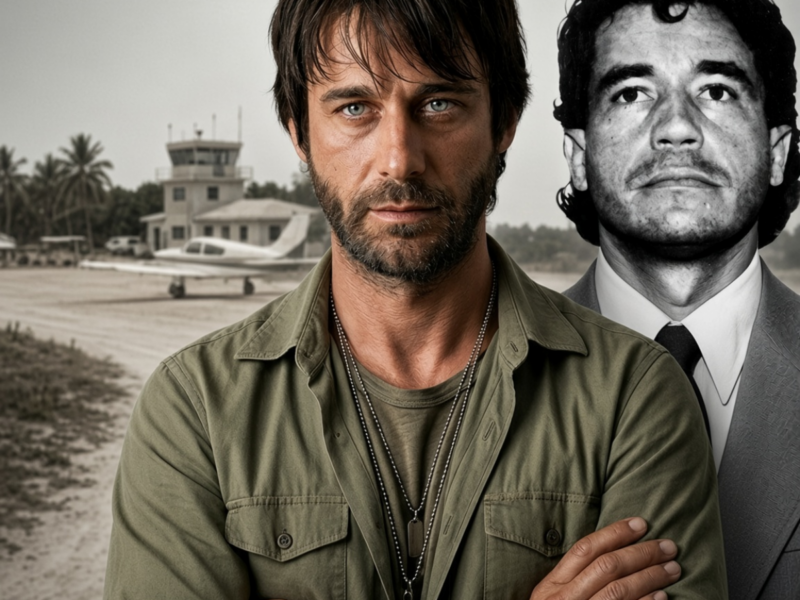
The Real ‘Diego Delgado’ Was the Most Dangerous Cocaine Smuggler Behind ‘Blow’ Movie
February 4th, 1987.
A country house in the hills east of Medellín, before dawn.
Police surrounded in the dark.
Inside sleeps a 37-year-old who once owned an island with its own airstrip and armed guards, and who swore no plane would ever take him north in chains.
At first light, the raid breaks.
A short burst of gunfire, bodyguards face down.
And he is pulled half-dressed into the cold mountain air.
His name is Carlos Lehder, co-founder of the Medellín Cartel, whose island moved tons of cocaine a month.
The first cartel boss ever extradited to America.
In the movie Blow, he stands beside Johnny Depp’s George Jung under another name—Diego Delgado, the partner who betrays him.
The film shows the betrayal.
It does not show this morning.
This is the story of how the real Diego Delgado became the most dangerous cocaine smuggler behind the movie Blow.
Carlos Lehder was born on September 7th, 1949, in Armenia, a coffee town in the Quindío region of western Colombia.
His father was a German immigrant, an engineer who had left Europe and settled in the Colombian hills, where he built a business and a family.
His mother was a Colombian schoolteacher.
So from the very beginning, Carlos lived between two worlds.
At home, there was German order, German pride, stories of a faraway country his father still carried with him.
Outside the door, there was Colombia—green mountains, coffee farms, and a town where everyone knew everyone.
The German half of him would matter his whole life.
It shaped how he saw himself—not as a local kid from a coffee town, but as something grander, someone destined for bigger things.
Decades later, it would even decide where he spent his old age.
But as a boy, what it mostly gave him was a feeling that he didn’t quite belong anywhere.
The family didn’t hold together.
His parents separated, and his mother decided to start over far away in the United States.
So in the mid-1960s, when Carlos was around fifteen, he left the coffee hills behind and landed in New York City.
Imagine that jump.
One year you’re a teenager in a quiet Colombian town.
The next year you’re in the biggest, loudest city on Earth, speaking a second language, with no money and no father in the house.
New York in the late 1960s was a hard place for a poor immigrant kid, but it was also a school.
Carlos was smart—genuinely smart.
Quick with numbers, quick with people, able to talk his way into rooms and out of trouble.
He looked around at the country he’d been dropped into and saw two Americas.
There was the official one, where immigrant kids worked long hours for small paychecks.
And there was the other one—the one that moved at night, where a clever teenager could make a month’s wages in an afternoon if he didn’t ask too many questions.
Carlos chose the second one.
He started small, the way almost everyone does.
But even then, people who knew him noticed something unusual.
He wasn’t just hustling for pocket money.
He studied how things worked.
He paid attention to supply, to demand, to risk.
He treated crime like a business class, and he was taking notes.
By the time he was in his early twenties, those notes had turned into an actual operation—and that operation was about to introduce him to the American justice system, which, without meaning to, was about to hand him the greatest business opportunity of the twentieth century.
The operation that got him caught was cars and marijuana.
Young Carlos Lehder had worked his way into a ring that moved stolen cars across state lines.
Steal them in one state, retag them, sell them in another.
On the side, he dealt marijuana.
Because in the early 1970s, marijuana was everywhere and the money was easy.
For a while it worked.
Then, like almost every young criminal, he got careless and federal agents got lucky.
He was arrested, convicted over the stolen cars, entangled in a marijuana charge as well.
In 1974, at twenty-five years old, Carlos Lehder arrived at the federal prison in Danbury, Connecticut.
And here’s the thing about Danbury.
It was not a dungeon.
It was a low-security federal facility—the kind of place where the government sent tax cheats, crooked accountants, fraudsters, and smugglers.
Non-violent men. Educated men. Men who knew things.
Lehder understood immediately what he was looking at.
Most inmates in Danbury killed time—lifted weights, played cards, counted the days.
Lehder treated the place like a university.
He sought out the bankers and asked how money got moved and hidden.
He sought out the smugglers and asked how loads got caught and how they didn’t.
He kept notebooks.
He exercised, stayed sharp, barely touched the drugs floating around inside.
Other inmates remembered him as polite, curious, and relentless.
He was a man conducting interviews.
And then the interview that changed everything.
In Danbury, Lehder met a broad-shouldered American from Massachusetts named George Jung.
Jung was in for marijuana smuggling—and not small-time smuggling.
Before his arrest, Jung had been flying plane loads of Mexican marijuana into the United States, landing on dry lake beds in California, moving it east, making a fortune.
He knew airplanes.
He knew remote airstrips.
He knew how to get weight across a border without anyone stamping a passport.
Jung would later say Danbury wasn’t really a prison at all.
It was a crime school, and he and Lehder became its two best students, teaching each other, because each man had exactly half of a perfect machine.
Jung had the American half—the planes, the pilot’s tricks, the landing zones, and a connection in California who could sell drugs in enormous quantities.
Lehder had the Colombian half—the language, the country, and an understanding of a product that made marijuana look like a joke.
That product was cocaine, and the numbers around it were almost unbelievable.
A kilo of cocaine cost a few thousand dollars in Colombia.
In the United States, that same kilo sold for tens of thousands—and it fit in a shoebox.
Marijuana made you money by the plane load.
Cocaine made you the same money by the suitcase.
Night after night in a Connecticut prison, the two of them built the plan that would flood America.
All they needed now was for the gates to open.
The gates opened in 1975.
Lehder served his time, was released, and was deported back to Colombia—which, for his purposes, was not a punishment.
It was a supply run.
Jung got out as well and went home to Massachusetts.
The deal they’d made in Danbury held.
Lehder would arrange the cocaine in Colombia.
Jung would arrange the selling in America.
And together they would solve the only hard problem: the space in between.
They started small and clever.
In the beginning there were no planes—just suitcases.
They recruited couriers, young women mostly, who looked like tourists, and had them fly commercial routes through the Caribbean into the United States with kilos of cocaine hidden in specially built luggage.
A smiling vacationer with a nice suitcase walked through customs where a nervous mule would have been searched.
It was low-tech and it worked.
Then came the selling—and this is where Jung’s old life paid off.
Back in his California days, Jung had known a hairdresser in a beach town near Los Angeles, a man whose little salon sat on top of one of the biggest cocaine distribution networks on the West Coast.
Jung brought him the product.
The hairdresser moved it so fast it was almost frightening.
Kilos that landed one week were gone the next, converted into duffel bags of cash.
The two ex-convicts from Danbury were suddenly rich.
Not comfortable rich. Paper bags of money rich. Count-it-with-a-machine rich.
But Lehder had never intended to stay in the suitcase business.
Suitcases were a proof of concept.
The real plan—the one from the prison notebooks—was always airplanes.
So they graduated.
Small private aircraft began lifting off from Colombia loaded with cocaine, skimming north across the Caribbean, stopping to refuel in the islands, then slipping into the southern United States, dropping their loads over remote country or touching down on quiet airstrips in Florida and Georgia, where cars waited in the dark.
One plane load carried more than an army of suitcase couriers, and the profits stopped being measured in bags and started being measured in rooms.
It’s worth pausing on what this actually meant, because it’s the reason this story matters.
In the mid-1970s, cocaine entered the United States in trickles.
A kilo here, a kilo there, hidden on bodies and in freight.
What Lehder and Jung built was the first real air bridge.
They industrialized it.
The trickle became a pipeline—and American demand, it turned out, was bottomless.
Every load sold out.
Every month the orders grew, and that growth created a problem of scale.
Two men and a hairdresser could not supply a continent.
Lehder needed more product than any independent operator could buy, which meant he needed the men who controlled cocaine at the source.
In the city of Medellín, a group of ambitious Colombian traffickers was consolidating exactly that control—and one of them, a chubby, soft-spoken young man with a genius for violence, was about to become the most famous criminal on Earth.
That man was Pablo Escobar.
In the late 1970s, Escobar and a handful of trafficking families in Medellín were organizing what had been a chaotic business—hundreds of small smugglers—into something centralized.
They controlled the labs that turned coca paste into powder.
They controlled the supply.
What they didn’t fully control yet was transport at scale—and that is exactly what Carlos Lehder walked in offering.
His pitch was simple.
Stop hiding kilos on human mules.
Stop dribbling product through airports.
Give me your cocaine, and I will fly it into the United States by the plane load—hundreds of kilos at a time—for a fee on every kilo.
For the Medellín men, it was irresistible.
For Lehder, it was the move that lifted him from smuggler to partner.
He wasn’t working for the organization that the world would later call the Medellín Cartel.
He was one of its founders—the transport wing of the whole enterprise.
Escobar handled product and muscle.
The established smuggling clans handled routes and connections.
Lehder handled the sky.
And somewhere in this climb, George Jung became a problem.
Not an enemy. Worse. An unnecessary expense.
Think about what Jung actually contributed at this point.
The flying knowledge? Lehder had absorbed it.
He now had his own planes and his own pilots.
The American connection? That was the real prize—the California hairdresser who could sell anything.
And Jung’s entire position rested on one fragile thing: being the man in the middle, the only bridge between Lehder and that connection.
So Lehder went around the bridge.
Behind Jung’s back, he made contact with the hairdresser directly and cut his own deal.
The product would flow straight from Lehder’s planes to the hairdresser’s network.
Same cocaine. Same buyers. Same money. Minus George Jung.
When Jung found out, he confronted his old cellmate—the man he taught everything, the man he built the pipeline with from a prison bunk.
By Jung’s own account, Lehder barely flinched.
This was business.
Jung had served his purpose.
There was no gratitude in the equation, because gratitude wasn’t a number.
If you’ve seen Blow, you know this moment.
It’s the emotional center of the whole film—Diego’s betrayal of George.
And on this one point, the movie tells the truth.
The betrayal happened essentially as Jung described it.
What the movie doesn’t tell you is what the betrayal was for.
In the film, Diego steals a connection.
In reality, Lehder was clearing the deck for something no drug trafficker had ever attempted—a piece of infrastructure so bold it still sounds made up.
George Jung stayed in the game on the margins, flying loads, nursing his grudge for a decade.
Keep him in mind.
He leaves the story now, but he comes back at the worst possible moment of Carlos Lehder’s life.
Because Lehder had stopped thinking like a smuggler.
Smugglers rent planes and bribe guards.
Lehder wanted to own the route itself—and he’d found a place on the map where that was actually for sale.
The place was called Norman’s Cay—a skinny strip of sand and scrub in the Exumas, a chain of islands in the Bahamas.
It sat about 210 miles southeast of the Florida coast, which, if you think like a pilot, is the whole story.
A small plane flying from Colombia is stretched to its limits reaching the United States.
A small plane flying from Norman’s Cay can be over Florida in a little more than an hour.
Whoever controlled that island controlled a stepping stone between the cocaine fields and the richest drug market on Earth.
And Norman’s Cay came with equipment.
It had a marina.
It had a small hotel and a yacht club that catered to sailors and vacationers.
Best of all, it had an airstrip—a paved runway laid across the island, built for the convenience of wealthy visitors flying in for the weekend.
In 1978, Carlos Lehder started buying it.
He did it quietly at first, through companies and intermediaries, the way the Danbury bankers had taught him.
The hotel. The marina. The land around the airstrip.
Acre by acre, the island’s commercial heart changed hands, and the new owner began making improvements that had nothing to do with tourism.
Fuel storage. Radio equipment.
Housing for staff who never seemed to do any hotel work—young men, Colombians and Germans among them, who watched the docks and watched the runway and carried themselves like soldiers, because that’s what they were.
Lehder was building a forward operating base, and the operation around it grew with astonishing speed.
Planes from Colombia began arriving loaded with cocaine.
On the island, the cargo was offloaded, stored, and broken into smaller loads.
Fresh planes—faster, lighter, perfect for the last hop—carried it on to Florida.
The strip saw constant traffic.
The fuel tanks were always busy.
In the lagoon, flying boats and small aircraft came and went past anchored yachts whose owners were starting to wonder what exactly had happened to their sleepy island.
At the peak of it, tons of cocaine were moving through Norman’s Cay every month, and Lehder collected his transport fee on every single kilo.
The money that generated is hard to describe, honestly, without sounding like exaggeration.
He was one of the richest criminals alive, and he was barely thirty years old.
But there was a flaw in the paradise, and the flaw was people.
Norman’s Cay wasn’t empty when Lehder bought into it.
There were homeowners, retirees, sailing families, foreigners with vacation houses—maybe a hundred people with every legal right to be there, with eyes and radios and friends in Nassau.
Every one of them was a witness to the strangest air traffic in the Caribbean.
Lehder’s first solution was money.
He offered to buy people out, and some took the offer and left.
But others loved their island and said no.
And that is when the island king showed what he was actually willing to do—the part of this story the movie never touches.
What happened to the holdouts of Norman’s Cay was a slow-motion siege.
It started with inconvenience.
The marina suddenly wasn’t available to them.
The hotel didn’t serve them.
Supply flights became difficult.
Dock space disappeared.
The island’s new management made ordinary life just hard enough to send a message.
Then the message got louder.
Armed men appeared on the beaches—patrols with automatic weapons walking the sand like it was a military perimeter.
Attack dogs moved with them.
Residents out for a morning walk found rifles turning their way.
Yachts that anchored in the wrong spot were approached by speedboats full of armed men and told to move on.
Houses were broken into while their owners were away.
Some were vandalized, possessions wrecked, as if to say: Nothing here is yours anymore.
People who complained to the authorities in Nassau noticed that nothing ever came of it.
One by one, the holdouts broke.
Families who had spent decades on the island packed what they could and left.
By around 1980, Norman’s Cay—a piece of a sovereign country, a place with deeds and property records and a government two hundred miles away—had been effectively emptied of ordinary citizens and converted into a private armed base for the Medellín Cartel.
Lehder hadn’t conquered it with an army.
He’d done it with purchase agreements, dogs, and the steady grinding threat of men with rifles who answered to no one.
And with the witnesses gone, the operation ran wide open.
Pilots who worked the route later described the island in those years as something out of a strange dream.
Cocaine stacked and stored like freight.
Armed guards lounging by a resort swimming pool.
Million-dollar aircraft treated as disposable tools.
One cargo plane—a big twin-engine machine—crashed into the shallow water off the island and was simply left there.
It’s still there today.
Tourists snorkel over its barnacled wreck without always knowing they’re swimming through the ruins of a cocaine empire.
Lehder ruled this little kingdom personally, and the power did something to him.
Visitors described a man who had begun to believe his own legend.
Unpredictable. Grandiose. Increasingly heavy into his own product.
On Norman’s Cay, he wasn’t a trafficker hiding from the law.
He was the law.
There was no police station on the island.
There was no one to call.
His word decided who landed, who anchored, who stayed, who left.
The Bahamas knew.
Nassau heard the complaints from the expelled residents.
Pilots talked.
The strange traffic was visible to anyone who flew over.
And the United States was starting to hear it, too—because you cannot run an airline-sized smuggling operation two hundred miles from Florida forever without American agencies noticing the blips on their radar.
But before the governments moved, the island’s security was tested by a very different kind of visitor.
Not an agent. Not a resident.
The most famous and trusted newsman in America was about to sail right into Carlos Lehder’s kingdom.
Walter Cronkite was, at that time, about the most recognizable face in the United States.
For nearly twenty years he had anchored the CBS Evening News.
Polls famously called him the most trusted man in America.
And Walter Cronkite’s great private passion was sailing.
He loved to cruise the Bahamian islands aboard his yacht, dropping anchor in quiet harbors—exactly the kind of harbors the Exumas were famous for.
So around 1980, at the height of the island operation, Cronkite’s boat approached Norman’s Cay.
What he found was not a sleepy anchorage.
He found armed men.
The island’s guards confronted the yacht and made the situation unmistakably clear: This island was closed.
No landing. No anchoring. No welcome.
The man whose face was on American television five nights a week was turned away from a Bahamian island at gunpoint by the private security force of a Colombian drug trafficker.
Cronkite sailed on and later told the story—which is exactly why it matters.
Because think about what that moment actually revealed.
It wasn’t just rudeness to a celebrity.
It was proof of how total the takeover had become.
The guards didn’t recognize any authority above their boss, and they didn’t need to.
They weren’t hiding an operation.
They were enforcing a border—a border that did not legally exist, around an island they had no right to seal, in a country whose government was being paid to look away.
And American law enforcement was watching all of it with growing fury.
The DEA had opened its eyes to Norman’s Cay.
Surveillance photos showed the airstrip traffic, the fuel operation, the armed patrols.
Pilots arrested in Florida were starting to talk, and their stories all pointed to the same dot on the map.
The agency pressed the Bahamian government: This is happening inside your country in plain sight. Do something.
Inside the Bahamas, that pressure created a real problem.
Nassau’s government could ignore its own displaced citizens, but it could not entirely ignore Washington.
And it could not ignore the newspapers that were beginning to ask how a known trafficker had come to own an island.
Officials needed to be seen acting.
Something visible. Something that looked like law enforcement.
So a raid was organized.
Bahamian police would descend on Norman’s Cay in force—boats, aircraft, armed officers—and confront the cartel’s island fortress directly.
What happened when they got there tells you everything about who really held power in the Bahamas in 1980.
Because the most protected man on the island already knew they were coming.
The raid came in hard, at least on paper.
In 1979, and again in 1980, Bahamian police forces landed on Norman’s Cay to search the island and confront its occupiers.
Officers swept the hotel, the strip, the storage buildings—and they found almost nothing.
No mountains of cocaine. No ledgers.
The island had been cleaned, because the island had been warned.
The same money that bought the marina had bought eyes inside the government.
And Lehder’s organization knew the raid schedule better than some of the raiders did.
Lehder himself was actually taken into custody in that period—briefly held along with some of his men—and then, with remarkable speed, he was simply let go.
Charges evaporated. Evidence problems appeared.
Paperwork went soft in the middle.
Within days, the king was back on his island, and the armed patrols were back on the beaches, and the planes were flying again as if nothing had happened.
The only lasting effect of the raids was the lesson they taught: The law had come to Norman’s Cay, touched it, and bounced off.
The reason was bribery on a national scale.
Witnesses would later swear, under oath in multiple proceedings, that cartel money flowed upward through the Bahamian system—to police officials, to politicians, and ultimately into the orbit of the Prime Minister himself.
Enormous regular payments, sums that dwarfed official salaries, buying not just silence but active protection.
The Prime Minister denied everything and was never convicted of any crime.
But when a formal commission of inquiry later dug through the finances, it found that his spending had massively exceeded his official income by multiples he struggled to explain.
The Bahamian public could draw its own conclusions.
For Lehder, those years were the summit.
He had the island, the fleet, the partnership with Medellín, protection bought at the highest level of a sovereign government, and money beyond counting.
His fortune at its peak was estimated in the billions.
He had done something no trafficker before him had done.
He hadn’t just beaten border security.
He had privatized a piece of the border itself.
But a machine that big throws off heat, and the heat was collecting in two places he couldn’t bribe.
The first was Florida, where federal prosecutors were methodically interviewing every arrested pilot and seized load connected to that dot in the Exumas.
The second was the American press, which had begun sniffing at the most explosive version of the story—not the smuggler on the island, but the government that was letting him stay.
One of those two threats was about to put his name on an indictment.
The other was about to put his secret on national television.
Together, they would cost him the island and send him home to Colombia, where he would make the most bizarre decision of his criminal life.
The indictment came first.
In 1981, a federal grand jury in Jacksonville, Florida, formally charged Carlos Lehder with running his cocaine smuggling operation through Norman’s Cay into the United States.
Jacksonville might seem like an odd venue, but North Florida and South Georgia were exactly where so many of his loads had come down onto those quiet airstrips and drop zones.
And it was there that prosecutors had quietly assembled the case, pilot by captured pilot.
An indictment alone couldn’t touch him.
Lehder didn’t live in the United States, and no Bahamian officer was going to deliver him.
But an indictment changes a man’s status permanently.
He was no longer just a suspected trafficker.
He was a named federal fugitive, with his file on a prosecutor’s desk—and every pilot and partner who got arrested from then on had something valuable to trade: testimony against Carlos Lehder.
Then came the television cameras.
In September 1983, NBC News aired an investigation into corruption in the Bahamas—the drug money, the protected smuggling islands, the allegations reaching toward the top of the government.
It landed like a bomb.
What had been whispered in Nassau was now being said out loud to tens of millions of Americans: a nation’s government for sale to the cocaine trade.
The embarrassment was international and intolerable.
A royal commission of inquiry was convened to dig into the corruption.
Witnesses were summoned. Finances were audited.
And suddenly every official who had ever taken cartel money had an urgent personal interest in Carlos Lehder’s absence.
His protection didn’t just weaken. It inverted.
The same system that had shielded him now needed him gone, because he was the walking evidence.
By then, Lehder had already read the wind and slipped away—out of the Bahamas, back to Colombia—leaving the island kingdom to be picked apart by investigators.
Norman’s Cay was finished as a smuggling base.
The empty hotel, the guard posts, the plane rusting in the lagoon—all of it became a monument.
A normal trafficker in his position had an obvious playbook: Go dark. Go quiet. Enjoy the money. Let lawyers and bribes fight the extradition requests from a distance.
Pablo Escobar was publicly playing the generous businessman.
The smart move was invisibility.
Carlos Lehder looked at that playbook and threw it away.
Back home in Quindío, with American prosecutors holding his indictment in his face, he decided the answer was not to hide from public life.
He decided to run for it.
The most wanted smuggler in the hemisphere was about to hold rallies, print newspapers, and found his own political party—under his own name, in his own hometown, with cocaine money as the campaign fund.
Back in Armenia, the coffee town where he was born, Lehder went public in a way no major trafficker ever had.
He built a showcase for himself on the edge of town—a hotel and restaurant complex done up in German Alpine style, a tribute to his father’s homeland, which became his headquarters and his stage.
On the grounds he put up a statue of John Lennon, because alongside everything else, Lehder considered himself a child of the ’60s and a revolutionary.
That was the mind you were dealing with.
A man whose personal heroes ran from Lenin to—by his own repeated statements—Adolf Hitler, and who saw no contradiction worth explaining.
In 1983, he founded his own political party, a nationalist movement based in Quindío, and started a newspaper to carry his message.
He held rallies and gave away money.
He funded local causes, and crowds came—some for the spectacle, some for the cash, some because parts of his message genuinely landed.
His party fielded candidates and won a real, if small, local following.
For a stretch, Carlos Lehder was simultaneously a fugitive from American justice and a functioning minor politician giving interviews in his own country.
And his message had exactly one load-bearing wall: extradition.
Colombia and the United States had a treaty allowing Colombian traffickers to be shipped north for trial in American courts.
Until Lehder, that treaty was death.
He understood what every cartel man understood: Colombian justice could be bought, intimidated, or waited out.
A United States federal courtroom could not.
So he wrapped his self-interest in a flag.
Extradition, he argued, was Yankee imperialism—a violation of sovereignty, a national humiliation.
No Colombian, he said, should ever be handed to a foreign power.
He went further than any of his partners dared.
He said openly what the cartel believed privately: that cocaine wasn’t a crime but a weapon—Latin America’s atomic bomb aimed at the United States.
In his telling, the drug trade was revenge and revolution rolled together, draining gringo dollars while feeding gringo appetites.
It was self-serving nonsense dressed up as ideology, but he delivered it with total conviction, and he delivered it on camera.
The other Medellín bosses watched this performance with something between amusement and alarm.
Escobar was spending his money building a political image, too—quietly buying goodwill and a seat in Congress.
But Lehder didn’t do quiet.
Every speech made the cartel’s power more visible, and visibility was the one thing the whole organization couldn’t afford.
Because inside the Colombian government, a young justice minister was already assembling the case that cocaine money had poisoned the country’s politics, and he was naming names.
What happened to that minister in the spring of 1984 would end the party, the speeches, and the entire open-air phase of the cartel’s existence in a single night.
The justice minister was young, ambitious, and unbought—and he went at the cartel head-on.
He denounced the drug money flowing into Colombian campaigns, including the movement bankrolled by Lehder.
He helped expose Escobar’s criminal history, driving him out of Congress in disgrace.
And in March 1984, forces under his push raided an industrial-scale cocaine laboratory complex deep in the jungle—a city of labs and airstrips that proved, in one stroke, that the cartel wasn’t a smuggling ring anymore.
It was a shadow industry bigger than most legal ones.
The cartel’s answer came on April 30th, 1984.
That evening, on a Bogotá street, gunmen on a motorcycle pulled alongside the justice minister’s car and shot him dead through the window.
He was in his thirties.
Colombia convulsed.
Whatever quiet arrangements had existed between the state and the traffickers died with him.
The president declared emergency measures and, crucially, committed to the one weapon Lehder had spent years campaigning against: extradition.
The treaty with the United States would be enforced.
The hunt was on, and it was national.
Everything Lehder had built in the open collapsed at once.
The party was finished, publicly gutted by its association with drug money.
The Alpine hotel complex was seized in time.
The rallies were over, and the politician of Quindío reverted to what he had always been underneath: a fugitive—now with his own government genuinely trying to catch him.
The other cartel chiefs scattered, too.
For a while, the leadership slipped across borders and waited for the storm to pass.
It didn’t pass.
For Lehder, the danger was uniquely sharp.
He wasn’t just wanted.
He was first in line.
The Americans had held an indictment on him since 1981.
Of all the cartel’s leaders, his case was the cleanest, the most ready for a courtroom.
If the new extradition policy needed a test case, everyone on both sides of the border knew whose name was at the top of the page.
A price was put on his head, and informants everywhere knew it.
So he vanished downward—into the deep country, jungle camps and remote ranches in the vast empty stretches of Colombia, moving constantly, sleeping behind rings of armed men.
The island king who had once controlled his own airstrip and turned away yachts at gunpoint was now a man who couldn’t stay two weeks in the same hammock.
Hunted men usually get quiet.
Lehder, being Lehder, did the opposite one more time.
From the middle of nowhere, with a price on his head, he sent word to journalists: Come out to the jungle. The fugitive wanted to give an interview.
The journalists came, and the footage they brought back was unforgettable.
There was Carlos Lehder in the bush—fatigues, weapon at hand, armed men around him, holding court like a guerrilla commander.
Not apologizing. Not negotiating. Performing.
He was thinner and wilder than the man from the rallies, but the voice was the same, and the message had only hardened.
He was defiant on every point.
Cocaine, he said again, was a weapon against the empire—the bomb the poor south could drop on the rich north.
He spoke of revolution, draped himself in the language of the guerrilla movements, and swore the thing he had sworn for years: He would never be extradited.
They could hunt him forever.
No plane would ever take him north in chains.
It was the whole Lehder persona distilled—the ideology, the grandiosity, the absolute certainty—broadcast from a man whose actual kingdom had shrunk to a clearing in the trees.
Strip away the performance, and the reality underneath was grim.
This was no commander’s life.
It was prey’s life.
He moved camp constantly, because standing still meant dying or worse.
Every ranch hand, every boatman, every supplier who glimpsed his face was a lottery ticket waiting to be cashed.
The cartel still functioned.
The loads still flew by new routes, and his share still accumulated.
But Lehder himself was increasingly cut off from the machine he’d helped build.
And people who crossed paths with him in those years described a man fraying at the edges—erratic, deep in his own product, harder and harder for even his allies to deal with.
That last part mattered more than he knew.
In the cartel’s cold arithmetic, every member was weighed by what he brought in against the heat he brought down.
And Lehder’s balance had gone badly negative.
The airlift genius had no island anymore.
What he had was the loudest mouth in the organization, a face on wanted posters, and the most extradition-ready case file in Colombia.
To partners trying to quietly bribe and murder their way out of the crackdown, he wasn’t an asset.
He was a lightning rod bolted to their roof.
He lasted like that for over two years—through 1985, through 1986—while the government war on the cartel ground on and the reward on him stood.
Two years of camps, rivers, safe houses, and the slow tightening of a net he could feel but not see.
Then, in the first days of February 1987, he made a mistake that hunted men make when they’re exhausted.
He stopped moving.
He settled into a comfortable country house in the hills outside Medellín—and stayed.
Somebody noticed.
And in the dark hours of February 4th, somebody’s phone call brought the Colombian police up the road toward that house with their weapons loaded.
Who made the call has never been settled, and the question still hangs over this story.
One version says it was mundane.
A neighbor, irritated by the noise and traffic around the property, complained—and the police, checking an ordinary complaint, realized what they’d stumbled onto.
The other version is darker, and it’s the one half of Medellín believed.
That the tip came from inside.
That his own world had decided the loud man was worth more gone.
And that the most useful thing Carlos Lehder could do for his partners was get caught.
No one has ever proven it either way.
Both versions end at the same gate.
Before dawn on February 4th, 1987, an elite unit of the Colombian National Police moved on the country house in the hills east of Medellín.
They came in force, and they came quietly, surrounding the property in the dark.
Inside were Lehder and his bodyguards—men who had kept him alive through two years in the jungle, now bunched in one building with the exits covered.
The police hit the house at first light.
There was gunfire—a short, chaotic exchange as the raid broke over the compound—but it was never really a battle.
Surprise had done the work.
Within minutes, the shooting stopped.
The guards were face down, and the man himself was taken alive—half-dressed, pulled out of his last free morning into the cold mountain air.
After nearly a decade as one of the most wanted men in the hemisphere, after the island, the party, the jungle, all the vows of defiance, the capture itself took moments.
For the police, there was no question of savoring it.
Holding Carlos Lehder inside Colombia was like holding a burning fuse.
The cartel had already shown, with the justice minister’s murder, exactly what it did to people between its leaders and freedom.
Every hour he sat in a Colombian cell was an hour for bribes to find a judge, for gunmen to find a convoy, for the system to perform its old trick of letting him evaporate.
Everyone remembered the Bahamas—raids that bounced off, charges that dissolved in days.
So the government did the one thing the cartel feared more than death, and it did it at a speed no one expected.
No long court fight. No years of appeals.
Lehder was bundled onto an aircraft and flown to Bogotá under heavy guard, and before the country had fully absorbed the morning’s news, he was being driven across the tarmac of a military airfield toward a waiting American plane.
The thing he had sworn in the jungle could never happen was minutes away.
On that same day, within hours of the shootout, Carlos Lehder was handed over to American agents and put aboard a DEA aircraft, and the plane lifted off for Florida.
The first boss of the Medellín Cartel to be extradited to the United States was in the air before his lawyers knew where he was.
It is hard to overstate what that flight meant.
The cartel had a slogan in those years, repeated like a prayer: “Better a tomb in Colombia than a prison cell in the United States.”
They bombed, bribed, and murdered to keep extradition dead.
And here was its co-founder—the loudest anti-extradition voice in the whole country—strapped into an American plane, watching Colombia drop away beneath him.
Every trafficker in Medellín understood the message of that day: It can actually happen.
To Escobar, Lehder’s extradition was the nightmare made real, and the war he would wage against the Colombian state for years afterward was, at its core, a war to never be on that plane himself.
Lehder landed in Florida and disappeared into maximum-security isolation.
Constant guard. No bribable sheriffs. No reachable windows.
The machinery he had beaten in the Bahamas simply did not exist here.
And waiting for him in Jacksonville was the 1981 indictment—six years older now, and six years stronger, fattened by every pilot and partner who had been arrested since and had chosen to talk.
The United States threw its full weight at the case.
When the trial opened in Jacksonville in late 1987, it was one of the biggest drug prosecutions in American history.
The government called witness after witness—well over a hundred of them before it was done—and together they rebuilt Lehder’s whole world under oath.
Pilots described the Colombia runs and the island refueling stops.
Associates walked the jury through Norman’s Cay—the airstrip, the armed guards, the residents driven out, the tonnage.
Money men traced the proceeds.
Month after month, the secret empire was dismantled in public, entered into the record one exhibit at a time.
Lehder sat through it with his defense arguing what little could be argued: that he was a scapegoat, that the witnesses were criminals buying leniency with his name.
And some of them were exactly that—men trading testimony for years off their own sentences.
The jury would have to decide what that was worth.
But the government had saved a particular weapon for this trial—a witness whose story started before the cartel, before the island, before any of it.
A man from Massachusetts who had sat in a Danbury cell teaching a young Colombian how to fly drugs into America, and who had spent the years since nursing the memory of what that Colombian did to him.
George Jung was coming to Jacksonville.
George Jung walked into the Jacksonville courtroom as a convict himself.
The years since the betrayal had chewed him up.
He’d kept smuggling, kept using, kept falling—and he’d finally been caught badly enough that federal time was staring him in the face.
The government made him the classic offer: Testify, and your own sentence gets lighter.
For a man who had spent a decade swallowing what Carlos Lehder did to him, it wasn’t a hard sell.
The prosecution got its storyteller.
Jung got his payback with legal cover—and he could tell the one story no pilot or accountant could: the beginning.
Under oath, Jung took the jury back to Danbury prison, the crime school, and the brilliant young Colombian in the next bunk who interviewed inmates like a graduate student.
He described the plan they built together—cocaine instead of marijuana, airplanes instead of mules, the Bahamas as the stepping stone.
He described the first suitcase runs, the California connection, the money arriving faster than they could count it.
And he described the cut—how Lehder had gone behind his back to his own contact and erased him from the operation he’d co-invented.
The jury wasn’t just hearing about a trafficker.
They were hearing the origin story of the cocaine airlift itself, told by its other author.
Somewhere in that room sat the scene no movie quite captured: the two Danbury cellmates, the teacher and the student—one at the defense table facing forever, the other on the stand putting him there.
Whatever had passed between them in fifteen years—partnership, betrayal, silence—ended as testimony.
The defense did what it could, hammering at Jung and the rest—criminals, addicts, deal-makers, every one of them paid in reduced years for their memories.
But there were too many of them, and their stories locked together too well.
And the documents and flight logs and seized loads kept agreeing with the witnesses.
Seven months of trial came down to a simple question: Did the jury believe the mountain or not?
In May 1988, the verdict came back: guilty.
Guilty of running a cocaine empire through Norman’s Cay into the United States.
Guilty across the board.
And that July, the judge gave the government everything it asked for: life in prison without the possibility of parole, plus 135 years.
A sentence built not to punish a man so much as to delete him—stacked so high that no appeal, no technicality, no future softening of the law could ever tunnel through it.
The untouchable island king, the man who swore no American cell would ever hold him, was thirty-eight years old.
The arithmetic said he would die in federal custody.
And nothing on Earth looked likely to change that math.
What changed it was a dictator in Panama.
Manuel Noriega was Panama’s military ruler through the 1980s, and for years, while taking American money as an intelligence asset, he had also been selling his country’s services to the Medellín Cartel.
Safe passage. Protection. A friendly haven for men and money.
Panama under Noriega was a toll road for cocaine, and the cartel paid the tolls.
In December 1989, the United States invaded Panama, took Noriega prisoner, and shipped him to Miami to stand trial as a drug trafficker in uniform.
And then the prosecutors ran into a problem.
To convict him, they needed witnesses who had seen the cartel’s dealings with Panama from the inside.
And almost everyone who fit that description was dead, missing, or in Medellín.
Almost everyone.
In a federal cell in the United States sat a co-founder of the cartel with firsthand knowledge, a photographic ego, and absolutely nothing left to lose.
Carlos Lehder had spent his whole career spitting at the American government.
Now the American government needed him—and he understood instantly what that was worth.
He took the deal.
In late 1991, the man serving life plus 135 years appeared as a United States government witness in the Noriega trial, testifying about how the cartel had bought Panama’s protection.
His family was brought to the United States under protection as part of the arrangement.
Noriega was convicted in 1992—and in return, quietly, the impossible sentence began to shrink.
The life-without-parole term was cut away, reduced to a long but finite stretch—ultimately somewhere around fifty-five years, the kind of number that good-behavior credits can actually eat.
Then Carlos Lehder did something almost no prisoner that famous has ever done.
He vanished.
For his safety as a government witness, he was moved through the prison system under protective secrecy—transferred, renamed in the paperwork, hidden so thoroughly that for stretches of the 1990s, even his own lawyer struggled to locate him.
The man who had owned an island, run for office, and given interviews from jungle camps became a ghost inside the American prison system.
Years passed with the outside world knowing almost nothing.
When his voice finally surfaced, it came as letters and lawsuits.
Lehder later claimed the government had cheated him—that the Noriega deal had promised far more than a trimmed sentence, and that Washington had taken his testimony and buried him anyway.
He sued. He wrote to judges.
He lost.
The courts let the sentence stand as written, and the ghost went back to serving it, year after silent year—as the world moved on, as Escobar died on a Medellín rooftop in 1993, as the cartel’s empire was carved up by successors, as the movie about his old cellmate made his alias famous in 2001.
And then one day in the summer of 2020, at the age of seventy, the ghost walked out.
On June 16th, 2020, after thirty-three years in American custody, Carlos Lehder was released from federal prison.
There was no press conference, no crowd.
The sentence had simply run out—the reduced term, worn down by decades of credits, reached its end in the middle of a pandemic, and the system did what the law required.
He left prison, an elderly man who had been treated for cancer behind bars, and he was immediately deported—but not to Colombia.
To Germany.
His father’s blood turned out to be his last asset.
As a German citizen by descent, Lehder was flown to Frankfurt and released into the country his father had left generations before.
The man who had turned a German immigrant’s son into Colombia’s island king now reversed the journey—starting over in his seventies, in a country he had never really lived in, unknown on the street, his empire a chapter in history books.
He settled into a quiet German life and eventually wrote his memoirs, published in 2024—the cartel’s co-founder at last telling his own version.
One journey remained.
In March 2024, at seventy-four, Lehder boarded a plane to Bogotá—back to Colombia for the first time since the morning in 1987 when it had handed him to the Americans in chains.
He said he came in peace, an old man wanting his homeland.
Colombia’s machinery had one last reflex in store.
At the airport, he was arrested on a decades-old trafficking order from 1995.
And for a few days, the story flickered back to life around the world.
Lehder, detained again in Bogotá—then a judge looked at the ancient file, ruled that the case had long since expired, and let him go.
The first cartel boss ever extradited walked out of a Colombian courthouse a free man, into a crowd of cameras.
And this time, nobody anywhere wanted him.
Of the two Danbury cellmates, he was the one still standing.
George Jung had done his own long time, walked free in 2014 into a strange late-life fame courtesy of Johnny Depp’s face, and died in 2021.
Escobar was decades gone.
The island hotel is a ruin.
The drowned plane still sits in the lagoon at Norman’s Cay, picked over by snorkelers.
Carlos Lehder outlived his partners, his enemies, his cartel, and his own death sentence.
The last founder—free on a technicality of blood and a deal with the government he called the empire.
Which leaves only the version of him most people will ever meet: the grinning man in the movie.
Blow came out in 2001, with Johnny Depp as George Jung and the Lehder character renamed Diego Delgado.
The film ends long before that cold morning in the hills east of Medellín—before the man pulled half-dressed from his last free house was strapped into an American plane within hours.
The first cartel boss ever extradited.
Before George Jung took the stand in Jacksonville and helped bury his old cellmate under life plus 135 years.
Before the Noriega deal cut the sentence down.
Before the quiet door opened in 2020 and an old man flew to Germany to outlive his partners, his cartel, and his own death sentence.
What the movie left out is that Diego Delgado was never a colorful sidekick.
He was a founder of the Medellín Cartel who bought an island, emptied it at gunpoint, turned away Walter Cronkite, and bought pieces of a government.
The record says what the film could not.
The real Diego Delgado was the most dangerous cocaine smuggler behind the movie Blow.









