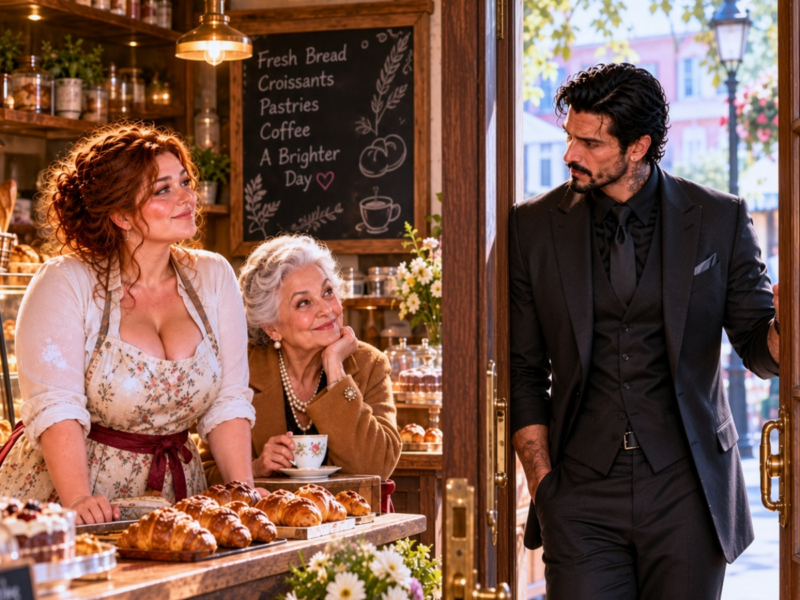
The Mafia Boss’s Grandmother Kept ‘Getting Lost’—So a Curvy Stranger Kept Bringing Her Home.
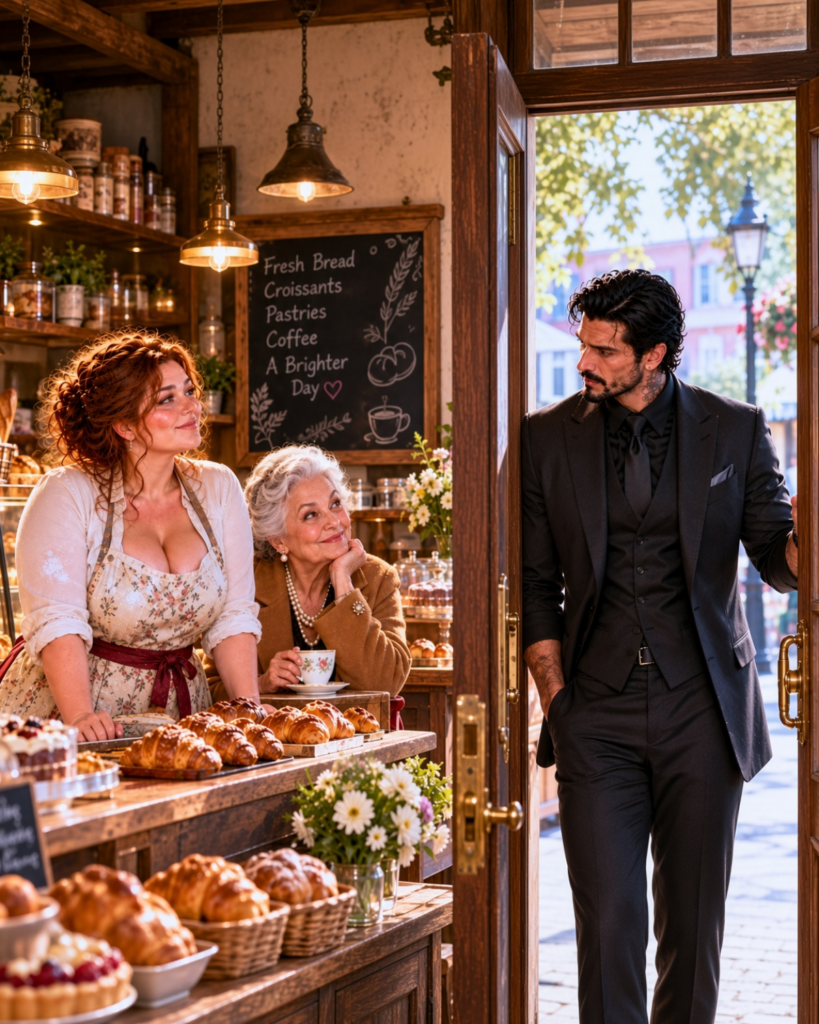
The first time the old woman wandered into her shop, Etta called the number sewn into the coat.
The second time, she made her tea.
By the fourth time—in a single week—she had begun to wonder why a grandmother who kept getting lost kept getting lost in exactly the same direction, and who the frightening man was who came to collect her, and why he looked at a little bakery like it might be a trap set just for him.
But all of that came later.
The first time, Etta only saw an old woman standing in the doorway of Etta’s, the small corner bakery she’d built out of nothing and a great deal of butter, looking around the room with the bright, unbothered curiosity of someone who had no idea where she was and was not remotely worried about it.
It was a Tuesday late afternoon, the light going long and gold across the flour-dusted counter, and Etta was alone, closing up, which is how she came to be the only one who saw the woman come in.
She was small and immaculate.
That was the first thing Etta noticed—that whatever else was going on, this was not a woman who had been neglected.
Her silver hair was set.
Her coat was beautiful, camel wool, old and cared for.
Her shoes were good.
She wore a single ring with a stone in it that Etta, who did not know jewelry, still understood at a glance was worth more than the bakery.
And she was unmistakably lost.
“Oh,” the old woman said, delighted, as if Etta were a pleasant surprise she’d arranged for herself.
“You’re still open. Wonderful! I’ll have whatever smells like that.”
“That’s the almond,” Etta said, coming around the counter—because you come around the counter for an old woman standing uncertain in a doorway.
That’s just what you do.
“Can I help you? Are you looking for someone?”
“I’m looking for the number four bus,” the woman said.
“It used to stop right here on this corner. I’ve been getting it from this corner for forty years.”
Etta, who had rented this corner for six years and knew for a fact the number four had never stopped anywhere near it, said gently, “I don’t think the four comes this way anymore. Do you know where you’re trying to get to? Is there someone I can call?”
The woman’s face did something then—a small flicker, there and gone, that Etta would only understand much later.
A flicker that was not confusion at all, but calculation.
The quick, private assessment of a woman deciding whether the trap she’d walked into was the right one.
But in the moment, it just looked like the soft bewilderment of the old, and it tugged at Etta the way it was designed to.
“There’s a number in my coat,” the woman said.
“My grandson sews them in. He worries. He’s a worrier, that boy. He always has been. Even as a baby, he had the face of a tax collector.”
She held out the collar of the camel coat, and sure enough, stitched neatly inside it on a strip of white cloth, was a phone number in small, careful thread.
The kind of thing you sew into the coat of someone you love and are afraid of losing.
“You can call it. He’ll come. He always comes. It’s the one reliable thing about him.”
So Etta called the number.
It rang once.
“Nona.”
The voice that answered was low and hard and moved fast—a voice that did not waste a syllable, and it did not say hello.
It said “Nona,” and there was in that single word such a compressed weight of fear held rigidly under control that Etta felt it through the phone.
“Where is she? Who is this? Where is my grandmother?”
“She’s fine,” Etta said quickly, because the fear in the voice needed answering before anything else.
“She’s completely fine. She’s right here. She wandered into my bakery. She’s having—”
She glanced at the old woman, who had helped herself to a stool and an almond croissant with the serenity of a cat.
“She’s having a croissant. She’s absolutely fine. She gave me this number.”
There was a silence on the line—a different quality of silence.
The silence of a man recalibrating a catastrophe into a merely bad afternoon.
“What’s the address?” the voice said.
Etta gave it.
“Do not let her leave,” the voice said.
“Do not let her out of your sight. I’m nine minutes away.”
And the line went dead, and Etta stood there holding her phone, and the old woman—Nona, the man had called her—looked up from her croissant with powdered sugar on her lip and an expression of the purest innocence.
“He’s coming?” she asked.
“He’s coming.”
“Good,” said Nona, and took another bite.
And something in the satisfaction of it should have told Etta everything and did not, because who suspects a grandmother?
He arrived in six minutes, not nine.
Etta heard the car first—heard it the way you hear a car that is being driven by someone who has stopped caring about the speed limit.
And then the bell over her door went off like an alarm, and a man filled the doorway of her little bakery in a way that made the whole warm, flowery room feel suddenly differently charged.
He was tall and dark, dressed in a charcoal suit that had not come from anywhere Etta could afford to look at, and he moved into the room with a controlled speed that was somehow more frightening than running would have been.
His eyes went straight to the old woman on the stool and did a fast, total inventory of her—upright, unharmed, powdered with sugar—and something in his shoulders came down by a fraction of an inch.
And only then did he let himself be angry.
“Nona,” Enzo Ferraro said.
“You cannot keep doing this.”
The old woman beamed at him.
“Enzo. You found me. You always find me. Isn’t he clever?” she said to Etta.
“My grandson. He could find a needle in a field. He gets it from my side.”
“You told Marco you were lying down. You went out a service door. Do you know what it does to me when I get a call from a number I don’t recognize?”
He stopped himself.
He was a man, Etta could see, who did not finish sentences that revealed things, who cut them off the instant they turned toward the soft interior.
And he cut this one off now and turned, for the first time, to look at Etta directly.
Etta felt the full weight of that attention land on her like a hand.
It was not a friendly look.
It was the look of a man cataloging a threat.
His eyes moved over her—the flower on her apron, the bakery behind her, the ordinary, warm smallness of the whole scene—and she watched him try to fit her into some frame that made sense to him, some category of person who might be a danger.
And she watched him fail to make her fit.
And she watched that failure make him more suspicious rather than less.
“You called the number,” he said.
“She gave it to me.”
“Why is she here?”
It wasn’t really a question to her.
It was a question to the universe, to the arrangement of the world that kept depositing his grandmother in strange rooms.
“Why this bakery, of all the—”
He shook his head once.
“What do I owe you? For the trouble, for the—”
He gestured at the croissant and at a shore who did not yet know who this man was, who knew only that he was frightening and beautiful in a cold, unhappy way, and clearly loved the old woman more than he could stand, felt something in her go stubborn the way it did.
“You don’t owe me anything,” she said.
“She’s not trouble. She’s a nice lady who got lost and liked my croissants. That’s not a bill. That’s just a Tuesday.”
She looked at him steadily—this man who was so braced for the world to want something from him that he couldn’t understand being simply helped.
“You should get her home, though. She looks tired, even if she won’t say so. Old people never say so.”
For a second—just a second—the cold, cataloging look on his face cracked, and underneath it was something young and exhausted and completely unguarded.
The face of a man who was so tired of carrying a fear he couldn’t name that being told his grandmother looked tired nearly undid him.
Then he put it away the way she’d watch him put everything away.
And he crossed to the old woman and helped her down off the stool with a gentleness that did not match one single other thing about him.
“Come on, Nona. Let’s go home. Say goodbye to the nice girl.”
“Goodbye,” Enzo said to Etta, like the word cost him something.
And Nona Victoria let herself be led to the door, small and triumphant and powdered with sugar, and at the very last moment, as her grandson turned to check the street the way he checked every street, she looked back at Etta over her shoulder and did a thing that Etta would spend the next three weeks trying to convince herself she had imagined.
She winked.
The second time was Thursday.
Etta was pulling the morning’s second bake when the bell went, and there she was again—Nona Victoria in the same camel coat in the doorway, delighted all over again to find the bakery exactly where she’d left it.
“You’re open,” she announced.
“I’m always open. It’s a bakery.”
Etta wiped her hands, torn between concern and a suspicion she couldn’t yet name.
“Nona. It’s Nona, right? Does your grandson know you’re out?”
“My grandson worries too much.”
“That’s not what I asked.”
“No,” the old woman admitted, settling onto what Etta was already thinking of as her stool.
“He doesn’t, but he’ll find out. He always finds out. That’s rather the point.”
And she said it so lightly, so exactly like a woman remarking on the weather, that Etta’s suspicion put its head up a little further and looked around.
She called the number anyway.
It rang once.
“Nona.” The same compressed fear.
“Where?”
“It’s the bakery again,” Etta said.
“On the corner. She’s fine. She’s on her stool. She’s—do you want me to just keep her till you get here? I’ve got a slow morning.”
A pause.
“You’d do that?”
“She’s not any trouble. I told you that Tuesday.”
Another pause, longer.
The pause of a man encountering a variable he had no column for.
“Six minutes,” Enzo Ferraro said, and hung up.
And this time when he came through the door, he was not running fast.
He was merely fast.
And his eyes did the same total inventory of his grandmother and came down the same fraction of an inch when they found her whole.
And Etta thought, he does that every time.
He braces for the worst every single time.
Whatever he’s afraid of, it isn’t a small fear.
“Nona,” he said.
“Enzo, you found me again. Isn’t he clever?”
“You went out the kitchen this time. You told Sophia you were making a call.”
He pressed two fingers briefly to the space between his eyes—managing a headache that was really a heartache.
“I’ve added two more men. I’ve added men, Nona. Do you understand what it means that I’ve had to put men on my own grandmother in her own house?”
“It means you love me and you’re bad at saying it,” said Nona serenely.
“Sit down. Have a croissant. You’re too thin. Isn’t he too thin?” she said to Etta.
“He’s a little thin,” Etta agreed before she could stop herself.
Enzo turned to look at her, and there was that crack again—that half second of the young, exhausted face, quickly sealed.
“I’m not staying,” he said.
“We’re not—she’s not going to keep—”
He seemed unable to finish any sentence that acknowledged this might happen again.
“I’m sorry for the disruption. Twice now.”
“It’s really not a disruption.”
Etta slid a croissant across the counter to him—the almond, the good one.
“Sit for two minutes. She wants you to. You can spare two minutes for your grandmother, whoever you are.”
And it was that—whoever you are—that stopped him.
Etta saw it stop him.
She watched the realization move across his face that she genuinely, actually did not know who he was.
That this warm, flowery woman with the flower on her nose had helped his grandmother twice and fed him a croissant and had no idea she was standing in a room with a man that most of the city would cross a street to avoid.
It was, she’d understand later, possibly the first time in years that anyone had looked at Enzo Ferraro and seen only a tired man who should sit down and eat.
He sat down.
He ate the croissant.
It took him about four minutes, not two, and he didn’t say a single word while he did it, and Nona Victoria watched him eat it with an expression of such deep, banked satisfaction that if Etta had been paying the right kind of attention, she’d have solved the whole thing right there.
The third time was the following Monday, and the fourth was Wednesday, and it was somewhere in the fourth that Etta stopped being able to lie to herself about it.
Because the fourth time, Nona Victoria made a mistake—or rather, she made a slip.
The small kind that clever people make when they’ve been getting away with something long enough to get comfortable.
She was on her stool, mid-story.
She told wonderful stories, all of them about Enzo, about the boy he’d been before he became whatever he’d become.
And Etta had started to notice that every single lost-grandmother visit somehow turned into an infomercial for the hidden gentleness of a grandson Etta had only ever seen be cold.
And she said, waving her beringed hand, “He was such a soft boy. That’s what nobody sees now. He reads, you know. Poetry, even, though he’d deny it to the grave. He just needs the right—”
And she stopped.
And she looked at Etta—sharp and quick and entirely, unmistakably present.
A look with not one gram of confusion in it.
The look of a woman checking whether her audience was following the pitch.
“He just needs the right sort of person. Someone warm. Someone who doesn’t want anything from him. Do you know how rare that is in his world? A person who doesn’t want anything.”
And Etta Shaw put down the tray she was holding and looked at the old woman on the stool.
The set hair.
The good shoes.
The priceless ring.
The four visits in eight days, all to the same corner.
The winks.
The stories.
The way she’d never once actually seemed lost so much as arrived.
And said, slowly, the thing that had been standing at the back of her mind for a week, waiting to be let in.
“You’re not lost.”
The bakery was very quiet.
Nona Victoria looked at her for a long moment, and then slowly the soft, bewildered grandmother melted off her face like sugar off a warm bun, and what was left underneath was something Etta liked immediately and enormously—shrewd and funny and absolutely unrepentant.
The face of a woman who had run a large and complicated family for sixty years and did not intend to stop running it just because everyone thought she’d gone dotty.
“No, dear,” said Nona Victoria.
“I am not lost. I have never been lost a day in my life. I have an excellent sense of direction. I could find my way home from the moon.”
She folded her hands over the head of the cane she carried and did not need.
“I have been coming here on purpose. Four times. Because the first time I came in, that was an accident, I’ll grant you. I truly was avoiding the men my grandson keeps stapling to me, and I ducked in here to lose them. The first time I came in, I watched you come around that counter for a stranger without being asked, and I thought, ‘There she is. That’s the one. That’s the person my grandson has been missing his whole life and doesn’t know exists.'”
She smiled, and it was a wicked, delighted, grandmotherly smile.
“So I came back. And I’ll keep coming back. And you’re going to help me. Because you like him, too. Don’t argue. I’ve watched you feed him the good croissant three times. I know what the good croissant means.”
“And because that boy has spent twenty years being feared by everyone and loved by almost no one, and I am eighty-one years old, and I am not leaving this earth until I see him sit in a warm room with someone who came around the counter for him.”
Etta stared at her.
“You’re using yourself as bait,” she said.
“You’re pretending to have dementia and scaring your grandson half to death so he’ll keep coming to my bakery.”
“When you say it like that, it sounds terrible.”
“It is terrible. He’s terrified. Every time he comes in, he looks like he’s aged a year.”
“He needs to age a little,” said Nona Victoria, unmoved.
“He’s been the same frozen thirty-four for a decade. A little fear is good for a frozen man. It reminds him he can still lose things. A man who thinks he can’t lose anything has stopped living, dear. He’s just guarding.”
She leaned forward, and the wickedness softened into something Etta couldn’t argue with.
“I’m not going to do it forever. I’ll stop the wandering the moment he has a reason of his own to come here. The moment it’s you he’s coming for and not me. That’s the whole plan. I make myself unnecessary.”
She sat back.
“Now. Are you going to help an old woman, or are you going to make me keep sneaking out of service doors at my age, which is genuinely dangerous? My knees are not what they were.”
And Etta should have said no.
She should have called Enzo Ferraro and told him his grandmother was a con artist and washed her hands of the whole beautiful, dangerous business.
She looked at the old woman’s face and thought about the tired young man who’d cracked for half a second when she told him his grandmother looked tired, and heard herself say the words that would change the shape of the next month of her life.
“What’s his name? His real name. If I’m doing this, I want to at least know his name.”
Nona Victoria’s smile could have lit the ovens.
“Enzo,” she said.
“Enzo Ferraro.”
And then, watching Etta’s face very carefully, testing the water with one toe: “You’ve heard the name Ferraro. I think most people in this city have.”
Etta had heard the name Ferraro.
Everyone had heard the name Ferraro.
It was a name you heard the way you heard about weather systems—something large and dangerous that happened to other people.
And she felt it drop through her, cold—the understanding of exactly whose grandmother she’d been feeding croissants.
“Oh,” Etta said faintly.
“Oh, that Ferraro.”
“That Ferraro,” Nona agreed.
“Still want his name, dear? Because I’ll tell you now, this is the part where the sensible ones stop.”
She watched, shrewd and kind.
“Are you sensible?”
Etta thought about it.
She thought about it honestly, standing in her bakery with flour on her nose and the ovens ticking behind her.
“Not especially,” she admitted.
“I opened a bakery on a corner the four bus doesn’t even come to.”
“Good,” said Nona Victoria, delighted.
“Neither was I. Now sit down. We have scheming to do. And pour me another tea. The scheming tea, not the innocent tea. I can tell the difference, and so soon will you.”
The scheme, such as it was, was elegant in its simplicity and monstrous in its cruelty to one specific frightened man, and Etta went along with it against every ounce of her better judgment—which had, she was noticing, gone very quiet lately where Enzo Ferraro was concerned.
Nona kept getting lost, but now the getting lost had a choreography.
She would time her escapes for the slow parts of Etta’s day, so there’d be space to talk.
She would linger longer, spinning out her arrival so that by the time Enzo came, there’d be a scene for him to walk into.
Nona and Etta laughing.
Nona and Etta with their heads together over the ledger—because it turned out Nona had run books for a large cash business her whole life and had opinions.
Nona teaching Etta a Calabrian bread her own grandmother had made, so that Enzo would arrive braced for catastrophe and find instead warmth, his grandmother happy, this stranger’s shop somehow the one place in the city where the old woman lit up.
And Etta watched it work on him week by week, against his will.
The fifth time, he stayed six minutes.
The sixth time, he stayed twenty and drank a coffee and answered a question Nona asked him about his week with an actual sentence instead of a grunt.
And Etta caught him once looking around her little bakery—the copper, the chalkboard, the mismatched stools, the warm, flowery ordinariness of it—with an expression she recognized, because she’d seen it on his grandmother’s face that first fraudulent afternoon.
The look of a person pressing up against the glass of a life they’d assumed was for other people.
The eighth time, he came in and his grandmother wasn’t even there yet.
Etta looked up at the bell, and it was just him alone in the doorway, and something went very still and very warm in her chest, and she said before she could stop herself, “She’s not here. Nona—she hasn’t—she’s not lost today, as far as I know.”
“I know,” Enzo said.
“Oh.”
“I was—” And here the man who ran half the city, who never finished a sentence that revealed anything, stood in the doorway of a corner bakery and visibly fought himself and lost and finished it.
“I was in the neighborhood. I wanted a coffee. Yours is—” a pause.
“It’s good. Your coffee.”
It was a terrible lie.
His neighborhood was not this neighborhood.
His neighborhood was towers and glass and men with earpieces.
He had driven across a city to stand in a bakery the four bus didn’t reach and tell a woman with flour on her nose that he’d wanted a coffee.
And they both knew it, and neither of them said it.
And Etta made him the coffee with hands that weren’t quite steady.
That was the day the plan worked, though it would be weeks before Nona would let either of them forget she’d known it would.
That was the day Enzo Ferraro started coming for Etta, and not for his grandmother.
He kept up the fiction that it was coffee.
She kept up the fiction that she believed him.
And in the space that fiction made, something real began to rise—slow and warm, the way dough rises when you stop watching it and just let it be somewhere warm.
The rain helped.
Nona, of course, took credit for the rain.
It came down in sheets one evening in the third week of the scheme—a real storm, the kind that turns the gutters to rivers.
And it happened entirely by coincidence, Nona would insist, with the face of a woman who had never arranged a coincidence in her life, that all three of them were at the bakery when it broke.
Nona on her stool, Etta closing up, and Enzo, who had come to collect his grandmother and been caught by the downpour at the door.
“You can’t drive in that,” Nona announced with enormous satisfaction as the rain hammered the glass.
“Nobody can drive in that. We’ll wait it out. Etta, is there anything to eat? Feed us, dear. We’re marooned.”
“You’re not marooned, Nona. The car is six feet away.”
“I am eighty-one and it is monsoon season and I am marooned,” Nona said with finality, and folded her hands on her cane, and that was the end of it.
So they waited it out, and Etta fed people—because feeding people was the thing she did with her hands when her heart didn’t know what to do with itself.
She pulled the day’s unsold bread and the good butter and a jar of the fig jam she made in the autumn and couldn’t sell fast enough.
And she fed the most dangerous man in the city and his grandmother at the little worktable while the storm came down outside and sealed the three of them into the warm-lit box of the bakery.
It should have been awkward.
It was not awkward.
That was the thing that undid Etta a little, sitting there—how completely un-awkward it was.
How the man across the table, who could apparently end people with a phone call, tore bread and spread fig jam and listened to his grandmother tell an ancient story about his grandfather with an expression that kept trying to be embarrassed and kept failing and landing on something softer.
The storm turned the windows to running silver.
The ovens ticked as they cooled.
And Nona Victoria, watching the two of them over the rim of her tea, played her hand with the shamelessness of a woman who has decided subtlety is a young person’s game and she doesn’t have time.
“Enzo used to bake with me,” she said to Etta, apropos of nothing.
“Did you know that? When he was small. Before his father decided a Ferraro boy shouldn’t have flour on his hands.”
She said it lightly, but there was a blade in it—a whole family history in one sentence.
“He had good hands for it. Patient. He’d wait for the dough. Most children can’t wait for anything, but that one—he’d sit and watch it rise like it was the television.”
She looked at her grandson.
“You could show her, Enzo. The knot roll. You remember the knot roll?”
“I don’t remember the knot roll, Nona.”
“You remember the knot roll. That was thirty years ago.”
“Show her the knot roll,” said Nona Victoria, in a voice that had commanded a family through four decades and two wars.
And Enzo Ferraro, who did not take orders from anyone in the city, sighed the sigh of a man who had never once successfully taken a stand against his grandmother, and rolled up his sleeves.
And Etta watched the most feared man in the city stand at her worktable in the stormlight and, with hands that hesitated and then slowly remembered, roll a length of dough and tie it into a knot the way a grandmother had taught a soft boy thirty years before.
Clumsy at first, and then not clumsy—the memory coming back up through his fingers.
And something happened to his face while he did it.
A kind of unguarding she hadn’t seen even in the best of their coffee evenings.
The boy surfacing all the way through the man.
And Nona Victoria did not say a word, because she didn’t need to, because she had known this exact thing would happen, because she had perhaps been trying to make it happen since the first afternoon.
“There,” Enzo said quietly, when the roll was tied.
He looked at it in his own hands like it was something he’d lost and found.
“The knot roll.”
“You still have the hands,” Nona said softly.
And then, because she could never leave a tender moment unweaponized: “Etta, doesn’t he have good hands?”
“Nona—”
“I’m only asking for the bakery. A baker has to notice hands.”
“He has good hands,” Etta said, and met Enzo’s eyes across the worktable, and neither of them looked away.
And the storm came down, and the dough sat rising between them, warm and patient and entirely unhurried, and Etta understood that she was in a great deal of trouble of the very best kind.
When the rain finally eased and Enzo drove his grandmother home that night, Nona Victoria looked back at the lit bakery through the streaming window, the way she had that very first afternoon, and she did not wink this time.
This time she just smiled—small and private and satisfied, a general watching a long campaign turn at last in her favor.
He was not an easy man to know.
She’d expected that.
What she hadn’t expected was how much there was once he let a door or two stand open.
That he did read poetry and would rather die than be caught at it.
That he’d run the family since he was twenty-four and had never once been asked whether he wanted to.
That under the cold and the suits and the terrible weight of the name, there was a man who had been a soft boy, exactly as his grandmother said—a soft boy who’d built a fortress around the softness, because in his world, the soft parts were where they hurt you.
“Why do you do it?” Etta asked him one evening, closing up, both of them lingering the way they’d started lingering, the light going gold across the floor.
“All of it. The name. If you were a soft boy who reads poetry, why do you do the thing you do?”
“Because someone has to, and it was mine,” he said simply.
“My father died and it was mine. And if I hadn’t taken it, it would have gone to men who’d have made it worse, hurt more people. And my grandmother would have been alone in it with no one to—”
He stopped.
He looked at his hands.
“I tell myself I do it to protect the people I have left. Some days that’s even true. The other days, I don’t look too closely.”
“That’s the loneliest thing anyone’s ever said in my bakery,” Etta said.
“And a man proposed to the wrong woman at that table once. Long story.”
He almost laughed.
She was learning the signs of it—the way something eased at the corner of his eyes a half beat before he suppressed it, the small exhale through the nose that for a man this locked was practically a belly laugh.
“You should be afraid of me,” he said quietly, not looking up.
“You know that. You know the name. Everyone who knows the name is afraid. It’s the one dependable thing. It’s almost restful, how afraid people are.”
“And you keep—” He gestured, helpless, at the coffee, the croissant, the warm room.
“Her. You keep coming around the counter like I’m just a man who wanted a coffee.”
“Maybe you’re just a man who wanted a coffee.”
Etta leaned on the counter across from him—close, closer than she stood to anyone.
“I’ve had all kinds in here, Enzo. Lonely ones, mean ones, sad ones, lost ones. Well—one fake lost one.”
He did laugh at that.
A real one, brief and startled.
“I read people by what they order and how they treat me when they think no one’s looking. And you order the same coffee every time, and you always, always say thank you to me, and you always leave too much money and try to hide it under the cup.”
She shrugged.
“That’s what I’ve got on the terrifying Enzo Ferraro. He tips like he’s ashamed of it, and he says thank you. I can’t be afraid of a man I’ve watched hide a tip under a cup. It’s the least frightening thing a person can do.”
He looked at her then.
Really looked.
The whole cold, cataloging weight of him turned on her, and finding she could see it land—not a threat, not an angle, not a person who wanted something.
Just Etta, with flour on her nose, telling him she’d watched him be kind, and it had ruined the whole effect.
“Etta,” he said, and her name in that low voice did something to the air.
“Yeah?”
“I don’t know how to do this.” He said it plainly, the way he’d said the loneliest thing.
“Whatever this is. I’ve never—there’s never been room. The name doesn’t leave room. Anyone close to me is a way to reach me, and everyone knows it. And I have spent twenty years making very sure there was no one close enough to be used.”
He was close now.
Or she was.
The counter between them felt like nothing.
“And then my grandmother started getting lost on purpose.”
“Yes, I know. I worked it out weeks ago. She’s not nearly as clever as she thinks.”
“She’s been matchmaking since I was fifteen.”
“And she kept getting lost here. And I let it keep happening. And I knew exactly what I was doing, and I did it anyway, which I never do.”
His voice dropped.
“I made room. For the first time in twenty years, I made room for a woman with flour on her nose who isn’t afraid of me, and it’s the most dangerous thing I’ve ever done. And I can’t seem to stop.”
“Enzo,” Etta breathed.
And the bell over the door did not ring, because for once—for the first time in the whole scheme—Nona Victoria was not there to interrupt.
She had, in fact, stayed carefully, deliberately home that evening, having decided that the dough had risen enough and needed now to be left entirely alone.
And so there was nothing at all to stop Enzo Ferraro from reaching across the counter and cupping the side of Etta’s face with a hand that had done things she would never ask about, and kissing her—slow and careful and disbelieving, like a man handling something he was certain he’d break.
He did not break it.
She kissed him back, flour and all, in the gold light of the bakery she’d built out of nothing and butter.
And for one long, warm moment, the name Ferraro did not exist.
There was only a soft boy who read poetry and a woman who came around the counter, and the whole dangerous world held its breath and let them have it.
It would not hold its breath for long.
Because a man who has spent twenty years making sure there is no one close enough to be used against him had just, in a lit bakery on a public corner, made someone.
And in his world, that never went unnoticed for long.
It came when it came, on a Thursday, and it came wearing the shape of the very thing they’d all stopped being afraid of.
The phone rang at the bakery at two in the afternoon.
Etta answered it with her shoulder, mid- knead, expecting a bread order.
And it was Enzo.
And the instant she heard his voice, she knew—because it was the voice from the very first phone call.
The compressed-fear voice.
The “Nona” voice.
Except worse now.
So much worse, because now there was no floor of hope under it.
“Is she with you?” Enzo said.
“Tell me she’s with you. Tell me she got lost and she’s on her stool and this is a normal, terrible Thursday.”
Etta’s hands went still in the dough.
“She’s not here, Enzo. She’s not here. She hasn’t come today. What’s happened?”
“She’s gone.”
The words came out with a terrible flatness—the flatness of a man holding himself together with both hands.
“Not gone. Lost. Gone. She went out for her walk in the garden this morning with two men on her. And she—there’s a gap. Four minutes. The cameras have a four-minute gap that someone made. And her walk stops at the gap. And there’s a—”
His voice cracked once, and he crushed it flat again.
“There’s a note. It’s Renata. Salvatore Renata. He’s been trying to move on my territory for a year, and he finally understood he couldn’t get to me through the front. So he went through the softest door I have. He took my grandmother. He has my grandmother, Etta, because I was careless. Because I made room. Because everyone in this city apparently knew before I did that there was finally something I couldn’t afford to lose.”
“Stop,” Etta said.
“Stop. Where are you?”
“On my way to you. Two minutes. I don’t—”
And here the most powerful man in the city said the thing that told her exactly how bad it was.
“I don’t know what to do. I always know what to do. I don’t know what to do.”
He came through the bakery door two minutes later looking like a building mid-collapse.
And Etta came around the counter.
Of course she did.
It was the whole thing.
It was the thing his grandmother had seen from the first afternoon.
And she did not tell him it would be all right, because she didn’t lie to people, especially not this one.
“Show me the note,” she said.
He showed her.
It was short and ugly, and it said what these things say.
A place, a time, a price—which was everything, the whole organization.
Hand it over or she doesn’t come back.
And it was signed with a name that clearly meant something dreadful to Enzo and nothing to Etta.
And Etta read it twice and felt the fear try to climb into her, and she pushed it down the way she pushed down everything on a bad morning at the ovens, because panic never once made the bread rise.
“He wants a meeting,” Enzo said.
“Tonight. To discuss terms. It’s a trap, obviously. It’s the oldest trap there is. I come to get her, they take me too, or they kill me and take everything. And either way, she’s—”
He couldn’t say it.
“My men are already working. We’re trying to find where he’s holding her. But he’s careful, and he’s had this planned, and every hour that he—”
He stopped.
He looked at Etta, and there was nothing left in his face but the drowning.
“I’m sorry. I shouldn’t have come here. I’m putting you in it just by standing here. I should go. I just—I didn’t know where else to—”
“Enzo.”
Etta took his face in both her hands the way he’d taken hers.
“Look at me. I need you to tell me something, and I need you to actually think about it, not panic about it. Your men are looking for a place. A location. They’re good at that, I’m sure. Better than me.”
She held his eyes.
“But nobody in this whole city knows how your grandmother actually moves except me. Not your men. Not you, even. If you’ll forgive me—you watch her like a hostage. You see the woman you’re afraid of losing. I’ve spent two months watching her the way you watch a person you’re plotting with. I know her patterns. I know how she thinks when she’s trying to get somewhere she’s not supposed to be. Because I helped her do it four times a week.”
She could see it starting to land.
“She’s been escaping her own guards for months, Enzo. She’s the best in the world at slipping a leash and leaving a trail only the right person can read. If there’s any chance she’s found a way to leave us something—a sign, a crumb, anything—I’m the one who will know it’s hers, because I’m the one she taught.”
And Enzo Ferraro looked at the woman holding his face.
This baker who had come around the counter for a stranger and kept coming around it.
And Etta watched the drowning man find, in the middle of the water, one solid thing to stand on.
“The note came with her ring,” he said slowly.
“They sent her ring to prove they had her. It’s in the car.”
“Why would they send the ring?”
Etta said it, and it wasn’t quite a question.
It was the organizing part of her brain waking all the way up—the part that noticed when a number was wrong.
“Proof of life is a photo. A voice. You send a photo. Why send the actual ring? Why give up a thing like that?”
Unless she was moving now, toward the door.
“Get the ring. Get me the ring. She never takes that ring off. You told me she wears it in the bath. It’s your grandfather’s. If she got it off and got it to them to send—if she made them send it, Enzo—she didn’t lose that ring. She gave it to them on purpose. Which means your grandmother, who fakes being lost for a living, is in there right now, not panicking. Running a scheme. And she just used the one channel she had to send a message to the one person she knows reads her messages.”
She held out her hand.
“Give me the ring.”
Etta said, “Let’s see what your grandmother’s telling us.”
The ring came wrapped in a paper napkin.
That was the first thing Etta noticed, and the thing Enzo’s men had noticed and dismissed.
Of course it was wrapped in something.
You wrap a small thing so it doesn’t rattle in the envelope.
It meant nothing.
It was packing material.
Enzo unfolded it on the flour-dusted counter with shaking hands, and there was the ring, his grandfather’s ring, the great stone catching the afternoon light.
And he made a sound when he saw it that Etta would not describe to anyone, ever.
But Etta was not looking at the ring.
Etta was looking at the napkin.
“This,” she said.
“This is the message. Not the ring. The ring’s just to make you send it to the right people. Look at the napkin.”
“It’s a napkin.”
“It’s a napkin from Delfino’s.”
Etta smoothed it flat, and there it was—faint, but unmistakable in the corner.
A small printed crest.
A little leaping fish.
“It’s a paper supplier out of the produce district. Delfino’s on Mercer. They do restaurant stock—napkins, and boxes, and bags. Wholesale. I know it because I buy my pastry boxes from the warehouse two doors down from them, and their delivery van is always double-parked, and I curse it once a week. This napkin came from a building on Mercer Street that stocks food-service paper.”
She looked up at him, and the whole organizing engine of her was running clean and cold now.
“Your grandmother was allowed to prepare the ring to send. I’d bet the bakery on it. I’d bet she made a whole production of it—the frail old woman who needs to wrap her late husband’s ring properly. ‘Let an old woman have her dignity.’ And while she did it, she palmed a napkin from wherever they’re keeping her, and wrapped the ring in it, because she knew—she knew—it would come to you, and that you’d bring it to me, and that I would be the one person in this entire city who’d look at a wholesale napkin and know exactly which block it came from.”
She said it quietly, into the silence.
“She didn’t send you the ring, Enzo. She sent me an address.”
The bakery was completely silent.
“Mercer Street,” Enzo said.
His voice had changed.
The drowning was gone.
In its place was something that made the hair on Etta’s arms stand up—something cold and vast and finally, finally pointed at a target.
“Renata has a paper-goods warehouse on Mercer. It’s legitimate. It’s a laundering front. We’ve known about it for years. It never mattered. It’s just a warehouse.”
He was already moving, already pulling the phone out.
And then he stopped, and turned, and looked at Etta with an expression she’d never seen on him—something like reverence and something like terror.
“You found her. Four minutes with a napkin, and you found her.”
“My whole organization—”
“And it was,” Etta said.
“It was your grandmother. She found herself. I just read the note she left. Now go get her.”
She swallowed.
“And Enzo—I’m coming.”
“Absolutely not.”
“You need someone who can tell the difference between your grandmother running a scheme and your grandmother in real trouble. And that’s me. That’s the whole reason any of this worked. If she’s in there stalling them—playing the confused old woman, working an angle—and she will be, Enzo, that’s what she does—then somebody who knows her real face from her fake one needs to be there to read which one she’s wearing before somebody does something that can’t be undone.”
Etta was already untying her apron.
“I’m not going to hold a gun. I don’t want to see the part with the guns. But I’m going to be close enough to read her, because a woman who fakes being lost for a living is going to be faking something in that room, and I’m the only one who’ll know what.”
And Enzo Ferraro, who had spent twenty years keeping everyone he loved far from the part with the guns, looked at the woman untying her apron and understood that he had fallen in love with someone who came around the counter no matter what was on the other side of it, and that he was not going to be able to stop her, and that, God help him, she was right.
“You stay behind me,” he said.
“The entire time. You do exactly what I say the moment I say it.”
“I run a kitchen,” Etta said.
“I know how to follow the person who knows the fire. Let’s go get your grandmother.”
The warehouse on Mercer Street was exactly as ugly as warehouses are.
And Etta spent the drive with her heart in her throat and her hands very still in her lap, and Enzo spent it on the phone in a low, fast voice, giving instructions in a register she’d never heard—the register of the name.
The Ferraro register.
And she understood that she was seeing, for the first time, the man the city was afraid of, and that she was not even now afraid of him, and that this was either the truest thing she knew about herself or the most foolish, and that she’d find out which in about twenty minutes.
What happened at the warehouse, Etta only ever saw the edges of, because she did what she’d promised and stayed behind him, behind the wall of men who moved through the ugly building with a terrible, quiet competence.
She heard raised voices.
She heard, once, a sound that might have been a shot or might have been a door, and her whole body flinched, and Enzo’s hand found her shoulder in the dark without his eyes ever leaving the corridor ahead—a brief pressure that said, still here.
Still here.
And then they came to a back office, and the door opened, and Etta looked past the shoulders of dangerous men into a small, ugly room, and started, helplessly, insanely, to laugh.
Because Nona Victoria was sitting in the room’s only good chair, with a cup of tea someone had clearly been too frightened not to make her, holding court over three of Salvatore Renata’s enforcers, who had the collective expression of men who had captured a queen and only slowly realized they’d trapped themselves in the cage with her.
She had, in the hours of her captivity, apparently learned all three of their names, criticized the younger one’s posture, extracted the fact that the one by the door had a sick mother, and was, at the moment the rescue arrived, in the middle of telling them how to properly reheat a lasagna so the edges didn’t go to rubber.
“And you never, never microwave it. You’ll ruin your mother’s leftovers and break her heart.”
“Enzo.”
She looked up, radiant, entirely unharmed, entirely unsurprised.
“You found me. You always find me.”
Her sharp old eyes went past him, to Etta.
And there it was.
The flicker.
The calculation.
The wink, held in reserve.
“Or rather, she found me. I knew she would. I told you, dear. She’s the one. Did the napkin work? I was so worried about the napkin. My hands aren’t what they were.”
“The napkin worked, Nona,” Etta managed, through the laughing and the crying, which had arrived at the same time and were fighting for control of her face.
“Good,” said Nona Victoria, and set down her tea, and rose—small and immaculate and triumphant—and surveyed the room full of armed men with the serene authority of a woman who had never once in her life been the most frightened person in any room.
“Now, Enzo, be quick about the rest of it, whatever it is, and try not to make a mess, and then take us home. I’ve had a very long day, and I’ve done all your work for you, and I would like my ring back and a decent supper.”
She patted the cheek of the enforcer with the sick mother on her way out, as if he were a nephew.
“Reheat it at three hundred, covered, for twenty minutes. Tell your mother a strange old woman said to get well.”
The rest of it—the part Etta didn’t watch—Enzo handled the way he handled things, and Salvatore Renata’s reach for the Ferraro territory ended that night.
Not in the way Etta would have chosen, probably.
But not in the way she’d feared, either.
No one died in that warehouse, Enzo would tell her later—only that Renata had made a bet on a soft door and lost.
That a man who kidnaps an old woman and then can’t even keep her from running his own guards is a man whose people stop believing in him very quickly.
And that some defeats you don’t need to make bloody, because they’re humiliating enough to do the work themselves.
Renata was finished in the city by morning.
Brought down less by Enzo’s men than by the story that got out—that he’d taken the Ferraro grandmother and she’d spent her captivity teaching his enforcers to cook and then walked out on the arm of a baker.
You cannot run a criminal empire, it turns out, once you’ve become a joke.
Nona Victoria had defeated a rival boss with a napkin and a lasagna recipe, and she was insufferable about it for weeks.
And she had earned it.
She brought it up at every possible opportunity and several impossible ones.
She brought it up to Enzo’s men, who had spent a frantic night failing to find her while an eighty-one-year-old woman solved her own kidnapping, and who now could not meet her eyes.
She brought it up to the family lawyer.
She brought it up, Etta was told, at a tense sit-down with the heads of the other families, in the middle of serious business, apropos of absolutely nothing.
“Of course, when Renata took me, I simply left a message in the napkin. One has to think ahead.”
Until Enzo had to pinch the bridge of his nose, and the most powerful men in the city had to pretend they weren’t smiling.
She had a small card made.
It said, under her name, in elegant script: “Defeated a rival boss with a napkin.”
And she gave it to people.
Etta had one on the bakery register.
She was in her ninth decade, having the time of her life.
“Let her,” Enzo said when Etta asked if it was going to become a problem—the whole city knowing the Ferraro grandmother had run circles around a kidnapper.
“It’s the best protection she’s ever had. Renata took her because he thought she was my soft spot. Now every man in this city knows that taking my grandmother means being humiliated by my grandmother. She’s made herself the most dangerous woman in the underworld, and she did it with a paper napkin.”
He almost smiled, which, on him, now, after everything, was nearly a grin.
“Nobody’s ever touching her again. She’s untouchable. She’s terrifying. I’ve never been prouder of anyone in my life.”
But that was later.
That night, after Nona had been delivered home and fussed over and put to bed, still faintly smug, Enzo drove Etta back to the bakery, and they sat in the dark car outside the dark shop, and the whole enormous day sat down with them.
“You know what I am now,” Enzo said finally.
He was looking straight ahead through the windshield at her darkened bakery.
“Not the idea of it. Not the name in the abstract. You were there. You heard the sounds. You know what tonight actually was, underneath the part where my grandmother taught them to reheat pasta. You know what I did to make Renata stop, even if you didn’t see it.”
He turned to look at her.
“This is the part where the sensible ones go inside and lock the door and change their number. Your bakery is right there. I’ll wait until you’re inside. I’ll make sure nothing ever touches you. That’s the one thing I can still do. I can make you safe by staying away from you. I’m very good at making people safe by staying away from them.”
“Enzo,” Etta said.
“You should go inside.”
“Do you want to know what I actually kept thinking in that car on the way there, when I should have been terrified? Of you? Of what you were about to do? Of all of it?”
She turned in the seat to face him.
“I kept thinking about the napkin. About how your grandmother, in the middle of being kidnapped by a man who wanted to destroy you, stayed calm enough to steal a napkin and wrap a ring in it. Because she trusted that the two of us together would be smart enough to read it. She bet her life on us being a team. On you bringing me the thing and me knowing the block. She built a bridge out of a napkin because she believed the bridge already existed.”
Etta reached over and took his hand—the hand that had done whatever it had done that night—and held it in both of hers on the console between them.
“I’m not going to lock the door, Enzo. I’ve been coming around the counter my whole life. It’s the one thing I know how to do, and I’m not going to stop now just because the man on the other side of it turned out to have the worst possible job and the best possible grandmother.”
“It’s dangerous,” he said.
But it came out like a man arguing against something he desperately wanted to lose the argument to.
“Loving me is dangerous. Tonight is what loving me looks like. It doesn’t get less dangerous. I can make it safer. I can build walls around you. But I can’t make it safe. I’ve never once in my life been able to make it safe.”
“Then we’ll do what I do when the ovens are too hot and the orders too big and it’s all about to go wrong,” Etta said.
“We won’t panic. Panic never once made the bread rise. We’ll just keep going. Carefully. Together. With your grandmother interfering constantly, apparently forever.”
She smiled at him in the dark.
“I fed you the good croissant three times before I even knew your name, Enzo. Your grandmother’s right. She’s always right. It’s exhausting. I picked you before I knew there was anything to be afraid of. And knowing hasn’t changed it. And I’ve stopped waiting for it to.”
And Enzo Ferraro, the most feared man in the city, who had spent twenty years making certain there was no one close enough to be used against him, and had lost that war completely to a baker and an eighty-one-year-old woman with a napkin, leaned across the dark car and kissed her.
And this time there was nothing careful in it.
Nothing braced.
Nothing held back for the collapse.
This time he kissed her like a man who had decided, finally, to stop guarding the thing and just have it.
And Etta kissed him back in front of her dark shop, with the whole dangerous world going on around them, and let him.
Nona Victoria got lost exactly one more time.
It was a month later, a Sunday, and she slipped her guards with the ease of long practice and turned up at Etta’s bakery in the late gold afternoon in the camel coat.
And she stood in the doorway with the old, bright, bewildered look and announced, “You’re open. Wonderful! I seem to have gotten turned around—”
Except Enzo was already there.
He was behind the counter in his shirtsleeves, badly and happily failing to learn how to shape a loaf under Etta’s instruction.
Flour on the charcoal trousers of a suit that cost more than the oven.
And he looked up when his grandmother came in, and he did not go pale, and he did not run the inventory, and he did not reach for the phone.
Because he already knew exactly where his grandmother was.
Because his grandmother was exactly where she’d been trying to steer all three of them since the very first afternoon.
“You’re not lost, Nona,” Enzo said.
“No,” Nona Victoria agreed, dropping the act entirely, coming to claim her stool.
“I am not. I have never been lost a day in my life. I have an excellent sense of direction.”
She settled herself and accepted the tea Etta was already pouring—the scheming tea, though there was no more scheming left to do.
And she looked around the warm, flowery bakery at her grandson with flour on his good trousers, and the baker who’d come around the counter, and the whole small, good, improbable life she had built for them out of nothing but a napkin and a series of increasingly implausible disappearances.
And she smiled the smile of a woman who has finished a very long and very difficult recipe exactly the way she meant to.
“I always knew the way,” she said—to no one, to both of them, to the leaping-fish crest on a napkin somewhere, and the number four bus that had never once come to this corner, and the soft boy who’d finally come unfrozen in a room full of butter.
“I was only ever waiting for the two of you to catch up.”
And she was, as usual, entirely right.
And she drank her tea.
And outside, the light went gold across a corner the bus didn’t reach.
And inside, the ovens were warm, and nobody anywhere was lost at all.









