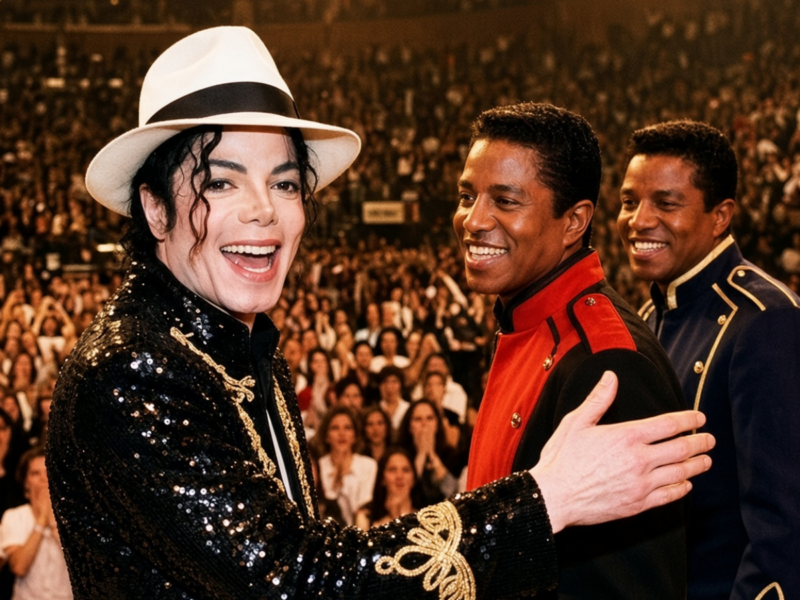
The Last Time All the Jackson Brothers Stood Beside Michael: Madison Square Garden, 2001.
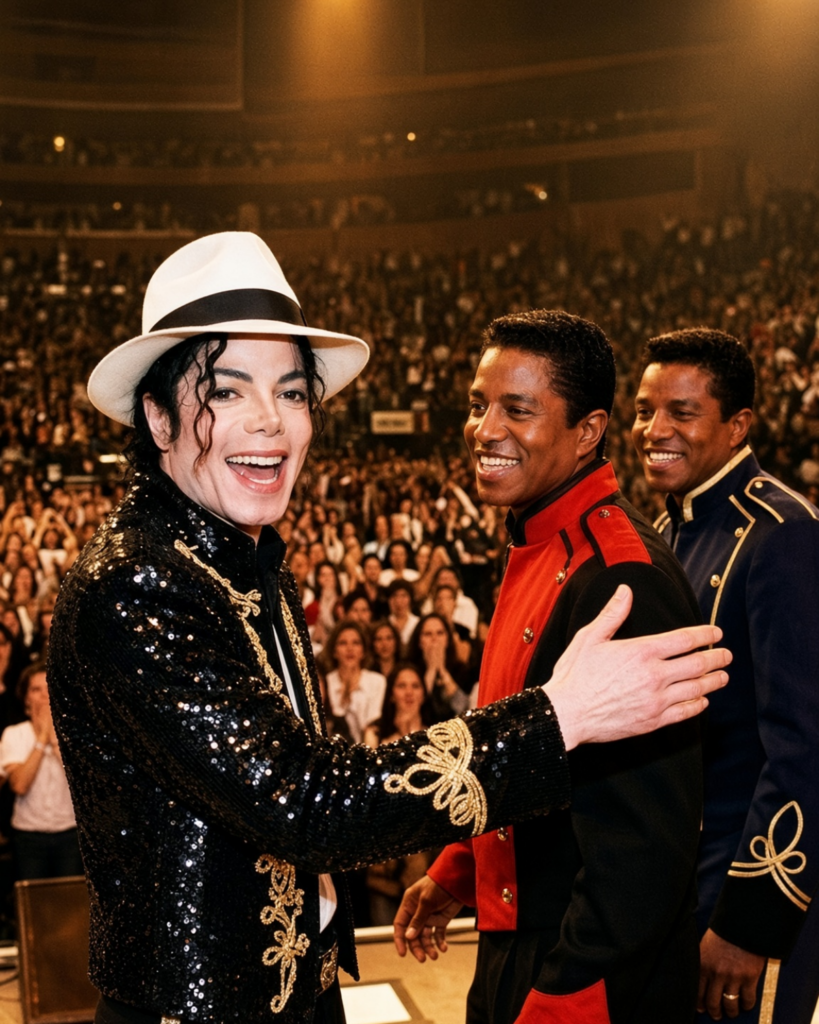
Thousands on their feet.
One shared memory.
A two-room house.
Eleven people.
A lead voice of five.
A tour.
A promise.
Then years of silence between brothers.
Whitney.
Usher.
Liza.
And a cue nobody could miss.
One soft voice, one hand on each shoulder.
Madison Square Garden.
A concrete corridor, a crowd humming overhead, and a door at the far end.
Four days before the world changed, five brothers waited in a concrete corridor under Madison Square Garden.
They were waiting for the sixth.
Friday, September 7, 2001.
New York City.
Nobody in the building was thinking about the following Tuesday.
They were thinking about a cue.
Above the corridor, close to twenty thousand people had filled every seat.
The occasion was Michael Jackson’s thirtieth year as a solo artist, counted from 1971, when a thirteen-year-old boy released a record called “Got to Be There.”
Michael was forty-three now.
He would sing his own songs that night, the big ones, one after another.
But the posters had made a quiet promise, and the whole building knew it.
Somewhere in the evening, the brothers would come out.
Jackie Jackson.
Tito Jackson.
Jermaine Jackson.
Marlon Jackson.
Randy Jackson.
Not as guests at someone else’s party.
As the Jacksons.
They had not shared a stage with Michael in almost seventeen years.
So here is the question under this whole night.
Did any of them sense, down in that corridor, that this was a chance to stand beside their brother once more, and that it might be the only one?
The cameras were upstairs, pointed at the stage.
They mostly missed the minutes before the cue.
What happened down there has to be pieced together from what we know of the men who waited, and of the family that made them.
Below an arena floor, the Garden is a maze.
Cinder block painted the color of old milk.
Pipes overhead.
Black equipment cases on wheels.
The sound of twenty thousand people reaches a corridor like that as a low hum, like weather on the other side of a wall.
The brothers who waited there were not boys anymore.
Jackie, the eldest, was fifty.
Tito, the quiet guitarist, was forty-seven.
Jermaine was forty-six, and Marlon forty-four.
Randy, the youngest, was thirty-nine.
Several of them were fathers by now.
Tito’s three sons had a pop group of their own, called 3T.
The old Jackson 5 photographs had become family history.
But their first stage had been a living room.
The house stood at 2300 Jackson Street in Gary, Indiana.
Two small rooms.
Eleven people.
The boys slept in bunks and rehearsed in the space between the furniture, because there was nowhere else to put them.
Their mother, Katherine, sang along.
Their father, Joe, stood over the rehearsals with a rule for every mistake.
Michael was the seventh of the nine children.
Not the oldest.
Not the loudest.
But at five years old, by every account, he could hear a rhythm once and keep it.
By the time he was eleven, he was the lead voice, singing “I Want You Back” for a country that had never heard of Gary.
The brothers behind him learned to be the frame around a bright picture.
They were good at it.
Jackie, Tito, Jermaine, and Marlon had been in the group first.
Michael had stepped up front because the music demanded it, and they knew that.
It was also a job that never let them stand in the middle.
Now they stood in a corridor, a long way from Jackson Street, and they waited.
Then, at the far end, a door opened.
It was Michael.
Everyone who ever described him off stage said the same thing, and it was true that night too.
He was quiet.
That was the surprise for people who met him away from the lights.
The man who could hold a stadium by lifting one hand spoke in something close to a whisper.
He looked at the floor more than at faces.
He apologized for taking up room.
By the accounts that have come down to us, he did not make a speech.
He went to his brothers one at a time.
A few soft words each.
A hand on a shoulder.
The kind of greeting men give each other when there is too much behind it to fit into a sentence.
And there was a great deal behind it.
In 1975, Jermaine had stayed at Motown.
He had married Berry Gordy’s daughter, and he chose to remain with the label while his brothers left for a new one.
The group became “The Jacksons,” and young Randy took Jermaine’s place.
For some years the family worked on two sides of a line.
Then came the spring of 1983, and a television special for Motown’s twenty-fifth birthday.
The brothers stood together on one stage again.
Then Michael stepped forward alone and glided backward across the floor in a move the world would call the moonwalk.
The country kept the solo.
The brothers had to live inside that fact.
Marlon had been Michael’s partner in those early dance routines, the one who learned the steps beside him.
Now Marlon stood in line with the others, waiting for his turn to be greeted.
What did the five of them need to hear from the sixth?
None of them said, in any record that survives.
But when the moment came, they walked toward the stage together.
And what had kept them apart for so long?
The answer begins in the summer of 1984, and a tour the family called Victory.
It was the last time all six brothers worked together.
It was enormous, and it was also hard.
Reports from the time described a family under strain, with big money, big crowds, and a lot of people with opinions.
Michael, by most accounts, was worn down by it.
He gave his share of the tour’s earnings to charity.
At Dodger Stadium in Los Angeles, in December of that year, he told the crowd it was the last show with his brothers.
He meant it.
And he went on to build a life no other entertainer had ever had.
After that, the family drifted into separate rooms.
Jackie, Tito, Jermaine, Marlon, and Randy made records, toured on their own, raised children, took work where they found it.
They also watched their brother become a name so large that it needed gates around it.
He bought a ranch in California and called it Neverland.
He recorded Bad, then Dangerous.
He played the halftime of a Super Bowl.
He lived under a spotlight that did not switch off, even when the light turned unkind.
Brothers can see things the public cannot.
They remember a boy who stood at the edge of the room.
They remember the bunk beds.
They know how that boy ended up in the middle of the world.
So the distance between them was never only about a tour.
It was sixteen years of phone calls that did not quite happen, and holidays that did not line up.
And now the stage manager was waiting for a signal.
Which meant the question changed.
It was no longer whether the brothers would be there.
It was whether they could still move as one.
Upstairs, the show had already run for hours.
It had been built as a celebration, with a long list of names.
Whitney Houston was on the bill.
So was Usher, and Liza Minnelli, and the guitarist Slash.
Elizabeth Taylor, Michael’s closest friend, was in the building.
She had known him longer than most of the people on that stage.
Michael had sung his own songs.
Now the schedule turned to the moment the posters had promised.
In the corridor, the noise from above pressed through the ceiling.
A stage manager spoke quietly into a headset.
Somewhere, a band began a vamp, an old groove, the kind that gets into your feet before it gets into your ears.
Five brothers and the sixth, at the foot of the stairs.
For years, the Jackson 5 had been a promise made to a country at the end of the 1960s.
Five boys from Indiana.
A hit called “I Want You Back.”
An appearance on the Ed Sullivan Show in December of 1969.
A whole generation of Americans had watched them on a Sunday night and decided they belonged to the family.
Now those same Americans were in their fifties and sixties, sitting in that arena.
Some had brought their own grown children.
A few, no doubt, had kept the old records in the same cardboard sleeves for thirty years, and had come to hear them played in a room where the singers could be seen.
The vamp rose.
The light above the stairs changed.
The brothers went up, one behind another, into a roar they could feel in their chests before they could hear it.
It had been almost seventeen years.
It would take a few seconds to find out whether anything was left.
The Garden stood up.
Not slowly.
Not politely.
All at once, the way a crowd stands when it has been waiting longer than it admits.
People were on their feet before a note was sung.
Then the music came.
Songs from the years when these men were boys.
“I Want You Back.”
“The Love You Save.”
“I’ll Be There.”
Songs people had played on kitchen radios.
And the brothers moved.
It is worth watching the broadcast tape for this alone.
The footwork they had learned as children came back into their bodies.
Jackie, Tito, Jermaine, Marlon, and Randy found their places around Michael without seeming to look at one another.
Thirty years had gone by, and the pattern was still in their muscles.
On that tape, Michael is smiling.
It is not the cool stage face the world knew.
It looks looser.
For a few minutes, the most famous entertainer alive looks less like a monument and more like the seventh child of a family from Gary, standing where he started.
Marlon turned with him on a beat.
Jermaine took a verse.
In the seats, people held their hands over their mouths.
Somewhere past the chorus, the roar rose and covered everything, and the music played on inside it.
A sound like that has weight.
It does not come from twenty thousand separate people.
It comes from one memory, shared by all of them, of a Sunday night in 1969 when five brothers first came through the television set.
Did any of the six look out at that crowd and think, this is the end of something?
Nothing on the tape says so.
The tape shows work, and joy, and a family that had remembered how to move together.
The show ended the way family shows end.
Nobody hurried off the stage.
By the accounts of the evening, the brothers stayed in the light while the other performers came back for the finale.
The crowd would not sit down.
For long minutes, the stage was crowded with people who had known Michael for decades, and with the family who had known him longest.
Then the lights dropped, and the corridor took them back.
They gave the same show once more, on Monday, September 10.
Another full house.
Another standing ovation.
After that, the brothers went home, to their families and their calendars.
On Tuesday morning, September 11, the towers fell.
Michael was in New York that week.
Like everyone in the city, he woke to a world with a different sound in it.
Flights stopped.
Phones jammed.
The great plans of the entertainment business went silent.
A few weeks later, in October, he joined a benefit concert at RFK Stadium in Washington for the victims and their families, and he sang a new song called “What More Can I Give.”
In November, CBS aired the anniversary concert as a television special.
Millions watched five brothers and the sixth walk out together on a Friday night in September.
Many of those viewers, knowing what had come after, looked at the picture a little differently.
It was still a family on a stage.
But it had become, without anyone planning it, a picture of a country before its “after.”
So did anyone know?
No record says so.
There is no interview, no letter, no line in a memoir saying that somebody stood in that corridor and understood.
The brothers went onstage the way brothers do.
They sang what they had always sung.
The only goodbye ever announced was the one in 1984, and it did not hold.
That is the quiet irony of the story.
Michael once told a stadium it was the last show with his brothers, and seventeen years later they were back.
The time that really was the last was never announced at all.
Jackie, Tito, Jermaine, Marlon, and Randy did not share a stage with Michael again.
Michael died on June 25, 2009, at the age of fifty.
At the memorial service in Los Angeles on July 7, his brothers walked out together in front of a world audience.
They wore dark suits, and each of them wore one white sequined glove.
They walked beside the casket.
Marlon spoke for the family that day.
“Maybe now, Michael, they will leave you alone,” he said.
So the corridor beneath Madison Square Garden turned out to have a second meaning.
Six Jacksons had walked out together into the light in 2001.
Eight years later, five of them walked out together once more, for the sixth.
The tape from that September Friday still exists.
Watch it, and look past the guests and past the spotlight, to the middle of the stage.
You will see six men standing shoulder to shoulder, doing the thing they first learned in a two-room house in Gary.
Nobody on that tape knows it is the last time.
Everybody who watches it now does.









