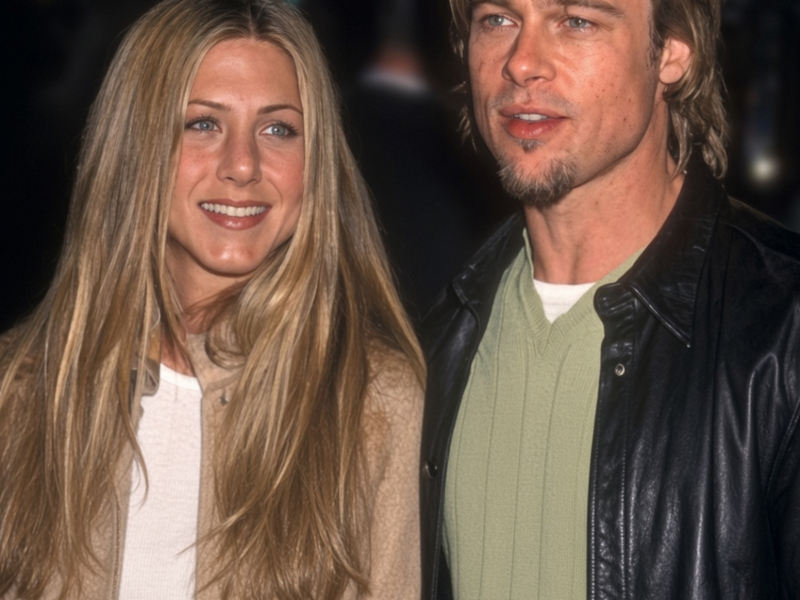
The Heartbreaking Truth About Jennifer Aniston’s 5 Year Marriage Behind Hollywood’s Golden Couple.
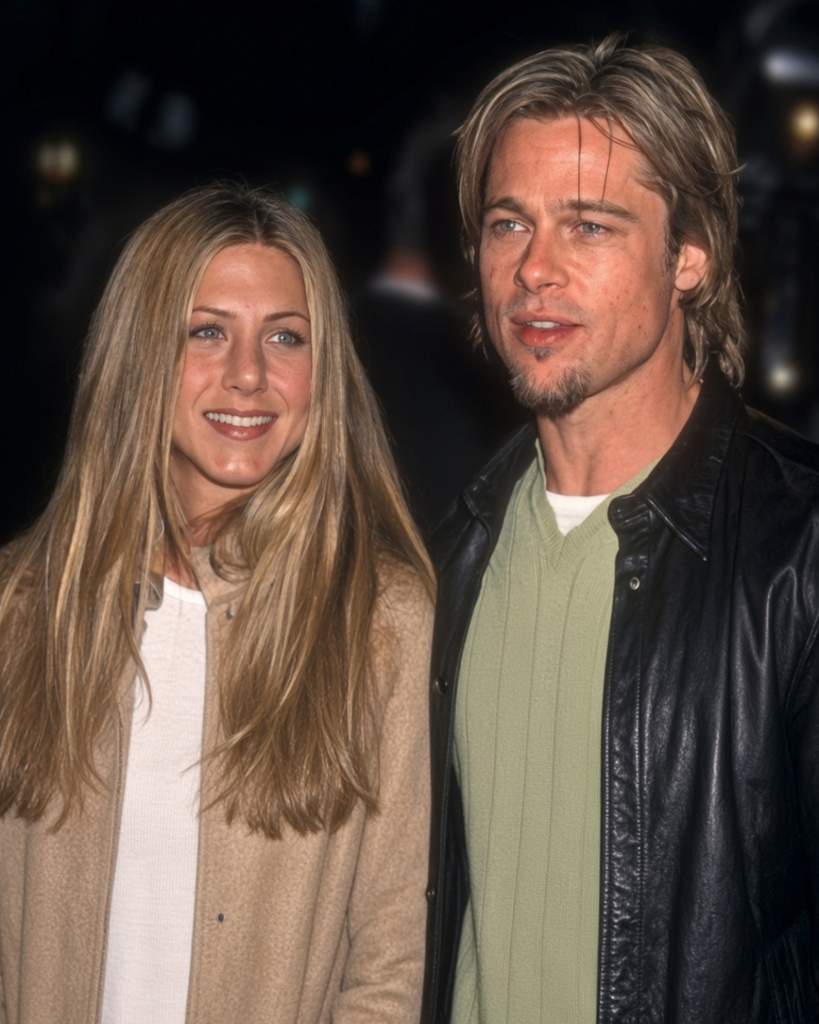
Five years of marriage, Jennifer Aniston and Brad Pitt were once the most dazzling golden couple in Hollywood history.
But behind the smile of America’s sweetheart was a bitter gamble.
She walked down the aisle without a single line of a defensive prenuptial agreement.
Look at the brutal 60-page photo spread in W magazine.
Her lawful husband openly staged a cozy family scene with another woman while the ink on the divorce papers was not even dry.
A raw testament to a betrayal that Hollywood helped orchestrate.
Tens of millions of dollars in fees built the Plan B empire, only to end up walking away empty-handed.
Her longing for motherhood was distorted by the media machine, turning her into a selfish villain.
And behind closed doors, nothing remained except solitary breakdowns surrounded by the paparazzi.
Can a sincere love survive inside the most ruthless commercial machine in the world?
To decode that shattered illusion, we must rewind to the most brilliant moment—the fateful sunset on the Malibu coast.
As dusk fell on July 29th, 2000, over the sheer cliffs overlooking the Pacific Ocean in Malibu, a strict no-fly zone established by the Federal Aviation Administration covered the entire five-acre estate of producer Marcy Carsey.
Four massive white tents were erected in a space surrounded by more than 50,000 imported roses, hyacinths, white lotus flowers, and marigolds.
A forty-member gospel choir sang hymns amid the crashing waves, blending into a tens-of-thousands-of-dollars fireworks display that lit up the night sky.
The entire event cost exactly $1 million—one of the most expensive figures at the turn of the millennium, aimed at establishing an ideal model for the love story of the century between two of the most powerful figures in North American entertainment.
Jennifer Aniston walked down the aisle in a white silk dress adorned with hand-stitched pearls designed by Lawrence Steele, standing before the man twice named by People magazine as the sexiest on the planet.
At that moment, 200 prestigious guests raised their glasses in toast.
The global media believed they were witnessing the most flawless union between two pop culture brands: America’s sweetheart and the box office star who held a commanding position on the big screen.
Yet behind that veil of luxurious silk, a cold legal reality was set.
The two chose not to sign any prenuptial agreement.
Among Los Angeles family law circles, two A-list stars entering a marriage without a prenup is not proof of pure romance, but rather a severe vulnerability in defense.
In 2000, Jennifer Aniston did not enter this marriage in the position of a dependent.
On the contrary, she held supreme power in the American television industry.
A record-breaking fee of $1 million per episode of Friends granted Aniston superior liquid cash flow and commercial clout compared to the scattered investments in Brad Pitt’s film projects.
The decision to bypass a prenuptial agreement meant that the two individuals voluntarily placed all assets accumulated during the marriage under the absolute judgment of California Family Code Section 760.
Under this statute, all income, all newly acquired real estate, and most importantly, all intellectual property value generated from July 29th, 2000, until the filing for separation automatically became community property divided 50/50.
This was a complete surrender of legal safeguards to the stability of personal emotions—a choice that placed the woman at a total disadvantage once the economic machinery began to turn.
In November 2001, the economic alliance between the two was officially institutionalized when Brad Pitt, Jennifer Aniston, and veteran producer Brad Grey signed the paperwork to establish Plan B Entertainment Inc.
Headquartered in Beverly Hills, the company operated under a long-term exclusive development deal with Warner Brothers.
In Aniston’s initial perspective, Plan B was envisioned as a shared artistic space where husband and wife would curate scripts together, develop mid-budget independent dramas, and walk onto the award stage together as co-founding partners.
However, in the real calculations of Hollywood executives, Plan B was an aggressive intellectual property investment engine.
The company was founded to buy up the rights to bestselling novels straight from their raw manuscripts, adapt them into blockbuster screenplays, and use the ownership of the works to dominate major studios.
It was at this intersection that the power asymmetry began to emerge.
While Aniston spent a full twelve to fourteen hours each day on Stage 24 of Warner Brothers in Burbank filming the final seasons of Friends, shouldering the pressure to keep ratings up for NBC, Brad Pitt began taking over actual executive control at Plan B.
The French Normandy-style mansion designed by legendary architect Wallace Neff in Beverly Hills—a 12,000-square-foot property they purchased in 2001 for $13.1 million—gradually turned into an ongoing construction site that lasted for three full years.
Pitt became immersed in architectural blueprints, traveling directly to France to select each imported marble slab, overseeing the removal of maple floors, and designing a specialized screening room.
The shared home was constantly besieged by the sound of saws, construction crews, and protracted business meetings.
Whenever she returned home after exhausting hours of filming, Aniston did not find a warm space to recharge.
Instead, she had to face a chaotic work site that reflected the shifting psychological state of her partner—a man who refused to settle down, continuously chasing larger-scale projects to assert his personal dominance.
Plan B’s management structure revealed an obvious injustice in titles and executive control.
Between 2002 and 2003, Plan B successively acquired major film projects such as Troy, Charlie and the Chocolate Factory, and the adaptation of The Departed.
Although this legal entity was nurtured by the joint brand reputation and mutual collateral of both spouses, Brad Pitt and Brad Grey always appeared as direct executive producers on contracts negotiated with world-class directors.
Aniston, due to a relentless filming schedule and absolute trust in her husband, did not intervene deeply in the internal corporate documentation.
She contributed capital and brought the commercial leverage necessary for the company to secure exclusive distribution deals, yet she never requested a single protective legal clause regarding veto power or preferred stock to safeguard her decision-making authority should an intellectual property dispute arise.
The invisible divide between the two continued to widen due to an irreconcilable divergence in their life plans.
In January 2004, the final wrap call for Friends sounded on Stage 24, closing out Aniston’s ten-year journey tied to the character of Rachel Green.
When the finale officially aired on May 6th, 2004, drawing 52.5 million American viewers, thirty-five-year-old Jennifer Aniston faced a massive psychological transition.
After a full decade dedicated entirely to the small screen, she publicly expressed her desire to step away temporarily from the Hollywood spotlight to focus on motherhood and nurture her home in the newly completed Beverly Hills mansion.
Yet at the exact moment the wife was ready to step back, the husband decided to accelerate his professional ambitions in the completely opposite direction.
Brad Pitt firmly resisted settling into a stable domestic routine.
He wanted to thoroughly dismantle the stereotype of a romantic comedy heartthrob and emerge as a power broker driving prestigious Oscar-contending cinema.
Pitt’s lifestyle shifted toward nonstop international flights, late-night script acquisition meetings, and increasingly rare appearances at the family dinner table.
The multimillion-dollar Beverly Hills estate ceased to be a home and became nothing more than a transient transit stop between the husband’s business trips.
The underlying asymmetry compounded into suffocating pressure behind closed doors.
Jennifer Aniston had committed all of her love, personal prestige, and financial capital into an alliance devoid of any legal safeguards.
Her sincerity was not met with mutual agreement on life goals.
Instead, it opened the door to a severe identity crisis as the relationship’s power balance tilted completely toward the man’s ambition.
All the quiet fissures that had accumulated over four years were pushed to the edge of collapse in the summer of 2004.
A plane ticket carried Brad Pitt away from Los Angeles to the set in Glen Cove, New York, to begin work on the $110 million action project titled Mr. and Mrs. Smith—where the structural vulnerabilities of that defenseless pact from the year 2000 would be torn wide open by the merciless marketing engine of Hollywood.
In June 2004, the cameras at the Salutation estate in Glen Cove, Long Island, officially began rolling on the first action sequences of the feature film project Mr. and Mrs. Smith.
The project held an initial budget of $110 million, financed by two industry powerhouses: Arnon Milchan’s Regency Enterprises and 20th Century Fox.
On the East Coast set, a tightly closed production machine was strictly established to ensure a summer 2005 release schedule.
Director Doug Liman implemented an improvisational filmmaking style with grueling schedules running continuously from dusk to the following dawn, completely isolating the lead cast from regular communications outside the set.
Right there in Glen Cove, Brad Pitt’s psychological shift became starkly visible before the eyes of the entire technical crew and production assistants.
Internal reports from the production team noted that the actor began extending his time in his personal trailer with co-star Angelina Jolie after every rehearsal.
The topics of conversation between them were no longer limited to the scope of a spy action script, but quickly expanded into humanitarian aid projects in Cambodia, United Nations refugee work, and plans for international adoption.
The independent energy, fierce instincts, and uninhibited lifestyle of his co-star triggered an intense psychological reaction in Pitt.
A man feeling confined within the traditional California family mold began to see in this woman a boarding pass into an entirely different world.
At the exact same time those action scenes in New York were underway, on the West Coast of the United States, Jennifer Aniston was facing a critical, life-altering career transition entirely on her own.
At 10 p.m. on January 23rd, 2004, applause from 250 studio audience members on Stage 24 of Warner Brothers in Burbank officially brought the final scene of the television series Friends to a close.
By May 6th, 2004, when the 236th episode aired and drew 52.5 million live viewers, Aniston entered the post-Friends era in a state of psychological turmoil.
For ten continuous years, her biological rhythm had been hardwired to the weekly filming cycles of Rachel Green.
When the contract ended, the thirty-five-year-old woman was abruptly cast into a power vacuum.
The 12,000-square-foot Wallace Neff-designed mansion on Beverly Hills had just completed its three-year renovation out of construction chaos.
Yet the husband who planned to build that home with her was residing on the East Coast with a filming schedule repeatedly prolonged by technical issues and script revisions.
In cautious interviews with the press in early 2004, Aniston made no secret of her personal plans: “It’s time. It’s time to slow down. I want to wrap up, travel, put my house in order, and have a baby. That’s the only thing I long for right now.”
Yet instead of receiving consensus and protection from her life partner, Jennifer Aniston was instantly thrust into the center of one of the most organized and ruthless media smear campaigns in Hollywood history.
From midsummer 2004 onward, newsstands across America were flooded with sensational headlines from tabloids like Us Weekly, Star magazine, and the National Enquirer.
A toxic, accusatory narrative was repeated week after week.
Jennifer Aniston was branded as selfish, blindly obsessed with fame, and adamantly refusing to get pregnant to preserve her figure and maintain her commercial film standing—thereby driving Brad Pitt into loneliness and forcing him to seek emotional refuge elsewhere.
This was a calculated strike aimed directly at the American public psyche of the early 2000s, a society still burdened by patriarchal prejudices where the woman was always held primarily and solely accountable whenever a marriage showed signs of fracture.
However, the entire historical archive of records and subsequent confrontation interviews proved that this tabloid narrative was a blatant fabrication.
In September 2005, in an exclusive interview with journalist Leslie Bennetts for Vanity Fair, Aniston openly dismantled the lie she had spent more than a year quietly enduring.
“A man divorcing would never be accused of choosing career over children,” she said. “That really pissed me off. I’ve never in my life said I didn’t want to have children. I did and I do and I will. I would never give up that experience for a career. But look at how the world works.”
When a man walks away from a broken marriage, society never accuses him of being too work-obsessed to care for his family.
On the contrary, the woman is always brutally punished by that exact same double standard.
Aniston’s outrage exposed a chilling operational mechanism within the entertainment machine.
To protect the commercial viability of a box office leading man and pave the public relations path for an upcoming romance, they did not hesitate to turn the lawful wife into a media scapegoat, draping her in the mantle of the guilty party.
The truth behind the fracture becomes even clearer when cross-referenced with Brad Pitt’s own admissions years later.
In September 2011, during an interview with Parade magazine, Pitt made a statement that sent shockwaves through international public opinion.
“In the 1990s and early 2000s, I was trying to hide out from the spotlight,” he said. “I started getting sick of myself, sitting on a couch, holding a cigarette, hiding away. It felt so pathetic. I realized I was intent on finding movies about interesting lives, but I was not living an interesting life myself. And I think that my marriage back then had something to do with it. I was trying to pretend that the marriage was something perfect, but in reality it was not at all.”
Pitt’s statement in Parade was a cold confirmation from the man himself that he had already emotionally disconnected from the marriage before the cameras ever rolled on Mr. and Mrs. Smith.
While Aniston strived for connection and believed that completing their Beverly Hills home would open a new chapter for their family, Pitt viewed their quiet married life as a dull imprisonment that stifled his rebellious artistic ego.
Yet what eroded Aniston’s self-esteem most deeply during this period was Brad Pitt’s calculated silence in the face of the media storm attacking his wife.
For months throughout 2004, as Aniston was besieged by brutal questions from reporters regarding having children, Pitt and his crisis management firm never issued a single press release to correct the record or defend his partner’s honor.
The actor’s silence was a tacit endorsement of the tabloid media—directing every blade of criticism toward the woman in California, while positioning himself as the victim of a marriage devoid of domestic warmth.
At the same time, Hollywood’s colossal marketing machine stepped in to thoroughly exploit the scandal for commercial gain.
To Arnon Milchan and top executives at 20th Century Fox, rumors of an affair between the two lead stars on the Glen Cove set were not a crisis to be extinguished, but rather a free publicity campaign worth tens of millions of dollars.
Set leaks were funneled in a controlled manner to entertainment news outlets like Entertainment Tonight and Access Hollywood.
Global public curiosity surrounding the movie was driven to its absolute peak.
In a high-stakes commercial gamble worth hundreds of millions of dollars in ticket sales, Jennifer Aniston’s pain and trampled dignity back in Beverly Hills were viewed by producers as nothing more than negligible collateral damage in exchange for record-breaking box office revenue.
The fracture spread and cut deep into the couple’s shared economic foundation: Plan B Entertainment.
Founded in 2001 on a foundation of romantic faith, by late 2004, the Plan B office in Beverly Hills had become an entirely alien space to Aniston.
The strategic film projects acquired by the company—most notably negotiating the remake rights to the Hong Kong film Infernal Affairs into The Departed under the direction of Martin Scorsese—were directly coordinated and controlled by Brad Pitt and Brad Grey.
Aniston was virtually shut out of critical board meetings.
Brad Grey’s upcoming departure from Plan B in January 2005 to assume the role of chairman and chief executive officer of Paramount Pictures plunged the company’s ownership structure into severe instability.
Aniston faced a brutal reality: if the marriage collapsed, she risked losing total control over the cinematic entity that she had poured money and reputation into building from day one.
Throughout the fall of 2004, Aniston had to rely on psychological support from marriage therapists in Los Angeles and the steadfast presence of her close friend Courteney Cox.
She patiently continued appearing beside Pitt at select red-carpet events in September and October 2004, trying to keep up a smile in front of hundreds of camera lenses to preserve the very last shreds of hope.
Yet all illusions of reconciliation were completely extinguished during a fateful New Year’s trip in 2005 to the Caribbean island of Anguilla.
Intended as a final effort to step away from the Hollywood spotlight and have an honest conversation about their future, the vacation in Anguilla quickly turned into a cold liquidation of their emotions.
Paparazzi snapshots captured the moment the two walked along a deserted beach.
There were no affectionate gestures, no smiles—only lingering silences between two people who once considered each other their everything.
On that island, Brad Pitt officially admitted to Aniston that he could no longer sustain the marriage.
Every emotional barrier officially collapsed.
As soon as their private jet touched down at Los Angeles Airport, Jennifer Aniston immediately packed her personal belongings and moved out of the Beverly Hills mansion.
On January 7th, 2005, a brief press statement was released to People magazine, officially announcing their separation after seven years together and nearly five years of marriage.
The statement attempted to preserve appearances with diplomatic phrasing: “We would like to announce that after 7 years together, we have decided to officially separate. This decision is not the result of any tabloid speculation, but the thoughtful consideration of both of us. We remain dedicated friends and share the utmost mutual respect.”
However, that diplomatic velvet curtain was instantly torn down by harsh reality.
Jennifer Aniston realized that her endurance throughout 2004 had not earned her respect from her partner or fairness from the media.
The time for emotional compromise had officially closed, giving way to a fierce war of nerves across legal negotiation tables—where top California divorce attorneys stepped in to determine the fate of shared community assets valued at over $100 million and the legal destiny of their brainchild, Plan B.
On the morning of March 25th, 2005, in the civil filing office of the California Superior Court in Los Angeles County, a case file bearing docket number BD423403 was officially stamped with red ink.
The petitioner named on the document was Jennifer Joanna Aniston, represented by attorney Laura Wasser—a leading specialist handling multimillion-dollar divorces across Southern California.
The respondent was William Bradley Pitt, with veteran attorney Robert Kaufman representing his legal interests.
In the standard petition submitted to the court, the sole legal cause cited for the dissolution of marriage was summarized entirely in the phrase “irreconcilable differences” under California state law.
The petition contained no allegations of infidelity, made no claims for spousal support from either party, and made no request for open adversarial hearings before a jury.
Through a precise judicial move, Jennifer Aniston and attorney Laura Wasser proactively established an orderly corridor of retreat—entirely isolating the proceeding from the intervention of open court judges, where every sensitive detail could be hunted down by the press.
However, behind the procedural calm of case file BD423403 was an intense six-month shadow asset negotiation taking place inside law offices in Century City.
Because the two parties had not established a prenuptial agreement in the summer of 2000, all assets accumulated across nearly five years of marriage—estimated to exceed $110 million by early 2005—were subject to direct governing by California Family Code Section 760.
Under community property rules, every revenue stream generated from syndication royalties, acting salaries, and international sponsorship contracts—down to the surplus value of corporate businesses formed during the marriage—had to undergo independent audits and be split 50/50.
If either party refused compromise and triggered an open property trial, all personal tax returns, confidential financial transactions, and intellectual property rights of each film project would be exposed completely to the public.
To ensure maximum privacy for her client, attorney Laura Wasser employed a dispute resolution method using a private judge—dividing the marital estate into two distinct categories: tangible, liquid physical assets, and corporate intellectual property rights that were inherently complex and fraught with long-term legal exposure.
The primary focus of physical asset resolution was the property at 1026 Ridgedale Drive.
Situated in the most exclusive section of Beverly Hills, this 12,000-square-foot estate was built in the 1930s by famed architect Wallace Neff specifically for actor Fredric March, and was later acquired by Pitt and Aniston in 2001 for $13.1 million.
Throughout three consecutive years of renovation, the couple poured in millions of additional dollars to completely reconstruct the architecture—from replacing the entire flooring with historic French maple planks sourced from European landmarks, tiling bathrooms in solid imported marble slabs, and constructing tournament-grade tennis courts to designing a specialized home screening room equipped with a 35mm film projector.
The structure once regarded as the strongest physical foundation for an enduring household was now formally placed on the commercial valuation table as a liquidation asset to recover cash.
Rather than prolonging residency disputes, both parties mutually agreed to authorize luxury real estate brokers to list the residence on the open market.
By mid-2006, the Wallace Neff estate officially found a new owner, closing at a transaction price of approximately $28 million.
After deducting California franchise taxes, capital gains taxes, brokerage commissions, and settling all remaining mortgage balances, the entire net liquid proceeds were divided equally into two separate personal bank accounts.
The most prized real estate asset of the marriage was liquidated smoothly, equitably, and without leaving behind a single civil dispute.
Yet the decisive legal turning point—the moment that reflected the most painful reality regarding Jennifer Aniston’s sacrifice of her status and economic interests—lay in the division of control over Plan B Entertainment Inc.
By early 2005, Plan B was no longer an infant film production outfit.
Backed by the financial collateral and brand prestige of Aniston and Pitt, the company had rapidly secured exclusive development deals with Warner Brothers and held the intellectual property rights to a series of blockbuster adaptations.
Most prominent among them was the remake of the classic Hong Kong crime film into The Departed, directed by Martin Scorsese and starring Leonardo DiCaprio alongside Matt Damon, as well as the project A Mighty Heart, adapted from Mariane Pearl’s memoir.
Through the lens of California Family Code Section 760, Jennifer Aniston held legal ownership of 50 percent of the equity value in Plan B Entertainment.
She possessed full legal standing to petition the court to freeze corporate operations, appoint an independent auditor to appraise all projected revenue streams, force a split of voting shares, or even demand a public auction of Plan B’s entire intellectual property portfolio to a third party to extract tens of millions of dollars in cash.
Had Aniston chosen that hardline legal path, production on all active film sets would have halted indefinitely, and Brad Pitt’s ambition to become an elite independent film producer would have suffered a fatal blow right at its inception.
Yet at the very moment she possessed overwhelming legal bargaining leverage, Jennifer Aniston made a decision that shifted the entire landscape.
She agreed to transfer all voting rights and controlling equity in Plan B to Brad Pitt.
Pursuant to the confidential out-of-court property settlement, Aniston retained only a symbolic financial entitlement clause—receiving a small percentage of back-end net profits from a few film projects she had directly participated in developing from the early days, including The Departed.
In return, she fully withdrew her name from the board of directors, relinquished all rights to intervene in corporate direction, and ended her status as co-founder of the company.
At that same time, when Brad Grey officially departed Plan B to assume the role of chairman and chief executive officer of Paramount Pictures, Brad Pitt officially became the sole owner of the entire Plan B empire.
Why would a woman who had just turned thirty-six, entirely financially independent, and fully aware of the value of intellectual property agree to let go of a company on the verge of becoming a top production powerhouse in Hollywood?
The answer lies in Jennifer Aniston’s strength of character and profound self-respect.
For her, continuing an intertwined economic relationship with a man who had publicly betrayed the trust of a family was a psychological burden she refused to carry into her future.
She understood that if she fought for every percentage point of Plan B equity, she would be forced to sit through dozens of tense shareholder meetings, continually face her ex-husband and his representing attorneys, and endure unrelenting scrutiny from financial media.
Furthermore, independent film production is a high-stakes financial gamble carrying massive debt risks.
Aniston did not want to continue bearing joint legal liability for Pitt’s ambitious yet volatile movie projects.
She chose a clean break from all business ties in exchange for absolute psychological peace and total autonomy over her own life.
Giving up control of Plan B was not a sign of weakness, but a definitive severing of the final ties tethering her to a marriage that no longer held mutual respect.
Yet the actual price Aniston had to pay following that civilized concession was utter isolation in the face of an uncompromising media campaign.
While attorneys were finalizing the closing legal filings, in June 2005, Mr. and Mrs. Smith officially premiered and ignited a global sensation, grossing a massive box office total of roughly $490 million.
The entire promotional campaign of the movie thoroughly capitalized on public curiosity regarding the relationship between the two lead stars—turning the collapse of a five-year marriage into a wildly successful commercial launchpad for the husband.
The pinnacle of hurt struck in July 2005 when W magazine released a special issue featuring a 60-page spread titled “Domestic Bliss.”
The image of the man she had been bound to for five years appearing in the role of an ideal father beside another woman—staged in a simulated suburban family setting surrounded by children in Palm Springs—was dropped at the exact moment their divorce settlement had not yet received final judicial approval.
It was a brutal psychological blow that eroded all of Aniston’s efforts to maintain peace.
During an exclusive interview with Leslie Bennetts for Vanity Fair in September 2005, the reporter witnessed the moment Aniston could not hold back tears of grief and indignation when the photo spread was brought up—right before she delivered a sharp yet stinging remark about her ex-husband’s total lack of a sensitivity chip.
The fallout from that collapse weighed heavily on Aniston’s daily life throughout the second half of 2005.
After leaving the Beverly Hills home, she had to move into a temporary rented beach house in Malibu.
The area was swiftly swarmed by dozens of specialized vans belonging to international paparazzi, turning her life into a prison with no escape.
Her closest friends, especially Courteney Cox, had to take turns staying by her side to shield her through prolonged bouts of emotional distress.
Society at the time blatantly commercialized her grief, turning a woman’s personal tragedy into a consumer craze—with hundreds of thousands of divisive T-shirts reading “Team Aniston” and “Team Jolie” flooding every corner of America.
On October 2nd, 2005, a California Superior Court judge in Los Angeles County officially signed and stamped the final decree, terminating completely the legal validity of the marriage between Jennifer Joanna Aniston and William Bradley Pitt.
The entire romance that had begun with a $1 million wedding of 50,000 blossoms on the Malibu cliffs and an unprotected gamble in the year 2000 officially closed with a few pages of case file BD423403—resting quietly in the judicial storage vaults of Los Angeles.
Brad Pitt marched forward on the path of prestige with sole ownership of the Plan B machine—the very company that would later bring him coveted Academy Awards.
Meanwhile, Jennifer Aniston walked out of the marriage with half the liquidation proceeds of their shared home, a television career that had just drawn to a close, and her personal dignity tested to the absolute limit before the public.
Case file BD423403 has officially closed in the eyes of the law, but the historical truth of what that woman had to sacrifice and endure has never been buried.
As time fades the sensational tabloid headlines and looking back across Jennifer Aniston’s twenty-year journey of rebirth, what has history’s true verdict recorded about her resilience behind the title of Hollywood’s former golden couple?
More than twenty years after divorce decree BD423403 officially took effect in Los Angeles Superior Court, the media clamor of 2005 has faded deep into the past.
Yet the historical question still demands a definitive answer.
What is the heartbreaking truth behind Jennifer Aniston’s five-year marriage?
The core of that tragedy never lay in an ordinary cheating scandal.
It was the harsh price paid when a woman entered marriage with pure sincerity, establishing not a single defensive safeguard under California community property law.
For half a decade, Aniston used her record-setting fee of $1 million per episode and her personal prestige to guarantee the birth of Plan B Entertainment.
Yet the moment her ten-year chapter with Friends came to a close, she was instantly turned into a scapegoat by the Hollywood marketing machine.
To clear the runway for a rival film’s commercial campaign, the media back then slapped her with a cruel stereotype: the selfish woman who refused the calling of motherhood.
Aniston’s act of letting go at the 2005 asset negotiation table was the most fitting testament to her resilience.
Relinquishing her 50 percent controlling stake in Plan B was not a sign of legal inferiority.
It was a decisive choice to sever all economic ties—refusing to turn their brainchild into a weapon of dispute in order to fully preserve her personal self-respect and peace of mind.
Hollywood history records an objective outcome.
Brad Pitt went on to build Plan B into an Oscar-winning production powerhouse, but Jennifer Aniston forged an entirely independent legacy.
In April 2008, she founded the production company Echo Films alongside partner Kristin Hahn.
She continuously earned professional recognition with Golden Globe nominations, Screen Actors Guild Awards, and Primetime Emmy nominations without relying on the name of any partner.
Aniston proved to millions of female viewers that a woman’s worth and standing are never defined by whether she holds onto a marriage.
Looking back at the complete 2005 case file, what do you respect more about Jennifer Aniston?
Her restraint in walking away from control of a multimillion-dollar empire in exchange for freedom—or her self-made grit in rebuilding her career in the face of that era’s storm of prejudice?









