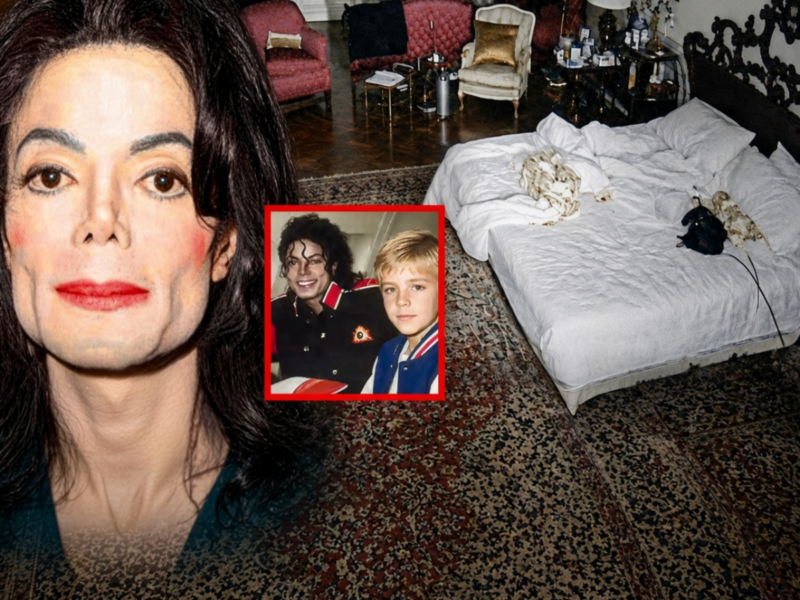
The DISTURBING Discovery in Michael Jackson’s Bedroom.
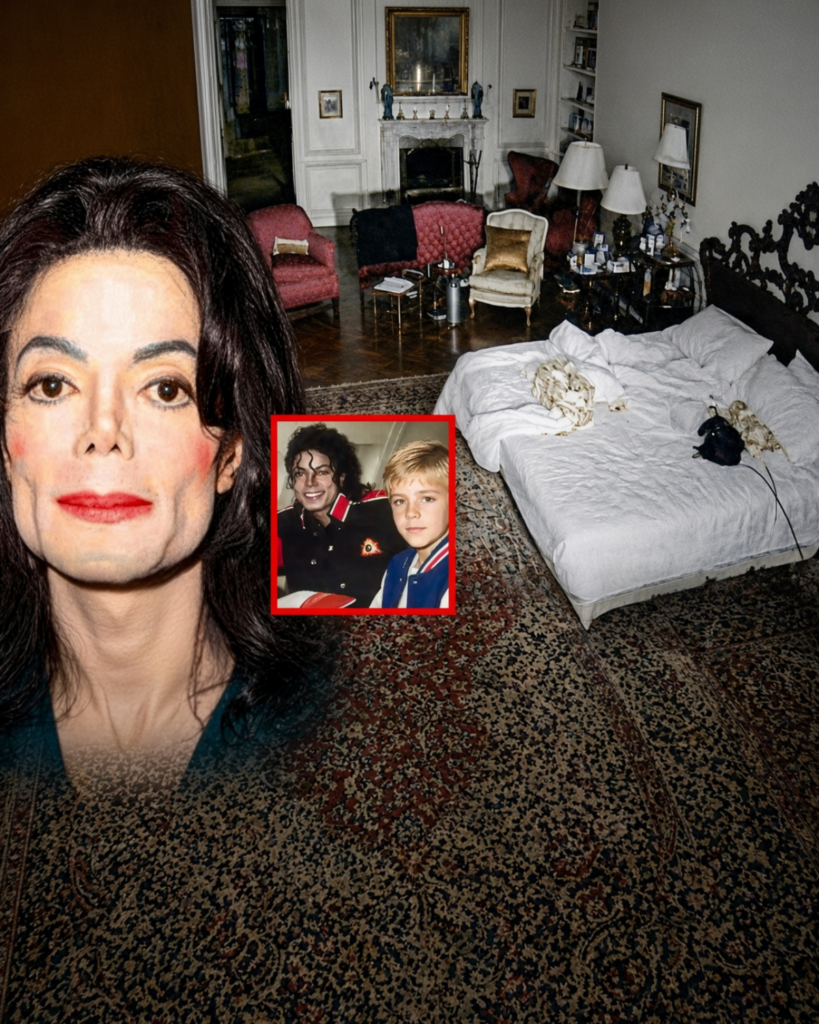
There is a photograph that has never been shown to the public.
It was taken on the morning of June 25th, 2009, inside a rented mansion in the Holmby Hills neighborhood of Los Angeles.
It shows a bedroom.
Not a stage, not a studio, not the Neverland Ranch that the world had come to know.
Just a bedroom on the second floor with a bed and a nightstand and a closet.
And on that bed, and on that nightstand, and in that closet, investigators found something that would change the course of music history forever.
They found propofol.
Twelve bottles of it.
Nine of them were stuffed inside a bag labeled “Baby Essentials.”
They found an IV stand, an empty IV bag, three tanks of oxygen in the bedroom, and fifteen more in a security guard shack outside.
They found syringes, two of them lying next to the bed.
They found a bloodstained shirt hanging in the wardrobe.
And they found something else.
Something that nobody expected.
Something that made the detective stop and stare.
There was a doll on the bed.
A lifelike boy doll lying on the pillows.
And taped to the mirrors and the doors, there were Post-it notes.
Little pieces of paper with scrawled messages, slogans, phrases, fragments of thoughts.
Some of them looked like lyrics.
Some of them looked like poems.
That is the disturbing discovery.
Not a secret room, not a hidden vault, not a confession.
Just a bedroom that looked like a makeshift hospital, occupied by a man who could not sleep, surrounded by the things that killed him.
I have spent this week going through every photograph, every court document, every testimony from the investigators who walked into that room.
And I am going to put all of it in front of you.
But there is something you need first.
Because the truth about what was found in Michael Jackson’s bedroom is not about what he was hiding.
It is about what he was suffering.
And once you hear it, you will never think about his death the same way again.
Stay with me, because the last few minutes of this video are the reason I made it.
Let us start with the night before.
Because to understand what was found in that bedroom, you have to understand what happened in the hours leading up to it.
On the night of June 24th, 2009, Michael Jackson came home from a rehearsal.
He was fifty years old.
He was preparing for a series of fifty concerts at the O2 Arena in London.
He was calling it “This Is It.”
He was telling the world that this was his final curtain call.
He was tired.
He was thin.
He was in pain.
But he was working.
He was rehearsing.
He was trying to give his fans one last gift.
He returned to the rented mansion on Carolwood Drive.
His personal physician, Dr. Conrad Murray, arrived shortly after midnight.
Murray had been hired by AEG Live, the concert promoter, to be Michael’s doctor during the preparation for the tour.
He was being paid $150,000 a month.
He was supposed to keep Michael healthy.
He was supposed to keep him alive.
What happened next is documented in court records and testimony.
Murray gave Michael a series of sedatives.
Lorazepam, midazolam, diazepam.
And then, when those did not work, he gave him propofol.
Propofol is a surgical anesthetic.
It is not a sleep aid.
It is not something you give someone at home, in a bedroom, without the proper equipment.
It is a drug that puts you into a coma-like state.
It is a drug that can stop your heart if it is not administered correctly.
It is a drug that is supposed to be used by anesthesiologists in hospitals, with monitoring equipment and resuscitation tools at the ready.
Murray gave it to Michael anyway.
He gave it to him through an IV drip.
And then, according to his own statements to police, he left the room.
He left the room.
He left his patient.
He left the man who was paying him $150,000 a month.
He left him alone with a propofol drip and a heart that was about to stop.
Now, let us talk about what happened next.
Because the timeline is important, and the timeline is where the tragedy becomes almost unbearable.
At some point, Murray realized that something was wrong.
He came back into the room.
He found Michael not breathing.
He found him with a pulse in his femoral artery, but no breath in his lungs.
He tried to revive him.
He did CPR.
But he did it on the bed, on a soft mattress, not on a hard floor, where CPR is actually effective.
He did it with one hand.
According to some accounts, he did it while he was on the phone.
Phone records show that Murray made multiple calls in the minutes after he discovered Michael in distress.
He called his girlfriend.
He called his office in Houston.
He did not call 911 until 12:21 p.m.
That is more than twenty minutes after he found Michael not breathing.
Twenty minutes.
Michael Jackson might have been saved if 911 had been called immediately.
He might have been saved if Murray had performed CPR correctly.
He might have been saved if Murray had not left the room in the first place.
He might have been saved if he had been in a hospital with the proper equipment, instead of a bedroom with a doctor who was more concerned with covering his tracks than saving his patient.
But he was not saved.
He died.
And when the paramedics arrived, they found a scene that they would never forget.
Let us talk about what they found.
Because that is the disturbing discovery.
That is the heart of this video.
The paramedics and the police who entered that bedroom found a room that did not look like a place where a man should have been receiving medical treatment.
It looked like a makeshift hospital.
There was an IV stand next to the bed.
There was a saline bag hanging from it.
There were oxygen tanks in the corner.
There were medications strewn across the nightstand and the floor.
There were syringes.
There was a propofol bottle, empty, lying on the floor.
There was a used syringe still attached within two feet of the bed.
There was a bloodstained shirt hanging in the closet, a shirt that Michael had been wearing when he died.
The coroner’s investigator, Elissa Fleak, was the first to document the scene.
She testified in court about what she found.
She said she found twelve bottles of propofol in the bedroom and the closet.
She said nine of them were in a bag labeled “Baby Essentials.”
She said she found six vials of lidocaine, a painkiller, along with other prescription medications and syringes.
She said two syringes were found next to Michael’s bed.
She also said something that the defense would later attack her for.
She said she found a bottle of propofol inside an IV bag, stashed inside a shopping bag in a closet area, four days after Michael’s death.
She admitted that her original notes did not mention this detail.
The defense accused her of changing her story to fit the prosecution’s case.
But the prosecution argued that Murray had tried to hide the evidence.
They argued that he had cleaned up the room before the paramedics arrived.
They argued that he had put the propofol bottle in the IV bag and stuffed it in a closet, hoping nobody would find it.
The security guard, Alberto Alvarez, testified that Murray told him to put the vials and the IV bag into a shopping bag.
Alvarez said Murray told him to hide them.
Alvarez said Murray told him not to tell anyone what he had seen.
That is a disturbing discovery.
Not just the drugs, not just the equipment.
The fact that a doctor, a man who had sworn an oath to do no harm, had tried to cover up the death of his patient.
The fact that he had tried to hide the evidence.
The fact that he had put the propofol bottle in a bag and put the bag in a closet.
The fact that he had left Michael Jackson on the bed, not breathing, while he tried to save himself.
Now, let us talk about the other things they found.
Because they tell us something about Michael Jackson that the world never understood.
They found a computer on the bed.
They found a lifelike doll on the bed, a boy doll lying on the pillows.
They found blown-up images of baby boys.
They found Post-it notes taped to the mirrors and the doors.
Little messages, slogans, phrases.
Some of them looked like lyrics.
Some of them looked like poems.
Detective Orlando Martinez described the scene in a documentary called “Killing Michael Jackson.”
He said there were Post-it notes, or pieces of paper, taped all over the room and mirrors and doors, with little slogans or phrases.
“I don’t know if they were lyrics or thoughts,” he said.
“Some of them seemed like poems.”
“The bedroom was, it was a mess,” he said.
“There was a computer on the bed. There was a lifelike doll on the bed. And there were pictures of babies.”
That is the part that makes people uncomfortable.
That is the part that the tabloids exploited for years.
A doll on the bed.
A man who was fifty years old, sleeping with a doll.
But here is what the tabloids never told you.
Michael Jackson was a man who had been robbed of his childhood.
He had been performing since he was five years old.
He had been working since he was old enough to hold a microphone.
He had never had a normal life.
He had never had a normal childhood.
He had never had the things that other children take for granted.
And that loss had followed him into adulthood.
It had shaped him.
It had broken him in ways that the world could not see.
The doll was not a sign of something sinister.
It was a sign of something sad.
It was a sign of a man who was still trying to hold on to the childhood he never had.
It was a sign of a man who was trying to fill a void that could never be filled.
It was a sign of a man who was lonely, who was in pain, and who was trying to find comfort in the only way he knew how.
The detectives knew this.
They knew that the doll and the pictures were not relevant to the case.
They knew that they were not evidence of a crime.
They knew that they were just a part of who Michael Jackson was.
Detective Dan Myers said, “It’s like with any case. You don’t allow whatever the victim was into prior to his death to color it. Your investigation is focused on how did he die and who was responsible for it.”
That is what the detectives did.
They focused on the death.
They focused on the propofol.
They focused on the doctor.
They did not let the doll distract them.
They did not let the baby pictures distract them.
They did not let the Post-it notes distract them.
They did their job.
But the world did not.
The world saw the doll and the pictures and the notes, and they made assumptions.
They made judgments.
They turned a tragedy into a spectacle.
They turned a man’s private struggle into a public circus.
Now, let us talk about the medical evidence.
Because the medical evidence is where the case was won.
Lab results presented at Murray’s trial showed that Michael Jackson’s fingerprints were not found on the medical evidence taken from his bedroom.
His fingerprints were not on the propofol bottles.
They were not on the syringes.
They were not on the IV tubes.
They were not on the sedative vials.
The only fingerprint that was found on the propofol bottle was Conrad Murray’s.
That is the key.
That is the fact that convicted him.
Michael Jackson did not give himself the propofol.
He did not pick up the bottle.
He did not insert the IV.
He did not push the drug into his own veins.
He was asleep.
He was unconscious.
He was trusting his doctor to keep him safe.
And his doctor betrayed that trust.
The defense argued that Michael gave himself the fatal dose.
They argued that he was so desperate for sleep that he woke up and injected himself with more propofol while Murray was out of the room.
They argued that it was not Murray’s fault.
They argued that Michael was responsible for his own death.
But the evidence did not support that.
The evidence showed that Murray had set up the IV.
Murray had started the drip.
Murray had left the room.
Murray had failed to monitor his patient.
Murray had delayed calling 911.
Murray had tried to hide the evidence.
Murray had lied to the paramedics.
Murray had lied to the police.
Murray had lied to the world.
And the jury saw through it.
They convicted him.
They found him guilty of involuntary manslaughter.
They sentenced him to four years in prison.
He served two years and was released on parole.
His medical licenses were revoked.
He was never allowed to practice medicine again.
But the conviction did not bring Michael back.
The conviction did not undo the damage.
The conviction did not give the world the ending it wanted.
It just gave the world someone to blame.
Let us talk about what Michael was going through.
Because that is the part of the story that nobody tells.
Michael Jackson had trouble sleeping.
He had been struggling with insomnia for years.
He had tried everything.
He had tried medication.
He had tried meditation.
He had tried everything the doctors could think of.
Nothing worked.
He could not sleep.
He had been through so much in his life.
He had been ridiculed.
He had been hounded by the press.
He had been betrayed by people he trusted.
He had been in pain, both physical and emotional, for most of his life.
He had been through things that would have broken a lesser person.
And he was still standing.
He was still working.
He was still trying.
And on top of all of that, he had a job to do.
He had fifty concerts to perform.
He had a comeback to deliver.
He had fans who had been waiting for him for years.
He could not afford to be tired.
He could not afford to be sick.
He could not afford to fail.
So he found a doctor who would give him what he needed.
He found a doctor who would give him propofol.
He found a doctor who would put him to sleep with a surgical anesthetic in a bedroom with no proper equipment.
Because he was desperate.
He was desperate for rest.
He was desperate for relief.
He was desperate for a few hours of peace.
That is what the propofol was.
It was not a party drug.
It was not a recreational drug.
It was a last resort.
It was a desperate attempt to get the sleep that his body and his mind would not give him.
And it killed him.
That is the tragedy.
That is the disturbing discovery.
Not that he was hiding something.
Not that he was doing something wrong.
But that he was suffering so much, and nobody around him was willing to say no.
Nobody was willing to tell him that propofol was not the answer.
Nobody was willing to tell him that he needed help.
Nobody was willing to save him from himself.
There is another thing that was found in that bedroom.
Something that is rarely mentioned.
They found skin bleaching ointments.
They found hair growing ointments.
They found anti-anxiety pills.
They found empty bottles of prescription medication.
The skin bleaching ointment was for his vitiligo, a skin condition that causes irregular patches of white skin.
The hair growing ointment was for the permanent hair loss he suffered when his scalp caught fire during a Pepsi commercial in 1984.
The anti-anxiety pills were for his anxiety.
The prescription medications were for everything else.
That bedroom was not a place of luxury.
It was not a place of happiness.
It was a place of pain.
It was a place where a man was trying to survive.
It was a place where a man was trying to hold himself together, one medication at a time, one desperate measure at a time.
And it was a place where a man died alone, with a doll on his bed and a doctor who failed him.
Let us talk about the doctor.
Because Conrad Murray is not the villain of this story.
He is the instrument of the tragedy.
He is the man who made the wrong choices.
He is the man who failed.
But he is not the only one.
AEG Live, the concert promoter, hired Murray.
They paid him $150,000 a month.
They knew that Michael was fragile.
They knew that he was struggling.
They knew that he needed help.
But they did not care.
They cared about the tour.
They cared about the money.
They cared about the tickets that had already been sold.
They pushed him too hard.
They scheduled fifty concerts when he could barely handle one.
They treated him like a machine, not a man.
The doctors who came before Murray are also part of the story.
Michael had been doctor-shopping for years.
He had been finding doctors who would give him what he wanted, no questions asked.
He had been using propofol for years, long before Murray came along.
The system failed him.
The people who were supposed to protect him failed him.
The people who were supposed to heal him failed him.
And then there was Michael himself.
He was the one who asked for the propofol.
He was the one who wanted the doctor to give him the drug.
He was the one who was so desperate for sleep that he was willing to risk his life.
He was not a victim in the traditional sense.
He was a man who made a choice.
But it was a choice made out of pain.
A choice made out of desperation.
A choice that nobody should ever have to make.
So let me ask you the thing this video is really about.
What are you hiding?
What are you carrying that you cannot put down?
What are the things in your bedroom, in your closet, in your life that tell the story of your pain?
Because Michael Jackson’s bedroom told his story.
It told the story of a man who could not sleep.
A man who could not rest.
A man who was carrying the weight of the world on his shoulders and who was trying desperately to find a moment of peace.
That is the disturbing discovery.
Not the drugs.
Not the syringes.
Not the doll.
The disturbing discovery is that Michael Jackson was suffering.
He was suffering more than anyone knew.
He was suffering more than anyone wanted to admit.
And he died in a bedroom, alone, surrounded by the things that were supposed to help him.









