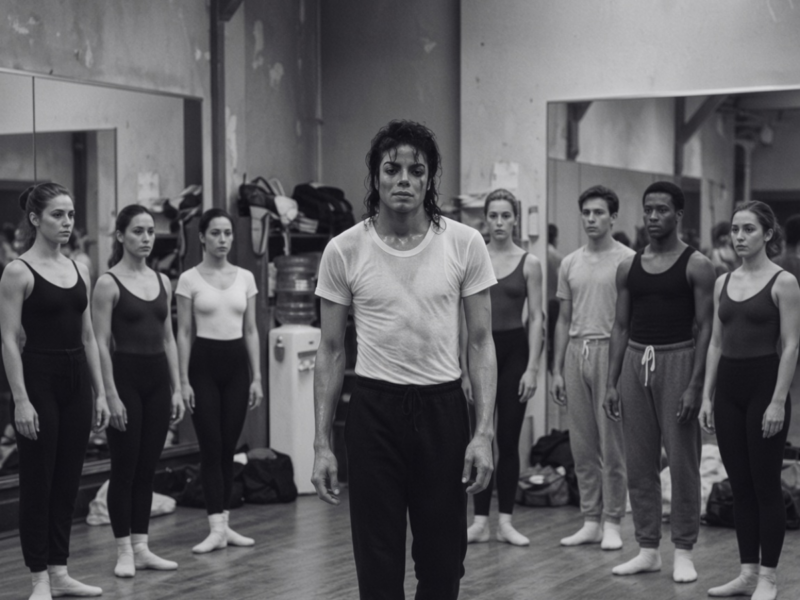
The Day Michael Jackson FIRED His Entire Dance Crew — What He Said Changed Their Lives.
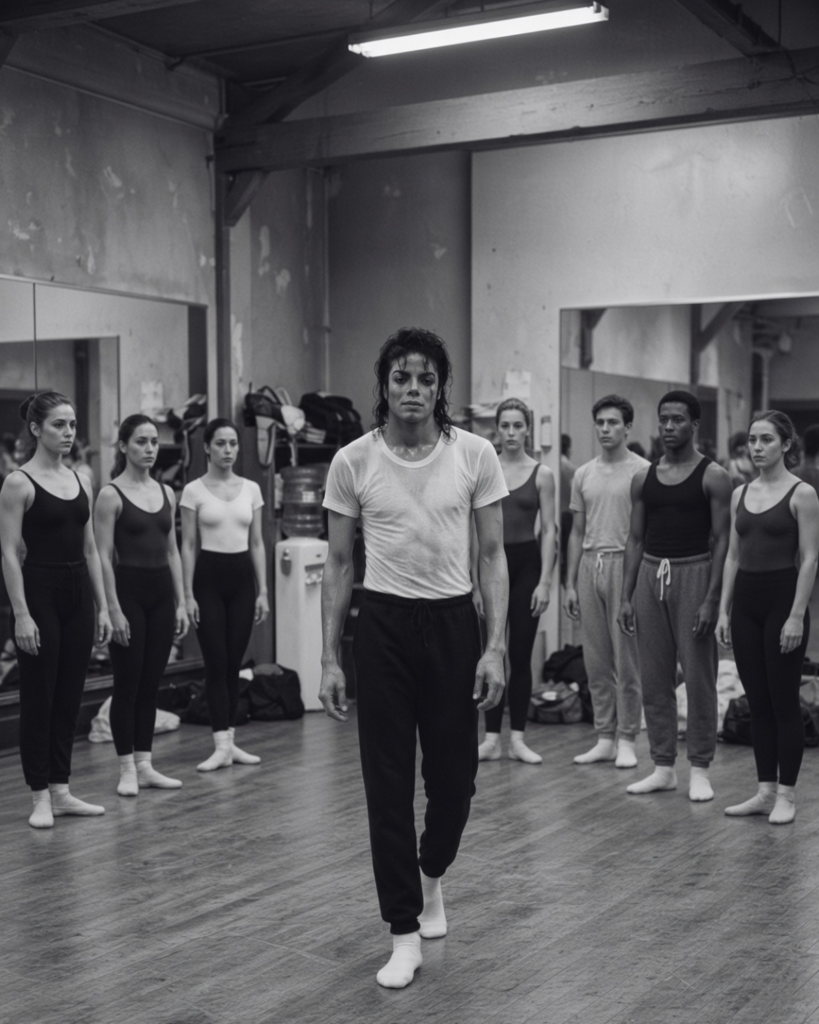
Los Angeles, January 1, 1987, 3 months before the Bad World Tour rehearsals officially begin.
The building looks like nothing from the outside.
A converted warehouse in Burbank.
No sign on the door, no windows facing the street.
Inside, the floor is hardwood.
The mirrors run wall to wall.
The sound system cost more than most people’s houses.
This is where Michael Jackson comes to disappear.
Not from the world, but into the work.
Into the thing that makes everything else make sense.
It’s 11 p.m. on a Tuesday.
Most people in Los Angeles are asleep.
Michael is not most people.
He’s been here since 4:00 in the afternoon.
7 hours.
No break longer than 10 minutes.
He’s wearing black sweatpants, a white t-shirt soaked through, white socks on hardwood, no shoes.
He says shoes lie to your feet about the floor.
The other dancers learned not to question this.
They learned a lot of things working with Michael Jackson that you couldn’t learn anywhere else.
There are 12 of them tonight.
Professional dancers.
Every single one.
These aren’t amateurs.
These are people who trained their entire lives, who auditioned against hundreds, who got the call and felt their hands shake when they answered.
Working with Michael Jackson is the highest position a dancer can hold.
It’s the summit.
But tonight, something is wrong.
You can feel it in the air the way you feel a storm before it arrives.
Michael is watching the run-through from a chair near the back wall, arms folded, completely still.
He hasn’t said anything in 40 minutes.
The choreographer, Vincent Paterson, keeps glancing at him.
The dancers keep glancing at him.
Everybody’s glancing at him, and nobody’s saying anything.
And the music keeps playing, and the feet keep moving, and the routine looks exactly the way it looked last week and the week before.
That’s the problem.
Michael stands up.
The music stops.
He walks to the center of the floor slowly, hands in his pockets, looking at the ground.
When he looks up, his expression isn’t angry.
It’s something harder to describe.
It’s the face of a man who expected more.
Not more from them.
More from this moment, from this art, from the thing they’re all supposed to be building together.
He says quietly, “Run it again.”
They run it again.
12 dancers executing choreography they have rehearsed 200 times.
Technically flawless.
Counts perfect.
Lines clean.
Spacing exact.
Michael watches for 30 seconds.
He holds up his hand.
The music stops again.
“Stop,” he says.
He’s still not angry.
That’s what makes this harder.
He turns around and faces the mirror.
And then he watches himself in it.
Everyone waits.
Michael turns back to face them and says seven words that nobody in that room will ever forget for the rest of their careers.
He says, “You’re dancing, but you’re not feeling anything.”
Silence.
Complete silence.
Marcus Wright is on the far left of the line.
24 years old, trained since he was six, worked his way up for three major tours before landing this job.
He’s good.
He knows he’s good.
And right now, standing in this warehouse at 11 p.m. with Michael Jackson looking at him, Marcus feels like a beginner.
Because Michael is right.
They’ve been executing the steps.
They’ve been counting the beats.
But somewhere in 200 repetitions, something died.
The feeling that makes the audience forget they’re watching choreography.
The feeling that makes them believe what they’re seeing is real, is human, is something that happened rather than something rehearsed.
That feeling is gone.
Michael says, “I’ve been sitting back there for 40 minutes watching you perform. Not dance. Perform. You know the difference?”
Nobody answers.
Not because they don’t have thoughts.
Because they can tell this isn’t a question.
“Performing is doing it for someone. Dancing is doing it because you can’t help it. Because something inside you has to come out, and this is the only way it knows how.”
He pauses.
“When I watch you right now, I see people who are very good at performing. I see people who are terrified of making a mistake. I see people who are thinking about my reaction the whole time, wondering if I’m satisfied, wondering if they’re keeping their jobs.”
He pauses again.
“That fear is in every single movement. And the audience will feel it. They won’t know why, but they’ll feel it. And it’ll cost us the whole show.”
But here’s what nobody expected him to say next.
Michael Jackson sat down on the floor.
Not in a chair.
On the floor.
Cross-legged.
In the center of the rehearsal space, like a kid.
He looked around at all of them standing above him and he said, “Sit down with me.”
12 professional dancers looked at each other.
Then they sat down on the floor.
Finally, he said, “I want to tell you something that nobody told me. I want to tell you what I wish someone had said before my first tour, before Motown 25, before any of it.”
“When I was rehearsing for Off the Wall, I made my dancers run the routine so many times that by the night of the show, they were moving perfectly. Every step exact. Every count flawless. And I watched them from backstage before we went on, and I saw the same thing I saw tonight. People going through motions they had memorized so deeply. The movement had no more soul than a machine.”
He shook his head slowly.
“I was wrong. Repetition doesn’t take the feeling out. Fear takes the feeling out. Repetition just makes the fear louder. The more you know the steps, the more you have time to think about everything that could go wrong.”
“So instead of dancing from here,” he touched his chest, “you start dancing from here.” He touched his temple. “And once that happens, the audience feels nothing. Because you’re feeling nothing.”
Marcus raised his hand like a student.
Michael nodded at him.
Marcus said, “So how do you get it back?”
Michael was quiet for a moment.
Then he said, “You stop trying to be good. Just for a moment. You stop trying to be correct. You close your eyes, literally if you need to. And you remember why you started. Not why you’re here. Not why you want to keep the job. Why you started. The first time you moved your body to music and felt like the music was coming from inside you instead of from a speaker. Find that. Then open your eyes and do the routine from there.”
He stood up.
He walked to the soundboard and pressed a button.
The opening of the song began to play, just the first eight bars before the beat drops.
Michael closed his eyes, and then he danced.
Not the choreography.
Not the routine they had rehearsed 200 times.
He moved through the music the way water moves through a space, finding every opening, filling every gap, responding to every shift in the sound as if it were a conversation rather than a script.
Then the beat dropped.
He opened his eyes and went straight into the routine.
Exact same choreography.
Every count, every mark, every line.
But it was completely different.
Nobody could explain why.
All the steps were identical, but something was alive in it that had not been alive before he closed his eyes.
And everyone in that room felt the difference in their chests before their minds could name it.
When the music ended, Michael stopped, turned around, and looked at them.
“That,” he said, “is the only thing that matters.”
What happened next is the part that never made the tabloids, never made the magazines, never became part of the legend.
But it’s the part that changed those 12 lives.
Michael sat back down on the floor, and for the next two hours, until 1 in the morning, he talked.
Not about choreography.
Not about the tour.
About why they danced.
About what their first memory of music was.
About the moment they knew they had no choice but to do this with their lives.
He asked each of them by name.
12 dancers.
12 stories.
Michael listened to every single one the way a person listens when they genuinely do not know what the answer is going to be and they cannot wait to find out.
At 1 in the morning, he stood up.
He said, “I didn’t fire you tonight. I know that’s what some of you thought was coming. I thought about it. And then I realized what you were doing wrong is what I taught you to do wrong. I gave you a routine so many times that I removed the reason for doing it. That’s on me.”
“We start over tomorrow. Same steps, different starting place. Every time we run it, I want you to close your eyes for 10 seconds before we begin. Find the reason. Then open them. Don’t show me the routine. Show me what the routine means to you.”
He paused at the door.
“You’re not backup dancers,” he said. “You’re the reason anyone in the back row believes what’s happening on stage is real. You matter more than most of you know.”
He left.
The Bad World Tour ran for 123 shows across 15 countries to 4.4 million people.
Every review mentioned the dancers.
Marcus Wright danced on that tour for 16 months.
Afterward, he started his own dance school in Atlanta.
He doesn’t start with technique.
He starts with one question.
Why did you start?
He learned it from Michael Jackson.
In the night, Michael Jackson didn’t fire anyone.
In the night, Michael Jackson sat on the floor and listened instead.
That’s the kind of strength that doesn’t make headlines, but it’s the kind that changes lives for 30 years and counting.
Who in your life needs you to sit down on the floor with them instead of standing above them with a verdict?
Michael didn’t ask his dancers to be better.
He asked them to remember why they started.
What would it unlock in you?









