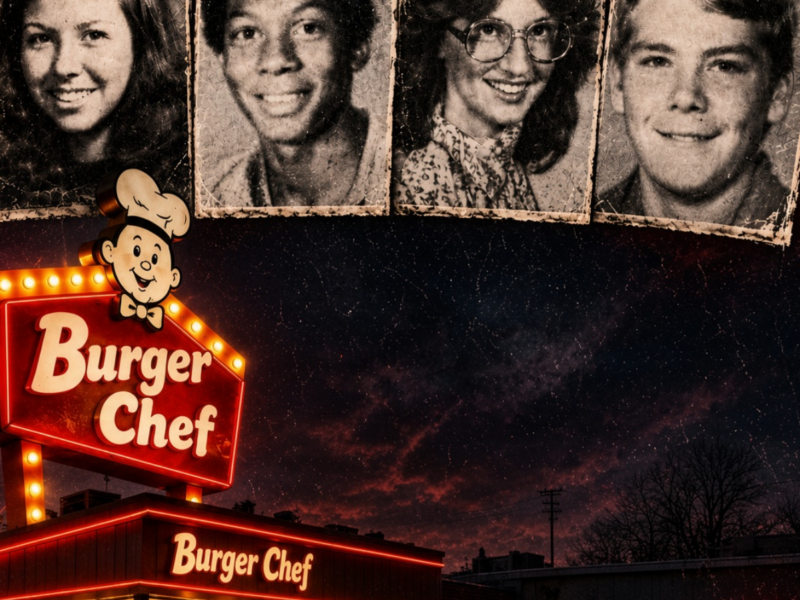
The Burger Chef Murders: 4 Employees Vanished Without a Trace.
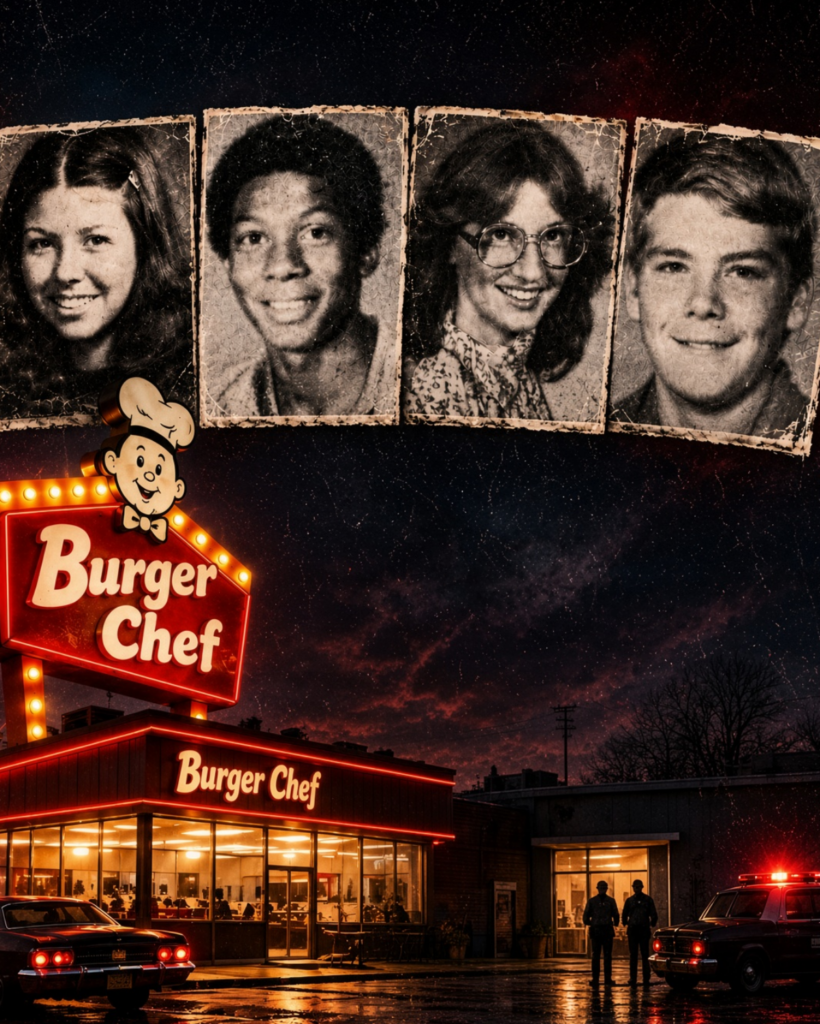
There are some places you pass every day without giving them a second thought.
A gas station. A grocery store. A little fast food restaurant sitting beside a busy road.
Places where people come and go, where the lights eventually go out, and another ordinary day comes to an end.
But in November of 1978, at one Burger Chef restaurant in Speedway, Indiana, four employees finished their final shift.
And sometime that night, all four had disappeared.
The back door was left open. Money was missing. And when another employee arrived after midnight, there was nobody there to explain what had happened.
Two days later, the four employees were found murdered.
And the people responsible were never brought to justice.
The strange thing about history is that we already know how certain stories end. But the people living through them—they don’t.
So tonight, we’re going back in time. Back to a Friday night in November of 1978, to Speedway, Indiana—a town known around the world for the roar of racing engines.
But the story we’re about to follow begins somewhere much quieter.
At a Burger Chef restaurant on Crawfordsville Road, where four young employees are about to become part of a mystery that will outlive them.
It’s Friday, November 17th, 1978, and we’re standing in Speedway, Indiana, just outside Indianapolis.
For most people, it’s another ordinary evening.
But at a Burger Chef restaurant on Crawfordsville Road, four employees are working the closing shift.
There’s twenty-two-year-old Jayne Friedt, the assistant manager. And alongside her are Ruth Ellen Shelton, Daniel Davis, and Mark Flemmonds.
Three teenagers working with the manager, who isn’t much older than they are.
There’s something unsettling about looking at a night like this, because we know something about these people that they don’t.
We know that by the time the sun comes up, they will be missing.
And the people searching for them won’t yet understand what has happened.
The restaurant is scheduled to close at eleven.
And sometime around that closing period, something happens inside the building.
Exactly how it begins remains unknown.
There’s no confirmed account of who first confronted the employees, what was said, or how they were taken.
But just after midnight, an off-duty employee named Brian Kring arrives.
The back door is ajar. The four people who had been working that night are gone.
Four employees, one empty restaurant, and the beginning of a mystery that decades later still has no resolution.
It’s now the early hours of Saturday, November 18th, 1978. And at the Burger Chef restaurant on Crawfordsville Road, something is terribly wrong.
Four employees who had been working just hours earlier are nowhere to be found.
The person who discovers this is an off-duty employee named Brian Kring. He arrives at the restaurant shortly after midnight.
And when he gets there, the back door is slightly open.
But Jayne, Ruth, Daniel, and Mark are gone.
And here’s what makes this discovery so difficult to explain.
There’s no one there who can tell Brian what happened. No one can explain why the restaurant was left unsecured. And no one knows where the four employees have gone.
Eventually, police are contacted.
And as they begin looking into the situation, they discover that money is missing. $581.
So at first, investigators consider a possibility that might explain both the missing money and the missing employees: What if the four workers had simply taken the cash and left?
It’s a theory that would later prove terribly wrong.
But at this point, investigators don’t know they’re dealing with a kidnapping. And they don’t know that the four missing employees are already in grave danger.
There’s something unsettling about that—because sometimes the decisions that shape an investigation are made before anyone understands what kind of crime actually occurred.
And in Speedway, Indiana, that is exactly the problem investigators are about to face.
The restaurant was not preserved as the scene of a possible abduction. Instead, it was cleaned and allowed to reopen.
We can’t say exactly what evidence was lost. That’s something investigators were never able to determine completely.
But cleaning a possible crime scene changes things. Surfaces are wiped down, objects are moved, and anything that might have helped reconstruct what happened becomes harder to evaluate.
It’s a strange thing about an investigation. Sometimes the most important clues aren’t the ones detectives find. They’re the ones nobody realizes they should have been looking for.
Meanwhile, there are other questions the police still need to answer.
Why were their personal belongings left behind? Why was Jayne Friedt’s car missing from the restaurant? And where had the four employees gone?
Police would eventually locate Jayne Friedt’s abandoned car elsewhere in Speedway.
But finding it didn’t answer the most important question: Where were Jayne, Ruth, Daniel, and Mark?
And as the search continued, the answer would come from somewhere investigators had not initially expected.
A wooded area in Johnson County, miles away from the Burger Chef.
And what would be discovered there would change the investigation forever.
It’s Sunday, November 19th, 1978.
Two days have passed since four young employees disappeared from a Burger Chef restaurant in Speedway, Indiana.
And more than twenty miles away in a wooded area of Johnson County, a discovery is about to bring the search to a terrible end.
Four bodies have been found—and authorities soon identify them as the missing employees: Jayne Friedt, Ruth Ellen Shelton, Daniel Davis, and Mark Flemmonds.
All four have been murdered.
Remember what the police initially considered back at the restaurant. Money was missing, the employees were gone, and there had been a possibility that the four workers had simply left with the cash.
But standing here two days later, that explanation no longer makes any sense.
These four young people hadn’t run away together. They had become victims of a violent crime.
And investigators were now facing something far more complicated than a missing persons case.
Because the bodies weren’t discovered at a burger shop—they were found miles away. Which meant the detectives had to understand not just what happened inside the restaurant, but what happened after the employees were taken.
Where had they been brought? Who had taken them from there? And why had none of them been allowed to return home?
The condition of the victims also told investigators that this hadn’t been a single uniform attack.
Jayne had suffered stab wounds. Ruth and Daniel had been shot. And Mark had suffered fatal blunt-force injuries.
Four victims, different injuries, and still no confirmed account of what happened between the restaurant and the woods.
There’s something particularly haunting about a place becoming part of history for a reason nobody could have imagined.
One day it’s simply a stretch of woodland in Indiana. The next it’s a place where mystery takes on an entirely different meaning.
And while the world beyond Johnson County continues its ordinary routines, four families are facing a loss that cannot be undone.
Now, investigators had two locations to consider: the wooded area where the bodies were found, and the Burger Chef restaurant where the four employees had been working.
But there was a major difference between the two places.
The discovery site could have been examined as part of the homicide investigation. The restaurant, however, had already been cleaned and reopened.
And that meant detectives could never be certain what traces of the original crime might have been disturbed.
Think about how important that could be.
Investigators were trying to determine who entered the restaurant, how the employees were taken, and whether anything had been left behind.
But they couldn’t return to the building exactly as it had been on the night of November 17th.
That opportunity was gone.
So detectives began working through the possibilities.
Was this a robbery that escalated? Had the employees been taken because someone feared being identified? Or was there another reason the four were targeted?
Those were possibilities, not answers.
And that’s an important distinction—because nearly fifty years later, nobody has been convicted of these murders.
But as investigators look more closely at what had happened, one question became increasingly more important:
If the original plan was to simply steal money from the fast-food restaurant, why take four employees away from the building? And why kill them?
By the end of November 19th, 1978, investigators knew they were dealing with four murders.
But one question remained particularly difficult to answer: Why had four employees been taken from the restaurant in the first place?
Because remember, money had been stolen from the Burger Chef. And if robbery was the original plan, the people responsible had already gotten what they came for.
So why didn’t they just leave? Why take four people with them?
Investigators began looking into whether this crime could be connected to other restaurant robberies happening around Indianapolis.
And there was a reason for that.
During the 1970s, a group of individuals had been suspected of targeting fast-food restaurants in the area. Their methods would eventually become important to investigators working the Burger Chef case.
According to retired Indiana State Police investigator Stony Van, the group sometimes operated in pairs. They would wait near the back of the restaurant around closing time—and when an employee came outside, they could use that opportunity to get inside.
Once inside, they would steal money from the registers.
Now think back to what Brian Kring said. The restaurant’s back door was open. Money was missing. And four employees had vanished.
There were similarities. But similarities weren’t proof.
And investigators still needed to explain why a robbery would turn into four murders.
Years later, Van would describe a theory that offered one possible explanation: What if one of the employees recognized one of the robbers?
Think about what that could mean.
Someone enters a restaurant expecting to steal money—but then realizes that one of the employees might be able to identify them. Suddenly, leaving behind witnesses becomes a much bigger risk.
Van believed that Jayne Friedt might have recognized one of the suspects from another Burger Chef location where she had worked. And in his view, the recognition could have been the reason the four employees were taken away and killed.
But there’s something important we need to understand.
Nobody has ever proven that Jayne recognized anyone that night. And nobody has established that this particular robbery group committed the murders.
It was an investigator’s theory, not a solved case.
And that’s one of the strange things about looking backward through history. From where we’re standing now, we can examine the evidence, study the theories, and imagine how the pieces might fit together.
But the one moment that could explain everything—the moment when those four employees first encountered the people responsible—is still missing.
Van wasn’t simply guessing without investigating. He spent years examining the case and believed he had identified the people who might have been responsible.
But believing you know who committed a crime and having enough evidence to prove it in court are two very different things.
And despite the years of investigative work, the case produced no arrests.
For years, that is where the case stood: a robbery theory, a possible motive for the abduction, and no one charged with the murders.
Then, decades later, a man came forward and claimed he knew what had happened to the four employees.
His account appeared to offer investigators something the case had never had before: a direct connection to the crime.
But the story would not remain consistent.
The man who said he knew the truth would eventually take it back.
And that raised an even more difficult question: Was his recantation the end of a false confession? Or the loss of the closest thing investigators had to an eyewitness account?
For eight years, the murders of Jayne Friedt, Ruth Shelton, Daniel Davis, and Mark Flemmonds remained unsolved.
Investigators had followed the leads. They had examined possible suspects. And they had tried to understand what happened inside the Burger Chef restaurant on the night of November 17th, 1978.
But nobody had been charged with the killing of the four employees.
Then, in 1986, investigators received something they had been waiting years for: a confession.
And it came from a man who was already behind bars.
His name was Donald Forrester.
Forrester was serving a lengthy prison sentence for an unrelated violent crime. And he had begun communicating with investigators about the Burger Chef murders as early as 1984.
You might be wondering why a man who was already in prison would suddenly want to talk about murders committed years earlier.
Forrester had something to gain. He was concerned about his prison situation, and cooperating with investigators offered a possible way to improve it.
So detectives had every reason to be cautious.
But as they listened to his account, certain details caught their attention.
Forrester claimed he had been involved in the murders. And he eventually admitted to shooting two of the victims: Daniel Davis and Ruth Shelton.
That’s a significant claim. But anyone can say they committed a crime. The real question is whether they can provide the information that supports their story.
According to accounts of the investigation, Forrester did exactly that.
He took investigators to the wooded area in Johnson County where the bodies had been discovered. And he described details about the location and positioning of the victims.
He also reportedly knew information about a damaged knife that had not been widely publicized.
Suddenly, detectives weren’t just listening to a man claiming responsibility. They were dealing with someone who appeared to know more details about that crime.
But how had he learned them?
Forrester offered an explanation for why the four employees had been targeted. He claimed the crime was connected to a drug debt involving Jayne Friedt’s brother.
According to his account, he and several other men went to the restaurant intending to confront Jayne—and he claimed that an altercation involving Mark Flemmonds escalated the situation.
But remember, this was Forrester’s story. It was not an established account of what happened. And no court ever determined that his version was true.
Detectives continued checking what he had told them.
Forrester reportedly claimed that a firearm connected to the murders had been thrown into the river. Investigators searched for it, but they didn’t recover a weapon.
Then another lead emerged.
Forrester’s former wife reportedly told investigators that she accompanied him to a wooded area after the murders, where he had retrieved spent cartridge casings. According to her account, he later disposed of them through the toilet.
Investigators searched the septic system at a house where Forrester had once lived—and they recovered cartridge casings.
Imagine being one of those detectives.
You’ve spent years trying to solve a case involving four murdered employees. A prisoner has finally given you a confession. He appears to know details about the crime scene. And now you’ve recovered physical evidence that seems connected to part of his account.
For a moment, it must have looked like the investigation was finally moving toward an answer.
But there was a problem.
Investigators still had to establish whether the evidence actually proved Forrester had committed the murders.
And before they could build a case strong enough to prosecute him, Forrester took back his confession.
He claimed he had been pressured into admitting responsibility.
And suddenly investigators were facing a different kind of mystery.
Had Forrester confessed to something he hadn’t done? Or had he told the truth only to change his story when the consequences became real?
There’s something unsettling about a confession. We tend to imagine the truth, once spoken, stays where we can find it.
But words can be withdrawn, memories can be challenged, and even a detailed account can leave investigators without enough evidence to prove what really happened.
Forrester was never charged with the Burger Chef murders.
He remained in prison for his unrelated conviction and died in 2006.
And the murders of Jayne, Ruth, Daniel, and Mark remained unsolved.
But the confession left behind questions that investigators couldn’t simply ignore.
How did Forrester know the details he described? What did the recovered casings actually prove? And if his story wasn’t true, who was responsible for taking four employees from the restaurant in 1978?
After all those years, the most important question was still unanswered.
It’s October 2026, and we’re no longer standing in Speedway, Indiana, on that Friday night in 1978.
Nearly forty-eight years have passed.
The investigation has lasted longer than the lives of the four young people who were killed.
And after all that time, one question remains: Who murdered Jayne Friedt, Ruth Ellen Shelton, Daniel Davis, and Mark Flemmonds?
Over the years, investigators have examined suspects, followed leads, and considered different explanations for what happened.
There was the possibility that a restaurant robbery had gone terribly wrong. There was the theory that one of the employees recognized someone involved. And there was Donald Forrester, whose confession appeared to offer answers before he withdrew it.
But none of those leads ever resulted in a conviction.
And that’s what makes this case so frustrating. Not because investigators never had theories, but because none of those theories has ever been proven in court.
There’s an unusual thing about time.
We tend to believe that the further we move away from an event, the more clearly we’ll understand it—that the passing years will eventually reveal what was hidden.
But sometimes, time does the opposite.
Witnesses grow older. Memories fade. People who might have held important information die.
And the distance between what happened and what can be proven becomes harder to overcome.
In this case, investigators also had to contend with something that had happened right at the beginning.
The Burger Chef restaurant had been cleaned before authorities fully understood they were dealing with an abduction and a murder investigation.
And although nobody can say exactly what evidence might have been lost, that early mistake became part of the case’s history.
Imagine having to investigate a crime when you can never completely reconstruct the place where it began.
You know four people were there. You know they disappeared. But you don’t know exactly who entered the building, what was said, or who made the employees leave.
And nearly five decades later, those missing moments still matter.
But there’s something else about this story I don’t want us to forget.
When we look back at November 17th, 1978, it is easy to focus on the mystery—the missing money, the abandoned car, the theories, the confession.
But before any of those things became part of a police investigation, there were four people simply working at a restaurant.
Jayne Friedt was twenty. Ruth Ellen Shelton was eighteen. Daniel Davis was sixteen. And Mark Flemmonds was sixteen.
They had lives beyond that Burger Chef. Families, friends, and futures that should have extended far beyond one Friday night in November.
Instead, their names became attached to one of Indiana’s most enduring unsolved murder cases.
And today, the Indiana State Police still list their murders among the department’s cold case investigations.
Authorities continue to ask anyone with information to please come forward.
Because even after all these years, someone may know something that could help explain what happened.
When we began this journey, we traveled back to a place where the year was 1978—where four young employees were finishing a shift at a restaurant in Speedway, Indiana.
To them, it was simply just another Friday night.
They couldn’t have known that people would still be telling their story nearly half a century later.
And perhaps that’s the most unsettling part of looking back through history.
We can return to the places. We can study the dates. We can examine the evidence.
But there are moments we can never enter, decisions we can never witness, and answers that remain just beyond our reach.
For Jayne, Ruth, Daniel, and Mark, time stopped in November of 1978.
For their families, the consequences never did.
And until somebody can establish who took the four employees from the Burger Chef—and why they never came home—their story remains unfinished.









