The Bee Gees Were at the Number One Position Worldwide — Then They Gave Every Royalty to UNICEF Kids.
 In the summer of 1978, Barry Gibb sat down at Criteria Studios in Miami with his brothers Robin and Maurice and wrote two songs in a single afternoon.
The first was called “Tragedy.”
The second was called “Too Much Heaven.”
They finished both before dinner.
Neither of them knew that afternoon that one of those songs would become a number one hit and then be given away entirely.
That the royalties from every copy ever sold, every radio play, every license, every stream would not go into their bank accounts, but into the lives of children they would never meet.
They didn’t know that yet.
They were just writing songs the way they had always written songs, in the particular chemistry that existed between three brothers who had been making music together since childhood and had never quite figured out how to stop.
The year 1978 was the year the world belonged to the Bee Gees in a way it had never belonged to anyone since the Beatles.
The Saturday Night Fever soundtrack had sold 40 million copies.
It was the highest-selling album in the history of recorded music.
In the first three months of 1978, five of the top 10 singles in the United States were written, performed, or produced by the Gibb family.
Barry Gibb had become the first songwriter since Lennon and McCartney to place four consecutive number one singles on the American charts, a record that had stood for 14 years.
The voices of three brothers from the Isle of Man, raised in Manchester and then in Brisbane and eventually in Miami, had colonized the popular imagination of the entire world and showed no sign of releasing it.
For 25 of 32 consecutive weeks across late 1977 and into 1978, a Bee Gees song held the number one position in the United States.
The industry had no framework for what was happening to them.
Neither did they.
This was the context.
This was the position from which they made their decision.
The decision did not come from a publicist or a manager or an adviser suggesting that a charitable act would be good for their image at a moment when the disco backlash was beginning to build.
It came from the brothers themselves, and it came early, before the backlash, before any calculation of image recovery would have been necessary or useful.
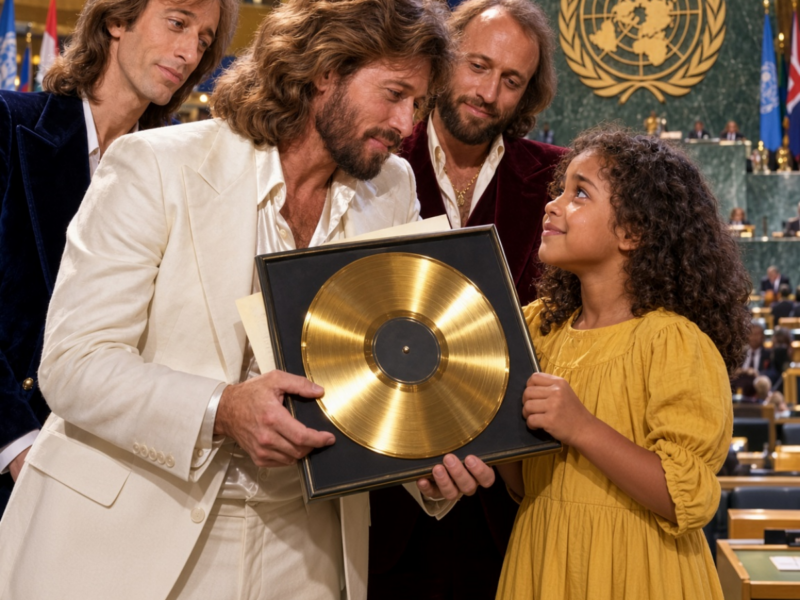
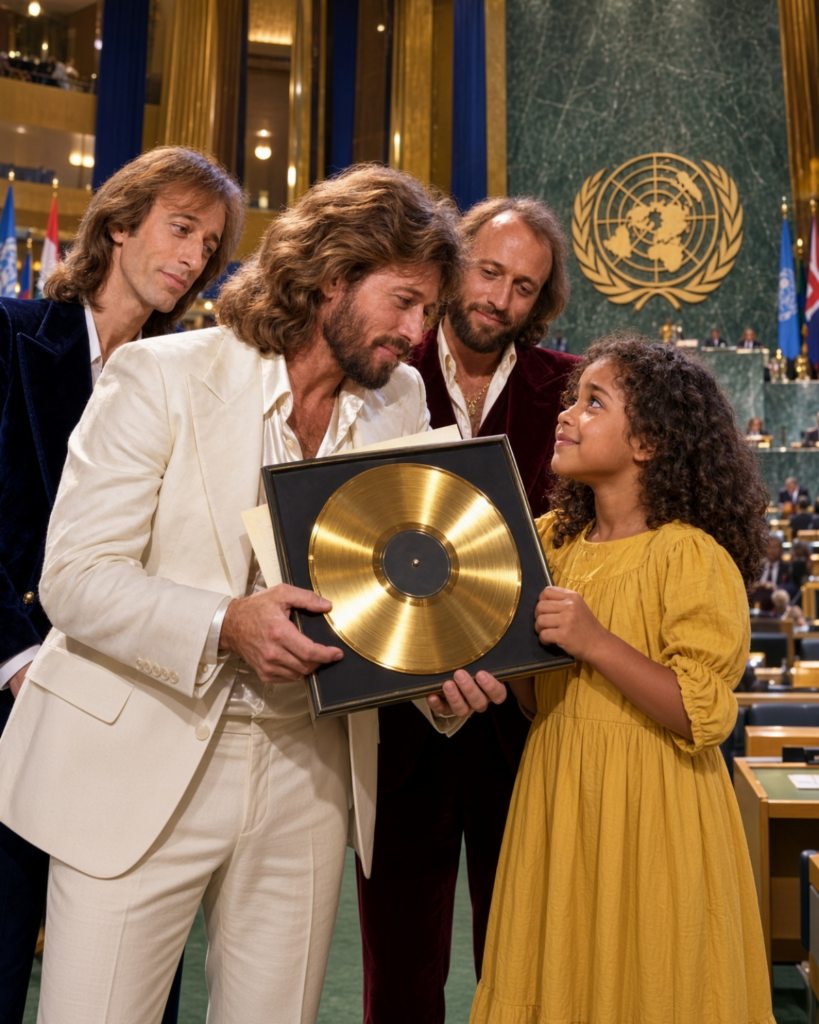
In the summer of 1978, at a press conference held at United Nations headquarters in New York City, Barry, Robin, and Maurice Gibb announced that the royalties from their next single would be donated in full to UNICEF.
Not a percentage.
Not a portion of net profits.
Not a one-time check.
All publishing royalties from the song that would become “Too Much Heaven,” which was at the precise moment they made this announcement not yet released, not yet known to anyone outside the studio where it had been written on a Miami afternoon.
They would keep nothing.
Barry Gibb explained it simply.
He said, “We’ve made a lot of money in the past two years, and now we’d like to give some of it back.”
Robin added that they knew there were enormous problems.
Starvation.
Medicine.
Education.
Problems that the children of the world were facing without anyone powerful enough to help them.
These were not elaborately prepared statements designed for maximum media impact.
They were three brothers from a working-class family in Manchester who had grown up without money and had then accumulated more of it than they could have imagined as children.
And they had looked at what the world was asking of them and decided that some of what they had was needed somewhere else more urgently than it was needed in Miami.
The concert they built around this pledge became something larger than any of them had anticipated.
They called it the Music for UNICEF Concert: A Gift of Song, and they organized it themselves, not as performers who had been invited to participate, but as architects of the entire event, working alongside their manager, Robert Stigwood, and the British broadcaster, David Frost.
The venue they secured was the United Nations General Assembly Hall in New York City.
Not a concert arena.
Not a television studio.
The actual floor of the United Nations, the room where the representatives of every nation on earth sat to make decisions about war and peace and the shape of the world.
On the night of January 9th, 1979, that floor was cleared of its diplomatic furniture and filled instead with musicians and their instruments.
The United Nations had agreed to host a concert because a group of musicians had asked the right question at the right moment.
And the right moment was the launch of the International Year of the Child, the year the entire global community had pledged to turn its attention to the welfare of children everywhere.
“Too Much Heaven” had been released on October 24th, 1978.
By the first week of January 1979, it had reached number one on the Billboard Hot 100.
The week of the concert, January 9th, 1979, the song was at its commercial peak, the most purchased and most played piece of popular music in the United States.
The Bee Gees were donating the royalties from the biggest song in the world at the exact moment it was the biggest song in the world.
This was not a gesture made from a comfortable distance, from a song that had already run its commercial course and whose earnings had diminished to a trickle.
It was made at the apex.
They were standing at the top and pointing at someone else.
The performers who gathered on the floor of the United Nations that night understood what the evening represented.
Rod Stewart was there.
Donna Summer.
Earth, Wind & Fire.
John Denver.
Olivia Newton-John.
And ABBA, who arrived with a song that no one outside their own studio had ever heard.
The Swedish group had decided to match the Bee Gees’ gesture with one of their own.
They would premiere their new song, a song called “Chiquitita,” on the floor of the United Nations General Assembly as a gift to the children of the world.
The world debut of one of the most beloved songs in the history of Swedish pop music was not on a television program or at a press event or at a fan concert.
It was here, on this stage, given to this purpose.
When ABBA finished performing “Chiquitita” for the first time in front of any audience anywhere, they announced that they too were donating all its royalties to UNICEF.
Something was happening in that room that had not happened before.
The most commercially powerful musicians on the planet deciding, one after another, that what they had built was for more than themselves.
Andy Gibb was also on that stage.
He was 20 years old, the youngest of the Gibb brothers, building a solo career in the shadow and support of his famous siblings.
He performed his own material and then stood with Olivia Newton-John for a duet.
And at the end of the evening, all four Gibb brothers, Barry, Robin, Maurice, and Andy, joined the full ensemble for the finale.
The four of them together in a room devoted to the future of children.
Nine years later, Andy Gibb would be dead at 30 from a heart condition weakened by years of struggle.
And the three brothers who survived him would spend the rest of their lives carrying the weight of that loss.
But on the night of January 9th, 1979, all four of them were alive and standing in the same room.
And the room was the United Nations.
And what they were doing with their voices was trying to help someone.
The concert was broadcast on NBC the following evening.
Millions of Americans watched it in prime time.
Millions more watched internationally through satellite relay to broadcast partners across Europe, South America, and Asia.
David Frost introduced the performers and read the pledges aloud.
The songs being given.
The royalties being surrendered.
The children who would be the ultimate recipients of what the most successful musicians in the world had decided to do with their success.
Every performer signed a large ceremonial parchment declaring their commitment.
It was theatrical, because large public acts of commitment require theater.
But the commitment beneath the theater was not theatrical at all.
The money was real.
The surrender of it was real.
The children it would reach were real, in places and circumstances the people in that room could not always picture but had decided to act on anyway.
The camera found Barry Gibb’s face at one point during the broadcast, and what it caught was not triumph.
It was something quieter.
The expression of someone who has made a decision they know they will never need to reconsider.
The immediate revenue from the concert itself, ticket sales, broadcast fees, was significant but not extraordinary.
That number was not the number that mattered.
What mattered was the publishing rights.
What mattered was the decision to give not a song’s proceeds but a song’s ongoing earning capacity.
The legal mechanism that would generate income every time the song moved through the world in any form.
Every time someone bought “Too Much Heaven,” or a radio station played it, or a film licensed it, or an artist in any country decided to record a cover version, or a streaming service delivered it to a subscriber’s phone in a country that did not yet exist in 1979.
The royalties went not to the Gibb estate, but to UNICEF.
This was not a donation that ended when the check cleared.
It was a donation that began and kept going, year after year, decade after decade, as the song continued moving through the culture.
And each movement generated money for children in places the Gibb brothers had never been and could not have named.
By 2003, “Too Much Heaven” had generated $7 million for UNICEF.
By 2017, the official Bee Gees account posted the updated total: approximately $11 million.
More recent estimates have placed the figure past $16 million.
It is still climbing.
Every time someone plays the song today, in a supermarket, in a film score, on a playlist assembled on an ordinary Tuesday evening, a small amount of money finds its way toward a child who needs it.
This is what it means to donate not the song but the rights to the song.
You do not make a single gesture.
You make a mechanism.
The mechanism runs without you, beyond you, after you.
President Jimmy Carter invited the brothers to the White House after the concert.
He acknowledged, with the directness that characterized him, that he was not personally a fan of disco music.
His daughter Amy had been his education in that regard.
But that what they had done required acknowledgement from his office.
He thanked them for what they had given, not to the United Nations or to a government program, but to the children themselves, the ones the International Year of the Child was meant to reach.
They gave him one of their black satin tour jackets as a gift, which he accepted with the grace of a man who knew he had just been handed something that meant more than it appeared.
Carter later noted that the concert had demonstrated something he wanted his administration to stand for: that individual generosity at the right scale could reach children in places government programs alone could not.
Barry Gibb has spoken many times over the years about the decision, and what he has consistently returned to is not the scale of the gesture or its legacy, but the simplicity of the reasoning behind it.
At the height of Saturday Night Fever, the success had become abstract.
Numbers so large they corresponded to nothing human, to no need or use that could be held in the mind.
The UNICEF decision was the first moment in that period, he has said, when the success pointed at something specific.
The song had been written in an afternoon at Criteria Studios in Miami.
It had taken less time to write “Too Much Heaven” than it takes to fly from Miami to New York.
And yet the thing it set in motion was still running decades later, still finding its way to children who had not yet been born on the afternoon it was written, still adding to a total that the brothers themselves had long since lost the ability to track.
The Bee Gees were the most powerful commercial force in popular music in January 1979.
They had accumulated everything the industry had to offer.
The records.
The chart positions.
The sales figures.
The cultural dominance that had no modern precedent.
And they had looked at all of it and asked a question that most people in their position never think to ask.
What is this for?
The answer they arrived at, in that summer press conference, at the United Nations, in that concert on the floor of the General Assembly, in that permanent surrender of publishing rights that has been generating money for children for nearly five decades, was not complicated.
It was the same answer three brothers from Manchester had always known from the time they were small enough to share a room and sing together just because they wanted to hear what three voices could do when they trusted one another.
Music is for reaching across the distance.









