The Amish Birth Rule No Bride Hears Until Her First Pregnancy, I Was the One Who Had to Tell Her.
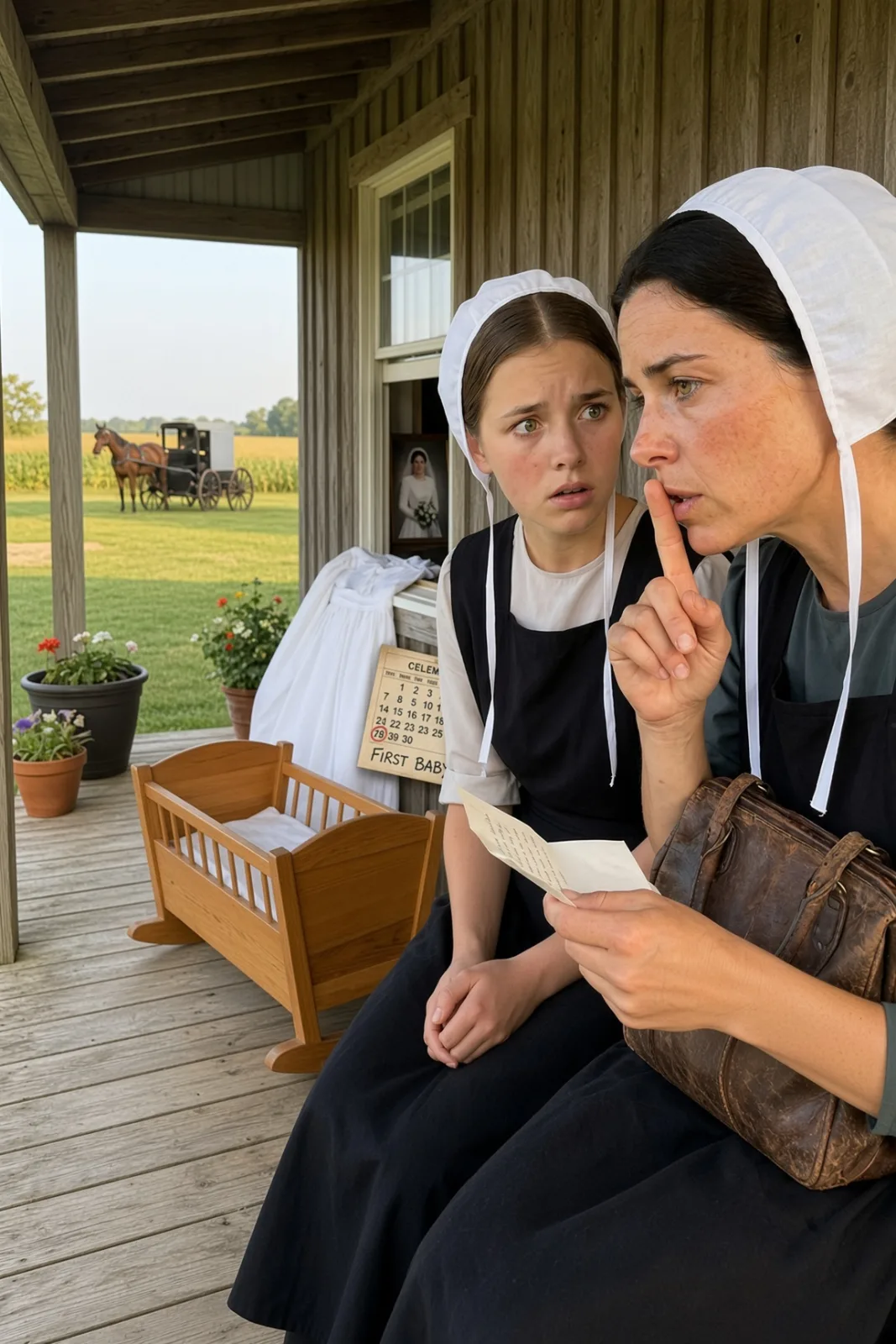
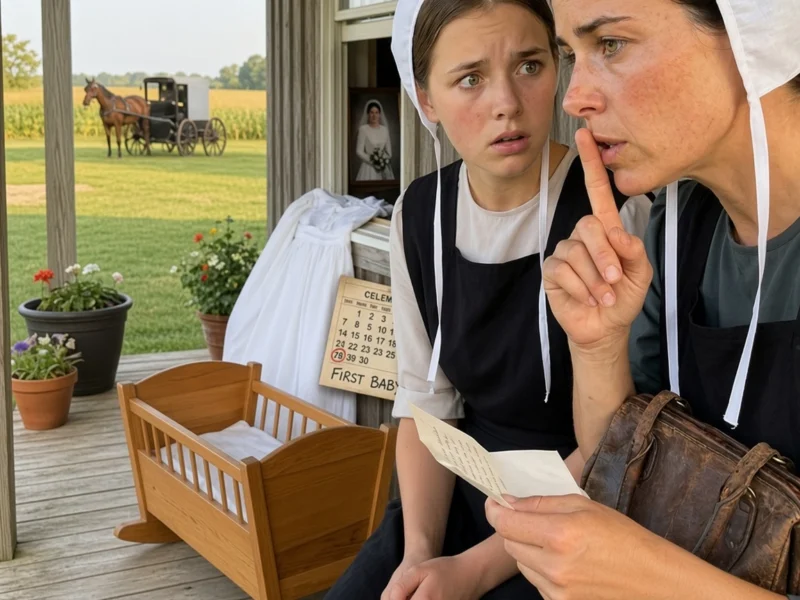
Lena Fischer was rolling out pie dough when I sat down at her kitchen table.
There was flour on her wrist and cinnamon in the air, and the clock on the shelf ticked a little too loudly.
She was 20 years old, six months married, and eleven weeks along.
She was smiling at nothing, in the way a girl smiles when she has a secret that is about to become everyone’s.
I folded my hands around the cup she had set in front of me and looked at the steam.
I had said the words sixty-one times before to sixty-one brides in a low flat voice with the door closed, and every one of them had gone still in the same way a rabbit goes still in a field.
It takes forty-one seconds.
She set down the rolling pin and asked me what I had come to tell her.
I am going to tell you what those forty-one seconds were because Lena asked me to say them again slowly and I did and it is the reason I am telling you any of this.
My name is Rachel and this is Rachel the Amish Midwife.
If this is resonating, take one moment to subscribe and turn on the bell because every one of you tells me this story matters.
For twenty-eight years, I was the district midwife in an Old Order settlement in Pennsylvania, and I caught more than a thousand children.
I left school after the eighth grade and learned the rest at the bedside, from my aunt Saloma, and from the women who trusted me with the worst hours of their lives.
This channel holds the stories from that bedside that the community never let me speak.
The births that went wrong, the faith that was chosen over medicine, and the children I could not save.
Tonight is about a rule that a woman is not told until it is already too late to refuse it.
Now, let me tell you what no one inside that community was ever allowed to say out loud.
The people who kept this rule were not cold.
They kept it because they loved their daughters and did not know another way.
Hold that thought because I will need you to hold it for the next hour.
There is a stone I carried through all of it.
Four children and a pattern I was forbidden to write down.
I still carry it.
And before we are finished tonight, I will tell you the phrase the bishop used at the graveside and why the families needed it to be true.
In this world, a bride is taught three things.
She is taught to keep a house and to keep a garden and to keep quiet.
There is a fourth thing that is never taught and it is not put in the same drawer as the others.
A man learns it on the day he marries from his father in the barn with the door pulled to.
A woman learns it on the day the midwife confirms that she is expecting at the kitchen table with the door closed.
The father’s whole instruction to his son is a single sentence.
“If it goes wrong, the midwife will see to it, and you will not go up.”
The midwife’s instruction to the bride is forty-one seconds.
Saloma taught me the words when I was nineteen in the buggy on the way to a birth, the way you would teach a girl a hymn she would need later.
The rule is this.
A child who is born wrong is not shown to its mother.
The midwife takes the child from the room before the mother turns her head, wrapped in a white cloth, and carries it out.
The men bury it on the third day in the corner of the graveyard where the small stones are.
The mother does not go.
Its name is not said, and it is spoken of afterward as the little one.
And on the following Sunday, the mother sits in her place on the bench, and nobody mentions it.
We were told that the mother must be spared.
I want you to feel how kind that word was in our mouths.
I said it sixty-one times myself.
I said it with my hand on a bride’s hand in a voice I had borrowed from my aunt Saloma, who had borrowed it from someone else.
Spared.
It sounds like a door held open.
It was a door held shut, and nobody asked the woman on the other side whether she wished to be spared.
I want to stop here for a moment because there is a part of this I have never managed to say on camera.
I have tried six times.
I sat down in front of this lens to tell you about the graveside, and six times I stopped when I reached the bishop’s first word.
So I wrote it instead by hand at a kitchen table over three winters in the exact detail I spent twenty-eight years not saying.
Ten chapters.
Ten objects I still see when I close my eyes.
The oilcloth.
The telephone forty rods from a bed.
The envelope that came back sealed.
It is called The Births They Never Recorded and it is at www.racheltheamish.com.
Rachel the Amish dot com, pinned at the top of the comments.
Read the first three chapters and if it has not put you in the room with me, write to me and I will send your money back.
It was not cruelty.
It was mercy as they understood it.
It was the absolute conviction that a woman who had never seen a thing could never grieve it, and that a grief with no face would be a smaller grief.
Not because they did not feel it themselves, not because they did not weep, but because they believed with their whole hearts that they were lifting the weight from her shoulders and carrying it themselves.
The cost was a mother lying awake for the rest of her life doing arithmetic on a child she was not permitted to have looked at.
In February of my twenty-first year as district midwife, Lena Fischer asked me to say it again.
I had said the forty-one seconds.
I had said them the way I always did, with the flat quiet of a woman reading a list.
I had said that a child who came wrong would be taken out before she turned her head, that the men would bury it, that she would not go, that she would be spared.
Then I had stopped talking and waited for the stillness.
It came.
She had gone very still with one flour-dusted hand on the edge of the table.
I watched her breathe.
She said, “Say it again, Rachel.”
Slowly, I said it again.
It took me ninety seconds and I heard every word as she must have heard it, one at a time, like stones set down on a table.
When I finished, she did not cry.
She looked at the window for a long time.
Then she said, “Will you promise me one thing?”
I said, “If I can.”
She said, “If it comes to that, look at me while you do it.”
I said, “I promise.”
It was the smallest promise I had ever been asked for, and I made it quickly because it seemed to cost nothing.
I would learn that it was the most expensive thing I ever said.
Lena’s pregnancy was easy.
I want you to know that she was a strong girl with wide hips and a laugh that made the dog bark.
And for six months, she carried herself through her days like a woman carrying a pail of water so full that she could not afford to look down.
At every visit, she measured the baby against her palm and asked me how it was lying.
In the eighth month, she began to sew small white flannel gowns in pairs.
When I asked why in pairs, she said it was so one would always be clean.
I said nothing.
I sat in her kitchen with my tea and watched her needle go in and out, and I understood that she was making one for the child and one for the rule.
Her husband Daniel was twenty-three, a gentle, broad man who repaired harness for half the district and cleared his throat before every sentence.
His mother, Maddie Fischer, was fifty-eight and lived across the yard in the dawdy house.
I should tell you about Maddie now.
Forty years earlier, she had borne a son who came wrong.
And her midwife, my aunt Saloma, had carried him out before Maddie turned her head.
She was spared.
She had never once in forty years said his name.
Every February on the same Sunday, she set a fresh loaf of bread on the sill of the kitchen window, and did not eat any herself.
The baby came at ten-four in the morning on the twenty-third of February in a room that smelled of lamp oil and clean linen after a labor of only seven hours.
Lena had done it beautifully.
I lifted him out into my hands and saw at once what the rule was for.
I will not tell you what I saw.
He was Lena’s son, and it is hers to describe, and I have never described him to anyone.
I will tell you that he was alive.
He drew a breath, and the breath was ragged, and he turned his head a fraction toward the sound of his mother’s voice.
I wrapped him in the white cloth.
It was the same square of white flannel I had carried in my bag for twenty-one years, folded in four, and I had used it exactly as I was taught to cover a face and carry a child out of a room.
I stood up.
I turned toward the door.
Lena said, “Rachel.”
I stopped.
I had promised to look at her and I did.
She was propped against the pillows with her braid coming loose and her face gray and wet and she was looking straight at me.
She did not look at the cloth.
I said, “Lena, the rule.”
She said, “I did not ask you what the rule was. I asked you to look at me.”
I said, “I am looking.”
She said, “Then look and bring him here. I have thought for nineteen years about what stood in that room. I have thought about Saloma and the small stones in the forty-one seconds. I have thought that I could have said the word spared one more time.”
I did not say it.
I crossed the room and put the white cloth into her arms and I did not say anything at all.
I sat down on the end of the bed and I stayed.
She held him three hours and ten minutes.
I counted them on the kitchen clock through the open door.
And I do not think I have ever been so quiet in my life.
She sang to him.
It was not a hymn.
It was a song about a duck from her own childhood.
And she sang it four times in a voice so low that only the two of them could have heard, and I sat there with my hands in my lap and heard it anyway.
When he was gone, she did not cry out.
She kissed the top of his head and she said in the plain quiet voice with which you say good night, “There you are.”
The men came at eight.
I heard Daniel’s boots on the stairs and then his mother’s step behind him, slow and careful, and they stopped in the doorway together.
Maddie Fischer stood there with her apron balled in one hand and looked at her daughter-in-law holding the child.
Her mouth moved once.
I do not think she knew.
She said, “You let her hold him.”
I said, “Yes.”
Maddie did not speak again for a long moment.
Then she crossed the room and she did not look at me.
She sat on the edge of the bed and put her hand very gently on the small wrapped shape in Lena’s arms.
And she said in a voice I had never heard her use, “What did he look like?”
Lena said he had Daniel’s ears.
Maddie made a sound.
It was not a word.
It was the sound of something being lifted out of a very deep place after forty years, and I will carry that sound until I die.
The bishop came at noon.
I was in the kitchen washing my hands for the third time.
He stood in the doorway with his hat in his hand, a tall stooped man with a beard like a spade, and he did not raise his voice.
He asked me whether the sparing had been carried out.
I said it had not.
He looked at me for what I would guess was a full minute.
He said, “We will speak of this, Rachel.”
Then he went upstairs to sit with the family and I went home.
I did not go to that grave on the third day.
I have gone to many.
That one I could not.
On the fourth morning I went to the Fischer farm to see how Lena was healing.
She sat by the window in a rocking chair with a quilt over her knees, and the light on her face was very pale and clean.
She did not turn her head when I came in.
She said they buried him at dawn.
I said yes.
She said, “I was in bed. I heard the shovels.”
She was quiet for a while.
“I have never heard anything so clearly in my life. And I knew exactly who was in the ground. Rachel, that is the difference. I knew who it was.”
I sat with her until the light moved off her face.
I did not say I was sorry.
I had said it a thousand times to a thousand women, and I understood that day that it had never once been the right thing to say.
For the next seven years, I said the rule at the first visit to every bride.
I did not stop saying it.
I want you to understand that.
I said it in the same low voice and I said the same forty-one seconds and then when I had finished I said one more sentence.
I said it very quietly.
I said, “And if it comes, you may hold it and I will not carry it out until you say.”
I said it to thirty-eight brides.
It took four seconds.
I never told the bishop.
It cost what such things cost.
A minister’s wife began to sit in on my first visits in the corner with her hands in her lap.
Three families sent for the midwife from the next district.
Daniel Fischer stopped meeting my eye.
No one spoke the child’s name in my hearing, which was the district’s way of telling me that it had been the right name.
I was not brave.
I had said the forty-one seconds to sixty-one brides before Lena, and I had said them well.
I want you to know that I was good at it.
I could say them in a voice so plain that a girl of nineteen would nod and thank me.
That is what I carry.
It is not that I broke the rule once.
It is that I kept it sixty-one times and never thought to ask a single one of those women whether she would have chosen it.
If you want to keep hearing what the midwife was never allowed to say out loud, subscribe.
I will not tell you the district was only the rule.
When Lena was expecting again two years later, Maddie Fischer walked across the yard on the morning of the first visit, uninvited, and sat down beside her daughter-in-law at the kitchen table.
The minister’s wife was in the corner.
Maddie took Lena’s hand and held it in plain sight on the tablecloth, and she kept it there for the whole of my visit, and neither of them said a word.
It was the loudest thing I have ever seen an Amish woman do.
I never learned where they put Maddie’s first child.
The men buried him on the third day forty years earlier in the corner where the small stones are, and no one ever showed her which stone.
She asked me once in the dawdy house with her back to me.
I told her that I did not know.
That was true.
It was the only true thing I ever told her about him.
I told you at the start there was a stone I carried.
The phrase the bishop used at the graveside and why the families needed it to be true is chapter three.
The bishop and I have never said it out loud to anyone.
It is at www.racheltheamish.com with the rest.
It was a Thursday evening in the second year after I left.
There was a bereavement group that met in the basement of a hospital in Lancaster in a room with a stack of folding chairs and a coffee urn that gurgled.
The floor was a shade of green I had never seen on a floor, and the lights had the faint tremble of lights that are not quite right.
I had not gone to speak.
I had gone because a nurse on the ward had put her hand on my arm and told me it was where I might sit.
I sat at the back in my plain dress with my hands folded and a woman beside me in a purple fleece passed me a tissue without looking, as though it were the most ordinary thing in the world to hand a stranger.
The woman leading the group had a clipboard she never looked at and a habit of touching her collar when she was thinking.
A man said something about his brother’s funeral and how everyone had told him to be strong and how it had made him want to scream.
She said, “That’s what we call disenfranchised grief. It’s grief the world hasn’t given you permission to have. Nobody is being cruel. There’s just no funeral for it.”
I sat there with a paper cup of coffee going cold in my hands, and I thought of a corner of a graveyard where the small stones are, and a loaf of bread set on a sill on the same Sunday for forty years.
There is a word for what Maddie Fischer carried.
It is not a sin, and it is not a weakness.
It is a grief that a whole community had agreed out of love that she was not to have.
I looked around that basement at a dozen people in a circle of folding chairs, each of them allowed to say the name out loud.
And I thought that I had never in my life seen anything so simple or so radical.
They were simply being permitted to sit in the room with what they had lost.
That was all.
It had been available all along.
It had only ever been withheld.
I have never said aloud that I said spared sixty-one times, and that every time I was speaking to myself.
Before that night, the white flannel in my bag had been a covering for what I carried out of rooms.
After it, I understood that I had spent twenty-one years handing a mother a closed door and calling it a blanket.
I had folded it in four a hundred times a year for twenty-one years, and I had never once unfolded it to see what it was.
It was a plain square, thin from washing, with a faint brown ring near one corner that would not come out.
I still have that cloth.
Last spring, I took it out of my drawer and I carried it to a hospital where a woman I did not know had lost a daughter at twenty-four weeks.
I wrapped the child in it and I put her in the mother’s arms and I did not carry anything out of that room.
If you grow up in a place where someone decided what you were permitted to see, I want you to hear me now.
I see you who folded a small gown and put it away in a drawer you were never to open.
I see you who was handed a casserole and told to be strong and who went home and stood in the kitchen with your hand on the counter until the feeling passed.
I see you who counted the days after in silence because nobody would say the number with you.
Your grief was never too much.
It was only unwitnessed.
And if you were the one who carried the cloth, if you were the midwife or the nurse or the sister who took the child from the room and shut the door behind you, I see you too.
I know how steady your hands were.
I know you told yourself that you were the one person who could bear it.
You were doing what you had been given to do by people you loved in a world that had not shown you another way.
It may be that you are allowed to put it down now.
It may be that someone still living would like to hear what you saw.
If there is a place where a small stone lies and no one has ever told you which one, you are allowed to ask.
You are allowed to keep asking.
Maddie Fischer waited forty years and she was still allowed.
I do not hate the place that made me.
It gave me forty women who came to the door with covered dishes and sat in silence for hours because they knew that silence was the only thing they had to give.
It gave me Maddie Fischer’s hand on a tablecloth.
It gave me the plain unadorned decency of people who did not know how to stand in front of a hole in the world and decided to stand there anyway.
They were not wrong to love their daughters.
They were only wrong about what love was permitted to look at.
I have stood on both sides of that door, and I know how heavy it is from either.
I carry all of that.
I carry the flannel, too, and the sound a woman makes when forty years come up out of her all at once.









