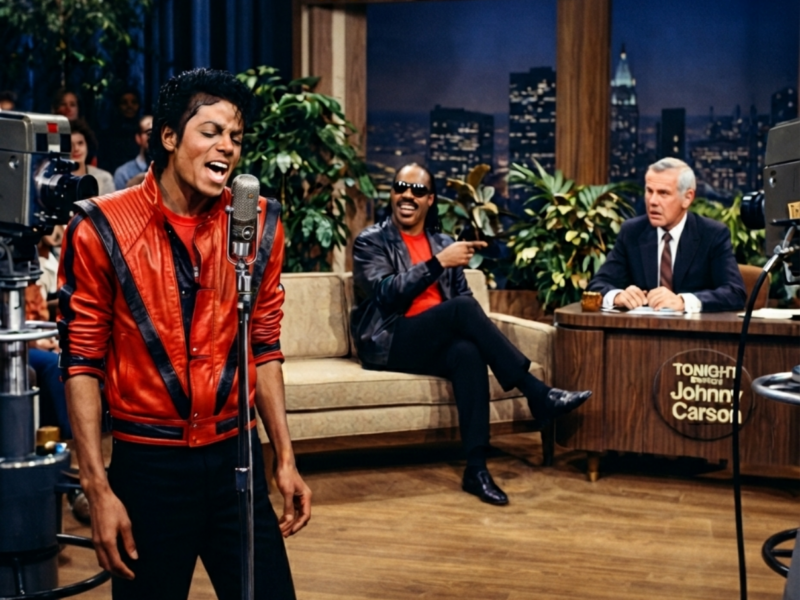
Stevie Wonder Laughed at Michael’s Voice on The Tonight Show — MJ Made Him Regret It in 60 Seconds.
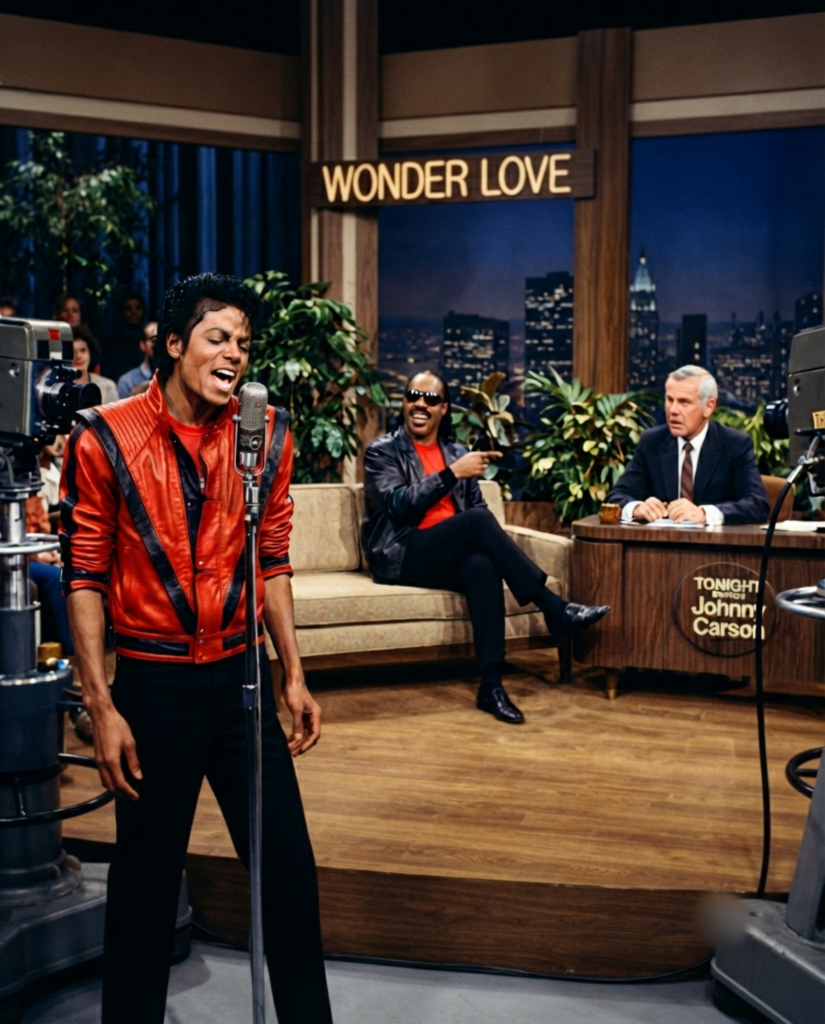
February 9th, 1983. *The Tonight Show*, Studio 6B, NBC Burbank. A cold Los Angeles evening by the standards anybody in Southern California ever bothered to complain about.
Stevie Wonder was mid-story, the whole audience leaning in and laughing along, when he did an impression that would end up being replayed on television clip shows for the next thirty years.
It wasn’t cruel. Not at first.
It was the kind of loose, easy joke a man makes when he’s comfortable in a room and forgets, just for a second, that the room is bigger than the people sitting in front of him.
He was doing a bit about how strange it was getting older in this business—watching a whole new generation of singers come up doing things he barely recognized as singing at all.
And then, without much warning, he slid into an impression.
A high, breathy, hiccuping little falsetto. Half singing, half yelping.
The kind of sound the whole country had spent the last three months hearing on every radio station in America.
The crowd got it instantly. They roared.
“That’s what the kids are calling singing these days,” Stevie said, grinning, rocking back in his chair. “Man’s out here going *hee-hee* and *ow*, and the whole world’s buying records by the millions. I remember when a man had to actually hold a note to get paid for it.”
Johnny Carson laughed along. Easy, the way he laughed at most things on his own show. The band chuckled.
Stevie kept going a minute longer, warming to the bit now that it had landed. Talking about how, in his day, a singer had to actually learn an instrument, had to actually write out a proper melody.
That a person could hum in the shower—not just lean on a drum machine and a dance floor full of smoke and lights to do the heavy lifting for you.
The audience ate it up. The particular delighted laughter of a room that trusts the man on stage completely—and has no idea yet that anything about tonight might turn out differently than every other night this show had ever taped.
Out past the lights, three hundred people in the studio audience were still clapping when the stage manager, headset pressed tight to one ear, leaned in close to Johnny’s desk between segments and told him, quiet and urgent, that the next guest had just arrived backstage.
And he’d heard every word of it over the monitor in his dressing room.
If you already love these two legends, go ahead and hit that subscribe button now, because this story is one you’re not going to forget.
Michael Jackson had gotten to Burbank a little after seven that evening. Quiet. Almost shy. Walking through the halls the way he always was off camera—a soft voice and a polite nod for every crew member he passed.
*Thriller* had been out three months by then, already the biggest-selling record in the history of the business. “Billie Jean” climbing every chart there was.
And yet the man himself moved through that building like somebody trying not to take up too much space in a room.
He’d worn a simple red jacket, sunglasses pushed up on his head rather than covering his eyes, and he’d settled into his dressing room to wait his turn—the same quiet way he waited for most things in life. Patient. Private. A little apart from everybody else.
A young wardrobe assistant, barely older than Michael himself, had asked nervously if he needed anything before the taping. And Michael had thanked her twice by name, having caught it off her name tag the moment he walked in—a small habit his mother had drilled into him as a boy that had never once worn off, no matter how famous he’d become.
He asked after her evening. Whether the drive in, from wherever she lived, had been bad.
Small, ordinary questions that seemed to catch her off guard, coming from a man whose face was at that exact moment plastered across more magazine covers than anybody else alive.
A production assistant had the monitor running low in the corner of his dressing room, the way they always did so guests could follow the show while they waited. And Michael had been half listening, flipping through a stack of that week’s trade magazines, when Stevie’s bit came through the little speaker.
He went still.
He set the magazine down slow. And for a long moment, he just sat there staring at nothing in particular—something complicated moving behind his quiet, careful face.
Because Stevie Wonder wasn’t just another singer to Michael. He was one of the reasons Michael had ever wanted to be a singer at all.
He’d grown up at Motown, practically in Stevie’s shadow—a small boy watching a slightly older, already legendary blind musician move through the halls of Hitsville with a confidence and a musical command that Michael, even at nine and ten years old, had recognized as something rare.
Stevie was only a handful of years older than Michael himself. But by the time the Jackson brothers arrived at Motown, Stevie had already been a working professional for the better part of a decade. Already a hitmaker. Already somebody the grown engineers and producers treated with a seriousness they rarely extended to anybody else that young.
Michael used to watch him work a session from the doorway, fascinated by the way Stevie could hear a whole arrangement in his head before a single other musician in the room had caught up to where he was going.
Stevie used to let him sit in the control room sometimes while he worked. Let him touch the keys of whatever instrument he was playing that day, patiently naming each note out loud so the smaller boy could follow along.
And once—when Michael was maybe eleven, exhausted after a grueling day of rehearsals his father had run him through without much mercy, voice raw from being made to sing the same eight bars over and over until Joseph Jackson was satisfied—Stevie had found him sitting alone in a hallway, knees pulled up to his chest, and sat down right there on the cold floor beside him.
No fuss. No big speech. Just company until Michael felt steady enough to stand back up.
Stevie hadn’t asked what was wrong. He’d simply hummed something low and easy under his breath, until the younger boy’s breathing slowed to match it.
Michael had never forgotten it. He’d carried that memory into every room he ever walked into since—a quiet debt he figured he’d never fully be able to repay.
Hearing that same man doing an impression of his voice for a laughing studio audience landed somewhere Michael hadn’t expected it to land.
Quick word before we keep going: if this one’s already got you hooked, drop a like. It genuinely helps this channel more than you’d think.
He didn’t say anything to the production assistant. He just sat there a while longer, working something out behind his still, careful expression.
And when the stage manager finally came to walk him toward the wings, Michael rose without a word and followed—his jaw set in a way none of the crew had seen from him all evening.
Out on the set, Stevie was still riding the wave of his own joke. Johnny leaning into the next bit of banter when the stage manager’s voice crackled low into Johnny’s earpiece, warning him the next guest had heard the whole thing and wasn’t walking out smiling.
Johnny, thirty years into hosting this show, knew exactly what that particular warning meant. Something was about to happen that wasn’t on any of his cards.
“Well,” Johnny said, glancing toward the wings. “I understand our next guest has arrived a little early. Ladies and gentlemen—Michael Jackson.”
The roar that came up out of that audience when Michael stepped into the light was a different animal entirely from the warm chuckling Stevie had been getting all night. Sharper. Younger. Three hundred people who could hardly credit that the single biggest star on the planet that winter had just walked onto their television screen in person.
Michael crossed the stage in that particular careful, graceful way he moved. Gave the crowd a small nod. Shook Johnny’s hand. And turned toward the couch where Stevie sat.
He didn’t sit down right away.
“Evening, Stevie,” Michael said—his voice soft, even, though something steady sat underneath it that hadn’t been there in any interview footage of him the crew had ever seen.
Stevie, still grinning from his own joke, turned his face toward the sound of Michael’s voice—the easy warmth of a man who genuinely liked the person he was about to greet.
“Michael, come on over here, man. Good to hear you.”
“I heard you, too,” Michael said.
Backstage, on the monitor, something in his tone made Stevie’s grin falter just slightly—though he couldn’t have said exactly why yet.
If you’re loving this so far, don’t forget to hit that like and subscribe, because it’s about to get a whole lot more interesting.
“Heard what?” Stevie asked—though the careful stillness in his own posture suggested he already had a fair guess.
“The impression,” Michael said. Not accusing. Not raising his voice. Just stating it plain, the way you’d state a fact. “Nobody in the room could argue with *hee-hee* and the whole audience laughing about it.”
The room went quiet in that particular way a studio audience goes quiet when they realize the thing they were laughing at ten seconds earlier might not have been quite as harmless as it seemed.
Sammy Davis Jr., sitting further down the couch that night as a returning guest for the show’s second half, shifted uncomfortably in his seat—sensing the same thing the rest of the room was only just beginning to sense.
That whatever had just walked out onto that stage wasn’t playing along with the evening’s rhythm anymore.
Stevie sat with that a moment. And something honest crossed his face—an old performer’s instinct working overtime to decide whether to laugh it off or actually reckon with it.
“Ah, come on now, Michael. You know I love you, man. Wasn’t nothing but a bit.”
“Maybe,” Michael said. “But it’s the bit everybody’s going to remember tomorrow. Not the story you told before it. Just the part where you made fun of how I sing.”
Keep watching, because what happens over these next few minutes is the whole reason this broadcast is still talked about decades later.
Johnny Carson, watching this unfold in real time with no cards to guide him, made a fast decision to let it breathe—rather than smooth it over the way thirty years of instinct told him a lesser host might have.
“Stevie,” Johnny said carefully. “Did you mean anything by it?”
Stevie considered the question honestly—which was more than most guests bothered to do on live television.
“Didn’t mean to hurt the boy,” he said. “Meant it the way I’ve meant plenty of jokes over the years about all sorts of singers coming up different than I did. Didn’t think it’d land the way it’s apparently landing right now.”
“It landed,” Michael said quietly.
Stevie turned his face toward that voice again, something working behind his own dark glasses.
“Then I’m sorry for that part of it. Truly.” He paused. “But I’ll tell you plain, since we’re already standing here plain. I do think something’s shifted in this business. All the theatrics. All the production. All the polish. Sometimes I wonder if anybody’s actually singing anymore—or if it’s all just a very expensive show built around somebody making a few high sounds people can dance to.”
The audience murmured, a few gasps threaded through the sound.
If this exchange is pulling you in, this is a perfect moment to hit subscribe before we keep going.
“You think that’s what I do?” Michael said. Not a question. A statement delivered with the same soft steadiness as everything else he’d said so far—though something underneath it had gone taut as a wire.
“I think that’s what a lot of what’s on the radio these days is,” Stevie said. “Didn’t mean to single you out entirely. But since you’re standing right here, I suppose I am.”
He paused. Something more honest working its way up underneath the defensiveness.
“I’ve had folks describe your videos to me. The zombies. The dancing. The whole production of it sounds like quite a show. But a show is not the same thing as a song. And I guess somewhere along the way, I decided the two of you had gotten tangled up together so tight that nobody could tell anymore where the singing ended and the spectacle began.”
“Maybe they have gotten tangled,” Michael said. “I won’t pretend they haven’t. But that doesn’t mean there’s nothing real sitting underneath all of it. Just means you have to look a little harder to find where the show stops and the truth starts.”
He paused.
“You know, I grew up wanting to be exactly like you.”
That landed differently than anything else that had been said so far.
Stevie’s whole posture shifted—surprise plain across his face.
“I used to sit in the hallway at Motown and watch you work,” Michael went on, his voice still soft but carrying now, filling the whole studio. “I was nine, ten years old. Exhausted most days from rehearsals my daddy ran us through. And you’d let me sit there and just be quiet for a while. One time you found me crying in that hallway. And you didn’t ask me why, or tell me to stop. You just sat down right there on the floor next to me till I felt steady enough to stand back up. Never forgot that. Been carrying it around near twenty years now.”
The studio had gone completely silent. Three hundred people leaning forward without meaning to.
“I didn’t know that landed with you that heavy,” Stevie said—his voice rougher now.
“It did,” Michael said. “Which is maybe why hearing you do an impression of my voice for a laughing room tonight cut a little deeper than it might have coming from somebody else.”
If this story is teaching you something already, that’s your cue to hit that like button.
Stevie sat with that a long moment, something visibly working behind his composed face.
“I hear you,” he said finally. “And I’m sorry. Genuinely. But I’ll tell you something else, since we’re being honest up here in front of God and everybody. I’ve never actually heard your whole album straight through. Not properly. I’ve heard pieces of it on the radio. Heard people describe the dancing, the video, all the spectacle everybody’s talking about. Man, in my position, I don’t get the visual part of what you do. I only get what reaches my ears. And what’s reached my ears is mostly other folks talking about you. Not you yourself.”
Michael’s expression shifted—something in it softening at that admission.
“So maybe what I laughed at tonight wasn’t really you,” Stevie went on. “Maybe it was my own idea of you, built out of what everybody else keeps telling me about you. And I never once bothered checking whether that idea held up against the actual thing.”
Stay with me, because what happens next is the reason this broadcast gets remembered decades later.
Johnny glanced between the two of them. The studio audience frozen in that particular electric silence that happens when everybody senses a live broadcast has slipped its leash and nobody quite knows yet where it’s headed.
Somewhere off in the control booth, a producer’s voice crackled low into an earpiece somewhere near the stage, asking whether they ought to cut to a break.
Nobody moved to signal yes.
“Then let me give you the actual thing,” Michael said.
Johnny sat forward—sensing the shape of where this was headed, and deciding, same as he’d decided with braver guests before, to let it run.
“What do you mean?” Stevie asked.
“Sixty seconds,” Michael said. “You sing something. I sing something. No band behind either one of us. Nothing dressed up, nothing produced. Just voices. Let’s see what actually holds up once you strip all the rest of it away.”
A ripple of astonished murmuring rolled through the crowd. Johnny glanced toward the control booth, got no signal telling him to cut away, and leaned into the moment instead.
“You’re both willing to do that right here, right now?” Johnny asked.
“I am, if he is,” Michael said.
Stevie was quiet a beat. And then a slow, real smile spread across his face—the smile of a man who respected a fair challenge when one was finally put to him plain.
“All right,” he said. “Let’s see what you’ve got, young man.”
The house band leader caught Johnny’s eye, and Johnny waved him off. No band. Exactly as Michael had asked.
If you think you already know where this story is headed, trust me—you don’t.
Stevie went first.
He rose from the couch, found his way to the standing microphone with the easy confidence of a man who’d walked a thousand stages by feel rather than sight, and without any introduction at all began to sing an old Motown standard—one of the deep soul numbers he’d cut his teeth on as a boy wonder decades earlier.
His voice filled that studio the way it had filled arenas for twenty years. Rich. Controlled. Every note landing exactly where three decades of mastery told it to land.
The band, silent as instructed, simply watched—a few of them mouthing the words along under their breath out of pure reverence.
When he finished, the applause was thunderous. Real appreciation rolling through that room for a voice that had earned every ounce of it.
Stevie found his way back toward the couch, grinning. “That’s how it’s done, young man. Clean. Honest. The kind of singing that don’t need a single light show behind it to matter.”
Michael nodded slowly, genuine respect plain on his face. “That was beautiful, Stevie. I mean that.”
“Thank you.”
“Technically flawless,” Michael went on. “Every note exactly where it belongs. The same as it’s belonged there every single time you’ve sung that song the last twenty years—and every time somebody else has covered it since.”
A murmur ran through the crowd again, uncertain whether that had been a compliment or something sharper underneath it.
Stevie’s easy grin faded a shade. “There’s a reason a song like that’s lasted this long. Because it’s good. Because it works.”
“Because it’s safe,” Michael said. Gentle, but unflinching. “A song everybody already knows how to love before you even open your mouth. I’m not saying that to take anything away from you. I’m saying it because you just told the whole country you weren’t sure I was really singing. I want to show you what singing costs when there’s nothing familiar standing between you and the truth of it.”
If this part’s got you feeling something, go ahead and hit that like button before we finish the story.
Michael rose, crossed to the microphone Stevie had just left, and stood there a moment with his eyes closed. The whole studio holding its breath around him.
He didn’t sing anything from his own catalog. He didn’t reach for “Billie Jean” or any of the polished, produced hits currently owning every radio station in the country.
Instead, he began—quiet, a cappella—with an old gospel hymn. The kind his own mother used to sing around the house when he was a small boy in Gary, Indiana, long before any stage or any spotlight had ever found him.
His voice rose thin and high at first. That same falsetto Stevie had mocked not fifteen minutes earlier. Except now, stripped bare of any production, any dance, any spectacle at all, it didn’t sound like a gimmick.
It sounded like an instrument that had been trained since childhood in the hardest possible school. Hours upon hours of rehearsal under a demanding father’s eye. Years of singing lead in front of grown men three times his age before he’d even finished elementary school.
A voice that had learned early how to carry real weight, because it had never once been given the luxury of staying small.
By the second line, his voice cracked once—a small, honest fracture that he didn’t try to hide or smooth over. He let it stand there, raw, in the open air of that studio.
The same way Stevie’s own imperfections—the ones nobody ever dared mock—had always stood raw and honest in his own recordings.
Up in the lighting booth, a technician who’d worked this show for six years found himself setting down the console entirely, transfixed.
In the third row, a middle-aged man who’d come that night mostly because his daughter had begged him to get tickets found his own eyes going unexpectedly wet—surprised at himself for it.
Sammy Davis Jr., still seated on the couch, had gone completely motionless—his whole body angled toward the sound, the way a man leans toward a fire on a cold night.
Nobody in that room made a sound.
If this story is giving you chills, that’s your cue to hit that like button.
Michael’s voice climbed into the chorus, the falsetto stretching high and pure, carrying something that had nothing at all to do with theatrics and everything to do with a boy who’d spent his entire childhood learning to turn exhaustion and loneliness into something beautiful—because that was the only outlet anybody had ever given him.
He sang about staying. About holding on through a hard season. About a faith bigger than whatever circumstances tried to crush it.
And every syllable landed with a weight that filled the studio far past where any spotlight or any choreography ever could have carried it.
Stevie sat completely still on the couch, his head tilted the way it always tilted when he was listening past the surface of a sound, toward whatever lived underneath it. Something was shifting, plainly, across his face. The easy confidence of ten minutes earlier draining away—replaced by something closer to reverence.
Michael reached the final line and let his voice fall away soft. No big theatrical ending. No showmanship at all. Just a quiet fade into silence. The same way a candle burns down rather than blowing out.
The studio held that silence a long moment.
Then the applause broke.
Not polite. Not the enthusiastic response Stevie had earned minutes earlier. But something rarer. Three hundred people who just heard something they hadn’t expected and weren’t entirely sure yet how to name.
Stevie rose from the couch slow. And for a long moment, he simply stood there saying nothing—his face turned toward where Michael’s voice had just come from.
Then he started clapping, too. Quiet at first. Then harder. Genuine. Unmistakable.
“Okay,” Stevie said, his voice thick. “Okay.”
The audience watched, waiting.
“I was wrong,” Stevie said, turning to face Michael directly—or as directly as he could manage without sight to guide him. “Whatever I thought that voice was. Whatever picture I’d built up in my head from other people’s descriptions—it wasn’t that. That was real. That was about as real as anything I’ve heard in a long, long while.”
Michael’s composure finally cracked just slightly, his eyes shining under the studio lights. “Thank you,” he said, barely above a whisper.
If you’re feeling this one right along with us, go ahead and hit that like button before we go on.
“You want to know something?” Stevie said. “I can’t see your dance moves. Can’t see the videos everybody’s talking about. Can’t see whatever spectacle the rest of the world’s so caught up in when your name comes up. All I’ve ever had access to—if I’d bothered accessing it properly—was exactly what you just gave this room. Your actual voice. And I let everybody else’s descriptions of the show around it convince me I already knew what that voice sounded like before I ever really listened to it myself.”
“That’s not something you owe me an apology for,” Michael said gently. “Not being able to see isn’t a failure. Not listening close enough, though—that’s a different thing.”
“You’re right,” Stevie said. “And I am sorry for that part. Genuinely. A man in my position ought to know better than anybody how much can get lost when people only describe a thing to you instead of letting you experience it plain.”
Sammy Davis Jr., sitting a few seats down on the couch that night, leaned forward into the moment.
“What we just watched,” Sammy said, “is two different kinds of truth, shaking hands. And that’s a beautiful thing to witness.”
This next part is the reason people who were in that studio still bring the story up whenever either man’s name comes up in conversation.
Johnny called for a commercial break but kept the cameras rolling backstage the way he sometimes did when he sensed a moment worth capturing hadn’t finished unfolding yet.
Stevie and Michael sat together in the green room, Sammy settling into a chair across from them, Johnny coming in a few minutes later once he’d given his crew instructions for the second half of the show.
“That was extraordinary television,” Johnny said, shaking his head.
“That was humbling,” Stevie admitted, loosening his collar. “Haven’t felt that in a long while. Somebody making me question what I thought I already had figured out.”
“Why’d you laugh in the first place?” Michael asked. No accusation in it—just honest curiosity.
Stevie sighed. Long and slow.
“Because I’ve been feeling my own age lately, if I’m honest. Whole industry moving fast around me. New sounds, new machines, new ways of making a record that didn’t exist when I was coming up. Easier to laugh at something you don’t understand than to sit with the discomfort of maybe not understanding it.”
“What scared you, exactly?” Michael pressed, gentle.
“That maybe what I built doesn’t matter the same way to people your age anymore,” Stevie said. “That the world’s moving on and I’m still back there making the kind of records I’ve always made, and one day soon nobody young is going to care.”
“It still matters,” Michael said. “Just maybe to a different generation, learning it a different way. I learned everything I know sitting in a hallway at Motown watching you work. You think that stopped mattering just because I went on to make different kinds of records myself?”
If this story left an impact on you, that’s a good sign to hit that like button.
“Is there room for both?” Stevie asked. “The old way and whatever it is you’re doing now?”
“Has to be,” Michael said. “Otherwise we’re just taking turns making each other feel small, and neither one of us actually gets anywhere worth going.”
“You know,” Stevie said, “my own daddy used to tell me something close to what you just described about your father. Different circumstances, but the same shape of a thing. A man pushing his children hard because he didn’t know any gentler way to make sure they’d survive a business that chews up talent and spits out whatever’s left. I never had the childhood I might have had otherwise either, if I’m honest. Different reasons than yours. But the studio was my whole world by the time I was your age when you were coming up through Motown.”
Michael nodded slow. “I think that’s part of why what you said tonight stung the way it did. Because some part of me always figured you, of anybody, might understand what it cost.”
“I do understand it,” Stevie said. “Which makes the laughing worse looking back, not better. I ought to have known better than almost anybody in this business.”
Sammy spoke up again. “We’re all just trying to say something true in whatever language we’ve been given to say it in. Stevie’s got his language. Michael’s got his. Neither one’s the wrong one.”
“And I mocked his language tonight,” Stevie said. “Because I was too stubborn or too scared to actually learn it.”
“You learned it in about sixty seconds,” Michael said, a small smile finally breaking through.
When they returned from commercial, the whole energy in that studio had shifted completely.
Stevie and Michael sat close together on the couch now, Sammy beside them, Johnny behind his desk—looking, for once in his long career, genuinely moved by something that had happened on his own stage.
“For everybody watching at home,” Johnny said, “what you just saw was completely unscripted. Nobody planned that. Nobody could have.”
“I learned something tonight,” Stevie said. “I learned that being unfamiliar with something isn’t the same as it being lesser. Just means I hadn’t done the work yet to understand it.”
“And I learned,” Michael added, “that just because a voice sounds different from mine doesn’t mean it isn’t saying something just as true. Different doesn’t mean opposite. Sometimes it just means a different room in the exact same house.”
If you’re loving this story, make sure that subscribe button’s already lit up before we get to the end.
“Can I ask you both something?” Johnny said. “Would you sing something together right now?”
The audience surged up out of their seats at the suggestion, applauding before either man had even answered.
“What would we even do?” Stevie asked, laughing.
“Something that belongs to both of us,” Michael said. “You know any of the old songs? The ones from back when we were both still kids running around Hitsville.”
Stevie’s face broke into a wide, real grin. “Boy, I was singing those songs before you were even born. Near enough.”
“Then pick one,” Michael said. “I’ll follow you.”
What happened next became one of the most replayed clips in the history of the network.
Stevie Wonder and Michael Jackson trading verses on an old Motown song neither one of them had performed together before. Stevie finding the changes by feel within a few bars, calling out the key under his breath so Michael could fall in beside him.
Stevie’s rich, seasoned voice weaving under Michael’s high, aching harmony—creating something neither man could have built entirely on his own. Each one stepping back at exactly the right moment to let the other’s voice fill the space.
The way two people who trust each other completely learn to move in a room without ever once colliding.
Sammy, watching from the couch, started keeping time with one hand against his own knee—unable to help himself.
Johnny, behind his desk, had genuinely forgotten he was supposed to be running a television program at all.
The studio audience rose to its feet somewhere around the second verse—standing because they understood, without needing to be told, that they were watching something that would never happen in quite the same way again.
The episode aired that night. And by the following morning, every entertainment column in the country was running some version of the same story.
“Stevie Wonder humbled by Michael Jackson,” one headline read. “The King of Pop and the King of Soul find common ground,” said another.
Radio stations played clips of the audio the next day between songs, DJs talking over each other trying to describe what it had felt like watching it live.
A few papers ran the story on their front page entertainment section rather than buried back with the rest of the television listings—an unusual placement for a late-night talk show segment. But the producers at every outlet seemed to sense the same way that studio audience had sensed it in the room: that this one was different.
But the people who’d actually been in that studio knew it was bigger than any headline could manage to capture.
It was about two artists choosing respect over ego. About assumption giving way to real listening. About the courage it takes to admit, on national television in front of millions of strangers, that you got something wrong.
If this story about grief, humility, and two of the greatest voices Black music ever produced moved you even a little, hit that subscribe button before we keep going.
Stevie called Michael two days later, tracking down the number through a mutual friend at the label. A little nervous doing it—which surprised him about himself, given how many years he’d spent perfectly at ease talking to anybody in this business.
“Wanted to thank you,” he said once the small talk had settled.
“For what?” Michael asked.
“For not embarrassing me any worse than you needed to out there. You had every right to make me look foolish in front of the whole country. Instead, you just sang something honest and let me arrive at the truth myself.”
“You did the same,” Michael said. “Could have dug your heels in. Doubled down. Made the whole thing about defending yourself. Instead, you actually listened.”
Over the months that followed, the two of them found themselves crossing paths more often than either one probably expected.
Stevie dropping by a recording session of Michael’s out of simple curiosity, sitting quiet in the control room for two full hours just listening—occasionally leaning forward to suggest a small change to a harmony line that the engineers would later admit made the whole track better.
Michael, in turn, showed up unannounced to one of Stevie’s own late-night studio marathons, just to sit quiet in the corner and absorb whatever he could. The same way he used to as a boy, watching from the doorway at Hitsville.
Except now, nobody had to tell him to go to bed when it got late.
They never became the kind of constant companions the tabloids like to imagine after a moment like that one. Both of their lives too full, too different in shape for that kind of closeness.
Stevie had a sprawling family and a packed touring schedule of his own. Michael, an increasingly guarded, increasingly strange kind of fame that made ordinary friendship harder to maintain with almost anybody as the years went on.
But something had shifted permanently between them that February night. A mutual respect neither one seemed inclined to let fade. The kind of bond that doesn’t need constant contact to stay real. Just the certainty that it would still be there, steady, whenever either man needed it.
Two years later, in January of 1985, both men found themselves standing shoulder-to-shoulder again—this time in a crowded Los Angeles studio full of nearly every major recording artist in the country, working through the night on a song meant to raise money for famine relief overseas.
Michael had written much of it himself. Stevie had helped shape the arrangement, his ear for melody guiding parts of the session long past midnight when younger voices in the room had started flagging—offering suggestions in that same patient teaching voice he used to use back at Hitsville with a small boy sitting on the control room floor beside him.
At one point, deep into that long night, with dozens of the biggest names in music packed into a single room and everybody’s energy starting to fray, a disagreement broke out over how a particular harmony ought to be arranged. Voices rose. Tempers, worn thin by the hour, threatened to boil over.
It was Michael who quietly suggested they let Stevie settle it. And it was Stevie, without hesitation, who found the fix inside of two minutes—humming out three different options until the whole room agreed the third one was the one.
Nobody in that studio that night would have guessed, watching the two of them work in such easy rhythm, that less than two years earlier, one of them had done an unkind impression of the other’s voice in front of a national television audience—and the other had answered it not with anger, but with sixty seconds of the plainest truth either man had ever sung.
If this story is teaching you something real, hit that like button before we keep going.
A reporter asked Stevie about the Carson broadcast years later, once it had already become the kind of clip film students studied and musicians referenced whenever the conversation turned toward what it actually meant to grow as an artist.
“People ask me if I regret laughing that night,” Stevie said. “Of course I regret it. But I’ll tell you something stranger than regret. I’m almost grateful it happened the way it did. Because if I hadn’t laughed, I don’t know that Michael would have ever pushed me to actually listen the way I finally listened that night. Sometimes you need to be wrong loud enough in front of enough people before you’re forced to go and get it right.”
The same reporter asked whether he thought about it differently now than he had in the months right after it happened.
“I do,” Stevie said. “Right after, I mostly just felt embarrassed, if I’m honest. Wanted to make sure everybody knew I’d apologized. Wanted the story to be about the apology. Took me longer than it should have to understand the real gift in that night wasn’t the apology at all. It was getting handed proof, right there in front of me, that I still had room to grow. Thirty years into a career I thought I already had all figured out. That’s a rare thing to get handed at any age. Rarer still to get handed it kindly—the way Michael handed it to me, instead of using it to tear me down.”
Michael, asked about the same night in a separate interview, kept his answer quieter—the way he tended to keep most things.
“I grew up idolizing that man,” he said. “Hearing him laugh at me hurt more than almost anything anybody’s ever said about my voice, before or since. But I think that’s exactly why it turned into something good instead of something bitter. Because I wasn’t trying to beat him. I was just trying to get him to actually hear me. The way he used to let me sit next to him in that hallway all those years back. Once he did, everything else kind of worked itself out.”
He was asked, too, whether he’d planned any of it walking out onto that stage—whether the challenge had been something he’d worked out in his head backstage before it happened.
“Wasn’t planned,” Michael said. “I just remember standing in the wings, listening to that monitor, feeling something crack open in my chest that I hadn’t expected to feel. And knowing I couldn’t walk out there and just smile through it the way I usually smiled through things. I didn’t know exactly what I was going to say until I was already halfway across that stage saying it. Sometimes the truest things come out that way. Not planned. Just finally let loose.”
The interviewer asked one more question before wrapping up—whether Michael still thought about that night often, all these years and all those records and all those sold-out stadiums later.
“More than people would probably guess,” Michael said. “Success has a way of surrounding you with people who tell you exactly what you want to hear every single day. Until you can’t always tell truth from flattery anymore. That night reminds me what it actually feels like when somebody finally hears you plain. No flattery attached. Nothing performed on either side. I’ve chased that feeling in a lot of rooms since. Don’t always find it. But I know exactly what it sounds like when I do—because I heard it that night, coming right back at me from a man I’d idolized since I was nine years old.”
The two men stayed connected in their own quiet way for the rest of both their lives—crossing paths at award shows and benefit concerts and recording sessions over the following decades, always greeting each other with the particular warmth of two people who’d once stood on the exact same small stage and let something true crack open in front of the whole country.
At more than one industry gathering over the years, guests would later recall seeing the two of them off in some quiet corner together, heads bent close, Stevie’s hand resting on Michael’s arm while they talked. The easy comfort of two men who’d long since moved past whatever formality usually governs relationships between famous people—into something that looked, from a distance, a great deal like family.
If this story about family, respect, and finding your voice again moved you even a little, hit that subscribe button before we keep going.
Stevie kept a recording of that Carson broadcast for years afterward. One of the few pieces of television he ever specifically asked to have described to him in full—sitting patient while a friend narrated every visual detail he couldn’t access himself.
The way Michael had crossed the stage. The way the audience had risen to its feet. All of it.
He asked more than once over the years to have that same description read back to him again—always stopping his friend at the exact same point, right as Michael’s voice cracked on that second line, wanting to hear again how the room had gone still around it.
He said once, in a later interview, that hearing the recount of that night never failed to remind him of a lesson he tried never to forget again: that you could be a master of your own craft for thirty years and still have something left to learn—so long as you were humble enough to actually stop and listen.
He kept a habit, too, in the years after: listening all the way through any young artist’s record before he let himself say a single word about it publicly. A small, private rule he never explained to anybody—but privately traced back, whenever he thought about it honestly, to one February night in a Burbank television studio, and the young man who taught him in sixty seconds exactly what he’d been getting wrong.
Michael, for his part, rarely spoke about that broadcast publicly in the years that followed, keeping most of what it meant to him private. The way he kept most things that mattered most to him private.
But those who worked closely with him over the following years said he never once repeated an unkind word about another artist’s voice again. Not in public. Not backstage. Not anywhere a young performer might overhear it and carry the sting of it around for years—the way he once had.
Footage of that broadcast resurfaces every so often, even now—passed hand to hand by fans who stumble onto it in some late-night archive search and can’t quite believe what they found.
Two of the greatest voices in American music history, stripped down to nothing but honesty. A studio full of strangers rising to their feet—not for the spectacle, but for the sheer unguarded truth of it.
Every time it circulates again, a new generation discovers the same way that studio audience did decades earlier: that the realest moments in this business rarely come from the songs everybody already knows the words to.
They come from the small, unscripted instant when somebody finally stops performing long enough to actually listen—and lets what they hear change them.
Music historians point to that night as one of the earliest, purest examples of what would later become a familiar idea in the industry: that generations don’t actually have to compete with each other. That respect can move in both directions at once, if both sides are willing to put ego down long enough to let it.
Vocal coaches have used the clip for years to teach students the difference between technical perfection and genuine feeling—pausing the tape right at the sixty-second mark to ask a room full of young singers which moment actually moved them more. The flawless standard, or the cracked, honest hymn that followed it.
More often than not, the answer surprises the ones asking the question least of all.
A documentary crew, working on a retrospective about *The Tonight Show*’s long history, tracked down the original footage decades later, restored it, and played it for a test audience of young musicians who hadn’t been born when it first aired.
The reaction in that screening room, according to people who were there, wasn’t so different from the reaction in the original studio audience all those years earlier.
A slow hush falling as Michael’s voice cracked on that second line. Followed by something close to reverence by the time the final chord faded out.
Some things, it turned out, didn’t need the context of the era to land. They just needed a listener willing to actually pay attention.
The wardrobe assistant who’d asked Michael that evening whether he needed anything before the taping went on to run her own department on a major network years later.
And she liked to tell newer staffers, whenever the conversation turned to memorable broadcasts, about the night a global superstar took the time to learn her name before anybody had told him he needed to—and then, less than an hour later, stood in the middle of a live taping and taught an entire studio audience something about grace they’d still be talking about decades on.
She said the two things never felt separate to her. The small kindness backstage and the larger one under the lights. Just two sides of the exact same man.









