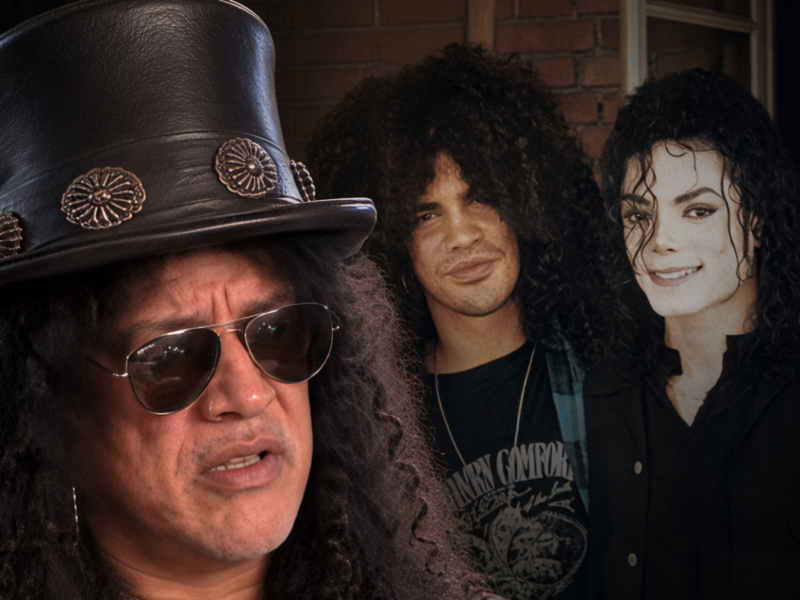
Slash On Michael Jackson’s Private World: ‘Nobody Was Real’.
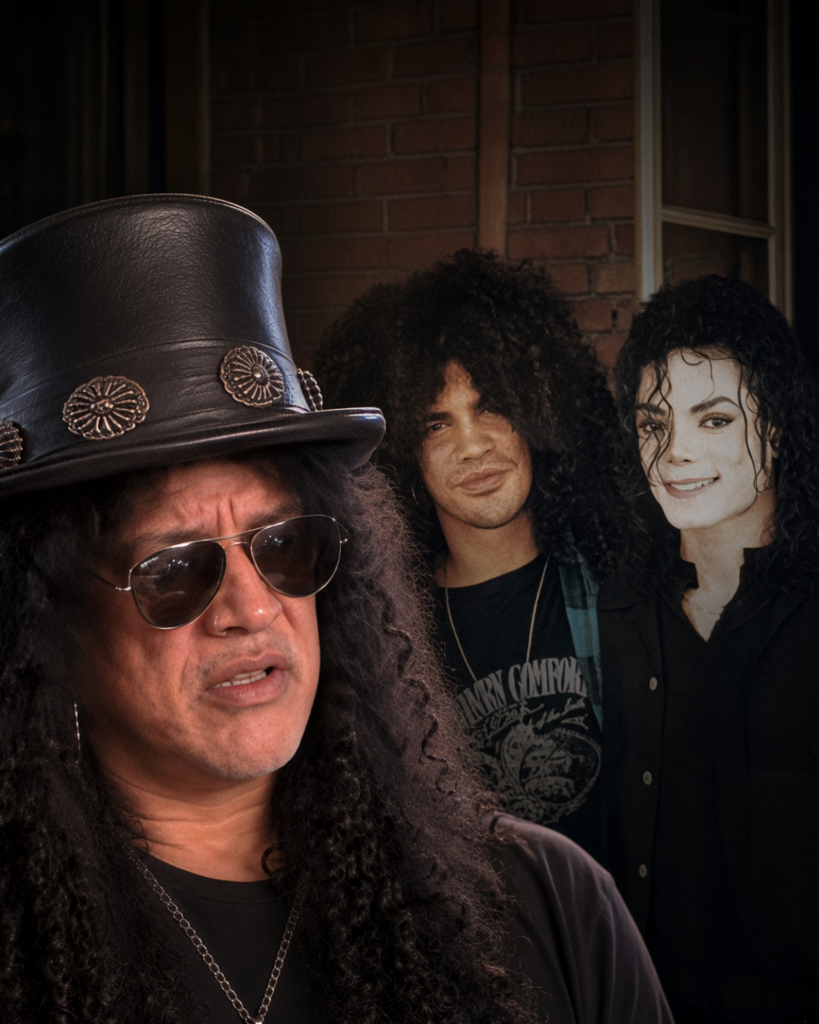
The kitchen light in Slash’s Los Angeles home was buzzing in that low, irritating way that makes you think a fly is trapped in the fixture.
It was sometime in the early 1990s, and the guitarist was standing at the counter with a sponge in one hand and a stack of dirty plates in front of him, trying to do something normal for once.
Then the phone rang, and everything about normal went straight out the window.
“I was in my kitchen at home and he calls me up,” Slash said, his voice still carrying that raspy, seen-it-all tone that has defined rock radio for four decades.
“The strangest thing in the world is to have Michael Jackson call you up when you’re trying to clean the kitchen.”
That single sentence is the doorway into a story that almost nobody gets to tell.
Not the tabloid version of Michael Jackson.
Not the trial version.
Not the documentary version.
The version from a guy who stood on the same stage, in the same spotlight, under the same impossible pressure, and watched the whole thing from the inside.
“I remember this distinctly,” Slash said, settling into the memory like it happened last week.
“I got a phone call from my manager saying, ‘Michael Jackson is trying to get in touch with you.’ And I was pretty starstruck, you know, it’s like, ‘Really?'”
That feeling never really goes away, even when you are the lead guitarist of Guns N’ Roses and the biggest rock band on the planet.
There is famous, and then there is Michael Jackson famous.
Slash knew the difference, and he knew it before he ever picked up the phone.
“In a way you get that feeling of like I guess I have arrived,” he said.
“So I had them give him my hotel number and he called me up in my room and it was that voice, you know, on the other end of the phone.”
That voice.
The soft, breathy, almost whispered voice that had sold hundreds of millions of records and made grown men in stadiums cry.
And it was asking him for something.
“And he said, ‘I’d like you to play on my record, you know.’ So I was like, ‘Okay, you know.'”
That is the whole pitch.
No contract.
No negotiation.
No entourage of lawyers on a conference call.
Just Michael Jackson, alone on the other end of the line, asking a rock guitarist to come make some music.
“What from rockers?” Slash was asked, because the backlash was real.
“Oh, yeah.”
Just from anybody who wanted him to stay in one sterile environment where you don’t branch out or anything.
It was the classic gatekeeping move that rock fans have pulled on their heroes for decades, the idea that stepping outside the genre is a betrayal of some sacred trust.
As far as Slash was concerned, that whole argument was nonsense.
“From a personality point of view, I’ve been unchanging ever since I started,” he said.
“I’ve never bent to, you know, I’ve never succumbed to anything like that.”
That is the thing about Slash that people forget.
He is not a rock guy who plays rock and only rock.
He is a musician who happens to play rock, and when Michael Jackson calls, a musician says yes.
“Michael was amazing,” Slash said.
“I mean, the Michael Jackson experience, I know a lot of people that didn’t care for me, like me stepping out of my box, right? To go play with Michael and alienating my rock fans.”
He laughed at that, the way you laugh at an old argument you already won.
“A phone call from Michael Jackson is somebody I grew up with, you know, like Michael Jackson and all that kind of stuff.”
And he was very quiet.
That is a detail that shows up again and again when people talk about Michael in private.
The screaming, spinning, crotch-grabbing showman on stage was, in real life, a soft-spoken man who barely raised his voice.
“Michael’s another one, I mean, in his own way, I remember being a kid and listening to Dancing Machine and all that kind of stuff.”
So Slash took the call.
He went down to the studio.
He met the man behind the myth.
“So yeah, I took the call and I went down there and I met him and he was a very nice, soothing, very sweet, you know, kind of guy.”
And then came the part that still amazes him all these years later.
“He sort of let me just have free reign to do whatever it was that I wanted.”
That is not how it usually works when a rock guitarist walks into a pop session.
Usually there is a producer with a chart.
A arranger with a plan.
A label executive with a stopwatch.
Michael Jackson gave Slash none of that.
“So he sort of invested in something that he knew about me without me even really knowing it,” Slash said.
That is trust, and in the music business, trust is rarer than a diamond in a driveway.
“I went down to the studio, I went to the Record Plant in LA and I met him there,” Slash said.
“And he was with his date at the time, which was Brooke Shields, right?”
That is the kind of detail that reminds you how surreal this world really was.
“And he just said, ‘Nice to meet you. This is Brooke, blah blah blah. We’re going to go to dinner.'”
And then Michael Jackson, the most famous entertainer on Earth, walked out of the room and left Slash alone with the tapes.
“And that’s how it started, and just left me with the music and I had pretty much free rein to do whatever it was that I wanted with the music they gave me.”
That is the moment the relationship was born.
Not on a stage.
Not in a video.
In a studio, with a closed door and a tape machine and a rock guitarist who was told to go crazy.
“We had a relationship based on that sort of kind of professionalism for me to just have the freedom to do my thing and he sort of accepted that.”
That was the deal.
Slash would bring the rock.
Michael would bring the pop.
And neither one would tell the other how to do it.
“When you went into a session with Michael Jackson, let’s say, he would play you a piece of music and say, ‘Hey, Slash, see what you can do with this?'” he was asked.
“Yeah, he would give me an arrangement and then he would go, you know, do whatever you want and he would leave.”
That is the sentence that explains the entire relationship.
Do whatever you want, and I will leave.
There was no hovering.
No micromanaging.
No second-guessing.
Just a genius who trusted another genius to figure it out.
The song was called “Give In to Me,” and it was on the Dangerous album, and it became the highlight of Slash’s time in Michael’s world.
“I’m going to do a song called Give In to Me that I played on that’s on that record and played leads on the stuff,” Slash said.
“So it’s like my Michael Jackson highlight for me.”
But there was another song, and that one has a story that almost nobody gets right.
“I did a record of his called Black or White,” Slash said.
“And I played on a song called Give In to Me on that record, which was pretty cool.”
And then he said something that corrects one of the most persistent myths in rock history.
“And I did some other stuff with him, but that was the one that really sort of, you know, I played the guitar solo and did a bunch of other guitar parts on there.”
“And I played on the song Black or White, but only in the very, very beginning before the actual song starts. It’s just me banging on the guitar.”
That is a huge distinction, and Slash wanted to make it clear.
“The song we recorded, the song Black or White, I did not play on,” he said.
“If you listen to that, you hear me and then that was Eddie Van Halen playing.”
“Yeah, I mean, it doesn’t sound like me. That was, but I was asked if I would play another song on the record called Give In to Me.”
“That was really a sort of showpiece for the guitar.”
Then there is the video, and that is where the confusion really took root.
“The reason I think I got sort of mixed in with Black or White was when they shot the video, they took some session stuff I done when I first got to the studio and put it in video with the clothes off and he stayed there by his back.”
That is a Michael Jackson move if there ever was one.
Take a random moment from the studio, chop it up, and drop it into a music video that the whole world would watch a million times.
“He always asked me,” Slash said, and you can hear the affection in his voice.
There was a time when someone asked Slash, point blank, how it felt to be in a Michael Jackson video.
“Yeah, I’m going to do a song called Give In to Me,” he said.
That was the one that mattered.
That was the one where he got to be himself.
But there was another moment, and it happened in a kitchen, and it is the one that Slash tells with the most delight.
“I was in my kitchen at home and he calls me up,” he said again, because the absurdity of it never gets old.
“The strangest thing in the world is to have Michael Jackson call you up when you’re trying to clean the kitchen.”
That is the human detail that makes the legend real.
The King of Pop, on the phone, while a rock star scrubs a plate.
“And so he asked me if I wanted to do it and I, you know, we’ve been friends for a while, so I said yeah.”
Then came the question that everybody asks when they hear about a rock guitarist in a Michael Jackson production.
“It’s a Michael Jackson thing, I understand, it’s like orchestras, choirs, smoke bombs. I’m trying to picture how you fit into this.”
Slash laughed.
“I can’t. I mean, I just, I just came in with my guitar and that’s it. You know, I just jammed.”
“You’re the guy wandering in with the guitar,” he was told.
“Yeah, yeah.”
That is the image that should be painted on a wall somewhere.
A guy in a top hat and sunglasses, walking into a Michael Jackson session with nothing but a Les Paul and an attitude.
“And I, you know, I went on to do a bunch of shows but I got to see that level of perfection that he was talking about,” Slash said.
“His passion for it and also what a god-given talent he has. He’s amazing to watch.”
And it was not just the talent that impressed him.
It was the work ethic.
“It was a really great experience for me because he had all these attributes that as a professional musician you want.”
“But we got on really well so it was a cool, cool little combo.”
“Harmless, one day.”
“Yeah, yeah.”
“Very nice.”
“But amazing. I mean, especially like to work on stage with him was just this kind of crazy energy that he had.”
That energy is the thing that separates the greats from the legends.
Michael Jackson had it in a way that very few performers ever have.
And Slash got to stand next to it.
“Just did two gigs with him,” he said.
“The one in Germany where he fell off the, the hanger thing fell, and I was standing right there when it happened.”
That is the moment that every Michael Jackson fan knows.
The 1999 Munich concert, where a bridge collapsed and Michael plummeted sixty feet while performing “Earth Song.”
“I just sat, but I had my hair in my face and my head down, so I didn’t, I just felt it,” Slash said.
“I just felt the wind come by and all of a sudden boom.”
That is how close he was.
Close enough to feel the wind of a falling legend.
“He got up and he climbed up on stage,” Slash said.
“I mean, this is a big stadium.”
“And he climbed up after he went about 30 miles an hour down about 60 feet.”
“And so it was a controlled fall because there was brakes on the cable.”
“But he was 60 feet up and he just drove his, and so he got up.”
“It was luckily it was the last song and he got up and went on stage and I thought everything was fine.”
“I had no idea what he’d just gone through.”
“And he did the whole last, and that’s to me, that’s rock and roll.”
“It doesn’t matter what type of music you’re rock and rolling out of tune. Anyway.”
That is the moment that defines Michael Jackson for Slash.
Not the moonwalk.
Not the Grammys.
Not the sold-out stadiums.
A man falling sixty feet, getting up, and finishing the show.
That is rock and roll, even if the music was pop.
“So that being the case, he’s always been my guy,” Slash said.
“I don’t know him on a personal level to the point where I seen his shows a couple of times but that’s about it.”
That is the boundary that Slash kept, and it is a boundary that he is still grateful he kept.
Because getting too close to Michael Jackson was dangerous, not because Michael was dangerous, but because the world around him was.
There is a detail that Slash shared that almost nobody knows, and it involves his own heart.
“But you’ve got this defibrillator and that gives you a heart and jolt when it decides, oh god, I’ve got to give up the ghost,” he was asked.
“Well.”
“How hard does that thing have to work?”
“Oh well, it says it’s never really been a problem,” Slash said.
“It was put in there because it didn’t look like I was going to make it and they thought, well, if there’s, give him a fighting chance, we’ll put that in there.”
“And especially if I was to fall off the wagon, which I did.”
“But I never had a problem with it.”
“The only time I had any issue with it was I did some shows with Michael Jackson in 2001 and I just had that thing put in and I’d forgot to mention it.”
That is the sentence that changes everything.
Slash had a defibrillator implanted in his chest, and he forgot to tell anyone before he walked on stage with Michael Jackson.
“It didn’t even occur to me to mention to the doctor that my heart rate goes through the roof when I get on stage as an adrenaline rush.”
“So I got up there and this thing was going off and at first I didn’t know what it was,” he said.
“I thought I was standing on a bad ground or something.”
That is the kind of moment that would make a normal person panic.
Slash just kept playing.
“So it’s like, you know, getting a, you know, you’ve seen defibrillators on TV and the sort of impact that they have,” he said.
“Well, it’s an internal thing. So it’s pretty dramatic and it did it about five times both nights for these two shows.”
Five times.
Both nights.
That is ten jolts of electricity through his chest while he was trying to play guitar for Michael Jackson.
“So anyway, so I went back to LA and we adjusted it and I haven’t had issues with it since.”
That is the most rock and roll sentence ever spoken.
Ten shocks to the heart, and the only adjustment was a trip to the doctor and a settings change.
“You’re one of those guys who was around the Michael Jackson world,” he was told.
“Right.”
“What don’t we know about that world that you know?”
That is the question that everyone wants answered, and Slash is one of the few people who can actually answer it.
“About Michael’s, I mean, Michael, you know, I mean, I only knew him on a for the most part a professional level,” Slash said.
“I don’t even think when he attempted to be any closer than that I even allowed it, because it’s just too crazy.”
That is a confession that says more than any tabloid story ever could.
Slash kept his distance, not because he didn’t like Michael, but because he understood what happened to people who got too close.
“You know, there’s there’s being famous and then there’s being that kind of famous and that’s a crazy world to be in.”
That is the thesis of the whole story.
Michael Jackson was not just famous.
He was a category of fame that had never existed before and has not existed since.
“Could you relate to him as a person?” he was asked.
“Um, yeah, as an artist for sure,” Slash said.
“I mean, our relationship was purely, you know, professional.”
“I didn’t go over to the house and hang out and all that kind of stuff.”
“But on a professional level, we got along great and I really liked him as a person on that level.”
That is the key.
On a professional level, Michael Jackson was a dream to work with.
On a human level, he was a man trapped in a bubble that nobody could penetrate.
“I know a lot of people have, you know, because he’s such a celebrity, a lot of people have, you know, they think different things about what he is as a person,” Slash said.
“But as far as I was concerned, he was just real sweet and he worked real hard and he was real down to earth.”
“So we had a great time.”
“To this day, Michael’s, you know, after having worked with him, is one of the most awesome people I’ve ever been on the same stage with. I mean, bar none.”
That is the highest praise a rock guitarist can give.
Bar none.
Not Prince.
Not Bowie.
Not anybody.
Michael Jackson was the best.
“And he’s badass,” Slash said.
“As crazy as Michael’s existence obviously is, um, as an artist, he’s one of the most amazing performers and most talented, you know, entertainers, singers, dancers I’ve ever had the pleasure to work with.”
“There’s there’s artists that completely transcend all labels and genres and, you know, Michael was one of them.”
“And this one of those experiences and his friendship and just that whole, all those gigs that we did was definitely worthwhile.”
That is the word that keeps coming back.
Worthwhile.
Not profitable.
Not career-changing.
Worthwhile.
Because working with Michael Jackson was not just a job.
It was a life experience.
“Do you ever have contact with him anymore?” Slash was asked.
“I haven’t seen him ever since everything went completely haywire with him,” Slash said.
“I haven’t seen him.”
“I saw him towards the beginning of it over at Robert Evans’ house. We were talking about doing a movie and then it just went wide open after that.”
“So I haven’t seen him since.”
“He’s been sort of a recluse. I think he was living in Dubai or something.”
That is the detail that breaks your heart.
Michael Jackson, the man who sold out stadiums on every continent, living as a recluse in Dubai.
The world had turned on him, and he had retreated to the only place he could find peace.
Distance.
“Yeah, yeah, that’s what I heard,” Slash said.
“It’s the world is sad that he’s not here.”
“Yeah, what did his, what did his passing affect you?”
And then Slash gave the answer that only a fellow musician could give.
“It’s just, you know, getting to know Michael, it’s just you, you very similar kind of personality to me in the sense that everything is about music and everything is about the work and there’s absolutely nothing else going on.”
That is the connection that nobody talks about.
Michael Jackson and Slash were both workaholics who had given their entire lives to the music.
“Which is a lot of how being a musician is, is you spend a lot of your time touring and it’s always on the road with music and it’s about the show and it’s about the record and it’s not about really anything else.”
That is the life.
The one that looks glamorous from the outside and feels like a prison on the inside.
“But it’s something that gives you a good idea when somebody that famous, somebody is, you know, that famous and that successful starts to really exist in this bubble and doesn’t have any sort of satisfying life outside of that.”
That is the tragedy.
The bubble.
The isolation.
The loneliness that comes with being the most famous person on Earth.
“I was close enough at that point because Guns N’ Roses was probably the biggest stadium rock band at the time and then you have Michael who was the sort of Elvis Presley of the period and it’s like that’s a scary thing.”
Scary is the right word.
Because being Elvis Presley is not a blessing.
It is a curse.
“And he was just dealing with it and I felt for him because he, as an artist, one of the genius artists, most genius artists I’d ever really been around next to maybe Ray Charles and a couple other guys.”
That is the company Michael Jackson kept in Slash’s mind.
Ray Charles.
And a couple of other guys.
That is it.
“And you know, sort of stuck in this world where nobody is real,” Slash said.
“You know, nobody will talk to him in a real fashion.”
“Everybody is sort of around him so they can gain something from him and so on and so forth.”
“It’s a very lonely situation.”
“And people take advantage of him and all that kind of stuff.”
“I watched it.”
That is the moment the story turns from a behind-the-scenes music tale into something much darker.
Slash was not just a guitarist on a record.
He was a witness to the slow isolation of a human being.
“So when all that stuff happened in 2000 or 2001, whatever it was, and he got all of these sort of accusations and stuff, one thing that Michael really wanted and the one thing that made him happy was he wanted everybody to like him,” Slash said.
“And he was putting on the best show possible so everybody would think he was great and that’s how he functions.”
That is the engine that drove Michael Jackson.
Not money.
Not fame.
Approval.
“Um, a little bit more depth to it than that because of that here and so all of a sudden he was completely ostracized pretty much by North America, you know, for all these accusations which even though he was acquitted, that was sort of how it started.”
“Yeah, and it sort of just killed him, you know.”
That is the last line, and it lands like a hammer.
It sort of just killed him.
Not the propofol.
Not the doctor.
Not the insomnia.
The rejection.
The world that had once screamed his name had turned its back, and Michael Jackson, a man who just wanted everybody to like him, could not survive it.
Slash did not go to the funeral.
He did not issue a long statement.
He did not do the talk-show circuit to share his grief.
He just told the truth, in his own way, in his own time, to the people who were willing to listen.
The kitchen phone.
The voice on the other end.
The studio with the closed door.
The sixty-foot fall.
The ten shocks to the heart.
The bubble that nobody could penetrate.
That is the story of Michael Jackson, told by a man who stood close enough to see the cracks and far enough away to survive.
“Nobody was real,” Slash said.
That is the line that stays with you.
Not the music.
Not the moonwalk.
Not the glove.
Just a man in a world where nobody was real, looking for someone who would talk to him like a human being.
And for a few sessions, in a studio in Los Angeles, with a rock guitarist who did not want anything from him except the freedom to play, Michael Jackson found that.
It did not last.
It never does.
But for a moment, in the middle of all the chaos, there was music.
And that, Slash believes, was the only thing that was ever real.









