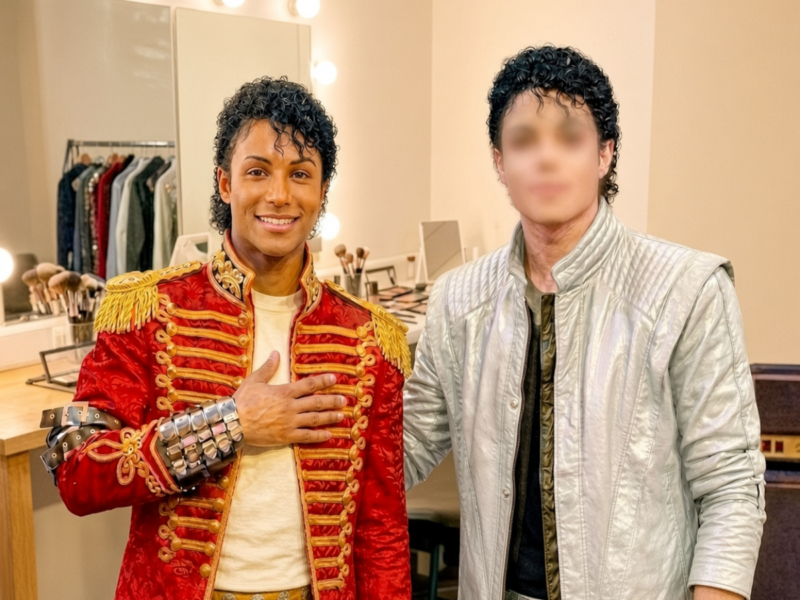
Shocking Actor Who Almost Played Michael Instead of Jaafar Jackson.
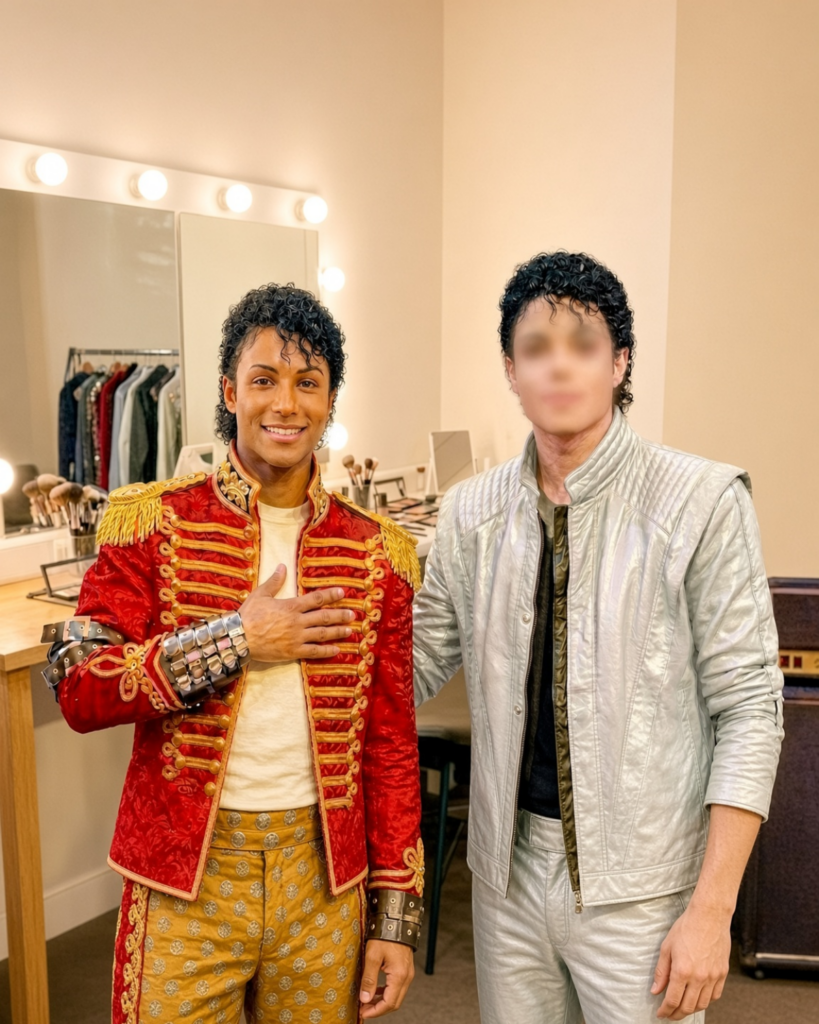
A film director is on set in Italy in the middle of shooting a different movie.
His cinematographer shows him a short video.
On the screen is a man dressed as Michael Jackson, moving on a set with that unmistakable glide and tilt of the head.
The director leans in.
He assumes he is looking at old footage of Michael himself.
However, he is not.
It is Michael’s nephew, a singer who has never acted a day in his life.
That small moment in a hotel corridor or a trailer may have started the road to one of the biggest casting decisions of the decade.
And years later, on the other side of that road, a very different man stood in a dance studio in a white fedora and asked the internet a pointed question about who it really wanted in the role.
Two men, two paths, one part.
So this is the full story of who almost played Michael Jackson, the impersonator who went viral, the famous names that were floated, the huge search that reached around the world, the years of punishing preparation, and the pieces of the story that nobody has confirmed.
Before we get into it, a quick thank you to everyone who commented on our last video.
One of you left a thought that fits this topic well, and it leads to a question for you.
Do you think impersonators deserve a real shot at roles like this one?
Tell us in the comments, because one comment could be featured in our next video.
Now, back to the story.
Let’s begin with a number, because it frames everything else.
Two hundred.
According to La Toya Jackson, that is how many actors tried out before Jaafar Jackson was chosen to play his uncle.
The production team publicly stated that they reviewed nearly 200 actors worldwide before selecting Jaafar.
And almost every one of them walked away without the part.
Pause on that for a second.
Some of those people may have spent months studying the moves.
Some may have sung these songs for years in their kitchens and cars.
Some may have traveled a long way for a few minutes in front of a camera.
Not one of their names has been made public.
The studio has never released a list of who read for the role.
That means the story of who almost played Michael is mostly a story we see in fragments.
A few of those fragments have surfaced, and they are worth looking at closely.
Let’s start with the loudest one, and his name is Fabio Jackson.
He is not related to Michael.
He is a tribute artist from Norfolk, England, born Fabio James.
According to reports, he auditioned for the lead in the 2026 film Michael.
In the same process that eventually led to Jaafar, he did not get the part.
A word of caution before we go further.
What we know about his audition comes from press reports and from his own public statements.
The producers have not described his audition in public.
So we are relying on what has been said, and we should be clear about that.
How did he end up here?
Around 2010, Fabio began posting on YouTube, mostly dance covers of Michael Jackson’s songs.
Then something started happening in the comments and in real life.
People kept telling him the same thing.
You look like him.
Not slightly.
Strongly.
Classmates said it.
Friends said it.
Strangers said it.
A remark like that can be a nice compliment, or it can turn into a direction in life.
For Fabio, it turned into a direction.
By around 2020, he had built a big audience on TikTok, recreating Michael’s outfits, hairstyles, facial expressions, and small mannerisms.
Somewhere along the way, James became Jackson.
He has also spoken openly about changing his look.
He has said that in 2022, he had a nose surgery, felt unhappy with the outcome, and had a second procedure to revise it.
He has shown followers a face cast tied to the Thriller era and called it his reference point.
You can have any opinion you like about those decisions.
What they show is scale.
This was never a hobby for the weekend.
It was a commitment that reshaped his life.
So when a major studio announced a film about Michael Jackson, his interest made sense.
By the reports, he auditioned, and he lost.
Why?
One analysis from a site called Activate Media pointed to training.
Its argument was that Jaafar was selected not just because of his surname but because he already worked as a singer and dancer with a natural sense of rhythm and stage presence.
In that framing, Fabio was an impersonator and Jaafar was a performer.
Treat that as one outlet’s opinion.
It is a thoughtful one, but it is not an official explanation, and nobody connected to the production has confirmed it.
Then came May 6th, 2026, roughly two weeks after the film reached theaters.
Fabio posted a dance video that ran just under three minutes.
He is in a studio wearing a white fedora with a black band, a white pleated jacket with a blue armband, a glittering gold top, black trousers, and shiny black shoes.
There are spins, moonwalks, hat tricks, sharp footwork, and the poses fans know by heart.
And then he looks into the camera and asks whether this is who people wanted to play Michael.
That line is what turned a dance clip into a debate.
It can be heard in two ways.
To some viewers, it sounded self-assured, even playful.
To others, it sounded bitter, like a man auditioning one more time for a role that had been filled long ago.
Both readings are possible, and only Fabio knows what he meant.
The internet reacted the way the internet usually does.
Supporters admired his nerve and his resemblance.
Critics were rough, and a few were cruel.
Plenty of commenters insisted that nobody had asked for him.
It is worth pausing there.
It is easy to mock a stranger for loving an artist too much when you are typing from the safety of a screen.
But Fabio is a real person, and the pile-on says a lot about online culture.
He answered in an interview with TMZ.
He said he thinks impersonators should get a chance to star in biopics about the artists they honor, because they put in enormous work and have real love for the music and the fans.
He also rejected the idea that he was bitter.
He said he learned about Jaafar’s casting around two years before the film came out, that he liked the way Jaafar delivered his lines, and that he saw promise in the movie.
Then he added something that tells you more than the video did.
He called the role a heavy burden, a very big pair of shoes to fill.
Think about what that means coming from him.
This is someone who has built his face, his name, and his public image around one person.
When another man takes the part he longed for, it is not only a professional disappointment.
It can feel like losing a piece of your identity.
Whether you found his video brave or misguided, that is a very human weight to carry.
But Fabio is only one name in this story.
Now we need to slow down, because the next part is shakier.
Industry chatter repeated in several entertainment articles says that Eminem was once considered for the lead.
The logic goes that producers admired his work in 8 Mile and thought his intensity might add an unexpected edge to the film.
But look closely at how this is told.
It is described as a passing idea, a conversation that went nowhere.
No statement from the studio, the producers, or Eminem has confirmed it.
That puts it firmly in the category of rumor, not fact.
Still, picturing it is fun.
A rapper known for raw, confrontational lyrics stepping into the life of the King of Pop would have produced an entirely different film.
But the Jackson family was said to want authenticity, and its choice was clear.
The next name is more concrete, although it belongs to a different project.
Indian filmmaker Sandeep Reddy Vanga said in comments reported in 2024 that he had once hoped to create his own Michael Jackson biopic.
He called it a tricky but exciting idea, and he said he had Allu Arjun in mind for the lead.
Allu Arjun is a major star in Telugu cinema, famous for his dancing, and his fans have long called him the Indian Michael Jackson.
But notice what this is and what it is not.
It was a separate project, not an earlier draft of the Lionsgate film.
It ran into obstacles and was never made.
Allu Arjun was never an audition candidate for the movie that actually arrived in theaters.
So the honest summary is that he was imagined for a movie that never happened.
Before we move on, there is one more casting detail that gets overlooked.
Finding the adult Michael was not the only challenge.
Director Antoine Fuqua has said that finding the young Michael was even harder than casting the lead.
Think about the job description.
A child who could sing, dance, and act, who could stand next to veteran performers, and who could carry the opening chapters of the story.
That role went to Juliano Valdi, who was 12 when the film opened.
According to coverage of his interviews, he read for the part multiple times before he was cast.
Producer Graham King pointed to a spark in him that echoed the young Michael himself, which brings us to the real question.
It may not be who almost played Michael.
It may be why Jaafar won.
On paper, the answer seems obvious.
He is Michael’s nephew.
He has the family’s features.
But the way the story is told is much richer than a family connection.
Go back to 2020.
Jaafar read that producer Graham King had secured the rights to a Michael Jackson film.
At the time, Jaafar was a musician writing and producing his own songs.
He had never acted, and by his own telling, he never wanted to.
He was just curious where the project might go.
Then King contacted him.
According to Jaafar’s account, King asked whether he had any acting experience.
Jaafar answered honestly.
“No.”
King asked him to think it over.
Jaafar asked for time, because he did not want to treat this as a casual experiment.
If he agreed, he wanted to give it everything he had.
Time passed without a decision, so he did something daring.
He recorded a voice note, speaking in his uncle’s higher, softer voice and singing a gentle Peter Pan song almost like a lullaby, and sent it to King.
It worked.
King reportedly phoned back right away and said he would find him a coach the next day.
But that call did not hand him the part.
King and casting director Kimberly Harden made it clear that a worldwide search would go ahead anyway.
Jaafar would have to earn the role the way everyone else did, with no acting background, no formal training in the craft, and a famous surname hanging over him.
And so the work began, and it was relentless.
By his own account, the process lasted about two years of auditions, callbacks, and rehearsals.
He spent a full year with an acting coach before even trying to step into Michael’s shoes.
He trained with Rich and Tone Talauega, who worked with Michael as choreographers on the HIStory tour.
He studied archival footage obsessively, gathered every video of Michael dancing he could find, and played the music constantly.
Then there are the writings.
Jaafar has said he was given access to Michael’s personal journals, poems, mantras, and affirmations, and that this was a turning point.
He began placing affirmations on his own walls and mirrors.
He built what he calls a research room, with every inch of the walls covered in quotes, handwriting, achievements, and a timeline of what was happening in the world during each stage of Michael’s life.
His thinking was that Michael’s art was shaped by the world around him.
So to understand the artist, he had to understand that world.
He also spent time at the family’s Hayvenhurst home, where he set up a sort of training camp.
He has said he grew up in that house and has personal memories of Michael there.
So being in the same space stirred deep emotions.
He practiced the dance routines there, including how Michael worked his costume as he moved.
Then there is the spin.
Michael Jackson spun to the left.
Jaafar’s body was conditioned to spin to the right.
That might sound minor until you remember that a spin is not a thought.
It is muscle memory.
Rewiring it is like learning to write with your other hand.
By his own account, it took about three years to master.
He has also said the rehearsals were punishing, that he danced until his feet went numb or bled, and that people assumed the role was easy when it was anything but.
Now we reach the moment that seems to have convinced the man who would direct the film.
Antoine Fuqua was not part of the project at the beginning.
According to his own telling, Graham King had been developing Jaafar for a couple of years before Fuqua signed on.
King traveled to Italy while Fuqua was shooting The Equalizer 3 to pitch him the movie there.
Cinematographer Robert Richardson showed Fuqua that video of a man in a Michael Jackson look on a set.
Fuqua assumed it was old footage of Michael himself.
It was Jaafar.
Fuqua has said he could not tell the difference.
But looking like someone is not the same as acting like them.
And Fuqua has been open that he first wondered whether Jaafar was simply performing for him.
So he tested him.
He threw an unscripted question at Jaafar to see how he would respond without a script.
According to Fuqua, Jaafar answered as Michael, and the room was moved to tears.
That was the moment Fuqua felt he had found the real thing.
Then came the first day of principal photography, which Fuqua has described as a stress test.
Jaafar’s first scene in front of the camera was a recreation of a Bad tour performance in front of about 500 extras.
Fuqua has said he blew everyone away.
Graham King’s verdict after the global search was blunt.
Even after looking around the world, he said it was clear Jaafar was the only person who could take on the role.
Now let’s be fair, because there is a real counterargument, and it deserves a hearing.
Some people believe the outcome was never truly open.
The estate was closely involved in the film, and Michael’s nephew was a natural choice for a project that wanted the family’s blessing.
Seen that way, a worldwide search can look like a formality, a way to show the process was fair.
That is a legitimate suspicion, and we cannot rule it out from the outside.
Nobody beyond the room can say how close each audition really was.
What we can say is that the people involved describe a long process, that Jaafar says he had to earn it, and that the director says what he saw convinced him.
It is also fair to point out that the accounts of Jaafar’s preparation come largely from Jaafar and from the filmmakers.
Those are the people with the most reason to tell an inspiring story.
That does not make the story untrue.
It means we should hold it with an open mind.
And fairness cuts the other way for Fabio as well.
It is easy to laugh at the white fedora and the confident stare, but he is a working performer who built an audience through his own effort.
And by his account, he has handled the aftermath without resentment.
A lack of professional training does not make someone’s love for an artist any less real.
So what separates Jaafar from Fabio, from Eminem in that rumored discussion, and from the hundreds of unnamed actors, based on what has been reported?
It was not a single thing.
It was the combination.
The voice note.
The two years of auditions.
The coaching.
The research room.
The backward spin.
And a director who watched him answer an unscripted question and saw something that could not be faked.
The film itself opened in April 2026 and became a global hit, and it went on to pass a billion dollars.
Jaafar reportedly won the Astra Award for Best Actor and was nominated for a British National Film Award.
His grandmother, Katherine Jackson, has spoken warmly about his performance, saying he captured her son so closely that there were moments she could not tell the difference.
And Fabio?
He reportedly watched the film and posted a reaction video.
He did not say much.
Then he went back to his studio.
Let’s step back and separate what we know from what we do not.
Here is what is not confirmed.
Whether Eminem was ever seriously considered rests on industry chatter with no official confirmation.
The Allu Arjun story belongs to a separate project that was never made, and he was not part of the casting for the finished film.
The studio has not released the names of the people who auditioned, and there is no public record of how close the final round was.
And here is what nobody can know.
Whether the process stayed truly open to the very end.
How Fabio’s audition compared with Jaafar’s.
And what any of those 200 actors would have done with the part.
So where does that leave us?
The simple version of this story is that a nephew with a famous name got a role.
The more accurate version is that a man with no acting background spent years rebuilding his body and voice for a part he did not yet have, while others, some far more experienced at imitation, hoped for the same chance.
That is why Fabio’s video resonates, and why it should not be brushed aside.
Beneath the challenge in his question is something familiar.
Every impersonator, every superfan, every person who has practiced a favorite artist’s moves in front of a bedroom mirror has wondered what it would feel like to be chosen.
Fabio simply said it out loud.
And that is why Jaafar’s path matters.
He did not succeed by being the closest copy.
By his own account and by the director’s, he succeeded by understanding the person behind the moves.
Go back to that first image.
A phone in a director’s hand in Italy and a clip he mistook for the past.
Behind that clip are two years of auditions, a room covered in handwriting, a spin learned backward, and 200 people who tried and never got the call.
Somewhere in that crowd is a man in a white fedora, still dancing.
Who almost played Michael?
Perhaps the better question is who gets to carry a legend, and what it takes.
In this case, the answer seems to be years of work that nobody was watching.









