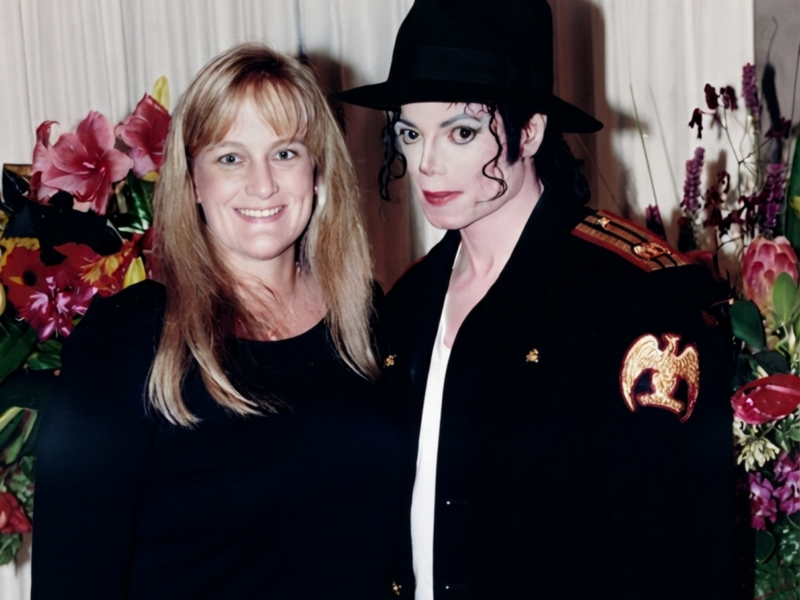
She Was Michael Jackson’s Makeup Artist for 27 Years… What She Saw Nobody Else Did.
The first time she saw him, he was not the King of Pop.
He was a young man in a photographer’s studio about to shoot the cover of an album that would change music forever.
She was in her twenties, a makeup artist trying to make a name for herself in an industry that did not always welcome women.
And when he walked in, she did not recognize him at first. He was quiet, shy, almost fragile.
And then he opened his mouth to speak, and she heard something she had never heard before.
A voice that was soft and high and utterly unlike the man who would soon become the most famous entertainer on Earth.
That was 1981. The album was *Thriller*. The photographer was Dick Zimmerman.
And the young woman holding the makeup brush was Karen Faye.
She would spend the next twenty-seven years by Michael Jackson’s side—through the triumphs, through the tours, through the pain, through the final desperate days when his heart was visible through his skin, and nobody in charge seemed to care.
She saw what the cameras never captured. She heard what the microphones never picked up.
And when she finally took the stand in a Los Angeles courtroom in 2013, she told the world the truth about what she had witnessed.
What she saw, nobody else did. And what she saw will break your heart.
Stay with me, because the last few minutes of this video are the reason I made it.
Before we continue, we want to spotlight this comment from our previous video.
After watching today’s video, do you think Karen Faye was right to speak up? Share your thoughts in the comments, and one comment could be featured in our next video.
Now, let’s return to Karen’s story.
Karen Faye was not a celebrity. She was not a hanger-on. She was a working artist who happened to land the job of a lifetime.
She had been doing makeup for years when Dick Zimmerman called her and said he was bringing someone special to the studio.
That someone was Michael Jackson. He was twenty-three years old, already famous, but not yet iconic.
He was working on the cover of what would become the best-selling album in history. And he needed someone who could make him look like the star he was about to become.
Before that day, Faye had spent years building her craft the hard way—learning on smaller shoots, smaller sets, smaller names, waiting for the kind of break that most artists in her field never get.
She did not know, walking into that studio, that she was about to step into the biggest chapter of her career.
She only knew that she had a job to do, and she intended to do it well.
Little did she know that the quiet young man in the chair would become the center of nearly three decades of her life.
Faye did his makeup for that shoot, and then she did it again, and again, and again.
For twenty-seven years, she was the one who painted his face, who covered his scars, who made him presentable to a world that demanded perfection.
She traveled with him on the *Bad*, *Dangerous*, and *HIStory* tours, crisscrossing continents, working in dressing rooms and backstage corridors from Tokyo to London to Buenos Aires.
She watched him prepare for stadiums packed with tens of thousands of people, and she watched him come off stage afterward—spent and silent, needing a few quiet minutes before he could be anyone’s Michael Jackson again.
She was there for the good times and the bad. She was there for the triumphs and the tragedies, and she became something more than a makeup artist.
She became a confidant, a friend, a sister. She considered him a brother.
On the road, she saw sides of him that fans in the audience never could. She saw him rehearse a single move for hours until it looked effortless.
She saw him break into laughter backstage, cracking jokes with the dancers before a show.
She saw the discipline it took to be that kind of performer night after night, city after city, and she marveled at it every time.
She saw the routine behind the spectacle, too. The hours in the makeup chair before doors opened, the steam rooms and vocal warm-ups, the careful ritual of turning an exhausted man into a performer who could hold a stadium in the palm of his hand for two hours straight.
She saw him give notes to the band after a show that had already looked flawless to everyone watching, because he heard things nobody else could hear.
She saw him thank the crew by name, remember birthdays, ask after people’s families.
Small things. Human things. The kind of details that never make it into a headline but stay with the people who were actually there.
And she saw the exhaustion that came after—the nights he sat quietly in his dressing room, not speaking, just breathing, gathering himself for whatever came next.
Tour life has a way of hollowing people out even when the shows themselves are triumphant. And Faye watched that slow erosion happen in real time, year after year, tour after tour.
But here is the thing about being that close to someone like Michael Jackson. You see things that other people do not.
You see the man behind the mask. And sometimes the mask is all that is holding him together.
Karen Faye’s story is not just a story about makeup. It is a story about what happens when fame consumes a person, when the weight of the world becomes too heavy to bear, when the people who are supposed to protect you are the ones pushing you toward the edge.
Quick one before we go on. If you are still here, hit the like button. It genuinely helps this channel more than you would guess.
And drop a comment telling us what you think it would be like to watch someone you love fade away in front of you. Because that is what Karen Faye watched for years, and she could not stop it.
Let me tell you about the Karen Faye that the world did not see. She was not just a makeup artist. She was a protector.
She was the one who kept Michael calm before he had to go on stage. She was the one who arrived at three in the morning to help him get ready during his 2005 trial.
She was the one who felt it was her duty to be a place of safety and peace for him.
She once said, “I was a place of safety for him and peace, and I didn’t want to bring up the allegations in my time with him. I wanted that to be a really safe place.”
She knew he was struggling. She knew he was in pain. But she also knew that confronting him about his demons would only push him further away.
So she stayed quiet. She stayed loyal. She stayed by his side.
She watched him go on stage every night carrying the weight of a level of scrutiny that few human beings will ever know.
She watched him waste away. She watched the light in his eyes dim, and she could not do a thing to stop it.
Now, let us talk about the things she saw that nobody else did. The things that only someone in her position could have witnessed.
She saw Michael Jackson in his private quarters at the Staples Center in June 2009, just days before he died.
She was there when his costume designer, Michael Bush, emerged wide-eyed from a bathroom after seeing Jackson’s unclothed body.
Bush said to her, “Oh my God, Karen, I could see Michael’s heartbeat through the skin in his chest. His heart beating through his skin.”
That is how thin he had become.
She saw his legs, once muscular, become thin and frail. She saw his face become skeletal. She saw a man who was once the most vibrant performer on Earth reduced to a shadow of himself.
And when she raised concerns, she was met with indifference.
She told Jackson’s manager, Frank DiLeo, about the singer’s dramatic weight loss. His response? “Get him a bucket of chicken.”
Faye later testified, “It was such a cold response. I mean, it broke my heart.” She wept on the stand as she recalled those words.
She saw AEG executives push Jackson to rehearse even as his health declined.
She testified that she overheard a phone conversation in which AEG co-CEO Paul Gongaware told Jackson’s assistant to get him out of a locked bathroom and to a rehearsal.
Gongaware was described as angry and kind of desperate, and told the assistant to do whatever it takes.
She said Jackson was very upbeat, but he was on the thin side when she saw him in April. “But the first time he actually got up on stage and rehearsed, I saw the change in him.”
She saw Jackson become paranoid in his final days. She testified that he was “acting like a person I didn’t recognize.”
He was shivering from chills. He was repeating himself. He kept repeating, “Why can’t I choose?”
He locked himself in a bathroom at his home, refusing to leave for rehearsals. He was scared to death.
She saw what happened after he died. She saw the lies. She saw the cover-up.
She was asked to help retouch footage of Jackson for the posthumous documentary. She refused.
“It was a lie. I didn’t want to lie,” she told jurors. “Everybody was lying after he died, that Michael was well. Everybody knew that he wasn’t. I felt retouching Michael was just a part of that lie.”
She was the one who prepared his body for his family to view in his casket. She broke down crying on the stand as she described that intimate experience.
Imagine that. Twenty-seven years of painting his face, of making him look perfect for the world, and the last time she touched him, he was dead.
Think about what that job actually meant for twenty-seven years.
Every tour, every award show, every photoshoot—she was the last person he saw before he stepped in front of the world, and often the first person he saw when he stepped away from it.
She knew his face better than almost anyone alive. Every contour of it. Every change in it over the decades.
So when that face began to change in ways that had nothing to do with makeup, she was the first to notice.
Not the executives counting ticket sales. Not the promoters mapping out fifty nights at the O2.
Karen Faye, standing an arm’s length away with a brush in her hand, watching a man she loved disappear in front of her.
Now, let us go back to the beginning, because to understand what Karen Faye witnessed, you have to understand who Michael Jackson was when she first met him.
In 1981, he was a young man on the verge of becoming something the world had never seen. He was talented. He was driven.
He had also spent his entire life in the spotlight since he was a small child performing with his brothers.
And that meant he had never had the ordinary rhythms of childhood that most people take for granted.
He grew up rehearsing instead of playing, performing instead of simply existing. That was the world that shaped him long before Karen Faye ever picked up a brush.
Faye watched him navigate fame with a grace that amazed her. She watched him handle the pressures of being the most famous man on Earth.
She watched him deal with the adoration and the scrutiny and the constant, unrelenting attention. And she watched him slowly wear down under the weight of it.
She described him as a gentleman. He was elegant. He was brilliant. She said she found herself working with “this magical person.”
She said she had never seen another performer with such energy or drive. “Michael would do five songs to the dancers’ one. I never saw anything like it.”
She called him a gentle genius with unparalleled stamina.
But she also saw the toll it took on him. She said he hated live performances. “It was just too hard on him,” she testified.
She said he needed a lot more time to rest and sleep between shows to be healthy and maintain that kind of longevity.
But the schedule for the *This Is It* tour was brutal. Fifty shows at London’s O2 Arena. The shows were far too close together.
When she first saw the schedule, she said, “He can’t do this.” She thought he might last a week.
She raised her concerns with show director Kenny Ortega. “He kind of fluffed it off,” she said.
She raised them with Jackson’s manager, Frank DiLeo. He told her he had it under control.
Nobody listened. Nobody acted on what she was trying to tell them.
She saw him struggle with back pain and insomnia after suffering injuries during his career.
She saw him shiver from the cold while huddling in front of a space heater because he had lost so much weight.
She saw him grow increasingly anxious about the sheer scale of what was being asked of him, worried that his body could not keep pace with the schedule the tour demanded.
She was not the only one who saw it. A fan sent an email to Jackson’s manager, Frank DiLeo, describing the singer as a skeleton.
“If we do nothing, he will die,” the fan wrote.
Faye forwarded the email to DiLeo and wrote that she agreed with the assessment. The manager never responded.
Nobody responded. Nobody acted. Nobody saved him. And then he was gone.
June 25th, 2009. A propofol overdose. A doctor who was supposed to be helping him. A concert promoter who had pushed him too hard. A man who had been failed by almost everyone in his life.
Karen Faye took the stand in 2013 and told the world what she had seen.
She testified in the wrongful death lawsuit brought by Michael Jackson’s mother and children against AEG Live.
She described the good times and the bad times. She cried. She told the truth.
She said that Jackson was a gentle genius with unparalleled stamina. She said she had never seen him use drugs.
She said she had only once been asked by him if she had painkillers.
She said she had requested prescriptions in her name for Latisse and Propecia so that she could give them to Jackson. She said she had inquired about Botox as a remedy for his on-stage sweating.
She said she had been fired from his entourage during the *HIStory* tour because Debbie Rowe, Jackson’s wife at the time, was jealous of her. Rowe later apologized.
She said she had spoken to Jackson’s siblings about his health struggles and that the family had attempted interventions that were unsuccessful.
She said she had never confronted Jackson directly about it because she felt it was her duty to keep him calm.
She said she loved him. She said he was like a brother to her.
And then she said the words that still echo in that courtroom.
“Everybody was lying after he died, sir, that Michael was well, and everybody knew he wasn’t.”
That is the thing that gets me. Not the lies. Not the cover-up. The fact that she knew.
She knew he was dying. She knew he was not well. She tried to tell people. She tried to sound the alarm, and nobody listened.
Nobody listened to the woman who had spent twenty-seven years by his side. Nobody listened to the woman who knew him better than almost anyone.
In the five days before his death, Faye sent two emails to Jackson’s manager, Frank DiLeo, warning that his health was deteriorating.
She warned that DiLeo and AEG Live CEO Randy Phillips might become villains or financial victims if Jackson were to die.
She struck a dire tone because earlier concerns about Jackson’s health had been ignored.
She sent one on June 20th, 2009—five days before he died. Two days later, she sent another.
“I don’t think you, Kenny, or Randy deserve becoming the villains or the financial victims,” her email stated.
She told jurors she was concerned the men could be responsible for that in some way.
Her emails described Jackson as emaciated, anxious, and unable to perform. She was not convinced he would be able to perform the fifty-concert schedule.
She tried. She tried to protect him. She tried to be a place of safety and peace.
She tried to sound the alarm, but she was just one person, and the machine that was consuming Michael Jackson was too big for one person to stop.
She prepared his body for the casket. She refused to retouch the footage of his final days. She told the truth in court even when it was painful.
She honored him the only way she knew how—by telling the world what she had seen.
Karen Faye is still out there. She still speaks about Michael Jackson with love and reverence. She still defends him.
She still carries the weight of those twenty-seven years, and she still wonders, I imagine, if there was something more she could have done.
But here is what I know. She did more than most. She stayed. She was there.
She saw the man behind the mask. And when he was gone, she refused to let the world forget who he really was.
Not the caricature. Not the punchline. The man. The artist. The friend. The brother. The human being who was failed by almost everyone who was supposed to protect him.
That is the story Karen Faye told. That is the truth she carried with her for twenty-seven years. And that is the truth she finally shared with the world.
The courtroom fell silent when she spoke. The jurors leaned forward. The lawyers stopped their pacing.
And for a moment, it was not a trial. It was a memorial.
A woman saying goodbye to a man she had loved for nearly three decades.
She said he was a gentle genius. She said he had unparalleled stamina. She said he was like a brother to her.
And then she said the words that still haunt me.
“Everybody was lying after he died. And everybody knew he wasn’t well.”
She knew. She always knew. And she spent the rest of her life trying to tell us.
So let me ask you the thing this video is really about.
Who is the Karen Faye in your life? Who is the person who sees you when you are not performing?
Who is the person who knows when you are falling apart, even when you are smiling for the cameras?
And more importantly, are you listening to them?
Michael Jackson did not have to be pushed to the edge the way he was. He did not have to be reduced to a skeleton with a beating heart visible through his skin.
He needed help. He needed someone to say no. He needed someone to protect him from a system that kept demanding more than he had left to give.
Think about how many people surrounded him in those final months. Managers, executives, doctors, assistants, choreographers, lawyers—an entire industry built around one man.
And somehow, out of all of them, it was the makeup artist who sent the emails, who made the calls, who tried to raise the alarm loud enough for someone in power to actually act.
Not the caricature. Not the punchline. The man. The artist. The friend. The brother. The human being who was failed by almost everyone who was supposed to protect him.
That is the story Karen Faye told. That is the truth she carried with her for twenty-seven years. And that is the truth she finally shared with the world.









