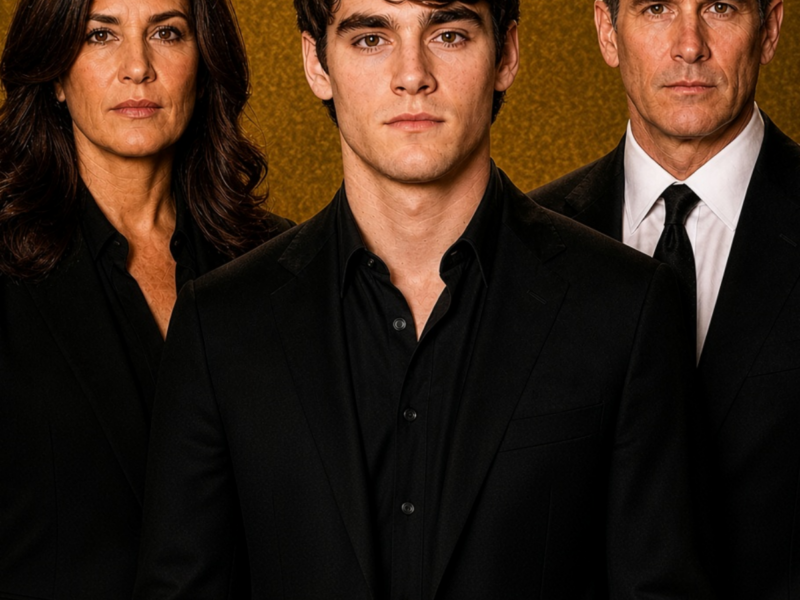
RJ Mitte’s Childhood Was Much CRUELER Than You Thought.
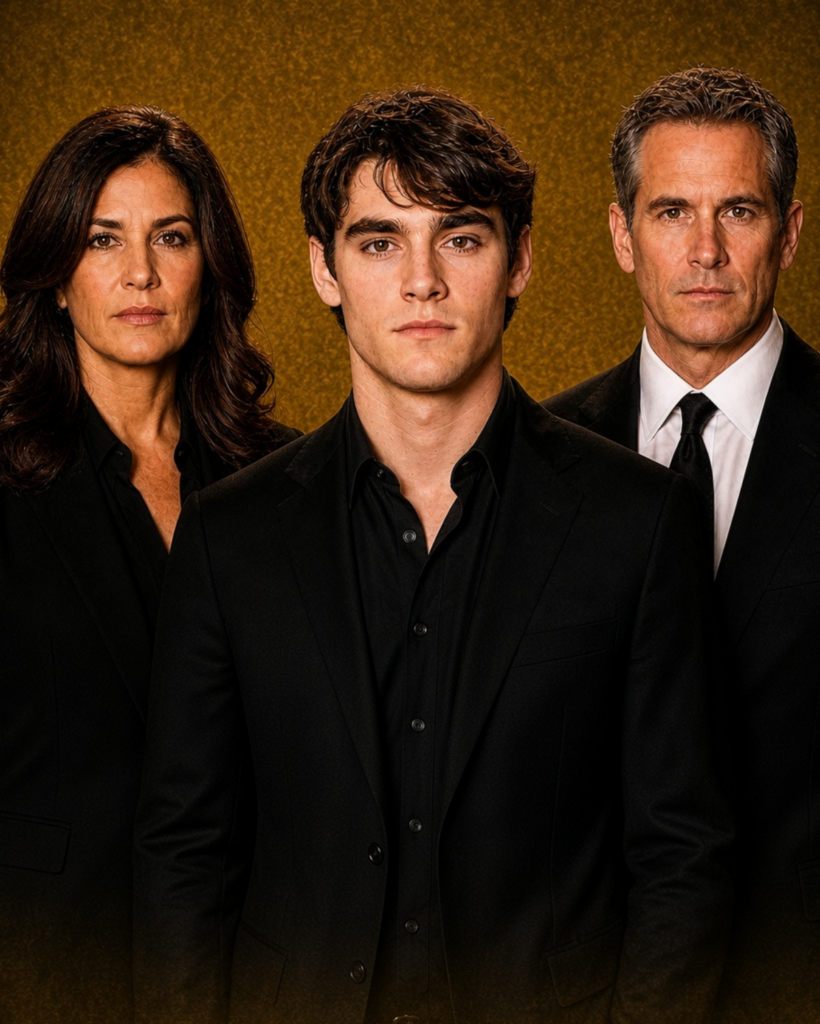
He was cast to play a version of himself, then told the world his real body was worse than the character’s.
The show made him famous. It did not make his life easier.
Before the fame, there were leg braces and crutches and a speech he had to fight to shape.
There was a house under pressure and a mother whose struggles stayed mostly off camera.
The public saw a sunny kid at a breakfast table. What they did not see was the documented grind behind that smile and what it cost him when the cameras stopped.
RJ Mitte was born in Jackson, Mississippi, in the summer of 2002.
His full name is Roy Frank Mitte III, and almost nobody who watched him on television knew that.
They knew him as Walter Jr.—the teenage son of Walter White, a boy with cerebral palsy who ate breakfast, rolled his eyes at his father, and called himself Flynn for a stretch of the series.
That role ran from 2008 to 2013, when RJ was still a teenager himself.
By the time it ended, he had grown up on one of the most watched shows on television, and the world had decided what his story meant.
He was the kid with the crutches who made it. He was proof that disability did not have to stop you.
That was the public version. The private one was messier—and the title of this story is not a marketing line. It is close to accurate.
The condition was real, and it was his.
RJ Mitte was diagnosed with cerebral palsy as a young child—a form of the disorder that affects motor control, balance, and muscle coordination.
His particular case was mild enough that he could walk and talk, but not mild enough to disappear.
He wore leg braces through much of his childhood. He used crutches. His speech was affected, and he worked with therapists to control his mouth and tongue.
In interviews, he has described the process plainly: the repetition, the drills, the small victories.
He did not glide through childhood. He pushed through it, one exercise at a time, while other kids ran past him without thinking about it.
That is the first layer, and it matters—because the character he played was written to have a milder version of the same thing.
Walter Jr. used crutches on screen. Walter Jr.’s speech was clear.
The show leaned into the character’s disability without making it the whole point, which was quietly revolutionary for network television at the time.
But it also created a strange mirror.
RJ was playing a boy whose body was close to his own—but softened, adjusted, made more presentable for a mass audience.
He has said as much himself in later years. His real condition was more involved than the character’s.
The braces, the therapy, the daily management—most of that stayed off-screen.
Viewers saw the crutches and assumed they understood. They did not.
He was around thirteen when he was cast, and the audition itself has become part of his story.
He had some early experience—a small role, some modeling, and a mother who pushed him toward it.
What he has described is a fairly standard child actor path, except that his body was being evaluated along with his talent.
The role was written for a boy with cerebral palsy, and RJ fit in a way that no fully able-bodied actor could fake.
That was the opening. It was also the trap—because once the industry has a category for you, it tends to keep you in it.
The show’s success came fast and then kept coming.
Breaking Bad was not an instant ratings giant. It built an audience over years, then exploded into one of the most acclaimed dramas ever made.
By the final season, RJ was a recognizable face, and the public had a story about it.
He was the disabled kid who beat the odds. He was on the poster. He walked red carpets. He did press.
And underneath all of it, the household he came from was under real strain—strain the cameras never captured.
His mother is the part of this that most people never heard.
RJ has spoken about her over the years, in interviews and on podcasts, and the picture he paints is complicated.
She raised him largely on her own after his parents split when he was young. She was his earliest champion—the one who got him into acting in the first place.
She was also, by his account, dealing with her own battles. And those battles shaped the house he grew up in, even as his career was taking off.
He has described periods of instability, money pressure, and a family life that did not match the polished image of a rising young star.
The fame did not arrive with a safety net. It arrived on top of existing problems.
That contrast is the heart of the story.
On screen, Walter Jr. had two parents, a stable house, a routine. Off screen, RJ was navigating a hit show, school, therapy, and a home situation that required him to grow up faster than his years.
He was a teenager carrying adult weight.
He has been candid about this in a way that most child stars are not, and the candor is what makes the “crueler than you thought” framing hold up.
He was not just a disabled kid who got lucky. He was a disabled kid who got lucky—and then had to manage everything that came with it without much of a cushion.
There was also the quieter cruelty of how the industry treated him.
Child actors with disabilities face a specific set of assumptions. They are seen as brave before they are seen as talented. They are cast for authenticity and then typecast for it.
RJ has talked about auditioning after Breaking Bad and running into the same wall over and over.
Roles written for disabled characters were few. Roles written for able-bodied characters that could be played by a disabled actor were fewer.
The industry liked the idea of him more than it knew what to do with him.
He was a symbol before he was a working actor, and symbols do not always get steady work.
For a while, though, the momentum carried him.
He booked other roles. He modeled—including a notable campaign for Gap, where his body was front and center in a way that fashion had rarely allowed for disabled men.
He became a public face, a speaker, an advocate. He did charity work, appeared at events, talked about cerebral palsy in schools and on stages.
On paper, it looked like a clean post-Breaking Bad career—a young actor transitioning from a beloved role into a broader public life.
It looked stable. It was not stable.
Underneath the speaking engagements and the press was a young man trying to figure out what he actually was, and a family situation that kept shifting.
He has described moments of real financial uncertainty—of not knowing where the next job was coming from, of the gap between being recognized and being secure.
Fame and money are not the same thing. And for a child actor on a cable drama that was not yet a phenomenon, the money was never as big as people assumed.
When the show ended, the safety of a steady paycheck ended with it.
What makes his story land harder than a standard child star cautionary tale is that he was not self-destructing in the usual way.
He was not in and out of rehab, not crashing cars, not feuding publicly.
He was working, showing up, doing the advocacy, being the good story—and still the ground was soft under him.
His mother’s situation was the thread that kept pulling. He has talked about stepping into a caretaker role at times, about the reversal where the child becomes the adult.
That reversal is its own kind of loss—quiet and mostly invisible.
By his late teens and early twenties, the public image was fully set.
RJ Mitte was the cerebral palsy guy from Breaking Bad—the inspirational one.
The problem with being an inspiration is that it flattens you. It turns a person into a lesson.
He has pushed back on this gently but clearly over the years, insisting that he is an actor first—that the disability is part of the job, not the whole job.
The audience wanted a story about overcoming. He wanted a career. Those two things kept colliding.
And then there was the part almost nobody was watching: the slow drift of his mother’s life and health, which would eventually reshape how he understood his own childhood.
What he has described is not a single dramatic collapse, but an accumulating set of pressures—the kind that look normal from the outside and feel heavy from the inside.
The title says his childhood was crueler than you thought.
The cruelty was not theatrical. It was the ordinary kind—the kind that does not make headlines, the kind that a smiling photo at a premiere hides completely.
That is where the public version of RJ Mitte stops being the whole story.
The character he played got a fairly clean arc—a family that mostly held together, a future that looked open.
The actor playing him got something messier.
He got a diagnosis he did not choose, braces he had to grow out of, a career that typecast him before it freed him, and a home life that demanded more from him than a kid should have to give.
He made it work anyway—and that is the part the title is reaching for.
What happens next is where the story turns stranger than the inspirational version allows.
Because the years after Breaking Bad were not a clean victory lap.
They were a long negotiation with an industry that did not quite know what to do with him, a body that kept requiring management, and a family that kept needing him.
The comeback, if you want to call it that, was never as simple as it looked from outside. It was happening in real time, mostly off camera, and the outcome was not guaranteed.
He kept working. That is the fact that matters most at this stage of the story.
Whatever the pressures were, he did not fold. But the way he kept working—and the things he had to do to keep going—are where the real material sits.
There is a version of RJ Mitte’s life where the show ends and everything gets easier. There is also the version that actually happened, where the applause faded, the checks got smaller, and the family problems did not politely wait their turn.
That second version is the one worth following.
The boy at the breakfast table grew up. The braces came off. The crutches became occasional. The speech got smoother.
And underneath all of that progress was a young man carrying a load that the public never saw—from a house that never quite stabilized into a career that never quite delivered what it promised.
That is the setup. That is why the title works. And that is only the beginning of what actually happened.
He was thirteen when the money started to matter.
Not in the abstract way adults mean it, but in the way where a bill is due—and the only person who can cover it is a kid with a crutch under one arm.
By then, he had already been doing the job for a year. He had been working as an extra, taking whatever came, pushing a body that had its own daily demands through audition rooms and on-set schedules that did not slow down for anyone.
He was not doing it for a reel. He was doing it because the house needed income, and he was the one who could bring it home.
The accident is the hinge the whole story swings on, and it is worse than the version most people got.
His mother was hit by a car—reportedly at around forty miles an hour—and the impact ruptured her spine.
This happened roughly a month after his younger sister was born, which means the timing was close to the worst possible version.
His mother was left partially paralyzed, and the paralysis lasted years, not weeks. Multiple accounts put the stretch at six years. She also lost her job.
So within a single turn of events, the household went from one parent working to one parent immobile and unemployed—with a newborn in the house and a preteen boy already dealing with his own condition.
He has called that stretch “the thing that changed everything.”
What gets lost in the retelling is how young he was.
He was eleven when his sister was born. He was twelve when the car hit his mother. He was thirteen when he became, in his own words, the main breadwinner for the family.
He said it was “scary but necessary”—and that phrasing is doing a lot of quiet work.
Scary, because a thirteen-year-old is not supposed to be the financial floor under three people. Necessary, because there was no alternative on the table.
There was no trust fund, no fallback, no relative stepping in to absorb the blow. There was him—and there was the work.
And the work was not just the acting.
He is described mowing lawns and taking whatever odd jobs he could scrape together, the way kids do when they have figured out early that money is not automatic.
He also helped raise his sister. His mother could not lift the baby after the surgeries on her spine—so he did.
He was twelve years old, changing and carrying an infant while his mother recovered from a spinal injury and a newborn cried in the next room.
That is the version of RJ Mitte the public never saw. The crutches were on camera. The diaper duty and the lawn mower and the audition callbacks were not.
The family moved to Los Angeles in 2006, and the move was tied to his sister, who had an opportunity connected to a film project.
The timing is worth sitting with. They moved states with a partially recovered mother, a young child, and a boy who was now the primary earner.
The move was a gamble that only made sense if you understand how little was left to lose.
He started booking work. Then came the role that would define the next decade of his life—and the irony is that he got it by being exactly what the part required.
A boy with cerebral palsy playing a boy with cerebral palsy, in a show that would become one of the most acclaimed dramas ever made.
That is the strange double edge of his early career. The condition that made childhood harder was the same condition that got him through the door.
He has been honest about this—that the disability was both obstacle and entry point.
He was not cast despite the cerebral palsy. He was cast, in part, because of it.
And once inside, he had to prove he was more than the diagnosis—because the industry had already filed him in a category before he could walk the red carpet.
There is another layer here that most profiles buried.
He was adopted. He learned he was adopted at eight years old, from a stepbrother, and he has said he did not really care.
His adoptive mother had previously fought ovarian cancer, and his adoptive father had his own medical issues. So the couple believed they might not have biological children. They adopted him as an infant.
His parents separated when he was two months old, and he was raised by his mother.
His relationship with his father was thin—described as somewhat estranged. A man who remarried and had another family, and was not much present.
RJ has said he did not feel the absence as a whole. The parent he needed was the one who stayed.
That parent is the one who went down.
So the person who raised him, believed in him, and pushed him toward acting in the first place was suddenly the person he was keeping afloat.
That reversal—the caretaker becoming the cared for—happened when he was barely a teenager.
He has described his mother and himself as extremely close, and they still live together years later, along with his sister.
This was not a distant arrangement. It was a household of three, held up by the youngest of the two children in terms of earning power.
The show itself was not an overnight money machine.
Breaking Bad was a slow build—a critical darling that took seasons to become a ratings and cultural giant.
He was around fourteen when he started on it, a working child actor on a cable drama—and the checks were steady, but not enormous.
So the “breadwinner” label is real, but it is not the Hollywood version with private jets. It is the version with rent and groceries and a mother who needed care and a sister who needed raising.
He kept grinding because the alternative was going backward.
This is where the contrast gets sharp.
On screen, Walter Jr. lived in a house with a father who, whatever else he was, provided. The character had two parents, a stable home, a fairly ordinary teenage life interrupted by his dad’s cancer.
Off screen, RJ was the one holding the financial line for his actual family, managing his own body, juggling school, and carrying the load that the audience—watching the warm breakfast scenes—had no reason to suspect.
The two realities ran in parallel for years, and only one of them got aired.
His mother’s recovery eventually came. After roughly six years of partial paralysis, she regained enough function to move through the world again.
That should have been the relief—the point where the pressure eased. It mostly was. But recovery does not rewind a childhood.
By the time his mother could stand on her own, he had already spent his early adolescence as an adult. The habits were set. The vigilance was set.
The sense that he was responsible for the people around him did not switch off just because the medical crisis resolved. It stayed—and it shaped the way he approached everything after.
And there was a quieter cost that rarely makes it into the retelling.
He was a kid with cerebral palsy in an industry that treated disabled actors as a niche.
He has spoken about the physical work behind the job—the therapy, the management of a body that required upkeep while he was also the provider.
He talked about bullying at points in his childhood. He talked about the way people underestimated him.
The on-screen smile and the well-rehearsed lines hid a boy who was doing more than most adults around him—and doing it while his own condition made the daily math harder.
So by the time the show ended in 2013, the public had a clean story.
He was the disabled kid who made it. The inspiration. The one who overcame.
And he was all of those things. But the word “overcame” implies a finished event—and his was not finished.
The money pressure did not end with the finale. The responsibility to his mother and sister did not end either.
Accounts note that he remained financially responsible for both of them well past the show’s run.
That is the part the highlight reels left out. The job that made him famous did not make him free.
He kept acting. He kept advocating. He showed up to events and spoke about disability and told rooms full of people that “can’t” is a mindset.
And underneath the message was a young man still carrying the same weight he had picked up at twelve—now with the added pressure of being a public symbol for a community that watched him closely.
The applause got louder. The load did not get lighter. If anything, the visibility made the stakes higher—because now the breadwinner was also the face.
That is where the story sits at the end of his early twenties.
A working actor, a caregiver, a provider, a symbol, and a son who had grown up too fast in a house that leaned on him.
Everything looked stable from the outside. The show was done. The money was steadier. The family was intact.
If the story had ended there, it would already be a decent one. But it did not end there.
And the next stretch of his life contains the developments that turn a hard childhood into something stranger and, in places, darker than the title even promises.
The recovery was real, and it changed the shape of the story without erasing the story.
His mother walked again. She returned to some version of normal life. And he, at roughly eighteen or nineteen, had to figure out who he was when the emergency was over.
That is its own strange passage.
A kid who spent his early teens as the provider does not automatically become a carefree young adult when the crisis lifts. He becomes a person who keeps looking for the next thing that might fall.
What he did with that space was keep working—and the work got more interesting.
He took roles that let him stretch. He moved into producing. He stepped into modeling in a way that put his body at the center of images rather than at the edge.
The Gap campaign mattered for reasons beyond the paycheck. It placed a man with cerebral palsy in a mainstream fashion spread—not as a novelty, but as a body.
That was a small shift in the culture, and he was the one standing in it.
He also deepened his advocacy, speaking at schools and events, becoming a name that got attached to cerebral palsy awareness in a way that was genuine and also, in the industry’s hands, limiting.
The limiting part is the thing he has pushed against for years.
Once you are “the disabled guy from a famous show,” casting directors file you.
Roles written for disabled characters are rare. Roles that could be played by a disabled actor but were not written as disabled are rarer still.
He has talked about the wall—the auditions that went nowhere, the sense that Hollywood would like the idea of him more than it knew what to do with him.
He was visible and he was stuck at the same time. That is a specific cruelty, and it does not show up in the inspirational version.
Then came the strangest development of his adult life—the one that turns the story sideways.
In 2015, at a charity basketball event, he met a woman named Kelly. She was a single mother, and the connection was immediate—in the way that gets described as fate by people who were there, and as convenient by people who were not.
What made it unusual was the age gap. He was twenty-two. She was in her early forties.
They became a couple, and for years the relationship drew attention precisely because it did not fit the expected script.
A young actor with a famous name dating an older woman with kids was a story—and he handled it with a shrug that suggested the age difference was the least interesting thing about them.
It was not a fling. They were together for years. They got engaged in 2018.
This is where the timeline gets messier and the public record gets thinner—because the engagement was long, the relationship was mostly private, and the details of what happened between them belong largely to the two people involved.
What is documented is that the engagement did not lead to a wedding on any predictable schedule—and that the relationship eventually ended.
Accounts differ on the exact timeline and the exact reason, which is normal for a couple that never turned their life into content.
What is clear is that a significant chunk of his twenties was spent in a serious, long-term, family-shaped partnership—and that it did not end in the ceremony people expected.
Running parallel to all of this was the mother thread, and this is where the darker material sits.
The same woman who had been his closest person—the one who pushed him into acting, the one he had helped carry through six years of paralysis—went through her own later struggles.
He has described her battles with her health and with habits that did not stay clean.
There were periods where the roles reversed again—where he was the stable one and she was the one who needed steadying.
The closeness never broke. But it was not a straight line. It was a relationship with real weather in it—and he has been candid that the weather was not always good.
That candidness is why the title holds. He does not perform the hardship. He states it, moves on, and lets you do the math.
A boy adopted at birth. Raised by a mother who fought cancer before he arrived. Whose parents split when he was two months old. Who was diagnosed with cerebral palsy. Who wore braces and learned to talk through therapy. Whose mother was nearly killed by a car a month after his sister was born. Who became the breadwinner at thirteen. Who carried a household on his shoulders through his entire adolescence. Who then spent his twenties as a public symbol while navigating a private life that refused to follow the script.
That is not a sad story in the weepy sense. It is a heavy one.
The word “cruel” fits because so much of it was not chosen. It was handed to him—and he was too young to negotiate.
He has kept the perspective, which is maybe the most striking thing.
In interviews, he does not sound bitter. He sounds like a person who did the math early and decided that complaining was a luxury.
He has said that his childhood made him who he is—that he would not trade it, that the difficulty built the discipline.
That is a real position, not a Hallmark line, and it lands because the difficulty was real.
He is also clear-eyed about the cost. He has talked about growing up fast, about missing a normal adolescence, about the weight of being the responsible one.
Where the story lands now, as of this telling, is in a place that is neither tragic nor triumphant.
He is a working actor in his mid-twenties. He produces. He models. He advocates.
He is close to his sister, who grew up in the same strange pressure cooker and came out of it with her own path. His mother is in his life. The engagement ended, and he moved forward.
He is a man who was shaped by a childhood that asked too much of him—and who, instead of breaking, built a life out of the pieces.
The final image is not a red carpet, and it is not a hospital room.
It is a boy on a lawn mower—maybe twelve years old, braces on his legs—cutting grass for money in a town he would soon leave, with a mother recovering inside the house and a baby sister asleep in a crib, and a callback for a television show waiting somewhere in the stack of papers on the kitchen table.
He did not know it yet, but the role would make him famous. And the fame would not save him from any of it. It would just put a camera in front of a kid who was already doing the hardest work of his life.
The braces came off. The crutches got left behind. The load stayed.
And he carried it—which is the whole story, and the reason a sunny breakfast scene now reads as something closer to a portrait of survival.









