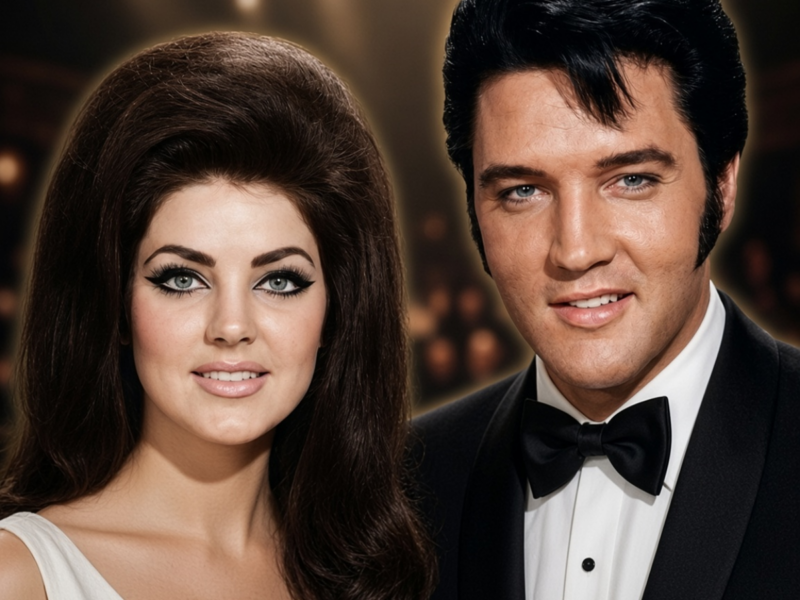
Priscilla’s Marriage With Elvis Was Much Nastier Than You Thought.
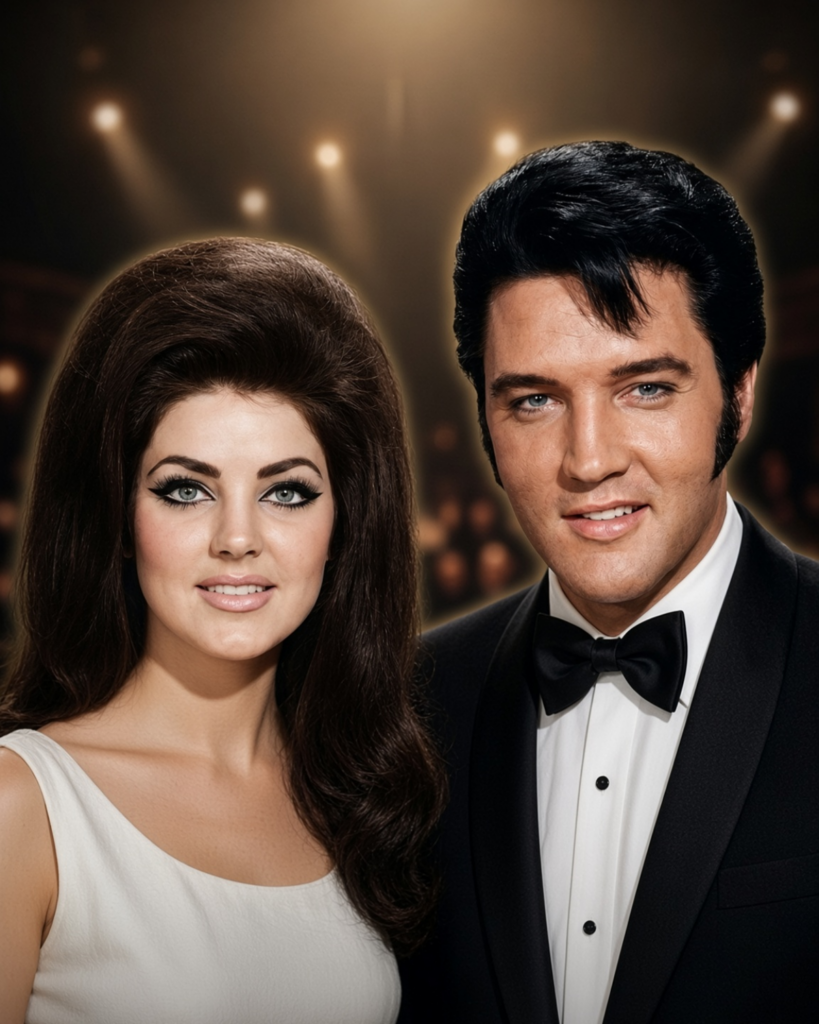
On the 9th of October 1973, Elvis and Priscilla Presley walked out of the Santa Monica courthouse holding hands.
The photographers got exactly the picture they came for.
“The friendliest divorce in show business,” people called it.
But the court file behind that photograph doesn’t read friendly at all.
It holds a 12-page agreement that called itself an equal split and handed her $100,000.
It holds a petition in which she said she had never been told what her own family owned.
And four years later came a will that didn’t name her as an heir.
Half a century on, a judge in Los Angeles would sign one more paper that put her right back beside him.
It started in a rented house in a German spa town.
You know the version America bought.
A lonely young soldier still grieving his mother meets a sweet American girl overseas when his tour ends in March of 1960.
She’s at the air base outside Frankfurt to wave goodbye, and the cameras catch her coat, her ponytail, and her brave little smile.
The fan magazines took it from there.
She waits for him.
He sends for her.
She finishes Catholic high school in Memphis while he’s off in Hollywood making movies, and Graceland becomes her home.
Then on the 1st of May 1967, in a private suite at the Aladdin Hotel in Las Vegas, with a Nevada Supreme Court Justice named David Zenoff reading the vows, the King of Rock and Roll marries the girl who waited.
She wears a white gown and a long veil.
He wears a patterned black tuxedo and the look of a man who finally sat still.
The wedding pictures went around the world in a day.
Nine months later, on the 1st of February 1968, Lisa Marie Presley is born in Memphis.
Four days after that, the new parents pose with her for the press, and the photograph ends up on magazine covers and in scrapbooks in every corner of the country.
Daddy is 33.
Mama is 22.
They look like the happiest people alive.
For the next five years, the official story barely changes.
There are Christmases at Graceland and a famous comeback on the Las Vegas stage in 1969.
If the marriage ends, the legend says it ends because the road is long and the touring never stops.
Even the divorce is gentle.
They hold hands on the way out.
They stay close for the sake of their little girl.
It’s a lovely story, and most of it happened.
What the magazines left out is everything that was written down.
The autumn of 1959.
Priscilla Beaulieu is 14 years old and in the ninth grade.
Her stepfather, Paul Beaulieu, an officer in the United States Air Force, has just been posted to Wiesbaden, West Germany, and the family is still living out of a hotel about 30 miles north in the spa town of Bad Nauheim.
The most famous soldier in the army is renting a house off post.
He’s 24.
Accounts disagree on the exact date.
Some put that first evening in September, others in November.
What they agree on is how it happened.
A serviceman who knew Elvis offered to bring the new girl along to one of the gatherings at the house.
Her parents checked the man out with his commanding officer, and then they said yes.
She went in a navy-and-white sailor dress.
Elvis spent the night singing at the piano for a ninth grader.
Here’s a detail the fan magazines never printed.
Elvis’s army friend Rex Mansfield later said Elvis told him this girl was young enough that he could train her any way he wanted.
That’s Mansfield’s memory, not a recording.
But hold on to it, because the next 14 years read like a plan being carried out.
After a handful of visits, Priscilla’s parents insisted on meeting him.
As she tells it in her memoir, Elvis assured Paul Beaulieu that he was very fond of his daughter and that she was mature for her age.
The Beaulieus let it continue.
Priscilla said in a 2023 interview with The Hollywood Reporter that she’d basically threatened them, that if they hadn’t let her go, she’d have found a way.
Then, in the first days of March 1960, Elvis flew home.
The Army newspaper Stars and Stripes photographed the 14-year-old stepdaughter of an Air Force officer waving him off.
She went back to school.
She wrote him letters in pink envelopes so he could pick them out of the fan mail.
Her parents told her gently that a man like that would forget her.
They were wrong, but not in the way she hoped.
He called.
He kept calling every few months from a world of movie sets and nightclubs she could only read about.
And in 1962, two years after Germany, he asked the Beaulieus to put their 17-year-old daughter on a plane to Los Angeles.
They agreed.
And the girl who got off that plane was not the girl who came home.
According to her account, Elvis bought her new grown-up clothes.
He had her hair and makeup redone the way he liked them.
He added a trip to Las Vegas to the itinerary, and she kept his hours, which meant nights that ended at dawn.
That Christmas, she came back for a visit to Graceland.
And then came the request that changed her life.
Elvis wanted her to finish high school in Memphis.
Her parents said no.
He kept working on them.
She would live, he promised, with his father, Vernon, and Vernon’s wife, Dee, not at Graceland.
He let them understand that marriage was in the picture.
Eventually, the Beaulieus said yes, and Priscilla enrolled at Immaculate Conception High School in Memphis.
She did stay with Vernon and Dee at first.
Before long, she was living at Graceland itself.
She graduated in May of 1963.
What happened to her over the next few years is the part she has described most often in her own words on the record.
Her hair was dyed black to match his.
It went up into a towering style that echoed his pompadour.
Her clothes came in the colors he wore himself.
When Katie Couric asked her about it in 2002, she remembered the smallest rules.
“He didn’t like prints on me,” she said.
In her memoir, she called herself his living doll.
In 2023, she put it more kindly.
“I lived in his world. I wanted to please him,” she told The Hollywood Reporter.
Sofia Coppola’s film Priscilla plays those years as a dress-up game that slowly stops being a game.
In reality, there was no slow part.
She was 17, a long way from her parents, inside the gates of the most famous house in Memphis with a boyfriend who was almost never home.
And when he wasn’t home, he was in Hollywood, where the newspapers were starting to print a name.
In the summer of 1963, Elvis made Viva Las Vegas for MGM.
His co-star was Ann-Margret, a Swedish-born dancer and singer who was every bit his match on screen.
The gossip columns noticed.
Priscilla, back in Memphis, noticed the gossip columns.
When she asked, Elvis told her it was publicity and that she shouldn’t believe what she read.
Then came a story she couldn’t ignore.
According to Priscilla’s memoir, Elvis and Me, reports broke that Ann-Margret had told the press in Los Angeles she was engaged to Elvis Presley.
Ann-Margret’s side has always been that her words were misreported.
Either way, every major paper picked it up.
Priscilla was in California at the time.
She wrote that Elvis told her he and Colonel Parker thought it best if she went back to Memphis until things calmed down.
She picked up a flower vase and threw it across the room.
And the next day, she flew back to Graceland just as she’d been asked.
Notice what Elvis and the Colonel did there.
The rumor was about another woman, and the person who got sent out of town was the girlfriend.
The star got his quiet.
The 18-year-old who lived on his terms got a plane ticket to Tennessee and an empty mansion to wait in.
It wouldn’t be the last time the needs of the career decided where she slept.
That should have been the moment she learned who she was dealing with.
It turned out to be the moment he learned who she was.
She stayed.
Priscilla wrote that after Ann-Margret, she soon began to suspect there were other women.
Elvis’s own friends have said the same in their books.
Ann-Margret, writing her own memoir decades later, described Elvis as a soulmate.
Two women, two books, one man, and neither of them wrong about how they felt.
By the mid-’60s, Priscilla had been living at Graceland for years without a ring, and the people around Elvis worried about how that looked.
In Baz Luhrmann’s film Elvis, Colonel Tom Parker is the villain of the career.
Several biographers suggest he also had a hand in the marriage, nudging his client toward the altar before the arrangement became a scandal.
Shortly before Christmas 1966, Elvis proposed.
The wedding came that May in Las Vegas.
Elvis was 32.
Priscilla was three weeks short of her 22nd birthday.
It was a quick ceremony in a hotel suite, followed by a reception and a press conference.
Exactly one week later, on the 8th of May, 1967, Ann-Margret married the actor Roger Smith.
If anyone in either couple sent a gift, the record doesn’t say.
The ring changed less than Priscilla hoped.
She became pregnant almost immediately, and by her own account, Elvis worried about what fatherhood would do to his image.
She wrote that when she was seven months along, he asked for a trial separation.
It lasted only a short time, and he was there when Lisa Marie arrived.
But she never forgot that he’d asked.
The years that followed are the ones the official photographs cover best and explain least.
Elvis went back on the road and into the showrooms of Las Vegas.
Priscilla raised a baby, often in the couple’s California houses, often alone.
“My life was his life,” she told People magazine in 1978.
“My problems were secondary.”
In Luhrmann’s Elvis, those Vegas years are all rhinestones and standing ovations, with the marriage reduced to a few quiet scenes backstage.
In reality, the marriage was being lived mostly at a distance.
When the divorce case was filed, Elvis himself was reported as saying that a major reason was the pressure of being on the road six months of every year.
Six months on the road meant six months of a wife and a little girl waiting for the phone to ring.
So she started finding things that were hers.
Dance lessons.
Karate, a sport Elvis loved and had encouraged her to try.
And a karate instructor named Mike Stone.
Here is where the story stops having a clear hero.
Elvis had never been faithful to her, by her account and by the accounts of the men around him.
Now she was the one with a secret.
In her memoir, she describes the relationship with Stone.
And in a court filing a year later, Elvis described it too.
According to his counter-petition, as it was quoted in the press, Priscilla told him at Christmas 1971 that she wanted a separation and her freedom.
He said he’d already heard about Mike Stone.
On the 23rd of February, 1972, they stopped living together.
That date isn’t from a fan magazine or a memoir.
It’s typed into a legal document, and that document is where the real story of this marriage is kept.
Before the paperwork, there was a song.
On the 27th of March, 1972, a month after the separation, Elvis walked into RCA’s Studio C at 6363 Sunset Boulevard in Hollywood and recorded a ballad called “Separate Ways.”
It was written by his old friend Red West and a young songwriter named Richard Mainegra.
And it’s about a couple parting and the child caught between them.
His friend Jerry Schilling remembered Elvis playing the tape of it again and again after the session.
Two nights later, he recorded “Always on My Mind.”
Years afterward, Lisa Marie would call “Separate Ways” one of the most painful songs her father ever made and one of the most beautiful.
She was four when he recorded it.
Now the paperwork.
On the 15th of August 1972 in Los Angeles, Elvis Aaron Presley and Priscilla Anne Presley signed a property settlement agreement.
Twelve pages.
Her lawyer was a man named Robert Brock.
His lawyers came from the firm of Hook, Stratton and Irwin.
The agreement opens with a sentence worth reading slowly.
It says the couple listed their property after a complete disclosure of all assets and sources of income.
Then comes the list.
Three houses in California.
One on Hillcrest Road in Beverly Hills.
One on Monovale Drive in Los Angeles.
One in Palm Springs.
A 1971 Mercedes-Benz.
A 1969 Cadillac Eldorado.
A 1971 Harley-Davidson motorcycle.
And cash in various bank accounts.
For a man who had sold records by the hundreds of millions, it’s a remarkably short list.
Here’s how it was divided.
Priscilla got the Mercedes, the Cadillac, the motorcycle, and $100,000 paid in two halves.
The second not due until the 20th of August, 1973.
Elvis got all three houses.
A separate clause declared that everything else he owned, real or personal, wherever it was located, was his own separate property, and that she signed away any claim to it.
And then there’s a one-page supplement signed the same day by both of them.
It says it was the intention of the parties to divide their community assets equally.
Equal is carrying an awful lot of weight in that sentence.
The movie version of this moment is cinematic.
In Coppola’s film, Priscilla drives out past the gates while a famous goodbye song plays.
The real goodbye was a stack of legal paper.
Priscilla signed it four times, counting her initials.
His divorce case went to Santa Monica Superior Court.
As far as anyone around him knew, it was finished.
All that was left was the judge’s signature.
It wasn’t finished.
Priscilla went back to court.
This is the document that turns the whole legend inside out.
Not a tell-all, not a tabloid.
A petition filed by Priscilla Presley before the divorce was final, asking the court to throw out the agreement she’d signed.
The petition was quoted in the press at the time.
And in it, the girl Elvis met in ninth grade tells a judge what her marriage was really like with the music turned off.
She said she’d been living with her husband and his father and the people around them since she was a teenager.
She said she was never involved in business or money.
Then came the line that matters most.
“I was never informed of my income nor the nature and amount of property which we had accumulated.”
She said her bills were paid out of a checking account with no limit, kept full by her husband’s business managers.
She never saw what went in, only what went out.
When Elvis told her that $100,000 was the right amount, she said she assumed it was fair.
And she said that if she had understood she was entitled to half of the community property and to support based on his income and the way they’d lived, she never would have signed.
Think back to what Rex Mansfield said in Germany.
Young enough to be trained any way he wanted.
Here is the result in her own court papers.
The clothes, the hair, the colors, the house rules, all the way down to the checkbook.
Fourteen years inside his world, and she didn’t know what the world was worth.
Elvis answered in court.
According to his counter-petition, as reported at the time, when she seemed determined to get an immediate divorce in July of 1972, he asked her what she wanted.
He said she told him she wanted nothing, only her freedom.
His side denied that she didn’t understand his finances.
Nobody knows exactly what was said between them that July.
Here’s what we do know.
The agreement that was supposed to be final didn’t hold.
On the 9th of October 1973, the divorce went through on new terms.
The next day, a story on the front page of the Tallahassee Democrat announced that Presley and his wife Priscilla were divorced, and that he’d given her a kiss and $1.5 million.
Reports have always varied on the exact breakdown, but the figure most often cited is a lump sum of about $725,000 plus monthly support for her and for Lisa Marie.
So look again at that photograph on the courthouse steps, the two of them holding hands.
It was never a picture of two people who’d parted without a fight.
It was the picture taken on the day she won it.
Here’s the question this story leaves with every one of us.
If you’d moved into a man’s house at 17, let him choose your hair and your clothes and your hours, and then signed away your half because he told you it was fair—would you have gone back to court for it?
Or would you have taken the hundred thousand and the cars and kept the peace?
She went back, and she still left holding his hand.
What came next was ordinary, and for her, that was the point.
That same year, she opened a clothing boutique in Los Angeles called Bis & Beau with her friend and stylist Olivia Bis.
For the first time since the ninth grade, she had a job, a business, and money she could see coming in.
Years later, she told Katie Couric that protecting her daughter had weighed heavily in her decision to go.
And in 2016, she put it more simply in an interview with Entertainment Tonight.
“I did not divorce him because I didn’t love him,” she said.
“He was the love of my life, but I had to find out about the world.”
She never remarried.
Not while he was alive, and not in the nearly 50 years since.
Elvis Presley died at Graceland on the 16th of August, 1977, at 42.
His will named three beneficiaries: his father, his grandmother, and his daughter.
Priscilla wasn’t one of them.
But when Vernon died in 1979, his own will made her one of three co-executors of the estate, alongside a Memphis bank and the family accountant.
The woman who once didn’t know what her family owned was suddenly helping run all of it.
Graceland opened for tours on the 7th of June, 1982.
In 1993, Lisa Marie turned 25 and took control of her inheritance.
In September of 2022, Lisa Marie read the script for Coppola’s film and wrote to the director saying her father came across only as a predator and manipulative, calling the script shockingly vengeful and contemptuous, and saying her mother had spent her whole life elevating her father’s legacy.
Lisa Marie died that January at 54.
Her mother then challenged a change to her daughter’s trust and settled with her granddaughter, Riley Keough, who became sole trustee.
The settlement a judge approved gave Priscilla $1 million.
It also gave her the right to be buried near Elvis in the Meditation Garden at Graceland.
The will left her out.
The paperwork let her back in.









