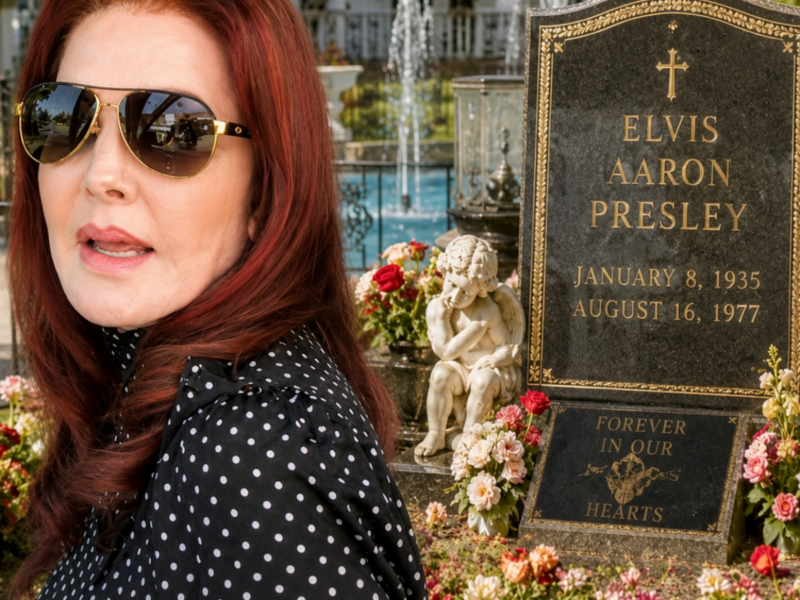
Priscilla Presley Wanted to Be Buried Next to Elvis — Here’s What Happened.
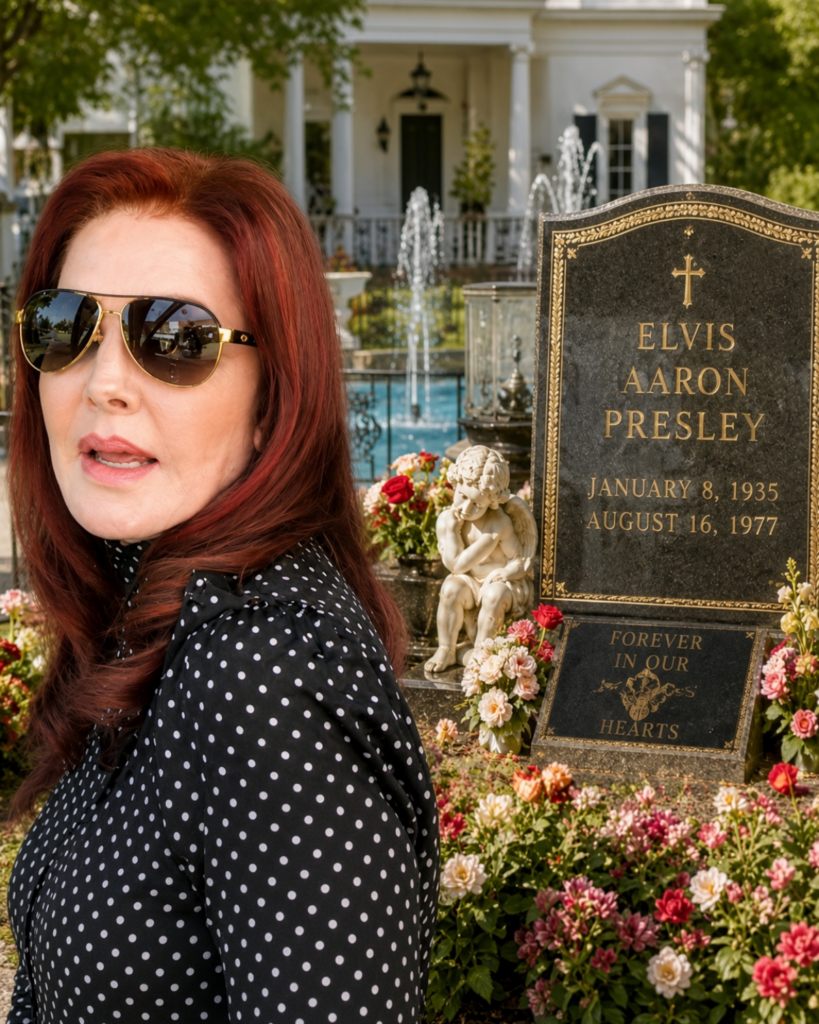
Priscilla Presley asked for one thing, just one.
After everything she had already lost, after everything she had already survived, she asked for the simplest, smallest, most human thing a person can ask for: to be buried next to the man she loved.
You would think that request would be uncontested.
You would think that of all the things a grieving mother could ask for, this one would be granted without a second thought.
A place in the ground, a few feet of soil next to a man she married in 1967 and never really stopped loving.
Not even after the divorce, not even after decades apart, not even after he was gone.
It should have been the easiest request in the world.
It wasn’t.
What actually happened is stranger, messier, and far more revealing than anyone expected.
A story that involves lawyers, a multi-million-dollar trust, a granddaughter who suddenly found herself in charge of an empire, and a family plot that quite literally ran out of room.
And by the end of it, you’re going to understand something about grief, legacy, and ownership that most people never think about until it’s their own family standing over a grave arguing about who belongs where.
So, let’s start where this story actually starts.
Not with Elvis, with Lisa Marie.
January 2023, Priscilla Presley gets a phone call no parent should ever have to receive.
Her only child with Elvis, her daughter, Lisa Marie, has suffered a cardiac arrest at her home in California.
She’s rushed to the hospital.
And later that day, Priscilla has to do the unthinkable.
She has to tell the world that her daughter is gone.
54 years old.
Gone.
Sit with that for a second because everything that follows only makes sense once you understand what Priscilla was carrying in that moment.
This is a woman who had already buried Elvis in 1977, who had already buried her grandson, Benjamin Keough, in 2020.
And now in January of 2023, she is burying her only child, her daughter.
The last living piece of her marriage to Elvis Presley, the person who connected her most directly to the great love and the great heartbreak of her life.
Lisa Marie is laid to rest at Graceland, right where you’d expect, on the estate her father built into a legend, in the meditation garden next to her son Benjamin, just across the fountain from Elvis himself.
Priscilla stands there at the estate that has defined her entire adult life, burying her daughter in the ground her ex-husband is already buried in.
Two of the people she loved most in this world, both gone, both resting in the same small patch of Memphis soil.
You would think that moment, that unbearable singular moment, would be met with nothing but grace and support from everyone around her.
It wasn’t, because underneath the grief, a very different kind of storm was already forming and it had nothing to do with love and everything to do with ownership.
Here’s what most people don’t fully grasp about Graceland.
It is not just a house.
It is not just a museum full of gold records and shag carpet and a jungle room that tourists line up to photograph.
Graceland is an estate worth tens of millions of dollars.
It is a business.
It is a brand.
It is in the most literal legal sense property that has to pass from person to person, generation to generation, according to trusts and wills and legal documents that most families never have to think about because most families don’t own something the entire world wants a piece of.
And in January of 2023, ownership of that property had just shifted.
It now belonged to Riley Keough, Lisa Marie’s daughter, Priscilla’s granddaughter.
34 years old, an accomplished actor in her own right, suddenly thrust into control of one of the most famous estates on the planet.
At the exact moment she was also burying her own mother and, years earlier, her own brother.
Two women, a grandmother and a granddaughter, both devastated, both grieving the same person.
And both, whether they wanted it or not, about to find themselves on opposite sides of a legal fight over what Lisa Marie actually intended for her estate.
Because before Lisa Marie was even properly laid to rest, a dispute erupted, a real one, a legal one, the kind with attorneys and filings and headlines over a 2016 amendment to her trust.
Priscilla challenged it.
She claimed the document naming Riley and Benjamin as the sole trustees wasn’t properly witnessed, wasn’t properly notarized, and had never been delivered to her the way the original terms required.
In plain terms, Priscilla was saying, “This document doesn’t hold up, and I don’t believe it reflects what my daughter actually wanted.”
Riley’s side saw it differently.
And just like that, a mother mourning her only child and a daughter mourning her only mother were suddenly adversaries in a courtroom fighting over control of Graceland, over the Elvis Presley Enterprises stake buried inside that trust, over money, over legacy, over who actually gets to decide how this family’s story moves forward from here.
I want to be honest with you about something.
Family fights over estates are common, painfully, boringly common.
Money does something to grief.
It doesn’t create the conflict, but it gives the conflict a place to live.
A set of documents to argue over, a courtroom to escalate in.
What made this one different wasn’t the money.
It was who was fighting and what was actually at stake underneath all of it.
Because somewhere in the middle of this legal battle, while lawyers were negotiating settlements, while headlines were speculating about how much money would change hands, while the public was watching a beloved American family tear at itself in public, Priscilla made one more request, a quiet one, not about money, not about control of the trust, not about who runs Graceland, or who profits from Elvis’s name.
She wanted to know that when her own time eventually came, she would be allowed to rest beside him.
That’s it.
That was the ask.
After 60 years of being connected to this man, after the marriage, the divorce, the decades of being known first and always as Elvis Presley’s wife, whether she liked it or not, she wanted the one thing that felt permanent, a place next to him forever.
You would think after everything, after burying her daughter, after burying her grandson decades apart, after watching her own granddaughter take control of the very ground her family history was buried in, that this request would be the easy part, the kind gesture, the thing nobody argues about.
It wasn’t.
And what happened when that request actually reached the negotiating table is going to tell you more about this family, about grief, about legacy, and about what it really means to belong somewhere than anything else in this entire story.
Because the answer Priscilla got back wasn’t yes.
According to reporting from TMZ, when the settlement negotiations over Lisa Marie’s trust were finally hammered out, Priscilla did walk away with something.
Millions of dollars reportedly in exchange for stepping back from her legal challenge against Riley Keough.
Money changed hands, documents were signed.
On paper, the biggest, loudest part of the fight was over.
But the other thing she asked for, the quiet thing, the personal thing, the request to be buried next to Elvis, got a very different response.
TMZ reported that it was treated as a non-starter, not up for debate, not something worth extended discussion.
According to that same reporting, Priscilla backed down on it almost immediately without much of a fight at all.
Think about the contrast there for a second.
This was a woman who had just spent months in a legal battle over tens of millions of dollars over control of an empire, over the legacy of the man she’d once married.
And she fought that fight.
She pushed.
She challenged documents.
She hired attorneys.
She went the distance on the money and the ownership and the control.
But on the one request that had nothing to do with any of that, the one that was purely simply about love, about wanting to spend eternity near the person she’d never really stopped loving, she folded almost instantly.
Why would that be the thing she didn’t fight for?
Part of the answer isn’t emotional at all.
It’s structural.
It’s physical.
It’s about dirt and geography and the unforgiving math of a family plot that was never designed to hold everyone who would eventually want a place in it.
Let me walk you through what that ground actually looks like.
Because once you understand the layout, you understand exactly why this request ran into a wall.
Elvis Presley is buried in the meditation garden at Graceland, and he is not buried alone in some open stretch of grass with room to spare.
He is buried in a specific fixed arrangement flanked on either side.
On one side of him rest his parents, Vernon and Gladys Presley.
On the other side rests his grandmother, Minnie Mae.
That is the immediate ring around Elvis, his mother, his father, his grandmother, the people who raised him, who came before him, who were there from the very beginning.
Across a small fountain on the opposite side of that same garden is where the newer additions to the family now rest.
Lisa Marie, who died in January of 2023, and her son Benjamin Keough, who died in 2020, mother and son together in that section of the garden.
So, look at the actual layout for a moment.
Elvis boxed in by his parents and his grandmother on either side, Lisa Marie and Benjamin together across the water.
Every space that currently exists in that garden already belongs to someone.
There is no quiet gap of unclaimed earth sitting next to Elvis Presley waiting for the next name to be carved into it.
Which means Priscilla’s request wasn’t just an emotional ask.
It was a logistical one, to be buried directly beside him, physically next to him the way she was picturing it.
Something would have had to move.
A grave.
An actual grave holding an actual member of this family would have needed to be relocated to make room for her.
Think about what that would have required.
Either Vernon Presley’s remains or Gladys Presley’s remains or Minnie Mae’s remains, someone’s grandmother, someone’s mother, someone’s father would have had to be dug up and moved to accommodate a new arrangement just so Priscilla’s grave could sit exactly where she wanted it.
That is not a small ask.
That is not a simple line item in a legal settlement.
That’s asking a family to disturb their own dead in order to make room for someone who legally hadn’t been married to Elvis in nearly 50 years.
Suddenly, the word non-starter makes a lot more sense.
And I think that’s worth sitting with because it reframes everything about this moment.
This wasn’t necessarily Riley Keough being cold or the estate being cruel or anyone trying to shut Priscilla out of the family plot out of spite.
It might have simply been an impossible physical request wrapped inside a family already stretched to its emotional limit, negotiated in the middle of a legal fight that had already asked everyone involved for more than they had left to give.
But knowing why doesn’t make it hurt any less.
Because here’s the thing about grief.
It doesn’t care about logistics.
It doesn’t care about who’s already buried where or what would need to be moved or what’s practical.
Grief just wants what it wants.
And what Priscilla wanted in the middle of burying her only child was to know that her own ending was already decided.
That there was a place waiting for her.
That when her time came, she wouldn’t be a footnote at the edge of someone else’s family plot.
She would be exactly where she’d always pictured herself, next to him.
She said as much in her own words in a statement given around this time.
Speaking about her wishes, she made clear that being laid to rest with her daughter and with the man she called the love of her life was something she and her family wanted, plainly, without hedging, without complication.
It wasn’t a legal maneuver.
It wasn’t a strategic ask designed to extract something else from the settlement.
It was just what she wanted.
And for a moment, it looked like she wasn’t going to get it.
Picture what that must have actually felt like for her.
60 years connected to this man’s name.
Married to him for five of those years.
Divorced from him for the other 50-plus, but never fully separate from him in the eyes of the public or, it seems, in her own heart.
She raised his daughter.
She protected his legacy for decades after his death.
Sometimes at real personal cost.
Fielding endless questions about their marriage, their divorce, their complicated history, always as the woman who used to be his wife.
And now in her late 70s, having just buried that same daughter, she’s told that the one thing she wanted for herself, a resting place beside him, isn’t something the family plot can accommodate.
For a woman who has spent most of her adult life being defined by her connection to Elvis Presley, being told there’s no room for her next to him carries a weight that goes far beyond real estate.
It’s not about six feet of dirt.
It’s about belonging.
It’s about whether after everything, after the marriage ended, after the divorce, after decades of being the ex-wife rather than the widow, after burying their daughter together in spirit, if not in person, she still counts as family in the most literal physical sense of that word.
And for a moment, the answer the settlement gave her was no.
Not out of malice, not out of cruelty, just out of the simple unromantic reality that a garden built for one family’s original core, a mother, a father, a grandmother, had no more room to expand without disturbing someone who was already there.
Priscilla accepted it quietly, without a prolonged fight.
She had already spent everything she had fighting over the trust, over the money, over the control of an empire that never quite felt fully hers to fight for in the first place.
This was one battle too many, and she let it go.
But here’s what I need you to hold on to, because this is where the story takes its first real turn.
This wasn’t the end.
Months later, a new court filing would surface.
Quietly, almost as an afterthought, buried inside a much larger legal document, a stipulation would appear that nobody expected, one that would reopen the exact question everyone thought had already been settled.
And the person who held the power to grant it or deny it forever wasn’t a judge, and it wasn’t a lawyer.
It was Riley Keough.
And in June of 2023, a court filing revealed that she had done something nobody expected.
A petition detailing the settlement between Priscilla and Riley, the same settlement that had already handed over money, resolved the trust dispute, and seemingly closed the door on the burial request, included a new stipulation buried inside the legal language.
It stated that Riley Keough, as the owner of Graceland, would allow her grandmother to be buried in the meditation garden.
Not denied, not a non-starter anymore.
Allowed.
Think about how quickly that reversal happened.
Weeks earlier, this exact request had reportedly been shut down without much discussion.
And now, quietly, without a press conference or a public statement, it had been written into a legal document and filed with a court.
According to the reporting that surfaced afterward, the petition specified that Riley, using her authority as the estate’s owner, would permit her grandmother a burial and a memorial service on the grounds.
So, what changed?
Maybe nothing changed in terms of the physical space.
The garden was exactly the same size it had always been.
Elvis was still boxed in by his parents on one side and his grandmother on the other.
Lisa Marie and Benjamin were still resting across the fountain.
No new plot of land had appeared out of nowhere.
What changed was the willingness to find a way to make it work within the space that already existed.
And here’s the part of this story that I think matters more than any of the legal back and forth.
Because when the details of the arrangement became clear, it turned out Priscilla still wasn’t getting exactly what she’d originally pictured.
She would not be buried directly beside Elvis.
That spot, as we already covered, physically does not exist without moving another grave, and nobody was going to disturb Vernon or Gladys or Minnie Mae to make room.
Instead, the agreement specified that Priscilla would be buried as close to Elvis as possible without relocating any existing grave site, near him, adjacent to him, close enough to be part of that same sacred ring of family in the meditation garden, but not touching, not directly beside, not the exact spot she’d once hoped for.
I want you to really sit with that distinction because I think it’s the emotional center of this entire story.
Close but not exact.
Present but not central.
A woman who spent her entire adult identity intertwined with this man’s name and legacy finally granted a place in the ground with him.
And even then, the physical reality of that place comes with an asterisk: near him as close as the space allows.
Not next to him in the way she originally meant.
Is that a victory?
In one sense, absolutely.
She got what most people would consider the important part, a permanent place at Graceland in the same garden, part of the same family circle that includes her daughter and grandson and the man she loved.
That’s not nothing.
For a lot of families, that would be more than enough.
But for Priscilla, who had been specific about wanting to be laid to rest with her daughter, and in her own words, the love of her life, close and next to are not quite the same promise.
One is generous, the other is exact, and the settlement only delivered the first one.
We actually know how much this meant to her because she didn’t stay quiet about it.
Later that year, in an interview on Piers Morgan’s program, Priscilla spoke directly about her feelings on being buried at Graceland.
She described her feelings about it as great, that it was, in her words, what she wanted and had always wanted.
When Morgan asked her directly whether she wanted to be buried next to Elvis, she said yes.
When he pressed her on whether it would actually happen, she said yes.
Again, simple answers, no hesitation.
This wasn’t a woman treating the question as complicated or uncomfortable.
It was something she’d clearly already made peace with, something she’d already decided a long time before any courtroom got involved.
And that’s worth pausing on because it tells you this wasn’t a passing wish invented for the sake of a legal negotiation.
This was something she had wanted for a long time, long before Lisa Marie’s death forced the family into crisis, long before a courtroom became involved in deciding where she would eventually rest.
The tragedy of her daughter’s death simply forced the question into the open, turned a private hope into a matter that lawyers and judges and granddaughters would ultimately have to weigh in on.
I think it’s worth widening the lens here for a second because this isn’t really just a story about one grave.
It’s a story about what that garden has quietly become for this family, a kind of physical map of belonging.
On one side, Elvis, flanked by the parents and grandmother who raised him, the original core of the Presley family, the people who were there before any of the fame, before Priscilla, before any of what came after.
On the other side of the fountain, Lisa Marie and Benjamin, the next generation, the ones who inherited both the legacy and the tragedy that so often seemed to follow this family.
And now somewhere in the space between or around those two clusters, Priscilla finally granted her place, but positioned by circumstance rather than by original intention.
It’s almost impossible not to read something into that geography.
The wife who came into this family through marriage, who was never buried among the parents who raised him, who instead ends up near but distinct from both generations, present in the garden, part of the family circle, but still in some small and permanent way, standing slightly outside the exact center of it.
Whether that was ever anyone’s intention, or just the unavoidable outcome of a plot of land that ran out of room decades before anyone thought to plan for a widow who wasn’t technically a widow at all, that’s something the layout itself can’t answer.
It just shows you the outcome.
The settlement was formally approved by a judge in October of 2023.
Judge Lynn Scaduto signed off on the full agreement which included not just the burial arrangement, but a broader financial resolution, a lump sum for Priscilla drawn from Lisa Marie’s life insurance policy along with an annual payment tied to her role advising the trust on its stake in Elvis Presley Enterprises.
On paper, this was the moment everything officially closed.
The lawsuits ended, the disputes were resolved.
The family’s legal chapter, at least, came to a close.
But something about this story still lingers past the paperwork, past the judge’s signature, past the official statements about the family resolving their differences together.
Because underneath all of it is a much simpler, much harder question that no settlement can really answer.
Why did it take a legal battle, a trust dispute, a granddaughter’s permission, a judge’s signature to grant an aging widow her one request to be near the man she loved when she died?
Why couldn’t that have just been given freely the moment she asked?
That question doesn’t have a clean answer, and maybe that’s exactly the point.
Because if you step back far enough from the lawyers and the filings and the court dates, you start to realize this was never really a fight about six feet of garden space.
It was a fight about something much bigger and much harder to put into a legal document.
Legacy, ownership, and who gets to decide how a family’s story actually ends.
Think about what Graceland has become over the last 50 years.
It stopped being just a home a long time ago.
It’s a business worth tens of millions of dollars.
It’s a brand recognized around the entire world.
It’s a piece of American cultural history that thousands of strangers walk through every single year, paying for the privilege of standing in rooms that used to just be somebody’s living room, somebody’s kitchen, somebody’s grandmother’s bedroom.
When you own something like that, decisions that would be simple for any other family, where to bury a relative, how much space to set aside, who gets a place in the family plot, stop being simple.
They become legal questions.
They become financial questions.
They become questions that have to be settled with signatures and judges because the ground itself is worth something now in ways it never used to be.
That’s the world Priscilla was negotiating inside.
Not really a garden, an estate, an asset, a legacy with a dollar value attached to it, and a granddaughter who now controlled every part of what happened to it next.
And here’s what I think gets lost in a story like this if you only look at the legal headlines.
Priscilla Presley and Elvis Presley were only married for five years.
Five years out of a life that has now stretched on for decades past his death.
They divorced in 1973.
He died in 1977.
That means Priscilla has spent nearly 50 years of her life as his ex-wife.
Far, far longer than she ever spent as his wife.
By any ordinary measure, five years of marriage followed by 50 years apart wouldn’t typically be the foundation someone builds their entire identity around.
And yet here she is in her late 70s going to court, negotiating a legal settlement specifically to make sure that when she dies, she ends up as close as possible to a man she was only legally married to for a fraction of her adult life.
That tells you something.
It tells you that whatever happened between them, whatever ended the marriage, whatever came after it, this wasn’t a connection that faded the way most divorces eventually do.
She spent the rest of her life protecting his image, managing his legacy, raising their daughter in his shadow and in his honor.
And now at the very end, fighting to make sure she’s remembered as part of his story, permanently, in the ground itself.
That’s not nothing.
That’s someone who never really let go.
Now, put yourself on the other side of this fight for a moment because it’s easy in a story like this to only see Priscilla’s side of it.
The grieving mother, the aging widow, the woman just asking for one small thing.
But there’s another person at the center of this who deserves just as much understanding, and that’s Riley Keough.
Riley was 34 years old when all of this happened.
34.
And suddenly the owner of Graceland, suddenly responsible for one of the most scrutinized estates on the planet.
And she inherited that responsibility in the worst possible way, by burying her own mother.
Lisa Marie Presley wasn’t just a public figure to Riley.
She was her mom.
And Benjamin, whose grave now sits beside Lisa Marie’s in that same garden, wasn’t just a name in a news story.
He was her brother, gone three years earlier, a loss that never really has a clean ending for anyone who survives it.
So, while all of this legal maneuvering was happening, while headlines were speculating about settlements and payouts and who was really in the right, Riley Keough was a young woman making decisions about her family’s literal resting ground while still in the middle of her own devastating grief.
She had to weigh her grandmother’s wishes against the physical reality of a garden that had no more room.
She had to decide how much authority to exercise, how much compassion to extend, all while carrying losses that would break most people entirely.
Whatever frustration or confusion people felt watching this play out from the outside, it’s worth remembering that inside that family, this wasn’t a business dispute.
It was grief wearing the clothes of a legal case because grief doesn’t always have anywhere else to go.
And maybe that’s why in the end the outcome wasn’t a clean yes or a clean no.
It was something in between.
Close but not exact.
Granted, but with limits.
Because that’s usually how real families resolve real pain.
Not with a perfect satisfying answer, but with a compromise that leaves almost everyone a little bit unsatisfied and a little bit at peace.









