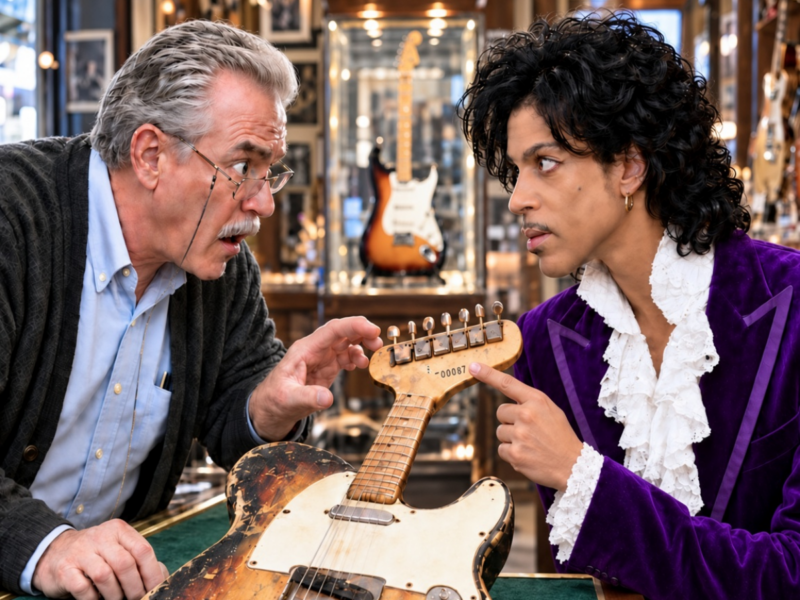
Prince Walks Into A Guitar Shop — What He Finds In The Corner Costs The Owner Everything.
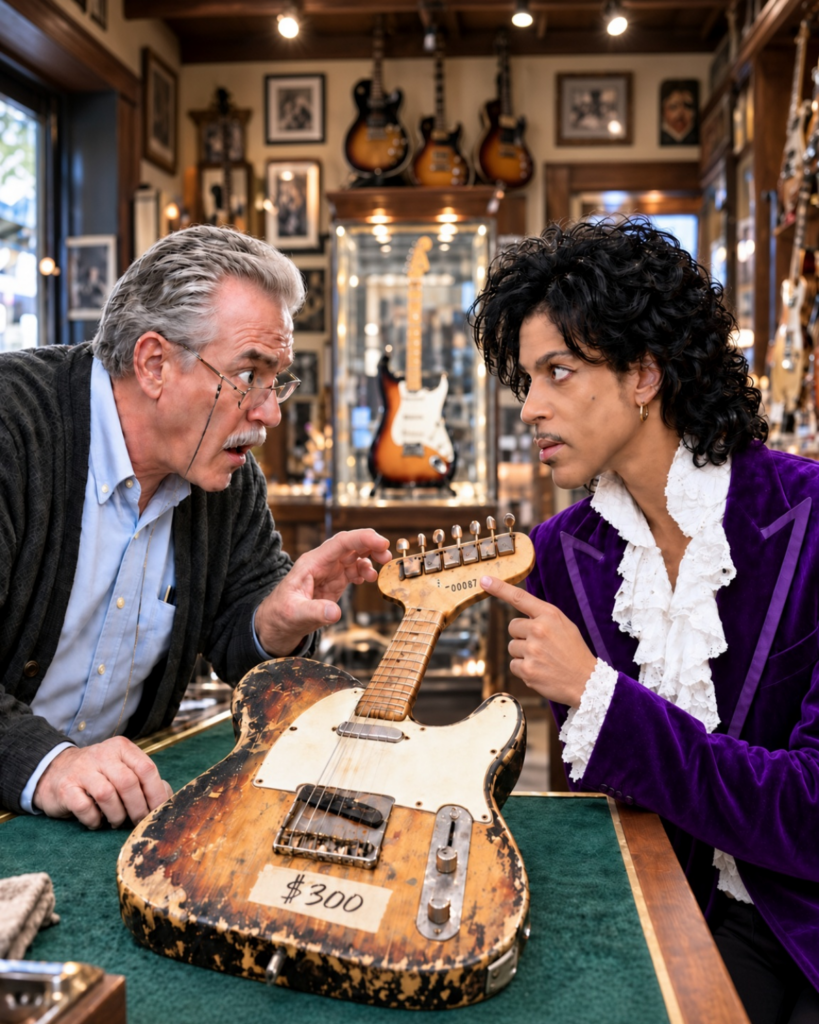
On April 16, 2011, at 2:47 in the afternoon, Prince Rogers Nelson pushed open the door of Norman’s Rare Guitars on Sunset Boulevard in West Hollywood.
A small brass chime overhead rang once into a shop that had, for the last 35 years, prided itself on knowing exactly who was walking through it.
Behind the desk, 58-year-old Norman Harris did not raise his head.
He was polishing a 1959 Gibson Les Paul worth more than most people’s houses.
And he had learned over three and a half decades that the customers whose feet mattered were the customers whose feet made noise.
This one didn’t.
This one was moving quietly, deliberately, hands out of pockets.
And Norman, without looking, mentally sorted the visitor into the largest category his shop received: the browser, the tire kicker, the $2,000 budget on a five-figure day.
The man he had not looked at was 53 years old, no taller than 5’2″, and he was dressed with the precise strangeness of a man who had never once in his adult life dressed to be forgotten.
Prince wore a rich royal purple velvet suit jacket with narrow satin lapels worn open over a crisp white lace shirt whose front broke into a voluminous ruffled jabot, and matching royal purple tailored trousers that fell against black Cuban-heeled ankle boots.
He wore dark aviator sunglasses.
He kept his hands where Norman could see them.
He was three blocks from Sunset Sound Studios where he had spent the morning finishing a session, and he had not intended to stop anywhere on the walk to his car.
But something in the shop’s front window had caught him.
A pale blue Stratocaster in a display case, and one guitar was reason enough.
He was here now.
Norman finally looked up.
He looked up the way a doorman looks up: fast, evaluative, done in a second.
Not our typical clientele, he thought without moving his face.
He noted the sunglasses and the small stature and the strangeness of the suit.
And he made a category error he would remember for the rest of his life.
He assumed eccentricity.
He assumed budget.
He assumed the visitor would look for three minutes, touch two things, and leave.
He set the Les Paul down carefully on a felt pad, stood, and walked out from behind the desk toward the man with a smile that did not quite reach his eyes.
“Can I help you find something?” he called out in the voice men use when they are hoping the answer is no.
Prince turned his head one small degree, just looking at the Strats.
His voice was quiet, almost shy, and there was something in the way he said it that a person who had spent his life listening to guitar players would have caught immediately.
Norman did not catch it.
Norman heard only the softness, and softness in his shop had for decades meant tourist.
He gestured toward the glass case at the back of the shop.
This was the case that held his crown.
This was where 35 years of Norman Harris had settled into their most polished form.
Inside sat a 1964 Fender Stratocaster in three-tone sunburst, all original parts, mint condition, one owner from Detroit, 40 years in a climate-controlled case.
Norman lifted it out with the small theatrical care he had rehearsed for a thousand collectors.
He set it on the counter between them.
“1964 pre-CBS,” he said, letting the words carry.
“$45,000.”
Prince nodded slowly.
He did not flinch.
He did not gasp.
He did not, Norman noticed with a small internal frown, do any of the things a man on a $2,000 budget does when he is shown $45,000 laid out flat under fluorescent light.
He simply looked.
And then he asked the sentence that decided the rest of the afternoon.
“Can I see it?”
Norman’s expression tightened in a way that did not quite become impolite.
“This is a very valuable instrument,” he said, hearing the words come out of his own mouth as if from another room.
“I typically require proof of funds before allowing customers to handle pieces in this price range.”
Prince said nothing for one beat.
Then he straightened up, said, “I understand,” and turned away from the glass case entirely.
Norman felt the small internal satisfaction of a man who has said no cleanly.
Good, he thought.
Didn’t waste too much time on a looker.
Which brings the story back to what Norman did not know, which was that Prince Rogers Nelson had spent 35 years developing a relationship with guitars that had nothing to do with the way Norman Harris had spent his own 35 years developing a relationship with guitars.
Norman collected.
Prince listened.
Norman knew prices.
Prince knew languages.
And the third fact Norman would never quite recover from was that Prince at that exact second was not walking out.
He was walking to the left wall of the shop.
The section Norman kept for trade-ins with cosmetic damage.
The section Norman planned to sell to pawn shops in bulk.
The section Norman barely glanced at anymore.
He was walking toward a shelf so dusty it caught the sunlight in visible motes.
He crouched down in front of the bottom shelf.
Norman, watching from across the shop, felt a small flicker of confusion.
Behind a cardboard box, half hidden, sat a beat-up Fender Telecaster with a faded finish, scratches down the body, rusty strings, and a price tag scrawled on masking tape.
$300.
Prince reached past the cardboard box and picked the guitar up.
He held it the way people hold sleeping animals.
Norman called across the shop, already reaching for the answer he did not need to think about.
“Sir, that’s just a trade-in. Came in last month. It needs so much work. If you’re looking for something playable, I’d recommend the back room. Better bang for your buck.”
Prince did not answer.
He was turning the Telecaster over slowly.
He was examining the back of the headstock, then the neck pocket, then the fretware, then the finish under the pickguard.
His fingers moved along the wood with the exact concentration of a man reading a page.
Norman walked over.
“Now that guitar needs new strings, a full setup, probably a fret job. I’ve got it marked at 300, but honestly, I’d let it go for two.”
He paused, expecting the guest to look up and thank him for the offer.
The guest did not look up.
Instead, still holding the guitar, still bent slightly toward it, the guest said very quietly, “How much do you think this is worth?”
Norman glanced at the masking tape price and gave the answer he had already given.
“Two hundred, maybe 250 if I’m being generous.”
Prince stood up.
He raised his head.
And for the first time since he had entered the shop, he removed his dark aviator sunglasses.
He looked at Norman directly.
“It’s worth $50,000.”
For one second, Norman waited for a punchline.
When none arrived, he laughed a small, nervous laugh.
The laugh a man laughs when a joke has landed wrong at a dinner table.
“I’m sorry, what?”
“This guitar,” Prince said, “is worth $50,000.”
Norman’s smile faded slowly.
He looked at the guest.
He looked at the guitar.
He looked at the guest again.
He was about to say something dismissive, the kind of sentence a man says to end a conversation and reclaim a shop, when Prince turned the Telecaster over and pointed one slim brown finger at the back of the headstock.
“Look,” Prince said.
Norman looked.
Under years of dust and shop grime, barely visible, was a small number stamping.
Not a factory stamp.
A hand-stamped custom number in a format Norman had never seen on a production Fender.
Norman took the guitar from Prince’s hands.
He carried it to his own desk.
He turned on the swing-arm lamp that lived above his felt pad, the same lamp he used for the Les Paul.
He wiped the back of the headstock with a shammy cloth.
The number came clearer.
It was still not a format Norman recognized.
His pulse unhelpfully chose that moment to make itself known.
“This,” Prince said, having followed him to the desk, “is a 1950 Telecaster prototype. One of maybe twelve ever built before Fender officially released the Telecaster to the public.”
Norman said nothing.
He did not know how to say anything.
Prince, without asking, reached across the desk and turned the guitar over into the neck pocket.
“See these tool marks? That’s Leo Fender’s milling pattern. He hand-shaped the early prototypes himself. There’s no jig for those. You can’t replicate them cleanly with modern tooling.”
He ran his thumb along a specific wear pattern on the neck.
“This is 60 years of playing. You can’t fake that. Fretwear, wood oxidation, the shape of a finger groove on the third fret. This guitar was used hard.”
Norman, still holding the shammy, sat down on his own stool without deciding to.
“Where did this come from?” Prince asked.
Norman’s voice when it came was smaller than he was used to.
“Trade-in. A kid last month. His grandfather had died. He said he’d found it in the garage. Wanted cash fast for the funeral.”
Prince nodded slowly.
“The grandfather. Do you know what he did?”
“I don’t know. I didn’t ask.”
Prince nodded again.
His face did not change.
“Probably a session player. 1950s Los Angeles. Fender used to give prototypes to local musicians for road testing. There was no formal program. Leo would find a kid at a Saturday night dance in Fullerton who could really play, hand him an instrument, tell him to bring it back in a month with notes on what needed fixing, and half the time the kid wouldn’t bring it back. Most of them got lost, sold, thrown out, played into the ground by second and third owners who had no idea what they had. This is one of maybe three known to still exist.”
He paused.
“The kid you took this from probably could have paid for that funeral three times over on the value of what he handed you across the counter.”
Norman put the shammy down on the desk.
He looked at the Telecaster.
Then he said very quietly, more to himself than to Prince, “I was going to sell this to a pawn shop next week in a bulk lot.”
Prince set the guitar down carefully on the felt pad next to the Les Paul, and he did something Norman would replay for years afterwards.
He turned toward the glass case at the back of the shop.
He pointed.
“That $45,000 Strat you showed me? It’s perfect. Museum condition, original parts. It sat in a climate-controlled case for 40 years being protected.”
Then he pointed at the Telecaster on the felt pad.
“This guitar was lived. It was played in studios. It was possibly played on records you have heard a thousand times. The scratches are not damage. They are history. You were looking for perfection. So you missed the guitar that had a soul. Perfection has a market. Soul has a story. In the long run, the story is what people pay for.”
Norman stared at the guitar.
He was forming a sentence, several sentences, but they were all one sentence dressed differently.
He said, finally, “I’ve been doing this 35 years. How did I miss this?”
Prince put his sunglasses back on.
“Because you were looking for the wrong things.”
Norman found his voice again on the last question he had left.
“Who are you?”
Prince was already halfway to the door.
He stopped, one hand on the door frame, and he turned.
The lace jabot caught the front window light for one moment.
“Prince,” he said.
Norman’s face went completely, comprehensively pale.
Every recognition that had failed him in the last 30 minutes arrived at once.
“Prince. Your Prince.”
Prince opened the door.
The brass chime rang once.
Then he stopped and turned back and delivered the sentence that decided how Norman Harris would tell this story for the rest of his working life.
“One more thing. When you sell this, don’t let it go to a collector who’s going to lock it away. Find someone who will appreciate what it is. Maybe even play it. That’s what Leo Fender would have wanted.”
He left.
The door closed.
The chime settled.
Norman stood alone in his shop, staring at a $50,000 guitar he had been three business days away from throwing away.
Which brings the story back to the phone call he made two weeks later.
He called Fender’s custom shop in Corona.
He asked them very calmly to send him their most experienced vintage authenticator.
Three days later, 62-year-old Michael Stevens flew into LAX with a small aluminum case of magnification tools, a UV lamp, a set of chemical test kits, and 30 years of authentication credentials.
He spent six hours in Norman’s shop.
He examined the serial number.
He examined the tool marks.
He examined the wood grain, the oxidation patterns, the neck pocket, the exact placement of the bridge saddles.
At hour five, without looking up from the magnifier, he asked Norman, “Where did you get this?”
Norman answered honestly.
“A kid. His grandfather. He needed funeral money. I was going to sell it to a pawn shop.”
Michael Stevens set the magnifier down.
His face lost a small amount of its usual color.
“Do you know what this is?”
Norman said, “Prince told me it’s a 1950 prototype.”
“Prince?”
“Prince Rogers. Yeah. He walked into the shop two weeks ago, picked it up from the corner, told me it was worth 50.”
Michael Stevens closed his case slowly.
“Prince was being conservative. This is one of Leo Fender’s personal test guitars. The serial number puts it in the batch used for the 1951 catalog photo shoot. That makes it museum grade. The auction estimate is going to be 65 to 85,000 and it will do better than the estimate.”
He paused.
“You are about to sell this to a pawn shop.”
Norman nodded.
He looked at the guitar.
He looked at Michael.
He looked back at the guitar.
Michael Stevens, who had spent 30 years telling other people they had valuable instruments, said the sentence he had never had to say before.
“Prince saved you from the biggest mistake of your career.”
In July of 2011, the Telecaster went to auction at Christie’s in New York.
Norman flew in for it.
He wore his best jacket.
The room was full of collectors he had known for decades and several he had only ever spoken to over the phone.
The lot was announced.
The catalog description called it one of eleven known 1950 Broadcaster-era Telecaster prototypes authenticated by Michael Stevens, Fender Custom Shop, and privately identified by Prince Rogers Nelson.
A murmur moved through the room at the second name.
Two paddles went up before the auctioneer had finished reading the description.
When the hammer came down at $73,500, Norman felt neither relief nor pride.
He felt something closer to gratitude.
He walked out of the auction house onto Rockefeller Plaza in the summer heat and he thought about Leo Fender and the grandfather in the garage and the kid who had needed funeral money and the small man in the royal purple velvet suit who had crouched down in front of a dusty shelf and lifted the guitar with the care of someone waking a sleeping animal.
Norman later heard through a mutual dealer that the winning bidder was a musician, not a collector, and that the musician had promised the auction house he would play it publicly at least once a year.
Norman kept that promise pinned to the corner of his register on a small yellow sticky note for the next 13 years.
His commission from the sale was $7,350.
He used it to hire a part-time authenticator.
He wrote a new policy for the shop, handwritten and taped inside the register drawer where only he and his staff would ever see it.
“Every trade-in gets professionally examined. No exceptions.”
He gave one interview to Guitar Player magazine six months later.
The reporter asked him what Prince had taught him.
Norman said that “I’d spent 35 years looking at guitars wrong. I was chasing perfection. But the most valuable instruments are the ones that have been used. The beat-up guitar in the corner might be worth ten times the pristine one in the case. You just have to know how to look.”
The reporter asked what the most important lesson had been.
Norman thought for a long time.
“That the things we overlook are often the things we need most. I was so focused on the expensive guitars and glass cases that I almost threw away something priceless. Prince saw what I couldn’t. Not because he was smarter, because he was looking for different things. I was looking for perfection. He was looking for soul.”
Five years later, on April 21, 2016, Prince died at Paisley Park.
Norman heard the news the way most people heard it: at the counter, from a customer, in the middle of an ordinary Thursday.
He had a couple in the shop looking at a 1962 Jazzmaster and a young father showing his teenage son a beginner Squier by the door.
The customer who told him leaned on the counter and said, “Did you hear about Prince?”
And Norman knew from the shape of the sentence what the second half was going to be before the customer said it.
He set down the price tag he had been writing.
He asked once very quietly, “When?”
The customer said, “This morning.”
Norman nodded.
He walked over to the couple looking at the Jazzmaster and told them, without explaining, that he was going to close the shop early today.
They understood without asking, which is the kind of small mercy that happens in a shop like Norman’s on a day like that.
He closed the shop for the day.
Before he locked the front door, he wrote a small sign in black marker on plain white card stock and taped it inside the window.
“Closed in honor of the man who taught me to look in the corners.”
The sign stayed up for a week.
Then Norman took it down, took it home that night, and had it framed the next morning.
It hangs behind his counter to this day.
By 2024, 13 years after the afternoon of April 16, 2011, Norman’s Rare Guitars is still open.
And Norman Harris, now 71, still runs the shop.
On the wall behind his desk, above the felt pad where he still polishes the same 1959 Les Paul, there is a framed photograph of Prince walking down Sunset Boulevard sometime in 2011.
In a royal purple velvet jacket, in dark aviator sunglasses.
Norman found the photograph online after Prince died.
Next to it hangs the framed sign from 2016.
Below both hangs a small brass plaque Norman made himself, engraved with seven lines.
“April 16, 2011. Prince taught me that value isn’t always visible. The dusty guitar in the corner changed my life. Not because of what it sold for, but because of what it taught me. Look beyond perfection. Look for history. Look for soul. Norman Harris.”
Michael Stevens, the authenticator, kept in touch with Norman for a few years after the auction.
He mentioned the encounter once at a Fender historian’s dinner in 2014, and the room went quiet in the exact way rooms go quiet when an off-hand story turns out to be a legendary one.
He said that in 30 years of authentication, he had verified maybe a dozen prototypes in the wild, but he had never before authenticated one that had been correctly identified from ten feet away in under two minutes by a customer who did not work in the trade.
He said that when he told the story to younger authenticators, the lesson he tried to pass on was not about serial numbers.
It was about attention.
Prince, Michael said, had spent his entire life paying a kind of attention to instruments that most professionals never fully develop, and it had turned him into an authenticator without a title.
Norman gave one final interview in 2023 for a small documentary about Prince.
The interviewer asked him if he regretted not recognizing Prince when he had walked in.
Norman said, “Every day. But also, I’m grateful I didn’t. Because if I had known it was Prince, I would have treated him like a celebrity. I would have shown him the expensive guitars. I would have given him the VIP experience. Instead, he was just another customer I underestimated. And that is exactly what I needed. To be humbled. To be taught. If he had walked in as Prince the Legend, I would have learned nothing. But he walked in as a small man in a royal purple suit and dark glasses, and I learned everything.”
The interviewer asked him what he would say to Prince if he could.
Norman’s eyes filled with tears.
He said, “Thank you for not destroying me when you could have. Thank you for teaching instead of lecturing. Thank you for seeing value in a guitar I was about to throw away. And thank you for reminding me that expertise without humility is just arrogance.”
He took a long breath and then he said the sentence that ended the documentary.
“You didn’t just find a valuable guitar that day. You found a worthless dealer, and you made him better.”









