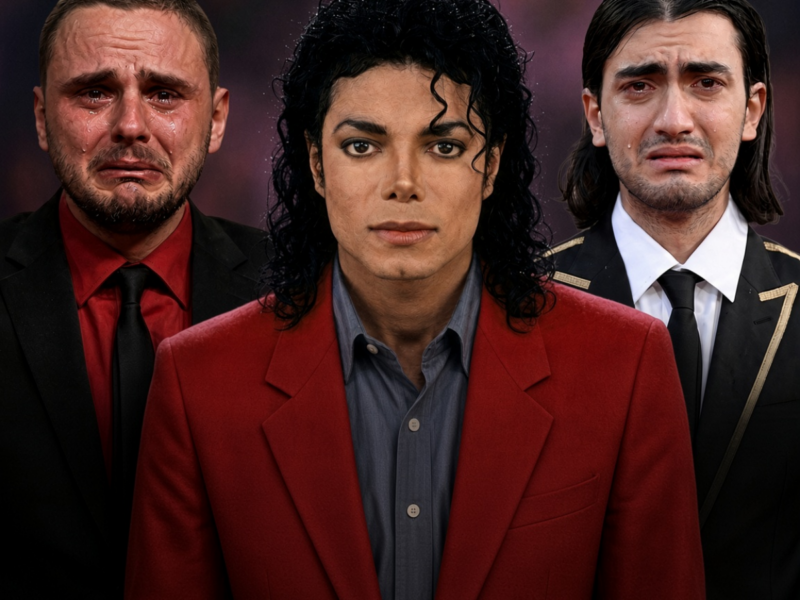
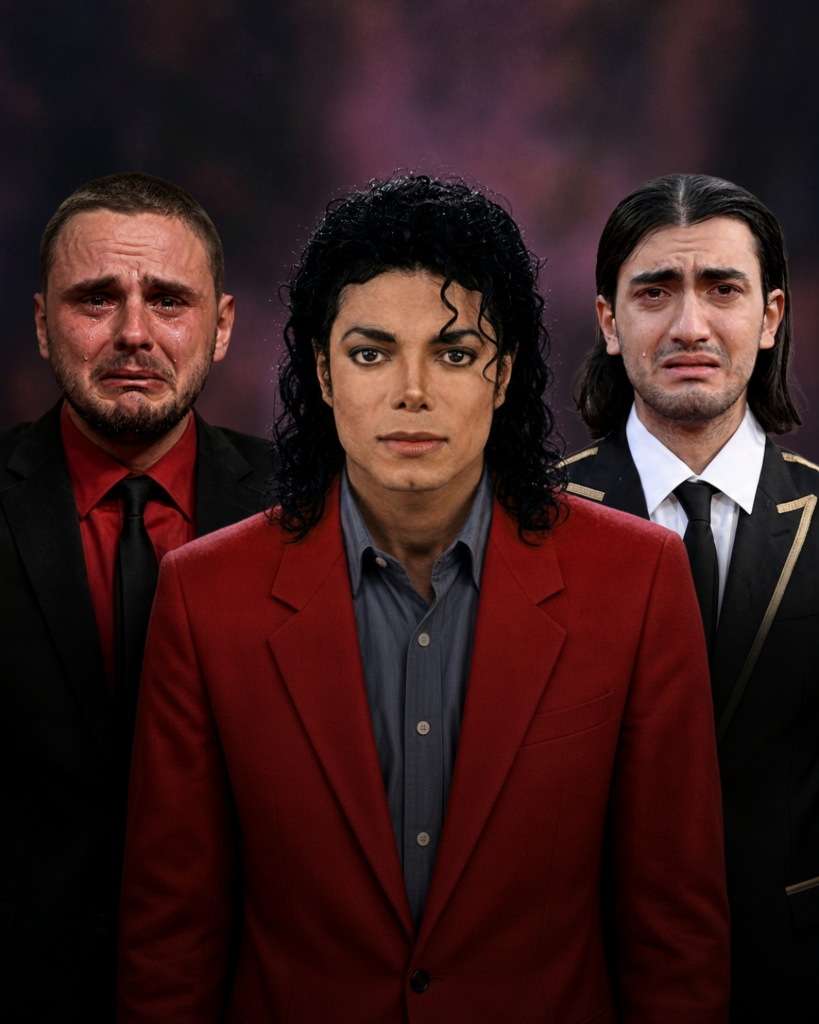
Prince vs Bigi Which Jackson Son Inherited Michael’s DNA.
And he used to say that whoever used this word more than the other person in a day got a candy or something like that.
So he taught me—he taught me, my brother, and my sister—all these words that normally, you know, not a lot of people use.
They grew up with their faces hidden behind black fabric inside a fairy-tale kingdom wrapped in extreme and suffocating protection.
The world out there called their father a legend, the King of Pop.
But to those three children, he was simply the man who shielded them from the storms.
And every time those veils appeared before the cameras, the entire world plunged into a frenzy of curiosity.
What on earth did the true faces hidden beneath that fateful black fabric actually look like?
People craved it.
People speculated, turning the faces of innocent children into the most expensive mystery on the planet.
Among the children who grew up beneath the colossal shadow of the King of Pop, Prince Michael Jackson Jr. has always carried a presence that most easily evokes the image of a true prince of the Jackson family.
Tall, with pitch-black hair, sharp facial features, and a composure strikingly serene before the camera, Prince stepped into the entertainment world not with ostentation, but with the quiet dignity of a man who knows exactly where he stands.
Yet what truly forces people to look at him with a different gaze is not his appearance, but how he confronts that dazzling spotlight—standing beneath the brightest stage lights, yet never letting the name Jackson swallow his core identity.
Born in 1997 as the sweet fruit of the marriage between Michael Jackson and nurse Debbie Rowe—a romance long picked apart by tabloid media as a cold, emotionless contract—Prince had to breathe in the suffocating atmosphere of pursuit from his earliest childhood days.
Every blink, every movement of his legendary father was instantly twisted into sensational headlines.
To protect his children from that ruthless matrix, Michael once chose to use masks and black fabrics to cover their faces whenever they stepped outside.
For a child like Prince, childhood did not mean carefree afternoons running under the sun, but survival behind the fortified walls of Neverland, enveloped in a world entirely detached from reality.
Yet when that fairy-tale kingdom collapsed and his legendary father departed in the fateful year of 2009—at a time when Prince was only a twelve-year-old boy—the world forced him to mature amidst excruciating agony.
“When my father died, my world collapsed. I didn’t just lose a father. I lost my whole sky,” Prince once choked out as he shared.
Instead of choosing to hide forever behind his father’s name or plunging into the music path in an attempt to replicate immortal moonwalks, Prince carved out a path of his own.
He does not hold a microphone, nor does he stand at the peak of the stage to endure rounds of applause.
Instead, he stepped back, choosing the perspective of a producer, a media professional, and a community activist.
Alongside his friend John Muto, Prince co-founded the Heal Los Angeles Foundation—a charitable organization carrying the breath and humanitarian spirit that Michael spent his whole life cultivating.
There he found a connection with the community, using his family’s influence to soothe unfortunate lives and continue the mission of healing the world that his father had once entrusted in every lyric.
The culmination of his journey in confronting that past came in 2026, when the official biographical film about the life of Michael Jackson premiered to the public.
Prince did not stand on the sidelines.
He directly stepped into the project as an executive producer, rolling up his sleeves at every stage to ensure the story of his father was told in the most authentic way possible.
Yet the haunting moment that pushed Prince’s emotions to their absolute limit did not take place on a lavish red carpet.
It was the first time he laid eyes on his cousin Jaafar Jackson transform into Michael Jackson on screen.
Jaafar and Prince once shared an intertwined childhood at the legendary Hayvenhurst home of the Jackson family, playing together and shooting innocent home videos.
Now, through sophisticated makeup, the signature curly hair, and perfectly recreated features, Jaafar emerged like a ghost stepping back from the realm of the dead.
Emotions pent up for so long erupted within Prince’s chest.
The psychological shock was so intense that he was forced to quietly step out into the cold expanse of the film studio to catch his breath.
The twelve-year-old child who once lost his father in agonizing pain was now standing in the blurred boundary between the present and the past, watching the silhouette of his departed father brought back to life in a way that was both painful and real.
In April 2026, in Berlin, Prince appeared on the red carpet in a dark suit highlighting a golden crown and a red armband—a silent declaration that he is here, carrying the full bloodline of the Jackson family and proudly safeguarding its soul.
Yet accompanying the light of fame is always the shadow of old, cynical suspicions.
As the name Prince Jackson flooded the headlines, ruthless questions about ancestry were rekindled from the dark.
People gossiped about Arnold Klein, the dermatologist who closely served Michael, or Mark Lester, the British actor claiming to be his godfather and sperm donor.
Not infrequently, malicious public opinion even wove baseless rumors that Michael was not the biological father of the children due to differences in physical appearance.
Yet Prince never wavered for a moment.
For him, the answer had been carved deep into his soul from the years of being held in that man’s arms, of being shielded behind childhood masks.
Michael Jackson is his father—everything most sacred.
No DNA test, no venomous rumor can ever replace a child’s memory of the unconditional love he once received.
It is precisely this steadfastness that has forged the Prince Jackson of today: calm, grounded, and self-possessed.
He is no longer the cowering boy hiding behind his father’s back, but has become a man ready to stand tall and tell the story of his own life.
If Prince Jackson is the embodiment of a prince stepping out with confidence beneath the dazzling spotlight, Bigi Jackson is a hazy, silent, and deeply mysterious realm on the other side of the valley of light.
Born in 2002 with the proud birth name Prince Michael Jackson II, the King of Pop’s youngest son was once known to the entire world by a much more fragile and haunting name: Blanket.
That name stemmed from one of Michael Jackson’s most controversial acts in 2002—draping a cloth blanket completely over the face of his newborn son while standing on a hotel balcony in Berlin before a wildly screaming crowd and media cameras.
In a world always poised to tear everything apart to satisfy its curiosity, Blanket was a treasure hidden behind the fortified walls of Neverland.
The tiny boy with flowing long hair and a face half hidden behind a thin layer of fabric became a haunting symbol of the tragedy of fame, where even the right to have a bare face exposed to the sun became a luxury.
Then the storm struck.
In 2009, when Michael Jackson breathed his last, the fairy-tale world instantly collapsed.
Blanket was then only seven years old—an age when a normal child should still be resting safely in their parents’ arms, innocently enjoying the world.
But for Blanket, that was the moment the door of innocence was permanently sealed shut.
The moment his legendary father passed away, the vast majority of his formative memories were left hanging in a lonely void without a satisfying explanation.
While Prince gradually stepped into the light to face the public, and Paris shone brightly as a model and singer, Bigi—the name he officially adopted in 2015 to escape the bitter childhood moniker—chose to sink deep into tranquility.
He chose absolute disappearance from the media.
It took many years for people to peer past that curtain of secrecy and realize that Bigi had never chosen to live in misery or resignation.
He nurtured a profound and pure love for cinema.
There was a strange and beautiful intersection between father and son.
While Michael Jackson spent his entire life standing in front of the lenses of millions to endure intense scrutiny, Bigi found safety standing behind it.
On a film discussion YouTube channel he once participated in alongside his older brother Prince and cousin Taj, Bigi displayed no ambition to become a silver-screen star or seek fame.
He was passionate about dissecting, analyzing, and appreciating every single frame and story through the lens of a true filmmaker.
Whispered anecdotes within the family circle claimed that Michael once remarked that his youngest son Bigi possessed the sharpest artistic mind in the household, always quietly observing everything around him with eyes far too mature for his age.
That was perhaps the most silent and delicate legacy gift the legendary father left behind in the soul of his youngest child—an artistic passion that required no applause.
And then that absolute silence was shattered in April 2026.
Bigi’s unexpected appearance alongside Prince at the premiere of the biographical film Michael in Berlin instantly sent shockwaves through the global media.
Not because he gave a speech or struck sharp poses before dozens of cameras, but because of the startling transformation wrought by time.
The boy Blanket, with his long, face-covering hair, had now transformed into a mature young man with neat short hair, sharp facial features, deep-set eyes, and a cold, irresistibly magnetic handsome look.
Standing side by side on the red carpet, the two Jackson brothers emerged as two completely contrasting poles of the same origin.
Prince was sharp, confident, and carried the demeanor of a man accustomed to interview podiums and stage lights.
Bigi remained quiet, reserved, exuding a more untamed and icy energy.
He did not try to pose or exchange polite smiles with the lenses.
It was precisely that proud indifference that made Bigi the epicenter of all curiosity.
Yet Bigi’s life has never ceased to be intertwined with the grand mysteries of the family, like an inescapable destiny.
The question of his biological origins—born from an anonymous surrogate mother who has never stepped into the light—has always been fertile ground for conspiracy theories.
There were persistent rumors claiming that Omer Bhatti, a Norwegian dancer who once lived at Neverland and shared a strangely close relationship with the Jackson family, to the point where Bhatti’s appearance looked identical to a clone of Michael, was actually his biological father or closely linked to Bigi.
People compared every single facial feature and profile angle, hopelessly searching for a bloodline connection, while the family chose absolute silence in the face of the public’s wildest speculations.
And amidst the eye of the storm of those external hypotheses, Bigi still chose to stay out of it.
He offered no clarifications, exposed no private life, and refused to turn his existence into the next chapter of a sensationalized novel about Michael Jackson.
Looking at Bigi Jackson today, the clearest truth is not whose genes he carries or whom he resembles biologically.
It is his fierce desire to write an entirely independent chapter of life with his own hands.
A cinephile.
A protector of privacy at all costs.
And a silhouette that never allows a father’s past to swallow his own present.
If Prince is the embodiment of composure and Bigi is a realm of mysterious tranquility, then Paris Jackson today is radiant, edgy, and fiercely feminine—a rose bearing scars that have never truly healed.
She stepped out into the world with a wild, fiercely independent ego.
A confident model striding across major international runways.
A familiar face to prestigious fashion houses.
An introspective actress and a singer carrying the free-spirited bohemian blood of an artist.
With her golden hair, mesmerizing deep blue eyes, and skin covered in artistic tattoos—including a small, nostalgic spoon tattoo commemorating her godfather Macaulay Culkin and her late father—Paris may not share many physical similarities with a young Michael Jackson.
But the radiant, fierce aura radiating from her could never be mistaken for anyone else in this world.
Yet behind that somewhat rebellious, free, and proud exterior lies a completely contrasting childhood memory, where black veils and suffocating masks once trapped her away from the endless prying eyes of the public.
Only for that eleven-year-old girl to be thrust into life amidst ruthless media scrutiny and endless debates over her bloodline when the golden cage collapsed following her father’s shocking passing in 2009.
In surprisingly candid and poignant shares about her years living at Neverland, Paris stripped away the fairy-tale facade that the public always imagined.
Contrary to the crowd’s perception that the three Jackson children were free to run wild and play to their heart’s content in the giant amusement park or private zoo whenever they pleased, the reality was suffocatingly strict.
Neverland was not their personal playground.
Those rides, roller coasters, and carousels were actually built primarily for underprivileged or terminally ill children invited from all over the world as a gesture of Michael’s charity.
For Paris, Prince, and Bigi, Neverland operated under ironclad rules.
They were homeschooled under strict discipline, with tightly limited time for television and entertainment.
Stepping out into the park or playing was not a natural privilege, but a rare reward granted only after they had successfully completed heavy academic assignments and household chores.
“My father was an amazing dad, but he was extremely strict when it came to our education and morals,” Paris once confided.
She admitted that if she had been allowed back then to run around the park like a normal child instead of being confined behind lessons and constant supervision, her life might have taken a much gentler turn.
Yet those strict rules at Neverland paled in comparison to the fateful shock of June 25th, 2009, when Michael Jackson took his final breath.
Paris was only an eleven-year-old girl—an age where the world should ideally revolve around games and innocence.
A month after that heart-wrenching pain, that eleven-year-old girl was forced to step onto the stage of a memorial service before millions of global viewers and a sea of weeping people.
That was not a scripted move.
In 2026, recalling that fateful moment, Paris shared that while everyone stood frozen in the backstage area waiting for someone to step up and say a few words to bid farewell to the legendary father, neither Prince nor Bigi could take a step forward because they were too overwhelmed by grief.
And in that helpless vacuum, little Paris stepped out into the lights all by herself.
No preparation.
No script.
No shelter.
Just an eleven-year-old child standing before a boundless sea of people, holding a microphone and choking out words that shattered the hearts of millions.
“Ever since I was born, Daddy has been the best father you could ever imagine. I just wanted to say I love him so much.”
Even years later, Paris has never dared to watch the video recording of that exact moment, because the psychological wound is far too deep and fragile to touch head-on.
The moment on stage that year also marked the dividing line that split her life into two halves.
On one side is Paris, a young woman yearning for a peaceful private life.
On the other is Paris Jackson, the involuntary symbol of public curiosity.
Few people know that in the moments before his passing, as Michael Jackson’s life drifted toward its weary and solitary final chapters, the man he entrusted to be the godfather of his beloved daughter Paris was none other than Macaulay Culkin—Hollywood’s former golden boy.
Having both grown up stripped away by the ruthless plunder of the spotlight, from a very young age they found in each other a silent language of kindred souls whose childhoods had been left behind.
Driven by that absolute understanding and unwavering trust, Michael entrusted a piece of his very flesh and blood to Culkin.
And that bond extends far beyond paperwork—etched permanently as an eternal symbol on their skin.
Later on, Paris Jackson and Macaulay Culkin decided to get matching tattoos of a small, meaningful spoon.
For Paris, it is not merely a piece of artistic ink on her body, but a quiet reminder of her late father, of the godfather whom Michael trusted and entrusted her to, and of a childhood that, despite its tempests, was always fully protected.
Amidst a cold and prying Hollywood, Macaulay Culkin has always remained there, quietly standing by Paris as the most vivid testimony to a promise of absolute trust delivered from the very final moments of the King of Pop’s life.
Paris’s resilience and independence are reflected not only in how she faces pain, but also in how she fiercely defends her father’s legacy.
When the biographical film Michael was being scripted, Paris was the first to openly criticize details she felt were untruthful or overly sugarcoated just to please the masses.
After reading the initial drafts and offering sharp feedback that was not fully heeded, she resolutely kept her distance from the project.
That action cements the most powerful truth about this young woman.
Paris does not need to please everyone, and she firmly protects her right to maintain a true, uncompromised perspective of her father, even when it goes against the wishes of Hollywood or her own family.
She does not need to copy Michael’s style to prove she carries Jackson blood.
Because in every proud gaze, in her spine-chilling bluntness, in the dense tattoos covering her body to honor her late father, and in a heart that dares to love and defy, Paris is the most radiant and authentic chapter continuing the story of the King of Pop.
Not by hiding in the shade of the past, but by walking proudly beneath her own sunlight.
Before the world grew consumed with debating how handsome Prince is, or how captivating Bigi’s gaze remains, before Paris began striding across international runways with the independent ego of a true artist, and before any of them could comprehend how the vast world out there operates, they were once merely three fragile mirrors, completely cradled within the embrace of Michael Jackson.
And Michael, with all the fierce extremity and heartache of a father who had suffered far too many wounds from the stage lights, chose to stand against the entire world to keep them safe from the vortex of public curiosity.
Looking back at old documentary footage of the Jackson family, people are forever haunted by a detail that feels like a scratch of time.
Michael appearing amidst the frantic, crushing sea of humanity, yet the delicate, tender faces beside him are entirely obscured.
A sheer veil.
A tightly fitted medical mask.
A lifeless piece of dark fabric.
Or the brim of a hat pulled down deep.
To outsiders, it was a degree of irrationality bordering on extremism.
But to Michael, it was the sole remaining shield to block prying eyes that hovered, ready to swallow his children whole.
He yearned for a simple thing that tore at his heart: to let his little ones breathe the peaceful air outside, to step naturally into a park or a grocery store like any other normal child, rather than being swarmed by hundreds of camera lenses and emotionless shouting voices.
Because of this, the memories shaping the childhood of Prince, Paris, and Bigi were not defined by carefree smiles under the sun, but by lonely layers of face-covering fabric.
They grew accustomed to hiding behind those masks long before the world ever caught a genuine glimpse of the true faces of the Jackson children.
Then the most terrifying storm struck in 2009.
Michael passed away.
That formidable protective shield instantly vanished into thin air.
The three children were abruptly hurled out into the blinding, merciless light of a world their father had spent his entire life trying to conceal from them.
Prince was barely twelve years old.
Paris had just turned eleven.
And Bigi was only a bewildered seven-year-old boy, not yet old enough to comprehend the concept of eternal farewell.
That is an age when a normal child should only have to worry about school notebooks or carefree afternoon play.
Yet the three siblings were forced to learn how to stand firm in a vast, hollow world when their greatest anchor—the most powerful and famous man on the planet—was gone forever.
It was precisely within that precarious void that the pieces of a real father gradually emerged through Paris’s recollections.
To the world, he was the King of Pop, with immortal records.
But to them, he was simply Dad.
The one who lulled them to sleep with whispered stories behind locked doors.
The one who existed fully and warmly behind the dazzling stage lights.
The one whose gentle voice still echoes persistently in the minds of his orphan children.
That heart-wrenching contrast explains why the moment Prince stood on the set of the biographical film Michael, watching Jaafar recreate his father’s image right before his eyes, became an overwhelming emotional shock.
He was not just looking at an actor performing.
He was confronting the man who had left him behind before his childhood could even take shape.
And perhaps that very deep-seated cut of loss carved out three completely distinct paths for the three siblings to survive within the colossal legacy of the family.
Prince chose to step closer to the limelight, to shoulder the soul of the legacy.
Paris chose to raise her voice, fierce and uncompromising, against prejudice.
While Bigi chose to retreat deep into absolute tranquility, enclosing himself behind cinematic frames.
No path is right or wrong.
They were simply three different ways for three human beings to carry an overwhelming grief and keep moving forward.
Yet ironically, when the pain of losing their father had yet to subside, another anguish named doubt continued to haunt them.
The internet has never spared the Jackson children from the cruel question: is Michael Jackson truly their biological father?
It remains the ugliest blind spot fabricated by the crowd out of ruthless curiosity.
From baseless speculations surrounding dermatologist Arnold Klein, to the unilateral claims of British actor Mark Lester regarding Paris’s bloodline, to the forced label of the “fourth son” thrust upon Omer Bhatti, the narrative sank deep into a tangled matrix of old photo angles and sensational conspiracy theories.
Yet the reactions of the three children delivered a fatal blow to the skeptics.
Prince brushed it aside to march forward proudly.
Paris fiercely defended her absolute faith in the father she worshipped.
Bigi chose absolute silence, viewing all the external storms as mere petty background noise unworthy of a second thought.
For no matter how many millions of old photos people zoom in on, or how many DNA analysis videos are manufactured, no outsider can ever answer for them.
Who was the one that patiently fed them spoonful by spoonful?
Who was the one that sheltered them behind veils against life’s tempests?
The scientific debate over DNA has never held enough weight to invalidate the reality of a home that truly existed in flesh and blood.
Time spun on, guiding the three children of yesterday to the threshold of adulthood.
Prince is steadily becoming the guardian of the legacy.
Bigi makes rare appearances, yet every time he surfaces, he carries the cool, self-contained aura of an independent filmmaker.
While Paris carves her path through the art world with a radiant, edgy persona resembling a fiery rose.
All the chatter comparing who is more handsome, or who possesses a more captivating gaze, or who resembles the father more, has suddenly become meaningless.
Because rising above every critique of appearance is a heartbreaking yet proud truth.
All three were once the most carefully hidden children on the planet, only for them, when that golden cage collapsed, to turn those scars into the launching pads for their own lives.
Nearly two decades have passed, filled with storms and skepticism.
Yet the final answer still rests entirely within their chests.
Science can argue over DNA, and the world can judge a legacy.
But the sensation of curling up inside the King of Pop’s embrace, hearing him whisper “I love you,” and being nurtured by a love that was extreme yet pure—that remains an exclusive, permanent birthright belonging to Prince, Paris, and Bigi.
A profound bond of love that no media trial or DNA test in this world could ever strip away.









