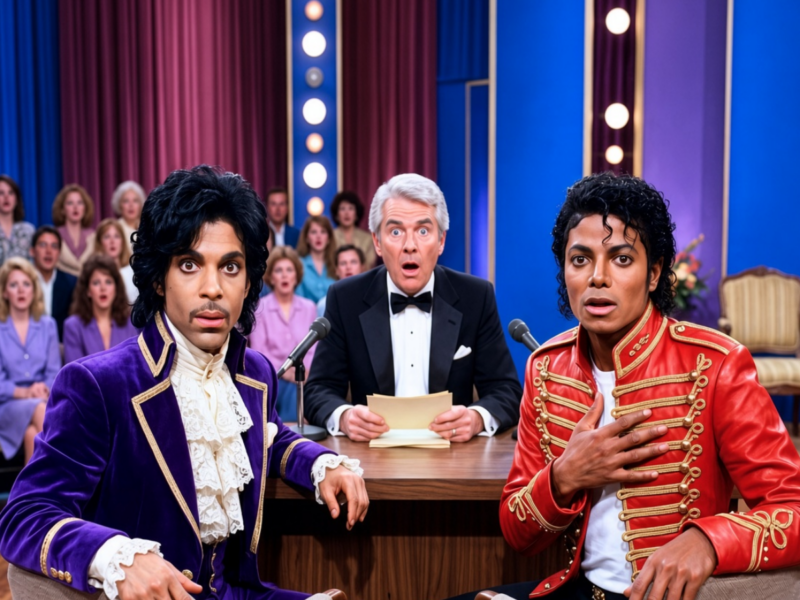
Prince Refused To Let Michael Jackson’s Silence Slide On Live TV — What Happened Next Made History.
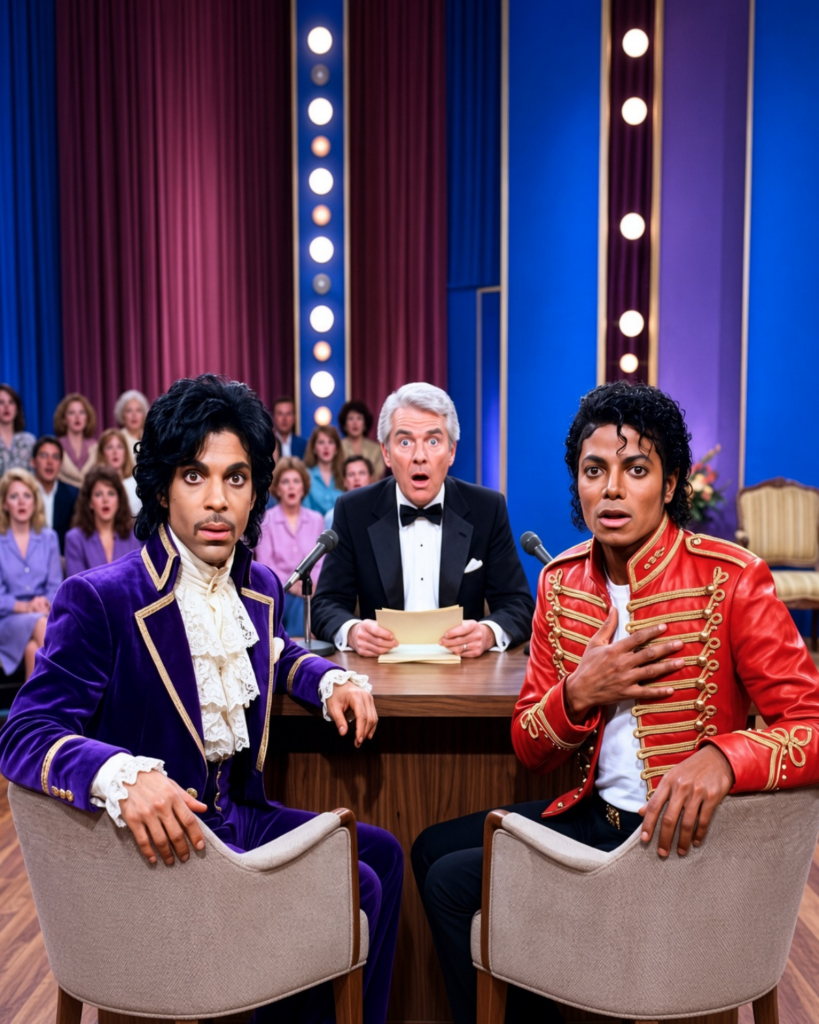
On March 14, 1984, at 9 in the morning inside Studio 22 at CBS Television City in Los Angeles, Prince Rogers Nelson and Michael Jackson were both 25 years old.
Both were entirely unaware they were about to share a couch on live television, and both were about to have the strangest 20 minutes of their careers in front of 400 witnesses.
The stage lights had been up since 7.
The floor crew had chalked their marks.
The studio audience, dressed as if for a wedding, would not be seated for another 10 hours.
And in two separate dressing rooms on opposite corridors of the same building, two men who had been engineered into rivals by an industry neither of them controlled were at the exact same time going over the wrong set of notes for the night that was coming.
Michael arrived first, a little after 8.
He came the way he always came: quiet, polite, no entourage beyond a small security detail, dressed down for rehearsal in a simple button-down shirt with the collar open.
He nodded at crew members.
He thanked people softly when they held doors or brought him water.
There was that careful, practiced quality to everything he did in public now.
A politeness that never cracked, the politeness of a man who had spent his entire childhood on cameras and had learned before most children learn to ride a bicycle that every gesture was going to be scored by somebody.
He found his dressing room.
He sat down at the small vanity table.
He opened his notes for the evening the way another man might open a hymnal.
Frank DiLeo, his manager, stuck his head into the dressing room at 9:30.
“You ready for tonight?”
“I think so,” Michael said. “Ted’s got some good questions lined up about the album.”
“Good,” Frank said.
Then he hesitated in the doorway a beat longer than he needed to.
Michael looked up, noticing the pause.
“Something wrong?”
“Nothing’s wrong,” Frank said. “Just wanted to check in. You know how these variety specials can get. Producers always trying to add something at the last minute for extra excitement.”
Michael’s brow furrowed slightly.
“They planning to add something to my segment?”
“Nothing’s confirmed,” Frank said, in the careful voice of a man who had been in management long enough to know that “nothing’s confirmed” was almost always the exact sentence you used when something had already been decided in a room you were not in.
Prince arrived at 10:00.
He came the way he always came: quiet, no entourage either, a single assistant named Renee walking a respectful two paces behind him and a black guitar case slung over his own right shoulder like it was luggage.
He had been up until 4 in the morning at Sunset Sound working on the Purple Rain material, which nobody in the country yet knew existed and which would in a matter of months redraw the map of the industry beneath his feet.
There was a restless, coiled energy to him that morning, the particular tension of a man who knows he is about to change everything but cannot say so publicly yet.
He wore a rich royal purple velvet suit jacket with narrow satin lapels worn open over a crisp white lace shirt with a voluminous ruffled jabot that broke across the front of his chest, and matching royal purple tailored trousers over black Cuban-heeled ankle boots.
He wore dark aviator sunglasses inside.
He walked into the studio, gave a small nod to a few people he recognized, found his dressing room, and set the guitar case down against the wall like a companion.
Fifteen minutes later, a producer knocked on Prince’s door and told him about the joint segment.
Prince considered this for a long moment, sitting quietly with the guitar case still leaning where he had placed it.
“Fine,” he said finally.
That was it.
One word.
That was usually all you got out of him when he was thinking about something bigger than what had actually been asked.
Renee lingered in the doorway.
“You sure? They didn’t ask if this was something you wanted.”
“Exactly. They rarely do,” Prince said without any particular bitterness. “Fine either way. Could be interesting.”
“You think it’ll be uncomfortable sharing a segment with him? People keep writing about you two like it’s some kind of showdown waiting to happen.”
Prince considered this.
“People love writing that story. Doesn’t mean it’s true. We’ll see what actually happens when we’re both sitting there.”
Nobody warned Michael the same way.
He found out roughly 20 minutes before the taping when a producer named Gary Weiss caught him backstage and said, almost in passing, “Oh, and by the way, we’re adding Prince to your segment tonight. Should be great TV.”
Michael blinked once.
“Nobody told me that.”
“It’s a good surprise,” Gary said, already walking away with the practiced side-step of a producer who knows he has just dropped something big and does not want to stick around for the reaction. “Trust me, audience is going to love it.”
Michael stood there a second.
His rehearsed answers were suddenly useless in his head.
He turned to Frank DiLeo, who had been standing nearby.
“You knew about this.”
“I heard rumors,” Frank admitted. “Wasn’t sure it was actually happening until just now. I’m sorry, Michael. I should have pushed harder.”
Michael’s expression stayed composed on the surface, but something had shifted underneath it.
He had planned a whole conversation about his own work, his own year, the thing he had built with his own hands and his own voice.
Now he was sharing his segment—his segment, the one thing that was supposed to be entirely his that night—with the one artist the entire industry kept insisting was his rival.
And nobody had bothered asking if that was all right with him.
He did not say anything else about it.
He tucked it away the way he had learned to tuck away a hundred things over the years.
And he went to have his hair checked one more time.
The taping started at 7.
Four hundred people in dress clothes filled the studio, and there was that particular buzz a live audience carries when it knows something good is about to happen.
Ted Larson, the smooth-talking variety show veteran who was hosting, opened with a monologue that landed fine.
Nothing special, just enough to warm the room.
Michael came out first.
The crowd came up out of their seats before he had said a word.
He performed a stripped-down version of “Human Nature,” the room going completely silent for the quiet parts, then erupting for the chorus.
He sat down with Ted afterwards, easy and warm, talking about the writing process behind Thriller, about the year, about the pressure of following up something that already lived in the record books.
“Does it ever feel like too much weight?” Ted asked.
Michael considered the question seriously.
“Sometimes. I try not to think about it that way. If you spend all your time trying to top yourself, you lose sight of just making something you genuinely believe in. That’s always been the real goal—not the numbers, not the records broken, just making something true.”
It was easy.
It was warm.
It was exactly the segment Michael had planned.
Then Ted glanced down at his cards and something in his face shifted.
A small producer’s smile crept in.
“Michael, we’ve got a surprise for you tonight. I think you’re going to like this one.”
Michael’s smile did not move.
But something behind his eyes did.
He already knew what was coming.
He just had not decided yet how he felt about it.
“Well, now you’ve got me curious,” he said, keeping his voice light.
“Ladies and gentlemen—Prince.”
The curtain opened, and the sound that came out of that crowd was a different animal entirely.
Louder, sharper, the kind of noise a room makes when it truly cannot believe what it is seeing with its own eyes.
Prince walked out with that unhurried, deliberate stride of his, gave the crowd a small nod, shook Ted’s hand, and turned toward the couch where Michael sat.
He put his hand out.
Michael looked at it.
He did not take it right away.
He looked at that hand for a second, then two, long enough that if you were watching close, you would know something was happening.
Then he folded his hands in his lap, turned his head toward Ted with the same easy smile still stuck on his face, and acted like nothing at all had happened.
Prince’s hand hung there in the air.
One second, two.
Then he pulled it back, no change in his face, and sat down in the open chair like it was nothing.
Most of the audience missed it.
The front two rows saw it.
Ted saw it, his grin flickering just barely before he smoothed it back over.
Backstage watching on a monitor, Frank DiLeo felt his stomach drop.
He turned to a handler standing nearby.
“Did you see that?”
“Saw it,” the handler said quietly. “This might get interesting.”
Ted recovered fast.
“Well, folks, we’ve got two of the biggest names in music sitting right here together.”
The audience clapped, grateful for the redirect.
“Michael, you built your career on total precision. Prince, from what I understand, you play nearly every instrument on your records yourself. What do you think the real difference is?”
“Couldn’t be more different,” Michael said.
And his voice was still soft, but there was a small edge under it now.
“In some ways,” Prince said evenly. “Maybe not in others.”
Michael’s eyes cut toward him.
“You do everything yourself, and everybody decides that means you’re an untouchable genius nobody can question. I build something with a whole team of talented people, and somehow that gets read as me needing help. Like the vision isn’t really mine. And I don’t think Prince here has ever had to answer for that particular assumption.”
Prince sat with that for one beat.
“You’re not wrong that it gets read different. I won’t argue that.”
“Well, I appreciate you not arguing with something so plain to see.”
The audience laughed.
“Can I ask you something?” Prince said.
“Go right ahead.”
“You didn’t shake my hand a minute ago.”
The studio went quiet fast.
Michael’s smile held steady, but something flickered behind his eyes.
“I suppose I didn’t.”
“Any particular reason?” Prince asked.
His voice carried no accusation, just plain curiosity.
Michael took a breath.
“Honestly, there’s a whole narrative that’s been built around the two of us for years. This idea that we’re locked in some kind of competition, that only one of us can be the real innovator. And sometimes I just decide I’m not playing along with that expectation. Nothing personal against you. More a general rule.”
A low murmur rolled through the crowd.
Nobody had expected that kind of honesty on live television.
“That’s a fair rule to hold on to,” Prince said. “But I’d push back on one piece of it.”
“Which piece?”
“That I walked over here trying to prove something about that competition. I put my hand out because that’s just what a person does when they meet somebody. Wasn’t looking for more than that.”
Michael studied him a long moment.
“Maybe. But you’ve got to understand, every time we’ve been in the same room, the same magazine, the same conversation, there’s an assumption riding along underneath it. Whether either of us means it that way or not.”
“What assumption do you figure I was making?” Prince asked.
“That we just fall into whatever role the press has already written for us. That I’d smile, shake your hand, play nice for the cameras, because that’s what’s expected of two men who’ve been told for years we’re supposed to be fighting over the same crown.”
Prince nodded slowly.
No defensiveness in it.
“I understand that history’s shaped a lot of how you move through a room like this. But I think you might be reading something into a handshake that wasn’t actually there.”
“Maybe,” Michael said. “Or maybe you’ve just never had to think about what it means when the whole world’s already decided you’re somebody’s rival before you’ve said a single word to them.”
The studio had gone quieter than it had been all night.
Ted tried to smooth things back over.
“I think what’s interesting here is that both of—”
Ted, Michael cut in, not unkind, but firm.
“I want to hear what he’s got to say. If he’s got something real to say.”
Ted glanced up toward the control booth.
No signal came telling him to cut away.
Prince considered his answer carefully.
“You’re right that I’ve never had to think about a handshake the way you’re describing. Never had to calculate whether a simple gesture was carrying more weight than I meant it to. That’s a real blind spot on my part. I appreciate you calling it out plain instead of just quietly resenting me for it.”
Michael’s expression softened, though he stayed guarded.
“That’s more sense than I expected, honestly.”
“Doesn’t mean I’ve got it all figured,” Prince said. “Just means I’m willing to think about what you’re saying instead of getting my back up over it.”
“Most people get their back up,” Michael said.
He laughed.
A real, surprised sound.
“Well, I’ll give you that much. Most people in your position would have made this whole thing about their own hurt feelings the second I didn’t shake their hand—gotten sulky, made a scene.”
Ted leaned in, sensing the tension had shifted into something real and worth chasing.
“Michael, has anything about this conversation changed how you’re seeing the moment from earlier?”
Michael considered it seriously.
“Yeah. I came in tonight ready for my own conversation, my own segment—the thing I’d planned and prepared for. Then they slid another big name into it without so much as a heads-up, and some part of me reacted before I even had time to think it through proper.”
“That’s a completely understandable reaction,” Prince said. “I’d probably have felt something close to the same in your shoes.”
“Would you have refused a handshake, though?” Michael asked, a small testing smile back on his face now.
Prince thought about it honestly.
“Probably not. But that’s likely because I’ve never had the entire industry pit me against somebody I never asked to be pitted against. Not the way they’ve done with you and me. That’s a specific kind of pressure I don’t think I fully understood until right now.”
The audience, sensing the tension breaking into something warmer, started to relax.
“Do you think people in this business consider what it’s actually like being on the receiving end of a manufactured rivalry?” Michael asked.
“If I’m being straight with you,” Prince said, “I’d have counted myself in that group at least until about 10 minutes ago. I’ve been so busy trying to build my own thing that I never stopped to think about how it might feel from your side.”
Michael laughed again, warmer this time.
“That’s more honesty than I usually get out of an interview like this.”
Ted decided to push it further.
“Prince, have you ever had to fight for something similar?”
“I spent years getting written off as too strange,” Prince said. “Somebody who’d never cross over the way he did. Took a long while before people stopped treating my whole sound like some kind of novelty act.”
“That’s not so different from what I went through,” Michael said.
Real surprise in his voice.
“Different image,” Prince said. “Similar assumption. Doesn’t make it equal. Your position carries pressure. Mine never has.”
Michael nodded.
“That might be the most honest thing anybody’s said to me on a show like this in years.”
“Can I ask you something now?” Prince said.
“If I put my hand out again right now, would you take it?”
Michael took a long breath, and the whole studio audience seemed to hold theirs right along with him.
“I think I would. Not because I feel obligated to now, but because you actually listened instead of getting defensive. That’s rare enough that it deserves a real response instead of a symbolic one.”
Prince put his hand out again.
The same gesture, completely different weight behind it now.
Michael reached out and shook it firm.
Every trace of the earlier hesitation gone.
The audience came up out of their seats.
That particular roar that happens when a room understands something true has just been settled between two people.
Not through some forced apology, but through actual honest talk that both of them had been willing to sit through.
Ted looked into the camera, visibly moved.
“Ladies and gentlemen, I have been doing this job a long time, and I don’t think I’ve ever seen anything quite like what just happened on this couch.”
The segment ran on for a few more minutes.
Michael asked Prince about his songwriting process, real curiosity in his voice now instead of just filling airtime.
Prince asked Michael about the choreography.
They talked about their earliest memories in music.
Michael described rehearsing in the living room in Gary, Indiana, with his brothers.
Prince talked about Minneapolis and learning piano from his father and the strange isolation of feeling different from everybody around him musically and otherwise.
“Sounds like we both found something in music we couldn’t quite find anywhere else,” Michael observed.
“I think that’s true for a lot of people who end up doing this for a living.”
Backstage after the taping wrapped, Michael found Prince near the exit before either of them headed home.
Frank DiLeo and Renee both hovered a respectful distance away, watching their clients with expressions somewhere between relief and lingering curiosity.
“I mean it,” Michael said. “What you did in there—actually asking instead of getting your back up—that’s rare.”
“Figured the truth was worth more than a comfortable silence,” Prince said.
“I owe you a proper apology, separate from all that camera talk. Wasn’t entirely fair of me, making you the target of years of built-up frustration.”
“Don’t need an apology,” Prince said. “What you said mattered.”
They stood together a moment in the quiet hallway.
“We ought to actually talk again sometime,” Michael said. “Not on camera.”
“I’d like that,” Prince said.
They shook hands one more time before parting for the night.
The gesture carrying a completely different weight than the moment from the start of the evening.
The broadcast became one of the most talked-about moments on television that whole spring.
Most of the early headlines only caught the surface of it.
“Jackson’s Cold Shoulder.”
“Prince Confronts Pop Icon.”
Missing the deeper conversation that had played out once that first moment passed.
A few weeks later, a reporter asked Michael about it straight out.
“People think I was cold to him. Maybe I was in the moment, but he didn’t let it just sit there and rot. And he didn’t get defensive about it either. He asked me plain why I’d done it. Then he actually sat there and listened to the answer instead of arguing with it. That’s rarer than folks think.”
Prince, asked separately for a music industry publication, kept his answer short.
“Sometimes the respectful thing isn’t pretending everything’s fine. Sometimes it’s asking a straight question and being willing to hear whatever comes back.”
Two years later, at an industry awards reception, Michael and Prince ended up seated near one another.
Michael brought up their exchange directly.
“I’ve thought about that night plenty. It actually changed some things about how I handle press comparisons now. Used to feel like every article comparing us was somehow diminishing what I’d built myself. Took that whole uncomfortable exchange to learn that lesson properly.”
Prince smiled.
“I’m glad something useful came from it beyond the initial discomfort.”
“Wouldn’t have gotten to that realization without you saying something honest enough to make me think differently.”
Years later, Michael brought up that night in his own reflections on the business.
“People ask me about all sorts of nights over the years, but that night with Prince sits with me different. Wasn’t about the entertainment of it. It was about a man actually sitting with something uncomfortable instead of waving it off. And that gave me a little more hope about this whole business than I walked in there with that night.”
Prince, in a rare extended interview years afterward, offered his own.
“Everybody wanted us to hate each other. Built up this whole narrative before either of us had said a single word to the other. That night taught me you don’t have to accept the story somebody else writes for you. Even when the whole world’s already decided what that story should be.”
Ted Larson referenced the evening frequently for the rest of his broadcasting career.
“Most segments follow predictable patterns, but that night with Michael and Prince reminded me why live television mattered. Both of them chose honesty over comfort at every turning point where they could have retreated into safer territory. Instead, they kept pushing towards something real.”
Frank DiLeo, in a memoir years later, wrote that of every professional day he had spent with Michael, that particular evening was the one he thought about most—because it was the only one he had witnessed in which Michael Jackson had walked in with a rehearsed answer and walked out with a real one.
Renee, Prince’s assistant, gave one interview in which she described the drive back to the hotel.
“He was quiet the whole way. Not upset, just thinking. When we got to the lobby, he stopped in front of the elevators and he said one sentence. He said, ‘I like him.’ Then he went up.”
That was the last thing said about the evening in her presence.
And as far as she knew, the last thing Prince ever said about Michael Jackson that a stranger ever heard.









